10-Q: Quarterly report pursuant to Section 13 or 15(d)
Published on April 29, 2022
UNITED STATES
SECURITIES AND EXCHANGE COMMISSION
Washington, D.C. 20549
FORM 10-Q
(Mark One)
EXCHANGE ACT OF 1934
For the Quarterly Period Ended March 31, 2022
or
EXCHANGE ACT OF 1934
For the transition period from to
Commission file number:
Exact name of registrant as specified in its charter:
State or other jurisdiction of incorporation or organization:
IRS Employer Identification No.:
Address of principal executive offices:
Bank of America Corporate Center
Registrant’s telephone number, including area code:
(704 ) 386-5681
Former name, former address and former fiscal year, if changed since last report:
Securities registered pursuant to Section 12(b) of the Act:
| Title of each class | Trading Symbol(s) | Name of each exchange on which registered | ||||||
| of Floating Rate Non-Cumulative Preferred Stock, Series E | ||||||||
| of 6.000% Non-Cumulative Preferred Stock, Series GG | ||||||||
| of 5.875% Non-Cumulative Preferred Stock, Series HH | ||||||||
| of Bank of America Corporation Floating Rate | ||||||||
| Non-Cumulative Preferred Stock, Series 1 | ||||||||
| Title of each class | Trading Symbol(s) | Name of each exchange on which registered | ||||||
| of Bank of America Corporation Floating Rate | ||||||||
| Non-Cumulative Preferred Stock, Series 2 | ||||||||
| of Bank of America Corporation Floating Rate | ||||||||
| Non-Cumulative Preferred Stock, Series 4 | ||||||||
| of Bank of America Corporation Floating Rate | ||||||||
| Non-Cumulative Preferred Stock, Series 5 | ||||||||
| Trust XIII (and the guarantee related thereto) | ||||||||
| of BAC Capital Trust XIV (and the guarantee related thereto) | ||||||||
| Bank of America Corporation | ||||||||
| November 28, 2031 of BofA Finance LLC (and the guarantee | ||||||||
| of the Registrant with respect thereto) | ||||||||
| 5.375% Non-Cumulative Preferred Stock, Series KK | ||||||||
| of 5.000% Non-Cumulative Preferred Stock, Series LL | ||||||||
| 4.375% Non-Cumulative Preferred Stock, Series NN | ||||||||
| 4.125% Non-Cumulative Preferred Stock, Series PP | ||||||||
| 4.250% Non-Cumulative Preferred Stock, Series QQ | ||||||||
| of 4.750% Non-Cumulative Preferred Stock, Series SS | ||||||||
Indicate by check mark whether the registrant (1) has filed all reports required to be filed by Section 13 or 15(d) of the Securities Exchange Act of 1934 during the preceding 12 months (or for such shorter period that the registrant was required to file such reports), and (2) has been subject to such filing requirements for the past 90 days.
Indicate by check mark whether the registrant has submitted electronically every Interactive Data File required to be submitted pursuant to Rule 405 of Regulation S-T (§ 232.405 of this chapter) during the preceding 12 months (or for such shorter period that the registrant was required to submit such files).
Indicate by check mark whether the registrant is a large accelerated filer, an accelerated filer, a non-accelerated filer, a smaller reporting company, or an emerging growth company. See the definitions of “large accelerated filer,” “accelerated filer,” “smaller reporting company,” and “emerging growth company” in Rule 12b-2 of the Exchange Act.
| ☑ | Accelerated filer | ☐ | Non-accelerated filer | ☐ | Smaller reporting company | |||||||||||||||||||||||||||
Emerging growth company ☐
If an emerging growth company, indicate by check mark if the registrant has elected not to use the extended transition period for complying with any new or revised financial accounting standards provided pursuant to Section 13(a) of the Exchange Act. ☐
Indicate by check mark whether the registrant is a shell company (as defined in Exchange Act Rule 12b-2).
Yes ☐ No ☑
On April 28, 2022, there were 8,056,881,363 shares of Bank of America Corporation Common Stock outstanding.
Bank of America Corporation and Subsidiaries
March 31, 2022
Form 10-Q
INDEX
Part I. Financial Information
| Item 1. Financial Statements | Page | |||||||
Note 5 – Outstanding Loans and Leases and Allowance for Credit Losses |
||||||||
Item 2. Management’s Discussion and Analysis of Financial Condition and Results of Operations |
||||||||
1 Bank of America
|
||||||||
Part II. Other Information
Item 5. Other Information |
||||||||
Item 2. Management’s Discussion and Analysis of Financial Condition and Results of Operations
Bank of America Corporation (the “Corporation”) and its management may make certain statements that constitute “forward-looking statements” within the meaning of the Private Securities Litigation Reform Act of 1995. These statements can be identified by the fact that they do not relate strictly to historical or current facts. Forward-looking statements often use words such as “anticipates,” “targets,” “expects,” “hopes,” “estimates,” “intends,” “plans,” “goals,” “believes,” “continue” and other similar expressions or future or conditional verbs such as “will,” “may,” “might,” “should,” “would” and “could.” Forward-looking statements represent the Corporation’s current expectations, plans or forecasts of its future results, revenues, provision for credit losses, expenses, efficiency ratio, capital measures, strategy, and future business and economic conditions more generally, and other future matters. These statements are not guarantees of future results or performance and involve certain known and unknown risks, uncertainties and assumptions that are difficult to predict and are often beyond the Corporation’s control. Actual outcomes and results may differ materially from those expressed in, or implied by, any of these forward-looking statements.
You should not place undue reliance on any forward-looking statement and should consider the following uncertainties and risks, as well as the risks and uncertainties more fully discussed under Item 1A. Risk Factors of the Corporation’s 2021 Annual Report on Form 10-K and in any of the Corporation’s subsequent Securities and Exchange Commission filings: the Corporation’s potential judgments, orders, settlements, penalties, fines and reputational damage resulting from pending or future litigation and regulatory investigations, proceedings and enforcement actions, including as a result of our participation in and execution of government programs related to the Coronavirus Disease 2019 (COVID-19) pandemic, such as the processing of unemployment benefits for California and certain other states; the possibility that the Corporation's future liabilities may be in excess of its recorded liability and estimated range of possible loss for litigation, and regulatory and government actions; the possibility that the Corporation could face increased claims from one or more parties involved in mortgage securitizations; the Corporation's ability to resolve representations and warranties repurchase and related claims; the risks related to the discontinuation of the London Interbank Offered Rate and other reference rates, including increased expenses and litigation and the effectiveness of hedging strategies; uncertainties about the financial stability and growth rates of non-U.S. jurisdictions, the risk that those jurisdictions may face difficulties servicing their sovereign debt, and related stresses on financial markets, currencies and trade, and the Corporation’s exposures to such risks, including direct, indirect and operational; the impact of U.S.
and global interest rates, inflation, currency exchange rates, economic conditions, trade policies and tensions, including tariffs, and potential geopolitical instability; the impact of the interest rate and inflationary environment on the Corporation’s business, financial condition and results of operations; the possibility that future credit losses may be higher than currently expected due to changes in economic assumptions, customer behavior, adverse
developments with respect to U.S. or global economic conditions and other uncertainties, including the impact of supply chain disruptions, inflationary pressures and labor shortages on the economic recovery and our business; potential losses related to the Corporation’s concentration of credit risk; the Corporation's ability to achieve its expense targets and expectations regarding revenue, net interest income, provision for credit losses, net charge-offs, effective tax rate, loan growth or other projections; adverse changes to the Corporation’s credit ratings from the major credit rating agencies; an inability to access capital markets or maintain deposits or borrowing costs; estimates of the fair value and other accounting values, subject to impairment assessments, of certain of the Corporation’s assets and liabilities; the estimated or actual impact of changes in accounting standards or assumptions in applying those standards; uncertainty regarding the content, timing and impact of regulatory capital and liquidity requirements; the impact of adverse changes to total loss-absorbing capacity requirements, stress capital buffer requirements and/or global systemically important bank surcharges; the potential impact of actions of the Board of Governors of the Federal Reserve System on the Corporation’s capital plans; the effect of changes in or interpretations of income tax laws and regulations; the impact of implementation and compliance with U.S. and international laws, regulations and regulatory interpretations, including, but not limited to, recovery and resolution planning requirements, Federal Deposit Insurance Corporation assessments, the Volcker Rule, fiduciary standards, derivatives regulations and the Coronavirus Aid, Relief, and Economic Security Act and any similar or related rules and regulations; a failure or disruption in or breach of the Corporation’s operational or security systems or infrastructure, or those of third parties, including as a result of cyberattacks or campaigns; the risks related to the transition and physical impacts of climate change; our ability to achieve environmental, social and governance goals and commitments or the impact of any changes in the Corporation’s sustainability strategy or commitments generally; the impact of any future federal government shutdown and uncertainty regarding the federal government’s debt limit or changes in fiscal, monetary or regulatory policy; the emergence of widespread health emergencies or pandemics, including the magnitude and duration of the COVID-19 pandemic and its impact on the U.S. and/or global financial market conditions and our business, results of operations, financial condition and prospects; the impact of
Bank of America 2
|
||||||||
natural disasters, extreme weather events, military conflict (including the Russia/Ukraine conflict and potential geopolitical consequences), terrorism or other geopolitical events; and other matters.
Forward-looking statements speak only as of the date they are made, and the Corporation undertakes no obligation to update any forward-looking statement to reflect the impact of circumstances or events that arise after the date the forward-looking statement was made.
Notes to the Consolidated Financial Statements referred to in Management’s Discussion and Analysis of Financial Condition and Results of Operations (MD&A) are incorporated by reference into the MD&A. Certain prior-period amounts have been reclassified to conform to current-period presentation. Throughout the MD&A, the Corporation uses certain acronyms and abbreviations which are defined in the Glossary.
Executive Summary
Business Overview
The Corporation is a Delaware corporation, a bank holding company (BHC) and a financial holding company. When used in this report, “the Corporation,” “we,” “us” and “our” may refer to Bank of America Corporation individually, Bank of America Corporation and its subsidiaries, or certain of Bank of America Corporation’s subsidiaries or affiliates. Our principal executive offices are located in Charlotte, North Carolina. Through our various bank and nonbank subsidiaries throughout the U.S. and in international markets, we provide a diversified range of banking and nonbank financial services and products through four business segments: Consumer Banking, Global Wealth & Investment Management (GWIM), Global Banking and Global Markets, with the remaining operations recorded in All Other. We operate our banking activities primarily under the Bank of America, National Association (Bank of America, N.A. or BANA) charter. At March 31, 2022, the Corporation had $3.2 trillion in assets and a headcount of approximately 208,000 employees.
As of March 31, 2022, we served clients through operations across the U.S., its territories and approximately 35 countries. Our retail banking footprint covers all major markets in the U.S., and we serve approximately 67 million consumer and small business clients with approximately 4,100 retail financial centers, approximately 16,000 ATMs, and leading digital banking platforms (www.bankofamerica.com) with approximately 42 million active users, including approximately 34 million active mobile users. We offer industry-leading support to approximately three million small business households. Our GWIM businesses, with client balances of $3.7 trillion, provide tailored solutions to meet client needs through a full set of investment management, brokerage, banking, trust and retirement products. We are a global leader in corporate and investment banking and trading across a broad range of asset classes serving corporations, governments, institutions and individuals around the world.
The Corporation’s website is www.bankofamerica.com, and the Investor Relations portion of our website is https://investor.bankofamerica.com. We use our website to distribute company information, including as a means of disclosing
material, non-public information and for complying with our disclosure obligations under Regulation FD. We routinely post and make accessible financial and other information, including environmental, social and governance (ESG) information, regarding the Corporation on our website. Investors should monitor the Investor Relations portion of our website, in addition to our press releases, U.S. Securities and Exchange Commission (SEC) filings, public conference calls and webcasts. Notwithstanding the foregoing, the information contained on our website as referenced in this paragraph is not incorporated by reference into this Quarterly Report on Form 10-Q.
Recent Developments
Russia/Ukraine Conflict
Due to the Russia/Ukraine conflict, there has been significant volatility in financial markets and commodities markets. In addition, multiple jurisdictions have implemented various economic sanctions on select Russian government and military leaders, financial institutions, business leaders and the Central Bank of Russia. The government of Russia has also implemented economic sanctions on certain non-Russian institutions and prevented outflows of selected currencies from Russia.
At March 31, 2022, our direct net country exposure to Russia was $759 million, which primarily consisted of outstanding loans and leases totaling $679 million. All of our loans to Russian counterparties have been downgraded and reported as reservable criticized exposure, with their expected credit losses incorporated into our estimate of the allowance for credit losses. At March 31, 2022, our net country exposure to Ukraine was not significant. For more information on our Russian exposure, see Credit Risk Management on page 25.
While the Corporation’s direct exposure to Russia is limited, the potential duration and impact of the Russia/Ukraine conflict and sanctions regime, including the impact of future sanctions, on global markets, institutions and macroeconomic conditions generally, as well as other future possible geopolitical consequences arising from the current conflict, remain uncertain. Episodes of economic and market volatility and pressure on supply chains and inflation may continue to occur and could worsen if the conflict persists or increases in severity. As a result, the Corporation's businesses, results of operations and financial position could be adversely affected by any of these factors directly or indirectly arising from the Russia/Ukraine conflict. For more information on the risks related to the Russia/Ukraine conflict, see the Market and Geopolitical sections within Item 1A. Risk Factors of the Corporation’s 2021 Annual Report on Form 10-K.
Capital Management
On April 27, 2022, the Corporation announced that the Board of Directors (the Board) declared a quarterly cash common stock dividend of $0.21 per share, payable on June 24, 2022 to shareholders of record as of June 3, 2022.
For more information on our capital resources, see Capital Management on page 18.
3 Bank of America
|
||||||||
LIBOR and Other Benchmark Rates
Immediately after December 31, 2021, ICE Benchmark Administration (IBA) ceased publishing British Pound Sterling (GBP), Euro, Swiss Franc, and Japanese Yen (JPY) London Interbank Offered Rate (LIBOR) settings and one-week and two-month U.S. dollar (USD) LIBOR settings. However, certain GBP and JPY LIBOR settings that became no longer representative of the underlying market that such rates sought to measure are being published using a modified calculation (i.e., on a “synthetic” basis). The remaining USD LIBOR settings (i.e., overnight, one month, three month, six month and 12 month) will cease or become non-representative immediately after June 30, 2023.
The Corporation continues to execute its enterprise-wide transition program with respect to Interbank Offered Rates. The Corporation has ceased entering into new contracts that use USD LIBOR as a reference rate, subject to certain exceptions permitted under the supervisory guidance issued by the Federal Reserve, the Office of the Comptroller of the Currency (OCC) and the Federal Deposit Insurance Corporation (FDIC). The Corporation also continues to monitor a variety of market scenarios as part of its transition efforts, including risks associated with insufficient preparation by individual market participants or the overall market ecosystem, ability of market participants to transition away from impacted benchmarks, and access and demand by clients and market participants to liquidity in certain products, including LIBOR products.
As previously disclosed, the Corporation has remediated a significant majority of its notional contractual exposure to LIBOR products referencing USD LIBOR settings ceasing or becoming non-representative immediately after June 30, 2023 (i.e., updated to include fallback provisions to alternative reference rates (ARRs), e.g., the Secured Overnight Financing Rate for USD LIBOR, based on market-driven protocols, regulatory guidance, and industry-recommended fallback provisions and related mechanisms). The remaining non-remediated USD LIBOR exposure, a majority of which is made up of derivatives and commercial loans, represents a small minority of outstanding USD LIBOR notional contractual exposure of the Corporation and will require active dialogue with clients to modify the contracts. For any residual exposures after June 2023 that continue to have no fallback provisions, the Corporation is assessing and planning to leverage relevant contractual and statutory solutions, including the Adjustable Interest Rate (LIBOR) Act, enacted in March 2022 at the federal level in the U.S., and other relevant legislation, to transition such exposure to ARRs.
For more information on the expected replacement of LIBOR and other benchmark rates, see Executive Summary – Recent Developments – LIBOR and Other Benchmark Rates in the MD&A and Item 1A. Risk Factors – Other of the Corporation’s 2021 Annual Report on Form 10-K.
Financial Highlights
| Table 1 | Summary Income Statement and Selected Financial Data | |||||||||||||
| Three Months Ended March 31 | ||||||||||||||
| (Dollars in millions, except per share information) | 2022 | 2021 | ||||||||||||
| Income statement | ||||||||||||||
| Net interest income | $ | 11,572 | $ | 10,197 | ||||||||||
| Noninterest income | 11,656 | 12,624 | ||||||||||||
| Total revenue, net of interest expense | 23,228 | 22,821 | ||||||||||||
| Provision for credit losses | 30 | (1,860) | ||||||||||||
| Noninterest expense | 15,319 | 15,515 | ||||||||||||
| Income before income taxes | 7,879 | 9,166 | ||||||||||||
| Income tax expense | 812 | 1,116 | ||||||||||||
| Net income | 7,067 | 8,050 | ||||||||||||
| Preferred stock dividends | 467 | 490 | ||||||||||||
Net income applicable to common shareholders |
$ | 6,600 | $ | 7,560 | ||||||||||
| Per common share information | ||||||||||||||
| Earnings | $ | 0.81 | $ | 0.87 | ||||||||||
| Diluted earnings | 0.80 | 0.86 | ||||||||||||
| Dividends paid | 0.21 | 0.18 | ||||||||||||
| Performance ratios | ||||||||||||||
Return on average assets (1)
|
0.89 | % | 1.13 | % | ||||||||||
Return on average common shareholders’ equity (1)
|
11.02 | 12.28 | ||||||||||||
Return on average tangible common shareholders’ equity (2)
|
15.51 | 17.08 | ||||||||||||
Efficiency ratio (1)
|
65.95 | 67.98 | ||||||||||||
| March 31 2022 | December 31 2021 |
|||||||||||||
| Balance sheet | ||||||||||||||
| Total loans and leases | $ | 993,145 | $ | 979,124 | ||||||||||
| Total assets | 3,238,223 | 3,169,495 | ||||||||||||
| Total deposits | 2,072,409 | 2,064,446 | ||||||||||||
| Total liabilities | 2,971,606 | 2,899,429 | ||||||||||||
| Total common shareholders’ equity | 239,480 | 245,358 | ||||||||||||
| Total shareholders’ equity | 266,617 | 270,066 | ||||||||||||
(1)For definitions, see Key Metrics on page 92.
(2)Return on average tangible common shareholders’ equity is a non-GAAP financial measure. For more information and a corresponding reconciliation to the most closely related financial measures defined by accounting principles generally accepted in the United States of America (GAAP), see Non-GAAP Reconciliations on page 43.
Net income was $7.1 billion, or $0.80 per diluted share, for the three months ended March 31, 2022 compared to $8.1 billion, or $0.86 per diluted share, for the same period in 2021. The decrease in net income was primarily due to an increase in the provision for credit losses and lower noninterest income, partially offset by higher net interest income and lower noninterest expense.
Total assets increased $68.7 billion from December 31, 2021 to $3.2 trillion primarily due to higher trading account assets and federal funds sold and securities borrowed under agreements to resell to support Global Markets client activity, as well as loan growth.
Bank of America 4
|
||||||||
Total liabilities increased $72.2 billion from December 31, 2021 to $3.0 trillion primarily driven by an increase in federal funds purchased and securities loaned under agreements to repurchase, accrued expenses and other liabilities and trading account liabilities due to increased activity in Global Markets.
Shareholders’ equity decreased $3.4 billion from December 31, 2021 primarily due to market value decreases on derivatives and debt securities and returns of capital to shareholders through common stock repurchases and common and preferred stock dividends, partially offset by net income and the issuance of preferred stock.
Net Interest Income
Net interest income increased $1.4 billion to $11.6 billion for the three months ended March 31, 2022 compared to the same period in 2021. Net interest yield on a fully taxable-equivalent (FTE) basis increased 1 basis point (bp) to 1.69 percent. The increase in net interest income was primarily driven by the deployment of cash from deposit inflows into debt securities, loan growth and lower premium amortization, partially offset by a decrease in the acceleration of net capitalized loan fees due to Paycheck Protection Program (PPP) loan forgiveness. For more information on net interest yield and the FTE basis, see Supplemental Financial Data on page 5, and for more information on interest rate risk management, see Interest Rate Risk Management for the Banking Book on page 41.
Noninterest Income
| Table 2 | Noninterest Income | |||||||||||||
| Three Months Ended March 31 | ||||||||||||||
| (Dollars in millions) | 2022 | 2021 | ||||||||||||
| Fees and commissions: | ||||||||||||||
| Card income | $ | 1,403 | $ | 1,435 | ||||||||||
| Service charges | 1,833 | 1,792 | ||||||||||||
| Investment and brokerage services | 4,292 | 4,063 | ||||||||||||
| Investment banking fees | 1,457 | 2,246 | ||||||||||||
| Total fees and commissions | 8,985 | 9,536 | ||||||||||||
| Market making and similar activities | 3,238 | 3,529 | ||||||||||||
| Other income | (567) | (441) | ||||||||||||
| Total noninterest income | $ | 11,656 | $ | 12,624 | ||||||||||
Noninterest income decreased $968 million to $11.7 billion for the three months ended March 31, 2022 compared to the same period in 2021. The following highlights the significant changes.
● Investment and brokerage services increased $229 million primarily driven by the impacts of higher market valuations and assets under management (AUM) flows, partially offset by declines in AUM pricing.
● Investment banking fees decreased $789 million primarily driven by lower equity issuance and debt issuance fees, partially offset by higher advisory fees.
● Market making and similar activities decreased $291 million primarily driven by a weaker performance in Fixed Income, Currencies and Commodities (FICC). The decrease was due to gains in commodities in the prior-year period for a weather-related event and a weaker trading environment for credit products in the current-year period, partially offset by improved performance across macro products, increased client activity and a strong trading performance in Equity derivatives.
● Other income decreased $126 million primarily due to certain valuation adjustments.
Provision for Credit Losses
The provision for credit losses increased $1.9 billion to $30 million for the three months ended March 31, 2022 compared to a benefit of $1.9 billion in the same period in 2021. The increase was primarily due to asset quality improvement offset by a reserve build related to Russian exposure and loan growth, compared to the impact of the improved macroeconomic outlook in the prior-year period. For more information on the provision for credit losses, see Allowance for Credit Losses on page 37.
Noninterest Expense
| Table 3 | Noninterest Expense | |||||||||||||
| Three Months Ended March 31 | ||||||||||||||
| (Dollars in millions) | 2022 | 2021 | ||||||||||||
| Compensation and benefits | $ | 9,482 | $ | 9,736 | ||||||||||
| Occupancy and equipment | 1,760 | 1,830 | ||||||||||||
| Information processing and communications | 1,540 | 1,425 | ||||||||||||
| Product delivery and transaction related | 933 | 977 | ||||||||||||
| Marketing | 397 | 371 | ||||||||||||
| Professional fees | 450 | 403 | ||||||||||||
| Other general operating | 757 | 773 | ||||||||||||
| Total noninterest expense | $ | 15,319 | $ | 15,515 | ||||||||||
Noninterest expense decreased $196 million to $15.3 billion for the three months ended March 31, 2022 compared to the same period in 2021. The prior-year period included the acceleration of expenses due to incentive compensation award changes and an impairment charge for real estate rationalization. In addition, the current-year period included lower net Coronavirus Disease 2019 (COVID-19) costs, partially offset by continued investment in the business.
Income Tax Expense
| Table 4 | Income Tax Expense | |||||||||||||
| Three Months Ended March 31 | ||||||||||||||
| (Dollars in millions) | 2022 | 2021 | ||||||||||||
| Income before income taxes | $ | 7,879 | $ | 9,166 | ||||||||||
| Income tax expense | 812 | 1,116 | ||||||||||||
| Effective tax rate | 10.3 | % | 12.2 | % | ||||||||||
The effective tax rates for the three months ended March 31, 2022 and 2021 were primarily driven by our recurring tax preference benefits that mainly consist of tax credits from ESG investments in affordable housing and renewable energy. Absent the ESG tax credits, the effective tax rates would have been approximately 24 percent and 23 percent, respectively.
Supplemental Financial Data
Non-GAAP Financial Measures
In this Form 10-Q, we present certain non-GAAP financial measures. Non-GAAP financial measures exclude certain items or otherwise include components that differ from the most directly comparable measures calculated in accordance with GAAP. Non-GAAP financial measures are provided as additional useful information to assess our financial condition, results of operations (including period-to-period operating performance) or compliance with prospective regulatory requirements. These non-GAAP financial measures are not intended as a substitute
5 Bank of America
|
||||||||
for GAAP financial measures and may not be defined or calculated the same way as non-GAAP financial measures used by other companies.
We view net interest income and related ratios and analyses on an FTE basis, which when presented on a consolidated basis are non-GAAP financial measures. To derive the FTE basis, net interest income is adjusted to reflect tax-exempt income on an equivalent before-tax basis with a corresponding increase in income tax expense. For purposes of this calculation, we use the federal statutory tax rate of 21 percent and a representative state tax rate. Net interest yield, which measures the basis points we earn over the cost of funds, utilizes net interest income on an FTE basis. We believe that presentation of these items on an FTE basis allows for comparison of amounts from both taxable and tax-exempt sources and is consistent with industry practices.
We may present certain key performance indicators and ratios excluding certain items (e.g., debit valuation adjustment (DVA) gains (losses)), which result in non-GAAP financial measures. We believe that the presentation of measures that exclude these items is useful because such measures provide additional information to assess the underlying operational performance and trends of our businesses and to allow better comparison of period-to-period operating performance.
We also evaluate our business based on certain ratios that utilize tangible equity, a non-GAAP financial measure. Tangible equity represents shareholders’ equity or common shareholders’ equity reduced by goodwill and intangible assets (excluding mortgage servicing rights (MSRs)), net of related deferred tax liabilities (“adjusted” shareholders’ equity or common shareholders’ equity). These measures are used to evaluate our use of equity. In addition, profitability, relationship and investment models use both return on average tangible common shareholders’ equity and return on average tangible shareholders’ equity as key measures to support our overall growth objectives. These ratios are:
● Return on average tangible common shareholders’ equity measures our net income applicable to common shareholders as a percentage of adjusted average common shareholders’ equity. The tangible common equity ratio represents adjusted ending common shareholders’ equity divided by total tangible assets.
● Return on average tangible shareholders’ equity measures our net income as a percentage of adjusted average total shareholders’ equity. The tangible equity ratio represents adjusted ending shareholders’ equity divided by total tangible assets.
● Tangible book value per common share represents adjusted ending common shareholders’ equity divided by ending common shares outstanding.
We believe ratios utilizing tangible equity provide additional useful information because they present measures of those assets that can generate income. Tangible book value per common share provides additional useful information about the level of tangible assets in relation to outstanding shares of common stock.
The aforementioned supplemental data and performance measures are presented in Table 5 on page 7.
For more information on the reconciliation of these non-GAAP financial measures to the corresponding GAAP financial measures, see Non-GAAP Reconciliations on page 43.
Key Performance Indicators
We present certain key financial and nonfinancial performance indicators (key performance indicators) that management uses when assessing our consolidated and/or segment results. We believe they are useful to investors because they provide additional information about our underlying operational performance and trends. These key performance indicators (KPIs) may not be defined or calculated in the same way as similar KPIs used by other companies. For information on how these metrics are defined, see Key Metrics on page 92.
Our consolidated key performance indicators, which include various equity and credit metrics, are presented in Table 1 on page 4 and Table 5 on page 7.
For information on key segment performance metrics, see Business Segment Operations on page 9.
Bank of America 6
|
||||||||
| Table 5 | Selected Quarterly Financial Data | |||||||||||||||||||||||||||||||
| 2022 Quarter | 2021 Quarters | |||||||||||||||||||||||||||||||
| (In millions, except per share information) | First | Fourth | Third | Second | First | |||||||||||||||||||||||||||
| Income statement | ||||||||||||||||||||||||||||||||
| Net interest income | $ | 11,572 | $ | 11,410 | $ | 11,094 | $ | 10,233 | $ | 10,197 | ||||||||||||||||||||||
| Noninterest income | 11,656 | 10,650 | 11,672 | 11,233 | 12,624 | |||||||||||||||||||||||||||
| Total revenue, net of interest expense | 23,228 | 22,060 | 22,766 | 21,466 | 22,821 | |||||||||||||||||||||||||||
| Provision for credit losses | 30 | (489) | (624) | (1,621) | (1,860) | |||||||||||||||||||||||||||
| Noninterest expense | 15,319 | 14,731 | 14,440 | 15,045 | 15,515 | |||||||||||||||||||||||||||
| Income before income taxes | 7,879 | 7,818 | 8,950 | 8,042 | 9,166 | |||||||||||||||||||||||||||
| Income tax expense | 812 | 805 | 1,259 | (1,182) | 1,116 | |||||||||||||||||||||||||||
| Net income | 7,067 | 7,013 | 7,691 | 9,224 | 8,050 | |||||||||||||||||||||||||||
| Net income applicable to common shareholders | 6,600 | 6,773 | 7,260 | 8,964 | 7,560 | |||||||||||||||||||||||||||
Average common shares issued and outstanding |
8,136.8 | 8,226.5 | 8,430.7 | 8,620.8 | 8,700.1 | |||||||||||||||||||||||||||
Average diluted common shares issued and outstanding |
8,202.1 | 8,304.7 | 8,492.8 | 8,735.5 | 8,755.6 | |||||||||||||||||||||||||||
| Performance ratios | ||||||||||||||||||||||||||||||||
Return on average assets (1)
|
0.89 | % | 0.88 | % | 0.99 | % | 1.23 | % | 1.13 | % | ||||||||||||||||||||||
Four-quarter trailing return on average assets (2)
|
0.99 | 1.05 | 1.04 | 0.97 | 0.79 | |||||||||||||||||||||||||||
Return on average common shareholders’ equity (1)
|
11.02 | 10.90 | 11.43 | 14.33 | 12.28 | |||||||||||||||||||||||||||
Return on average tangible common shareholders’ equity (3)
|
15.51 | 15.25 | 15.85 | 19.90 | 17.08 | |||||||||||||||||||||||||||
Return on average shareholders’ equity (1)
|
10.64 | 10.27 | 11.08 | 13.47 | 11.91 | |||||||||||||||||||||||||||
Return on average tangible shareholders’ equity (3)
|
14.40 | 13.87 | 14.87 | 18.11 | 16.01 | |||||||||||||||||||||||||||
| Total ending equity to total ending assets | 8.23 | 8.52 | 8.83 | 9.15 | 9.23 | |||||||||||||||||||||||||||
| Total average equity to total average assets | 8.40 | 8.56 | 8.95 | 9.11 | 9.52 | |||||||||||||||||||||||||||
Dividend payout (1)
|
25.86 | 25.33 | 24.10 | 17.25 | 20.68 | |||||||||||||||||||||||||||
| Per common share data | ||||||||||||||||||||||||||||||||
| Earnings | $ | 0.81 | $ | 0.82 | $ | 0.86 | $ | 1.04 | $ | 0.87 | ||||||||||||||||||||||
| Diluted earnings | 0.80 | 0.82 | 0.85 | 1.03 | 0.86 | |||||||||||||||||||||||||||
| Dividends paid | 0.21 | 0.21 | 0.21 | 0.18 | 0.18 | |||||||||||||||||||||||||||
Book value (1)
|
29.70 | 30.37 | 30.22 | 29.89 | 29.07 | |||||||||||||||||||||||||||
Tangible book value (3)
|
20.99 | 21.68 | 21.69 | 21.61 | 20.90 | |||||||||||||||||||||||||||
| Market capitalization | $ | 332,320 | $ | 359,383 | $ | 349,841 | $ | 349,925 | $ | 332,337 | ||||||||||||||||||||||
| Average balance sheet | ||||||||||||||||||||||||||||||||
| Total loans and leases | $ | 977,793 | $ | 945,062 | $ | 920,509 | $ | 907,900 | $ | 907,723 | ||||||||||||||||||||||
| Total assets | 3,207,702 | 3,164,118 | 3,076,452 | 3,015,113 | 2,879,221 | |||||||||||||||||||||||||||
| Total deposits | 2,045,811 | 2,017,223 | 1,942,705 | 1,888,834 | 1,805,747 | |||||||||||||||||||||||||||
| Long-term debt | 246,042 | 248,525 | 248,988 | 232,034 | 220,836 | |||||||||||||||||||||||||||
| Common shareholders’ equity | 242,865 | 246,519 | 252,043 | 250,948 | 249,648 | |||||||||||||||||||||||||||
| Total shareholders’ equity | 269,309 | 270,883 | 275,484 | 274,632 | 274,047 | |||||||||||||||||||||||||||
| Asset quality | ||||||||||||||||||||||||||||||||
Allowance for credit losses (4)
|
$ | 13,483 | $ | 13,843 | $ | 14,693 | $ | 15,782 | $ | 17,997 | ||||||||||||||||||||||
Nonperforming loans, leases and foreclosed properties (5)
|
4,778 | 4,697 | 4,831 | 5,031 | 5,299 | |||||||||||||||||||||||||||
Allowance for loan and lease losses as a percentage of total loans and leases outstanding (5)
|
1.23 | % | 1.28 | % | 1.43 | % | 1.55 | % | 1.80 | % | ||||||||||||||||||||||
Allowance for loan and lease losses as a percentage of total nonperforming loans and leases (5)
|
262 | 271 | 279 | 287 | 313 | |||||||||||||||||||||||||||
| Net charge-offs | $ | 392 | $ | 362 | $ | 463 | $ | 595 | $ | 823 | ||||||||||||||||||||||
Annualized net charge-offs as a percentage of average loans and leases outstanding (5)
|
0.16 | % | 0.15 | % | 0.20 | % | 0.27 | % | 0.37 | % | ||||||||||||||||||||||
Capital ratios at period end (6)
|
||||||||||||||||||||||||||||||||
Common equity tier 1 capital |
10.4 | % | 10.6 | % | 11.1 | % | 11.5 | % | 11.8 | % | ||||||||||||||||||||||
Tier 1 capital |
12.0 | 12.1 | 12.6 | 13.0 | 13.3 | |||||||||||||||||||||||||||
Total capital |
14.0 | 14.1 | 14.7 | 15.1 | 15.6 | |||||||||||||||||||||||||||
Tier 1 leverage |
6.3 | 6.4 | 6.6 | 6.9 | 7.2 | |||||||||||||||||||||||||||
Supplementary leverage ratio |
5.4 | 5.5 | 5.6 | 5.9 | 7.0 | |||||||||||||||||||||||||||
Tangible equity (3)
|
6.2 | 6.4 | 6.7 | 7.0 | 7.0 | |||||||||||||||||||||||||||
Tangible common equity (3)
|
5.3 | 5.7 | 5.9 | 6.2 | 6.2 | |||||||||||||||||||||||||||
| Total loss-absorbing capacity and long-term debt metrics | ||||||||||||||||||||||||||||||||
| Total loss-absorbing capacity to risk-weighted assets | 27.2 | % | 26.9 | % | 27.7 | % | 27.7 | % | 26.8 | % | ||||||||||||||||||||||
| Total loss-absorbing capacity to supplementary leverage exposure | 12.2 | 12.1 | 12.4 | 12.5 | 14.1 | |||||||||||||||||||||||||||
| Eligible long-term debt to risk-weighted assets | 14.4 | 14.1 | 14.4 | 14.1 | 13.0 | |||||||||||||||||||||||||||
| Eligible long-term debt to supplementary leverage exposure | 6.5 | 6.3 | 6.4 | 6.3 | 6.8 | |||||||||||||||||||||||||||
(1)For definitions, see Key Metrics on page 92.
(2)Calculated as total net income for four consecutive quarters divided by annualized average assets for four consecutive quarters.
(3)Tangible equity ratios and tangible book value per share of common stock are non-GAAP financial measures. For more information on these ratios and corresponding reconciliations to GAAP financial measures, see Supplemental Financial Data on page 5 and Non-GAAP Reconciliations on page 43.
(4)Includes the allowance for loan and lease losses and the reserve for unfunded lending commitments.
(5)Balances and ratios do not include loans accounted for under the fair value option. For additional exclusions from nonperforming loans, leases and foreclosed properties, see Consumer Portfolio Credit Risk Management – Nonperforming Consumer Loans, Leases and Foreclosed Properties Activity on page 30 and corresponding Table 24 and Commercial Portfolio Credit Risk Management – Nonperforming Commercial Loans, Leases and Foreclosed Properties Activity on page 34 and corresponding Table 31.
(6)For more information, including which approach is used to assess capital adequacy, see Capital Management on page 18.
7 Bank of America
|
||||||||
| Table 6 | Quarterly Average Balances and Interest Rates - FTE Basis | |||||||||||||||||||||||||||||||||||||
| Average Balance |
Interest
Income/
Expense (1)
|
Yield/ Rate |
Average Balance |
Interest
Income/
Expense (1)
|
Yield/ Rate |
|||||||||||||||||||||||||||||||||
| (Dollars in millions) | First Quarter 2022 | First Quarter 2021 | ||||||||||||||||||||||||||||||||||||
| Earning assets | ||||||||||||||||||||||||||||||||||||||
|
Interest-bearing deposits with the Federal Reserve, non-U.S. central
banks and other banks
|
$ | 244,971 | $ | 86 | 0.14 | % | $ | 278,098 | $ | 29 | 0.04 | % | ||||||||||||||||||||||||||
| Time deposits placed and other short-term investments | 9,253 | 12 | 0.52 | 8,742 | 4 | 0.18 | ||||||||||||||||||||||||||||||||
|
Federal funds sold and securities borrowed or purchased under
agreements to resell (2)
|
299,404 | (7) | (0.01) | 249,985 | (7) | (0.01) | ||||||||||||||||||||||||||||||||
| Trading account assets | 151,969 | 1,096 | 2.92 | 145,089 | 885 | 2.47 | ||||||||||||||||||||||||||||||||
| Debt securities | 975,656 | 3,838 | 1.58 | 788,638 | 2,745 | 1.41 | ||||||||||||||||||||||||||||||||
Loans and leases (3)
|
||||||||||||||||||||||||||||||||||||||
| Residential mortgage | 223,979 | 1,525 | 2.73 | 219,005 | 1,529 | 2.80 | ||||||||||||||||||||||||||||||||
| Home equity | 27,784 | 220 | 3.21 | 33,634 | 281 | 3.38 | ||||||||||||||||||||||||||||||||
| Credit card | 78,409 | 1,940 | 10.03 | 74,165 | 1,947 | 10.65 | ||||||||||||||||||||||||||||||||
| Direct/Indirect and other consumer | 104,632 | 579 | 2.25 | 91,430 | 559 | 2.48 | ||||||||||||||||||||||||||||||||
| Total consumer | 434,804 | 4,264 | 3.96 | 418,234 | 4,316 | 4.17 | ||||||||||||||||||||||||||||||||
| U.S. commercial | 346,510 | 2,127 | 2.49 | 322,010 | 2,051 | 2.58 | ||||||||||||||||||||||||||||||||
| Non-U.S. commercial | 118,767 | 504 | 1.72 | 90,904 | 409 | 1.83 | ||||||||||||||||||||||||||||||||
Commercial real estate (4)
|
63,065 | 387 | 2.49 | 59,736 | 365 | 2.48 | ||||||||||||||||||||||||||||||||
| Commercial lease financing | 14,647 | 106 | 2.92 | 16,839 | 132 | 3.15 | ||||||||||||||||||||||||||||||||
| Total commercial | 542,989 | 3,124 | 2.33 | 489,489 | 2,957 | 2.45 | ||||||||||||||||||||||||||||||||
| Total loans and leases | 977,793 | 7,388 | 3.06 | 907,723 | 7,273 | 3.24 | ||||||||||||||||||||||||||||||||
| Other earning assets | 120,798 | 587 | 1.97 | 103,650 | 577 | 2.26 | ||||||||||||||||||||||||||||||||
| Total earning assets | 2,779,844 | 13,000 | 1.89 | 2,481,925 | 11,506 | 1.87 | ||||||||||||||||||||||||||||||||
| Cash and due from banks | 28,082 | 33,925 | ||||||||||||||||||||||||||||||||||||
| Other assets, less allowance for loan and lease losses | 399,776 | 363,371 | ||||||||||||||||||||||||||||||||||||
| Total assets | $ | 3,207,702 | $ | 2,879,221 | ||||||||||||||||||||||||||||||||||
| Interest-bearing liabilities | ||||||||||||||||||||||||||||||||||||||
| U.S. interest-bearing deposits | ||||||||||||||||||||||||||||||||||||||
| Demand and money market deposits | $ | 1,001,184 | $ | 80 | 0.03 | % | $ | 889,793 | $ | 77 | 0.04 | % | ||||||||||||||||||||||||||
| Time and savings deposits | 163,981 | 40 | 0.10 | 158,575 | 51 | 0.13 | ||||||||||||||||||||||||||||||||
| Total U.S. interest-bearing deposits | 1,165,165 | 120 | 0.04 | 1,048,368 | 128 | 0.05 | ||||||||||||||||||||||||||||||||
| Non-U.S. interest-bearing deposits | 81,879 | 44 | 0.22 | 81,966 | 5 | 0.02 | ||||||||||||||||||||||||||||||||
| Total interest-bearing deposits | 1,247,044 | 164 | 0.05 | 1,130,334 | 133 | 0.05 | ||||||||||||||||||||||||||||||||
|
Federal funds purchased and securities loaned or sold under agreements
to repurchase (5)
|
217,152 | 79 | 0.15 | 193,325 | 111 | 0.23 | ||||||||||||||||||||||||||||||||
Short-term borrowings and other interest-bearing liabilities (2, 5)
|
126,454 | (191) | (0.61) | 99,911 | (190) | (0.77) | ||||||||||||||||||||||||||||||||
| Trading account liabilities | 64,240 | 364 | 2.30 | 42,923 | 246 | 2.32 | ||||||||||||||||||||||||||||||||
| Long-term debt | 246,042 | 906 | 1.50 | 220,836 | 898 | 1.65 | ||||||||||||||||||||||||||||||||
| Total interest-bearing liabilities | 1,900,932 | 1,322 | 0.28 | 1,687,329 | 1,198 | 0.29 | ||||||||||||||||||||||||||||||||
| Noninterest-bearing sources | ||||||||||||||||||||||||||||||||||||||
| Noninterest-bearing deposits | 798,767 | 675,413 | ||||||||||||||||||||||||||||||||||||
Other liabilities (6)
|
238,694 | 242,432 | ||||||||||||||||||||||||||||||||||||
| Shareholders’ equity | 269,309 | 274,047 | ||||||||||||||||||||||||||||||||||||
| Total liabilities and shareholders’ equity | $ | 3,207,702 | $ | 2,879,221 | ||||||||||||||||||||||||||||||||||
| Net interest spread | 1.61 | % | 1.58 | % | ||||||||||||||||||||||||||||||||||
| Impact of noninterest-bearing sources | 0.08 | 0.10 | ||||||||||||||||||||||||||||||||||||
Net interest income/yield on earning assets (7)
|
$ | 11,678 | 1.69 | % | $ | 10,308 | 1.68 | % | ||||||||||||||||||||||||||||||
(1)Includes the impact of interest rate risk management contracts. For more information, see Interest Rate Risk Management for the Banking Book on page 41.
(2)For more information on negative interest, see Note 1 – Summary of Significant Accounting Principles to the Consolidated Financial Statements of the Corporation’s 2021 Annual Report on Form 10-K.
(3)Nonperforming loans are included in the respective average loan balances. Income on these nonperforming loans is generally recognized on a cost recovery basis.
(4)Includes U.S. commercial real estate loans of $58.5 billion and $56.6 billion, and non-U.S. commercial real estate loans of $4.5 billion and $3.1 billion for the first quarter of 2022 and 2021.
(5)Certain prior-period amounts have been reclassified to conform to current period presentation.
(6)Includes $30.2 billion and $31.3 billion of structured notes and liabilities for the first quarter of 2022 and 2021.
(7)Net interest income includes FTE adjustments of $106 million and $111 million for the first quarter of 2022 and 2021.
Bank of America 8
|
||||||||
Business Segment Operations
Segment Description and Basis of Presentation
We report our results of operations through four business segments: Consumer Banking, GWIM, Global Banking and Global Markets, with the remaining operations recorded in All Other. We manage our segments and report their results on an FTE basis. For more information, see Business Segment Operations in the MD&A of the Corporation’s 2021 Annual Report on Form 10-K.
We periodically review capital allocated to our businesses and allocate capital annually during the strategic and capital planning processes. We utilize a methodology that considers the effect of regulatory capital requirements in addition to internal risk-based capital models. Our internal risk-based capital models use a risk-adjusted methodology incorporating each segment’s credit, market, interest rate, business and operational risk components. For more information on the nature of these risks, see Managing Risk on page 18. The capital allocated to the business segments is referred to as
allocated capital. Allocated equity in the reporting units is comprised of allocated capital plus capital for the portion of goodwill and intangibles specifically assigned to the reporting unit. For more information, including the definition of a reporting unit, see Note 7 – Goodwill and Intangible Assets to the Consolidated Financial Statements.
For more information on our presentation of financial information on an FTE basis, see Supplemental Financial Data on page 5, and for reconciliations to consolidated total revenue, net income and period-end total assets, see Note 17 – Business Segment Information to the Consolidated Financial Statements.
Key Performance Indicators
We present certain key financial and nonfinancial performance indicators that management uses when evaluating segment results. We believe they are useful to investors because they provide additional information about our segments’ operational performance, customer trends and business growth.
Consumer Banking
| Deposits | Consumer Lending | Total Consumer Banking | |||||||||||||||||||||||||||||||||
| Three Months Ended March 31 | |||||||||||||||||||||||||||||||||||
| (Dollars in millions) | 2022 | 2021 | 2022 | 2021 | 2022 | 2021 | % Change | ||||||||||||||||||||||||||||
| Net interest income | $ | 4,052 | $ | 3,278 | $ | 2,628 | $ | 2,642 | $ | 6,680 | $ | 5,920 | 13 | % | |||||||||||||||||||||
| Noninterest income: | |||||||||||||||||||||||||||||||||||
| Card income | (8) | (5) | 1,193 | 1,194 | 1,185 | 1,189 | — | ||||||||||||||||||||||||||||
| Service charges | 843 | 830 | 1 | 1 | 844 | 831 | 2 | ||||||||||||||||||||||||||||
| All other income | 68 | 73 | 36 | 56 | 104 | 129 | (19) | ||||||||||||||||||||||||||||
| Total noninterest income | 903 | 898 | 1,230 | 1,251 | 2,133 | 2,149 | (1) | ||||||||||||||||||||||||||||
Total revenue, net of interest expense |
4,955 | 4,176 | 3,858 | 3,893 | 8,813 | 8,069 | 9 | ||||||||||||||||||||||||||||
| Provision for credit losses | 73 | 74 | (125) | (691) | (52) | (617) | (92) | ||||||||||||||||||||||||||||
| Noninterest expense | 3,008 | 3,209 | 1,913 | 1,922 | 4,921 | 5,131 | (4) | ||||||||||||||||||||||||||||
| Income before income taxes | 1,874 | 893 | 2,070 | 2,662 | 3,944 | 3,555 | 11 | ||||||||||||||||||||||||||||
| Income tax expense | 459 | 219 | 507 | 652 | 966 | 871 | 11 | ||||||||||||||||||||||||||||
| Net income | $ | 1,415 | $ | 674 | $ | 1,563 | $ | 2,010 | $ | 2,978 | $ | 2,684 | 11 | ||||||||||||||||||||||
Effective tax rate (1)
|
24.5 | % | 24.5 | % | |||||||||||||||||||||||||||||||
| Net interest yield | 1.56 | % | 1.46 | % | 3.79 | % | 3.74 | % | 2.48 | 2.51 | |||||||||||||||||||||||||
| Return on average allocated capital | 44 | 23 | 23 | 31 | 30 | 28 | |||||||||||||||||||||||||||||
| Efficiency ratio | 60.71 | 76.87 | 49.58 | 49.34 | 55.84 | 63.59 | |||||||||||||||||||||||||||||
| Balance Sheet | |||||||||||||||||||||||||||||||||||
| Three Months Ended March 31 | |||||||||||||||||||||||||||||||||||
| Average | 2022 | 2021 | 2022 | 2021 | 2022 | 2021 | % Change | ||||||||||||||||||||||||||||
| Total loans and leases | $ | 4,215 | $ | 4,607 | $ | 279,853 | $ | 286,284 | $ | 284,068 | $ | 290,891 | (2) | % | |||||||||||||||||||||
Total earning assets (2)
|
1,050,490 | 912,135 | 281,255 | 286,720 | 1,092,742 | 957,112 | 14 | ||||||||||||||||||||||||||||
Total assets (2)
|
1,084,343 | 950,803 | 287,660 | 290,709 | 1,133,001 | 999,769 | 13 | ||||||||||||||||||||||||||||
| Total deposits | 1,050,247 | 917,319 | 5,853 | 6,818 | 1,056,100 | 924,137 | 14 | ||||||||||||||||||||||||||||
| Allocated capital | 13,000 | 12,000 | 27,000 | 26,500 | 40,000 | 38,500 | 4 | ||||||||||||||||||||||||||||
| Period end | March 31 2022 |
December 31 2021 |
March 31 2022 |
December 31 2021 |
March 31 2022 |
December 31 2021 |
% Change | ||||||||||||||||||||||||||||
| Total loans and leases | $ | 4,165 | $ | 4,206 | $ | 282,157 | $ | 282,305 | $ | 286,322 | $ | 286,511 | — | % | |||||||||||||||||||||
Total earning assets (2)
|
1,083,664 | 1,048,009 | 284,069 | 282,850 | 1,125,963 | 1,090,331 | 3 | ||||||||||||||||||||||||||||
Total assets (2)
|
1,117,241 | 1,082,449 | 290,972 | 289,220 | 1,166,443 | 1,131,142 | 3 | ||||||||||||||||||||||||||||
| Total deposits | 1,082,885 | 1,049,085 | 6,055 | 5,910 | 1,088,940 | 1,054,995 | 3 | ||||||||||||||||||||||||||||
(1)Estimated at the segment level only.
(2)In segments and businesses where the total of liabilities and equity exceeds assets, we allocate assets from All Other to match the segments’ and businesses’ liabilities and allocated shareholders’ equity. As a result, total earning assets and total assets of the businesses may not equal total Consumer Banking.
9 Bank of America
|
||||||||
Consumer Banking, comprised of Deposits and Consumer Lending, offers a diversified range of credit, banking and investment products and services to consumers and small businesses. For more information about Consumer Banking, see Business Segment Operations in the MD&A of the Corporation’s 2021 Annual Report on Form 10-K.
Consumer Banking Results
Net income for Consumer Banking increased $294 million to $3.0 billion during the three months ended March 31, 2022 compared to the same period in 2021 due to higher revenue and lower noninterest expense, partially offset by a lower benefit in the provision for credit losses. Net interest income increased $760 million to $6.7 billion primarily due to the benefit of higher deposit balances and the allocation of asset and liability management (ALM) results, partially offset by a decrease in the acceleration of net capitalized loan fees due to PPP loan forgiveness. Noninterest income decreased $16 million to $2.1 billion primarily driven by changes to overdraft services, lower mortgage banking income, the allocation of ALM results and lower card income, partially offset by higher other service charges due to increased client activity.
The benefit in the provision for credit losses decreased $565 million to $52 million primarily due to the impact of the improved macroeconomic outlook in the prior-year period. Noninterest expense decreased $210 million to $4.9 billion primarily driven by an impairment charge for real estate rationalization in the prior-year period, partially offset by continued investments for business growth and increased client activity.
The return on average allocated capital was 30 percent, up from 28 percent, driven by higher net income, partially offset by an increase in allocated capital. For more information on capital allocated to the business segments, see Business Segment Operations on page 9.
Deposits
Net income for Deposits increased $741 million to $1.4 billion due to higher revenue and lower noninterest expense. Net interest income increased $774 million to $4.1 billion primarily due to the allocation of ALM results and the benefit of higher
deposit balances. Noninterest income increased $5 million to $903 million primarily driven by higher other service charges due to increased client activity and investment and brokerage fees, largely offset by changes to overdraft services and the allocation of ALM results.
Noninterest expense decreased $201 million to $3.0 billion primarily driven by an impairment charge for real estate rationalization in the prior-year period, partially offset by continued investments for business growth and increased client activity.
Average deposits increased $132.9 billion to $1.1 trillion primarily due to net inflows of $79.1 billion in checking and $51.1 billion in money market savings largely driven by strong organic growth.
The table below provides key performance indicators for Deposits. Management uses these metrics, and we believe they are useful to investors because they provide additional information to evaluate our deposit profitability and digital/mobile trends.
| Key Statistics – Deposits | |||||||||||
| Three Months Ended March 31 | |||||||||||
| 2022 | 2021 | ||||||||||
Total deposit spreads (excludes noninterest costs) (1)
|
1.65% | 1.73% | |||||||||
| Period End | |||||||||||
Consumer investment assets (in millions) (2)
|
$ | 357,593 | $ | 324,479 | |||||||
Active digital banking users (in thousands) (3)
|
42,269 | 40,286 | |||||||||
Active mobile banking users (in thousands) (4)
|
33,589 | 31,487 | |||||||||
| Financial centers | 4,056 | 4,324 | |||||||||
| ATMs | 15,959 | 16,905 | |||||||||
(1)Includes deposits held in Consumer Lending.
(2)Includes client brokerage assets, deposit sweep balances and AUM in Consumer Banking.
(3)Represents mobile and/or online active users over the past 90 days.
(4)Represents mobile active users over the past 90 days.
Consumer investment assets increased $33.1 billion to $357.6 billion driven by client flows and market performance. Active mobile banking users increased approximately two million, reflecting continuing changes in our customers’ banking preferences. We had a net decrease of 268 financial centers and 946 ATMs as we continue to optimize our consumer banking network.
Bank of America 10
|
||||||||
Consumer Lending
Net income for Consumer Lending decreased $447 million to $1.6 billion primarily due to a lower benefit in the provision for credit losses. Net interest income declined $14 million to $2.6 billion primarily due to a decrease in the acceleration of net capitalized loan fees due to PPP loan forgiveness, largely offset by the allocation of ALM results. Noninterest income decreased $21 million to $1.2 billion primarily driven by lower mortgage banking income.
The benefit in the provision for credit losses decreased $566 million to $125 million primarily due to the impact of the improved macroeconomic outlook in the prior-year period.
Average loans decreased $6.4 billion to $279.9 billion primarily driven by a decline in PPP loans, partially offset by an increase in credit card loans.
The table below provides key performance indicators for Consumer Lending. Management uses these metrics, and we believe they are useful to investors because they provide additional information about loan growth and profitability.
| Key Statistics – Consumer Lending | |||||||||||
| Three Months Ended March 31 | |||||||||||
| (Dollars in millions) | 2022 | 2021 | |||||||||
Total credit card (1)
|
|||||||||||
Gross interest yield (2)
|
9.90 | % | 10.52 | % | |||||||
Risk-adjusted margin (3)
|
10.40 | 9.29 | |||||||||
| New accounts (in thousands) | 977 | 674 | |||||||||
| Purchase volumes | $ | 80,914 | $ | 64,591 | |||||||
Debit card purchase volumes |
$ | 117,584 | $ | 107,907 | |||||||
(1)Includes GWIM's credit card portfolio.
(2)Calculated as the effective annual percentage rate divided by average loans.
(3)Calculated as the difference between total revenue, net of interest expense, and net credit losses divided by average loans.
During the three months ended March 31, 2022, the total risk-adjusted margin increased 111 basis points (bps) compared to the same period in 2021 primarily driven by lower net credit losses, partially offset by lower net interest margin and lower fee income. Total credit card purchase volumes increased $16.3 billion to $80.9 billion as spending continued to recover, with improvements across all categories. Debit card purchase volumes increased $9.7 billion to $117.6 billion due to continued growth in spending.
Key Statistics – Loan Production (1)
| |||||||||||
| Three Months Ended March 31 | |||||||||||
| (Dollars in millions) | 2022 | 2021 | |||||||||
| Consumer Banking: | |||||||||||
| First mortgage | $ | 8,116 | $ | 9,182 | |||||||
| Home equity | 1,725 | 410 | |||||||||
Total (2):
|
|||||||||||
| First mortgage | $ | 16,353 | $ | 15,233 | |||||||
| Home equity | 2,040 | 503 | |||||||||
(1)The loan production amounts represent the unpaid principal balance of loans and, in the case of home equity, the principal amount of the total line of credit.
(2)In addition to loan production in Consumer Banking, there is also first mortgage and home equity loan production in GWIM.
First mortgage loan originations for Consumer Banking and the total Corporation decreased $1.1 billion and increased $1.1 billion during the three months ended March 31, 2022 compared to the same period in 2021 primarily driven by changes in demand.
Home equity production in Consumer Banking and the total Corporation increased $1.3 billion and $1.5 billion during the three months ended March 31, 2022 primarily driven by higher demand.
11 Bank of America
|
||||||||
Global Wealth & Investment Management
| Three Months Ended March 31 | ||||||||||||||||||||
| (Dollars in millions) | 2022 | 2021 | % Change | |||||||||||||||||
| Net interest income | $ | 1,668 | $ | 1,331 | 25 | % | ||||||||||||||
| Noninterest income: | ||||||||||||||||||||
| Investment and brokerage services | 3,654 | 3,391 | 8 | |||||||||||||||||
| All other income | 154 | 249 | (38) | |||||||||||||||||
| Total noninterest income | 3,808 | 3,640 | 5 | |||||||||||||||||
| Total revenue, net of interest expense | 5,476 | 4,971 | 10 | |||||||||||||||||
| Provision for credit losses | (41) | (65) | (37) | |||||||||||||||||
| Noninterest expense | 4,015 | 3,867 | 4 | |||||||||||||||||
| Income before income taxes | 1,502 | 1,169 | 28 | |||||||||||||||||
| Income tax expense | 368 | 286 | 29 | |||||||||||||||||
| Net income | $ | 1,134 | $ | 883 | 28 | |||||||||||||||
| Effective tax rate | 24.5 | % | 24.5 | % | ||||||||||||||||
| Net interest yield | 1.62 | 1.50 | ||||||||||||||||||
| Return on average allocated capital | 26 | 22 | ||||||||||||||||||
| Efficiency ratio | 73.31 | 77.79 | ||||||||||||||||||
| Balance Sheet | ||||||||||||||||||||
| Three Months Ended March 31 | ||||||||||||||||||||
| Average | 2022 | 2021 | % Change | |||||||||||||||||
| Total loans and leases | $ | 210,937 | $ | 188,495 | 12 | % | ||||||||||||||
| Total earning assets | 418,248 | 360,099 | 16 | |||||||||||||||||
| Total assets | 431,040 | 372,594 | 16 | |||||||||||||||||
| Total deposits | 384,902 | 326,370 | 18 | |||||||||||||||||
| Allocated capital | 17,500 | 16,500 | 6 | |||||||||||||||||
| Period end | March 31 2022 |
December 31 2021 |
% Change | |||||||||||||||||
| Total loans and leases | $ | 214,273 | $ | 208,971 | 3 | % | ||||||||||||||
| Total earning assets | 419,903 | 425,112 | (1) | |||||||||||||||||
| Total assets | 433,122 | 438,275 | (1) | |||||||||||||||||
| Total deposits | 385,288 | 390,143 | (1) | |||||||||||||||||
GWIM consists of two primary businesses: Merrill Wealth Management and Bank of America Private Bank. For more information about GWIM, see Business Segment Operations in the MD&A of the Corporation’s 2021 Annual Report on Form 10-K.
Net income for GWIM increased $251 million to $1.1 billion driven by higher revenue, partially offset by higher noninterest expense. The operating margin was 27 percent compared to 24 percent a year ago.
Net interest income increased $337 million to $1.7 billion driven by the benefits of deposit and loan growth.
Noninterest income, which primarily includes investment and brokerage services income, increased $168 million to $3.8 billion primarily due to the impacts of higher market valuations and positive AUM flows, partially offset by declines in AUM pricing.
Noninterest expense increased $148 million to $4.0 billion primarily driven by higher revenue-related incentives.
The return on average allocated capital was 26 percent, up from 22 percent, due to higher net income, partially offset by an increase in allocated capital. For more information on capital allocated to the business segments, see Business Segment Operations on page 9.
Average loans increased $22.4 billion to $210.9 billion primarily driven by securities-based lending, residential mortgage and custom lending. Average deposits increased $58.5 billion to $384.9 billion primarily driven by inflows from new and existing accounts.
Merrill Wealth Management revenue of $4.6 billion increased 10 percent primarily driven by higher asset management fees and the benefits of deposit and loan growth.
Bank of America Private Bank revenue of $887 million increased 13 percent driven by the benefits of deposit and loan growth and higher market valuations.
Bank of America 12
|
||||||||
Key Indicators and Metrics |
|||||||||||
| Three Months Ended March 31 | |||||||||||
| (Dollars in millions) | 2022 | 2021 | |||||||||
| Revenue by Business | |||||||||||
| Merrill Wealth Management | $ | 4,589 | $ | 4,185 | |||||||
Bank of America Private Bank |
887 | 786 | |||||||||
| Total revenue, net of interest expense | $ | 5,476 | $ | 4,971 | |||||||
| Client Balances by Business, at period end | |||||||||||
| Merrill Wealth Management | $ | 3,116,052 | $ | 2,922,770 | |||||||
Bank of America Private Bank |
598,100 | 557,569 | |||||||||
| Total client balances | $ | 3,714,152 | $ | 3,480,339 | |||||||
| Client Balances by Type, at period end | |||||||||||
| Assets under management | $ | 1,571,605 | $ | 1,467,487 | |||||||
| Brokerage and other assets | 1,592,802 | 1,535,424 | |||||||||
| Deposits | 385,288 | 333,254 | |||||||||
Loans and leases (1)
|
217,461 | 192,725 | |||||||||
| Less: Managed deposits in assets under management | (53,004) | (48,551) | |||||||||
| Total client balances | $ | 3,714,152 | $ | 3,480,339 | |||||||
| Assets Under Management Rollforward | |||||||||||
| Assets under management, beginning of period | $ | 1,638,782 | $ | 1,408,465 | |||||||
| Net client flows | 15,537 | 18,208 | |||||||||
Market valuation/other
|
(82,714) | 40,814 | |||||||||
| Total assets under management, end of period | $ | 1,571,605 | $ | 1,467,487 | |||||||
Total wealth advisors, at period end (2)
|
18,571 | 19,808 | |||||||||
(1)Includes margin receivables which are classified in customer and other receivables on the Consolidated Balance Sheet.
(2)Includes advisors across all wealth management businesses in GWIM and Consumer Banking.
Client Balances
Client balances increased $233.8 billion, or seven percent, to $3.7 trillion at March 31, 2022 compared to March 31, 2021. The increase in client balances was primarily due to positive client flows and higher market valuations.
13 Bank of America
|
||||||||
Global Banking
| Three Months Ended March 31 | ||||||||||||||||||||
| (Dollars in millions) | 2022 | 2021 | % Change | |||||||||||||||||
| Net interest income | $ | 2,344 | $ | 1,980 | 18 | % | ||||||||||||||
| Noninterest income: | ||||||||||||||||||||
| Service charges | 886 | 847 | 5 | |||||||||||||||||
| Investment banking fees | 880 | 1,172 | (25) | |||||||||||||||||
| All other income | 1,084 | 634 | 71 | |||||||||||||||||
| Total noninterest income | 2,850 | 2,653 | 7 | |||||||||||||||||
| Total revenue, net of interest expense | 5,194 | 4,633 | 12 | |||||||||||||||||
| Provision for credit losses | 165 | (1,126) | n/m | |||||||||||||||||
| Noninterest expense | 2,683 | 2,782 | (4) | |||||||||||||||||
| Income before income taxes | 2,346 | 2,977 | (21) | |||||||||||||||||
| Income tax expense | 622 | 804 | (23) | |||||||||||||||||
| Net income | $ | 1,724 | $ | 2,173 | (21) | |||||||||||||||
| Effective tax rate | 26.5 | % | 27.0 | % | ||||||||||||||||
| Net interest yield | 1.68 | 1.56 | ||||||||||||||||||
| Return on average allocated capital | 16 | 21 | ||||||||||||||||||
| Efficiency ratio | 51.65 | 60.04 | ||||||||||||||||||
| Balance Sheet | ||||||||||||||||||||
| Three Months Ended March 31 | ||||||||||||||||||||
| Average | 2022 | 2021 | % Change | |||||||||||||||||
Total loans and leases
|
$ | 358,807 | $ | 330,107 | 9 | % | ||||||||||||||
| Total earning assets | 566,277 | 515,880 | 10 | |||||||||||||||||
| Total assets | 630,517 | 576,145 | 9 | |||||||||||||||||
| Total deposits | 539,912 | 487,034 | 11 | |||||||||||||||||
| Allocated capital | 44,500 | 42,500 | 5 | |||||||||||||||||
| Period end | March 31 2022 |
December 31 2021 |
% Change | |||||||||||||||||
| Total loans and leases | $ | 367,423 | $ | 352,933 | 4 | % | ||||||||||||||
| Total earning assets | 558,639 | 574,583 | (3) | |||||||||||||||||
| Total assets | 623,168 | 638,131 | (2) | |||||||||||||||||
| Total deposits | 533,820 | 551,752 | (3) | |||||||||||||||||
n/m = not meaningful
Global Banking, which includes Global Corporate Banking, Global Commercial Banking, Business Banking and Global Investment Banking, provides a wide range of lending-related products and services, integrated working capital management and treasury solutions, and underwriting and advisory services through our network of offices and client relationship teams. For more information about Global Banking, see Business Segment Operations in the MD&A of the Corporation’s 2021 Annual Report on Form 10-K.
Net income for Global Banking decreased $449 million to $1.7 billion for the three months ended March 31, 2022 compared to the same period in 2021 driven by higher provision for credit losses, partially offset by higher revenue and lower noninterest expense.
Net interest income increased $364 million to $2.3 billion primarily due to the allocation of ALM results and the benefit of higher deposit and loan balances, partially offset by lower credit and deposit spreads.
Noninterest income increased $197 million to $2.9 billion driven by growth in ESG investment activities, partially offset by lower investment banking fees. In addition, the prior-year period included weather-related impairment charges on certain renewable energy investments.
The provision for credit losses increased $1.3 billion to $165 million primarily due to a reserve build driven by Russian exposure and loan growth compared to a benefit in the provision for credit losses of $1.1 billion in the prior-year period due to the improved macroeconomic outlook.
Noninterest expense decreased $99 million to $2.7 billion, as the prior-year period included an acceleration of expenses due to incentive compensation award changes, partially offset by continued investment in the business.
The return on average allocated capital was 16 percent, down from 21 percent, due to lower net income and higher allocated capital. For more information on capital allocated to the business segments, see Business Segment Operations on page 9.
Global Corporate, Global Commercial and Business Banking
The following table and discussion present a summary of the results, which exclude certain investment banking and PPP activities in Global Banking.
Bank of America 14
|
||||||||
| Global Corporate, Global Commercial and Business Banking | ||||||||||||||||||||||||||||||||||||||||||||||||||
| Global Corporate Banking | Global Commercial Banking | Business Banking | Total | |||||||||||||||||||||||||||||||||||||||||||||||
| Three Months Ended March 31 | ||||||||||||||||||||||||||||||||||||||||||||||||||
| (Dollars in millions) | 2022 | 2021 | 2022 | 2021 | 2022 | 2021 | 2022 | 2021 | ||||||||||||||||||||||||||||||||||||||||||
| Revenue | ||||||||||||||||||||||||||||||||||||||||||||||||||
| Business Lending | $ | 1,060 | $ | 654 | $ | 993 | $ | 898 | $ | 58 | $ | 55 | $ | 2,111 | $ | 1,607 | ||||||||||||||||||||||||||||||||||
Global Transaction Services (1)
|
949 | 711 | 896 | 772 | 243 | 222 | 2,088 | 1,705 | ||||||||||||||||||||||||||||||||||||||||||
Total revenue, net of interest expense |
$ | 2,009 | $ | 1,365 | $ | 1,889 | $ | 1,670 | $ | 301 | $ | 277 | $ | 4,199 | $ | 3,312 | ||||||||||||||||||||||||||||||||||
| Balance Sheet | ||||||||||||||||||||||||||||||||||||||||||||||||||
| Average | ||||||||||||||||||||||||||||||||||||||||||||||||||
Total loans and leases
|
$ | 166,994 | $ | 148,237 | $ | 177,483 | $ | 160,309 | $ | 12,837 | $ | 13,001 | $ | 357,314 | $ | 321,547 | ||||||||||||||||||||||||||||||||||
Total deposits (1)
|
257,903 | 229,925 | 223,741 | 203,777 | 58,268 | 53,309 | 539,912 | 487,011 | ||||||||||||||||||||||||||||||||||||||||||
| Period end | ||||||||||||||||||||||||||||||||||||||||||||||||||
| Total loans and leases | $ | 174,134 | $ | 148,914 | $ | 179,253 | $ | 155,842 | $ | 12,794 | $ | 12,813 | $ | 366,181 | $ | 317,569 | ||||||||||||||||||||||||||||||||||
Total deposits (1)
|
255,694 | 242,923 | 219,462 | 207,810 | 58,660 | 55,248 | 533,816 | 505,981 | ||||||||||||||||||||||||||||||||||||||||||
(1)Prior periods have been revised to conform to current-period presentation.
Business Lending revenue increased $504 million for the three months ended March 31, 2022 compared to the same period in 2021 primarily due to ESG investment activities and the benefit of higher loan balances, partially offset by lower credit spreads. In addition, the prior-year period included weather-related impairment charges on certain renewable energy investments.
Global Transaction Services revenue increased $383 million driven by the allocation of ALM results and the benefit of higher deposit balances, partially offset by lower deposit spreads.
Average loans and leases increased 11 percent due to higher client demand. Average deposits increased 11 percent due to continued portfolio growth.
Global Investment Banking
Client teams and product specialists underwrite and distribute debt, equity and loan products, and provide advisory services and tailored risk management solutions. The economics of certain investment banking and underwriting activities are shared primarily between Global Banking and Global Markets under an internal revenue-sharing arrangement. Global Banking originates certain deal-related transactions with our corporate and commercial clients that are executed and distributed by Global Markets. To provide a complete discussion of our
consolidated investment banking fees, the table below presents total Corporation investment banking fees and the portion attributable to Global Banking.
| Investment Banking Fees | ||||||||||||||||||||||||||
| Global Banking | Total Corporation | |||||||||||||||||||||||||
| Three Months Ended March 31 | ||||||||||||||||||||||||||
| (Dollars in millions) | 2022 | 2021 | 2022 | 2021 | ||||||||||||||||||||||
| Products | ||||||||||||||||||||||||||
| Advisory | $ | 439 | $ | 357 | $ | 473 | $ | 400 | ||||||||||||||||||
| Debt issuance | 359 | 423 | 831 | 988 | ||||||||||||||||||||||
| Equity issuance | 82 | 392 | 225 | 900 | ||||||||||||||||||||||
Gross investment banking fees |
880 | 1,172 | 1,529 | 2,288 | ||||||||||||||||||||||
| Self-led deals | (29) | (17) | (72) | (42) | ||||||||||||||||||||||
Total investment banking fees |
$ | 851 | $ | 1,155 | $ | 1,457 | $ | 2,246 | ||||||||||||||||||
Total Corporation investment banking fees of $1.5 billion, which exclude self-led deals and are primarily included within Global Banking and Global Markets, decreased 35 percent for the three months ended March 31, 2022 compared to the same period in 2021 primarily driven by lower equity issuance and debt issuance fees, partially offset by higher advisory fees.
15 Bank of America
|
||||||||
Global Markets
| Three Months Ended March 31 | ||||||||||||||||||||
| (Dollars in millions) | 2022 | 2021 | % Change | |||||||||||||||||
| Net interest income | $ | 993 | $ | 990 | — | % | ||||||||||||||
| Noninterest income: | ||||||||||||||||||||
| Investment and brokerage services | 545 | 560 | (3) | |||||||||||||||||
| Investment banking fees | 582 | 981 | (41) | |||||||||||||||||
| Market making and similar activities | 3,190 | 3,470 | (8) | |||||||||||||||||
| All other income | (18) | 197 | (109) | |||||||||||||||||
| Total noninterest income | 4,299 | 5,208 | (17) | |||||||||||||||||
| Total revenue, net of interest expense | 5,292 | 6,198 | (15) | |||||||||||||||||
| Provision for credit losses | 5 | (5) | n/m | |||||||||||||||||
| Noninterest expense | 3,117 | 3,427 | (9) | |||||||||||||||||
| Income before income taxes | 2,170 | 2,776 | (22) | |||||||||||||||||
| Income tax expense | 575 | 722 | (20) | |||||||||||||||||
| Net income | $ | 1,595 | $ | 2,054 | (22) | |||||||||||||||
| Effective tax rate | 26.5 | % | 26.0 | % | ||||||||||||||||
| Return on average allocated capital | 15 | 22 | ||||||||||||||||||
| Efficiency ratio | 58.90 | 55.29 | ||||||||||||||||||
| Balance Sheet | ||||||||||||||||||||
| Three Months Ended March 31 | ||||||||||||||||||||
| 2022 | 2021 | % Change | ||||||||||||||||||
| Average | ||||||||||||||||||||
| Trading-related assets: | ||||||||||||||||||||
| Trading account securities | $ | 301,285 | $ | 265,181 | 14 | % | ||||||||||||||
| Reverse repurchases | 138,581 | 99,886 | 39 | |||||||||||||||||
| Securities borrowed | 114,468 | 89,253 | 28 | |||||||||||||||||
| Derivative assets | 41,820 | 47,469 | (12) | |||||||||||||||||
| Total trading-related assets | 596,154 | 501,789 | 19 | |||||||||||||||||
| Total loans and leases | 108,576 | 77,415 | 40 | |||||||||||||||||
| Total earning assets | 610,926 | 495,324 | 23 | |||||||||||||||||
| Total assets | 858,719 | 723,264 | 19 | |||||||||||||||||
| Total deposits | 44,393 | 53,852 | (18) | |||||||||||||||||
| Allocated capital | 42,500 | 38,000 | 12 | |||||||||||||||||
| Period end | March 31 2022 |
December 31 2021 |
% Change | |||||||||||||||||
| Total trading-related assets | $ | 616,811 | $ | 491,160 | 26 | % | ||||||||||||||
| Total loans and leases | 110,037 | 114,846 | (4) | |||||||||||||||||
| Total earning assets | 609,290 | 561,135 | 9 | |||||||||||||||||
| Total assets | 883,304 | 747,794 | 18 | |||||||||||||||||
| Total deposits | 43,371 | 46,374 | (6) | |||||||||||||||||
n/m = not meaningful
Global Markets offers sales and trading services and research services to institutional clients across fixed-income, credit, currency, commodity and equity businesses. Global Markets product coverage includes securities and derivative products in both the primary and secondary markets. For more information about Global Markets, see Business Segment Operations in the MD&A of the Corporation’s 2021 Annual Report on Form 10-K.
The following explanations for current period-over-period changes for Global Markets, including those disclosed under Sales and Trading Revenue, are the same for amounts including and excluding net DVA. Amounts excluding net DVA are a non-GAAP financial measure. For more information on net DVA, see Supplemental Financial Data on page 5.
Net income for Global Markets decreased $459 million to $1.6 billion for the three months ended March 31, 2022 compared to the same period in 2021. Net DVA gains were $69 million compared to losses of $2 million in 2021. Excluding net DVA, net income decreased $513 million to $1.5 billion. These decreases were primarily driven by lower revenue, partially offset by lower noninterest expense.
Revenue decreased $906 million to $5.3 billion primarily driven by lower investment banking fees and sales and trading revenue. Sales and trading revenue decreased $359 million, and excluding net DVA, decreased $430 million. These decreases were driven by lower revenue in FICC, partially offset by higher revenue in Equities.
Noninterest expense decreased $310 million to 3.1 billion primarily driven by the realignment of a liquidating business activity from Global Markets to All Other in the fourth quarter of 2021. In addition, the prior-year period included an acceleration of expenses from incentive compensation award changes.
Average total assets increased $135.5 billion to $858.7 billion for the three months ended March 31, 2022 compared to same period in 2021 driven by higher levels of inventory and loan growth in FICC as well as higher client balances in Equities. Period-end total assets increased $135.5 billion from December 31, 2021 to $883.3 billion driven by higher levels of inventory in FICC and increased hedging of client activity with stock positions relative to derivatives in Equities.
Bank of America 16
|
||||||||
The return on average allocated capital was 15 percent, down from 22 percent, reflecting lower net income and an increase in allocated capital. For more information on capital allocated to the business segments, see Business Segment Operations on page 9.
Sales and Trading Revenue
For a description of sales and trading revenue, see Business Segment Operations in the MD&A of the Corporation’s 2021
Annual Report on Form 10-K. The table below and related discussion present sales and trading revenue, substantially all of which is in Global Markets, with the remainder in Global Banking. In addition, the following table and related discussion present sales and trading revenue, excluding net DVA, which is a non-GAAP financial measure. For more information on net DVA, see Supplemental Financial Data on page 5.
Sales and Trading Revenue (1, 2, 3)
| |||||||||||
| Three Months Ended March 31 | |||||||||||
| (Dollars in millions) | 2022 | 2021 | |||||||||
| Sales and trading revenue | |||||||||||
Fixed income, currencies and commodities |
$ | 2,708 | $ | 3,242 | |||||||
| Equities | 2,011 | 1,836 | |||||||||
| Total sales and trading revenue | $ | 4,719 | $ | 5,078 | |||||||
Sales and trading revenue, excluding net DVA (4)
|
|||||||||||
Fixed income, currencies and commodities |
$ | 2,648 | $ | 3,251 | |||||||
| Equities | 2,002 | 1,829 | |||||||||
Total sales and trading revenue, excluding net DVA |
$ | 4,650 | $ | 5,080 | |||||||
(1)For more information on sales and trading revenue, see Note 3 – Derivatives to the Consolidated Financial Statements.
(2)Includes FTE adjustments of $93 million and $73 million for the three months ended March 31, 2022 and 2021.
(3) Includes Global Banking sales and trading revenue of $179 million and $104 million for the three months ended March 31, 2022 and 2021.
(4) FICC and Equities sales and trading revenue, excluding net DVA, is a non-GAAP financial measure. FICC net DVA gains (losses) were $60 million and $(9) million for the three months ended March 31, 2022 and 2021. Equities net DVA gains were $9 million and $7 million for the three months ended March 31, 2022 and 2021.
FICC revenue decreased $603 million for the three months ended March 31, 2022 compared to the same period in 2021 driven by gains in commodities in the prior-year period for a weather-related event and a weaker trading environment for credit products in the current-year period, partially offset by improved performance across macro products. Equities revenue increased $173 million driven by increased client activity and a strong trading performance in derivatives.
All Other
| Three Months Ended March 31 | ||||||||||||||||||||
| (Dollars in millions) | 2022 | 2021 | % Change | |||||||||||||||||
| Net interest income | $ | (7) | $ | 87 | (108) | % | ||||||||||||||
| Noninterest income (loss) | (1,434) | (1,026) | 40 | |||||||||||||||||
| Total revenue, net of interest expense | (1,441) | (939) | 53 | |||||||||||||||||
| Provision for credit losses | (47) | (47) | — | |||||||||||||||||
| Noninterest expense | 583 | 308 | 89 | |||||||||||||||||
| Loss before income taxes | (1,977) | (1,200) | 65 | |||||||||||||||||
| Income tax benefit | (1,613) | (1,456) | 11 | |||||||||||||||||
| Net income (loss) | $ | (364) | $ | 256 | n/m | |||||||||||||||
| Balance Sheet | ||||||||||||||||||||
| Three Months Ended March 31 | ||||||||||||||||||||
| Average | 2022 | 2021 | % Change | |||||||||||||||||
| Total loans and leases | $ | 15,405 | $ | 20,815 | (26) | % | ||||||||||||||
Total assets (1)
|
154,425 | 207,449 | (26) | |||||||||||||||||
| Total deposits | 20,504 | 14,354 | 43 | |||||||||||||||||
| Period end | March 31 2022 |
December 31 2021 |
% Change | |||||||||||||||||
| Total loans and leases | $ | 15,090 | $ | 15,863 | (5) | % | ||||||||||||||
Total assets (1)
|
132,186 | 214,153 | (38) | |||||||||||||||||
| Total deposits | 20,990 | 21,182 | (1) | |||||||||||||||||
(1)In segments where the total of liabilities and equity exceeds assets, which are generally deposit-taking segments, we allocate assets from All Other to those segments to match liabilities (i.e., deposits) and allocated shareholders’ equity. Average allocated assets were $1.2 trillion and $1.0 trillion for the three months ended March 31, 2022 and 2021, and period-end allocated assets were $1.2 trillion at both March 31, 2022 and December 31, 2021.
n/m = not meaningful
17 Bank of America
|
||||||||
All Other primarily consists of ALM activities, liquidating businesses and certain expenses not otherwise allocated to a business segment. ALM activities encompass interest rate and foreign currency risk management activities for which substantially all of the results are allocated to our business segments. For more information on our ALM activities, see Note 17 – Business Segment Information to the Consolidated Financial Statements.
Net income decreased $620 million to a loss of $364 million due to lower revenue and higher noninterest expense.
Revenue decreased $502 million primarily due to higher partnership losses for ESG investments.
Noninterest expense increased $275 million primarily due to the realignment of a liquidating business activity from Global Markets to All Other in the fourth quarter of 2021.
The income tax benefit increased $157 million primarily reflecting increased tax preference benefits related to ESG investment activity. Both periods included income tax benefit adjustments to eliminate the FTE treatment of certain tax credits recorded in Global Banking.
Managing Risk
Risk is inherent in all our business activities. The seven key types of risk faced by the Corporation are strategic, credit, market, liquidity, compliance, operational and reputational. Sound risk management enables us to serve our customers and deliver for our shareholders. If not managed well, risk can result in financial loss, regulatory sanctions and penalties, and damage to our reputation, each of which may adversely impact our ability to execute our business strategies. We take a comprehensive approach to risk management with a defined Risk Framework and an articulated Risk Appetite Statement, which are approved annually by the Enterprise Risk Committee and the Board.
Our Risk Framework serves as the foundation for the consistent and effective management of risks facing the Corporation. The Risk Framework sets forth roles and responsibilities for the management of risk and provides a blueprint for how the Board, through delegation of authority to committees and executive officers, establishes risk appetite and associated limits for our activities.
Our risk appetite provides a common set of measures for senior management and the Board to clearly indicate the level of risk we are willing to take in alignment with our strategic and capital plans and ensure that the Corporation’s risk profile remains aligned with our risk appetite. Our risk appetite is formally articulated in the Risk Appetite Statement, which includes both qualitative components and quantitative limits that are reviewed and approved by the Board at least annually.
For more information about the Corporation’s risks related to the COVID-19 pandemic (the pandemic), see Item 1A. Risk Factors – Coronavirus Disease of the Corporation’s 2021 Annual Report on Form 10-K. These pandemic-related risks are being managed within our Risk Framework and supporting risk management programs.
For more information on our Risk Framework, our risk management activities and the key types of risk faced by the Corporation, see the Managing Risk section in the MD&A of the Corporation’s 2021 Annual Report on Form 10-K.
Capital Management
The Corporation manages its capital position so that its capital is more than adequate to support its business activities and aligns with risk, risk appetite and strategic planning. For more information, including related regulatory requirements, see
Capital Management in the MD&A of the Corporation’s 2021 Annual Report on Form 10-K.
CCAR and Capital Planning
The Federal Reserve requires BHCs to submit a capital plan and planned capital actions on an annual basis, consistent with the rules governing the Comprehensive Capital Analysis and Review (CCAR) capital plan. Based on the results of our 2021 CCAR capital plan and related supervisory stress tests, we are subject to a 2.5 percent stress capital buffer (SCB) from October 1, 2021 through September 30, 2022. Our Common equity tier 1 (CET1) capital ratio under the Standardized approach must remain above 9.5 percent during this period in order to avoid restrictions on capital distributions and discretionary bonus payments. In April 2022, we submitted our 2022 CCAR capital plan and related supervisory stress tests. The Federal Reserve will disclose CCAR capital plan supervisory stress test results by June 30, 2022.
In October 2021, the Board renewed the Corporation’s $25 billion common stock repurchase program previously announced in April 2021. The Board’s authorization replaced the previous program. As with the April authorization, the Board also authorized common stock repurchases to offset shares awarded under the Corporation’s equity-based compensation plans. Pursuant to the Board’s authorizations, during the first quarter of 2022, we repurchased $2.6 billion of common stock, including repurchases to offset shares awarded under equity-based compensation plans.
The timing and amount of common stock repurchases are subject to various factors, including the Corporation’s capital position, liquidity, financial performance and alternative uses of capital, stock trading price, regulatory requirements and general market conditions, and may be suspended at any time. Such repurchases may be effected through open market purchases or privately negotiated transactions, including repurchase plans that satisfy the conditions of Rule 10b5-1 of the Securities Exchange Act of 1934, as amended (Exchange Act).
Regulatory Capital
As a financial services holding company, we are subject to regulatory capital rules, including Basel 3, issued by U.S. banking regulators. The Corporation's depository institution subsidiaries are also subject to the Prompt Corrective Action (PCA) framework. The Corporation and its primary affiliated banking entity, BANA, are Advanced approaches institutions under Basel 3 and are required to report regulatory risk-based capital ratios and risk-weighted assets (RWA) under both the Standardized and Advanced approaches. The approach that yields the lower ratio is used to assess capital adequacy, including under the PCA framework. As of March 31, 2022, the CET1, Tier 1 capital and Total capital ratios for the Corporation were lower under the Standardized approach.
Minimum Capital Requirements
In order to avoid restrictions on capital distributions and discretionary bonus payments, the Corporation must meet risk-based capital ratio requirements that include a capital conservation buffer of 2.5 percent (under the Advanced approaches only), an SCB (under the Standardized approach only), plus any applicable countercyclical capital buffer and a global systemically important bank (G-SIB) surcharge. The buffers and surcharge must be comprised solely of CET1 capital. The Corporation's CET1 capital ratio must be a minimum of 9.5 percent under both the Standardized and Advanced approaches.
Bank of America 18
|
||||||||
The Corporation is required to calculate its G-SIB surcharge on an annual basis under two methods and is subject to the higher of the resulting two surcharges. Method 1 is consistent with the approach prescribed by the Basel Committee’s assessment methodology and is calculated using specified indicators of systemic importance. Method 2 modifies the Method 1 approach by, among other factors, including a measure of the Corporation’s reliance on short-term wholesale funding. The Corporation’s G-SIB surcharge, which is higher under Method 2, is expected to increase to 3.0 percent on January 1, 2024 unless its surcharge calculated as of December 31, 2022 is lower than 3.0 percent.
The current SCB of 2.5 percent, which remains effective from October 1, 2021 through September 30, 2022, could change based on results of the 2022 CCAR capital plan and related supervisory stress tests that we submitted in April 2022.
The Corporation is also required to maintain a minimum supplementary leverage ratio (SLR) of 3.0 percent plus a leverage buffer of 2.0 percent in order to avoid certain restrictions on capital distributions and discretionary bonus payments. Our insured depository institution subsidiaries are required to maintain a minimum 6.0 percent SLR to be considered well capitalized under the PCA framework.
Capital Composition and Ratios
Table 7 presents Bank of America Corporation’s capital ratios and related information in accordance with Basel 3 Standardized and Advanced approaches as measured at March 31, 2022 and December 31, 2021. For the periods presented herein, the Corporation met the definition of well capitalized under current regulatory requirements.
| Table 7 | Bank of America Corporation Regulatory Capital under Basel 3 | |||||||||||||||||||
Standardized Approach (1) |
Advanced Approaches (1) |
Regulatory Minimum (2) |
||||||||||||||||||
| (Dollars in millions, except as noted) | March 31, 2022 | |||||||||||||||||||
| Risk-based capital metrics: | ||||||||||||||||||||
| Common equity tier 1 capital | $ | 169,874 | $ | 169,874 | ||||||||||||||||
| Tier 1 capital | 197,007 | 197,007 | ||||||||||||||||||
Total capital (3)
|
229,186 | 222,481 | ||||||||||||||||||
| Risk-weighted assets (in billions) | 1,639 | 1,416 | ||||||||||||||||||
| Common equity tier 1 capital ratio | 10.4 | % | 12.0 | % | 9.5 | % | ||||||||||||||
| Tier 1 capital ratio | 12.0 | 13.9 | 11.0 | |||||||||||||||||
| Total capital ratio | 14.0 | 15.7 | 13.0 | |||||||||||||||||
| Leverage-based metrics: | ||||||||||||||||||||
Adjusted quarterly average assets (in billions) (4)
|
$ | 3,130 | $ | 3,130 | ||||||||||||||||
| Tier 1 leverage ratio | 6.3 | % | 6.3 | % | 4.0 | |||||||||||||||
| Supplementary leverage exposure (in billions) | $ | 3,662 | ||||||||||||||||||
| Supplementary leverage ratio | 5.4 | % | 5.0 | |||||||||||||||||
| December 31, 2021 | ||||||||||||||||||||
| Risk-based capital metrics: | ||||||||||||||||||||
| Common equity tier 1 capital | $ | 171,759 | $ | 171,759 | ||||||||||||||||
| Tier 1 capital | 196,465 | 196,465 | ||||||||||||||||||
Total capital (3)
|
227,592 | 220,616 | ||||||||||||||||||
| Risk-weighted assets (in billions) | 1,618 | 1,399 | ||||||||||||||||||
| Common equity tier 1 capital ratio | 10.6 | % | 12.3 | % | 9.5 | % | ||||||||||||||
| Tier 1 capital ratio | 12.1 | 14.0 | 11.0 | |||||||||||||||||
| Total capital ratio | 14.1 | 15.8 | 13.0 | |||||||||||||||||
| Leverage-based metrics: | ||||||||||||||||||||
Adjusted quarterly average assets (in billions) (4)
|
$ | 3,087 | $ | 3,087 | ||||||||||||||||
| Tier 1 leverage ratio | 6.4 | % | 6.4 | % | 4.0 | |||||||||||||||
| Supplementary leverage exposure (in billions) | $ | 3,604 | ||||||||||||||||||
| Supplementary leverage ratio | 5.5 | % | 5.0 | |||||||||||||||||
(1)Capital ratios as of March 31, 2022 and December 31, 2021 are calculated using the regulatory capital rule that allows a five-year transition period related to the adoption of the current expected credit losses (CECL) accounting standard.
(2)The capital conservation buffer and G-SIB surcharge were 2.5 percent at both March 31, 2022 and December 31, 2021. At both March 31, 2022 and December 31, 2021, the Corporation's SCB of 2.5 percent was applied in place of the capital conservation buffer under the Standardized approach. The countercyclical capital buffer for both periods was zero. The CET1 capital regulatory minimum is the sum of the CET1 capital ratio minimum of 4.5 percent, our G-SIB surcharge of 2.5 percent and our SCB or the capital conservation buffer, as applicable, of 2.5 percent. The SLR regulatory minimum includes a leverage buffer of 2.0 percent.
(3)Total capital under the Advanced approaches differs from the Standardized approach due to differences in the amount permitted in Tier 2 capital related to the qualifying allowance for credit losses.
(4)Reflects total average assets adjusted for certain Tier 1 capital deductions.
19 Bank of America
|
||||||||
At March 31, 2022, CET1 capital was $169.9 billion, a decrease of $1.9 billion from December 31, 2021, driven by common stock repurchases, dividends and increases in net unrealized losses on available-for-sale (AFS) debt securities included in accumulated other comprehensive income (OCI), partially offset by earnings. Tier 1 capital increased $542 million primarily driven by non-cumulative perpetual preferred stock issuances, partially offset by the same factors as CET1 capital. Total capital under the Standardized approach increased $1.6 billion primarily driven by the same factors driving the increase
in Tier 1 capital, subordinated debt issuances and an increase in the adjusted allowance for credit losses included in Tier 2 capital. RWA under the Standardized approach, which yielded the lower CET1 capital ratio at March 31, 2022, increased $21.1 billion during the three months ended March 31, 2022 to $1,639 billion primarily due to loan growth and client activity in Global Markets. Supplementary leverage exposure at March 31, 2022 increased $58.1 billion primarily due to on and off-balance sheet growth in Global Markets. Table 8 shows the capital composition at March 31, 2022 and December 31, 2021.
| Table 8 | Capital Composition under Basel 3 | |||||||||||||
| (Dollars in millions) | March 31 2022 |
December 31 2021 |
||||||||||||
| Total common shareholders’ equity | $ | 239,480 | $ | 245,358 | ||||||||||
CECL transitional amount (1)
|
1,881 | 2,508 | ||||||||||||
| Goodwill, net of related deferred tax liabilities | (68,641) | (68,641) | ||||||||||||
| Deferred tax assets arising from net operating loss and tax credit carryforwards | (7,843) | (7,743) | ||||||||||||
| Intangibles, other than mortgage servicing rights, net of related deferred tax liabilities | (1,589) | (1,605) | ||||||||||||
| Defined benefit pension plan net assets | (1,248) | (1,261) | ||||||||||||
| Cumulative unrealized net (gain) loss related to changes in fair value of financial liabilities attributable to own creditworthiness, net-of-tax |
1,047 | 1,400 | ||||||||||||
Accumulated net (gain) loss on certain cash flow hedges (2)
|
7,049 | 1,870 | ||||||||||||
| Other | (262) | (127) | ||||||||||||
| Common equity tier 1 capital | 169,874 | 171,759 | ||||||||||||
| Qualifying preferred stock, net of issuance cost | 27,136 | 24,707 | ||||||||||||
| Other | (3) | (1) | ||||||||||||
| Tier 1 capital | 197,007 | 196,465 | ||||||||||||
| Tier 2 capital instruments | 21,737 | 20,750 | ||||||||||||
Qualifying allowance for credit losses (3)
|
11,000 | 10,534 | ||||||||||||
| Other | (558) | (157) | ||||||||||||
| Total capital under the Standardized approach | 229,186 | 227,592 | ||||||||||||
Adjustment in qualifying allowance for credit losses under the Advanced approaches (3)
|
(6,705) | (6,976) | ||||||||||||
| Total capital under the Advanced approaches | $ | 222,481 | $ | 220,616 | ||||||||||
(1)December 31, 2021 includes the impact of the Corporation's adoption of the CECL accounting standard on January 1, 2020 and 25 percent of the increase in reserves since the initial adoption. March 31, 2022 includes 75 percent of the transition provision’s impact as of December 31, 2021.
(2)Includes amounts in accumulated other comprehensive income related to the hedging of items that are not recognized at fair value on the Consolidated Balance Sheet.
(3)Includes the impact of transition provisions related to the CECL accounting standard.
Table 9 shows the components of RWA as measured under Basel 3 at March 31, 2022 and December 31, 2021.
| Table 9 | Risk-weighted Assets under Basel 3 | |||||||||||||||||||||||||
| Standardized Approach | Advanced Approaches | Standardized Approach | Advanced Approaches | |||||||||||||||||||||||
| (Dollars in billions) |
March 31, 2022 | December 31, 2021 | ||||||||||||||||||||||||
| Credit risk | $ | 1,564 | $ | 917 | $ | 1,549 | $ | 913 | ||||||||||||||||||
| Market risk | 75 | 75 | 69 | 69 | ||||||||||||||||||||||
| Operational risk | n/a | 378 | n/a | 378 | ||||||||||||||||||||||
| Risks related to credit valuation adjustments | n/a | 46 | n/a | 39 | ||||||||||||||||||||||
| Total risk-weighted assets | $ | 1,639 | $ | 1,416 | $ | 1,618 | $ | 1,399 | ||||||||||||||||||
n/a = not applicable
Bank of America 20
|
||||||||
Bank of America, N.A. Regulatory Capital
Table 10 presents regulatory capital information for BANA in accordance with Basel 3 Standardized and Advanced approaches as measured at March 31, 2022 and December 31, 2021. BANA met the definition of well capitalized under the PCA framework for both periods.
| Table 10 | Bank of America, N.A. Regulatory Capital under Basel 3 | |||||||||||||||||||
Standardized Approach (1) |
Advanced Approaches (1) |
Regulatory Minimum (2) |
||||||||||||||||||
| (Dollars in millions, except as noted) | March 31, 2022 | |||||||||||||||||||
| Risk-based capital metrics: | ||||||||||||||||||||
Common equity tier 1 capital |
$ | 179,640 | $ | 179,640 | ||||||||||||||||
| Tier 1 capital | 179,640 | 179,640 | ||||||||||||||||||
Total capital (3)
|
192,230 | 185,789 | ||||||||||||||||||
| Risk-weighted assets (in billions) | 1,375 | 1,056 | ||||||||||||||||||
| Common equity tier 1 capital ratio | 13.1 | % | 17.0 | % | 7.0 | % | ||||||||||||||
| Tier 1 capital ratio | 13.1 | 17.0 | 8.5 | |||||||||||||||||
| Total capital ratio | 14.0 | 17.6 | 10.5 | |||||||||||||||||
| Leverage-based metrics: | ||||||||||||||||||||
Adjusted quarterly average assets (in billions) (4)
|
$ | 2,436 | $ | 2,436 | ||||||||||||||||
| Tier 1 leverage ratio | 7.4 | % | 7.4 | % | 5.0 | |||||||||||||||
| Supplementary leverage exposure (in billions) | $ | 2,860 | ||||||||||||||||||
| Supplementary leverage ratio | 6.3 | % | 6.0 | |||||||||||||||||
| December 31, 2021 | ||||||||||||||||||||
| Risk-based capital metrics: | ||||||||||||||||||||
Common equity tier 1 capital |
$ | 182,526 | $ | 182,526 | ||||||||||||||||
| Tier 1 capital | 182,526 | 182,526 | ||||||||||||||||||
Total capital (3)
|
194,773 | 188,091 | ||||||||||||||||||
| Risk-weighted assets (in billions) | 1,352 | 1,048 | ||||||||||||||||||
| Common equity tier 1 capital ratio | 13.5 | % | 17.4 | % | 7.0 | % | ||||||||||||||
| Tier 1 capital ratio | 13.5 | 17.4 | 8.5 | |||||||||||||||||
| Total capital ratio | 14.4 | 17.9 | 10.5 | |||||||||||||||||
| Leverage-based metrics: | ||||||||||||||||||||
Adjusted quarterly average assets (in billions) (4)
|
$ | 2,414 | $ | 2,414 | ||||||||||||||||
| Tier 1 leverage ratio | 7.6 | % | 7.6 | % | 5.0 | |||||||||||||||
| Supplementary leverage exposure (in billions) | $ | 2,824 | ||||||||||||||||||
| Supplementary leverage ratio | 6.5 | % | 6.0 | |||||||||||||||||
(1)Capital ratios as of March 31, 2022 and December 31, 2021 are calculated using the regulatory capital rule that allows a five-year transition period related to the adoption of the CECL accounting standard.
(2)Risk-based capital regulatory minimums at both March 31, 2022 and December 31, 2021 are the minimum ratios under Basel 3 including a capital conservation buffer of 2.5 percent. The regulatory minimums for the leverage ratios as of both period ends are the percent required to be considered well capitalized under the PCA framework.
(3)Total capital under the Advanced approaches differs from the Standardized approach due to differences in the amount permitted in Tier 2 capital related to the qualifying allowance for credit losses.
(4)Reflects total average assets adjusted for certain Tier 1 capital deductions.
Total Loss-Absorbing Capacity Requirements
Total loss-absorbing capacity (TLAC) consists of the Corporation’s Tier 1 capital and eligible long-term debt issued directly by the Corporation. Eligible long-term debt for TLAC ratios is comprised of unsecured debt that has a remaining maturity of at least one year and satisfies additional requirements as prescribed in the TLAC final rule. As with the
risk-based capital ratios and SLR, the Corporation is required to maintain TLAC ratios in excess of minimum requirements plus applicable buffers to avoid restrictions on capital distributions and discretionary bonus payments. Table 11 presents the Corporation's TLAC and long-term debt ratios and related information as of March 31, 2022 and December 31, 2021.
21 Bank of America
|
||||||||
| Table 11 | Bank of America Corporation Total Loss-Absorbing Capacity and Long-Term Debt | |||||||||||||||||||||||||
|
TLAC (1)
|
Regulatory Minimum (2)
|
Long-term Debt |
Regulatory Minimum (3)
|
|||||||||||||||||||||||
| (Dollars in millions) | March 31, 2022 | |||||||||||||||||||||||||
| Total eligible balance | $ | 445,385 | $ | 236,828 | ||||||||||||||||||||||
Percentage of risk-weighted assets (4)
|
27.2 | % | 22.0 | % | 14.4 | % | 8.5 | % | ||||||||||||||||||
| Percentage of supplementary leverage exposure | 12.2 | 9.5 | 6.5 | 4.5 | ||||||||||||||||||||||
| December 31, 2021 | ||||||||||||||||||||||||||
| Total eligible balance | $ | 435,904 | $ | 227,714 | ||||||||||||||||||||||
Percentage of risk-weighted assets (4)
|
26.9 | % | 22.0 | % | 14.1 | % | 8.5 | % | ||||||||||||||||||
| Percentage of supplementary leverage exposure | 12.1 | 9.5 | 6.3 | 4.5 | ||||||||||||||||||||||
(1)As of March 31, 2022 and December 31, 2021, TLAC ratios are calculated using the regulatory capital rule that allows a five-year transition period related to the adoption of CECL.
(2)The TLAC RWA regulatory minimum consists of 18.0 percent plus a TLAC RWA buffer comprised of 2.5 percent plus the Method 1 G-SIB surcharge of 1.5 percent. The countercyclical buffer is zero for both periods. The TLAC supplementary leverage exposure regulatory minimum consists of 7.5 percent plus a 2.0 percent TLAC leverage buffer. The TLAC RWA and leverage buffers must be comprised solely of CET1 capital and Tier 1 capital, respectively.
(3)The long-term debt RWA regulatory minimum is comprised of 6.0 percent plus an additional 2.5 percent requirement based on the Corporation’s Method 2 G-SIB surcharge. The long-term debt leverage exposure regulatory minimum is 4.5 percent.
(4)The approach that yields the higher RWA is used to calculate TLAC and long-term debt ratios, which was the Standardized approach as of March 31, 2022 and December 31, 2021.
Regulatory Developments
For information on regulatory developments, see Capital Management – Regulatory Developments in the MD&A of the Corporation’s 2021 Annual Report on Form 10-K.
Regulatory Capital and Securities Regulation
The Corporation’s principal U.S. broker-dealer subsidiaries are BofA Securities, Inc. (BofAS), Merrill Lynch Professional Clearing Corp. (MLPCC) and Merrill Lynch, Pierce, Fenner & Smith Incorporated (MLPF&S). The Corporation's principal European broker-dealer subsidiaries are Merrill Lynch International (MLI) and BofA Securities Europe SA (BofASE).
The U.S. broker-dealer subsidiaries are subject to the net capital requirements of Rule 15c3-1 under the Exchange Act. BofAS computes its minimum capital requirements as an alternative net capital broker-dealer under Rule 15c3-1e, and MLPCC and MLPF&S compute their minimum capital requirements in accordance with the alternative standard under Rule 15c3-1. BofAS and MLPCC are also registered as futures commission merchants and are subject to Commodity Futures Trading Commission (CFTC) Regulation 1.17. The U.S. broker-dealer subsidiaries are also registered with the Financial Industry Regulatory Authority, Inc. (FINRA). Pursuant to FINRA Rule 4110, FINRA may impose higher net capital requirements than Rule 15c3-1 under the Exchange Act with respect to each of the broker-dealers.
BofAS provides institutional services, and in accordance with the alternative net capital requirements, is required to maintain tentative net capital in excess of $5.0 billion and net capital in excess of the greater of $1.0 billion or a certain percentage of its reserve requirement in addition to a certain percentage of securities-based swap risk margin. BofAS must also notify the SEC in the event its tentative net capital is less than $6.0 billion. BofAS is also required to hold a certain percentage of its customers' and affiliates' risk-based margin in order to meet its CFTC minimum net capital requirement. At March 31, 2022, BofAS had tentative net capital of $17.2 billion. BofAS also had regulatory net capital of $14.4 billion, which exceeded the minimum requirement of $4.0 billion.
MLPCC is a fully-guaranteed subsidiary of BofAS and provides clearing and settlement services as well as prime brokerage and arranged financing services for institutional clients. At March 31, 2022, MLPCC’s regulatory net capital of $7.7 billion exceeded the minimum requirement of $1.4 billion.
MLPF&S provides retail services. At March 31, 2022, MLPF&S' regulatory net capital was $6.0 billion, which exceeded the minimum requirement of $183 million.
Our European broker-dealers are subject to requirements from U.S. and non-U.S. regulators. MLI, a U.K. investment firm, is regulated by the Prudential Regulation Authority and the Financial Conduct Authority and is subject to certain regulatory capital requirements. At March 31, 2022, MLI’s capital resources were $33.5 billion, which exceeded the minimum Pillar 1 requirement of $13.3 billion. BofASE, a French investment firm, is regulated by the Autorité de Contrôle Prudentiel et de Résolution and the Autorité des Marchés Financiers, and is subject to certain regulatory capital requirements. At March 31, 2022, BofASE's capital resources were $7.6 billion, which exceeded the minimum Pillar 1 requirement of $3.3 billion.
In addition, MLI and BofASE became conditionally registered with the SEC as security-based swap dealers in the fourth quarter of 2021, and maintained net liquid assets at March 31, 2022 that exceeded the applicable minimum requirements under the Exchange Act.
Liquidity Risk
Funding and Liquidity Risk Management
Our primary liquidity risk management objective is to meet expected or unexpected cash flow and collateral requirements, including payments under long-term debt agreements, commitments to extend credit and customer deposit withdrawals, while continuing to support our businesses and customers under a range of economic conditions. To achieve that objective, we analyze and monitor our liquidity risk under expected and stressed conditions, maintain liquidity and access to diverse funding sources, including our stable deposit base, and seek to align liquidity-related incentives and risks. These liquidity risk management practices have allowed us to effectively manage the market fluctuation from the pandemic. For more information on the risks of the pandemic, see Item 1A. Risk Factors – Coronavirus Disease of the Corporation’s 2021 Annual Report on Form 10-K.
We define liquidity as readily available assets, limited to cash and high-quality, liquid, unencumbered securities that we can use to meet our contractual and contingent financial obligations as they arise. We manage our liquidity position through line-of-business and ALM activities, as well as through our legal entity funding strategy, on both a forward and current (including intraday) basis under both expected and stressed conditions. We believe that a centralized approach to funding and liquidity management enhances our ability to monitor liquidity requirements, maximizes access to funding sources, minimizes borrowing costs and facilitates timely responses to
Bank of America 22
|
||||||||
liquidity events. For more information regarding global funding and liquidity risk management, as well as liquidity sources, liquidity arrangements, contingency planning and credit ratings discussed below, see Liquidity Risk in the MD&A of the Corporation’s 2021 Annual Report on Form 10-K.
NB Holdings Corporation
The parent company, which is a separate and distinct legal entity from our bank and nonbank subsidiaries, has an intercompany arrangement with our wholly-owned holding company subsidiary, NB Holdings Corporation (NB Holdings). We have transferred, and agreed to transfer, additional parent company assets not required to satisfy anticipated near-term expenditures to NB Holdings. The parent company is expected to continue to have access to the same flow of dividends, interest and other amounts of cash necessary to service its debt, pay dividends and perform other obligations as it would have had it not entered into these arrangements and transferred any assets. These arrangements support our preferred single point of entry resolution strategy, under which only the parent company would be resolved under the U.S. Bankruptcy Code.
Global Liquidity Sources and Other Unencumbered Assets
Table 12 presents average Global Liquidity Sources (GLS) for the three months ended March 31, 2022 and December 31, 2021.
| Table 12 | Average Global Liquidity Sources | |||||||||||||
| Three Months Ended | ||||||||||||||
| (Dollars in billions) | March 31 2022 |
December 31 2021 |
||||||||||||
| Bank entities | $ | 957 | $ | 1,006 | ||||||||||
Nonbank and other entities (1)
|
152 | 152 | ||||||||||||
Total Average Global Liquidity Sources |
$ | 1,109 | $ | 1,158 | ||||||||||
(1) Nonbank includes Parent, NB Holdings and other regulated entities.
Our bank subsidiaries’ liquidity is primarily driven by deposit and lending activity, as well as securities valuation and net debt activity. Bank subsidiaries can also generate incremental liquidity by pledging a range of unencumbered loans and securities to certain Federal Home Loan Banks (FHLBs) and the Federal Reserve Discount Window. The cash we could have obtained by borrowing against this pool of specifically-identified eligible assets was $339 billion and $322 billion at March 31, 2022 and December 31, 2021. We have established operational procedures to enable us to borrow against these assets, including regularly monitoring our total pool of eligible loans and securities collateral. Eligibility is defined in guidelines from the FHLBs and the Federal Reserve and is subject to change at their discretion. Due to regulatory restrictions, liquidity generated by the bank subsidiaries can generally be used only to fund obligations within the bank subsidiaries, and transfers to the parent company or nonbank subsidiaries may be subject to prior regulatory approval.
Liquidity is also held in nonbank entities, including the parent, NB Holdings and other regulated entities. The parent company and NB Holdings liquidity is typically in the form of cash deposited at BANA, which is excluded from the liquidity at bank subsidiaries, and high-quality, liquid, unencumbered securities. Liquidity held in other regulated entities, comprised primarily of broker-dealer subsidiaries, is primarily available to meet the obligations of that entity, and transfers to the parent company or to any other subsidiary may be subject to prior regulatory approval due to regulatory restrictions and minimum
requirements. Our other regulated entities also hold unencumbered investment-grade securities and equities that we believe could be used to generate additional liquidity.
Table 13 presents the composition of average GLS for the three months ended March 31, 2022 and December 31, 2021.
| Table 13 | Average Global Liquidity Sources Composition | ||||||||||
| Three Months Ended | |||||||||||
| (Dollars in billions) | March 31 2022 |
December 31 2021 |
|||||||||
| Cash on deposit | $ | 243 | $ | 259 | |||||||
| U.S. Treasury securities | 265 | 278 | |||||||||
U.S. agency securities, mortgage-backed securities, and other investment-grade securities |
585 | 606 | |||||||||
Non-U.S. government securities |
16 | 15 | |||||||||
| Total Average Global Liquidity Sources | $ | 1,109 | $ | 1,158 | |||||||
Our GLS are substantially the same in composition to what qualifies as High Quality Liquid Assets (HQLA) under the final U.S. Liquidity Coverage Ratio (LCR) rules. However, HQLA for purposes of calculating LCR is not reported at market value, but at a lower value that incorporates regulatory deductions and the exclusion of excess liquidity held at certain subsidiaries. The LCR is calculated as the amount of a financial institution’s unencumbered HQLA relative to the estimated net cash outflows the institution could encounter over a 30-day period of significant liquidity stress, expressed as a percentage. Our average consolidated HQLA, on a net basis, was $616 billion and $617 billion for the three months ended March 31, 2022 and December 31, 2021. For the same periods, the average consolidated LCR was 116 percent and 115 percent. Our LCR fluctuates due to normal business flows from customer activity.
Liquidity Stress Analysis
We utilize liquidity stress analysis to assist us in determining the appropriate amounts of liquidity to maintain at the parent company and our subsidiaries to meet contractual and contingent cash outflows under a range of scenarios. For more information on liquidity stress analysis, see Liquidity Risk – Liquidity Stress Analysis in the MD&A of the Corporation’s 2021 Annual Report on Form 10-K.
Net Stable Funding Ratio
The Net Stable Funding Ratio (NSFR) is a liquidity requirement for large banks to maintain a minimum level of stable funding over a one-year period. The requirement is intended to support the ability of banks to lend to households and businesses in both normal and adverse economic conditions and is complementary to the LCR, which focuses on short-term liquidity risks. The U.S. NSFR applies to the Corporation on a consolidated basis and to our insured depository institutions. At March 31, 2022, the Corporation and its insured depository institutions were in compliance with this requirement.
Diversified Funding Sources
We fund our assets primarily with a mix of deposits, and secured and unsecured liabilities through a centralized, globally coordinated funding approach diversified across products, programs, markets, currencies and investor groups. We fund a substantial portion of our lending activities through our deposits, which totaled $2.1 trillion at both March 31, 2022 and December 31, 2021.
23 Bank of America
|
||||||||
Our trading activities in other regulated entities are primarily funded on a secured basis through securities lending and repurchase agreements, and these amounts will vary based on customer activity and market conditions.
Long-term Debt
During the three months ended March 31, 2022, we issued $21.1 billion of long-term debt consisting of $17.2 billion of notes issued by Bank of America Corporation, substantially all of which was TLAC compliant, $546 million of notes issued by
Bank of America, N.A. and $3.4 billion of other debt, which is primarily structured liabilities.
During the three months ended March 31, 2022, we had total long-term debt maturities and redemptions in the aggregate of $8.2 billion consisting of $4.8 billion for Bank of America Corporation, $2.3 billion for Bank of America, N.A. and $1.1 billion of other debt. Table 14 presents the carrying value of aggregate annual contractual maturities of long-term debt at March 31, 2022.
| Table 14 | Long-term Debt by Maturity | |||||||||||||||||||||||||||||||||||||||||||
| (Dollars in millions) | Remainder of 2022 | 2023 | 2024 | 2025 | 2026 | Thereafter | Total | |||||||||||||||||||||||||||||||||||||
| Bank of America Corporation | ||||||||||||||||||||||||||||||||||||||||||||
Senior notes (1)
|
$ | 2,007 | $ | 20,131 | $ | 22,934 | $ | 23,230 | $ | 21,065 | $ | 121,928 | $ | 211,295 | ||||||||||||||||||||||||||||||
| Senior structured notes | 1,362 | 537 | 405 | 438 | 774 | 10,129 | 13,645 | |||||||||||||||||||||||||||||||||||||
| Subordinated notes | — | — | 3,244 | 5,247 | 5,035 | 12,989 | 26,515 | |||||||||||||||||||||||||||||||||||||
| Junior subordinated notes | — | — | — | — | — | 742 | 742 | |||||||||||||||||||||||||||||||||||||
| Total Bank of America Corporation | 3,369 | 20,668 | 26,583 | 28,915 | 26,874 | 145,788 | 252,197 | |||||||||||||||||||||||||||||||||||||
| Bank of America, N.A. | ||||||||||||||||||||||||||||||||||||||||||||
| Senior notes | — | 1,574 | — | — | — | — | 1,574 | |||||||||||||||||||||||||||||||||||||
| Subordinated notes | — | — | — | — | — | 1,670 | 1,670 | |||||||||||||||||||||||||||||||||||||
| Advances from Federal Home Loan Banks | 201 | 501 | — | 16 | 10 | 60 | 788 | |||||||||||||||||||||||||||||||||||||
Securitizations and other Bank VIEs (2)
|
1,255 | 992 | 1,000 | 1 | — | — | 3,248 | |||||||||||||||||||||||||||||||||||||
| Other | 68 | 391 | 16 | 20 | 7 | 88 | 590 | |||||||||||||||||||||||||||||||||||||
| Total Bank of America, N.A. | 1,524 | 3,458 | 1,016 | 37 | 17 | 1,818 | 7,870 | |||||||||||||||||||||||||||||||||||||
| Other debt | ||||||||||||||||||||||||||||||||||||||||||||
| Structured Liabilities | 2,676 | 3,539 | 1,943 | 1,442 | 1,540 | 7,231 | 18,371 | |||||||||||||||||||||||||||||||||||||
Nonbank VIEs (2)
|
1 | 43 | — | — | 1 | 227 | 272 | |||||||||||||||||||||||||||||||||||||
| Total other debt | 2,677 | 3,582 | 1,943 | 1,442 | 1,541 | 7,458 | 18,643 | |||||||||||||||||||||||||||||||||||||
| Total long-term debt | $ | 7,570 | $ | 27,708 | $ | 29,542 | $ | 30,394 | $ | 28,432 | $ | 155,064 | $ | 278,710 | ||||||||||||||||||||||||||||||
(1)Total includes $180.3 billion of outstanding notes that are both TLAC eligible and callable one year before their stated maturities, including $11.9 billion during the remainder of 2022, and $16.7 billion, $19.7 billion, $18.3 billion and $16.9 billion during each year of 2023 through 2026, respectively, and $96.8 billion thereafter. For more information on our TLAC eligible and callable outstanding notes, see Liquidity Risk – Diversified Funding Sources in the MD&A of the Corporation’s 2021 Annual Report on Form 10-K.
(2)Represents liabilities of consolidated variable interest entities (VIEs) included in total long-term debt on the Consolidated Balance Sheet.
Total long-term debt decreased $1.4 billion to $278.7 billion during the three months ended March 31, 2022, primarily due to debt valuation adjustments, maturities and redemptions, partially offset by debt issuances. We may, from time to time, purchase outstanding debt instruments in various transactions, depending on market conditions, liquidity and other factors. Our other regulated entities may also make markets in our debt instruments to provide liquidity for investors.
During the three months ended March 31, 2022, we issued $2.7 billion of structured notes, which are debt obligations that pay investors returns linked to other debt or equity securities, indices, currencies or commodities. These structured notes are typically issued to meet client demand, and notes with certain attributes may also be TLAC eligible. We typically hedge the returns we are obligated to pay on these liabilities with derivatives and/or investments in the underlying instruments, so that from a funding perspective, the cost is similar to our other unsecured long-term debt. We could be required to settle certain structured note obligations for cash or other securities prior to maturity under certain circumstances, which we consider for liquidity planning purposes. We believe, however, that a portion of such borrowings will remain outstanding beyond the earliest put or redemption date.
Substantially all of our senior and subordinated debt obligations contain no provisions that could trigger a requirement for an early repayment, require additional collateral support, result in changes to terms, accelerate maturity or create additional financial obligations upon an adverse change
in our credit ratings, financial ratios, earnings, cash flows or stock price. For more information on long-term debt funding, including issuances and maturities and redemptions, see Note 11 – Long-term Debt to the Consolidated Financial Statements of the Corporation’s 2021 Annual Report on Form 10-K.
We use derivative transactions to manage the duration, interest rate and currency risks of our borrowings, considering the characteristics of the assets they are funding. For more information on our ALM activities, see Interest Rate Risk Management for the Banking Book on page 41.
Credit Ratings
Credit ratings and outlooks are opinions expressed by rating agencies on our creditworthiness and that of our obligations or securities, including long-term debt, short-term borrowings, preferred stock and other securities, including asset securitizations. Table 15 presents the Corporation’s current long-term/short-term senior debt ratings and outlooks expressed by the rating agencies.
The ratings from Moody's Investors Service, Standard & Poor’s Global Ratings and Fitch Ratings for the Corporation and its subsidiaries have not changed from those disclosed in the Corporation's 2021 Annual Report on Form 10-K.
For more information on additional collateral and termination payments that could be required in connection with certain over-the-counter derivative contracts and other trading agreements in the event of a credit rating downgrade, see Note 3 – Derivatives to the Consolidated Financial Statements herein and Item 1A. Risk Factors of the Corporation’s 2021 Annual Report on Form 10-K.
Bank of America 24
|
||||||||
| Table 15 | Senior Debt Ratings | |||||||||||||||||||||||||||||||||||||||||||||||||||||||
| Moody’s Investors Service | Standard & Poor’s Global Ratings | Fitch Ratings | ||||||||||||||||||||||||||||||||||||||||||||||||||||||
| Long-term | Short-term | Outlook | Long-term | Short-term | Outlook | Long-term | Short-term | Outlook | ||||||||||||||||||||||||||||||||||||||||||||||||
| Bank of America Corporation | A2 | P-1 | Positive | A- | A-2 | Positive | AA- | F1+ | Stable | |||||||||||||||||||||||||||||||||||||||||||||||
| Bank of America, N.A. | Aa2 | P-1 | Positive | A+ | A-1 | Positive | AA | F1+ | Stable | |||||||||||||||||||||||||||||||||||||||||||||||
| Bank of America Europe Designated Activity Company | NR | NR | NR | A+ | A-1 | Positive | AA | F1+ | Stable | |||||||||||||||||||||||||||||||||||||||||||||||
| Merrill Lynch, Pierce, Fenner & Smith Incorporated | NR | NR | NR | A+ | A-1 | Positive | AA | F1+ | Stable | |||||||||||||||||||||||||||||||||||||||||||||||
| BofA Securities, Inc. | NR | NR | NR | A+ | A-1 | Positive | AA | F1+ | Stable | |||||||||||||||||||||||||||||||||||||||||||||||
| Merrill Lynch International | NR | NR | NR | A+ | A-1 | Positive | AA | F1+ | Stable | |||||||||||||||||||||||||||||||||||||||||||||||
| BofA Securities Europe SA | NR | NR | NR | A+ | A-1 | Positive | AA | F1+ | Stable | |||||||||||||||||||||||||||||||||||||||||||||||
NR = not rated
Finance Subsidiary Issuers and Parent Guarantor
BofA Finance LLC, a Delaware limited liability company (BofA Finance), is a consolidated finance subsidiary of the Corporation that has issued and sold, and is expected to continue to issue and sell, its senior unsecured debt securities (Guaranteed Notes) that are fully and unconditionally guaranteed by the Corporation. The Corporation guarantees the due and punctual payment, on demand, of amounts payable on the Guaranteed Notes if not paid by BofA Finance. In addition, each of BAC Capital Trust XIII, BAC Capital Trust XIV and BAC Capital Trust XV, Delaware statutory trusts (collectively, the Trusts), is a 100 percent owned finance subsidiary of the Corporation that has issued and sold trust preferred securities (the Trust Preferred Securities) or capital securities (the Capital Securities and, together with the Guaranteed Notes and the Trust Preferred Securities, the Guaranteed Securities), as applicable, that remained outstanding at March 31, 2022. The Corporation has fully and unconditionally guaranteed (or effectively provided for the full and unconditional guarantee of) all such securities issued by such finance subsidiaries. For more information regarding such guarantees by the Corporation, see Liquidity Risk – Finance Subsidiary Issuers and Parent Guarantor in the MD&A of the Corporation’s 2021 Annual Report on Form 10-K.
Representations and Warranties Obligations
For information on representations and warranties obligations in connection with the sale of mortgage loans, see Note 12 – Commitments and Contingencies to the Consolidated Financial Statements of the Corporation’s 2021 Annual Report on Form 10-K.
Credit Risk Management
For information on our credit risk management activities, see Consumer Portfolio Credit Risk Management below, Commercial Portfolio Credit Risk Management on page 30, Non-U.S. Portfolio on page 36, Allowance for Credit Losses on page 37, and Note 5 – Outstanding Loans and Leases and Allowance for Credit Losses to the Consolidated Financial Statements.
During the three months ended March 31, 2022, asset quality continued to improve. Consumer net charge-offs remained near historic lows and commercial non-performing loans and reservable criticized utilized exposure decreased, which was partially offset by an increase in reservable criticized exposure associated with our direct exposure to Russia as a result of the Russia/Ukraine conflict. While there have been signs of relief from the pandemic, uncertainty remains about the
timing and strength of the economy’s recovery, which could be hampered by broader economic impacts as a result of the current geopolitical situation, supply chain disruptions and inflationary pressures and could lead to adverse impacts to credit quality metrics in future periods.
Consumer Portfolio Credit Risk Management
Credit risk management for the consumer portfolio begins with initial underwriting and continues throughout a borrower’s credit cycle. Statistical techniques in conjunction with experiential judgment are used in all aspects of portfolio management including underwriting, product pricing, risk appetite, setting credit limits, and establishing operating processes and metrics to quantify and balance risks and returns. Statistical models are built using detailed behavioral information from external sources such as credit bureaus and/or internal historical experience and are a component of our consumer credit risk management process. These models are used in part to assist in making both new and ongoing credit decisions, as well as portfolio management strategies, including authorizations and line management, collection practices and strategies, and determination of the allowance for loan and lease losses and allocated capital for credit risk.
Consumer Credit Portfolio
During the three months ended March 31, 2022, the U.S. unemployment rate continued to decline and home prices increased. During the three months ended March 31, 2022, net charge-offs decreased $353 million to $340 million primarily driven by lower credit card losses, as loss rates remained near historic lows. During the three months ended March 31, 2022, nonperforming loans increased primarily due to loans with expired payment deferrals that were modified as troubled debt restructurings (TDRs) during the quarter.
The consumer allowance for loan and lease losses decreased $318 million during the three months ended March 31, 2022 to $6.7 billion. For more information, see Allowance for Credit Losses on page 37.
For more information on our accounting policies regarding delinquencies, nonperforming status, charge-offs and TDRs for the consumer portfolio, see Note 1 – Summary of Significant Accounting Principles to the Consolidated Financial Statements of the Corporation’s 2021 Annual Report on Form 10-K and Note 5 – Outstanding Loans and Leases and Allowance for Credit Losses to the Consolidated Financial Statements.
25 Bank of America
|
||||||||
Table 16 presents our outstanding consumer loans and leases, consumer nonperforming loans and accruing consumer loans past due 90 days or more.
| Table 16 | Consumer Credit Quality | |||||||||||||||||||||||||||||||||||||
| Outstandings | Nonperforming | Accruing Past Due 90 Days or More |
||||||||||||||||||||||||||||||||||||
| (Dollars in millions) | March 31 2022 |
December 31 2021 |
March 31 2022 |
December 31 2021 |
March 31 2022 |
December 31 2021 |
||||||||||||||||||||||||||||||||
Residential mortgage (1)
|
$ | 226,030 | $ | 221,963 | $ | 2,422 | $ | 2,284 | $ | 574 | $ | 634 | ||||||||||||||||||||||||||
| Home equity | 26,936 | 27,935 | 615 | 630 | — | — | ||||||||||||||||||||||||||||||||
| Credit card | 79,356 | 81,438 | n/a | n/a | 492 | 487 | ||||||||||||||||||||||||||||||||
Direct/Indirect consumer (2)
|
105,754 | 103,560 | 67 | 75 | 11 | 11 | ||||||||||||||||||||||||||||||||
| Other consumer | 205 | 190 | — | — | — | — | ||||||||||||||||||||||||||||||||
Consumer loans excluding loans accounted for under the fair value option |
$ | 438,281 | $ | 435,086 | $ | 3,104 | $ | 2,989 | $ | 1,077 | $ | 1,132 | ||||||||||||||||||||||||||
Loans accounted for under the fair value option (3)
|
568 | 618 | ||||||||||||||||||||||||||||||||||||
| Total consumer loans and leases | $ | 438,849 | $ | 435,704 | ||||||||||||||||||||||||||||||||||
Percentage of outstanding consumer loans and leases (4)
|
n/a | n/a | 0.71 | % | 0.69 | % | 0.25 | % | 0.26 | % | ||||||||||||||||||||||||||||
Percentage of outstanding consumer loans and leases, excluding fully-insured loan portfolios (4)
|
n/a | n/a | 0.73 | 0.71 | 0.12 | 0.12 | ||||||||||||||||||||||||||||||||
(1)Residential mortgage loans accruing past due 90 days or more are fully-insured loans. At March 31, 2022 and December 31, 2021, residential mortgage includes $468 million and $444 million of loans on which interest had been curtailed by the Federal Housing Administration, and therefore were no longer accruing interest, although principal was still insured, and $106 million and $190 million of loans on which interest was still accruing.
(2)Outstandings primarily include auto and specialty lending loans and leases of $49.7 billion and $48.5 billion, U.S. securities-based lending loans of $51.9 billion and $51.1 billion and non-U.S. consumer loans of $3.2 billion and $3.0 billion at March 31, 2022 and December 31, 2021.
(3)For more information on the fair value option, see Note 15 – Fair Value Option to the Consolidated Financial Statements.
(4)Excludes consumer loans accounted for under the fair value option. At March 31, 2022 and December 31, 2021, $19 million and $21 million of loans accounted for under the fair value option were past due 90 days or more and not accruing interest.
n/a = not applicable
Table 17 presents net charge-offs and related ratios for consumer loans and leases.
| Table 17 | Consumer Net Charge-offs and Related Ratios | |||||||||||||||||||||||||
| Net Charge-offs |
Net Charge-off Ratios (1)
|
|||||||||||||||||||||||||
| Three Months Ended March 31 | ||||||||||||||||||||||||||
| (Dollars in millions) | 2022 | 2021 | 2022 | 2021 | ||||||||||||||||||||||
| Residential mortgage | $ | (10) | $ | (4) | (0.02) | % | (0.01) | % | ||||||||||||||||||
| Home equity | (30) | (35) | (0.44) | (0.42) | ||||||||||||||||||||||
| Credit card | 297 | 634 | 1.53 | 3.47 | ||||||||||||||||||||||
| Direct/Indirect consumer | 4 | 31 | 0.02 | 0.14 | ||||||||||||||||||||||
| Other consumer | 79 | 67 | n/m | n/m | ||||||||||||||||||||||
| Total | $ | 340 | $ | 693 | 0.32 | 0.67 | ||||||||||||||||||||
(1)Net charge-off ratios are calculated as annualized net charge-offs divided by average outstanding loans and leases excluding loans accounted for under the fair value option.
n/m = not meaningful
We believe that the presentation of information adjusted to exclude the impact of the fully-insured loan portfolio and loans accounted for under the fair value option is more representative of the ongoing operations and credit quality of the business. As a result, in the following tables and discussions of the residential mortgage and home equity portfolios, we exclude loans accounted for under the fair value option and provide information that excludes the impact of the fully-insured loan portfolio in certain credit quality statistics.
Residential Mortgage
The residential mortgage portfolio made up the largest percentage of our consumer loan portfolio at 52 percent of consumer loans and leases at March 31, 2022. Approximately 51 percent of the residential mortgage portfolio was in Consumer Banking and 43 percent was in GWIM. The remaining portion was in All Other.
Outstanding balances in the residential mortgage portfolio increased $4.1 billion during the three months ended March 31, 2022 as originations were partially offset by paydowns.
At March 31, 2022 and December 31, 2021, the residential mortgage portfolio included $12.4 billion and $12.7 billion of outstanding fully-insured loans, of which $2.1 billion and $2.2 billion had Federal Housing Administration (FHA) insurance, with the remainder protected by Fannie Mae long-term standby agreements.
Table 18 presents certain residential mortgage key credit statistics on both a reported basis and excluding the fully-insured loan portfolio. The following discussion presents the residential mortgage portfolio excluding the fully-insured loan portfolio.
Bank of America 26
|
||||||||
| Table 18 | Residential Mortgage – Key Credit Statistics | |||||||||||||||||||||||||||||||||||||||||||
Reported Basis (1)
|
Excluding Fully-insured Loans (1)
|
|||||||||||||||||||||||||||||||||||||||||||
| (Dollars in millions) | March 31 2022 |
December 31 2021 |
March 31 2022 |
December 31 2021 |
||||||||||||||||||||||||||||||||||||||||
| Outstandings | $ | 226,030 | $ | 221,963 | $ | 213,619 | $ | 209,259 | ||||||||||||||||||||||||||||||||||||
| Accruing past due 30 days or more | 1,528 | 1,753 | 712 | 866 | ||||||||||||||||||||||||||||||||||||||||
| Accruing past due 90 days or more | 574 | 634 | — | — | ||||||||||||||||||||||||||||||||||||||||
Nonperforming loans (2)
|
2,422 | 2,284 | 2,422 | 2,284 | ||||||||||||||||||||||||||||||||||||||||
| Percent of portfolio | ||||||||||||||||||||||||||||||||||||||||||||
| Refreshed LTV greater than 90 but less than or equal to 100 | 1 | % | 1 | % | 1 | % | 1 | % | ||||||||||||||||||||||||||||||||||||
| Refreshed LTV greater than 100 | — | — | — | — | ||||||||||||||||||||||||||||||||||||||||
| Refreshed FICO below 620 | 2 | 2 | 1 | 1 | ||||||||||||||||||||||||||||||||||||||||
(1)Outstandings, accruing past due, nonperforming loans and percentages of portfolio exclude loans accounted for under the fair value option.
(2)Includes loans that are contractually current which primarily consist of collateral-dependent TDRs, including those that have been discharged in Chapter 7 bankruptcy and loans that have not yet demonstrated a sustained period of payment performance following a TDR.
Nonperforming outstanding balances in the residential mortgage portfolio increased $138 million during the three months ended March 31, 2022 primarily due to loans with expired payment deferrals that were modified as TDRs during the quarter. Of the nonperforming residential mortgage loans at March 31, 2022, $1.4 billion, or 59 percent, were current on contractual payments. Loans accruing past due 30 days or more decreased $154 million.
Net recoveries of $10 million for the three months ended March 31, 2022 remained relatively unchanged compared to the same period in 2021.
Of the $213.6 billion in total residential mortgage loans outstanding at March 31, 2022, 27 percent were originated as interest-only loans. The outstanding balance of interest-only residential mortgage loans that have entered the amortization period was $4.5 billion, or eight percent, at March 31, 2022. Residential mortgage loans that have entered the amortization period generally experienced a higher rate of early stage delinquencies and nonperforming status compared to the residential mortgage portfolio as a whole. At March 31, 2022, $37 million, or one percent, of outstanding interest-only residential mortgages that had entered the amortization period
were accruing past due 30 days or more compared to $712 million or less than one percent, for the entire residential mortgage portfolio. In addition, at March 31, 2022, $264 million, or six percent, of outstanding interest-only residential mortgage loans that had entered the amortization period were nonperforming, of which $98 million were contractually current. Loans that have yet to enter the amortization period in our interest-only residential mortgage portfolio are primarily well-collateralized loans to our wealth management clients and have an interest-only period of three to ten years. Approximately 93 percent of these loans that have yet to enter the amortization period will not be required to make a fully-amortizing payment until 2025 or later.
Table 19 presents outstandings, nonperforming loans and net charge-offs by certain state concentrations for the residential mortgage portfolio. The Los Angeles-Long Beach-Santa Ana Metropolitan Statistical Area (MSA) within California represented 14 percent and 15 percent of outstandings at March 31, 2022 and December 31, 2021. In the New York area, the New York-Northern New Jersey-Long Island MSA made up 15 percent of outstandings at both March 31, 2022 and December 31, 2021.
| Table 19 | Residential Mortgage State Concentrations | |||||||||||||||||||||||||||||||||||||
Outstandings (1)
|
Nonperforming (1)
|
Net Charge-offs | ||||||||||||||||||||||||||||||||||||
| March 31 2022 |
December 31 2021 |
March 31 2022 |
December 31 2021 |
Three Months Ended March 31 | ||||||||||||||||||||||||||||||||||
| (Dollars in millions) | 2022 | 2021 | ||||||||||||||||||||||||||||||||||||
| California | $ | 79,407 | $ | 77,819 | $ | 735 | $ | 693 | $ | (3) | $ | (2) | ||||||||||||||||||||||||||
| New York | 25,432 | 24,975 | 381 | 358 | — | 2 | ||||||||||||||||||||||||||||||||
| Florida | 14,421 | 13,883 | 165 | 158 | (1) | (2) | ||||||||||||||||||||||||||||||||
| Texas | 9,185 | 9,002 | 92 | 86 | — | — | ||||||||||||||||||||||||||||||||
| New Jersey | 8,813 | 8,723 | 121 | 117 | — | — | ||||||||||||||||||||||||||||||||
| Other | 76,361 | 74,857 | 928 | 872 | (6) | (2) | ||||||||||||||||||||||||||||||||
| Residential mortgage loans | $ | 213,619 | $ | 209,259 | $ | 2,422 | $ | 2,284 | $ | (10) | $ | (4) | ||||||||||||||||||||||||||
| Fully-insured loan portfolio | 12,411 | 12,704 | ||||||||||||||||||||||||||||||||||||
Total residential mortgage loan portfolio |
$ | 226,030 | $ | 221,963 | ||||||||||||||||||||||||||||||||||
(1)Outstandings and nonperforming loans exclude loans accounted for under the fair value option.
Home Equity
At March 31, 2022, the home equity portfolio made up six percent of the consumer portfolio and was comprised of home equity lines of credit (HELOCs), home equity loans and reverse mortgages. HELOCs generally have an initial draw period of 10 years, and after the initial draw period ends, the loans generally convert to 15- or 20-year amortizing loans. We no longer originate home equity loans or reverse mortgages.
At March 31, 2022, 80 percent of the home equity portfolio was in Consumer Banking, 11 percent was in All Other and the remainder of the portfolio was primarily in GWIM. Outstanding
balances in the home equity portfolio decreased $1.0 billion during the three months ended March 31, 2022 primarily due to paydowns outpacing draws on existing lines and new originations. Of the total home equity portfolio at March 31, 2022 and December 31, 2021, $11.8 billion and $12.2 billion, or 44 percent, were in first-lien positions. At March 31, 2022, outstanding balances in the home equity portfolio that were in a second-lien or more junior-lien position and where we also held the first-lien loan totaled $4.5 billion, or 17 percent of our total home equity portfolio.
27 Bank of America
|
||||||||
Unused HELOCs totaled $40.9 billion and $40.5 billion at March 31, 2022 and December 31, 2021. The HELOC utilization rate was 38 percent and 39 percent at March 31, 2022 and December 31, 2021.
Table 20 presents certain home equity portfolio key credit statistics.
| Table 20 |
Home Equity – Key Credit Statistics (1)
|
||||||||||||||||
| (Dollars in millions) | March 31 2022 |
December 31 2021 |
|||||||||||||||
| Outstandings | $ | 26,936 | $ | 27,935 | |||||||||||||
| Accruing past due 30 days or more | 111 | 157 | |||||||||||||||
Nonperforming loans (2)
|
615 | 630 | |||||||||||||||
| Percent of portfolio | |||||||||||||||||
| Refreshed CLTV greater than 90 but less than or equal to 100 | — | % | — | % | |||||||||||||
| Refreshed CLTV greater than 100 | 1 | 1 | |||||||||||||||
| Refreshed FICO below 620 | 3 | 3 | |||||||||||||||
(1)Outstandings, accruing past due, nonperforming loans and percentages of the portfolio exclude loans accounted for under the fair value option.
(2)Includes loans that are contractually current which primarily consist of collateral-dependent TDRs, including those that have been discharged in Chapter 7 bankruptcy, junior-lien loans where the underlying first lien is 90 days or more past due, as well as loans that have not yet demonstrated a sustained period of payment performance following a TDR.
Nonperforming outstanding balances in the home equity portfolio remained relatively flat at $615 million during the three months ended March 31, 2022. Of the nonperforming home equity loans at March 31, 2022, $256 million, or 42 percent, were current on contractual payments. In addition, $228 million, or 37 percent of nonperforming home equity loans were 180 days or more past due and had been written down to the estimated fair value of the collateral, less costs to sell. Accruing loans that were 30 days or more past due decreased $46 million during the three months ended March 31, 2022.
Net recoveries decreased $5 million to $30 million for the three months ended March 31, 2022 compared to the same period in 2021.
Of the $26.9 billion in total home equity portfolio outstandings at March 31, 2022, as shown in Table 20, 14 percent require interest-only payments. The outstanding balance of HELOCs that have reached the end of their draw period and have entered the amortization period was $6.3 billion at March 31, 2022. The HELOCs that have entered the amortization period have experienced a higher percentage of early stage delinquencies and nonperforming status when compared to the HELOC portfolio as a whole. At March 31,
2022, $71 million, or one percent, of outstanding HELOCs that had entered the amortization period were accruing past due 30 days or more. In addition, at March 31, 2022, $455 million, or seven percent, were nonperforming.
For our interest-only HELOC portfolio, we do not actively track how many of our home equity customers pay only the minimum amount due on their home equity loans and lines; however, we can infer some of this information through a review of our HELOC portfolio that we service and is still in its revolving period. During the three months ended March 31, 2022, 18 percent of these customers with an outstanding balance did not pay any principal on their HELOCs.
Table 21 presents outstandings, nonperforming balances and net recoveries by certain state concentrations for the home equity portfolio. In the New York area, the New York-Northern New Jersey-Long Island MSA made up 13 percent of the outstanding home equity portfolio at both March 31, 2022 and December 31, 2021. The Los Angeles-Long Beach-Santa Ana MSA within California made up 11 percent and 10 percent of the outstanding home equity portfolio at March 31, 2022 and December 31, 2021.
| Table 21 | Home Equity State Concentrations | |||||||||||||||||||||||||||||||||||||
Outstandings (1)
|
Nonperforming (1)
|
Net Charge-offs | ||||||||||||||||||||||||||||||||||||
| March 31 2022 |
December 31 2021 |
March 31 2022 |
December 31 2021 |
Three Months Ended March 31 | ||||||||||||||||||||||||||||||||||
| (Dollars in millions) | 2022 | 2021 | ||||||||||||||||||||||||||||||||||||
| California | $ | 7,395 | $ | 7,600 | $ | 145 | $ | 140 | $ | (6) | $ | (12) | ||||||||||||||||||||||||||
| Florida | 2,844 | 2,977 | 70 | 78 | (7) | (6) | ||||||||||||||||||||||||||||||||
| New Jersey | 2,176 | 2,259 | 68 | 69 | (2) | (2) | ||||||||||||||||||||||||||||||||
| New York | 1,987 | 2,072 | 100 | 96 | (2) | (3) | ||||||||||||||||||||||||||||||||
| Massachusetts | 1,363 | 1,422 | 29 | 32 | (1) | 1 | ||||||||||||||||||||||||||||||||
| Other | 11,171 | 11,605 | 203 | 215 | (12) | (13) | ||||||||||||||||||||||||||||||||
| Total home equity loan portfolio | $ | 26,936 | $ | 27,935 | $ | 615 | $ | 630 | $ | (30) | $ | (35) | ||||||||||||||||||||||||||
(1)Outstandings and nonperforming loans exclude loans accounted for under the fair value option.
Credit Card
At March 31, 2022, 97 percent of the credit card portfolio was managed in Consumer Banking with the remainder in GWIM. Outstandings in the credit card portfolio decreased $2.1 billion during the three months ended March 31, 2022 to $79.4 billion primarily driven by the transfer of a $1.6 billion affinity card loan portfolio to held for sale in anticipation of its sale later in 2022. Net charge-offs decreased $337 million to $297 million during the three months ended March 31, 2022 compared to the same period in 2021 as loss rates remained near historic lows. In
addition, the prior-year period included charge-offs associated with deferrals that expired in 2020. Credit card loans 30 days and 90 days or more past due and still accruing interest remained relatively flat at $1.0 billion and $492 million at March 31, 2022.
Unused lines of credit for credit card decreased to $357.1 billion at March 31, 2022 from $361.2 billion at December 31, 2021.
Table 22 presents certain state concentrations for the credit card portfolio.
Bank of America 28
|
||||||||
| Table 22 | Credit Card State Concentrations | |||||||||||||||||||||||||||||||||||||
| Outstandings | Accruing Past Due 90 Days or More |
Net Charge-offs | ||||||||||||||||||||||||||||||||||||
| March 31 2022 |
December 31 2021 |
March 31 2022 |
December 31 2021 |
Three Months Ended March 31 | ||||||||||||||||||||||||||||||||||
| (Dollars in millions) | 2022 | 2021 | ||||||||||||||||||||||||||||||||||||
| California | $ | 12,848 | $ | 13,076 | $ | 85 | $ | 82 | $ | 50 | $ | 119 | ||||||||||||||||||||||||||
| Florida | 8,032 | 8,046 | 68 | 71 | 42 | 91 | ||||||||||||||||||||||||||||||||
| Texas | 6,869 | 6,894 | 48 | 47 | 27 | 58 | ||||||||||||||||||||||||||||||||
| New York | 4,580 | 4,725 | 38 | 35 | 22 | 54 | ||||||||||||||||||||||||||||||||
| Washington | 4,073 | 4,080 | 14 | 13 | 7 | 15 | ||||||||||||||||||||||||||||||||
| Other | 42,954 | 44,617 | 239 | 239 | 149 | 297 | ||||||||||||||||||||||||||||||||
| Total credit card portfolio | $ | 79,356 | $ | 81,438 | $ | 492 | $ | 487 | $ | 297 | $ | 634 | ||||||||||||||||||||||||||
Direct/Indirect Consumer
At March 31, 2022, 47 percent of the direct/indirect portfolio was included in Consumer Banking (consumer auto and recreational vehicle lending) and 53 percent was included in GWIM (principally securities-based lending loans). Outstandings
in the direct/indirect portfolio increased by $2.2 billion at March 31, 2022 to $105.8 billion driven by growth in our auto portfolio and client demand for liquidity in securities-based lending.
Table 23 presents certain state concentrations for the direct/indirect consumer loan portfolio.
| Table 23 | Direct/Indirect State Concentrations | |||||||||||||||||||||||||||||||||||||
| Outstandings | Accruing Past Due 90 Days or More |
Net Charge-offs | ||||||||||||||||||||||||||||||||||||
| March 31 2022 |
December 31 2021 |
March 31 2022 |
December 31 2021 |
Three Months Ended March 31 | ||||||||||||||||||||||||||||||||||
| (Dollars in millions) | 2022 | 2021 | ||||||||||||||||||||||||||||||||||||
| California | $ | 15,395 | $ | 15,061 | $ | 2 | $ | 2 | $ | 1 | $ | 7 | ||||||||||||||||||||||||||
| Florida | 13,845 | 13,352 | 1 | 1 | 1 | 3 | ||||||||||||||||||||||||||||||||
| Texas | 9,747 | 9,505 | 2 | 2 | 1 | 5 | ||||||||||||||||||||||||||||||||
| New York | 7,959 | 7,802 | 1 | 1 | — | 3 | ||||||||||||||||||||||||||||||||
| New Jersey | 4,315 | 4,228 | — | — | — | — | ||||||||||||||||||||||||||||||||
| Other | 54,493 | 53,612 | 5 | 5 | 1 | 13 | ||||||||||||||||||||||||||||||||
| Total direct/indirect loan portfolio | $ | 105,754 | $ | 103,560 | $ | 11 | $ | 11 | $ | 4 | $ | 31 | ||||||||||||||||||||||||||
Nonperforming Consumer Loans, Leases and Foreclosed Properties Activity
Table 24 presents nonperforming consumer loans, leases and foreclosed properties activity for the three months ended March 31, 2022 and 2021. During the three months ended March 31, 2022, nonperforming consumer loans increased $115 million to $3.1 billion primarily due to loans with expired payment deferrals that were modified in TDRs during the quarter.
At March 31, 2022, $836 million, or 27 percent of nonperforming loans were 180 days or more past due and had been written down to their estimated property value less costs
to sell. In addition, at March 31, 2022, $1.7 billion, or 56 percent of nonperforming consumer loans were modified and are now current after successful trial periods, or are current loans classified as nonperforming loans in accordance with applicable policies.
Foreclosed properties increased $17 million during the three months ended March 31, 2022 to $118 million. Nonperforming loans also include certain loans that have been modified in TDRs where economic concessions have been granted to borrowers experiencing financial difficulties.
29 Bank of America
|
||||||||
| Table 24 | Nonperforming Consumer Loans, Leases and Foreclosed Properties Activity | |||||||||||||
| Three Months Ended March 31 | ||||||||||||||
| (Dollars in millions) | 2022 | 2021 | ||||||||||||
| Nonperforming loans and leases, January 1 | $ | 2,989 | $ | 2,725 | ||||||||||
| Additions | 644 | 851 | ||||||||||||
| Reductions: | ||||||||||||||
| Paydowns and payoffs | (175) | (123) | ||||||||||||
| Sales | (131) | (1) | ||||||||||||
Returns to performing status (1)
|
(202) | (347) | ||||||||||||
| Charge-offs | (15) | (12) | ||||||||||||
| Transfers to foreclosed properties | (6) | (2) | ||||||||||||
| Total net additions to nonperforming loans and leases | 115 | 366 | ||||||||||||
Total nonperforming loans and leases, March 31 |
3,104 | 3,091 | ||||||||||||
Foreclosed properties, March 31 (2)
|
118 | 101 | ||||||||||||
Nonperforming consumer loans, leases and foreclosed properties, March 31 |
$ | 3,222 | $ | 3,192 | ||||||||||
Nonperforming consumer loans and leases as a percentage of outstanding consumer loans and leases (3)
|
0.71 | % | 0.75 | % | ||||||||||
Nonperforming consumer loans, leases and foreclosed properties as a percentage of outstanding consumer loans, leases and foreclosed properties (3)
|
0.74 | 0.78 | ||||||||||||
(1)Consumer loans may be returned to performing status when all principal and interest is current and full repayment of the remaining contractual principal and interest is expected, or when the loan otherwise becomes well-secured and is in the process of collection.
(2)Foreclosed property balances do not include properties insured by certain government-guaranteed loans, principally FHA-insured, of $61 million and $87 million at March 31, 2022 and 2021.
(3)Outstanding consumer loans and leases exclude loans accounted for under the fair value option.
Table 25 presents TDRs for the consumer real estate portfolio. Performing TDR balances are excluded from nonperforming loans and leases in Table 24.
| Table 25 | Consumer Real Estate Troubled Debt Restructurings | |||||||||||||||||||||||||||||||||||||
| March 31, 2022 | December 31, 2021 | |||||||||||||||||||||||||||||||||||||
| (Dollars in millions) | Nonperforming | Performing | Total | Nonperforming | Performing | Total | ||||||||||||||||||||||||||||||||
Residential mortgage (1, 2)
|
$ | 1,697 | $ | 2,181 | $ | 3,878 | $ | 1,498 | $ | 2,278 | $ | 3,776 | ||||||||||||||||||||||||||
Home equity (3)
|
277 | 622 | 899 | 254 | 652 | 906 | ||||||||||||||||||||||||||||||||
| Total consumer real estate troubled debt restructurings | $ | 1,974 | $ | 2,803 | $ | 4,777 | $ | 1,752 | $ | 2,930 | $ | 4,682 | ||||||||||||||||||||||||||
(1)At March 31, 2022 and December 31, 2021, residential mortgage TDRs deemed collateral dependent totaled $1.8 billion and $1.6 billion, and included $1.6 billion and $1.4 billion of loans classified as nonperforming and $267 million and $279 million of loans classified as performing.
(2)At both March 31, 2022 and December 31, 2021, residential mortgage performing TDRs include $1.2 billion of loans that were fully-insured.
(3)At March 31, 2022 and December 31, 2021, home equity TDRs deemed collateral dependent totaled $383 million and $370 million, and include $243 million and $222 million of loans classified as nonperforming and $140 million and $148 million of loans classified as performing.
In addition to modifying consumer real estate loans, we work with customers who are experiencing financial difficulty by modifying credit card and other consumer loans. Credit card and other consumer loan modifications generally involve a reduction in the customer’s interest rate on the account and placing the customer on a fixed payment plan not exceeding 60 months.
Modifications of credit card and other consumer loans are made through programs utilizing direct customer contact, but may also utilize external programs. At March 31, 2022 and December 31, 2021, our credit card and other consumer TDR portfolio was $646 million and $672 million, of which $572 million and $599 million were current or less than 30 days past due under the modified terms.
Commercial Portfolio Credit Risk Management
Commercial credit risk is evaluated and managed with the goal that concentrations of credit exposure continue to be aligned with our risk appetite. We review, measure and manage concentrations of credit exposure by industry, product, geography, customer relationship and loan size. We also review, measure and manage commercial real estate loans by geographic location and property type. In addition, within our non-U.S. portfolio, we evaluate exposures by region and by country. Tables 30, 33 and 36 summarize our concentrations. We also utilize syndications of exposure to third parties, loan sales, hedging and other risk mitigation techniques to manage the size and risk profile of the commercial credit portfolio. For more information on our industry concentrations, see Table 33
and Commercial Portfolio Credit Risk Management – Industry Concentrations on page 34.
For more information on our accounting policies regarding delinquencies, nonperforming status, net charge-offs and TDRs for the commercial portfolio, see Note 1 – Summary of Significant Accounting Principles to the Consolidated Financial Statements of the Corporation’s 2021 Annual Report on Form 10-K.
Commercial Credit Portfolio
During the three months ended March 31, 2022, commercial credit quality improved as charge-offs, nonperforming commercial loans and reservable criticized utilized exposure declined during this period. Due to the ongoing Russia/Ukraine conflict, all of the $759 million of direct exposure to Russian counterparties has been downgraded and reported as reservable criticized exposure, and expected credit losses have been incorporated into our estimate of the allowance for credit losses. Outstanding commercial loans and leases increased $10.9 billion during the three months ended March 31, 2022 due to growth in commercial and industrial, primarily in Global Banking. This increase was partially offset by lower U.S. small business commercial loans due to repayments of PPP loans by the Small Business Administration (SBA) under the terms of the program. For more information on PPP loans, see Note 1 – Summary of Significant Accounting Principles to the Consolidated Financial Statements of the Corporation’s 2021 Annual Report on Form 10-K.
Bank of America 30
|
||||||||
Credit quality of commercial real estate borrowers continued to stabilize in many sectors as economies have continued to reopen and pandemic-impacted sectors continue to recover. However, many real estate markets, while improving, are still experiencing some disruptions in demand, supply chain challenges and tenant difficulties. Demand for office space is uncertain as companies evaluate space needs with employment models that utilize a mix of remote and conventional office use.
The commercial allowance for loan and lease losses remained relatively flat at $5.4 billion, as asset quality improvements were offset by a reserve build related to Russian exposure and loan growth. For more information, see Allowance for Credit Losses on page 37.
Total commercial utilized credit exposure increased $20.5 billion during the three months ended March 31, 2022 to
$674.0 billion primarily driven by derivative assets and higher loans and leases. The utilization rate for loans and leases, standby letters of credit (SBLCs) and financial guarantees, and commercial letters of credit, in the aggregate, was 55 percent at March 31, 2022 and 56 percent at December 31, 2021.
Table 26 presents commercial credit exposure by type for utilized, unfunded and total binding committed credit exposure. Commercial utilized credit exposure includes SBLCs and financial guarantees and commercial letters of credit that have been issued and for which we are legally bound to advance funds under prescribed conditions during a specified time period, and excludes exposure related to trading account assets. Although funds have not yet been advanced, these exposure types are considered utilized for credit risk management purposes.
| Table 26 | Commercial Credit Exposure by Type | |||||||||||||||||||||||||||||||||||||
Commercial Utilized (1)
|
Commercial Unfunded (2, 3, 4)
|
Total Commercial Committed | ||||||||||||||||||||||||||||||||||||
| (Dollars in millions) | March 31 2022 |
December 31 2021 |
March 31 2022 |
December 31 2021 |
March 31 2022 |
December 31 2021 |
||||||||||||||||||||||||||||||||
| Loans and leases | $ | 554,296 | $ | 543,420 | $ | 472,231 | $ | 454,256 | $ | 1,026,527 | $ | 997,676 | ||||||||||||||||||||||||||
Derivative assets (5)
|
48,231 | 35,344 | — | — | 48,231 | 35,344 | ||||||||||||||||||||||||||||||||
| Standby letters of credit and financial guarantees | 34,430 | 34,389 | 1,216 | 639 | 35,646 | 35,028 | ||||||||||||||||||||||||||||||||
| Debt securities and other investments | 22,247 | 19,427 | 3,415 | 4,638 | 25,662 | 24,065 | ||||||||||||||||||||||||||||||||
| Loans held-for-sale | 7,057 | 13,185 | 16,296 | 16,581 | 23,353 | 29,766 | ||||||||||||||||||||||||||||||||
| Operating leases | 5,778 | 5,935 | — | — | 5,778 | 5,935 | ||||||||||||||||||||||||||||||||
| Commercial letters of credit | 1,444 | 1,176 | 85 | 247 | 1,529 | 1,423 | ||||||||||||||||||||||||||||||||
| Other | 556 | 652 | — | — | 556 | 652 | ||||||||||||||||||||||||||||||||
| Total | $ | 674,039 | $ | 653,528 | $ | 493,243 | $ | 476,361 | $ | 1,167,282 | $ | 1,129,889 | ||||||||||||||||||||||||||
(1)Commercial utilized exposure includes loans of $6.5 billion and $7.2 billion accounted for under the fair value option at March 31, 2022 and December 31, 2021.
(2)Commercial unfunded exposure includes commitments accounted for under the fair value option with a notional amount of $3.9 billion and $4.8 billion at March 31, 2022 and December 31, 2021.
(3)Excludes unused business card lines, which are not legally binding.
(4)Includes the notional amount of unfunded legally binding lending commitments net of amounts distributed (i.e., syndicated or participated) to other financial institutions. The distributed amounts were $11.0 billion and $10.7 billion at March 31, 2022 and December 31, 2021.
(5)Derivative assets are carried at fair value, reflect the effects of legally enforceable master netting agreements and have been reduced by cash collateral of $34.1 billion and $30.8 billion at March 31, 2022 and December 31, 2021. Not reflected in utilized and committed exposure is additional non-cash derivative collateral held of $46.4 billion and $44.8 billion at March 31, 2022 and December 31, 2021, which consists primarily of other marketable securities.
Nonperforming commercial loans decreased $57 million. Table 27 presents our commercial loans and leases portfolio and related credit quality information at March 31, 2022 and December 31, 2021.
| Table 27 | Commercial Credit Quality | |||||||||||||||||||||||||||||||||||||
| Outstandings | Nonperforming | Accruing Past Due 90 Days or More |
||||||||||||||||||||||||||||||||||||
| (Dollars in millions) | March 31 2022 |
December 31 2021 |
March 31 2022 |
December 31 2021 |
March 31 2022 |
December 31 2021 |
||||||||||||||||||||||||||||||||
| Commercial and industrial: | ||||||||||||||||||||||||||||||||||||||
| U.S. commercial | $ | 330,973 | $ | 325,936 | $ | 818 | $ | 825 | $ | 195 | $ | 171 | ||||||||||||||||||||||||||
| Non-U.S. commercial | 122,267 | 113,266 | 268 | 268 | 49 | 19 | ||||||||||||||||||||||||||||||||
| Total commercial and industrial | 453,240 | 439,202 | 1,086 | 1,093 | 244 | 190 | ||||||||||||||||||||||||||||||||
| Commercial real estate | 62,533 | 63,009 | 361 | 382 | 17 | 40 | ||||||||||||||||||||||||||||||||
| Commercial lease financing | 14,008 | 14,825 | 54 | 80 | 14 | 8 | ||||||||||||||||||||||||||||||||
| 529,781 | 517,036 | 1,501 | 1,555 | 275 | 238 | |||||||||||||||||||||||||||||||||
U.S. small business commercial (1)
|
17,972 | 19,183 | 20 | 23 | 321 | 87 | ||||||||||||||||||||||||||||||||
| Commercial loans excluding loans accounted for under the fair value option | $ | 547,753 | $ | 536,219 | $ | 1,521 | $ | 1,578 | $ | 596 | $ | 325 | ||||||||||||||||||||||||||
Loans accounted for under the fair value option (2)
|
6,543 | 7,201 | ||||||||||||||||||||||||||||||||||||
| Total commercial loans and leases | $ | 554,296 | $ | 543,420 | ||||||||||||||||||||||||||||||||||
(1)Includes card-related products.
(2)Commercial loans accounted for under the fair value option include U.S. commercial of $4.0 billion and $4.6 billion and non-U.S. commercial of $2.6 billion at both March 31, 2022 and December 31, 2021. For more information on the fair value option, see Note 15 – Fair Value Option to the Consolidated Financial Statements.
31 Bank of America
|
||||||||
Table 28 presents net charge-offs and related ratios for our commercial loans and leases for the three months ended March 31, 2022 and 2021.
| Table 28 | Commercial Net Charge-offs and Related Ratios | |||||||||||||||||||||||||
| Net Charge-offs |
Net Charge-off Ratios (1)
|
|||||||||||||||||||||||||
| Three Months Ended March 31 | ||||||||||||||||||||||||||
| (Dollars in millions) | 2022 | 2021 | 2022 | 2021 | ||||||||||||||||||||||
| Commercial and industrial: | ||||||||||||||||||||||||||
| U.S. commercial | $ | (14) | $ | 12 | (0.02) | % | 0.02 | % | ||||||||||||||||||
| Non-U.S. commercial | 1 | 26 | — | 0.12 | ||||||||||||||||||||||
| Total commercial and industrial | (13) | 38 | (0.01) | 0.04 | ||||||||||||||||||||||
| Commercial real estate | 23 | 11 | 0.15 | 0.07 | ||||||||||||||||||||||
| 10 | 49 | 0.01 | 0.04 | |||||||||||||||||||||||
| U.S. small business commercial | 42 | 81 | 0.94 | 0.89 | ||||||||||||||||||||||
| Total commercial | $ | 52 | $ | 130 | 0.04 | 0.11 | ||||||||||||||||||||
(1)Net charge-off ratios are calculated as annualized net charge-offs divided by average outstanding loans and leases excluding loans accounted for under the fair value option.
Table 29 presents commercial reservable criticized utilized exposure by loan type. Criticized exposure corresponds to the Special Mention, Substandard and Doubtful asset categories as defined by regulatory authorities. Total commercial reservable criticized utilized exposure decreased $1.7 billion during the three months ended March 31, 2022, which was broad-based across industries. At March 31, 2022 and December 31, 2021, 86 percent and 87 percent of commercial reservable criticized utilized exposure was secured.
| Table 29 |
Commercial Reservable Criticized Utilized Exposure (1, 2)
|
|||||||||||||||||||||||||
| (Dollars in millions) | March 31, 2022 | December 31, 2021 | ||||||||||||||||||||||||
| Commercial and industrial: | ||||||||||||||||||||||||||
| U.S. commercial | $ | 10,369 | 2.88 | % | $ | 11,327 | 3.20 | % | ||||||||||||||||||
| Non-U.S. commercial | 3,180 | 2.48 | 2,582 | 2.17 | ||||||||||||||||||||||
| Total commercial and industrial | 13,549 | 2.78 | 13,909 | 2.94 | ||||||||||||||||||||||
| Commercial real estate | 6,303 | 9.85 | 7,572 | 11.72 | ||||||||||||||||||||||
| Commercial lease financing | 365 | 2.60 | 387 | 2.61 | ||||||||||||||||||||||
| 20,217 | 3.57 | 21,868 | 3.96 | |||||||||||||||||||||||
| U.S. small business commercial | 465 | 2.59 | 513 | 2.67 | ||||||||||||||||||||||
| Total commercial reservable criticized utilized exposure | $ | 20,682 | 3.54 | $ | 22,381 | 3.91 | ||||||||||||||||||||
(1)Total commercial reservable criticized utilized exposure includes loans and leases of $19.8 billion and $21.2 billion and commercial letters of credit of $930 million and $1.2 billion at March 31, 2022 and December 31, 2021.
(2)Percentages are calculated as commercial reservable criticized utilized exposure divided by total commercial reservable utilized exposure for each exposure category.
Commercial and Industrial
Commercial and industrial loans include U.S. commercial and non-U.S. commercial portfolios.
U.S. Commercial
At March 31, 2022, 65 percent of the U.S. commercial loan portfolio, excluding small business, was managed in Global Banking, 19 percent in Global Markets, 15 percent in GWIM (loans that provide financing for asset purchases, business investments and other liquidity needs for high net worth clients) and the remainder primarily in Consumer Banking. U.S. commercial loans increased $5.0 billion, or two percent, during the three months ended March 31, 2022 primarily driven by Global Banking. Reservable criticized utilized exposure decreased $958 million, or eight percent, driven by decreases across a broad range of industries.
Non-U.S. Commercial
At March 31, 2022, 68 percent of the non-U.S. commercial loan portfolio was managed in Global Banking, 31 percent in Global Markets and the remainder in GWIM. Non-U.S. commercial loans increased $9.0 billion, or eight percent, during the three months ended March 31, 2022 primarily in Global Banking and Global Markets. Reservable criticized utilized exposure increased $598 million, or 23 percent, due to downgrades for direct exposure to Russian counterparties. For information on the non-U.S. commercial portfolio, see Non-U.S. Portfolio on page 36. For
more information on the Russia/Ukraine conflict, see Recent Developments on page 3.
Commercial Real Estate
Commercial real estate primarily includes commercial loans secured by non-owner-occupied real estate and is dependent on the sale or lease of the real estate as the primary source of repayment. Outstanding loans decreased $476 million, or one percent, during the three months ended March 31, 2022 to $62.5 billion due to paydowns outpacing new originations. Reservable criticized utilized exposure decreased $1.3 billion, or 17 percent, primarily driven by Hotels due to improving vacancy rates and reduced travel restrictions. The portfolio remains diversified across property types and geographic regions. California represented the largest state concentration at 20 percent and 21 percent of the commercial real estate portfolio at March 31, 2022 and December 31, 2021. The commercial real estate portfolio is predominantly managed in Global Banking and consists of loans made primarily to public and private developers, and commercial real estate firms.
During the three months ended March 31, 2022, we continued to see low default rates and varying degrees of improvement in certain geographic regions and property types of the portfolio. We use a number of proactive risk mitigation initiatives to reduce adversely rated exposure in the commercial real estate portfolio, including transfers of deteriorating exposures for management by independent special asset
Bank of America 32
|
||||||||
officers and the pursuit of loan restructurings or asset sales to achieve the best results for our customers and the Corporation.
Table 30 presents outstanding commercial real estate loans by geographic region, based on the geographic location of the collateral, and by property type.
| Table 30 | Outstanding Commercial Real Estate Loans | |||||||||||||
| (Dollars in millions) | March 31 2022 |
December 31 2021 |
||||||||||||
| By Geographic Region | ||||||||||||||
| Northeast | $ | 14,566 | $ | 14,318 | ||||||||||
| California | 12,770 | 13,145 | ||||||||||||
| Southwest | 7,668 | 7,510 | ||||||||||||
| Southeast | 6,743 | 6,758 | ||||||||||||
| Florida | 4,462 | 4,367 | ||||||||||||
| Midwest | 3,262 | 3,221 | ||||||||||||
| Illinois | 2,782 | 2,878 | ||||||||||||
| Midsouth | 2,580 | 2,289 | ||||||||||||
| Northwest | 1,597 | 1,709 | ||||||||||||
| Non-U.S. | 4,279 | 4,760 | ||||||||||||
| Other | 1,824 | 2,054 | ||||||||||||
Total outstanding commercial real estate loans |
$ | 62,533 | $ | 63,009 | ||||||||||
| By Property Type | ||||||||||||||
| Non-residential | ||||||||||||||
| Office | $ | 17,769 | $ | 18,309 | ||||||||||
| Industrial / Warehouse | 10,749 | 10,749 | ||||||||||||
| Multi-family rental | 8,292 | 8,173 | ||||||||||||
| Shopping centers /Retail | 6,463 | 6,502 | ||||||||||||
| Hotel / Motels | 5,549 | 5,932 | ||||||||||||
| Unsecured | 3,168 | 3,178 | ||||||||||||
| Multi-use | 2,180 | 1,835 | ||||||||||||
| Other | 6,971 | 7,238 | ||||||||||||
| Total non-residential | 61,141 | 61,916 | ||||||||||||
| Residential | 1,392 | 1,093 | ||||||||||||
Total outstanding commercial real estate loans |
$ | 62,533 | $ | 63,009 | ||||||||||
U.S. Small Business Commercial
The U.S. small business commercial loan portfolio is comprised of small business card loans and small business loans primarily managed in Consumer Banking, and includes $3.0 billion and $4.7 billion of PPP loans outstanding at March 31, 2022 and December 31, 2021. The decline of $1.7 billion in PPP loans during the three months ended March 31, 2022 was due to repayment of the loans by the SBA under the terms of the program. Excluding PPP, credit card-related products were 53 percent and 50 percent of the U.S. small business commercial portfolio at March 31, 2022 and December 31, 2021 and represented all of the net charge-offs for the three months ended March 31, 2022 compared to 90 percent for the three months ended March 31, 2021. The increase of $234 million in accruing past due 90 days or more for the three months ended March 31, 2022 was driven by PPP loans, which are fully guaranteed by the SBA.
Nonperforming Commercial Loans, Leases and Foreclosed Properties Activity
Table 31 presents the nonperforming commercial loans, leases and foreclosed properties activity during the three months ended March 31, 2022 and 2021. Nonperforming loans do not include loans accounted for under the fair value option. During the three months ended March 31, 2022, nonperforming commercial loans and leases decreased $57 million to $1.5 billion. At March 31, 2022, 90 percent of commercial nonperforming loans, leases and foreclosed properties were secured and 54 percent were contractually current. Commercial nonperforming loans were carried at 90 percent of their unpaid principal balance, as the carrying value of these loans has been reduced to the estimated collateral value less costs to sell.
33 Bank of America
|
||||||||
| Table 31 |
Nonperforming Commercial Loans, Leases and Foreclosed Properties Activity (1, 2)
|
|||||||||||||
| Three Months Ended March 31 | ||||||||||||||
| (Dollars in millions) | 2022 | 2021 | ||||||||||||
| Nonperforming loans and leases, January 1 | $ | 1,578 | $ | 2,227 | ||||||||||
| Additions | 183 | 472 | ||||||||||||
| Reductions: | ||||||||||||||
| Paydowns | (159) | (312) | ||||||||||||
| Sales | (25) | (22) | ||||||||||||
Returns to performing status (3)
|
(5) | (28) | ||||||||||||
| Charge-offs | (12) | (78) | ||||||||||||
| Transfers to loans held-for-sale | (39) | (188) | ||||||||||||
| Total net reductions to nonperforming loans and leases | (57) | (156) | ||||||||||||
| Total nonperforming loans and leases, March 31 | 1,521 | 2,071 | ||||||||||||
| Foreclosed properties, March 31 | 35 | 36 | ||||||||||||
| Nonperforming commercial loans, leases and foreclosed properties, March 31 | $ | 1,556 | $ | 2,107 | ||||||||||
Nonperforming commercial loans and leases as a percentage of outstanding commercial loans and leases (4)
|
0.28 | % | 0.43 | % | ||||||||||
Nonperforming commercial loans, leases and foreclosed properties as a percentage of outstanding commercial loans, leases and foreclosed properties (4)
|
0.28 | 0.43 | ||||||||||||
(1)Balances do not include nonperforming loans held-for-sale of $336 million and $384 million at March 31, 2022 and 2021.
(2)Includes U.S. small business commercial activity. Small business card loans are excluded as they are not classified as nonperforming.
(3)Commercial loans and leases may be returned to performing status when all principal and interest is current and full repayment of the remaining contractual principal and interest is expected, or when the loan otherwise becomes well-secured and is in the process of collection. TDRs are generally classified as performing after a sustained period of demonstrated payment performance.
(4)Outstanding commercial loans exclude loans accounted for under the fair value option.
Table 32 presents our commercial TDRs by product type and performing status. U.S. small business commercial TDRs are comprised of renegotiated small business card loans and small business loans. The renegotiated small business card loans are not classified as nonperforming as they are charged off no later
than the end of the month in which the loan becomes 180 days past due. Commercial TDRs increased $506 million, or 27 percent, during the three months ended March 31, 2022 primarily due to commercial real estate loans with expired payment deferrals that were modified as TDRs during the quarter.
| Table 32 | Commercial Troubled Debt Restructurings | |||||||||||||||||||||||||||||||||||||
| March 31, 2022 | December 31, 2021 | |||||||||||||||||||||||||||||||||||||
| (Dollars in millions) | Nonperforming | Performing | Total | Nonperforming | Performing | Total | ||||||||||||||||||||||||||||||||
| Commercial and industrial: | ||||||||||||||||||||||||||||||||||||||
| U.S. commercial | $ | 386 | $ | 791 | $ | 1,177 | $ | 359 | $ | 685 | $ | 1,044 | ||||||||||||||||||||||||||
| Non-U.S. commercial | 62 | 16 | 78 | 72 | 8 | 80 | ||||||||||||||||||||||||||||||||
| Total commercial and industrial | 448 | 807 | 1,255 | 431 | 693 | 1,124 | ||||||||||||||||||||||||||||||||
| Commercial real estate | 270 | 788 | 1,058 | 244 | 437 | 681 | ||||||||||||||||||||||||||||||||
| Commercial lease financing | 46 | 7 | 53 | 50 | 7 | 57 | ||||||||||||||||||||||||||||||||
| 764 | 1,602 | 2,366 | 725 | 1,137 | 1,862 | |||||||||||||||||||||||||||||||||
| U.S. small business commercial | — | 40 | 40 | — | 38 | 38 | ||||||||||||||||||||||||||||||||
Total commercial troubled debt restructurings |
$ | 764 | $ | 1,642 | $ | 2,406 | $ | 725 | $ | 1,175 | $ | 1,900 | ||||||||||||||||||||||||||
Industry Concentrations
Table 33 presents commercial committed and utilized credit exposure by industry. For information on net notional credit protection purchased to hedge funded and unfunded exposures for which we elected the fair value option, as well as certain other credit exposures, see Commercial Portfolio Credit Risk Management – Risk Mitigation.
Our commercial credit exposure is diversified across a broad range of industries. Total commercial committed exposure increased $37.4 billion, or three percent, during the three months ended March 31, 2022 to $1.2 trillion. The increase in commercial committed exposure was concentrated in Asset managers and funds and Materials.
For information on industry limits, see Commercial Portfolio Credit Risk Management – Industry Concentrations in the MD&A of the Corporation’s 2021 Annual Report on Form 10-K.
Asset managers and funds, our largest industry concentration with committed exposure of $159.0 billion,
increased $22.1 billion, or 16 percent, during the three months ended March 31, 2022, which was primarily driven by secured investment-grade exposures.
Real estate, our second largest industry concentration with committed exposure of $93.9 billion, decreased $2.3 billion, or two percent, during the three months ended March 31, 2022. For more information on the commercial real estate and related portfolios, see Commercial Portfolio Credit Risk Management – Commercial Real Estate on page 32.
Capital goods, our third largest industry concentration with committed exposure of $85.9 billion, increased $1.6 billion, or two percent during the three months ended March 31, 2022.
While the U.S. and global economies have shown signs of relief from the pandemic, uncertainty remains as a result of geopolitical and inflationary pressures, and a number of industries will likely continue to be adversely impacted due to these conditions. We continue to monitor all industries, particularly higher risk industries that are experiencing or could experience a more significant impact to their financial condition.
Bank of America 34
|
||||||||
| Table 33 |
Commercial Credit Exposure by Industry (1)
|
|||||||||||||||||||||||||
| Commercial Utilized |
Total Commercial
Committed (2)
|
|||||||||||||||||||||||||
| (Dollars in millions) | March 31 2022 |
December 31 2021 |
March 31 2022 |
December 31 2021 |
||||||||||||||||||||||
| Asset managers & funds | $ | 102,558 | $ | 89,786 | $ | 158,973 | $ | 136,914 | ||||||||||||||||||
Real estate (3)
|
67,211 | 69,384 | 93,888 | 96,202 | ||||||||||||||||||||||
| Capital goods | 44,545 | 42,784 | 85,942 | 84,293 | ||||||||||||||||||||||
| Finance companies | 50,559 | 59,327 | 76,101 | 86,009 | ||||||||||||||||||||||
| Materials | 27,570 | 25,133 | 60,017 | 53,652 | ||||||||||||||||||||||
| Healthcare equipment and services | 33,164 | 32,003 | 58,264 | 58,195 | ||||||||||||||||||||||
| Retailing | 26,678 | 24,514 | 51,557 | 50,816 | ||||||||||||||||||||||
| Government & public education | 35,212 | 37,597 | 49,213 | 50,066 | ||||||||||||||||||||||
| Consumer services | 27,045 | 28,172 | 47,344 | 48,052 | ||||||||||||||||||||||
| Food, beverage and tobacco | 23,332 | 21,584 | 46,566 | 45,419 | ||||||||||||||||||||||
| Commercial services and supplies | 20,818 | 22,390 | 42,809 | 42,451 | ||||||||||||||||||||||
| Individuals and trusts | 29,340 | 29,752 | 38,961 | 39,869 | ||||||||||||||||||||||
| Utilities | 18,908 | 17,082 | 38,178 | 36,855 | ||||||||||||||||||||||
| Energy | 16,770 | 14,217 | 36,001 | 34,136 | ||||||||||||||||||||||
| Transportation | 21,268 | 21,079 | 32,034 | 32,015 | ||||||||||||||||||||||
| Software and services | 12,075 | 10,663 | 30,195 | 27,643 | ||||||||||||||||||||||
| Media | 11,693 | 12,495 | 27,525 | 26,318 | ||||||||||||||||||||||
| Technology hardware and equipment | 10,551 | 10,159 | 26,479 | 26,910 | ||||||||||||||||||||||
| Global commercial banks | 25,092 | 20,062 | 26,234 | 21,390 | ||||||||||||||||||||||
| Consumer durables and apparel | 10,989 | 9,740 | 22,089 | 21,226 | ||||||||||||||||||||||
| Vehicle dealers | 11,438 | 11,030 | 20,381 | 15,678 | ||||||||||||||||||||||
| Pharmaceuticals and biotechnology | 6,175 | 5,608 | 19,093 | 19,439 | ||||||||||||||||||||||
| Telecommunication services | 10,500 | 10,056 | 18,453 | 21,270 | ||||||||||||||||||||||
| Insurance | 6,784 | 5,743 | 18,120 | 14,323 | ||||||||||||||||||||||
| Automobiles and components | 9,195 | 9,236 | 17,782 | 17,052 | ||||||||||||||||||||||
| Food and staples retailing | 7,304 | 6,902 | 12,772 | 12,226 | ||||||||||||||||||||||
| Financial markets infrastructure (clearinghouses) | 4,359 | 3,876 | 6,966 | 6,076 | ||||||||||||||||||||||
| Religious and social organizations | 2,906 | 3,154 | 5,345 | 5,394 | ||||||||||||||||||||||
| Total commercial credit exposure by industry | $ | 674,039 | $ | 653,528 | $ | 1,167,282 | $ | 1,129,889 | ||||||||||||||||||
(1)Includes U.S. small business commercial exposure.
(2)Includes the notional amount of unfunded legally binding lending commitments net of amounts distributed (i.e., syndicated or participated) to other financial institutions. The distributed amounts were $11.0 billion and $10.7 billion at March 31, 2022 and December 31, 2021.
(3)Industries are viewed from a variety of perspectives to best isolate the perceived risks. For purposes of this table, the real estate industry is defined based on the primary business activity of the borrowers or counterparties using operating cash flows and primary source of repayment as key factors.
Risk Mitigation
We purchase credit protection to cover the funded portion as well as the unfunded portion of certain credit exposures. To lower the cost of obtaining our desired credit protection levels, we may add credit exposure within an industry, borrower or counterparty group by selling protection.
At March 31, 2022 and December 31, 2021, net notional credit default protection purchased in our credit derivatives portfolio to hedge our funded and unfunded exposures for which we elected the fair value option, as well as certain other credit exposures, was $3.4 billion and $2.6 billion. We recorded net losses of $9 million for the three months ended March 31, 2022 compared to net losses of $36 million for same period in 2021. The gains and losses on these instruments were largely offset by gains and losses on the related exposures. The Value-at-Risk (VaR) results for these exposures are included in the fair value option portfolio information in Table 39. For more information, see Trading Risk Management on page 39.
Tables 34 and 35 present the maturity profiles and the credit exposure debt ratings of the net credit default protection portfolio at March 31, 2022 and December 31, 2021.
| Table 34 | Net Credit Default Protection by Maturity | |||||||||||||
| March 31 2022 |
December 31 2021 |
|||||||||||||
| Less than or equal to one year | 29 | % | 34 | % | ||||||||||
Greater than one year and less than or equal to five years |
56 | 62 | ||||||||||||
| Greater than five years | 15 | 4 | ||||||||||||
| Total net credit default protection | 100 | % | 100 | % | ||||||||||
| Table 35 | Net Credit Default Protection by Credit Exposure Debt Rating | |||||||||||||||||||||||||
Net Notional (1) |
Percent of Total |
Net Notional (1) |
Percent of Total |
|||||||||||||||||||||||
| (Dollars in millions) | March 31, 2022 | December 31, 2021 | ||||||||||||||||||||||||
Ratings (2, 3)
|
||||||||||||||||||||||||||
| A | $ | (400) | 11.8 | % | $ | (350) | 13.4 | % | ||||||||||||||||||
| BBB | (786) | 23.3 | (710) | 27.1 | ||||||||||||||||||||||
| BB | (990) | 29.3 | (809) | 30.9 | ||||||||||||||||||||||
| B | (732) | 21.7 | (659) | 25.2 | ||||||||||||||||||||||
| CCC and below | (93) | 2.8 | (35) | 1.3 | ||||||||||||||||||||||
NR (4)
|
(376) | 11.1 | (55) | 2.1 | ||||||||||||||||||||||
|
Total net credit
default protection
|
$ | (3,377) | 100.0 | % | $ | (2,618) | 100.0 | % | ||||||||||||||||||
(1)Represents net credit default protection purchased.
(2)Ratings are refreshed on a quarterly basis.
(3)Ratings of BBB- or higher are considered to meet the definition of investment grade.
(4)NR is comprised of index positions held and any names that have not been rated.
35 Bank of America
|
||||||||
For more information on credit derivatives and counterparty credit risk valuation adjustments, see Note 3 – Derivatives to the Consolidated Financial Statements of the Corporation’s 2021 Annual Report on Form 10-K.
Non-U.S. Portfolio
Our non-U.S. credit and trading portfolios are subject to country risk. We define country risk as the risk of loss from unfavorable economic and political conditions, currency fluctuations, social instability and changes in government policies. A risk management framework is in place to measure, monitor and manage non-U.S. risk and exposures. In addition to the direct risk of doing business in a country, we also are exposed to indirect country risks (e.g., related to the collateral received on secured financing transactions or related to client clearing
activities). These indirect exposures are managed in the normal course of business through credit, market and operational risk governance rather than through country risk governance. For more information on our non-U.S. credit and trading portfolios, see Non-U.S. Portfolio in the MD&A of the Corporation’s 2021 Annual Report on Form 10-K.
Table 36 presents our 20 largest non-U.S. country exposures at March 31, 2022. These exposures accounted for 90 percent and 89 percent of our total non-U.S. exposure at March 31, 2022 and December 31, 2021. Net country exposure for these 20 countries increased $36.9 billion during the three months ended March 31, 2022 primarily driven by increases in the United Kingdom, Japan and Germany, partially offset by reductions in Canada and Italy.
| Table 36 | Top 20 Non-U.S. Countries Exposure | |||||||||||||||||||||||||||||||||||||||||||||||||
| (Dollars in millions) | Funded Loans and Loan Equivalents |
Unfunded Loan Commitments |
Net Counterparty Exposure |
Securities/ Other Investments |
Country Exposure at March 31 2022 |
Hedges and Credit Default Protection | Net Country Exposure at March 31 2022 |
Increase (Decrease) from December 31 2021 |
||||||||||||||||||||||||||||||||||||||||||
| United Kingdom | $ | 40,668 | $ | 18,840 | $ | 7,447 | $ | 2,308 | $ | 69,263 | $ | (1,293) | $ | 67,970 | $ | 13,001 | ||||||||||||||||||||||||||||||||||
| Germany | 27,446 | 8,504 | 2,259 | 2,202 | 40,411 | (896) | 39,515 | 5,690 | ||||||||||||||||||||||||||||||||||||||||||
| Japan | 19,920 | 1,567 | 2,462 | 5,102 | 29,051 | (835) | 28,216 | 10,954 | ||||||||||||||||||||||||||||||||||||||||||
| France | 12,162 | 8,932 | 1,314 | 3,637 | 26,045 | (894) | 25,151 | 244 | ||||||||||||||||||||||||||||||||||||||||||
| Canada | 9,175 | 9,615 | 1,532 | 3,533 | 23,855 | (572) | 23,283 | (3,028) | ||||||||||||||||||||||||||||||||||||||||||
| Australia | 10,940 | 7,125 | 555 | 3,081 | 21,701 | (297) | 21,404 | 100 | ||||||||||||||||||||||||||||||||||||||||||
| Brazil | 7,338 | 1,372 | 845 | 4,147 | 13,702 | (190) | 13,512 | 762 | ||||||||||||||||||||||||||||||||||||||||||
| China | 9,903 | 548 | 1,433 | 1,411 | 13,295 | (333) | 12,962 | 380 | ||||||||||||||||||||||||||||||||||||||||||
| Singapore | 4,540 | 620 | 299 | 6,708 | 12,167 | (58) | 12,109 | 1,444 | ||||||||||||||||||||||||||||||||||||||||||
| Netherlands | 5,588 | 4,651 | 1,024 | 907 | 12,170 | (609) | 11,561 | 1,965 | ||||||||||||||||||||||||||||||||||||||||||
| India | 7,412 | 351 | 507 | 2,326 | 10,596 | (153) | 10,443 | 1,812 | ||||||||||||||||||||||||||||||||||||||||||
| Switzerland | 5,934 | 3,762 | 342 | 380 | 10,418 | (201) | 10,217 | 1,642 | ||||||||||||||||||||||||||||||||||||||||||
| South Korea | 6,125 | 709 | 713 | 1,786 | 9,333 | (143) | 9,190 | 1,038 | ||||||||||||||||||||||||||||||||||||||||||
| Hong Kong | 5,495 | 505 | 333 | 1,137 | 7,470 | (36) | 7,434 | 107 | ||||||||||||||||||||||||||||||||||||||||||
| Ireland | 5,902 | 1,034 | 215 | 379 | 7,530 | (170) | 7,360 | 1,821 | ||||||||||||||||||||||||||||||||||||||||||
| Mexico | 4,314 | 1,390 | 162 | 1,065 | 6,931 | (201) | 6,730 | 268 | ||||||||||||||||||||||||||||||||||||||||||
| Spain | 2,333 | 1,574 | 685 | 1,316 | 5,908 | (139) | 5,769 | (151) | ||||||||||||||||||||||||||||||||||||||||||
| Belgium | 2,495 | 1,456 | 342 | 667 | 4,960 | (237) | 4,723 | (308) | ||||||||||||||||||||||||||||||||||||||||||
| Italy | 2,520 | 1,168 | 438 | 411 | 4,537 | (526) | 4,011 | (1,193) | ||||||||||||||||||||||||||||||||||||||||||
| Sweden | 1,361 | 1,318 | 480 | 412 | 3,571 | (200) | 3,371 | 397 | ||||||||||||||||||||||||||||||||||||||||||
Total top 20 non-U.S. countries exposure |
$ | 191,571 | $ | 75,041 | $ | 23,387 | $ | 42,915 | $ | 332,914 | $ | (7,983) | $ | 324,931 | $ | 36,945 | ||||||||||||||||||||||||||||||||||
Our largest non-U.S. country exposure at March 31, 2022 was the United Kingdom with net exposure of $68.0 billion, which represents a $13.0 billion increase from December 31, 2021. Our second largest non-U.S. country exposure was Germany with net exposure of $39.5 billion at March 31, 2022, a $5.7 billion increase from December 31, 2021. The increase in both of these countries was primarily driven by an increase in deposits with central banks.
Bank of America 36
|
||||||||
Allowance for Credit Losses
The allowance for credit losses decreased $360 million from December 31, 2021 to $13.5 billion at March 31, 2022, which included a $323 million reserve decrease related to the consumer portfolio and a $37 million reserve decrease related to the commercial portfolio. The decrease in the allowance was
primarily driven by credit quality improvement, offset by a reserve build related to Russian exposure and loan growth.
Table 37 presents an allocation of the allowance for credit losses by product type at March 31, 2022 and December 31, 2021.
| Table 37 | Allocation of the Allowance for Credit Losses by Product Type | |||||||||||||||||||||||||||||||||||||
| Amount | Percent of Total |
Percent of
Loans and Leases
Outstanding (1)
|
Amount | Percent of Total |
Percent of
Loans and Leases
Outstanding (1)
|
|||||||||||||||||||||||||||||||||
| (Dollars in millions) | March 31, 2022 | December 31, 2021 | ||||||||||||||||||||||||||||||||||||
| Allowance for loan and lease losses | ||||||||||||||||||||||||||||||||||||||
| Residential mortgage | $ | 301 | 2.49 | % | 0.13 | % | $ | 351 | 2.83 | % | 0.16 | % | ||||||||||||||||||||||||||
| Home equity | 172 | 1.42 | 0.64 | 206 | 1.66 | 0.74 | ||||||||||||||||||||||||||||||||
| Credit card | 5,684 | 46.97 | 7.16 | 5,907 | 47.70 | 7.25 | ||||||||||||||||||||||||||||||||
| Direct/Indirect consumer | 512 | 4.23 | 0.48 | 523 | 4.22 | 0.51 | ||||||||||||||||||||||||||||||||
| Other consumer | 46 | 0.38 | n/m | 46 | 0.37 | n/m | ||||||||||||||||||||||||||||||||
| Total consumer | 6,715 | 55.49 | 1.53 | 7,033 | 56.78 | 1.62 | ||||||||||||||||||||||||||||||||
U.S. commercial (2)
|
2,966 | 24.50 | 0.85 | 3,019 | 24.37 | 0.87 | ||||||||||||||||||||||||||||||||
| Non-U.S. commercial | 1,155 | 9.54 | 0.94 | 975 | 7.87 | 0.86 | ||||||||||||||||||||||||||||||||
| Commercial real estate | 1,218 | 10.06 | 1.95 | 1,292 | 10.43 | 2.05 | ||||||||||||||||||||||||||||||||
| Commercial lease financing | 50 | 0.41 | 0.36 | 68 | 0.55 | 0.46 | ||||||||||||||||||||||||||||||||
| Total commercial | 5,389 | 44.51 | 0.98 | 5,354 | 43.22 | 1.00 | ||||||||||||||||||||||||||||||||
| Allowance for loan and lease losses | 12,104 | 100.00 | % | 1.23 | 12,387 | 100.00 | % | 1.28 | ||||||||||||||||||||||||||||||
| Reserve for unfunded lending commitments | 1,379 | 1,456 | ||||||||||||||||||||||||||||||||||||
| Allowance for credit losses | $ | 13,483 | $ | 13,843 | ||||||||||||||||||||||||||||||||||
(1)Ratios are calculated as allowance for loan and lease losses as a percentage of loans and leases outstanding excluding loans accounted for under the fair value option.
(2)Includes allowance for loan and lease losses for U.S. small business commercial loans of $1.0 billion and $1.2 billion at March 31, 2022 and December 31, 2021.
n/m = not meaningful
Net charge-offs for the three months ended March 31, 2022 were $392 million compared to $823 million for the same period in 2021 driven by decreases across most products. The provision for credit losses increased $1.9 billion to an expense of $30 million for the three months ended March 31, 2022 compared to the same period in 2021. The allowance for credit losses had a reserve release of $360 million for the three months ended March 31, 2022, primarily driven by credit quality improvements. The provision for credit losses for the consumer portfolio, including unfunded lending commitments, increased $770 million to an expense of $14 million for the three months ended March 31, 2022 compared to the same period in 2021. The provision for credit losses for the commercial portfolio,
including unfunded lending commitments, increased $1.1 billion to an expense of $16 million for the three months ended March 31, 2022 compared to the same period in 2021.
Table 38 presents a rollforward of the allowance for credit losses, including certain loan and allowance ratios for the three months ended March 31, 2022 and 2021. For more information on the Corporation’s credit loss accounting policies and activity related to the allowance for credit losses, see Note 1 – Summary of Significant Accounting Principles to the Consolidated Financial Statements of the Corporation’s 2021 Annual Report on Form 10-K and Note 5 – Outstanding Loans and Leases and Allowance for Credit Losses to the Consolidated Financial Statements.
37 Bank of America
|
||||||||
| Table 38 | Allowance for Credit Losses | |||||||||||||
| Three Months Ended March 31 | ||||||||||||||
| (Dollars in millions) | 2022 | 2021 | ||||||||||||
Allowance for loan and lease losses, January 1 |
$ | 12,387 | $ | 18,802 | ||||||||||
| Loans and leases charged off | ||||||||||||||
| Residential mortgage | (10) | (9) | ||||||||||||
| Home equity | (13) | (6) | ||||||||||||
| Credit card | (473) | (800) | ||||||||||||
| Direct/Indirect consumer | (62) | (102) | ||||||||||||
| Other consumer | (84) | (75) | ||||||||||||
| Total consumer charge-offs | (642) | (992) | ||||||||||||
U.S. commercial (1)
|
(67) | (156) | ||||||||||||
| Non-U.S. commercial | (2) | (26) | ||||||||||||
| Commercial real estate | (23) | (12) | ||||||||||||
| Total commercial charge-offs | (92) | (194) | ||||||||||||
| Total loans and leases charged off | (734) | (1,186) | ||||||||||||
| Recoveries of loans and leases previously charged off | ||||||||||||||
| Residential mortgage | 20 | 13 | ||||||||||||
| Home equity | 43 | 41 | ||||||||||||
| Credit card | 176 | 166 | ||||||||||||
| Direct/Indirect consumer | 58 | 71 | ||||||||||||
| Other consumer | 5 | 8 | ||||||||||||
| Total consumer recoveries | 302 | 299 | ||||||||||||
U.S. commercial (2)
|
39 | 63 | ||||||||||||
| Non-U.S. commercial | 1 | — | ||||||||||||
| Commercial real estate | — | 1 | ||||||||||||
| Total commercial recoveries | 40 | 64 | ||||||||||||
| Total recoveries of loans and leases previously charged off | 342 | 363 | ||||||||||||
| Net charge-offs | (392) | (823) | ||||||||||||
| Provision for loan and lease losses | 108 | (1,811) | ||||||||||||
| Other | 1 | — | ||||||||||||
| Allowance for loan and lease losses, March 31 | 12,104 | 16,168 | ||||||||||||
Reserve for unfunded lending commitments, January 1 |
1,456 | 1,878 | ||||||||||||
| Provision for unfunded lending commitments | (78) | (49) | ||||||||||||
| Other | 1 | — | ||||||||||||
Reserve for unfunded lending commitments, March 31 |
1,379 | 1,829 | ||||||||||||
Allowance for credit losses, March 31 |
$ | 13,483 | $ | 17,997 | ||||||||||
Loan and allowance ratios (3) :
|
||||||||||||||
Loans and leases outstanding at March 31 |
$ | 986,034 | $ | 896,085 | ||||||||||
Allowance for loan and lease losses as a percentage of total loans and leases outstanding at March 31 |
1.23 | % | 1.80 | % | ||||||||||
Consumer allowance for loan and lease losses as a percentage of total consumer loans and leases outstanding at March 31 |
1.53 | 2.10 | ||||||||||||
Commercial allowance for loan and lease losses as a percentage of total commercial loans and leases outstanding at March 31 |
0.98 | 1.55 | ||||||||||||
| Average loans and leases outstanding | $ | 970,491 | $ | 901,587 | ||||||||||
| Annualized net charge-offs as a percentage of average loans and leases outstanding | 0.16 | % | 0.37 | % | ||||||||||
Allowance for loan and lease losses as a percentage of total nonperforming loans and leases at March 31 |
262 | 313 | ||||||||||||
Ratio of the allowance for loan and lease losses at March 31 to annualized net charge-offs |
7.62 | 4.85 | ||||||||||||
Amounts included in allowance for loan and lease losses for loans and leases that are excluded from nonperforming loans and leases at March 31 (4)
|
$ | 6,646 | $ | 8,710 | ||||||||||
Allowance for loan and lease losses as a percentage of total nonperforming loans and leases, excluding the allowance for loan and lease losses for loans and leases that are excluded from nonperforming loans and leases at March 31 (4)
|
118 | % | 144 | % | ||||||||||
(1)Includes U.S. small business commercial charge-offs of $56 million and $101 million for the three months ended March 31, 2022 and 2021.
(2)Includes U.S. small business commercial recoveries of $14 million and $20 million for the three months ended March 31, 2022 and 2021.
(3)Ratios are calculated as allowance for loan and lease losses as a percentage of loans and leases outstanding excluding loans accounted for under the fair value option.
(4)Primarily includes amounts related to credit card and unsecured consumer lending portfolios in Consumer Banking.
Bank of America 38
|
||||||||
Market Risk Management
For more information on our market risk management process, see Market Risk Management in the MD&A of the Corporation’s 2021 Annual Report on Form 10-K.
Market risk is the risk that changes in market conditions may adversely impact the value of assets or liabilities, or otherwise negatively impact earnings. This risk is inherent in the financial instruments associated with our operations, primarily within our Global Markets segment. We are also exposed to these risks in other areas of the Corporation (e.g., our ALM activities). In the event of market stress, these risks could have a material impact on our results.
Trading Risk Management
To evaluate risks in our trading activities, we focus on the actual and potential volatility of revenues generated by individual positions as well as portfolios of positions. VaR is a common statistic used to measure market risk. Our primary VaR statistic is equivalent to a 99 percent confidence level, which means that for a VaR with a one-day holding period, there should not be losses in excess of VaR, on average, 99 out of 100 trading days.
Table 39 presents the total market-based portfolio VaR, which is the combination of the total covered positions (and
less liquid trading positions) portfolio and the fair value option portfolio. For more information on the market risk VaR for trading activities, see Trading Risk Management in the MD&A of the Corporation’s 2021 Annual Report on Form 10-K.
The total market-based portfolio VaR results in Table 39 include market risk to which we are exposed from all business segments, excluding credit valuation adjustment (CVA), DVA and related hedges. The majority of this portfolio is within the Global Markets segment.
Table 39 presents period-end, average, high and low daily trading VaR for the three months ended March 31, 2022, December 31, 2021 and March 31, 2021 using a 99 percent confidence level. The amounts disclosed in Table 39 and Table 40 align to the view of covered positions used in the Basel 3 capital calculations. Foreign exchange and commodity positions are always considered covered positions, regardless of trading or banking treatment for the trade, except for structural foreign currency positions that are excluded with prior regulatory approval.
The average of total covered positions and less liquid trading positions portfolio VaR increased for the three months ended March 31, 2022 compared to the prior quarter primarily due to decreased diversification benefit across Equities and FICC and increased FX exposures through market making activities.
| Table 39 | Market Risk VaR for Trading Activities | |||||||||||||||||||||||||||||||||||||||||||||||||||||||||||||||||||||||||
| Three Months Ended | ||||||||||||||||||||||||||||||||||||||||||||||||||||||||||||||||||||||||||
| March 31, 2022 | December 31, 2021 | March 31, 2021 | ||||||||||||||||||||||||||||||||||||||||||||||||||||||||||||||||||||||||
| (Dollars in millions) | Period End |
Average |
High (1)
|
Low (1)
|
Period End |
Average |
High (1)
|
Low (1)
|
Period End |
Average |
High (1)
|
Low (1)
|
||||||||||||||||||||||||||||||||||||||||||||||||||||||||||||||
| Foreign exchange | $ | 20 | $ | 18 | $ | 24 | $ | 13 | $ | 11 | $ | 9 | $ | 13 | $ | 6 | $ | 13 | $ | 10 | $ | 17 | $ | 5 | ||||||||||||||||||||||||||||||||||||||||||||||||||
| Interest rate | 49 | 36 | 56 | 25 | 54 | 35 | 57 | 16 | 53 | 35 | 53 | 18 | ||||||||||||||||||||||||||||||||||||||||||||||||||||||||||||||
| Credit | 55 | 64 | 71 | 52 | 73 | 73 | 84 | 65 | 58 | 64 | 82 | 53 | ||||||||||||||||||||||||||||||||||||||||||||||||||||||||||||||
| Equity | 23 | 23 | 28 | 19 | 21 | 25 | 34 | 20 | 22 | 24 | 35 | 19 | ||||||||||||||||||||||||||||||||||||||||||||||||||||||||||||||
| Commodities | 13 | 10 | 18 | 7 | 6 | 8 | 11 | 5 | 4 | 9 | 28 | 4 | ||||||||||||||||||||||||||||||||||||||||||||||||||||||||||||||
| Portfolio diversification | (99) | (95) | — | — | (114) | (101) | — | — | (96) | (90) | — | — | ||||||||||||||||||||||||||||||||||||||||||||||||||||||||||||||
| Total covered positions portfolio | 61 | 56 | 69 | 48 | 51 | 49 | 65 | 36 | 54 | 52 | 85 | 34 | ||||||||||||||||||||||||||||||||||||||||||||||||||||||||||||||
Impact from less liquid exposures (2)
|
17 | 23 | — | — | 8 | 14 | — | — | 9 | 22 | — | — | ||||||||||||||||||||||||||||||||||||||||||||||||||||||||||||||
Total covered positions and less liquid trading positions portfolio |
78 | 79 | 135 | 61 | 59 | 63 | 102 | 46 | 63 | 74 | 125 | 47 | ||||||||||||||||||||||||||||||||||||||||||||||||||||||||||||||
| Fair value option loans | 63 | 54 | 63 | 45 | 51 | 50 | 65 | 41 | 48 | 56 | 64 | 37 | ||||||||||||||||||||||||||||||||||||||||||||||||||||||||||||||
| Fair value option hedges | 22 | 18 | 22 | 16 | 15 | 16 | 18 | 14 | 15 | 13 | 16 | 11 | ||||||||||||||||||||||||||||||||||||||||||||||||||||||||||||||
| Fair value option portfolio diversification | (51) | (35) | — | — | (27) | (29) | — | — | (33) | (24) | — | — | ||||||||||||||||||||||||||||||||||||||||||||||||||||||||||||||
| Total fair value option portfolio | 34 | 37 | 41 | 31 | 39 | 37 | 42 | 30 | 30 | 45 | 53 | 30 | ||||||||||||||||||||||||||||||||||||||||||||||||||||||||||||||
| Portfolio diversification | (18) | (19) | — | — | (24) | (20) | — | — | (19) | (1) | — | — | ||||||||||||||||||||||||||||||||||||||||||||||||||||||||||||||
| Total market-based portfolio | $ | 94 | $ | 97 | 153 | 70 | $ | 74 | $ | 80 | 161 | 54 | $ | 74 | $ | 118 | 169 | 62 | ||||||||||||||||||||||||||||||||||||||||||||||||||||||||
(1)The high and low for each portfolio may have occurred on different trading days than the high and low for the components. Therefore the impact from less liquid exposures and the amount of portfolio diversification, which is the difference between the total portfolio and the sum of the individual components, is not relevant.
(2)Impact is net of diversification effects between the covered positions and less liquid trading positions portfolios.
The following graph presents the daily covered positions and less liquid trading positions portfolio VaR for the previous five quarters, corresponding to the data in Table 39.
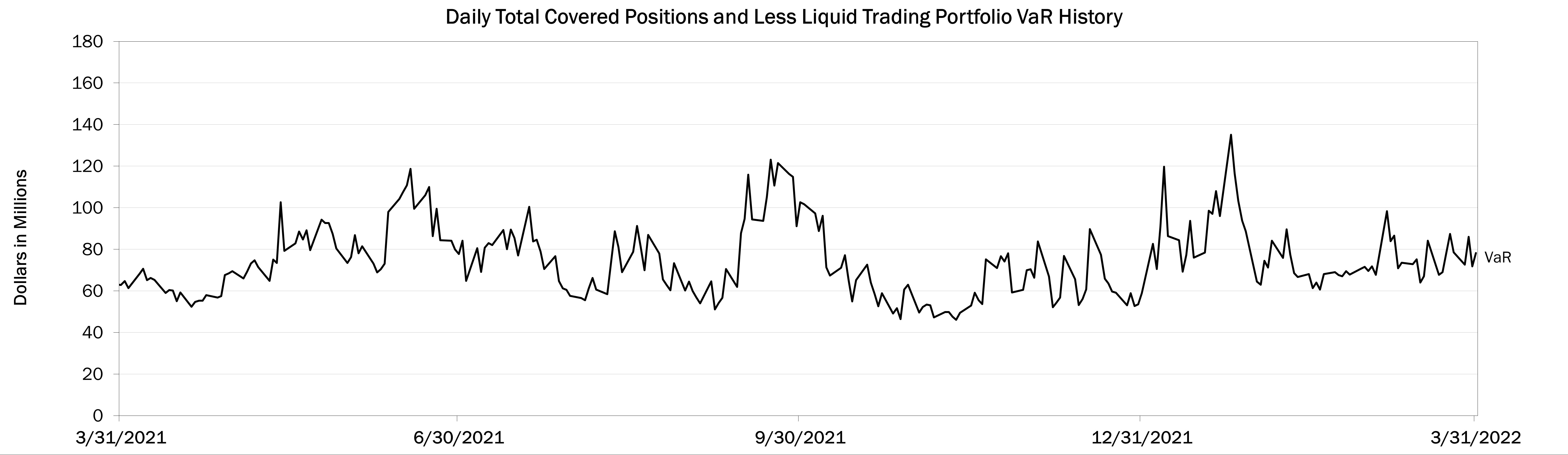
39 Bank of America
|
||||||||
Additional VaR statistics produced within our single VaR model are provided in Table 40 at the same level of detail as in Table 39. Evaluating VaR with additional statistics allows for an increased understanding of the risks in the portfolio, as the historical market data used in the VaR calculation does not
necessarily follow a predefined statistical distribution. Table 40 presents average trading VaR statistics at 99 percent and 95 percent confidence levels for the three months ended March 31, 2022, December 31, 2021 and March 31, 2021.
| Table 40 | Average Market Risk VaR for Trading Activities – 99 percent and 95 percent VaR Statistics | ||||||||||||||||||||||||||||||||||||||||
| Three Months Ended | |||||||||||||||||||||||||||||||||||||||||
| March 31, 2022 | December 31, 2021 | March 31, 2021 | |||||||||||||||||||||||||||||||||||||||
| (Dollars in millions) | 99 percent | 95 percent | 99 percent | 95 percent | 99 percent | 95 percent | |||||||||||||||||||||||||||||||||||
| Foreign exchange | $ | 18 | $ | 12 | $ | 9 | $ | 6 | $ | 10 | $ | 6 | |||||||||||||||||||||||||||||
| Interest rate | 36 | 16 | 35 | 17 | 35 | 17 | |||||||||||||||||||||||||||||||||||
| Credit | 64 | 27 | 73 | 23 | 64 | 18 | |||||||||||||||||||||||||||||||||||
| Equity | 23 | 13 | 25 | 11 | 24 | 12 | |||||||||||||||||||||||||||||||||||
| Commodities | 10 | 6 | 8 | 4 | 9 | 4 | |||||||||||||||||||||||||||||||||||
| Portfolio diversification | (95) | (47) | (101) | (36) | (90) | (34) | |||||||||||||||||||||||||||||||||||
| Total covered positions portfolio | 56 | 27 | 49 | 25 | 52 | 23 | |||||||||||||||||||||||||||||||||||
| Impact from less liquid exposures | 23 | 3 | 14 | 1 | 22 | 3 | |||||||||||||||||||||||||||||||||||
Total covered positions and less liquid trading positions portfolio |
79 | 30 | 63 | 26 | 74 | 26 | |||||||||||||||||||||||||||||||||||
| Fair value option loans | 54 | 14 | 50 | 13 | 56 | 14 | |||||||||||||||||||||||||||||||||||
| Fair value option hedges | 18 | 10 | 16 | 9 | 13 | 7 | |||||||||||||||||||||||||||||||||||
| Fair value option portfolio diversification | (35) | (12) | (29) | (10) | (24) | (6) | |||||||||||||||||||||||||||||||||||
| Total fair value option portfolio | 37 | 12 | 37 | 12 | 45 | 15 | |||||||||||||||||||||||||||||||||||
| Portfolio diversification | (19) | (8) | (20) | (8) | (1) | (8) | |||||||||||||||||||||||||||||||||||
| Total market-based portfolio | $ | 97 | $ | 34 | $ | 80 | $ | 30 | $ | 118 | $ | 33 | |||||||||||||||||||||||||||||
Backtesting
The accuracy of the VaR methodology is evaluated by backtesting, which compares the daily VaR results, utilizing a one-day holding period, against a comparable subset of trading revenue. For more information on our backtesting process, see Trading Risk Management – Backtesting in the MD&A of the Corporation’s 2021 Annual Report on Form 10-K.
During the three months ended March 31, 2022, there were no days where this subset of trading revenue had losses that exceeded our total covered portfolio VaR, utilizing a one-day holding period.
Total Trading-related Revenue
Total trading-related revenue, excluding brokerage fees, and CVA, DVA and funding valuation adjustment gains (losses), represents the total amount earned from trading positions, including market-based net interest income, which are taken in a diverse range of financial instruments and markets. For more information, see Trading Risk Management – Total Trading-related Revenue in the MD&A of the Corporation’s 2021 Annual Report on Form 10-K.
The following histogram is a graphic depiction of trading volatility and illustrates the daily level of trading-related revenue for the three months ended March 31, 2022 compared to the three months ended December 31, 2021. During the three months ended March 31, 2022, positive trading-related revenue was recorded for 100 percent of the trading days, of which 95 percent were daily trading gains of over $25
million. This compares to the three months ended December 31, 2021 where positive trading-related revenue was recorded for 92 percent of the trading days, of which 67 percent were daily trading gains of over $25 million, and the largest loss was $45 million.
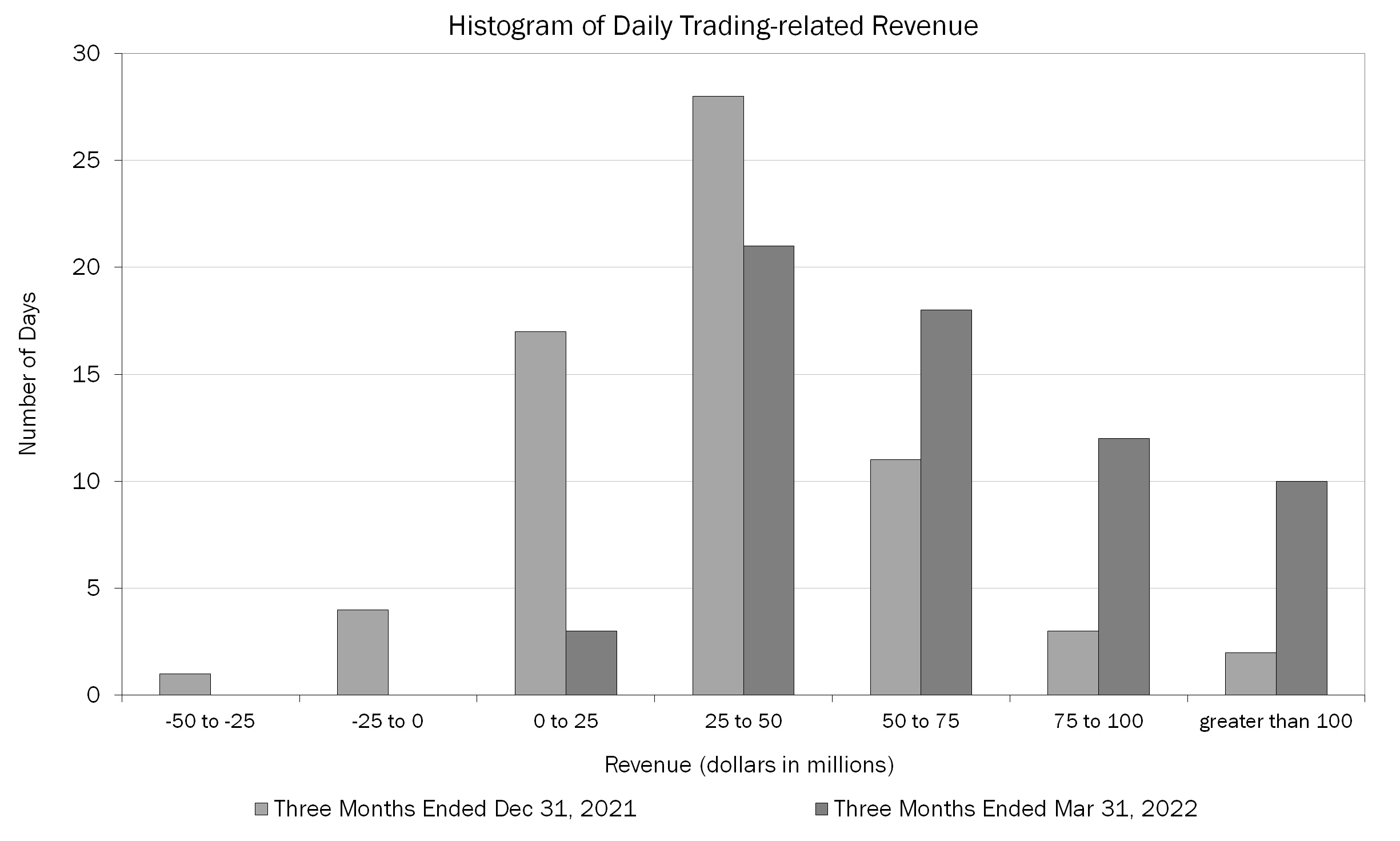
Trading Portfolio Stress Testing
Because the very nature of a VaR model suggests results can exceed our estimates and it is dependent on a limited historical window, we also stress test our portfolio using scenario analysis. This analysis estimates the change in the value of our trading portfolio that may result from abnormal market movements. For more information, see Trading Risk Management – Trading Portfolio Stress Testing in the MD&A of the Corporation’s 2021 Annual Report on Form 10-K.
Bank of America 40
|
||||||||
Interest Rate Risk Management for the Banking Book
The following discussion presents net interest income for banking book activities. For more information, see Interest Rate Risk Management for the Banking Book in the MD&A of the Corporation’s 2021 Annual Report on Form 10-K.
Table 41 presents the spot and 12-month forward rates used in our baseline forecasts at March 31, 2022 and December 31, 2021.
| Table 41 | Forward Rates | |||||||||||||||||||
| March 31, 2022 | ||||||||||||||||||||
| Federal Funds |
Three-month LIBOR |
10-Year Swap |
||||||||||||||||||
| Spot rates | 0.50 | % | 0.96 | % | 2.41 | % | ||||||||||||||
| 12-month forward rates | 3.00 | 3.11 | 2.47 | |||||||||||||||||
| December 31, 2021 | ||||||||||||||||||||
| Spot rates | 0.25 | % | 0.21 | % | 1.58 | % | ||||||||||||||
| 12-month forward rates | 1.00 | 1.07 | 1.84 | |||||||||||||||||
Table 42 shows the pretax impact to forecasted net interest income over the next 12 months from March 31, 2022 and December 31, 2021 resulting from instantaneous parallel and non-parallel shocks to the market-based forward curve. Periodically, we evaluate the scenarios presented so that they are meaningful in the context of the current rate environment. The interest rate scenarios also assume U.S. dollar rates are floored at zero.
During the three months ended March 31, 2022, the overall decrease in asset sensitivity of our balance sheet to Up-rate and Down-rate scenarios was primarily due to an increase in long-end rates. We continue to be asset sensitive to a parallel upward move in interest rates with the majority of that impact coming from the short end of the yield curve. Additionally, higher interest rates negatively impact the fair value of our debt securities classified as available for sale and adversely affect accumulated other comprehensive income and thus capital levels under the Basel 3 capital rules. Under instantaneous upward parallel shifts, the near-term adverse impact to Basel 3 capital would be reduced over time by offsetting positive impacts to net interest income generated from the banking book activities. For more information on Basel 3, see Capital Management – Regulatory Capital on page 18.
| Table 42 | Estimated Banking Book Net Interest Income Sensitivity to Curve Changes | |||||||||||||||||||||||||
| Short Rate (bps) |
Long Rate (bps) |
|||||||||||||||||||||||||
| (Dollars in millions) | March 31, 2022 |
December 31, 2021 |
||||||||||||||||||||||||
| Parallel Shifts | ||||||||||||||||||||||||||
|
+100 bps
instantaneous shift
|
+100 | +100 | $ | 5,383 | $ | 6,542 | ||||||||||||||||||||
|
-25 bps
instantaneous shift
|
-25 | -25 | (1,424) | (2,092) | ||||||||||||||||||||||
| Flatteners | ||||||||||||||||||||||||||
|
Short-end
instantaneous change
|
+100 | — | 4,856 | 4,982 | ||||||||||||||||||||||
|
Long-end
instantaneous change
|
— | -25 | (162) | (735) | ||||||||||||||||||||||
| Steepeners | ||||||||||||||||||||||||||
|
Short-end
instantaneous change
|
-25 | — | (1,259) | (1,344) | ||||||||||||||||||||||
|
Long-end
instantaneous change
|
— | +100 | 554 | 1,646 | ||||||||||||||||||||||
The sensitivity analysis in Table 42 assumes that we take no action in response to these rate shocks and does not assume any change in other macroeconomic variables normally correlated with changes in interest rates. As part of our ALM activities, we use securities, certain residential mortgages, and interest rate and foreign exchange derivatives in managing interest rate sensitivity.
The behavior of our deposits portfolio in the baseline forecast and in alternate interest rate scenarios is a key assumption in our projected estimates of net interest income. The sensitivity analysis in Table 42 assumes no change in deposit portfolio size or mix from the baseline forecast in alternate rate environments. In higher rate scenarios, any customer activity resulting in the replacement of low-cost or noninterest-bearing deposits with higher yielding deposits or market-based funding would reduce our benefit in those scenarios.
Interest Rate and Foreign Exchange Derivative Contracts
We use interest rate and foreign exchange derivative contracts in our ALM activities to manage our interest rate and foreign exchange risks. Specifically, we use those derivatives to manage both the variability in cash flows and changes in fair value of various assets and liabilities arising from those risks. Our interest rate derivative contracts are generally non-leveraged swaps tied to various benchmark interest rates and foreign exchange basis swaps, options, futures and forwards, and our foreign exchange contracts include cross-currency interest rate swaps, foreign currency futures contracts, foreign currency forward contracts and options.
The derivatives used in our ALM activities can be split into two broad categories: designated accounting hedges and other risk management derivatives. Designated accounting hedges are primarily used to manage our exposure to interest rates as described in the Interest Rate Risk Management for the Banking Book section and are included in the sensitivities presented in Table 42. The Corporation also uses foreign currency derivatives in accounting hedges to manage substantially all of the foreign exchange risk of our foreign operations. By hedging the foreign exchange risk of our foreign operations, the Corporation's market risk exposure in this area is insignificant.
Risk management derivatives are predominantly used to hedge foreign exchange risks related to various foreign currency-denominated assets and liabilities and eliminate substantially all foreign currency exposures in the cash flows of the Corporation’s non-trading foreign currency-denominated financial instruments. These foreign exchange derivatives are sensitive to other market risk exposures such as cross-currency basis spreads and interest rate risk. However, as these features are not a significant component of these foreign exchange derivatives, the market risk related to this exposure is insignificant. For more information on the accounting for derivatives, see Note 3 – Derivatives to the Consolidated Financial Statements.
Mortgage Banking Risk Management
We originate, fund and service mortgage loans, which subject us to credit, liquidity and interest rate risks, among others. We determine whether loans will be held for investment or held for sale at the time of commitment and manage credit and liquidity risks by selling or securitizing a portion of the loans we originate.
Changes in interest rates impact the value of interest rate lock commitments (IRLCs) and the related residential first
41 Bank of America
|
||||||||
mortgage loans held-for-sale (LHFS), as well as the value of the MSRs. Because the interest rate risks of these hedged items offset, we combine them into one overall hedged item with one combined economic hedge portfolio consisting of derivative contracts and securities. For more information on IRLCs and the related residential mortgage LHFS, see Mortgage Banking Risk Management in the MD&A of the Corporation’s 2021 Annual Report on Form 10-K.
During the three months ended March 31, 2022 and 2021, we recorded gains of $14 million and $13 million related to the change in fair value of MSRs, IRLCs and LHFS, net of gains and losses on the hedge portfolio. For more information on MSRs, see Note 14 – Fair Value Measurements to the Consolidated Financial Statements.
Climate Risk Management
Climate-related risks are divided into two major categories: (1) risks related to the transition to a low-carbon economy, which may entail extensive policy, legal, technology and market changes, and (2) risks related to the physical impacts of climate change, driven by extreme weather events, such as hurricanes and floods, as well as chronic longer-term shifts, such as rising average global temperatures and sea levels. These changes and events can have broad impacts on operations, supply chains, distribution networks, customers and markets and are otherwise referred to, respectively, as transition risk and physical risk. These risks can impact both financial and nonfinancial risk types. The impacts of transition risk can lead to and amplify credit risk or market risk by reducing our customers’ operating income or the value of their assets as well as expose us to reputational and/or litigation risk due to increased regulatory scrutiny or negative public sentiment. Physical risk can lead to increased credit risk by diminishing borrowers’ repayment capacity or impacting the value of collateral. In addition, it could pose increased operational risk to our facilities and people.
In 2021, we publicly announced our goal to achieve net zero greenhouse gas emissions in our financing activities, operations and supply chain before 2050 (Net Zero Goal). We also committed to set emission reduction targets for 2030. In connection with this commitment, on April 13, 2022, we published our first targets to reduce emissions by 2030 associated with our financing activities in the auto manufacturing, energy and power generation sectors (2030 Targets). These reduction targets are intended to align with the goal to limit warming to 1.5 degrees Celsius.
We plan to disclose our 2019 financed emissions baseline for our auto manufacturing, energy and power generation sectors along with 2020 data in our 2022 Task Force for Climate-related Financial Disclosures (TCFD) Report that we expect to publish in the Fall of 2022. We also plan to disclose the financed emissions for our entire business loan portfolio in 2023.
Achieving our Net Zero Goal and 2030 Targets will require technological advances, clearly defined roadmaps for industry sectors, public policies, including those that improve the cost of capital for net zero transition and better emissions data reporting, as well as ongoing, strong and active engagement with clients, suppliers, investors, government officials and other stakeholders.
Given the extended period of these and other climate-related goals we have established, our initiatives have not resulted in a significant effect on our results of operations or financial condition in the relevant periods presented herein, and are not expected to have a significant effect on our results of operations or financial condition in the near-term.
For more information on our governance framework and climate risk management process, see the Managing Risk and Climate Risk Management sections in the MD&A of the Corporation’s 2021 Annual Report on Form 10-K. For more information on climate risk, see Item 1A. Risk Factors – Other of the Corporation’s 2021 Annual Report on Form 10-K. For more information about climate-related matters and the Corporation’s climate-related goals and commitments, including our plans to achieve our Net Zero Goal and progress on our sustainable finance goals, see the Corporation’s website and the 2021 Annual Report to shareholders available on the Investor Relations portion of our website. The contents of the Corporation’s website and the 2021 Annual Report to shareholders are not incorporated by reference into this Quarterly Report on Form 10-Q.
The foregoing discussion and our discussion in the 2021 Annual Report to shareholders regarding our goals and commitments with respect to climate risk management, including environmental transition considerations, include “forward-looking statements” within the meaning of the Private Securities Litigation Reform Act of 1995. These statements are not guarantees of future results or performance and involve certain known and unknown risks, uncertainties and assumptions that are difficult to predict and are often beyond the Corporation’s control. Actual outcomes and results may differ materially from those expressed in, or implied by, any of these forward-looking statements.
Complex Accounting Estimates
Our significant accounting principles, are essential in understanding the MD&A. Many of our significant accounting principles require complex judgments to estimate the values of assets and liabilities. We have procedures and processes in place to facilitate making these judgments. For more information, see Complex Accounting Estimates in the MD&A of the Corporation’s 2021 Annual Report on Form 10-K and Note 1 – Summary of Significant Accounting Principles to the Consolidated Financial Statements of the Corporation’s 2021 Annual Report on Form 10-K.
Bank of America 42
|
||||||||
Non-GAAP Reconciliations
Table 43 provides reconciliations of certain non-GAAP financial measures to the most closely related GAAP financial measures.
| Table 43 |
Period-end and Average Supplemental Financial Data and Reconciliations to GAAP Financial Measures (1)
|
|||||||||||||||||||||||||
| Period-end | Average | |||||||||||||||||||||||||
| March 31 2022 |
December 31 2021 |
Three Months Ended March 31 | ||||||||||||||||||||||||
| (Dollars in millions) | 2022 | 2021 | ||||||||||||||||||||||||
| Shareholders’ equity | $ | 266,617 | $ | 270,066 | $ | 269,309 | $ | 274,047 | ||||||||||||||||||
| Goodwill | (69,022) | (69,022) | (69,022) | (68,951) | ||||||||||||||||||||||
| Intangible assets (excluding MSRs) | (2,133) | (2,153) | (2,146) | (2,146) | ||||||||||||||||||||||
| Related deferred tax liabilities | 926 | 929 | 929 | 920 | ||||||||||||||||||||||
| Tangible shareholders’ equity | $ | 196,388 | $ | 199,820 | $ | 199,070 | $ | 203,870 | ||||||||||||||||||
| Preferred stock | (27,137) | (24,708) | (26,444) | (24,399) | ||||||||||||||||||||||
| Tangible common shareholders’ equity | $ | 169,251 | $ | 175,112 | $ | 172,626 | $ | 179,471 | ||||||||||||||||||
| Total assets | $ | 3,238,223 | $ | 3,169,495 | ||||||||||||||||||||||
| Goodwill | (69,022) | (69,022) | ||||||||||||||||||||||||
| Intangible assets (excluding MSRs) | (2,133) | (2,153) | ||||||||||||||||||||||||
| Related deferred tax liabilities | 926 | 929 | ||||||||||||||||||||||||
| Tangible assets | $ | 3,167,994 | $ | 3,099,249 | ||||||||||||||||||||||
(1)For more information on non-GAAP financial measures and ratios we use in assessing the results of the Corporation, see Supplemental Financial Data on page 5.
Item 3. Quantitative and Qualitative Disclosures about Market Risk
See Market Risk Management on page 39 in the MD&A and the sections referenced therein for Quantitative and Qualitative Disclosures about Market Risk.
Item 4. Controls and Procedures
Disclosure Controls and Procedures
As of the end of the period covered by this report, the Corporation’s management, including the Chief Executive Officer and Chief Financial Officer, conducted an evaluation of the effectiveness and design of the Corporation’s disclosure controls and procedures (as that term is defined in Rule 13a-15(e) of the Exchange Act). Based upon that evaluation, the Corporation’s Chief Executive Officer and Chief Financial Officer concluded that the Corporation’s disclosure controls and procedures were effective, as of the end of the period covered by this report.
Changes in Internal Control Over Financial Reporting
There have been no changes in the Corporation’s internal control over financial reporting (as defined in Rule 13a-15(f) of the Exchange Act) during the three months ended March 31, 2022, that have materially affected, or are reasonably likely to materially affect, the Corporation’s internal control over financial reporting.
43 Bank of America
|
||||||||
Part I. Financial Information
Item 1. Financial Statements
Bank of America Corporation and Subsidiaries
Consolidated Statement of Income | ||||||||||||||
| Three Months Ended March 31 | ||||||||||||||
| (In millions, except per share information) | 2022 | 2021 | ||||||||||||
| Net interest income | ||||||||||||||
| Interest income | $ |
|
$ | |||||||||||
| Interest expense |
|
|||||||||||||
| Net interest income |
|
|||||||||||||
| Noninterest income | ||||||||||||||
| Fees and commissions |
|
|||||||||||||
| Market making and similar activities |
|
|||||||||||||
| Other income | ( |
( |
||||||||||||
| Total noninterest income |
|
|||||||||||||
| Total revenue, net of interest expense |
|
|||||||||||||
| Provision for credit losses |
|
( |
||||||||||||
| Noninterest expense | ||||||||||||||
| Compensation and benefits |
|
|||||||||||||
| Occupancy and equipment |
|
|||||||||||||
| Information processing and communications |
|
|||||||||||||
| Product delivery and transaction related |
|
|||||||||||||
| Marketing |
|
|||||||||||||
| Professional fees |
|
|||||||||||||
| Other general operating |
|
|||||||||||||
| Total noninterest expense |
|
|||||||||||||
| Income before income taxes |
|
|||||||||||||
| Income tax expense |
|
|||||||||||||
| Net income | $ |
|
$ | |||||||||||
| Preferred stock dividends |
|
|||||||||||||
| Net income applicable to common shareholders | $ |
|
$ | |||||||||||
| Per common share information | ||||||||||||||
| Earnings | $ |
|
$ | |||||||||||
| Diluted earnings |
|
|||||||||||||
| Average common shares issued and outstanding |
|
|||||||||||||
| Average diluted common shares issued and outstanding |
|
|||||||||||||
Consolidated Statement of Comprehensive Income |
|||||||||||||||||
| Three Months Ended March 31 | |||||||||||||||||
| (Dollars in millions) | 2022 | 2021 | |||||||||||||||
| Net income | $ |
|
$ | ||||||||||||||
| Other comprehensive income (loss), net-of-tax: | |||||||||||||||||
| Net change in debt securities | ( |
( |
|||||||||||||||
| Net change in debit valuation adjustments |
|
||||||||||||||||
| Net change in derivatives | ( |
( |
|||||||||||||||
| Employee benefit plan adjustments |
|
||||||||||||||||
| Net change in foreign currency translation adjustments |
|
( |
|||||||||||||||
| Other comprehensive income (loss) | ( |
( |
|||||||||||||||
| Comprehensive income (loss) | $ | ( |
$ | ||||||||||||||
See accompanying Notes to Consolidated Financial Statements.
Bank of America 44
|
||||||||
Bank of America Corporation and Subsidiaries
Consolidated Balance Sheet | ||||||||||||||
| March 31 2022 |
December 31 2021 |
|||||||||||||
| (Dollars in millions) | ||||||||||||||
| Assets | ||||||||||||||
| Cash and due from banks | $ |
|
$ | |||||||||||
| Interest-bearing deposits with the Federal Reserve, non-U.S. central banks and other banks |
|
|||||||||||||
| Cash and cash equivalents |
|
|||||||||||||
| Time deposits placed and other short-term investments |
|
|||||||||||||
|
Federal funds sold and securities borrowed or purchased under agreements to resell
(includes $
|
|
|||||||||||||
Trading account assets (includes $ |
|
|||||||||||||
| Derivative assets |
|
|||||||||||||
| Debt securities: | ||||||||||||||
| Carried at fair value |
|
|||||||||||||
Held-to-maturity, at cost (fair value – $ |
|
|||||||||||||
| Total debt securities |
|
|||||||||||||
Loans and leases (includes $ |
|
|||||||||||||
| Allowance for loan and lease losses | ( |
( |
||||||||||||
| Loans and leases, net of allowance |
|
|||||||||||||
| Premises and equipment, net |
|
|||||||||||||
| Goodwill |
|
|||||||||||||
Loans held-for-sale (includes $ |
|
|||||||||||||
| Customer and other receivables |
|
|||||||||||||
Other assets (includes $ |
|
|||||||||||||
| Total assets | $ |
|
$ | |||||||||||
| Liabilities | ||||||||||||||
| Deposits in U.S. offices: | ||||||||||||||
| Noninterest-bearing | $ |
|
$ | |||||||||||
Interest-bearing (includes $ |
|
|||||||||||||
| Deposits in non-U.S. offices: | ||||||||||||||
| Noninterest-bearing |
|
|||||||||||||
| Interest-bearing |
|
|||||||||||||
| Total deposits |
|
|||||||||||||
|
Federal funds purchased and securities loaned or sold under agreements to repurchase
(includes $
|
|
|||||||||||||
| Trading account liabilities |
|
|||||||||||||
| Derivative liabilities |
|
|||||||||||||
Short-term borrowings (includes $ |
|
|||||||||||||
|
Accrued expenses and other liabilities (includes $
and $
|
|
|||||||||||||
Long-term debt (includes $ |
|
|||||||||||||
| Total liabilities |
|
|||||||||||||
|
Commitments and contingencies (Note 6 – Securitizations and Other Variable Interest Entities
and Note 10 – Commitments and Contingencies)
|
||||||||||||||
| Shareholders’ equity | ||||||||||||||
Preferred stock, $ |
|
|||||||||||||
|
Common stock and additional paid-in capital, $
issued and outstanding –
|
|
|||||||||||||
| Retained earnings |
|
|||||||||||||
| Accumulated other comprehensive income (loss) | ( |
( |
||||||||||||
| Total shareholders’ equity |
|
|||||||||||||
| Total liabilities and shareholders’ equity | $ |
|
$ | |||||||||||
| Assets of consolidated variable interest entities included in total assets above (isolated to settle the liabilities of the variable interest entities) | ||||||||||||||
| Trading account assets | $ |
|
$ | |||||||||||
| Loans and leases |
|
|||||||||||||
| Allowance for loan and lease losses | ( |
( |
||||||||||||
| Loans and leases, net of allowance |
|
|||||||||||||
| All other assets |
|
|||||||||||||
| Total assets of consolidated variable interest entities | $ |
|
$ | |||||||||||
| Liabilities of consolidated variable interest entities included in total liabilities above | ||||||||||||||
Short-term borrowings (includes $ |
$ |
|
$ | |||||||||||
Long-term debt (includes $ |
|
|||||||||||||
All other liabilities (includes $ |
|
|||||||||||||
| Total liabilities of consolidated variable interest entities | $ |
|
$ | |||||||||||
See accompanying Notes to Consolidated Financial Statements.
45 Bank of America
|
||||||||
Bank of America Corporation and Subsidiaries
| Consolidated Statement of Changes in Shareholders’ Equity | |||||||||||||||||||||||||||||||||||
| Preferred Stock |
Common Stock and Additional Paid-in Capital |
Retained Earnings |
Accumulated Other Comprehensive Income (Loss) |
Total Shareholders’ Equity |
|||||||||||||||||||||||||||||||
| (In millions) | Shares | Amount | |||||||||||||||||||||||||||||||||
| Balance, December 31, 2020 | $ | $ | $ | $ | ( |
$ | |||||||||||||||||||||||||||||
| Net income | |||||||||||||||||||||||||||||||||||
| Net change in debt securities | ( |
( |
|||||||||||||||||||||||||||||||||
| Net change in debit valuation adjustments | |||||||||||||||||||||||||||||||||||
| Net change in derivatives | ( |
( |
|||||||||||||||||||||||||||||||||
| Employee benefit plan adjustments | |||||||||||||||||||||||||||||||||||
| Net change in foreign currency translation adjustments | ( |
( |
|||||||||||||||||||||||||||||||||
| Dividends declared: | |||||||||||||||||||||||||||||||||||
| Common | ( |
( |
|||||||||||||||||||||||||||||||||
| Preferred | ( |
( |
|||||||||||||||||||||||||||||||||
| Issuance of preferred stock | |||||||||||||||||||||||||||||||||||
| Redemption of preferred stock | ( |
( |
|||||||||||||||||||||||||||||||||
| Common stock issued under employee plans, net, and other | ( |
||||||||||||||||||||||||||||||||||
| Common stock repurchased | ( |
( |
( |
||||||||||||||||||||||||||||||||
| Balance, March 31, 2021 | $ | $ | $ | $ | ( |
$ | |||||||||||||||||||||||||||||
| Balance, December 31, 2021 | $ |
|
|
$ |
|
$ |
|
$ | ( |
$ |
|
||||||||||||||||||||||||
| Net income |
|
|
|||||||||||||||||||||||||||||||||
| Net change in debt securities | ( |
( |
|||||||||||||||||||||||||||||||||
| Net change in debit valuation adjustments |
|
|
|||||||||||||||||||||||||||||||||
| Net change in derivatives | ( |
( |
|||||||||||||||||||||||||||||||||
| Employee benefit plan adjustments |
|
|
|||||||||||||||||||||||||||||||||
| Net change in foreign currency translation adjustments |
|
|
|||||||||||||||||||||||||||||||||
| Dividends declared: | |||||||||||||||||||||||||||||||||||
| Common | ( |
( |
|||||||||||||||||||||||||||||||||
| Preferred | ( |
( |
|||||||||||||||||||||||||||||||||
| Issuance of preferred stock |
|
|
|||||||||||||||||||||||||||||||||
| Common stock issued under employee plans, net, and other |
|
|
( |
|
|||||||||||||||||||||||||||||||
| Common stock repurchased | ( |
( |
( |
||||||||||||||||||||||||||||||||
| Balance, March 31, 2022 | $ |
|
|
$ |
|
$ |
|
$ | ( |
$ |
|
||||||||||||||||||||||||
See accompanying Notes to Consolidated Financial Statements.
Bank of America 46
|
||||||||
Bank of America Corporation and Subsidiaries
Consolidated Statement of Cash Flows |
|||||||||||
| Three Months Ended March 31 | |||||||||||
| (Dollars in millions) | 2022 | 2021 | |||||||||
| Operating activities | |||||||||||
| Net income | $ |
|
$ | ||||||||
| Adjustments to reconcile net income to net cash provided by operating activities: | |||||||||||
| Provision for credit losses |
|
( |
|||||||||
| Gains on sales of debt securities | ( |
||||||||||
| Depreciation and amortization |
|
||||||||||
| Net amortization of premium/discount on debt securities |
|
||||||||||
| Deferred income taxes |
|
||||||||||
| Stock-based compensation |
|
||||||||||
| Loans held-for-sale: | |||||||||||
| Originations and purchases | ( |
( |
|||||||||
|
Proceeds from sales and paydowns of loans originally classified as held for sale and instruments
from related securitization activities
|
|
||||||||||
| Net change in: | |||||||||||
| Trading and derivative assets/liabilities | ( |
( |
|||||||||
| Other assets | ( |
( |
|||||||||
| Accrued expenses and other liabilities |
|
||||||||||
| Other operating activities, net | ( |
||||||||||
| Net cash used in operating activities | ( |
( |
|||||||||
| Investing activities | |||||||||||
| Net change in: | |||||||||||
| Time deposits placed and other short-term investments |
|
( |
|||||||||
| Federal funds sold and securities borrowed or purchased under agreements to resell | ( |
||||||||||
| Debt securities carried at fair value: | |||||||||||
| Proceeds from sales |
|
||||||||||
| Proceeds from paydowns and maturities |
|
||||||||||
| Purchases | ( |
( |
|||||||||
| Held-to-maturity debt securities: | |||||||||||
| Proceeds from paydowns and maturities |
|
||||||||||
| Purchases | ( |
( |
|||||||||
| Loans and leases: | |||||||||||
|
Proceeds from sales of loans originally classified as held for investment and instruments
from related securitization activities
|
|
||||||||||
| Purchases | ( |
( |
|||||||||
| Other changes in loans and leases, net | ( |
||||||||||
| Other investing activities, net | ( |
( |
|||||||||
| Net cash used in investing activities | ( |
( |
|||||||||
| Financing activities | |||||||||||
| Net change in: | |||||||||||
| Deposits |
|
||||||||||
| Federal funds purchased and securities loaned or sold under agreements to repurchase |
|
||||||||||
| Short-term borrowings |
|
||||||||||
| Long-term debt: | |||||||||||
| Proceeds from issuance |
|
||||||||||
| Retirement | ( |
( |
|||||||||
| Preferred stock: | |||||||||||
| Proceeds from issuance |
|
||||||||||
| Redemption |
|
( |
|||||||||
| Common stock repurchased | ( |
( |
|||||||||
| Cash dividends paid | ( |
( |
|||||||||
| Other financing activities, net | ( |
( |
|||||||||
| Net cash provided by financing activities |
|
||||||||||
| Effect of exchange rate changes on cash and cash equivalents | ( |
( |
|||||||||
| Net decrease in cash and cash equivalents | ( |
( |
|||||||||
| Cash and cash equivalents at January 1 |
|
||||||||||
| Cash and cash equivalents at March 31 | $ |
|
$ | ||||||||
See accompanying Notes to Consolidated Financial Statements.
47 Bank of America
|
||||||||
Bank of America Corporation and Subsidiaries
Notes to Consolidated Financial Statements
NOTE 1 Summary of Significant Accounting Principles
Bank of America Corporation, a bank holding company and a financial holding company, provides a diverse range of financial services and products throughout the U.S. and in certain international markets. The term “the Corporation” as used herein may refer to Bank of America Corporation, individually, Bank of America Corporation and its subsidiaries, or certain of Bank of America Corporation’s subsidiaries or affiliates.
Principles of Consolidation and Basis of Presentation
disclosures. Actual results could materially differ from those estimates and assumptions.
These unaudited Consolidated Financial Statements should be read in conjunction with the audited Consolidated Financial Statements, and related notes thereto, of the Corporation’s 2021 Annual Report on Form 10-K.
The nature of the Corporation’s business is such that the results of any interim period are not necessarily indicative of results for a full year. In the opinion of management, all adjustments, which consist of normal recurring adjustments necessary for a fair statement of the interim period results, have been made. The Corporation evaluates subsequent events through the date of filing with the Securities and Exchange Commission. Certain prior-period amounts have been reclassified to conform to current period presentation.
Accounting Standards Issued and Not Yet Adopted
Hedge Accounting
The FASB issued a new accounting standard effective on January 1, 2023, with early adoption permitted, that makes targeted improvements to the application of the fair value hedge accounting guidance for closed portfolios of financial assets. Upon adoption, the application of these hedge strategies would be applied prospectively.
Financial Instruments – Credit Losses
The FASB amended the accounting and disclosure requirements for expected credit losses by removing the recognition and measurement guidance on troubled debt restructurings (TDRs) and enhancing certain disclosures. The amendments are effective on January 1, 2023 with early adoption permitted. The effects of this change on the Corporation’s financial statements have not yet been determined, but are not expected to have a material impact on its consolidated financial position, results of operations or disclosures in the Notes to the Consolidated Financial Statements.
Bank of America 48
|
||||||||
NOTE 2 Net Interest Income and Noninterest Income
The table below presents the Corporation’s net interest income and noninterest income disaggregated by revenue source for the three months ended March 31, 2022 and 2021. For more information, see Note 1 – Summary of Significant Accounting Principles to the Consolidated Financial Statements of the Corporation’s 2021 Annual Report on Form 10-K. For a disaggregation of noninterest income by business segment and All Other, see Note 17 – Business Segment Information.
| Three Months Ended March 31 | |||||||||||
| (Dollars in millions) | 2022 | 2021 | |||||||||
| Net interest income | |||||||||||
| Interest income | |||||||||||
| Loans and leases | $ |
|
$ | ||||||||
| Debt securities |
|
||||||||||
Federal funds sold and securities borrowed or purchased under agreements to resell (1)
|
( |
( |
|||||||||
| Trading account assets |
|
||||||||||
| Other interest income |
|
||||||||||
| Total interest income |
|
||||||||||
| Interest expense | |||||||||||
| Deposits |
|
||||||||||
Short-term borrowings (1)
|
( |
( |
|||||||||
| Trading account liabilities |
|
||||||||||
| Long-term debt |
|
||||||||||
| Total interest expense |
|
||||||||||
| Net interest income | $ |
|
$ | ||||||||
| Noninterest income | |||||||||||
| Fees and commissions | |||||||||||
| Card income | |||||||||||
Interchange fees (2)
|
$ |
|
$ | ||||||||
| Other card income |
|
||||||||||
| Total card income |
|
||||||||||
| Service charges | |||||||||||
| Deposit-related fees |
|
||||||||||
| Lending-related fees |
|
||||||||||
| Total service charges |
|
||||||||||
| Investment and brokerage services | |||||||||||
| Asset management fees |
|
||||||||||
| Brokerage fees |
|
||||||||||
| Total investment and brokerage services |
|
||||||||||
| Investment banking fees | |||||||||||
| Underwriting income |
|
||||||||||
| Syndication fees |
|
||||||||||
| Financial advisory services |
|
||||||||||
| Total investment banking fees |
|
||||||||||
| Total fees and commissions |
|
||||||||||
| Market making and similar activities |
|
||||||||||
| Other income (loss) | ( |
( |
|||||||||
| Total noninterest income | $ |
|
$ | ||||||||
(1)For more information on negative interest, see Note 1 – Summary of Significant Accounting Principles to the Consolidated Financial Statements of the Corporation’s 2021 Annual Report on Form 10-K.
(2)Gross interchange fees and merchant income were $2.9 billion and $2.5 billion for the three months ended March 31, 2022 and 2021 and are presented net of $2.0 billion and $1.4 billion of expenses for rewards and partner payments as well as certain other card costs for the same periods.
49 Bank of America
|
||||||||
NOTE 3 Derivatives
Derivative Balances
Derivatives are entered into on behalf of customers, for trading or to support risk management activities. Derivatives used in risk management activities include derivatives that may or may not be designated in qualifying hedge accounting relationships. Derivatives that are not designated in qualifying hedge accounting relationships are referred to as other risk management derivatives. For more information on the Corporation’s derivatives and hedging activities, see Note 1 – Summary of Significant Accounting Principles and Note 3 –
| March 31, 2022 | |||||||||||||||||||||||||||||||||||||||||
| Gross Derivative Assets | Gross Derivative Liabilities | ||||||||||||||||||||||||||||||||||||||||
| (Dollars in billions) |
Contract/
Notional (1)
|
Trading and Other Risk Management Derivatives | Qualifying Accounting Hedges |
Total | Trading and Other Risk Management Derivatives | Qualifying Accounting Hedges |
Total | ||||||||||||||||||||||||||||||||||
| Interest rate contracts | |||||||||||||||||||||||||||||||||||||||||
| Swaps | $ |
|
$ |
|
$ |
|
$ |
|
$ |
|
$ |
|
$ |
|
|||||||||||||||||||||||||||
| Futures and forwards |
|
|
|
|
|
|
|
||||||||||||||||||||||||||||||||||
| Written options |
|
|
|
|
|
|
|
||||||||||||||||||||||||||||||||||
| Purchased options |
|
|
|
|
|
|
|
||||||||||||||||||||||||||||||||||
| Foreign exchange contracts | |||||||||||||||||||||||||||||||||||||||||
| Swaps |
|
|
|
|
|
|
|
||||||||||||||||||||||||||||||||||
| Spot, futures and forwards |
|
|
|
|
|
|
|
||||||||||||||||||||||||||||||||||
| Written options |
|
|
|
|
|
|
|
||||||||||||||||||||||||||||||||||
| Purchased options |
|
|
|
|
|
|
|
||||||||||||||||||||||||||||||||||
| Equity contracts | |||||||||||||||||||||||||||||||||||||||||
| Swaps |
|
|
|
|
|
|
|
||||||||||||||||||||||||||||||||||
| Futures and forwards |
|
|
|
|
|
|
|
||||||||||||||||||||||||||||||||||
| Written options |
|
|
|
|
|
|
|
||||||||||||||||||||||||||||||||||
| Purchased options |
|
|
|
|
|
|
|
||||||||||||||||||||||||||||||||||
| Commodity contracts | |||||||||||||||||||||||||||||||||||||||||
| Swaps |
|
|
|
|
|
|
|
||||||||||||||||||||||||||||||||||
| Futures and forwards |
|
|
|
|
|
|
|
||||||||||||||||||||||||||||||||||
| Written options |
|
|
|
|
|
|
|
||||||||||||||||||||||||||||||||||
| Purchased options |
|
|
|
|
|
|
|
||||||||||||||||||||||||||||||||||
Credit derivatives (2)
|
|||||||||||||||||||||||||||||||||||||||||
| Purchased credit derivatives: | |||||||||||||||||||||||||||||||||||||||||
| Credit default swaps |
|
|
|
|
|
|
|
||||||||||||||||||||||||||||||||||
| Total return swaps/options |
|
|
|
|
|
|
|
||||||||||||||||||||||||||||||||||
| Written credit derivatives: | |||||||||||||||||||||||||||||||||||||||||
| Credit default swaps |
|
|
|
|
|
|
|
||||||||||||||||||||||||||||||||||
| Total return swaps/options |
|
|
|
|
|
|
|
||||||||||||||||||||||||||||||||||
| Gross derivative assets/liabilities | $ |
|
$ |
|
$ |
|
$ |
|
$ |
|
$ |
|
|||||||||||||||||||||||||||||
| Less: Legally enforceable master netting agreements | ( |
( |
|||||||||||||||||||||||||||||||||||||||
| Less: Cash collateral received/paid | ( |
( |
|||||||||||||||||||||||||||||||||||||||
| Total derivative assets/liabilities | $ |
|
$ |
|
|||||||||||||||||||||||||||||||||||||
(1)Represents the total contract/notional amount of derivative assets and liabilities outstanding.
(2)The net derivative asset and notional amount of written credit derivatives for which the Corporation held purchased credit derivatives with identical underlying referenced names were $707 million and $317.2 billion at March 31, 2022.
Bank of America 50
|
||||||||
| December 31, 2021 | |||||||||||||||||||||||||||||||||||||||||
| Gross Derivative Assets | Gross Derivative Liabilities | ||||||||||||||||||||||||||||||||||||||||
| (Dollars in billions) |
Contract/
Notional (1)
|
Trading and Other Risk Management Derivatives | Qualifying Accounting Hedges |
Total | Trading and Other Risk Management Derivatives | Qualifying Accounting Hedges |
Total | ||||||||||||||||||||||||||||||||||
| Interest rate contracts | |||||||||||||||||||||||||||||||||||||||||
| Swaps | $ | $ | $ | $ | $ | $ | $ | ||||||||||||||||||||||||||||||||||
| Futures and forwards | |||||||||||||||||||||||||||||||||||||||||
| Written options | |||||||||||||||||||||||||||||||||||||||||
| Purchased options | |||||||||||||||||||||||||||||||||||||||||
| Foreign exchange contracts | |||||||||||||||||||||||||||||||||||||||||
| Swaps | |||||||||||||||||||||||||||||||||||||||||
| Spot, futures and forwards | |||||||||||||||||||||||||||||||||||||||||
| Written options | |||||||||||||||||||||||||||||||||||||||||
| Purchased options | |||||||||||||||||||||||||||||||||||||||||
| Equity contracts | |||||||||||||||||||||||||||||||||||||||||
| Swaps | |||||||||||||||||||||||||||||||||||||||||
| Futures and forwards | |||||||||||||||||||||||||||||||||||||||||
| Written options | |||||||||||||||||||||||||||||||||||||||||
| Purchased options | |||||||||||||||||||||||||||||||||||||||||
| Commodity contracts | |||||||||||||||||||||||||||||||||||||||||
| Swaps | |||||||||||||||||||||||||||||||||||||||||
| Futures and forwards | |||||||||||||||||||||||||||||||||||||||||
| Written options | |||||||||||||||||||||||||||||||||||||||||
| Purchased options | |||||||||||||||||||||||||||||||||||||||||
Credit derivatives (2)
|
|||||||||||||||||||||||||||||||||||||||||
| Purchased credit derivatives: | |||||||||||||||||||||||||||||||||||||||||
| Credit default swaps | |||||||||||||||||||||||||||||||||||||||||
| Total return swaps/options | |||||||||||||||||||||||||||||||||||||||||
| Written credit derivatives: | |||||||||||||||||||||||||||||||||||||||||
| Credit default swaps | |||||||||||||||||||||||||||||||||||||||||
| Total return swaps/options | |||||||||||||||||||||||||||||||||||||||||
| Gross derivative assets/liabilities | $ | $ | $ | $ | $ | $ | |||||||||||||||||||||||||||||||||||
| Less: Legally enforceable master netting agreements | ( |
( |
|||||||||||||||||||||||||||||||||||||||
| Less: Cash collateral received/paid | ( |
( |
|||||||||||||||||||||||||||||||||||||||
| Total derivative assets/liabilities | $ | $ | |||||||||||||||||||||||||||||||||||||||
(1)Represents the total contract/notional amount of derivative assets and liabilities outstanding.
(2)The net derivative asset and notional amount of written credit derivatives for which the Corporation held purchased credit derivatives with identical underlying referenced names were $2.3 billion and $258.4 billion at December 31, 2021.
Offsetting of Derivatives
The Corporation enters into International Swaps and Derivatives Association, Inc. (ISDA) master netting agreements or similar agreements with substantially all of the Corporation’s derivative counterparties. For more information, see Note 3 – Derivatives to the Consolidated Financial Statements of the Corporation’s 2021 Annual Report on Form 10-K.
on which these derivatives are transacted. Balances are presented on a gross basis, prior to the application of counterparty and cash collateral netting. Total gross derivative assets and liabilities are adjusted on an aggregate basis to take into consideration the effects of legally enforceable master netting agreements, which include reducing the balance for counterparty netting and cash collateral received or paid.
For more information on offsetting of securities financing agreements, see Note 9 – Securities Financing Agreements and Restricted Cash.
51 Bank of America
|
||||||||
Offsetting of Derivatives (1)
|
|||||||||||||||||||||||
| Derivative Assets |
Derivative Liabilities |
Derivative Assets |
Derivative Liabilities |
||||||||||||||||||||
| (Dollars in billions) | March 31, 2022 | December 31, 2021 | |||||||||||||||||||||
| Interest rate contracts | |||||||||||||||||||||||
| Over-the-counter | $ |
|
$ |
|
$ | $ | |||||||||||||||||
| Exchange-traded |
|
|
|||||||||||||||||||||
| Over-the-counter cleared |
|
|
|||||||||||||||||||||
| Foreign exchange contracts | |||||||||||||||||||||||
| Over-the-counter |
|
|
|||||||||||||||||||||
| Over-the-counter cleared |
|
|
|||||||||||||||||||||
| Equity contracts | |||||||||||||||||||||||
| Over-the-counter |
|
|
|||||||||||||||||||||
| Exchange-traded |
|
|
|||||||||||||||||||||
| Commodity contracts | |||||||||||||||||||||||
| Over-the-counter |
|
|
|||||||||||||||||||||
| Exchange-traded |
|
|
|||||||||||||||||||||
| Over-the-counter cleared |
|
|
|||||||||||||||||||||
| Credit derivatives | |||||||||||||||||||||||
| Over-the-counter |
|
|
|||||||||||||||||||||
| Over-the-counter cleared |
|
|
|||||||||||||||||||||
| Total gross derivative assets/liabilities, before netting | |||||||||||||||||||||||
| Over-the-counter |
|
|
|||||||||||||||||||||
| Exchange-traded |
|
|
|||||||||||||||||||||
| Over-the-counter cleared |
|
|
|||||||||||||||||||||
| Less: Legally enforceable master netting agreements and cash collateral received/paid | |||||||||||||||||||||||
| Over-the-counter | ( |
( |
( |
( |
|||||||||||||||||||
| Exchange-traded | ( |
( |
( |
( |
|||||||||||||||||||
| Over-the-counter cleared | ( |
( |
( |
( |
|||||||||||||||||||
| Derivative assets/liabilities, after netting |
|
|
|||||||||||||||||||||
Other gross derivative assets/liabilities (2)
|
|
|
|||||||||||||||||||||
| Total derivative assets/liabilities |
|
|
|||||||||||||||||||||
Less: Financial instruments collateral (3)
|
( |
( |
( |
( |
|||||||||||||||||||
| Total net derivative assets/liabilities | $ |
|
$ |
|
$ | $ | |||||||||||||||||
(1)Over-the-counter derivatives include bilateral transactions between the Corporation and a particular counterparty. Over-the-counter cleared derivatives include bilateral transactions between the Corporation and a counterparty where the transaction is cleared through a clearinghouse. Exchange-traded derivatives include listed options transacted on an exchange.
(2)Consists of derivatives entered into under master netting agreements where the enforceability of these agreements is uncertain under bankruptcy laws in some countries or industries.
(3)Amounts are limited to the derivative asset/liability balance and, accordingly, do not include excess collateral received/pledged. Financial instruments collateral includes securities collateral received or pledged and cash securities held and posted at third-party custodians that are not offset on the Consolidated Balance Sheet but shown as a reduction to derive net derivative assets and liabilities.
Derivatives Designated as Accounting Hedges
The Corporation uses various types of interest rate and foreign exchange derivative contracts to protect against changes in the fair value of its assets and liabilities due to fluctuations in interest rates and exchange rates (fair value hedges). The Corporation also uses these types of contracts to protect against changes in the cash flows of its assets and liabilities, and other forecasted transactions (cash flow hedges). The Corporation hedges its net investment in consolidated non-U.S.
operations determined to have functional currencies other than the U.S. dollar using forward exchange contracts and cross-currency basis swaps, and by issuing foreign currency-denominated debt (net investment hedges).
Fair Value Hedges
| Gains and Losses on Derivatives Designated as Fair Value Hedges | |||||||||||||||||||||||
| Three Months Ended March 31 | |||||||||||||||||||||||
| 2022 | 2021 | ||||||||||||||||||||||
| (Dollars in millions) | Derivative | Hedged Item | Derivative | Hedged Item | |||||||||||||||||||
Interest rate risk on long-term debt (1)
|
$ | ( |
$ |
|
$ | ( |
$ | ||||||||||||||||
Interest rate and foreign currency risk on long-term debt (2)
|
( |
|
( |
||||||||||||||||||||
Interest rate risk on available-for-sale securities (3)
|
|
( |
( |
||||||||||||||||||||
| Total | $ | ( |
$ |
|
$ | ( |
$ | ||||||||||||||||
(1)Amounts are recorded in interest expense in the Consolidated Statement of Income.
(2)For the three months ended March 31, 2022, and 2021, the derivative amount includes gains (losses) of $(21 ) million and $(34 ) million in interest expense, $14 million and $8 million in market making and similar activities, and $(2 ) million and $(2 ) million in accumulated other comprehensive income (OCI), respectively. Line item totals are in the Consolidated Statement of Income and on the Consolidated Balance Sheet.
(3)Amounts are recorded in interest income in the Consolidated Statement of Income.
Bank of America 52
|
||||||||
The table below summarizes the carrying value of hedged assets and liabilities that are designated and qualifying in fair value hedging relationships along with the cumulative amount of fair value hedging adjustments included in the carrying value that have been recorded in the current hedging relationships. These fair value hedging adjustments are open basis adjustments that are not subject to amortization as long as the hedging relationship remains designated.
| Designated Fair Value Hedged Assets and Liabilities | |||||||||||||||||||||||
| March 31, 2022 | December 31, 2021 | ||||||||||||||||||||||
| (Dollars in millions) | Carrying Value |
Cumulative
Fair Value
Adjustments (1)
|
Carrying Value |
Cumulative
Fair Value
Adjustments (1)
|
|||||||||||||||||||
Long-term debt (2)
|
$ |
|
$ | ( |
$ | $ | |||||||||||||||||
Available-for-sale debt securities (2, 3, 4)
|
|
( |
( |
||||||||||||||||||||
Trading account assets (5)
|
|
|
|||||||||||||||||||||
(1)Increase (decrease) to carrying value.
(2)At March 31, 2022 and December 31, 2021, the cumulative fair value adjustments remaining on long-term debt and available-for-sale debt securities from discontinued hedging relationships resulted in an increase in the related liability of $1.3 billion and $1.5 billion and a decrease in the related asset of $4.2 billion and $1.0 billion, which are being amortized over the remaining contractual life of the de-designated hedged items.
(3)These amounts include the amortized cost of the prepayable financial assets used to designate hedging relationships in which the hedged item is the last layer expected to be remaining at the end of the hedging relationship (i.e. last-of-layer hedging relationship). At March 31, 2022 and December 31, 2021, the amortized cost of the closed portfolios used in these hedging relationships was $19.5 billion and $21.1 billion, of which $6.2 billion and $6.9 billion was designated in the last-of-layer hedging relationship. At March 31, 2022 and December 31, 2021 the cumulative adjustment associated with these hedging relationships was a decrease of $370 million and $172 million.
(4)Carrying value represents amortized cost.
(5)Represents hedging activities related to certain commodities inventory.
Cash Flow and Net Investment Hedges
| Gains and Losses on Derivatives Designated as Cash Flow and Net Investment Hedges | |||||||||||||||||||||||
| Three Months Ended March 31 | |||||||||||||||||||||||
| 2022 | 2021 | ||||||||||||||||||||||
| (Dollars in millions, amounts pretax) | Gains (Losses) Recognized in Accumulated OCI on Derivatives |
Gains (Losses) in Income Reclassified from Accumulated OCI |
Gains (Losses) Recognized in Accumulated OCI on Derivatives |
Gains (Losses) in Income Reclassified from Accumulated OCI |
|||||||||||||||||||
| Cash flow hedges | |||||||||||||||||||||||
Interest rate risk on variable-rate assets (1)
|
$ | ( |
$ | ( |
$ | ( |
$ | ||||||||||||||||
Price risk on forecasted MBS purchases (1)
|
( |
|
( |
||||||||||||||||||||
Price risk on certain compensation plans (2)
|
( |
|
|||||||||||||||||||||
| Total | $ | ( |
$ |
|
$ | ( |
$ | ||||||||||||||||
| Net investment hedges | |||||||||||||||||||||||
Foreign exchange risk (3)
|
$ |
|
$ |
|
$ | $ | |||||||||||||||||
(1)Amounts reclassified from accumulated OCI are recorded in interest income in the Consolidated Statement of Income.
(2)Amounts reclassified from accumulated OCI are recorded in compensation and benefits expense in the Consolidated Statement of Income.
(3)Amounts reclassified from accumulated OCI are recorded in other income in the Consolidated Statement of Income. For the three months ended March 31, 2022 and 2021, amounts excluded from effectiveness testing and recognized in market making and similar activities were losses of $74 million and $2 million.
53 Bank of America
|
||||||||
Other Risk Management Derivatives
Other risk management derivatives are used by the Corporation to reduce certain risk exposures by economically hedging various assets and liabilities. The table below presents gains (losses) on these derivatives for the three months ended March 31, 2022 and 2021. These gains (losses) are largely offset by the income or expense recorded on the hedged item.
| Gains and Losses on Other Risk Management Derivatives | |||||||||||
| Three Months Ended March 31 | |||||||||||
| (Dollars in millions) | 2022 | 2021 | |||||||||
Interest rate risk on mortgage activities (1, 2)
|
$ | ( |
$ | ( |
|||||||
Credit risk on loans (2)
|
( |
( |
|||||||||
Interest rate and foreign currency risk on asset and liability management activities (3)
|
|
||||||||||
Price risk on certain compensation plans (4)
|
( |
||||||||||
(1)Includes hedges of interest rate risk on mortgage servicing rights and interest rate lock commitments to originate mortgage loans that will be held for sale.
(2)Gains (losses) on these derivatives are recorded in other income.
(3)Gains (losses) on these derivatives are recorded in market making and similar activities.
(4)Gains (losses) on these derivatives are recorded in compensation and benefits expense.
Transfers of Financial Assets with Risk Retained through Derivatives
The Corporation enters into certain transactions involving the transfer of financial assets that are accounted for as sales where substantially all of the economic exposure to the transferred financial assets is retained through derivatives (e.g., interest rate and/or credit), but the Corporation does not retain control over the assets transferred. At both March 31, 2022 and December 31, 2021, the Corporation had transferred $4.8 4.8 5.0
Sales and Trading Revenue
The Corporation enters into trading derivatives to facilitate client transactions and to manage risk exposures arising from trading account assets and liabilities. It is the Corporation’s policy to include these derivative instruments in its trading activities, which include derivatives and non-derivative cash instruments. The resulting risk from these derivatives is managed on a portfolio basis as part of the Corporation’s Global Markets business segment. For more information on sales and trading revenue, see Note 3 – Derivatives to the Consolidated Financial Statements of the Corporation’s 2021 Annual Report on Form 10-K.
The table below, which includes both derivatives and non-derivative cash instruments, identifies the amounts in the respective income statement line items attributable to the Corporation’s sales and trading revenue in Global Markets, categorized by primary risk, for the three months ended March 31, 2022 and 2021. This table includes debit valuation adjustment (DVA) and funding valuation adjustment (FVA) gains (losses). Global Markets results in Note 17 – Business Segment Information are presented on a fully taxable-equivalent (FTE) basis. The table below is not presented on an FTE basis.
| Sales and Trading Revenue | |||||||||||||||||||||||
| Market Making and Similar Activities | Net Interest Income |
Other (1)
|
Total | ||||||||||||||||||||
| (Dollars in millions) | Three Months Ended March 31, 2022 | ||||||||||||||||||||||
| Interest rate risk | $ |
|
$ |
|
$ |
|
$ |
|
|||||||||||||||
| Foreign exchange risk |
|
( |
|
|
|||||||||||||||||||
| Equity risk |
|
( |
|
|
|||||||||||||||||||
| Credit risk |
|
|
|
|
|||||||||||||||||||
Other risk (2)
|
|
( |
|
|
|||||||||||||||||||
Total sales and trading revenue |
$ |
|
$ |
|
$ |
|
$ |
|
|||||||||||||||
| Three Months Ended March 31, 2021 | |||||||||||||||||||||||
| Interest rate risk | $ | $ | $ | $ | |||||||||||||||||||
| Foreign exchange risk | ( |
||||||||||||||||||||||
| Equity risk | |||||||||||||||||||||||
| Credit risk | |||||||||||||||||||||||
Other risk (2)
|
( |
||||||||||||||||||||||
Total sales and trading revenue |
$ | $ | $ | $ | |||||||||||||||||||
(1)Represents amounts in investment and brokerage services and other income that are recorded in Global Markets and included in the definition of sales and trading revenue. Includes investment and brokerage services revenue of $531 million and $548 million for the three months ended March 31, 2022 and 2021.
(2)Includes commodity risk.
Credit Derivatives
The Corporation enters into credit derivatives primarily to facilitate client transactions and to manage credit risk exposures. Credit derivatives are classified as investment and non-investment grade based on the credit quality of the underlying referenced obligation. The Corporation considers ratings of BBB- or higher as investment grade. Non-investment grade includes non-rated credit derivative instruments. The Corporation discloses internal categorizations of investment grade and non-investment grade consistent with how risk is managed for these instruments. For more information on credit derivatives, see Note 3 – Derivatives to the Consolidated Financial Statements of the Corporation’s 2021 Annual Report on Form 10-K.
Bank of America 54
|
||||||||
Credit derivative instruments where the Corporation is the seller of credit protection and their expiration at March 31, 2022 and December 31, 2021 are summarized in the table below.
| Credit Derivative Instruments | |||||||||||||||||||||||||||||
| Less than One Year |
One to Three Years |
Three to Five Years |
Over Five Years |
Total | |||||||||||||||||||||||||
| March 31, 2022 | |||||||||||||||||||||||||||||
| (Dollars in millions) | Carrying Value | ||||||||||||||||||||||||||||
| Credit default swaps: | |||||||||||||||||||||||||||||
| Investment grade | $ |
|
$ |
|
$ |
|
$ |
|
$ |
|
|||||||||||||||||||
| Non-investment grade |
|
|
|
|
|
||||||||||||||||||||||||
| Total |
|
|
|
|
|
||||||||||||||||||||||||
| Total return swaps/options: | |||||||||||||||||||||||||||||
| Investment grade |
|
|
|
|
|
||||||||||||||||||||||||
| Non-investment grade |
|
|
|
|
|
||||||||||||||||||||||||
| Total |
|
|
|
|
|
||||||||||||||||||||||||
| Total credit derivatives | $ |
|
$ |
|
$ |
|
$ |
|
$ |
|
|||||||||||||||||||
| Credit-related notes: | |||||||||||||||||||||||||||||
| Investment grade | $ |
|
$ |
|
$ |
|
$ |
|
$ |
|
|||||||||||||||||||
| Non-investment grade |
|
|
|
|
|
||||||||||||||||||||||||
| Total credit-related notes | $ |
|
$ |
|
$ |
|
$ |
|
$ |
|
|||||||||||||||||||
| Maximum Payout/Notional | |||||||||||||||||||||||||||||
| Credit default swaps: | |||||||||||||||||||||||||||||
| Investment grade | $ |
|
$ |
|
$ |
|
$ |
|
$ |
|
|||||||||||||||||||
| Non-investment grade |
|
|
|
|
|
||||||||||||||||||||||||
| Total |
|
|
|
|
|
||||||||||||||||||||||||
| Total return swaps/options: | |||||||||||||||||||||||||||||
| Investment grade |
|
|
|
|
|
||||||||||||||||||||||||
| Non-investment grade |
|
|
|
|
|
||||||||||||||||||||||||
| Total |
|
|
|
|
|
||||||||||||||||||||||||
| Total credit derivatives | $ |
|
$ |
|
$ |
|
$ |
|
$ |
|
|||||||||||||||||||
| December 31, 2021 | |||||||||||||||||||||||||||||
| Carrying Value | |||||||||||||||||||||||||||||
| Credit default swaps: | |||||||||||||||||||||||||||||
| Investment grade | $ | $ | $ | $ | $ | ||||||||||||||||||||||||
| Non-investment grade | |||||||||||||||||||||||||||||
| Total | |||||||||||||||||||||||||||||
| Total return swaps/options: | |||||||||||||||||||||||||||||
| Investment grade | |||||||||||||||||||||||||||||
| Non-investment grade | |||||||||||||||||||||||||||||
| Total | |||||||||||||||||||||||||||||
| Total credit derivatives | $ | $ | $ | $ | $ | ||||||||||||||||||||||||
| Credit-related notes: | |||||||||||||||||||||||||||||
| Investment grade | $ | $ | $ | $ | $ | ||||||||||||||||||||||||
| Non-investment grade | |||||||||||||||||||||||||||||
| Total credit-related notes | $ | $ | $ | $ | $ | ||||||||||||||||||||||||
| Maximum Payout/Notional | |||||||||||||||||||||||||||||
| Credit default swaps: | |||||||||||||||||||||||||||||
| Investment grade | $ | $ | $ | $ | $ | ||||||||||||||||||||||||
| Non-investment grade | |||||||||||||||||||||||||||||
| Total | |||||||||||||||||||||||||||||
| Total return swaps/options: | |||||||||||||||||||||||||||||
| Investment grade | |||||||||||||||||||||||||||||
| Non-investment grade | |||||||||||||||||||||||||||||
| Total | |||||||||||||||||||||||||||||
| Total credit derivatives | $ | $ | $ | $ | $ | ||||||||||||||||||||||||
The notional amount represents the maximum amount payable by the Corporation for most credit derivatives. However, the Corporation does not monitor its exposure to credit derivatives based solely on the notional amount because this measure does not take into consideration the probability of occurrence. As such, the notional amount is not a reliable indicator of the Corporation’s exposure to these contracts. Instead, a risk framework is used to define risk tolerances and establish limits so that certain credit risk-related losses occur within acceptable, predefined limits.
Credit-related notes in the table above include investments in securities issued by collateralized debt obligation (CDO), collateralized loan obligation (CLO) and credit-linked note vehicles. These instruments are primarily classified as trading securities. The carrying value of these instruments equals the Corporation’s maximum exposure to loss. The Corporation is not obligated to make any payments to the entities under the terms of the securities owned.
55 Bank of America
|
||||||||
Credit-related Contingent Features and Collateral
Certain of the Corporation’s derivative contracts contain credit risk-related contingent features, primarily in the form of ISDA master netting agreements and credit support documentation that enhance the creditworthiness of these instruments compared to other obligations of the respective counterparty with whom the Corporation has transacted. These contingent features may be for the benefit of the Corporation as well as its counterparties with respect to changes in the Corporation’s creditworthiness and the mark-to-market exposure under the derivative transactions. At March 31, 2022 and December 31, 2021, the Corporation held cash and securities collateral of $98.9 billion and $91.4 billion and posted cash and securities collateral of $83.0 billion and $79.3 billion in the normal course of business under derivative agreements, excluding cross-product margining agreements where clients are permitted to margin on a net basis for both derivative and secured financing arrangements.
In connection with certain OTC derivative contracts and other trading agreements, the Corporation can be required to provide additional collateral or to terminate transactions with certain counterparties in the event of a downgrade of the senior debt ratings of the Corporation or certain subsidiaries. The amount of additional collateral required depends on the contract and is usually a fixed incremental amount and/or the market value of the exposure. For more information on credit-related contingent features and collateral, see Note 3 – Derivatives to the Consolidated Financial Statements of the Corporation’s 2021 Annual Report on Form 10-K.
At March 31, 2022, the amount of collateral, calculated based on the terms of the contracts, that the Corporation and certain subsidiaries could be required to post to counterparties but had not yet posted to counterparties was $3.0 billion, including $1.5 billion for Bank of America, National Association.
Some counterparties are currently able to unilaterally terminate certain contracts, or the Corporation or certain subsidiaries may be required to take other action such as find a suitable replacement or obtain a guarantee. At March 31, 2022 and December 31, 2021, the liability recorded for these derivative contracts was not significant.
senior debt ratings for the Corporation or certain subsidiaries by one incremental notch and by an additional second incremental notch. The table also presents derivative liabilities that would be subject to unilateral termination by counterparties upon downgrade of the Corporation's or certain subsidiaries' long-term senior debt ratings.
| Additional Collateral Required to be Posted and Derivative Liabilities Subject to Unilateral Termination Upon Downgrade at March 31, 2022 | |||||||||||
| (Dollars in millions) | One Incremental Notch |
Second Incremental Notch |
|||||||||
| Additional collateral required to be posted upon downgrade | |||||||||||
| Bank of America Corporation | $ | $ | |||||||||
Bank of America, N.A. and subsidiaries (1)
|
|||||||||||
| Derivative liabilities subject to unilateral termination upon downgrade | |||||||||||
| Derivative liabilities | $ | $ | |||||||||
| Collateral posted | |||||||||||
(1)Included in Bank of America Corporation collateral requirements in this table.
Valuation Adjustments on Derivatives
The table below presents credit valuation adjustment (CVA), DVA and FVA gains (losses) on derivatives (excluding the effect of any related hedge activities), which are recorded in market making and similar activities, for the three months ended March 31, 2022 and 2021. For more information on the valuation adjustments on derivatives, see Note 3 – Derivatives to the Consolidated Financial Statements of the Corporation’s 2021 Annual Report on Form 10-K.
Valuation Adjustments Gains (Losses) on Derivatives (1)
| |||||||||||
| Three Months Ended March 31 | |||||||||||
| (Dollars in millions) | 2022 | 2021 | |||||||||
| Derivative assets (CVA) | $ | ( |
$ | ||||||||
Derivative assets/liabilities (FVA) |
|
||||||||||
| Derivative liabilities (DVA) |
|
||||||||||
(1)At March 31, 2022 and December 31, 2021, cumulative CVA reduced the derivative assets balance by $497 million and $438 million, cumulative FVA reduced the net derivative balance by $144 million and $179 million, and cumulative DVA reduced the derivative liabilities balance by $433 million and $312 million.
Bank of America 56
|
||||||||
NOTE 4 Securities
The table below presents the amortized cost, gross unrealized gains and losses, and fair value of available-for-sale (AFS) debt securities, other debt securities carried at fair value and held-to-maturity (HTM) debt securities at March 31, 2022 and December 31, 2021.
| Debt Securities | |||||||||||||||||||||||||||||||||||||||||||||||
| Amortized Cost |
Gross Unrealized Gains |
Gross Unrealized Losses |
Fair Value |
Amortized Cost |
Gross Unrealized Gains |
Gross Unrealized Losses |
Fair Value |
||||||||||||||||||||||||||||||||||||||||
| (Dollars in millions) | March 31, 2022 | December 31, 2021 | |||||||||||||||||||||||||||||||||||||||||||||
| Available-for-sale debt securities | |||||||||||||||||||||||||||||||||||||||||||||||
| Mortgage-backed securities: | |||||||||||||||||||||||||||||||||||||||||||||||
| Agency | $ |
|
$ |
|
$ | ( |
$ |
|
$ | $ | $ | ( |
$ | ||||||||||||||||||||||||||||||||||
| Agency-collateralized mortgage obligations |
|
|
( |
|
( |
||||||||||||||||||||||||||||||||||||||||||
| Commercial |
|
|
( |
|
( |
||||||||||||||||||||||||||||||||||||||||||
Non-agency residential (1)
|
|
|
( |
|
( |
||||||||||||||||||||||||||||||||||||||||||
| Total mortgage-backed securities |
|
|
( |
|
( |
||||||||||||||||||||||||||||||||||||||||||
| U.S. Treasury and government agencies |
|
|
( |
|
( |
||||||||||||||||||||||||||||||||||||||||||
| Non-U.S. securities |
|
|
( |
|
|||||||||||||||||||||||||||||||||||||||||||
| Other taxable securities |
|
|
( |
|
( |
||||||||||||||||||||||||||||||||||||||||||
| Tax-exempt securities |
|
|
( |
|
( |
||||||||||||||||||||||||||||||||||||||||||
| Total available-for-sale debt securities |
|
|
( |
|
( |
||||||||||||||||||||||||||||||||||||||||||
Other debt securities carried at fair value (2)
|
|
|
( |
|
( |
||||||||||||||||||||||||||||||||||||||||||
| Total debt securities carried at fair value |
|
|
( |
|
( |
||||||||||||||||||||||||||||||||||||||||||
| Held-to-maturity debt securities | |||||||||||||||||||||||||||||||||||||||||||||||
| Agency mortgage-backed securities |
|
|
( |
|
( |
||||||||||||||||||||||||||||||||||||||||||
| U.S. Treasury and government agencies |
|
|
( |
|
( |
||||||||||||||||||||||||||||||||||||||||||
| Other taxable securities |
|
|
( |
|
( |
||||||||||||||||||||||||||||||||||||||||||
| Total held-to-maturity debt securities |
|
|
( |
|
( |
||||||||||||||||||||||||||||||||||||||||||
Total debt securities (3,4)
|
$ |
|
$ |
|
$ | ( |
$ |
|
$ | $ | $ | ( |
$ | ||||||||||||||||||||||||||||||||||
(1)At March 31, 2022 and December 31, 2021, the underlying collateral type included approximately 16 percent and 21 percent prime and 84 percent and 79 percent subprime.
(2)Primarily includes non-U.S. securities used to satisfy certain international regulatory requirements. Any changes in value are reported in market making and similar activities. For detail on the components, see Note 14 – Fair Value Measurements.
(3)Includes securities pledged as collateral of $106.0 billion and $111.9 billion at March 31, 2022 and December 31, 2021.
(4)The Corporation held debt securities from Fannie Mae (FNMA) and Freddie Mac (FHLMC) that each exceeded 10 percent of shareholders’ equity, with an amortized cost of $334.7 billion and $201.4 billion, and a fair value of $310.5 billion and $185.7 billion at March 31, 2022, and an amortized cost of $345.3 billion and $205.3 billion, and a fair value of $342.5 billion and $202.4 billion at December 31, 2021.
At March 31, 2022, the accumulated net unrealized loss on AFS debt securities, excluding the amount related to debt securities previously transferred to held to maturity, included in accumulated OCI was $962 million, net of the related income tax benefit of $309 million. At March 31, 2022 and December 31, 2021, nonperforming AFS debt securities held by the Corporation were insignificant.
At March 31, 2022 and December 31, 2021, the Corporation had $254.4 billion and $268.5 billion in AFS debt securities, which were primarily U.S. agency and U.S. Treasury securities that have a zero credit loss assumption. For the remaining $34.9 billion and $30.7 billion in AFS debt securities at March 31, 2022 and December 31, 2021, the amount of expected credit losses was insignificant. Substantially all of the
Corporation's HTM debt securities consist of U.S. agency and U.S. Treasury securities and have a zero credit loss assumption.
At March 31, 2022 and December 31, 2021, the Corporation held equity securities at an aggregate fair value of $510 million and $513 million and other equity securities, as valued under the measurement alternative, at a carrying value of $296 million and $266 million, both of which are included in other assets. At March 31, 2022 and December 31, 2021, the Corporation also held money market investments at a fair value of $729 million and $707 million, which are included in time deposits placed and other short-term investments.
During the three months ended March 31, 2022 and 2021, gross realized gains and losses on the sales of AFS debt securities were not significant.
57 Bank of America
|
||||||||
The table below presents the fair value and the associated gross unrealized losses on AFS debt securities and whether these securities have had gross unrealized losses for less than 12 months or for 12 months or longer at March 31, 2022 and December 31, 2021.
| Total AFS Debt Securities in a Continuous Unrealized Loss Position | |||||||||||||||||||||||||||||||||||
| Less than Twelve Months | Twelve Months or Longer | Total | |||||||||||||||||||||||||||||||||
| Fair Value |
Gross Unrealized Losses |
Fair Value |
Gross Unrealized Losses |
Fair Value |
Gross Unrealized Losses |
||||||||||||||||||||||||||||||
| (Dollars in millions) | March 31, 2022 | ||||||||||||||||||||||||||||||||||
| Continuously unrealized loss-positioned AFS debt securities | |||||||||||||||||||||||||||||||||||
| Mortgage-backed securities: | |||||||||||||||||||||||||||||||||||
| Agency | $ |
|
$ | ( |
$ |
|
$ | ( |
$ |
|
$ | ( |
|||||||||||||||||||||||
| Agency-collateralized mortgage obligations |
|
( |
|
( |
|
( |
|||||||||||||||||||||||||||||
| Commercial |
|
( |
|
( |
|
( |
|||||||||||||||||||||||||||||
| Non-agency residential |
|
( |
|
( |
|
( |
|||||||||||||||||||||||||||||
| Total mortgage-backed securities |
|
( |
|
( |
|
( |
|||||||||||||||||||||||||||||
| U.S. Treasury and government agencies |
|
( |
|
( |
|
( |
|||||||||||||||||||||||||||||
| Non-U.S. securities |
|
( |
|
|
|
( |
|||||||||||||||||||||||||||||
| Other taxable securities |
|
( |
|
( |
|
( |
|||||||||||||||||||||||||||||
| Tax-exempt securities |
|
( |
|
( |
|
( |
|||||||||||||||||||||||||||||
| Total AFS debt securities in a continuous unrealized loss position |
$ |
|
$ | ( |
$ |
|
$ | ( |
$ |
|
$ | ( |
|||||||||||||||||||||||
| December 31, 2021 | |||||||||||||||||||||||||||||||||||
| Continuously unrealized loss-positioned AFS debt securities | |||||||||||||||||||||||||||||||||||
| Mortgage-backed securities: | |||||||||||||||||||||||||||||||||||
| Agency | $ | $ | ( |
$ | $ | ( |
$ | $ | ( |
||||||||||||||||||||||||||
| Agency-collateralized mortgage obligations | ( |
( |
( |
||||||||||||||||||||||||||||||||
| Commercial | ( |
( |
( |
||||||||||||||||||||||||||||||||
| Non-agency residential | ( |
( |
( |
||||||||||||||||||||||||||||||||
| Total mortgage-backed securities | ( |
( |
( |
||||||||||||||||||||||||||||||||
| U.S. Treasury and government agencies | ( |
( |
( |
||||||||||||||||||||||||||||||||
| Other taxable securities | ( |
( |
|||||||||||||||||||||||||||||||||
| Tax-exempt securities | ( |
( |
( |
||||||||||||||||||||||||||||||||
| Total AFS debt securities in a continuous unrealized loss position |
$ | $ | ( |
$ | $ | ( |
$ | $ | ( |
||||||||||||||||||||||||||
Bank of America 58
|
||||||||
The remaining contractual maturity distribution and yields of the Corporation’s debt securities carried at fair value and HTM debt securities at March 31, 2022 are summarized in the table below. Actual duration and yields may differ as prepayments on the loans underlying the mortgage-backed securities (MBS) or other asset-backed securities (ABS) are passed through to the Corporation.
| Maturities of Debt Securities Carried at Fair Value and Held-to-maturity Debt Securities | |||||||||||||||||||||||||||||||||||||||||||||||||||||||||||
| Due in One Year or Less |
Due after One Year through Five Years |
Due after Five Years through Ten Years |
Due after Ten Years |
Total | |||||||||||||||||||||||||||||||||||||||||||||||||||||||
| (Dollars in millions) | Amount |
Yield (1)
|
Amount |
Yield (1)
|
Amount |
Yield (1)
|
Amount |
Yield (1)
|
Amount |
Yield (1)
|
|||||||||||||||||||||||||||||||||||||||||||||||||
| Amortized cost of debt securities carried at fair value | |||||||||||||||||||||||||||||||||||||||||||||||||||||||||||
| Mortgage-backed securities: | |||||||||||||||||||||||||||||||||||||||||||||||||||||||||||
| Agency | $ | % | $ | % | $ | % | $ | % | $ | % | |||||||||||||||||||||||||||||||||||||||||||||||||
| Agency-collateralized mortgage obligations | |||||||||||||||||||||||||||||||||||||||||||||||||||||||||||
| Commercial | |||||||||||||||||||||||||||||||||||||||||||||||||||||||||||
| Non-agency residential | |||||||||||||||||||||||||||||||||||||||||||||||||||||||||||
| Total mortgage-backed securities | |||||||||||||||||||||||||||||||||||||||||||||||||||||||||||
| U.S. Treasury and government agencies | |||||||||||||||||||||||||||||||||||||||||||||||||||||||||||
| Non-U.S. securities | |||||||||||||||||||||||||||||||||||||||||||||||||||||||||||
| Other taxable securities | |||||||||||||||||||||||||||||||||||||||||||||||||||||||||||
| Tax-exempt securities | |||||||||||||||||||||||||||||||||||||||||||||||||||||||||||
Total amortized cost of debt securities carried at fair value |
$ |
|
|
$ |
|
|
$ |
|
|
$ |
|
|
$ |
|
|
||||||||||||||||||||||||||||||||||||||||||||
| Amortized cost of HTM debt securities | |||||||||||||||||||||||||||||||||||||||||||||||||||||||||||
| Agency mortgage-backed securities | $ | % | $ | % | $ | % | $ | % | $ | % | |||||||||||||||||||||||||||||||||||||||||||||||||
| U.S. Treasury and government agencies | |||||||||||||||||||||||||||||||||||||||||||||||||||||||||||
| Other taxable securities | |||||||||||||||||||||||||||||||||||||||||||||||||||||||||||
| Total amortized cost of HTM debt securities | $ |
|
|
$ |
|
|
$ |
|
|
$ |
|
|
$ |
|
|
||||||||||||||||||||||||||||||||||||||||||||
| Debt securities carried at fair value | |||||||||||||||||||||||||||||||||||||||||||||||||||||||||||
| Mortgage-backed securities: | |||||||||||||||||||||||||||||||||||||||||||||||||||||||||||
| Agency | $ | $ | $ | $ | $ | ||||||||||||||||||||||||||||||||||||||||||||||||||||||
| Agency-collateralized mortgage obligations | |||||||||||||||||||||||||||||||||||||||||||||||||||||||||||
| Commercial | |||||||||||||||||||||||||||||||||||||||||||||||||||||||||||
| Non-agency residential | |||||||||||||||||||||||||||||||||||||||||||||||||||||||||||
| Total mortgage-backed securities | |||||||||||||||||||||||||||||||||||||||||||||||||||||||||||
| U.S. Treasury and government agencies | |||||||||||||||||||||||||||||||||||||||||||||||||||||||||||
| Non-U.S. securities | |||||||||||||||||||||||||||||||||||||||||||||||||||||||||||
| Other taxable securities | |||||||||||||||||||||||||||||||||||||||||||||||||||||||||||
| Tax-exempt securities | |||||||||||||||||||||||||||||||||||||||||||||||||||||||||||
| Total debt securities carried at fair value | $ |
|
$ |
|
$ |
|
$ |
|
$ |
|
|||||||||||||||||||||||||||||||||||||||||||||||||
| Fair value of HTM debt securities | |||||||||||||||||||||||||||||||||||||||||||||||||||||||||||
| Agency mortgage-backed securities | $ | $ | $ | $ | $ | ||||||||||||||||||||||||||||||||||||||||||||||||||||||
| U.S. Treasury and government agencies | |||||||||||||||||||||||||||||||||||||||||||||||||||||||||||
| Other taxable securities | |||||||||||||||||||||||||||||||||||||||||||||||||||||||||||
| Total fair value of HTM debt securities | $ |
|
$ |
|
$ |
|
$ |
|
$ |
|
|||||||||||||||||||||||||||||||||||||||||||||||||
(1)The weighted-average yield is computed based on a constant effective interest rate over the contractual life of each security. The average yield considers the contractual coupon and the amortization of premiums and accretion of discounts, excluding the effect of related hedging derivatives.
59 Bank of America
|
||||||||
NOTE 5 Outstanding Loans and Leases and Allowance for Credit Losses
The following tables present total outstanding loans and leases and an aging analysis for the Consumer Real Estate, Credit Card and Other Consumer, and Commercial portfolio segments, by class of financing receivables, at March 31, 2022 and December 31, 2021.
|
30-59 Days
Past Due (1)
|
60-89 Days
Past Due (1)
|
90 Days or
More
Past Due (1)
|
Total Past Due 30 Days or More |
Total
Current or
Less Than
30 Days
Past Due (1)
|
Loans Accounted for Under the Fair Value Option |
Total Outstandings |
|||||||||||||||||||||||||||||||||||
| (Dollars in millions) | March 31, 2022 | ||||||||||||||||||||||||||||||||||||||||
| Consumer real estate | |||||||||||||||||||||||||||||||||||||||||
| Residential mortgage | $ |
|
$ |
|
$ |
|
$ |
|
$ |
|
$ |
|
|||||||||||||||||||||||||||||
| Home equity |
|
|
|
|
|
|
|||||||||||||||||||||||||||||||||||
| Credit card and other consumer | |||||||||||||||||||||||||||||||||||||||||
| Credit card |
|
|
|
|
|
|
|||||||||||||||||||||||||||||||||||
Direct/Indirect consumer (2)
|
|
|
|
|
|
|
|||||||||||||||||||||||||||||||||||
| Other consumer |
|
|
|
|
|
|
|||||||||||||||||||||||||||||||||||
| Total consumer |
|
|
|
|
|
|
|||||||||||||||||||||||||||||||||||
Consumer loans accounted for under the fair value option (3)
|
$ |
|
|
||||||||||||||||||||||||||||||||||||||
| Total consumer loans and leases |
|
|
|
|
|
|
|
||||||||||||||||||||||||||||||||||
| Commercial | |||||||||||||||||||||||||||||||||||||||||
| U.S. commercial |
|
|
|
|
|
|
|||||||||||||||||||||||||||||||||||
| Non-U.S. commercial |
|
|
|
|
|
|
|||||||||||||||||||||||||||||||||||
Commercial real estate (4)
|
|
|
|
|
|
|
|||||||||||||||||||||||||||||||||||
| Commercial lease financing |
|
|
|
|
|
|
|||||||||||||||||||||||||||||||||||
U.S. small business commercial (5)
|
|
|
|
|
|
|
|||||||||||||||||||||||||||||||||||
| Total commercial |
|
|
|
|
|
|
|||||||||||||||||||||||||||||||||||
Commercial loans accounted for under the fair value option (3)
|
|
|
|||||||||||||||||||||||||||||||||||||||
| Total commercial loans and leases |
|
|
|
|
|
|
|
||||||||||||||||||||||||||||||||||
Total loans and leases (6)
|
$ |
|
$ |
|
$ |
|
$ |
|
$ |
|
$ |
|
$ |
|
|||||||||||||||||||||||||||
| Percentage of outstandings |
|
% |
|
% |
|
% |
|
% |
|
% |
|
% |
|
% | |||||||||||||||||||||||||||
(1)Consumer real estate loans 30-59 days past due includes fully-insured loans of $172 million and nonperforming loans of $90 million. Consumer real estate loans 60-89 days past due includes fully-insured loans of $72 million and nonperforming loans of $87 million. Consumer real estate loans 90 days or more past due includes fully-insured loans of $573 million. Consumer real estate loans current or less than 30 days past due includes $1.7 billion and direct/indirect consumer includes $49 million of nonperforming loans.
(2)Total outstandings primarily includes auto and specialty lending loans and leases of $49.7 billion, U.S. securities-based lending loans of $51.9 billion and non-U.S. consumer loans of $3.2 billion.
(3)Consumer loans accounted for under the fair value option includes residential mortgage loans of $248 million and home equity loans of $320 million. Commercial loans accounted for under the fair value option includes U.S. commercial loans of $4.0 billion and non-U.S. commercial loans of $2.6 billion. For more information, see Note 14 – Fair Value Measurements and Note 15 – Fair Value Option.
(4)Total outstandings includes U.S. commercial real estate loans of $58.3 billion and non-U.S. commercial real estate loans of $4.3 billion.
(5)Includes Paycheck Protection Program loans.
(6)Total outstandings includes loans and leases pledged as collateral of $13.0 billion. The Corporation also pledged $147.4 billion of loans with no related outstanding borrowings to secure potential borrowing capacity with the Federal Reserve Bank and Federal Home Loan Bank.
Bank of America 60
|
||||||||
30-59 Days Past Due (1) |
60-89 Days
Past Due (1)
|
90 Days or More Past Due (1) |
Total Past Due 30 Days or More |
Total
Current or
Less Than
30 Days
Past Due (1)
|
Loans Accounted for Under the Fair Value Option |
Total Outstandings | |||||||||||||||||||||||||||||||||||
| (Dollars in millions) | December 31, 2021 | ||||||||||||||||||||||||||||||||||||||||
| Consumer real estate | |||||||||||||||||||||||||||||||||||||||||
| Residential mortgage | $ | $ | $ | $ | $ | $ | |||||||||||||||||||||||||||||||||||
| Home equity | |||||||||||||||||||||||||||||||||||||||||
| Credit card and other consumer | |||||||||||||||||||||||||||||||||||||||||
| Credit card | |||||||||||||||||||||||||||||||||||||||||
Direct/Indirect consumer (2)
|
|||||||||||||||||||||||||||||||||||||||||
| Other consumer | |||||||||||||||||||||||||||||||||||||||||
| Total consumer | |||||||||||||||||||||||||||||||||||||||||
Consumer loans accounted for under the fair value option (3)
|
$ | ||||||||||||||||||||||||||||||||||||||||
| Total consumer loans and leases | |||||||||||||||||||||||||||||||||||||||||
| Commercial | |||||||||||||||||||||||||||||||||||||||||
| U.S. commercial | |||||||||||||||||||||||||||||||||||||||||
| Non-U.S. commercial | |||||||||||||||||||||||||||||||||||||||||
Commercial real estate (4)
|
|||||||||||||||||||||||||||||||||||||||||
| Commercial lease financing | |||||||||||||||||||||||||||||||||||||||||
U.S. small business commercial (5)
|
|||||||||||||||||||||||||||||||||||||||||
| Total commercial | |||||||||||||||||||||||||||||||||||||||||
Commercial loans accounted for under the fair value option (3)
|
|||||||||||||||||||||||||||||||||||||||||
Total commercial loans and leases |
|||||||||||||||||||||||||||||||||||||||||
Total loans and leases (6)
|
$ | $ | $ | $ | $ | $ | $ | ||||||||||||||||||||||||||||||||||
| Percentage of outstandings | % | % | % | % | % | % | % | ||||||||||||||||||||||||||||||||||
(1)Consumer real estate loans 30-59 days past due includes fully-insured loans of $164 million and nonperforming loans of $118 million. Consumer real estate loans 60-89 days past due includes fully-insured loans of $89 million and nonperforming loans of $100 million. Consumer real estate loans 90 days or more past due includes fully-insured loans of $633 million. Consumer real estate loans current or less than 30 days past due includes $1.4 billion and direct/indirect consumer includes $55 million of nonperforming loans.
(2)Total outstandings primarily includes auto and specialty lending loans and leases of $48.5 billion, U.S. securities-based lending loans of $51.1 billion and non-U.S. consumer loans of $3.0 billion.
(3)Consumer loans accounted for under the fair value option includes residential mortgage loans of $279 million and home equity loans of $339 million. Commercial loans accounted for under the fair value option includes U.S. commercial loans of $4.6 billion and non-U.S. commercial loans of $2.6 billion. For more information, see Note 14 – Fair Value Measurements and Note 15 – Fair Value Option.
(4)Total outstandings includes U.S. commercial real estate loans of $58.2 billion and non-U.S. commercial real estate loans of $4.8 billion.
(5)Includes Paycheck Protection Program loans.
(6)Total outstandings includes loans and leases pledged as collateral of $13.0 billion. The Corporation also pledged $146.6 billion of loans with no related outstanding borrowings to secure potential borrowing capacity with the Federal Reserve Bank and Federal Home Loan Bank.
The Corporation has entered into long-term credit protection agreements with FNMA and FHLMC on loans totaling $10.3 billion and $10.5 billion at March 31, 2022 and December 31, 2021, providing full credit protection on residential mortgage loans that become severely delinquent. All of these loans are individually insured, and therefore the Corporation does not record an allowance for credit losses related to these loans.
Nonperforming Loans and Leases
Commercial nonperforming loans decreased to $1.5 billion at March 31, 2022 from $1.6 billion at December 31, 2021. Consumer nonperforming loans increased to $3.1 billion at March 31, 2022 from $3.0 billion at December 31, 2021
primarily due to loans with expired payment deferrals that were modified in TDRs during the quarter.
61 Bank of America
|
||||||||
| Credit Quality | |||||||||||||||||||||||
| Nonperforming Loans and Leases |
Accruing Past Due 90 Days or More |
||||||||||||||||||||||
| (Dollars in millions) | March 31 2022 |
December 31 2021 |
March 31 2022 |
December 31 2021 |
|||||||||||||||||||
Residential mortgage (1)
|
$ |
|
$ | $ |
|
$ | |||||||||||||||||
With no related allowance (2)
|
|
|
|||||||||||||||||||||
Home equity (1)
|
|
|
|||||||||||||||||||||
With no related allowance (2)
|
|
|
|||||||||||||||||||||
| Credit Card | n/a | n/a |
|
||||||||||||||||||||
| Direct/indirect consumer |
|
|
|||||||||||||||||||||
| Total consumer |
|
|
|||||||||||||||||||||
| U.S. commercial |
|
|
|||||||||||||||||||||
| Non-U.S. commercial |
|
|
|||||||||||||||||||||
| Commercial real estate |
|
|
|||||||||||||||||||||
| Commercial lease financing |
|
|
|||||||||||||||||||||
| U.S. small business commercial |
|
|
|||||||||||||||||||||
| Total commercial |
|
|
|||||||||||||||||||||
| Total nonperforming loans | $ |
|
$ | $ |
|
$ | |||||||||||||||||
Percentage of outstanding loans and leases |
|
% | % |
|
% | % | |||||||||||||||||
(1)Residential mortgage loans accruing past due 90 days or more are fully-insured loans. At March 31, 2022 and December 31, 2021 residential mortgage includes $468 million and $444 million of loans on which interest had been curtailed by the Federal Housing Administration (FHA), and therefore were no longer accruing interest, although principal was still insured, and $106 million and $190 million of loans on which interest was still accruing.
(2)Primarily relates to loans for which the estimated fair value of the underlying collateral less any costs to sell is greater than the amortized cost of the loans as of the reporting date.
Credit Quality Indicators
The Corporation monitors credit quality within its Consumer Real Estate, Credit Card and Other Consumer, and Commercial portfolio segments based on primary credit quality indicators. For more information on the portfolio segments, see Note 1 – Summary of Significant Accounting Principles to the Consolidated Financial Statements of the Corporation’s 2021 Annual Report on Form 10-K. Within the Consumer Real Estate portfolio segment, the primary credit quality indicators are refreshed loan-to-value (LTV) and refreshed Fair Isaac Corporation (FICO) score. Refreshed LTV measures the carrying value of the loan as a percentage of the value of the property securing the loan, refreshed quarterly. Home equity loans are evaluated using combined loan-to-value (CLTV), which measures the carrying value of the Corporation’s loan and available line of credit combined with any outstanding senior liens against the property as a percentage of the value of the property securing the loan, refreshed quarterly. FICO score measures the creditworthiness of the borrower based on the financial obligations of the borrower and the borrower’s credit history. FICO scores are typically refreshed quarterly or more frequently. Certain borrowers (e.g., borrowers that have had debts discharged in a bankruptcy proceeding) may not have their FICO scores updated.
FICO scores are also a primary credit quality indicator for the Credit Card and Other Consumer portfolio segment and the business card portfolio within U.S. small business commercial. Within the Commercial portfolio segment, loans are evaluated using the internal classifications of pass rated or reservable criticized as the primary credit quality indicators. The term reservable criticized refers to those commercial loans that are internally classified or listed by the Corporation as Special Mention, Substandard or Doubtful, which are asset quality categories defined by regulatory authorities. These assets have an elevated level of risk and may have a high probability of default or total loss. Pass rated refers to all loans not considered reservable criticized. In addition to these primary credit quality indicators, the Corporation uses other credit quality indicators for certain types of loans.
Bank of America 62
|
||||||||
Residential Mortgage – Credit Quality Indicators By Vintage | |||||||||||||||||||||||||||||||||||||||||
| Term Loans by Origination Year | |||||||||||||||||||||||||||||||||||||||||
| (Dollars in millions) | Total as of March 31, 2022 |
2022 | 2021 | 2020 | 2019 | 2018 | Prior | ||||||||||||||||||||||||||||||||||
| Residential Mortgage | |||||||||||||||||||||||||||||||||||||||||
Refreshed LTV
|
|||||||||||||||||||||||||||||||||||||||||
| Less than or equal to 90 percent | $ |
|
$ | $ | $ | $ | $ | $ | |||||||||||||||||||||||||||||||||
Greater than 90 percent but less than or equal to 100 percent |
|
||||||||||||||||||||||||||||||||||||||||
Greater than 100 percent |
|
||||||||||||||||||||||||||||||||||||||||
Fully-insured loans |
|
||||||||||||||||||||||||||||||||||||||||
| Total Residential Mortgage | $ |
|
$ | $ | $ | $ | $ | $ | |||||||||||||||||||||||||||||||||
| Residential Mortgage | |||||||||||||||||||||||||||||||||||||||||
| Refreshed FICO score | |||||||||||||||||||||||||||||||||||||||||
| Less than 620 | $ |
|
$ | $ | $ | $ | $ | $ | |||||||||||||||||||||||||||||||||
Greater than or equal to 620 and less than 680 |
|
||||||||||||||||||||||||||||||||||||||||
Greater than or equal to 680 and less than 740 |
|
||||||||||||||||||||||||||||||||||||||||
Greater than or equal to 740 |
|
||||||||||||||||||||||||||||||||||||||||
Fully-insured loans |
|
||||||||||||||||||||||||||||||||||||||||
| Total Residential Mortgage | $ |
|
$ | $ | $ | $ | $ | $ | |||||||||||||||||||||||||||||||||
| Home Equity - Credit Quality Indicators | |||||||||||||||||||||||
| Total |
Home Equity Loans and Reverse Mortgages (1)
|
Revolving Loans | Revolving Loans Converted to Term Loans | ||||||||||||||||||||
| (Dollars in millions) | March 31, 2022 | ||||||||||||||||||||||
| Home Equity | |||||||||||||||||||||||
Refreshed LTV
|
|||||||||||||||||||||||
| Less than or equal to 90 percent | $ |
|
$ |
|
$ |
|
$ |
|
|||||||||||||||
Greater than 90 percent but less than or equal to 100 percent |
|
|
|
|
|||||||||||||||||||
Greater than 100 percent |
|
|
|
|
|||||||||||||||||||
| Total Home Equity | $ |
|
$ |
|
$ |
|
$ |
|
|||||||||||||||
| Home Equity | |||||||||||||||||||||||
| Refreshed FICO score | |||||||||||||||||||||||
| Less than 620 | $ |
|
$ |
|
$ |
|
$ |
|
|||||||||||||||
Greater than or equal to 620 and less than 680 |
|
|
|
|
|||||||||||||||||||
Greater than or equal to 680 and less than 740 |
|
|
|
|
|||||||||||||||||||
Greater than or equal to 740 |
|
|
|
|
|||||||||||||||||||
| Total Home Equity | $ |
|
$ |
|
$ |
|
$ |
|
|||||||||||||||
(1)Includes reverse mortgages of $1.2 billion and home equity loans of $531 million, which are no longer originated.
| Credit Card and Direct/Indirect Consumer – Credit Quality Indicators By Vintage | |||||||||||||||||||||||||||||||||||||||||||||||||||||||||||||||||
| Direct/Indirect | |||||||||||||||||||||||||||||||||||||||||||||||||||||||||||||||||
| Term Loans by Origination Year | Credit Card | ||||||||||||||||||||||||||||||||||||||||||||||||||||||||||||||||
| (Dollars in millions) | Total Direct/ Indirect as of March 31, 2022 |
Revolving Loans | 2022 | 2021 | 2020 | 2019 | 2018 | Prior | Total Credit Card as of March 31, 2022 |
Revolving Loans |
Revolving Loans Converted to Term Loans (1)
|
||||||||||||||||||||||||||||||||||||||||||||||||||||||
| Refreshed FICO score | |||||||||||||||||||||||||||||||||||||||||||||||||||||||||||||||||
| Less than 620 | $ |
|
$ | $ | $ | $ | $ | $ | $ | $ |
|
$ | $ | ||||||||||||||||||||||||||||||||||||||||||||||||||||
| Greater than or equal to 620 and less than 680 |
|
|
|||||||||||||||||||||||||||||||||||||||||||||||||||||||||||||||
Greater than or equal to 680 and less than 740 |
|
|
|||||||||||||||||||||||||||||||||||||||||||||||||||||||||||||||
| Greater than or equal to 740 |
|
|
|||||||||||||||||||||||||||||||||||||||||||||||||||||||||||||||
|
Other internal credit
metrics (2,3)
|
|
|
|||||||||||||||||||||||||||||||||||||||||||||||||||||||||||||||
| Total credit card and other consumer |
$ |
|
$ | $ | $ | $ | $ | $ | $ | $ |
|
$ | $ | ||||||||||||||||||||||||||||||||||||||||||||||||||||
(1)Represents TDRs that were modified into term loans.
(2)Other internal credit metrics may include delinquency status, geography or other factors.
(3)Direct/indirect consumer includes $55.1 billion of securities-based lending which is typically supported by highly liquid collateral with market value greater than or equal to the outstanding loan balance and therefore has minimal credit risk at March 31, 2022.
63 Bank of America
|
||||||||
Commercial – Credit Quality Indicators By Vintage (1)
|
|||||||||||||||||||||||||||||||||||||||||||||||
| Term Loans | |||||||||||||||||||||||||||||||||||||||||||||||
| Amortized Cost Basis by Origination Year | |||||||||||||||||||||||||||||||||||||||||||||||
| (Dollars in millions) | Total as of March 31, 2022 |
2022 | 2021 | 2020 | 2019 | 2018 | Prior | Revolving Loans | |||||||||||||||||||||||||||||||||||||||
| U.S. Commercial | |||||||||||||||||||||||||||||||||||||||||||||||
| Risk ratings | |||||||||||||||||||||||||||||||||||||||||||||||
| Pass rated | $ |
|
$ | $ | $ | $ | $ | $ | $ | ||||||||||||||||||||||||||||||||||||||
| Reservable criticized |
|
||||||||||||||||||||||||||||||||||||||||||||||
Total U.S. Commercial |
$ |
|
$ | $ | $ | $ | $ | $ | $ | ||||||||||||||||||||||||||||||||||||||
| Non-U.S. Commercial | |||||||||||||||||||||||||||||||||||||||||||||||
| Risk ratings | |||||||||||||||||||||||||||||||||||||||||||||||
| Pass rated | $ |
|
$ | $ | $ | $ | $ | $ | $ | ||||||||||||||||||||||||||||||||||||||
| Reservable criticized |
|
||||||||||||||||||||||||||||||||||||||||||||||
Total Non-U.S. Commercial |
$ |
|
$ | $ | $ | $ | $ | $ | $ | ||||||||||||||||||||||||||||||||||||||
| Commercial Real Estate | |||||||||||||||||||||||||||||||||||||||||||||||
| Risk ratings | |||||||||||||||||||||||||||||||||||||||||||||||
| Pass rated | $ |
|
$ | $ | $ | $ | $ | $ | $ | ||||||||||||||||||||||||||||||||||||||
| Reservable criticized |
|
||||||||||||||||||||||||||||||||||||||||||||||
Total Commercial Real Estate |
$ |
|
$ | $ | $ | $ | $ | $ | $ | ||||||||||||||||||||||||||||||||||||||
| Commercial Lease Financing | |||||||||||||||||||||||||||||||||||||||||||||||
| Risk ratings | |||||||||||||||||||||||||||||||||||||||||||||||
| Pass rated | $ |
|
$ | $ | $ | $ | $ | $ | $ | ||||||||||||||||||||||||||||||||||||||
| Reservable criticized |
|
||||||||||||||||||||||||||||||||||||||||||||||
Total Commercial Lease Financing |
$ |
|
$ | $ | $ | $ | $ | $ | $ | ||||||||||||||||||||||||||||||||||||||
U.S. Small Business Commercial (2)
|
|||||||||||||||||||||||||||||||||||||||||||||||
| Risk ratings | |||||||||||||||||||||||||||||||||||||||||||||||
| Pass rated | $ |
|
$ | $ | $ | $ | $ | $ | $ | ||||||||||||||||||||||||||||||||||||||
| Reservable criticized |
|
||||||||||||||||||||||||||||||||||||||||||||||
Total U.S. Small Business Commercial |
$ |
|
$ | $ | $ | $ | $ | $ | $ | ||||||||||||||||||||||||||||||||||||||
| Total | $ |
|
$ | $ | $ | $ | $ | $ | $ | ||||||||||||||||||||||||||||||||||||||
(1) Excludes $6.5 billion of loans accounted for under the fair value option at March 31, 2022.
(2) Excludes U.S. Small Business Card loans of $7.6 billion. Refreshed FICO scores for this portfolio are $198 million for less than 620; $658 million for greater than or equal to 620 and less than 680; $2.0 billion for greater than or equal to 680 and less than 740; and $4.7 billion greater than or equal to 740.
Bank of America 64
|
||||||||
The following tables present certain credit quality indicators for the Corporation's Consumer Real Estate, Credit Card and Other Consumer, and Commercial portfolio segments by class of financing receivables and year of origination for term loan balances at December 31, 2021, including revolving loans that converted to term loans without an additional credit decision after origination or through a TDR.
Residential Mortgage – Credit Quality Indicators By Vintage | |||||||||||||||||||||||||||||||||||||||||
| Term Loans by Origination Year | |||||||||||||||||||||||||||||||||||||||||
| (Dollars in millions) | Total as of December 31, 2021 |
2021 | 2020 | 2019 | 2018 | 2017 | Prior | ||||||||||||||||||||||||||||||||||
| Residential Mortgage | |||||||||||||||||||||||||||||||||||||||||
Refreshed LTV
|
|||||||||||||||||||||||||||||||||||||||||
| Less than or equal to 90 percent | $ | $ | $ | $ | $ | $ | $ | ||||||||||||||||||||||||||||||||||
Greater than 90 percent but less than or equal to 100 percent |
|||||||||||||||||||||||||||||||||||||||||
Greater than 100 percent |
|||||||||||||||||||||||||||||||||||||||||
Fully-insured loans |
|||||||||||||||||||||||||||||||||||||||||
| Total Residential Mortgage | $ | $ | $ | $ | $ | $ | $ | ||||||||||||||||||||||||||||||||||
| Residential Mortgage | |||||||||||||||||||||||||||||||||||||||||
| Refreshed FICO score | |||||||||||||||||||||||||||||||||||||||||
| Less than 620 | $ | $ | $ | $ | $ | $ | $ | ||||||||||||||||||||||||||||||||||
Greater than or equal to 620 and less than 680 |
|||||||||||||||||||||||||||||||||||||||||
Greater than or equal to 680 and less than 740 |
|||||||||||||||||||||||||||||||||||||||||
| Greater than or equal to 740 | |||||||||||||||||||||||||||||||||||||||||
Fully-insured loans |
|||||||||||||||||||||||||||||||||||||||||
| Total Residential Mortgage | $ | $ | $ | $ | $ | $ | $ | ||||||||||||||||||||||||||||||||||
| Home Equity - Credit Quality Indicators | |||||||||||||||||||||||
| Total |
Home Equity Loans and Reverse Mortgages (1)
|
Revolving Loans | Revolving Loans Converted to Term Loans | ||||||||||||||||||||
| (Dollars in millions) | December 31, 2021 | ||||||||||||||||||||||
| Home Equity | |||||||||||||||||||||||
Refreshed LTV
|
|||||||||||||||||||||||
| Less than or equal to 90 percent | $ | $ | $ | $ | |||||||||||||||||||
Greater than 90 percent but less than or equal to 100 percent |
|||||||||||||||||||||||
Greater than 100 percent |
|||||||||||||||||||||||
| Total Home Equity | $ | $ | $ | $ | |||||||||||||||||||
| Home Equity | |||||||||||||||||||||||
| Refreshed FICO score | |||||||||||||||||||||||
| Less than 620 | $ | $ | $ | $ | |||||||||||||||||||
Greater than or equal to 620 and less than 680 |
|||||||||||||||||||||||
Greater than or equal to 680 and less than 740 |
|||||||||||||||||||||||
Greater than or equal to 740 |
|||||||||||||||||||||||
| Total Home Equity | $ | $ | $ | $ | |||||||||||||||||||
(1)Includes reverse mortgages of $1.3 billion and home equity loans of $582 million, which are no longer originated.
65 Bank of America
|
||||||||
| Credit Card and Direct/Indirect Consumer – Credit Quality Indicators By Vintage | |||||||||||||||||||||||||||||||||||||||||||||||||||||||||||||||||
| Direct/Indirect | |||||||||||||||||||||||||||||||||||||||||||||||||||||||||||||||||
| Term Loans by Origination Year | Credit Card | ||||||||||||||||||||||||||||||||||||||||||||||||||||||||||||||||
| (Dollars in millions) | Total Direct/Indirect as of December 31, 2021 | Revolving Loans | 2021 | 2020 | 2019 | 2018 | 2017 | Prior | Total Credit Card as of December 31, 2021 | Revolving Loans |
Revolving Loans Converted to Term Loans (1)
|
||||||||||||||||||||||||||||||||||||||||||||||||||||||
| Refreshed FICO score | |||||||||||||||||||||||||||||||||||||||||||||||||||||||||||||||||
| Less than 620 | $ | $ | $ | $ | $ | $ | $ | $ | $ | $ | $ | ||||||||||||||||||||||||||||||||||||||||||||||||||||||
Greater than or equal to 620 and less than 680 |
|||||||||||||||||||||||||||||||||||||||||||||||||||||||||||||||||
Greater than or equal to 680 and less than 740 |
|||||||||||||||||||||||||||||||||||||||||||||||||||||||||||||||||
| Greater than or equal to 740 | |||||||||||||||||||||||||||||||||||||||||||||||||||||||||||||||||
|
Other internal credit
metrics (2, 3)
|
|||||||||||||||||||||||||||||||||||||||||||||||||||||||||||||||||
| Total credit card and other consumer |
$ | $ | $ | $ | $ | $ | $ | $ | $ | $ | $ | ||||||||||||||||||||||||||||||||||||||||||||||||||||||
(1)Represents TDRs that were modified into term loans.
(2)Other internal credit metrics may include delinquency status, geography or other factors.
(3)Direct/indirect consumer includes $54.2 billion of securities-based lending which is typically supported by highly liquid collateral with market value greater than or equal to the outstanding loan balance and therefore has minimal credit risk at December 31, 2021.
Commercial – Credit Quality Indicators By Vintage (1)
|
|||||||||||||||||||||||||||||||||||||||||||||||
| Term Loans | |||||||||||||||||||||||||||||||||||||||||||||||
| Amortized Cost Basis by Origination Year | |||||||||||||||||||||||||||||||||||||||||||||||
| (Dollars in millions) | Total as of December 31, 2021 | 2021 | 2020 | 2019 | 2018 | 2017 | Prior | Revolving Loans | |||||||||||||||||||||||||||||||||||||||
| U.S. Commercial | |||||||||||||||||||||||||||||||||||||||||||||||
| Risk ratings | |||||||||||||||||||||||||||||||||||||||||||||||
| Pass rated | $ | $ | $ | $ | $ | $ | $ | $ | |||||||||||||||||||||||||||||||||||||||
| Reservable criticized | |||||||||||||||||||||||||||||||||||||||||||||||
Total U.S. Commercial |
$ | $ | $ | $ | $ | $ | $ | $ | |||||||||||||||||||||||||||||||||||||||
| Non-U.S. Commercial | |||||||||||||||||||||||||||||||||||||||||||||||
| Risk ratings | |||||||||||||||||||||||||||||||||||||||||||||||
| Pass rated | $ | $ | $ | $ | $ | $ | $ | $ | |||||||||||||||||||||||||||||||||||||||
| Reservable criticized | |||||||||||||||||||||||||||||||||||||||||||||||
Total Non-U.S. Commercial |
$ | $ | $ | $ | $ | $ | $ | $ | |||||||||||||||||||||||||||||||||||||||
| Commercial Real Estate | |||||||||||||||||||||||||||||||||||||||||||||||
| Risk ratings | |||||||||||||||||||||||||||||||||||||||||||||||
| Pass rated | $ | $ | $ | $ | $ | $ | $ | $ | |||||||||||||||||||||||||||||||||||||||
| Reservable criticized | |||||||||||||||||||||||||||||||||||||||||||||||
Total Commercial Real Estate |
$ | $ | $ | $ | $ | $ | $ | $ | |||||||||||||||||||||||||||||||||||||||
| Commercial Lease Financing | |||||||||||||||||||||||||||||||||||||||||||||||
| Risk ratings | |||||||||||||||||||||||||||||||||||||||||||||||
| Pass rated | $ | $ | $ | $ | $ | $ | $ | $ | |||||||||||||||||||||||||||||||||||||||
| Reservable criticized | |||||||||||||||||||||||||||||||||||||||||||||||
Total Commercial Lease Financing |
$ | $ | $ | $ | $ | $ | $ | $ | |||||||||||||||||||||||||||||||||||||||
U.S. Small Business Commercial (2)
|
|||||||||||||||||||||||||||||||||||||||||||||||
| Risk ratings | |||||||||||||||||||||||||||||||||||||||||||||||
| Pass rated | $ | $ | $ | $ | $ | $ | $ | $ | |||||||||||||||||||||||||||||||||||||||
| Reservable criticized | |||||||||||||||||||||||||||||||||||||||||||||||
Total U.S. Small Business Commercial |
$ | $ | $ | $ | $ | $ | $ | $ | |||||||||||||||||||||||||||||||||||||||
| Total | $ | $ | $ | $ | $ | $ | $ | $ | |||||||||||||||||||||||||||||||||||||||
(1) Excludes $7.2 billion of loans accounted for under the fair value option at December 31, 2021.
(2) Excludes U.S. Small Business Card loans of $7.1 billion. Refreshed FICO scores for this portfolio are $192 million for less than 620; $618 million for greater than or equal to 620 and less than 680; $1.9 billion for greater than or equal to 680 and less than 740; and $4.4 billion greater than or equal to 740.
Bank of America 66
|
||||||||
Troubled Debt Restructurings
Consumer Real Estate
Modifications of consumer real estate loans are classified as TDRs when the borrower is experiencing financial difficulties and a concession has been granted. Concessions may include reductions in interest rates, capitalization of past due amounts, principal and/or interest forbearance, payment extensions, principal and/or interest forgiveness, or combinations thereof. Prior to permanently modifying a loan, the Corporation may enter into trial modifications with certain borrowers under both government and proprietary programs. Trial modifications generally represent a three- to four-month period during which the borrower makes monthly payments under the anticipated modified payment terms. Upon successful completion of the trial period, the Corporation and the borrower enter into a permanent modification. Binding trial modifications are classified as TDRs when the trial offer is made and continue to be classified as TDRs regardless of whether the borrower enters into a permanent modification.
Consumer real estate loans of $280 million that have been discharged in Chapter 7 bankruptcy with no change in repayment terms and not reaffirmed by the borrower were
included in TDRs at March 31, 2022, of which $78 million were classified as nonperforming and $49 million were loans fully insured.
At March 31, 2022 and December 31, 2021, remaining commitments to lend additional funds to debtors whose terms have been modified in a consumer real estate TDR were not significant. Consumer real estate foreclosed properties totaled $118 million and $101 million at March 31, 2022 and December 31, 2021. The carrying value of consumer real estate loans, including fully-insured loans, for which formal foreclosure proceedings were in process at March 31, 2022 and December 31, 2021 was $1.0 billion and $1.1 billion. During the three months ended March 31, 2022 and 2021, the Corporation reclassified $56 million and $10 million of consumer real estate loans to foreclosed properties or, for properties acquired upon foreclosure of certain government-guaranteed loans (principally FHA-insured loans), to other assets. The reclassifications represent non-cash investing activities and, accordingly, are not reflected in the Consolidated Statement of Cash Flows.
| Consumer Real Estate – TDRs Entered into During the Three Months Ended March 31, 2022 and 2021 | |||||||||||||||||||||||
| Unpaid Principal Balance | Carrying Value |
Pre-Modification Interest Rate |
Post-Modification Interest Rate (1)
|
||||||||||||||||||||
| (Dollars in millions) | March 31, 2022 | ||||||||||||||||||||||
| Residential mortgage | $ |
|
$ |
|
|
% |
|
% | |||||||||||||||
| Home equity |
|
|
|
|
|||||||||||||||||||
| Total | $ |
|
$ |
|
|
|
|||||||||||||||||
| March 31, 2021 | |||||||||||||||||||||||
| Residential mortgage | $ | $ | % | % | |||||||||||||||||||
| Home equity | |||||||||||||||||||||||
| Total | $ | $ | |||||||||||||||||||||
(1)The post-modification interest rate reflects the interest rate applicable only to permanently completed modifications, which exclude loans that are in a trial modification period.
The table below presents the March 31, 2022 and 2021 carrying value for consumer real estate loans that were modified in a TDR during the three months ended March 31, 2022 and 2021, by type of modification.
| Consumer Real Estate – Modification Programs | |||||||||||
| TDRs Entered into During the Three Months Ended March 31 |
|||||||||||
| (Dollars in millions) | 2022 | 2021 | |||||||||
| Modifications under government programs | $ |
|
$ | ||||||||
| Modifications under proprietary programs |
|
||||||||||
Loans discharged in Chapter 7 bankruptcy (1)
|
|
||||||||||
| Trial modifications |
|
||||||||||
| Total modifications | $ |
|
$ | ||||||||
(1)Includes loans discharged in Chapter 7 bankruptcy with no change in repayment terms that are classified as TDRs.
67 Bank of America
|
||||||||
The table below presents the carrying value of consumer real estate loans that entered into payment default during the three months ended March 31, 2022 and 2021 that were modified in a TDR during the 12 months preceding payment default. A payment default for consumer real estate TDRs is recognized when a borrower has missed three monthly payments (not necessarily consecutively) since modification.
| Consumer Real Estate – TDRs Entering Payment Default that were Modified During the Preceding 12 Months | |||||||||||
| Three Months Ended March 31 | |||||||||||
| (Dollars in millions) | 2022 | 2021 | |||||||||
| Modifications under government programs | $ |
|
$ | ||||||||
| Modifications under proprietary programs |
|
||||||||||
Loans discharged in Chapter 7 bankruptcy (1)
|
|
||||||||||
Trial modifications (2)
|
|
||||||||||
| Total modifications | $ |
|
$ | ||||||||
(1)Includes loans discharged in Chapter 7 bankruptcy with no change in repayment terms that are classified as TDRs.
(2)Includes trial modification offers to which the customer did not respond.
Credit Card and Other Consumer
The Corporation seeks to assist customers who are experiencing financial difficulty by modifying loans while ensuring compliance with federal and local laws and guidelines. Credit card and other consumer loan modifications generally involve reducing the interest rate on the account, placing the customer on a fixed payment plan not exceeding 60 months and canceling the customer’s available line of credit, all of which are considered TDRs. The Corporation makes loan modifications directly with borrowers for debt held only by the Corporation (internal programs). Additionally, the Corporation makes loan modifications for borrowers working with third-party renegotiation
agencies that provide solutions to customers’ entire unsecured debt structures (external programs). The Corporation classifies other secured consumer loans that have been discharged in Chapter 7 bankruptcy as TDRs, which are written down to collateral value and placed on nonaccrual status no later than the time of discharge.
| Credit Card and Other Consumer – TDRs Entered into During the Three Months Ended March 31, 2022 and 2021 | |||||||||||||||||||||||
| Unpaid Principal Balance |
Carrying Value (1) |
Pre-Modification Interest Rate | Post-Modification Interest Rate | ||||||||||||||||||||
| (Dollars in millions) | March 31, 2022 | ||||||||||||||||||||||
| Credit card | $ |
|
$ |
|
|
% |
|
% | |||||||||||||||
| Direct/Indirect consumer |
|
|
|
|
|||||||||||||||||||
| Total | $ |
|
$ |
|
|
|
|||||||||||||||||
| March 31, 2021 | |||||||||||||||||||||||
| Credit card | $ | $ | % | % | |||||||||||||||||||
| Direct/Indirect consumer | |||||||||||||||||||||||
| Total | $ | $ | |||||||||||||||||||||
(1)Includes accrued interest and fees.
The table below presents the March 31, 2022 and 2021 carrying value for Credit Card and Other Consumer loans that were modified in a TDR during the three months ended March 31, 2022 and 2021 by program type.
Credit Card and Other Consumer – TDRs by Program Type (1)
| |||||||||||
| TDRs Entered into During the Three Months Ended March 31 |
|||||||||||
(Dollars in millions) |
2022 | 2021 | |||||||||
| Internal programs | $ |
|
$ | ||||||||
External programs |
|
||||||||||
Other |
|
||||||||||
| Total | $ |
|
$ | ||||||||
Commercial Loans
Modifications of loans to commercial borrowers that are experiencing financial difficulty are designed to reduce the Corporation’s loss exposure while providing the borrower with an opportunity to work through financial difficulties, often to avoid foreclosure or bankruptcy. Each modification is unique and reflects the individual circumstances of the borrower. Modifications that result in a TDR may include extensions of maturity at a concessionary (below market) rate of interest,
Bank of America 68
|
||||||||
payment forbearances or other actions designed to benefit the borrower while mitigating the Corporation’s risk exposure. Reductions in interest rates are rare. Instead, the interest rates are typically increased, although the increased rate may not represent a market rate of interest. Infrequently, concessions may also include principal forgiveness in connection with foreclosure, short sale or other settlement agreements leading to termination or sale of the loan.
At the time of restructuring, the loans are remeasured to reflect the impact, if any, on projected cash flows resulting from the modified terms. If a portion of the loan is deemed to be uncollectible, a charge-off may be recorded at the time of restructuring. Alternatively, a charge-off may have already been recorded in a previous period such that no charge-off is required at the time of modification.
During the three months ended March 31, 2022 and 2021, the carrying value of the Corporation’s commercial loans that were modified as TDRs was $848 million and $680 million. At March 31, 2022 and December 31, 2021, the Corporation had commitments to lend $386 million and $283 million to commercial borrowers whose loans were classified as TDRs. The balance of commercial TDRs in payment default was $258 million and $262 million at March 31, 2022 and December 31, 2021.
Loans Held-for-sale
The Corporation had LHFS of $10.3 billion and $15.6 billion at March 31, 2022 and December 31, 2021. Cash and non-cash proceeds from sales and paydowns of loans originally classified as LHFS were $13.3 billion and $9.9 billion for the three months ended March 31, 2022 and 2021. Cash used for originations and purchases of LHFS totaled $6.8 billion and $8.3 billion for the three months ended March 31, 2022 and 2021. Also included were non-cash net transfers into LHFS of $1.5 billion for the three months ended March 31, 2022, primarily driven by the transfer of a $1.6 billion affinity card loan portfolio to held for sale in anticipation of its sale later in 2022, and $481 million for the three months ended March 31, 2021.
Accrued Interest Receivable
Accrued interest receivable for loans and leases and loans held-for-sale at March 31, 2022 and December 31, 2021 was $2.3 billion and $2.2 billion and is reported in customer and other receivables on the Consolidated Balance Sheet.
Outstanding credit card loan balances include unpaid principal, interest and fees. Credit card loans are not classified as nonperforming but are charged off no later than the end of the month in which the account becomes 180 days past due, within 60 days after receipt of notification of death or bankruptcy, or upon confirmation of fraud. During the three months ended March 31, 2022 and 2021, the Corporation reversed $131 million and $158 million of interest and fee income against the income statement line item in which it was originally recorded upon charge-off of the principal balance of the loan.
Allowance for Credit Losses
The allowance for credit losses is estimated using quantitative and qualitative methods that consider a variety of factors, such as historical loss experience, the current credit quality of the portfolio and an economic outlook over the life of the loan. Qualitative reserves cover losses that are expected but, in the Corporation's assessment, may not be adequately reflected in the quantitative methods or the economic assumptions. The Corporation incorporates forward-looking information through the use of several macroeconomic scenarios in determining the weighted economic outlook over the forecasted life of the assets. These scenarios include key macroeconomic variables such as gross domestic product, unemployment rate, real estate prices and corporate bond spreads. The scenarios that are chosen each quarter and the weighting given to each scenario depend on a variety of factors including recent economic events, leading economic indicators, internal and third-party economist views, and industry trends. For more information on the Corporation's credit loss accounting policies including the allowance for credit losses, see Note 1 – Summary of Significant Accounting Principles to the Consolidated Financial Statements of the Corporation’s 2021 Annual Report on Form 10-K.
The March 31, 2022 estimate for allowance for credit losses was based on various economic outlooks that included a baseline scenario, which is derived from consensus estimates, a downside scenario that assumed a significantly longer period until full economic recovery, a tail risk scenario similar to the severely adverse scenario used in stress testing, and a scenario to account for inflationary risk and higher interest rates at levels above what is already factored into the Corporation’s baseline and other downside scenarios. The Corporation’s upside scenario was removed as of March 31, 2022 given that the recent geopolitical environment may limit an upside outlook. The weighted economic outlook assumes that the U.S. average unemployment rate will be 5.0 percent by the fourth quarter of 2022 and thereafter will slowly decline to just above 4.5 percent by the fourth quarter of 2023. Additionally, in this economic outlook, U.S. gross domestic product is forecasted to grow at 1.4
The allowance for credit losses at March 31, 2022 was $13.5 billion, a decrease of $360 million compared to December 31, 2021. The decrease in the allowance for credit losses was primarily driven by credit quality improvements, offset by a reserve build related to Russian exposure and loan growth. The change in the allowance for credit losses was comprised of a net decrease of $283 million in the allowance for loan and lease losses and a $77 million decrease in the reserve for unfunded lending commitments. The decrease in the allowance for credit losses was attributed to $89 million in the consumer real estate portfolio, $234 million in the credit card and other consumer portfolio, and $37 million in the commercial portfolio. The provision for credit losses was $30 million during
69 Bank of America
|
||||||||
three months ended March 31, 2022, as asset quality improvements were offset by a reserve build related to Russian exposure and loan growth. The provision for credit losses increased $1.9 billion compared to the same period in 2021, primarily due to the impact of the improved macroeconomic outlook in the prior-year period.
Outstanding loans and leases excluding loans accounted for under the fair value option increased $14.7 billion during the
three months ended March 31, 2022 driven by commercial loans, which increased $12.7 billion excluding small business, primarily driven by Global Banking. Consumer loans increased $3.2 billion primarily driven by new originations in Residential Mortgage.
| Consumer Real Estate |
Credit Card and Other Consumer |
Commercial | Total | ||||||||||||||||||||
| (Dollars in millions) | Three Months Ended March 31, 2022 | ||||||||||||||||||||||
| Allowance for loan and lease losses, January 1 | $ |
|
$ |
|
$ |
|
$ |
|
|||||||||||||||
| Loans and leases charged off | ( |
( |
( |
( |
|||||||||||||||||||
| Recoveries of loans and leases previously charged off |
|
|
|
|
|||||||||||||||||||
| Net charge-offs |
|
( |
( |
( |
|||||||||||||||||||
| Provision for loan and lease losses | ( |
|
|
|
|||||||||||||||||||
| Other |
|
|
( |
|
|||||||||||||||||||
Allowance for loan and lease losses, March 31 |
|
|
|
|
|||||||||||||||||||
| Reserve for unfunded lending commitments, January 1 |
|
|
|
|
|||||||||||||||||||
| Provision for unfunded lending commitments | ( |
|
( |
( |
|||||||||||||||||||
| Other |
|
|
|
|
|||||||||||||||||||
Reserve for unfunded lending commitments, March 31 |
|
|
|
|
|||||||||||||||||||
Allowance for credit losses, March 31 |
$ |
|
$ |
|
$ |
|
$ |
|
|||||||||||||||
| Three Months Ended March 31, 2021 | |||||||||||||||||||||||
| Allowance for loan and lease losses, January 1 | $ | $ | $ | $ | |||||||||||||||||||
| Loans and leases charged off | ( |
( |
( |
( |
|||||||||||||||||||
| Recoveries of loans and leases previously charged off | |||||||||||||||||||||||
| Net charge-offs | ( |
( |
( |
||||||||||||||||||||
| Provision for loan and lease losses | ( |
( |
( |
( |
|||||||||||||||||||
| Other | ( |
||||||||||||||||||||||
Allowance for loan and lease losses, March 31 |
|||||||||||||||||||||||
| Reserve for unfunded lending commitments, January 1 | |||||||||||||||||||||||
| Provision for unfunded lending commitments | ( |
( |
( |
||||||||||||||||||||
Reserve for unfunded lending commitments, March 31 |
|||||||||||||||||||||||
Allowance for credit losses, March 31 |
$ | $ | $ | $ | |||||||||||||||||||
NOTE 6 Securitizations and Other Variable Interest Entities
The Corporation utilizes VIEs in the ordinary course of business to support its own and its customers’ financing and investing needs. The tables in this Note present the assets and liabilities of consolidated and unconsolidated VIEs at March 31, 2022 and December 31, 2021 in situations where the Corporation has continuing involvement with transferred assets or if the Corporation otherwise has a variable interest in the VIE. The tables also present the Corporation’s maximum loss exposure at March 31, 2022 and December 31, 2021 resulting from its involvement with consolidated VIEs and unconsolidated VIEs in which the Corporation holds a variable interest. For more information on the Corporation’s use of VIEs and related maximum loss exposure, see Note 1 – Summary of Significant Accounting Principles and Note 6 – Securitizations and Other Variable Interest Entities to the Consolidated Financial Statements of the Corporation’s 2021 Annual Report on Form 10-K.
The Corporation invests in ABS issued by third-party VIEs with which it has no other form of involvement and enters into certain commercial lending arrangements that may also incorporate the use of VIEs, for example to hold collateral.
These securities and loans are included in Note 4 – Securities or Note 5 – Outstanding Loans and Leases and Allowance for Credit Losses. In addition, the Corporation has used VIEs in connection with its funding activities.
The Corporation did not provide financial support to consolidated or unconsolidated VIEs during the three months ended March 31, 2022 or the year ended December 31, 2021 that it was not previously contractually required to provide, nor does it intend to do so.
The Corporation had liquidity commitments, including written put options and collateral value guarantees, with certain unconsolidated VIEs of $958 million and $968 million at March 31, 2022 and December 31, 2021.
First-lien Mortgage Securitizations
As part of its mortgage banking activities, the Corporation securitizes a portion of the first-lien residential mortgage loans it originates or purchases from third parties. Except as described in Note 10 – Commitments and Contingencies, the Corporation does not provide guarantees or recourse to the securitization trusts other than standard representations and warranties.
Bank of America 70
|
||||||||
| First-lien Mortgage Securitizations | |||||||||||||||||||||||
| Residential Mortgage - Agency | Commercial Mortgage | ||||||||||||||||||||||
| Three Months Ended March 31 | |||||||||||||||||||||||
| (Dollars in millions) | 2022 | 2021 | 2022 | 2021 | |||||||||||||||||||
Proceeds from loan sales (1)
|
$ |
|
$ | $ |
|
$ | |||||||||||||||||
Gains on securitizations (2)
|
|
|
|||||||||||||||||||||
Repurchases from securitization trusts (3)
|
|
|
|||||||||||||||||||||
(1)The Corporation transfers residential mortgage loans to securitizations sponsored primarily by the government-sponsored enterprises (GSEs) or Government National Mortgage Association (GNMA) in the normal course of business and primarily receives residential mortgage-backed securities in exchange. Substantially all of these securities are classified as Level 2 within the fair value hierarchy and are typically sold shortly after receipt.
(2)A majority of the first-lien residential mortgage loans securitized are initially classified as LHFS and accounted for under the fair value option. Gains recognized on these LHFS prior to securitization, which totaled $20 million and $33 million net of hedges, during the three months ended March 31, 2022 and 2021, respectively, are not included in the table above.
(3)The Corporation may have the option to repurchase delinquent loans out of securitization trusts, which reduces the amount of servicing advances it is required to make. The Corporation may also repurchase loans from securitization trusts to perform modifications. Repurchased loans include FHA-insured mortgages collateralizing GNMA securities.
The Corporation recognizes consumer mortgage servicing rights (MSRs) from the sale or securitization of consumer real estate loans. The unpaid principal balance of loans serviced for investors, including residential mortgage and home equity loans, totaled $110.4 billion and $149.7 billion at March 31, 2022 and 2021. Servicing fee and ancillary fee income on serviced loans was $70 million and $113 million during the three months ended March 31, 2022 and 2021. Servicing advances on serviced loans, including loans serviced for others and loans held for investment, were $1.9 billion and $2.0 billion at March 31, 2022 and December 31, 2021. For more information on MSRs, see Note 14 – Fair Value Measurements.
During the three months ended March 31, 2022, the Corporation deconsolidated agency residential mortgage securitization trusts with total assets of $527 million. There were no significant deconsolidations during the three months ended March 31, 2021.
| First-lien Mortgage VIEs | ||||||||||||||||||||||||||||||||||||||||||||
| Residential Mortgage | ||||||||||||||||||||||||||||||||||||||||||||
| Non-agency | ||||||||||||||||||||||||||||||||||||||||||||
| Agency | Prime | Subprime | Alt-A | Commercial Mortgage | ||||||||||||||||||||||||||||||||||||||||
| (Dollars in millions) | March 31 2022 |
December 31 2021 |
March 31 2022 |
December 31 2021 |
March 31 2022 |
December 31 2021 |
March 31 2022 |
December 31 2021 |
March 31 2022 |
December 31 2021 |
||||||||||||||||||||||||||||||||||
| Unconsolidated VIEs | ||||||||||||||||||||||||||||||||||||||||||||
Maximum loss exposure (1)
|
$ |
|
$ | $ |
|
$ | $ |
|
$ | $ |
|
$ | $ |
|
$ | |||||||||||||||||||||||||||||
On-balance sheet assets |
||||||||||||||||||||||||||||||||||||||||||||
Senior securities: |
||||||||||||||||||||||||||||||||||||||||||||
Trading account assets |
$ |
|
$ | $ |
|
$ | $ |
|
$ | $ |
|
$ | $ |
|
$ | |||||||||||||||||||||||||||||
Debt securities carried at fair value |
|
|
|
|
|
|||||||||||||||||||||||||||||||||||||||
Held-to-maturity securities |
|
|
|
|
|
|||||||||||||||||||||||||||||||||||||||
| All other assets |
|
|
|
|
|
|||||||||||||||||||||||||||||||||||||||
Total retained positions |
$ |
|
$ | $ |
|
$ | $ |
|
$ | $ |
|
$ | $ |
|
$ | |||||||||||||||||||||||||||||
Principal balance outstanding (2)
|
$ |
|
$ | $ |
|
$ | $ |
|
$ | $ |
|
$ | $ |
|
$ | |||||||||||||||||||||||||||||
| Consolidated VIEs | ||||||||||||||||||||||||||||||||||||||||||||
Maximum loss exposure (1)
|
$ |
|
$ | $ |
|
$ | $ |
|
$ | $ |
|
$ | $ |
|
$ | |||||||||||||||||||||||||||||
On-balance sheet assets |
||||||||||||||||||||||||||||||||||||||||||||
Trading account assets |
$ |
|
$ | $ |
|
$ | $ |
|
$ | $ |
|
$ | $ |
|
$ | |||||||||||||||||||||||||||||
| Loans and leases, net |
|
|
|
|
|
|||||||||||||||||||||||||||||||||||||||
| Total assets | $ |
|
$ | $ |
|
$ | $ |
|
$ | $ |
|
$ | $ |
|
$ | |||||||||||||||||||||||||||||
| Total liabilities | $ |
|
$ | $ |
|
$ | $ |
|
$ | $ |
|
$ | $ |
|
$ | |||||||||||||||||||||||||||||
(1)Maximum loss exposure includes obligations under loss-sharing reinsurance and other arrangements for non-agency residential mortgage and commercial mortgage securitizations, but excludes the reserve for representations and warranties obligations and corporate guarantees and also excludes servicing advances and other servicing rights and obligations. For more information, see Note 10 – Commitments and Contingencies and Note 14 – Fair Value Measurements.
(2)Principal balance outstanding includes loans where the Corporation was the transferor to securitization VIEs with which it has continuing involvement, which may include servicing the loans.
Other Asset-backed Securitizations
71 Bank of America
|
||||||||
| Home Equity Loan, Credit Card and Other Asset-backed VIEs | |||||||||||||||||||||||||||||||||||
Home Equity (1)
|
Credit Card (2)
|
Resecuritization Trusts | Municipal Bond Trusts | ||||||||||||||||||||||||||||||||
| (Dollars in millions) | March 31 2022 |
December 31 2021 |
March 31 2022 |
December 31 2021 |
March 31 2022 |
December 31 2021 |
March 31 2022 |
December 31 2021 |
|||||||||||||||||||||||||||
| Unconsolidated VIEs | |||||||||||||||||||||||||||||||||||
| Maximum loss exposure | $ |
|
$ | $ |
|
$ | $ |
|
$ | $ |
|
$ | |||||||||||||||||||||||
| On-balance sheet assets | |||||||||||||||||||||||||||||||||||
Securities (3):
|
|||||||||||||||||||||||||||||||||||
| Trading account assets | $ |
|
$ | $ |
|
$ | $ |
|
$ | $ |
|
$ | |||||||||||||||||||||||
Debt securities carried at fair value |
|
|
|
|
|||||||||||||||||||||||||||||||
| Held-to-maturity securities |
|
|
|
|
|||||||||||||||||||||||||||||||
| Total retained positions | $ |
|
$ | $ |
|
$ | $ |
|
$ | $ |
|
$ | |||||||||||||||||||||||
| Total assets of VIEs | $ |
|
$ | $ |
|
$ | $ |
|
$ | $ |
|
$ | |||||||||||||||||||||||
| Consolidated VIEs | |||||||||||||||||||||||||||||||||||
| Maximum loss exposure | $ |
|
$ | $ |
|
$ | $ |
|
$ | $ |
|
$ | |||||||||||||||||||||||
| On-balance sheet assets | |||||||||||||||||||||||||||||||||||
| Trading account assets | $ |
|
$ | $ |
|
$ | $ |
|
$ | $ |
|
$ | |||||||||||||||||||||||
| Loans and leases |
|
|
|
|
|||||||||||||||||||||||||||||||
Allowance for loan and lease losses |
|
( |
( |
|
|
||||||||||||||||||||||||||||||
| All other assets |
|
|
|
|
|||||||||||||||||||||||||||||||
| Total assets | $ |
|
$ | $ |
|
$ | $ |
|
$ | $ |
|
$ | |||||||||||||||||||||||
| On-balance sheet liabilities | |||||||||||||||||||||||||||||||||||
Short-term borrowings |
$ |
|
$ | $ |
|
$ | $ |
|
$ | $ |
|
$ | |||||||||||||||||||||||
| Long-term debt |
|
|
|
|
|||||||||||||||||||||||||||||||
| All other liabilities |
|
|
|
|
|||||||||||||||||||||||||||||||
| Total liabilities | $ |
|
$ | $ |
|
$ | $ |
|
$ | $ |
|
$ | |||||||||||||||||||||||
(1)For unconsolidated home equity loan VIEs, the maximum loss exposure includes outstanding trust certificates issued by trusts in rapid amortization, net of recorded reserves. For both consolidated and unconsolidated home equity loan VIEs, the maximum loss exposure excludes the reserve for representations and warranties obligations and corporate guarantees. For more information, see Note 10 – Commitments and Contingencies.
(2)At March 31, 2022 and December 31, 2021, loans and leases in the consolidated credit card trust included $3.8 billion and $4.3 billion of seller’s interest.
Home Equity Loans
The Corporation retains interests, primarily senior securities, in home equity securitization trusts to which it transferred home equity loans. In addition, the Corporation may be obligated to provide subordinate funding to the trusts during a rapid amortization event. This obligation is included in the maximum loss exposure in the table above. The charges that will ultimately be recorded as a result of the rapid amortization events depend on the undrawn portion of the home equity lines of credit, performance of the loans, the amount of subsequent draws and the timing of related cash flows.
Credit Card Securitizations
The Corporation securitizes originated and purchased credit card loans. The Corporation’s continuing involvement with the securitization trust includes servicing the receivables, retaining an undivided interest (seller’s interest) in the receivables, and holding certain retained interests, including subordinate interests in accrued interest and fees on the securitized receivables and cash reserve accounts.
No new senior debt securities were issued to third-party investors from the credit card securitization trust during the three months ended March 31, 2022 and 2021.
At both March 31, 2022 and December 31, 2021, the Corporation held subordinate securities issued by the credit card securitization trust with a notional principal amount of $6.5 zero
Resecuritization Trusts
The Corporation transfers securities, typically MBS, into resecuritization VIEs generally at the request of customers seeking securities with specific characteristics. Generally, there are no significant ongoing activities performed in a resecuritization trust, and no single investor has the unilateral ability to liquidate the trust.
The Corporation resecuritized $9.5 billion and $1.0 billion of securities during the three months ended March 31, 2022 and 2021. Securities transferred into resecuritization VIEs were measured at fair value with changes in fair value recorded in market making and similar activities prior to the resecuritization and, accordingly, no gain or loss on sale was recorded. During the three months ended March 31, 2022 and 2021, resecuritization proceeds included securities with an initial fair value of $699 million and $178 million, of which substantially all of the securities were classified as trading account assets for both periods. Trading account securities carried at fair value were largely categorized as Level 2 within the fair value hierarchy.
Municipal Bond Trusts
The Corporation administers municipal bond trusts that hold highly-rated, long-term, fixed-rate municipal bonds. The trusts obtain financing by issuing floating-rate trust certificates that reprice on a weekly or other short-term basis to third-party investors.
The Corporation’s liquidity commitments to unconsolidated municipal bond trusts, including those for which the Corporation was transferor, totaled $4.1 6.2 years. There were no significant write-downs or downgrades of assets or issuers during the three months ended March 31, 2022 and 2021.
Bank of America 72
|
||||||||
Other Variable Interest Entities
The table below summarizes select information related to other VIEs in which the Corporation held a variable interest at March 31, 2022 and December 31, 2021.
| Other VIEs | |||||||||||||||||||||||||||||||||||
| Consolidated | Unconsolidated | Total | Consolidated | Unconsolidated | Total | ||||||||||||||||||||||||||||||
| (Dollars in millions) | March 31, 2022 | December 31, 2021 | |||||||||||||||||||||||||||||||||
| Maximum loss exposure | $ |
|
$ |
|
$ |
|
$ | $ | $ | ||||||||||||||||||||||||||
| On-balance sheet assets | |||||||||||||||||||||||||||||||||||
| Trading account assets | $ |
|
$ |
|
$ |
|
$ | $ | $ | ||||||||||||||||||||||||||
| Debt securities carried at fair value |
|
|
|
||||||||||||||||||||||||||||||||
| Loans and leases |
|
|
|
||||||||||||||||||||||||||||||||
| Allowance for loan and lease losses | ( |
( |
( |
( |
( |
( |
|||||||||||||||||||||||||||||
| All other assets |
|
|
|
||||||||||||||||||||||||||||||||
| Total | $ |
|
$ |
|
$ |
|
$ | $ | $ | ||||||||||||||||||||||||||
| On-balance sheet liabilities | |||||||||||||||||||||||||||||||||||
| Short-term borrowings | $ |
|
$ |
|
$ |
|
$ | $ | $ | ||||||||||||||||||||||||||
| Long-term debt |
|
|
|
||||||||||||||||||||||||||||||||
| All other liabilities |
|
|
|
||||||||||||||||||||||||||||||||
| Total | $ |
|
$ |
|
$ |
|
$ | $ | $ | ||||||||||||||||||||||||||
| Total assets of VIEs | $ |
|
$ |
|
$ |
|
$ | $ | $ | ||||||||||||||||||||||||||
Customer VIEs
Customer VIEs include credit-linked, equity-linked and commodity-linked note VIEs, repackaging VIEs and asset acquisition VIEs, which are typically created on behalf of customers who wish to obtain market or credit exposure to a specific company, index, commodity or financial instrument.
The Corporation’s maximum loss exposure to consolidated and unconsolidated customer VIEs totaled $1.1 billion and $2.9 billion at March 31, 2022 and December 31, 2021, including the notional amount of derivatives to which the Corporation is a counterparty, net of losses previously recorded, and the Corporation’s investment, if any, in securities issued by the VIEs.
Collateralized Debt Obligation VIEs
The Corporation receives fees for structuring CDO VIEs, which hold diversified pools of fixed-income securities, typically corporate debt or ABS, which the CDO VIEs fund by issuing multiple tranches of debt and equity securities. CDOs are generally managed by third-party portfolio managers. The Corporation typically transfers assets to these CDOs, holds securities issued by the CDOs and may be a derivative counterparty to the CDOs. The Corporation’s maximum loss exposure to consolidated and unconsolidated CDOs totaled $205 million and $235 million at March 31, 2022 and December 31, 2021.
Investment VIEs
The Corporation sponsors, invests in or provides financing, which may be in connection with the sale of assets, to a variety of investment VIEs that hold loans, real estate, debt securities or other financial instruments and are designed to provide the desired investment profile to investors or the Corporation. At March 31, 2022 and December 31, 2021, the Corporation’s
consolidated investment VIEs had total assets of $652 million and $1.0 billion. The Corporation also held investments in unconsolidated VIEs with total assets of $7.7 billion and $7.1 billion at March 31, 2022 and December 31, 2021. The Corporation’s maximum loss exposure associated with both consolidated and unconsolidated investment VIEs totaled $1.7 billion and $2.0 billion at March 31, 2022 and December 31, 2021 comprised primarily of on-balance sheet assets less non-recourse liabilities.
Leveraged Lease Trusts
The Corporation’s net investment in consolidated leveraged lease trusts totaled $1.5
Tax Credit VIEs
The Corporation holds investments in unconsolidated limited partnerships and similar entities that construct, own and operate affordable housing, wind and solar projects. An unrelated third party is typically the general partner or managing member and has control over the significant activities of the VIE. The Corporation earns a return primarily through the receipt of tax credits allocated to the projects. The maximum loss exposure included in the Other VIEs table was $26.3 billion and $25.7 billion at March 31, 2022 and December 31, 2021. The Corporation’s risk of loss is generally mitigated by policies requiring that the project qualify for the expected tax credits prior to making its investment.
73 Bank of America
|
||||||||
NOTE 7 Goodwill and Intangible Assets
Goodwill
The table below presents goodwill balances by business segment at March 31, 2022 and December 31, 2021. The reporting units utilized for goodwill impairment testing are the operating segments or one level below.
| Goodwill | |||||||||||
| March 31 | December 31 | ||||||||||
| (Dollars in millions) | 2022 | 2021 | |||||||||
| Consumer Banking | $ |
|
$ | ||||||||
| Global Wealth & Investment Management |
|
||||||||||
| Global Banking |
|
||||||||||
| Global Markets |
|
||||||||||
| Total goodwill | $ |
|
$ | ||||||||
Intangible Assets
At March 31, 2022 and December 31, 2021, the net carrying value of intangible assets was $2.1 billion and $2.2 billion. At both March 31, 2022 and December 31, 2021, intangible assets included $1.6 20 million and $17 million for the three months ended March 31, 2022 and 2021.
NOTE 8 Leases
Lessor Arrangements
The Corporation’s lessor arrangements primarily consist of operating, sales-type and direct financing leases for equipment. Lease agreements may include options to renew and for the lessee to purchase the leased equipment at the end of the lease term.
The table below presents the net investment in sales-type and direct financing leases at March 31, 2022 and December 31, 2021.
Net Investment (1)
|
|||||||||||
| (Dollars in millions) | March 31 2022 |
December 31 2021 |
|||||||||
| Lease receivables | $ |
|
$ | ||||||||
| Unguaranteed residuals |
|
||||||||||
| Total net investment in sales-type and direct financing leases |
$ |
|
$ | ||||||||
(1)In certain cases, the Corporation obtains third-party residual value insurance to reduce its residual asset risk. The carrying value of residual assets with third-party residual value insurance for at least a portion of the asset value was $7.1
The table below presents lease income for the three months ended March 31, 2022 and 2021.
| Lease Income | |||||||||||
| Three Months Ended March 31 | |||||||||||
| (Dollars in millions) | 2022 | 2021 | |||||||||
| Sales-type and direct financing leases | $ |
|
$ | ||||||||
| Operating leases |
|
||||||||||
| Total lease income | $ |
|
$ | ||||||||
Lessee Arrangements
The Corporation's lessee arrangements predominantly consist of operating leases for premises and equipment; the Corporation's financing leases are not significant.
The table below provides information on the right-of-use assets and lease liabilities at March 31, 2022 and December 31, 2021.
| Lessee Arrangements | |||||||||||
| (Dollars in millions) | March 31 2022 |
December 31 2021 |
|||||||||
| Right-of-use asset | $ |
|
$ | ||||||||
| Lease liabilities |
|
||||||||||
Bank of America 74
|
||||||||
NOTE 9 Securities Financing Agreements and Restricted Cash
The Corporation enters into securities financing agreements which include securities borrowed or purchased under agreements to resell and securities loaned or sold under agreements to repurchase. These financing agreements (also referred to as “matched-book transactions”) are to accommodate customers, obtain securities to cover short positions and finance inventory positions. The Corporation elects to account for certain securities financing agreements under the fair value option. For more information on the fair value option, see Note 15 – Fair Value Option.
Offsetting of Securities Financing Agreements
| Securities Financing Agreements | |||||||||||||||||||||||||||||
Gross Assets/Liabilities (1)
|
Amounts Offset | Net Balance Sheet Amount |
Financial Instruments (2)
|
Net Assets/Liabilities | |||||||||||||||||||||||||
| (Dollars in millions) | March 31, 2022 | ||||||||||||||||||||||||||||
Securities borrowed or purchased under agreements to resell (3)
|
$ |
|
$ | ( |
$ |
|
$ | ( |
$ |
|
|||||||||||||||||||
| Securities loaned or sold under agreements to repurchase | $ |
|
$ | ( |
$ |
|
$ | ( |
$ |
|
|||||||||||||||||||
Other (4)
|
|
|
|
( |
|
||||||||||||||||||||||||
| Total | $ |
|
$ | ( |
$ |
|
$ | ( |
$ |
|
|||||||||||||||||||
| December 31, 2021 | |||||||||||||||||||||||||||||
Securities borrowed or purchased under agreements to resell (3)
|
$ | $ | ( |
$ | $ | ( |
$ | ||||||||||||||||||||||
| Securities loaned or sold under agreements to repurchase | $ | $ | ( |
$ | $ | ( |
$ | ||||||||||||||||||||||
Other (4)
|
( |
||||||||||||||||||||||||||||
| Total | $ | $ | ( |
$ | $ | ( |
$ | ||||||||||||||||||||||
(1)Includes activity where uncertainty exists as to the enforceability of certain master netting agreements under bankruptcy laws in some countries or industries.
(2)Includes securities collateral received or pledged under repurchase or securities lending agreements where there is a legally enforceable master netting agreement. These amounts are not offset on the Consolidated Balance Sheet, but are shown as a reduction to derive a net asset or liability. Securities collateral received or pledged where the legal enforceability of the master netting agreements is uncertain is excluded from the table.
(3)Excludes repurchase activity of $12.7 billion and $20.1 billion reported in loans and leases on the Consolidated Balance Sheet at March 31, 2022 and December 31, 2021.
(4)Balance is reported in accrued expenses and other liabilities on the Consolidated Balance Sheet and relates to transactions where the Corporation acts as the lender in a securities lending agreement and receives securities that can be pledged as collateral or sold. In these transactions, the Corporation recognizes an asset at fair value, representing the securities received, and a liability, representing the obligation to return those securities.
Repurchase Agreements and Securities Loaned Transactions Accounted for as Secured Borrowings
| Remaining Contractual Maturity | |||||||||||||||||||||||||||||
| Overnight and Continuous | 30 Days or Less | After 30 Days Through 90 Days |
Greater than
90 Days (1)
|
Total | |||||||||||||||||||||||||
| (Dollars in millions) | March 31, 2022 | ||||||||||||||||||||||||||||
| Securities sold under agreements to repurchase | $ |
|
$ |
|
$ |
|
$ |
|
$ |
|
|||||||||||||||||||
| Securities loaned |
|
|
|
|
|
||||||||||||||||||||||||
| Other |
|
|
|
|
|
||||||||||||||||||||||||
| Total | $ |
|
$ |
|
$ |
|
$ |
|
$ |
|
|||||||||||||||||||
| December 31, 2021 | |||||||||||||||||||||||||||||
| Securities sold under agreements to repurchase | $ | $ | $ | $ | $ | ||||||||||||||||||||||||
| Securities loaned | |||||||||||||||||||||||||||||
| Other | |||||||||||||||||||||||||||||
| Total | $ | $ | $ | $ | $ | ||||||||||||||||||||||||
(1)No three years
75 Bank of America
|
||||||||
| Class of Collateral Pledged | |||||||||||||||||||||||
| Securities Sold Under Agreements to Repurchase | Securities Loaned |
Other | Total | ||||||||||||||||||||
| (Dollars in millions) | March 31, 2022 | ||||||||||||||||||||||
| U.S. government and agency securities | $ |
|
$ |
|
$ |
|
$ |
|
|||||||||||||||
| Corporate securities, trading loans and other |
|
|
|
|
|||||||||||||||||||
| Equity securities |
|
|
|
|
|||||||||||||||||||
| Non-U.S. sovereign debt |
|
|
|
|
|||||||||||||||||||
| Mortgage trading loans and ABS |
|
|
|
|
|||||||||||||||||||
| Total | $ |
|
$ |
|
$ |
|
$ |
|
|||||||||||||||
| December 31, 2021 | |||||||||||||||||||||||
| U.S. government and agency securities | $ | $ | $ | $ | |||||||||||||||||||
| Corporate securities, trading loans and other | |||||||||||||||||||||||
| Equity securities | |||||||||||||||||||||||
| Non-U.S. sovereign debt | |||||||||||||||||||||||
| Mortgage trading loans and ABS | |||||||||||||||||||||||
| Total | $ | $ | $ | $ | |||||||||||||||||||
Restricted Cash
At March 31, 2022 and December 31, 2021, the Corporation held restricted cash included within cash and cash equivalents on the Consolidated Balance Sheet of $6.2 billion and $5.9 billion, predominantly related to cash segregated in compliance with securities regulations and cash held on deposit with central banks to meet reserve requirements.
NOTE 10 Commitments and Contingencies
In the normal course of business, the Corporation enters into a number of off-balance sheet commitments. These commitments expose the Corporation to varying degrees of credit and market risk and are subject to the same credit and market risk limitation reviews as those instruments recorded on the Consolidated Balance Sheet. For more information on commitments and contingencies, see Note 12 – Commitments and Contingencies to the Consolidated Financial Statements of the Corporation’s 2021 Annual Report on Form 10-K.
Credit Extension Commitments
The Corporation enters into commitments to extend credit such as loan commitments, standby letters of credit (SBLCs) and commercial letters of credit to meet the financing needs of its customers. The following table includes the notional amount of unfunded legally binding lending commitments net of amounts
distributed (i.e., syndicated or participated) to other financial institutions. The distributed amounts were $11.0 billion and $10.7 billion at March 31, 2022 and December 31, 2021. The carrying value of the Corporation’s credit extension commitments at March 31, 2022 and December 31, 2021, excluding commitments accounted for under the fair value option, was $1.4 billion and $1.5 billion, which predominantly related to the reserve for unfunded lending commitments. The carrying value of these commitments is classified in accrued expenses and other liabilities on the Consolidated Balance Sheet.
Legally binding commitments to extend credit generally have specified rates and maturities. Certain of these commitments have adverse change clauses that help to protect the Corporation against deterioration in the borrower’s ability to pay.
Bank of America 76
|
||||||||
| Credit Extension Commitments | |||||||||||||||||||||||||||||
| Expire in One Year or Less |
Expire After One Year Through Three Years |
Expire After Three Years Through Five Years |
Expire After Five Years |
Total | |||||||||||||||||||||||||
| (Dollars in millions) | March 31, 2022 | ||||||||||||||||||||||||||||
| Notional amount of credit extension commitments | |||||||||||||||||||||||||||||
Loan commitments (1)
|
$ |
|
$ |
|
$ |
|
$ |
|
$ |
|
|||||||||||||||||||
| Home equity lines of credit |
|
|
|
|
|
||||||||||||||||||||||||
Standby letters of credit and financial guarantees (2)
|
|
|
|
|
|
||||||||||||||||||||||||
| Letters of credit |
|
|
|
|
|
||||||||||||||||||||||||
Other commitments (3)
|
|
|
|
|
|
||||||||||||||||||||||||
| Legally binding commitments |
|
|
|
|
|
||||||||||||||||||||||||
Credit card lines (4)
|
|
|
|
|
|
||||||||||||||||||||||||
| Total credit extension commitments | $ |
|
$ |
|
$ |
|
$ |
|
$ |
|
|||||||||||||||||||
| December 31, 2021 | |||||||||||||||||||||||||||||
| Notional amount of credit extension commitments | |||||||||||||||||||||||||||||
Loan commitments (1)
|
$ | $ | $ | $ | $ | ||||||||||||||||||||||||
| Home equity lines of credit | |||||||||||||||||||||||||||||
Standby letters of credit and financial guarantees (2)
|
|||||||||||||||||||||||||||||
| Letters of credit | |||||||||||||||||||||||||||||
Other commitments (3)
|
|||||||||||||||||||||||||||||
| Legally binding commitments | |||||||||||||||||||||||||||||
Credit card lines (4)
|
|||||||||||||||||||||||||||||
| Total credit extension commitments | $ | $ | $ | $ | $ | ||||||||||||||||||||||||
(1) At March 31, 2022 and December 31, 2021, $3.4 billion and $4.6 billion of these loan commitments were held in the form of a security.
(2) The notional amounts of SBLCs and financial guarantees classified as investment grade and non-investment grade based on the credit quality of the underlying reference name within the instrument were $26.4 billion and $9.3 billion at March 31, 2022, and $26.3 billion and $8.7 billion at December 31, 2021. Amounts in the table include consumer SBLCs of $487 million and $512 million at March 31, 2022 and December 31, 2021.
(3) Primarily includes second-loss positions on lease-end residual value guarantees.
Other Commitments
At March 31, 2022 and December 31, 2021, the Corporation had commitments to purchase loans (e.g., residential mortgage and commercial real estate) of $987 million and $181 million, which upon settlement will be included in trading account assets, loans or LHFS, and commitments to purchase commercial loans of $984 million and $518 million, which upon settlement will be included in trading account assets.
At March 31, 2022 and December 31, 2021, the Corporation had commitments to purchase commodities, primarily liquefied natural gas, of $1.4 billion and $949 million, which upon settlement will be included in trading account assets.
At March 31, 2022 and December 31, 2021, the Corporation had commitments to enter into resale and forward-dated resale and securities borrowing agreements of $101.2 billion and $92.0 billion, and commitments to enter into forward-dated repurchase and securities lending agreements of $54.4 billion and $32.6 billion. These commitments generally expire within the next 12 months.
At March 31, 2022 and December 31, 2021, the Corporation had a commitment to originate or purchase up to $3.9 billion and $4.0 billion on a rolling 12-month basis, of auto loans and leases from a strategic partner. This commitment extends through November 2026 and can be terminated with 12 months prior notice.
At March 31, 2022 and December 31, 2021, the Corporation had unfunded equity investment commitments of $397 million and $395 million.
Other Guarantees
Bank-owned Life Insurance Book Value Protection
The Corporation sells products that offer book value protection to insurance carriers who offer group life insurance policies to corporations, primarily banks. At March 31, 2022 and
December 31, 2021, the notional amount of these guarantees totaled $4.4 billion and $6.3 billion. At March 31, 2022 and December 31, 2021, the Corporation’s maximum exposure related to these guarantees totaled $654 million and $928 million, with estimated maturity dates between 2033 and 2039.
Merchant Services
The Corporation in its role as merchant acquirer or as a sponsor of other merchant acquirers may be held liable for any reversed charges that cannot be collected from the merchants, due to, among other things, merchant fraud or insolvency. If charges are properly reversed after a purchase and cannot be collected from either the merchants or merchant acquirers, the Corporation may be held liable for these reversed charges. The ability to reverse a charge is primarily governed by the applicable payment network rules and regulations, which include, but are not limited to, the type of charge, type of payment used and time limits. The total amount of transactions subject to reversal under payment network rules and regulations processed for the preceding six-month period, which was $475.1 billion, is an estimate of the Corporation’s maximum potential exposure as of March 31, 2022. The Corporation’s risk in this area primarily relates to circumstances where a cardholder has purchased goods or services for future delivery. The Corporation mitigates this risk by requiring cash deposits, guarantees, letters of credit or other types of collateral from certain merchants. The Corporation’s reserves for contingent losses and the losses incurred related to the merchant processing activity were not significant. The Corporation continues to monitor its exposure in this area due to the potential economic impacts of the pandemic.
Representations and Warranties Obligations and Corporate Guarantees
For more information on representations and warranties obligations and corporate guarantees, see Note 12 –
77 Bank of America
|
||||||||
Commitments and Contingencies to the Consolidated Financial Statements of the Corporation’s 2021 Annual Report on Form 10-K.
The reserve for representations and warranties obligations and corporate guarantees was $1.2
Fixed Income Clearing Corporation Sponsored Member Repo Program
The Corporation acts as a sponsoring member in a repo program whereby the Corporation clears certain eligible resale and repurchase agreements through the Government Securities Division of the Fixed Income Clearing Corporation on behalf of clients that are sponsored members in accordance with the Fixed Income Clearing Corporation’s rules. As part of this program, the Corporation guarantees the payment and performance of its sponsored members to the Fixed Income Clearing Corporation. The Corporation’s guarantee obligation is secured by a security interest in cash or high-quality securities collateral placed by clients with the clearinghouse and therefore, the potential for the Corporation to incur significant losses under this arrangement is remote. The Corporation’s maximum potential exposure, without taking into consideration the related collateral, was $39.5 billion and $42.0 billion at March 31, 2022 and December 31, 2021.
Other Guarantees
In the normal course of business, the Corporation periodically guarantees the obligations of its affiliates in a variety of transactions including ISDA-related transactions and non-ISDA related transactions such as commodities trading, repurchase agreements, prime brokerage agreements and other transactions.
Guarantees of Certain Long-term Debt
The Corporation, as the parent company, fully and unconditionally guarantees the securities issued by BofA Finance LLC, a consolidated finance subsidiary of the Corporation, and effectively provides for the full and unconditional guarantee of trust securities issued by certain statutory trust companies that are 100 percent owned finance subsidiaries of the Corporation.
Litigation and Regulatory Matters
The following disclosures supplement the disclosure in Note 12 – Commitments and Contingencies to the Consolidated Financial Statements of the Corporation’s 2021 Annual Report on Form 10-K (the prior commitments and contingencies disclosure).
In the ordinary course of business, the Corporation and its subsidiaries are routinely defendants in or parties to many pending and threatened legal, regulatory and governmental actions and proceedings. In view of the inherent difficulty of predicting the outcome of such matters, particularly where the claimants seek very large or indeterminate damages or where the matters present novel legal theories or involve a large number of parties, the Corporation generally cannot predict the eventual outcome of the pending matters, timing of the ultimate resolution of these matters, or eventual loss, fines or penalties related to each pending matter.
As a matter develops, the Corporation, in conjunction with any outside counsel handling the matter, evaluates whether such matter presents a loss contingency that is probable and estimable, and for the matters disclosed in the prior commitments and contingencies disclosure, whether a loss in excess of any accrued liability is reasonably possible in future periods. Once the loss contingency is deemed to be both probable and estimable, the Corporation will establish an accrued liability and record a corresponding amount of litigation-related expense. The Corporation continues to monitor the matter for further developments that could affect the amount of the accrued liability that has been previously established. Excluding expenses of internal and external legal service providers, litigation-related expense of $106 million and $34 million was recognized for the three months ended March 31, 2022 and 2021.
For any matter disclosed in the prior commitments and contingencies disclosure for which a loss in future periods is reasonably possible and estimable (whether in excess of an accrued liability or where there is no accrued liability) and for representations and warranties exposures, the Corporation’s estimated range of possible loss is $0 to $1.0 billion in excess of the accrued liability, if any, as of March 31, 2022.
The accrued liability and estimated range of possible loss are based upon currently available information and subject to significant judgment, a variety of assumptions and known and unknown uncertainties. The matters underlying the accrued liability and estimated range of possible loss are unpredictable and may change from time to time, and actual losses may vary significantly from the current estimate and accrual. The estimated range of possible loss does not represent the Corporation’s maximum loss exposure.
Bank of America 78
|
||||||||
NOTE 11 Shareholders’ Equity
Common Stock
Declared Quarterly Cash Dividends on Common Stock (1)
| ||||||||||||||||||||
| Declaration Date | Record Date | Payment Date | Dividend Per Share | |||||||||||||||||
| April 27, 2022 | June 3, 2022 | June 24, 2022 | $ | |||||||||||||||||
| February 2, 2022 | March 4, 2022 | March 25, 2022 | ||||||||||||||||||
During the three months ended March 31, 2022, the Corporation repurchased and retired 57 million shares of common stock, which reduced shareholders’ equity by $2.6 billion.
During the three months ended March 31, 2022, in connection with employee stock plans, the Corporation issued 68 million shares of its common stock and, to satisfy tax withholding obligations, repurchased 26 million shares of its common stock. At March 31, 2022, the Corporation had reserved 496 million unissued shares of common stock for future issuances under employee stock plans, convertible notes and preferred stock.
On April 27, 2022, the Board of Directors declared a quarterly common stock dividend of $0.21 per share.
Preferred Stock
During the three months ended March 31, 2022, the Corporation declared $467 million of cash dividends on preferred stock. On January 25, 2022, the Corporation issued 70,000 shares of 4.375 % Fixed-Rate Reset Non-Cumulative Preferred Stock, Series RR for $1.8 billion, with quarterly dividends commencing in April 2022. The Series RR preferred stock has a liquidation preference of $25,000 per share and is subject to certain restrictions in the event the Corporation fails to declare and pay full dividends.
On January 31, 2022 the Corporation issued 28,000 shares of 4.750 % Non-Cumulative Preferred Stock, Series SS for $700 million, with quarterly dividends commencing in May 2022. The Series SS preferred stock has a liquidation preference of $25,000 per share and is subject to certain restrictions in the event the Corporation fails to declare and pay full dividends.
NOTE 12 Accumulated Other Comprehensive Income (Loss)
The table below presents the changes in accumulated OCI after-tax for the three months ended March 31, 2022 and 2021.
| (Dollars in millions) | Debt Securities | Debit Valuation Adjustments | Derivatives | Employee Benefit Plans |
Foreign Currency |
Total | |||||||||||||||||||||||||||||
| Balance, December 31, 2020 | $ | $ | ( |
$ | $ | ( |
$ | ( |
$ | ( |
|||||||||||||||||||||||||
| Net change | ( |
( |
( |
( |
|||||||||||||||||||||||||||||||
| Balance, March 31, 2021 | $ | $ | ( |
$ | ( |
$ | ( |
$ | ( |
$ | ( |
||||||||||||||||||||||||
| Balance, December 31, 2021 | $ | $ | ( |
$ | ( |
$ | ( |
$ | ( |
$ | ( |
||||||||||||||||||||||||
| Net change | ( |
|
( |
|
|
( |
|||||||||||||||||||||||||||||
| Balance, March 31, 2022 | $ | ( |
$ | ( |
$ | ( |
$ | ( |
$ | ( |
$ | ( |
|||||||||||||||||||||||
79 Bank of America
|
||||||||
| Pretax | Tax effect |
After- tax |
Pretax | Tax effect |
After- tax |
||||||||||||||||||||||||||||||
| Three Months Ended March 31 | |||||||||||||||||||||||||||||||||||
| (Dollars in millions) | 2022 | 2021 | |||||||||||||||||||||||||||||||||
| Debt securities: | |||||||||||||||||||||||||||||||||||
| Net increase (decrease) in fair value | $ | ( |
$ |
|
$ | ( |
$ | ( |
$ | $ | ( |
||||||||||||||||||||||||
Net realized gains reclassified into earnings (1)
|
( |
|
( |
||||||||||||||||||||||||||||||||
| Net change | ( |
|
( |
( |
( |
||||||||||||||||||||||||||||||
| Debit valuation adjustments: | |||||||||||||||||||||||||||||||||||
| Net increase (decrease) in fair value |
|
( |
|
( |
|||||||||||||||||||||||||||||||
Net realized losses reclassified into earnings (1)
|
|
|
|
( |
|||||||||||||||||||||||||||||||
| Net change |
|
( |
|
( |
|||||||||||||||||||||||||||||||
| Derivatives: | |||||||||||||||||||||||||||||||||||
| Net increase (decrease) in fair value | ( |
|
( |
( |
( |
||||||||||||||||||||||||||||||
Reclassifications into earnings: |
|||||||||||||||||||||||||||||||||||
| Net interest income |
|
( |
|
( |
( |
||||||||||||||||||||||||||||||
| Compensation and benefits expense | ( |
|
( |
( |
( |
||||||||||||||||||||||||||||||
| Net realized gains reclassified into earnings | ( |
|
( |
( |
( |
||||||||||||||||||||||||||||||
| Net change | ( |
|
( |
( |
( |
||||||||||||||||||||||||||||||
| Employee benefit plans: | |||||||||||||||||||||||||||||||||||
Net actuarial losses and other reclassified into earnings (2)
|
|
( |
|
( |
|||||||||||||||||||||||||||||||
| Net change |
|
( |
|
( |
|||||||||||||||||||||||||||||||
| Foreign currency: | |||||||||||||||||||||||||||||||||||
| Net increase (decrease) in fair value |
|
( |
|
( |
( |
||||||||||||||||||||||||||||||
| Net change |
|
( |
|
( |
( |
||||||||||||||||||||||||||||||
| Total other comprehensive income (loss) | $ | ( |
$ |
|
$ | ( |
$ | ( |
$ | $ | ( |
||||||||||||||||||||||||
(1) Reclassifications of pretax debt securities, DVA and foreign currency (gains) losses are recorded in other income in the Consolidated Statement of Income.
(2) Reclassifications of pretax employee benefit plan costs are recorded in other general operating expense in the Consolidated Statement of Income.
NOTE 13 Earnings Per Common Share
The calculation of earnings per common share (EPS) and diluted EPS for the three months ended March 31, 2022 and 2021 is presented below. For more information on the calculation of EPS, see Note 1 – Summary of Significant Accounting Principles to the Consolidated Financial Statements of the Corporation’s 2021 Annual Report on Form 10-K.
| Three Months Ended March 31 | |||||||||||
| (In millions, except per share information) | 2022 | 2021 | |||||||||
| Earnings per common share | |||||||||||
| Net income | $ |
|
$ | ||||||||
| Preferred stock dividends | ( |
( |
|||||||||
| Net income applicable to common shareholders | $ |
|
$ | ||||||||
| Average common shares issued and outstanding |
|
||||||||||
| Earnings per common share | $ |
|
$ | ||||||||
| Diluted earnings per common share | |||||||||||
| Net income applicable to common shareholders | $ |
|
$ | ||||||||
| Average common shares issued and outstanding |
|
||||||||||
Dilutive potential common shares (1)
|
|
||||||||||
| Total diluted average common shares issued and outstanding |
|
||||||||||
| Diluted earnings per common share | $ |
|
$ | ||||||||
(1)Includes incremental dilutive shares from preferred stock, RSUs, restricted stock and warrants.
NOTE 14 Fair Value Measurements
financial models measuring the fair values of the assets and liabilities become unobservable or observable in the current marketplace. During the three months ended March 31, 2022, there were no changes to valuation approaches or techniques that had, or are expected to have, a material impact on the Corporation’s consolidated financial position or results of operations.
For more information regarding the fair value hierarchy, how the Corporation measures fair value and valuation techniques, see Note 1 – Summary of Significant Accounting Principles and Note 20 – Fair Value Measurements to the Consolidated Financial Statements of the Corporation’s 2021 Annual Report on Form 10-K. The Corporation accounts for certain financial instruments under the fair value option. For more information, see Note 15 – Fair Value Option.
Bank of America 80
|
||||||||
Recurring Fair Value
Assets and liabilities carried at fair value on a recurring basis at March 31, 2022 and December 31, 2021, including financial instruments that the Corporation accounts for under the fair value option, are summarized in the following tables.
| March 31, 2022 | |||||||||||||||||||||||||||||
| Fair Value Measurements | |||||||||||||||||||||||||||||
| (Dollars in millions) | Level 1 | Level 2 | Level 3 |
Netting Adjustments (1)
|
Assets/Liabilities at Fair Value | ||||||||||||||||||||||||
| Assets | |||||||||||||||||||||||||||||
Time deposits placed and other short-term investments |
$ |
|
$ |
|
$ |
|
$ | — | $ |
|
|||||||||||||||||||
Federal funds sold and securities borrowed or purchased under agreements to resell |
|
|
|
— |
|
||||||||||||||||||||||||
| Trading account assets: | |||||||||||||||||||||||||||||
| U.S. Treasury and government agencies |
|
|
|
— |
|
||||||||||||||||||||||||
| Corporate securities, trading loans and other |
|
|
|
— |
|
||||||||||||||||||||||||
| Equity securities |
|
|
|
— |
|
||||||||||||||||||||||||
| Non-U.S. sovereign debt |
|
|
|
— |
|
||||||||||||||||||||||||
| Mortgage trading loans, MBS and ABS: | |||||||||||||||||||||||||||||
| U.S. government-sponsored agency guaranteed |
|
|
|
— |
|
||||||||||||||||||||||||
| Mortgage trading loans, ABS and other MBS |
|
|
|
— |
|
||||||||||||||||||||||||
Total trading account assets (2)
|
|
|
|
— |
|
||||||||||||||||||||||||
| Derivative assets |
|
|
|
( |
|
||||||||||||||||||||||||
| AFS debt securities: | |||||||||||||||||||||||||||||
| U.S. Treasury and government agencies |
|
|
|
— |
|
||||||||||||||||||||||||
| Mortgage-backed securities: | |||||||||||||||||||||||||||||
| Agency |
|
|
|
— |
|
||||||||||||||||||||||||
| Agency-collateralized mortgage obligations |
|
|
|
— |
|
||||||||||||||||||||||||
| Non-agency residential |
|
|
|
— |
|
||||||||||||||||||||||||
| Commercial |
|
|
|
— |
|
||||||||||||||||||||||||
| Non-U.S. securities |
|
|
|
— |
|
||||||||||||||||||||||||
| Other taxable securities |
|
|
|
— |
|
||||||||||||||||||||||||
| Tax-exempt securities |
|
|
|
— |
|
||||||||||||||||||||||||
| Total AFS debt securities |
|
|
|
— |
|
||||||||||||||||||||||||
| Other debt securities carried at fair value: | |||||||||||||||||||||||||||||
| U.S. Treasury and government agencies |
|
|
|
— |
|
||||||||||||||||||||||||
| Non-agency residential MBS |
|
|
|
— |
|
||||||||||||||||||||||||
Non-U.S. and other securities |
|
|
|
— |
|
||||||||||||||||||||||||
| Total other debt securities carried at fair value |
|
|
|
— |
|
||||||||||||||||||||||||
| Loans and leases |
|
|
|
— |
|
||||||||||||||||||||||||
| Loans held-for-sale |
|
|
|
— |
|
||||||||||||||||||||||||
Other assets (3)
|
|
|
|
— |
|
||||||||||||||||||||||||
Total assets (4)
|
$ |
|
$ |
|
$ |
|
$ | ( |
$ |
|
|||||||||||||||||||
| Liabilities | |||||||||||||||||||||||||||||
| Interest-bearing deposits in U.S. offices | $ |
|
$ |
|
$ |
|
$ | — | $ |
|
|||||||||||||||||||
Federal funds purchased and securities loaned or sold under agreements to repurchase |
|
|
|
— |
|
||||||||||||||||||||||||
| Trading account liabilities: | |||||||||||||||||||||||||||||
| U.S. Treasury and government agencies |
|
|
|
— |
|
||||||||||||||||||||||||
| Equity securities |
|
|
|
— |
|
||||||||||||||||||||||||
| Non-U.S. sovereign debt |
|
|
|
— |
|
||||||||||||||||||||||||
| Corporate securities and other |
|
|
|
— |
|
||||||||||||||||||||||||
| Total trading account liabilities |
|
|
|
— |
|
||||||||||||||||||||||||
| Derivative liabilities |
|
|
|
( |
|
||||||||||||||||||||||||
| Short-term borrowings |
|
|
|
— |
|
||||||||||||||||||||||||
| Accrued expenses and other liabilities |
|
|
|
— |
|
||||||||||||||||||||||||
| Long-term debt |
|
|
|
— |
|
||||||||||||||||||||||||
Total liabilities (4)
|
$ |
|
$ |
|
$ |
|
$ | ( |
$ |
|
|||||||||||||||||||
(1)Amounts represent the impact of legally enforceable master netting agreements and also cash collateral held or placed with the same counterparties.
(2)Includes securities with a fair value of $15.7 billion that were segregated in compliance with securities regulations or deposited with clearing organizations. This amount is included in the parenthetical disclosure on the Consolidated Balance Sheet. Trading account assets also includes certain commodities inventory of $931 million that is accounted for at the lower of cost or net realizable value, which is the current selling price less any costs to sell.
(3)Includes MSRs of $914 million, which are classified as Level 3 assets.
(4)Total recurring Level 3 assets were 0.36 percent of total consolidated assets, and total recurring Level 3 liabilities were 0.23 percent of total consolidated liabilities.
81 Bank of America
|
||||||||
| December 31, 2021 | |||||||||||||||||||||||||||||
| Fair Value Measurements | |||||||||||||||||||||||||||||
| (Dollars in millions) | Level 1 | Level 2 | Level 3 |
Netting Adjustments (1)
|
Assets/Liabilities at Fair Value | ||||||||||||||||||||||||
| Assets | |||||||||||||||||||||||||||||
Time deposits placed and other short-term investments |
$ | $ | $ | $ | — | $ | |||||||||||||||||||||||
Federal funds sold and securities borrowed or purchased under agreements to resell |
— | ||||||||||||||||||||||||||||
| Trading account assets: | |||||||||||||||||||||||||||||
| U.S. Treasury and government agencies | — | ||||||||||||||||||||||||||||
| Corporate securities, trading loans and other | — | ||||||||||||||||||||||||||||
| Equity securities | — | ||||||||||||||||||||||||||||
| Non-U.S. sovereign debt | — | ||||||||||||||||||||||||||||
| Mortgage trading loans, MBS and ABS: | |||||||||||||||||||||||||||||
| U.S. government-sponsored agency guaranteed | — | ||||||||||||||||||||||||||||
| Mortgage trading loans, ABS and other MBS | — | ||||||||||||||||||||||||||||
Total trading account assets (2)
|
— | ||||||||||||||||||||||||||||
| Derivative assets | ( |
||||||||||||||||||||||||||||
| AFS debt securities: | |||||||||||||||||||||||||||||
| U.S. Treasury and government agencies | — | ||||||||||||||||||||||||||||
| Mortgage-backed securities: | |||||||||||||||||||||||||||||
| Agency | — | ||||||||||||||||||||||||||||
| Agency-collateralized mortgage obligations | — | ||||||||||||||||||||||||||||
| Non-agency residential | — | ||||||||||||||||||||||||||||
| Commercial | — | ||||||||||||||||||||||||||||
| Non-U.S. securities | — | ||||||||||||||||||||||||||||
| Other taxable securities | — | ||||||||||||||||||||||||||||
| Tax-exempt securities | — | ||||||||||||||||||||||||||||
| Total AFS debt securities | — | ||||||||||||||||||||||||||||
| Other debt securities carried at fair value: | |||||||||||||||||||||||||||||
| U.S. Treasury and government agencies | — | ||||||||||||||||||||||||||||
| Non-agency residential MBS | — | ||||||||||||||||||||||||||||
| Non-U.S. and other securities | — | ||||||||||||||||||||||||||||
| Total other debt securities carried at fair value | — | ||||||||||||||||||||||||||||
| Loans and leases | — | ||||||||||||||||||||||||||||
| Loans held-for-sale | — | ||||||||||||||||||||||||||||
Other assets (3)
|
— | ||||||||||||||||||||||||||||
Total assets (4)
|
$ | $ | $ | $ | ( |
$ | |||||||||||||||||||||||
| Liabilities | |||||||||||||||||||||||||||||
| Interest-bearing deposits in U.S. offices | $ | $ | $ | $ | — | $ | |||||||||||||||||||||||
Federal funds purchased and securities loaned or sold under agreements to repurchase |
— | ||||||||||||||||||||||||||||
| Trading account liabilities: | |||||||||||||||||||||||||||||
| U.S. Treasury and government agencies | — | ||||||||||||||||||||||||||||
| Equity securities | — | ||||||||||||||||||||||||||||
| Non-U.S. sovereign debt | — | ||||||||||||||||||||||||||||
| Corporate securities and other | — | ||||||||||||||||||||||||||||
| Total trading account liabilities | — | ||||||||||||||||||||||||||||
| Derivative liabilities | ( |
||||||||||||||||||||||||||||
| Short-term borrowings | — | ||||||||||||||||||||||||||||
| Accrued expenses and other liabilities | — | ||||||||||||||||||||||||||||
| Long-term debt | — | ||||||||||||||||||||||||||||
Total liabilities (4)
|
$ | $ | $ | $ | ( |
$ | |||||||||||||||||||||||
(1)Amounts represent the impact of legally enforceable master netting agreements and also cash collateral held or placed with the same counterparties.
(2)Includes securities with a fair value of $10.6 billion that were segregated in compliance with securities regulations or deposited with clearing organizations. This amount is included in the parenthetical disclosure on the Consolidated Balance Sheet. Trading account assets also includes certain commodities inventory of $752 million that is accounted for at the lower of cost or net realizable value, which is the current selling price less any costs to sell.
(3)Includes MSRs of $818 million, which are classified as Level 3 assets.
(4)Total recurring Level 3 assets were 0.34 percent of total consolidated assets, and total recurring Level 3 liabilities were 0.24 percent of total consolidated liabilities.
Bank of America 82
|
||||||||
The following tables present a reconciliation of all assets and liabilities measured at fair value on a recurring basis using significant unobservable inputs (Level 3) during the three months ended March 31, 2022 and 2021, including net realized and unrealized gains (losses) included in earnings and accumulated OCI. Transfers into Level 3 occur primarily due to
decreased price observability, and transfers out of Level 3 occur primarily due to increased price observability. Transfers occur on a regular basis for long-term debt instruments due to changes in the impact of unobservable inputs on the value of the embedded derivative in relation to the instrument as a whole.
Level 3 – Fair Value Measurements (1)
| |||||||||||||||||||||||||||||||||||
| Balance January 1 |
Total
Realized/Unrealized Gains
(Losses) in Net
Income (2)
|
Gains (Losses) in OCI (3) |
Gross | Gross Transfers into Level 3 |
Gross Transfers out of Level 3 |
Balance March 31 |
Change in Unrealized Gains (Losses) in Net Income Related to Financial Instruments Still Held (2)
|
||||||||||||||||||||||||||||
| (Dollars in millions) | Purchases | Sales | Issuances | Settlements | |||||||||||||||||||||||||||||||
| Three Months Ended March 31, 2022 | |||||||||||||||||||||||||||||||||||
| Trading account assets: | |||||||||||||||||||||||||||||||||||
Corporate securities, trading loans and other |
$ |
|
$ | ( |
$ |
|
$ |
|
$ | ( |
$ |
|
$ | ( |
$ |
|
$ | ( |
$ |
|
$ | ( |
|||||||||||||
| Equity securities |
|
|
|
|
( |
|
( |
|
( |
|
|
||||||||||||||||||||||||
| Non-U.S. sovereign debt |
|
|
|
|
|
|
( |
|
( |
|
|
||||||||||||||||||||||||
| Mortgage trading loans, MBS and ABS |
|
( |
|
|
( |
|
( |
|
( |
|
( |
||||||||||||||||||||||||
| Total trading account assets |
|
( |
|
|
( |
|
( |
|
( |
|
( |
||||||||||||||||||||||||
Net derivative assets (liabilities) (4)
|
( |
|
|
|
( |
|
|
( |
|
( |
|
||||||||||||||||||||||||
| AFS debt securities: | |||||||||||||||||||||||||||||||||||
| Non-agency residential MBS |
|
|
( |
|
( |
|
( |
|
|
|
|
||||||||||||||||||||||||
| Non-U.S. and other taxable securities |
|
|
( |
|
|
|
|
|
( |
|
|
||||||||||||||||||||||||
| Tax-exempt securities |
|
|
|
|
|
|
|
|
|
|
|
||||||||||||||||||||||||
| Total AFS debt securities |
|
|
( |
|
( |
|
( |
|
( |
|
|
||||||||||||||||||||||||
Other debt securities carried at fair value – Non-agency residential MBS |
|
( |
|
|
|
|
( |
|
|
|
( |
||||||||||||||||||||||||
Loans and leases (5,6)
|
|
( |
|
|
( |
|
( |
|
|
|
( |
||||||||||||||||||||||||
Loans held-for-sale (5,6)
|
|
|
|
|
|
|
( |
|
|
|
|
||||||||||||||||||||||||
Other assets (6,7)
|
|
|
|
|
|
|
( |
|
|
|
|
||||||||||||||||||||||||
|
Trading account liabilities – Corporate securities
and other
|
( |
|
|
|
|
|
|
|
|
( |
|
||||||||||||||||||||||||
Accrued expenses and other liabilities (5)
|
|
( |
|
|
|
|
|
|
|
( |
( |
||||||||||||||||||||||||
Long-term debt (5)
|
( |
( |
|
|
|
|
|
( |
|
( |
( |
||||||||||||||||||||||||
| Three Months Ended March 31, 2021 | |||||||||||||||||||||||||||||||||||
| Trading account assets: | |||||||||||||||||||||||||||||||||||
Corporate securities, trading loans and other |
$ | $ | ( |
$ | $ | $ | ( |
$ | $ | ( |
$ | $ | ( |
$ | $ | ( |
|||||||||||||||||||
| Equity securities | ( |
( |
( |
( |
|||||||||||||||||||||||||||||||
| Non-U.S. sovereign debt | ( |
||||||||||||||||||||||||||||||||||
| Mortgage trading loans, MBS and ABS | ( |
( |
( |
||||||||||||||||||||||||||||||||
| Total trading account assets | ( |
( |
( |
( |
|||||||||||||||||||||||||||||||
Net derivative assets (liabilities) (4)
|
( |
( |
( |
( |
|||||||||||||||||||||||||||||||
| AFS debt securities: | |||||||||||||||||||||||||||||||||||
| Non-agency residential MBS | ( |
( |
( |
( |
|||||||||||||||||||||||||||||||
| Non-U.S. and other taxable securities | ( |
( |
|||||||||||||||||||||||||||||||||
| Tax-exempt securities | ( |
||||||||||||||||||||||||||||||||||
| Total AFS debt securities | ( |
( |
( |
( |
( |
||||||||||||||||||||||||||||||
Other debt securities carried at fair value – Non-agency residential MBS |
( |
( |
( |
||||||||||||||||||||||||||||||||
Loans and leases (5,6)
|
( |
||||||||||||||||||||||||||||||||||
Loans held-for-sale (5,6)
|
( |
( |
( |
( |
( |
||||||||||||||||||||||||||||||
Other assets (6,7)
|
( |
( |
|||||||||||||||||||||||||||||||||
|
Trading account liabilities – Corporate securities
and other
|
( |
( |
|||||||||||||||||||||||||||||||||
Long-term debt (5)
|
( |
( |
( |
( |
|||||||||||||||||||||||||||||||
(1)Assets (liabilities). For assets, increase (decrease) to Level 3 and for liabilities, (increase) decrease to Level 3.
(2)Includes gains (losses) reported in earnings in the following income statement line items: Trading account assets/liabilities - predominantly market making and similar activities; Net derivative assets (liabilities) - market making and similar activities and other income; AFS debt securities - other income; Other debt securities carried at fair value - other income; Loans and leases - market making and similar activities and other income; Loans held-for-sale - other income; Other assets - primarily market making and similar activities and other income related to MSRs; Accrued expenses and other liabilities - market making and similar activities; Long-term debt - market making and similar activities.
(3)Includes unrealized gains (losses) in OCI on AFS debt securities, foreign currency translation adjustments and the impact of changes in the Corporation’s credit spreads on long-term debt accounted for under the fair value option. Amounts include net unrealized gains (losses) of $81 million and $(136 ) million related to financial instruments still held at March 31, 2022 and 2021.
(4)Net derivative assets (liabilities) include derivative assets of $3.7 billion and $2.8 billion and derivative liabilities of $5.9 billion and $6.0 billion at March 31, 2022 and 2021.
(5)Amounts represent instruments that are accounted for under the fair value option.
(6)Issuances represent loan originations and MSRs recognized following securitizations or whole-loan sales.
(7)Settlements primarily represent the net change in fair value of the MSR asset due to the recognition of modeled cash flows and the passage of time.
83 Bank of America
|
||||||||
The following tables present information about significant unobservable inputs related to the Corporation’s material categories of Level 3 financial assets and liabilities at March 31, 2022 and December 31, 2021.
| Quantitative Information about Level 3 Fair Value Measurements at March 31, 2022 | |||||||||||||||||
| (Dollars in millions) | Inputs | ||||||||||||||||
| Financial Instrument | Fair Value |
Valuation Technique |
Significant Unobservable Inputs |
Ranges of Inputs |
Weighted Average (1)
|
||||||||||||
Loans and Securities (2)
|
|||||||||||||||||
| Instruments backed by residential real estate assets | $ |
|
Discounted cash flow, Market comparables | Yield | % | ||||||||||||
Trading account assets – Mortgage trading loans, ABS and other MBS |
Prepayment speed | ||||||||||||||||
| Loans and leases | Default rate | ||||||||||||||||
| AFS debt securities – Non-agency residential | Price | $ |
$ |
||||||||||||||
| Other debt securities carried at fair value – Non-agency residential | Loss severity | % | |||||||||||||||
| Instruments backed by commercial real estate assets | $ |
|
Discounted cash flow |
Yield | % | ||||||||||||
| Trading account assets – Corporate securities, trading loans and other | Price | $ |
$ |
||||||||||||||
| Trading account assets – Mortgage trading loans, ABS and other MBS | |||||||||||||||||
| AFS debt securities – Non-U.S. and other taxable securities | |||||||||||||||||
| Loans held-for-sale | |||||||||||||||||
| Commercial loans, debt securities and other | $ |
|
Discounted cash flow, Market comparables | Yield | % | ||||||||||||
Trading account assets – Corporate securities, trading loans and other |
Prepayment speed | % | |||||||||||||||
| Trading account assets – Non-U.S. sovereign debt | Default rate | % | |||||||||||||||
| Trading account assets – Mortgage trading loans, ABS and other MBS | Loss severity | % | |||||||||||||||
| AFS debt securities – Tax-exempt securities | Price | $ |
$ |
||||||||||||||
| AFS debt securities – Non-U.S. and other taxable securities | Long-dated equity volatilities | n/a | |||||||||||||||
| Loans and leases | |||||||||||||||||
| Loans held-for-sale | |||||||||||||||||
| Other assets, primarily auction rate securities | $ |
|
Discounted cash flow, Market comparables | Price | $ |
$ |
|||||||||||
| Discount rate | % | n/a | |||||||||||||||
| MSRs | $ |
|
Discounted cash flow |
Weighted-average life, fixed rate (5)
|
|||||||||||||
Weighted-average life, variable rate (5)
|
|||||||||||||||||
| Option-adjusted spread, fixed rate | % | ||||||||||||||||
| Option-adjusted spread, variable rate | % | ||||||||||||||||
| Structured liabilities | |||||||||||||||||
| Long-term debt | $ | ( |
Discounted cash flow, Market comparables, Industry standard derivative pricing (3)
|
Yield | % | ||||||||||||
| Equity correlation | % | ||||||||||||||||
| Long-dated equity volatilities | % | ||||||||||||||||
| Price | $ |
$ |
|||||||||||||||
| Natural gas forward price | $ |
$ |
|||||||||||||||
| Net derivative assets (liabilities) | |||||||||||||||||
| Credit derivatives | $ | ( |
Discounted cash flow, Stochastic recovery correlation model | Credit spreads | |||||||||||||
| Upfront points | |||||||||||||||||
| Prepayment speed | n/a | ||||||||||||||||
| Default rate | n/a | ||||||||||||||||
| Credit correlation | % | ||||||||||||||||
| Price | $ |
$ |
|||||||||||||||
| Equity derivatives | $ | ( |
Industry standard derivative pricing (3)
|
Equity correlation | % | ||||||||||||
| Long-dated equity volatilities | % | ||||||||||||||||
| Commodity derivatives | $ | ( |
Discounted cash flow, Industry standard derivative pricing (3)
|
Natural gas forward price | $ |
$ |
|||||||||||
| Correlation | % | ||||||||||||||||
| Power forward price | $ |
$ |
|||||||||||||||
| Volatilities | % | ||||||||||||||||
| Interest rate derivatives | $ |
|
Industry standard derivative pricing (4)
|
Correlation (IR/IR) | ( |
% | |||||||||||
| Correlation (FX/IR) | ( |
% | |||||||||||||||
| Long-dated inflation rates |
( |
% | |||||||||||||||
| Long-dated inflation volatilities | % | ||||||||||||||||
| Interest rate volatilities | % | ||||||||||||||||
| Total net derivative assets (liabilities) | $ | ( |
|||||||||||||||
(1)For loans and securities, structured liabilities and net derivative assets (liabilities), the weighted average is calculated based upon the absolute fair value of the instruments.
(2)The categories are aggregated based upon product type which differs from financial statement classification. The following is a reconciliation to the line items in the table on page 81: Trading account assets – Corporate securities, trading loans and other of $2.2 billion, Trading account assets – Non-U.S. sovereign debt of $496 million, Trading account assets – Mortgage trading loans, MBS and ABS of $1.6 billion, AFS debt securities of $451 million, Other debt securities carried at fair value - Non-agency residential of $138 million, Other assets, including MSRs, of $1.7 billion, Loans and leases of $690 million and LHFS of $382 million.
(3)Includes models such as Monte Carlo simulation and Black-Scholes.
(4)Includes models such as Monte Carlo simulation, Black-Scholes and other methods that model the joint dynamics of interest, inflation and foreign exchange rates.
(5)The weighted-average life is a product of changes in market rates of interest, prepayment rates and other model and cash flow assumptions.
CPR = Constant Prepayment Rate
CDR = Constant Default Rate
MMBtu = Million British thermal units
IR = Interest Rate
FX = Foreign Exchange
n/a = not applicable
Bank of America 84
|
||||||||
| Quantitative Information about Level 3 Fair Value Measurements at December 31, 2021 | |||||||||||||||||
| (Dollars in millions) | Inputs | ||||||||||||||||
| Financial Instrument | Fair Value |
Valuation Technique |
Significant Unobservable Inputs |
Ranges of Inputs |
Weighted Average (1)
|
||||||||||||
Loans and Securities (2)
|
|||||||||||||||||
| Instruments backed by residential real estate assets | $ |
|
Discounted cash flow, Market comparables |
Yield | % | ||||||||||||
Trading account assets – Mortgage trading loans, ABS and other MBS |
Prepayment speed |
||||||||||||||||
| Loans and leases | Default rate | ||||||||||||||||
| AFS debt securities - Non-agency residential | Price | $ |
$ |
||||||||||||||
| Other debt securities carried at fair value - Non-agency residential | Loss severity | % | |||||||||||||||
| Instruments backed by commercial real estate assets | $ |
|
Discounted cash flow |
Yield | % | ||||||||||||
| Trading account assets – Corporate securities, trading loans and other | Price | $ |
$ |
||||||||||||||
| Trading account assets – Mortgage trading loans, ABS and other MBS | |||||||||||||||||
| AFS debt securities – Non-U.S. and other taxable securities | |||||||||||||||||
| Loans held-for-sale | |||||||||||||||||
| Commercial loans, debt securities and other | $ |
|
Discounted cash flow, Market comparables | Yield | % | ||||||||||||
Trading account assets – Corporate securities, trading loans and other |
Prepayment speed |
% | |||||||||||||||
| Trading account assets – Non-U.S. sovereign debt | Default rate | % | |||||||||||||||
| Trading account assets – Mortgage trading loans, ABS and other MBS | Loss severity | % | |||||||||||||||
| AFS debt securities – Tax-exempt securities | Price | $ |
$ |
||||||||||||||
| Loans and leases | Long-dated equity volatilities | n/a | |||||||||||||||
| Loans held-for-sale | |||||||||||||||||
| Other assets, primarily auction rate securities | $ |
|
Discounted cash flow, Market comparables | Price |
$ |
$ |
|||||||||||
| Discount rate | n/a | ||||||||||||||||
| MSRs | $ |
|
Discounted cash flow |
Weighted-average life, fixed rate (5)
|
|||||||||||||
Weighted-average life, variable rate (5)
|
|||||||||||||||||
| Option-adjusted spread, fixed rate | % | ||||||||||||||||
| Option-adjusted spread, variable rate | % | ||||||||||||||||
| Structured liabilities | |||||||||||||||||
| Long-term debt | $ | ( |
Discounted cash flow, Market comparables, Industry standard derivative pricing (3)
|
Yield | % | ||||||||||||
| Equity correlation | % | ||||||||||||||||
| Long-dated equity volatilities | % | ||||||||||||||||
| Price | $ |
$ |
|||||||||||||||
| Natural gas forward price | $ |
$ |
|||||||||||||||
| Net derivative assets (liabilities) | |||||||||||||||||
Credit derivatives |
$ | ( |
Discounted cash flow, Stochastic recovery correlation model | Credit spreads | |||||||||||||
Upfront points |
|||||||||||||||||
Prepayment speed |
n/a |
||||||||||||||||
Default rate |
n/a |
||||||||||||||||
| Credit correlation | % | ||||||||||||||||
Price |
$ |
$ |
|||||||||||||||
Equity derivatives |
$ | ( |
Industry standard derivative pricing (3)
|
Equity correlation |
% | ||||||||||||
Long-dated equity volatilities |
% | ||||||||||||||||
Commodity derivatives |
$ | ( |
Discounted cash flow, Industry standard derivative pricing (3)
|
Natural gas forward price |
$ |
$ |
|||||||||||
Correlation |
% | ||||||||||||||||
| Power forward price | $ |
$ |
|||||||||||||||
Volatilities |
% | ||||||||||||||||
Interest rate derivatives |
$ |
|
Industry standard derivative pricing (4)
|
Correlation (IR/IR) |
( |
% | |||||||||||
Correlation (FX/IR) |
( |
% | |||||||||||||||
Long-dated inflation rates |
G( |
% | |||||||||||||||
Long-dated inflation volatilities |
% | ||||||||||||||||
| Interest rates volatilities | % | ||||||||||||||||
| Total net derivative assets (liabilities) | $ | ( |
|||||||||||||||
(1)For loans and securities, structured liabilities and net derivative assets (liabilities), the weighted average is calculated based upon the absolute fair value of the instruments.
(2)The categories are aggregated based upon product type which differs from financial statement classification. The following is a reconciliation to the line items in the table on page 82: Trading account assets – Corporate securities, trading loans and other of $2.1 billion, Trading account assets – Non-U.S. sovereign debt of $396 million, Trading account assets – Mortgage trading loans, MBS and ABS of $1.5 billion, AFS debt securities of $439 million, Other debt securities carried at fair value - Non-agency residential of $242 million, Other assets, including MSRs, of $1.6 billion, Loans and leases of $748 million and LHFS of $317 million.
(3)Includes models such as Monte Carlo simulation and Black-Scholes.
(4)Includes models such as Monte Carlo simulation, Black-Scholes and other methods that model the joint dynamics of interest, inflation and foreign exchange rates.
(5)The weighted-average life is a product of changes in market rates of interest, prepayment rates and other model and cash flow assumptions.
CPR = Constant Prepayment Rate
CDR = Constant Default Rate
MMBtu = Million British thermal units
IR = Interest Rate
FX = Foreign Exchange
n/a = not applicable
Uncertainty of Fair Value Measurements from Unobservable Inputs
For information on the types of instruments, valuation approaches and the impact of changes in unobservable inputs used in Level 3 measurements, see Note 20 – Fair Value Measurements to the Consolidated Financial Statements of the Corporation’s 2021 Annual Report on Form 10-K.
85 Bank of America
|
||||||||
Nonrecurring Fair Value
The Corporation holds certain assets that are measured at fair value only in certain situations (e.g., the impairment of an asset), and these measurements are referred to herein as nonrecurring. The amounts below represent assets still held as of the reporting date for which a nonrecurring fair value adjustment was recorded during the three months ended March 31, 2022 and 2021.
Assets Measured at Fair Value on a Nonrecurring Basis | |||||||||||||||||
| March 31, 2022 | Three Months Ended March 31, 2022 | ||||||||||||||||
| (Dollars in millions) | Level 2 | Level 3 | Gains (Losses) | ||||||||||||||
| Assets | |||||||||||||||||
| Loans held-for-sale | $ |
|
$ |
|
$ | ( |
|||||||||||
Loans and leases (1)
|
|
|
( |
||||||||||||||
Foreclosed properties (2, 3)
|
|
|
|
||||||||||||||
| Other assets |
|
|
( |
||||||||||||||
| March 31, 2021 | Three Months Ended March 31, 2021 | ||||||||||||||||
| Assets | |||||||||||||||||
| Loans held-for-sale | $ | $ | $ | ||||||||||||||
Loans and leases (1)
|
( |
||||||||||||||||
Foreclosed properties (2, 3)
|
( |
||||||||||||||||
| Other assets | ( |
||||||||||||||||
(1)Includes $6 million and $3 million of losses on loans that were written down to a collateral value of zero during the three months ended March 31, 2022 and 2021.
(2)Amounts are included in other assets on the Consolidated Balance Sheet and represent the carrying value of foreclosed properties that were written down subsequent to their initial classification as foreclosed properties. Losses on foreclosed properties include losses recorded during the first 90 days after transfer of a loan to foreclosed properties.
(3)Excludes $61 million and $87 million of properties acquired upon foreclosure of certain government-guaranteed loans (principally FHA-insured loans) at March 31, 2022 and 2021.
The table below presents information about significant unobservable inputs utilized in the Corporation's nonrecurring Level 3 fair value measurements during the three months ended March 31, 2022 and the year ended December 31, 2021.
Quantitative Information about Nonrecurring Level 3 Fair Value Measurements | |||||||||||||||||
| Inputs | |||||||||||||||||
| Financial Instrument | Fair Value | Valuation Technique |
Significant Unobservable Inputs |
Ranges of Inputs |
Weighted
Average (1)
|
||||||||||||
| (Dollars in millions) | Three Months Ended March 31, 2022 | ||||||||||||||||
| Loans held-for-sale | $ |
|
Market comparables | Price | $ |
$ |
|||||||||||
Loans and leases (2)
|
|
Market comparables | OREO discount | % | |||||||||||||
| Costs to sell | % | ||||||||||||||||
Other assets (3)
|
|
Discounted cash flow | Discount rate | % | n/a | ||||||||||||
| Year Ended December 31, 2021 | |||||||||||||||||
Loans and leases (2)
|
$ | Market comparables | OREO discount | % | |||||||||||||
| Costs to sell | % | ||||||||||||||||
Other assets (4)
|
Discounted cash flow | Discount rate | n/a | ||||||||||||||
| Market comparables | Estimated appraisal value | n/a | n/a | ||||||||||||||
(1)The weighted average is calculated based upon the fair value of the loans.
(2)Represents residential mortgages where the loan has been written down to the fair value of the underlying collateral.
(3)Represents the fair value of certain impaired renewable energy investments.
(4)Represents the fair value of certain impaired renewable energy investments and impaired assets related to the Corporation’s real estate rationalization.
n/a = not applicable
NOTE 15 Fair Value Option
Bank of America 86
|
||||||||
Fair Value Option Elections | |||||||||||||||||||||||||||||||||||
| March 31, 2022 | December 31, 2021 | ||||||||||||||||||||||||||||||||||
(Dollars in millions) |
Fair Value Carrying Amount |
Contractual Principal Outstanding |
Fair Value Carrying Amount Less Unpaid Principal |
Fair Value Carrying Amount |
Contractual Principal Outstanding |
Fair Value Carrying Amount Less Unpaid Principal |
|||||||||||||||||||||||||||||
Federal funds sold and securities borrowed or purchased under agreements to resell |
$ |
|
$ |
|
$ | ( |
$ | $ | $ | ( |
|||||||||||||||||||||||||
Loans reported as trading account assets (1)
|
|
|
( |
( |
|||||||||||||||||||||||||||||||
| Trading inventory – other |
|
n/a | n/a | n/a | n/a | ||||||||||||||||||||||||||||||
| Consumer and commercial loans |
|
|
( |
( |
|||||||||||||||||||||||||||||||
Loans held-for-sale (1)
|
|
|
( |
( |
|||||||||||||||||||||||||||||||
| Other assets |
|
n/a | n/a | n/a | n/a | ||||||||||||||||||||||||||||||
| Long-term deposits |
|
|
( |
||||||||||||||||||||||||||||||||
Federal funds purchased and securities loaned or sold under agreements to repurchase |
|
|
( |
( |
|||||||||||||||||||||||||||||||
| Short-term borrowings |
|
|
( |
||||||||||||||||||||||||||||||||
| Unfunded loan commitments |
|
n/a | n/a | n/a | n/a | ||||||||||||||||||||||||||||||
| Long-term debt |
|
|
( |
( |
|||||||||||||||||||||||||||||||
(1)A significant portion of the loans reported as trading account assets and LHFS are distressed loans that were purchased at a deep discount to par, and the remainder are loans with a fair value near contractual principal outstanding.
n/a = not applicable
| Gains (Losses) Related to Assets and Liabilities Accounted for Under the Fair Value Option | |||||||||||||||||||||||||||||||||||
| Three Months Ended March 31 | |||||||||||||||||||||||||||||||||||
| 2022 | 2021 | ||||||||||||||||||||||||||||||||||
| (Dollars in millions) | Market making and similar activities |
Other Income |
Total | Market making and similar activities |
Other Income |
Total | |||||||||||||||||||||||||||||
| Loans reported as trading account assets | $ |
|
$ |
|
$ |
|
$ | $ | $ | ||||||||||||||||||||||||||
Trading inventory – other (1)
|
|
|
|
( |
( |
||||||||||||||||||||||||||||||
| Consumer and commercial loans | ( |
( |
( |
||||||||||||||||||||||||||||||||
| Loans held-for-sale |
|
( |
( |
( |
( |
||||||||||||||||||||||||||||||
| Short-term borrowings |
|
|
|
||||||||||||||||||||||||||||||||
Long-term debt (2)
|
|
( |
|
( |
|||||||||||||||||||||||||||||||
Other (3)
|
( |
|
|
||||||||||||||||||||||||||||||||
Total (4)
|
$ |
|
$ | ( |
$ |
|
$ | $ | $ | ||||||||||||||||||||||||||
(1) The gains (losses) in market making and similar activities are primarily offset by (losses) gains on trading liabilities that hedge these assets.
(2) The net gains in market making and similar activities relate to the embedded derivatives in structured liabilities and are typically offset by losses on derivatives and securities that hedge these liabilities. For the cumulative impact of changes in the Corporation’s own credit spreads and the amount recognized in accumulated OCI, see Note 12 – Accumulated Other Comprehensive Income (Loss). For more information on how the Corporation’s own credit spread is determined, see Note 20 – Fair Value Measurements to the Consolidated Financial Statements of the Corporation’s 2021 Annual Report on Form 10-K.
(3) Includes gains (losses) on federal funds sold and securities borrowed or purchased under agreements to resell, other assets, long-term deposits, federal funds purchased and securities loaned or sold under agreements to repurchase and unfunded loan commitments.
(4) Includes gains (losses) related to borrower-specific credit risk were $(69 ) million and $78 million for the three months ended March 31, 2022 and 2021.
NOTE 16 Fair Value of Financial Instruments
The following disclosures include financial instruments that are not carried at fair value or only a portion of the ending balance is carried at fair value on the Consolidated Balance Sheet. Certain loans, deposits, long-term debt, unfunded lending commitments and other financial instruments are accounted for under the fair value option. For more information, see Note 21 – Fair Value Option to the Consolidated Financial Statements of the Corporation’s 2021 Annual Report on Form 10-K.
Fair Value of Financial Instruments
87 Bank of America
|
||||||||
Fair Value of Financial Instruments | |||||||||||||||||||||||
| Fair Value | |||||||||||||||||||||||
| Carrying Value | Level 2 | Level 3 | Total | ||||||||||||||||||||
| (Dollars in millions) | March 31, 2022 | ||||||||||||||||||||||
| Financial assets | |||||||||||||||||||||||
Loans |
$ |
|
$ |
|
$ |
|
$ |
|
|||||||||||||||
| Loans held-for-sale |
|
|
|
|
|||||||||||||||||||
| Financial liabilities | |||||||||||||||||||||||
Deposits (1)
|
|
|
|
|
|||||||||||||||||||
| Long-term debt |
|
|
|
|
|||||||||||||||||||
Commercial unfunded lending commitments (2)
|
|
|
|
|
|||||||||||||||||||
| December 31, 2021 | |||||||||||||||||||||||
| Financial assets | |||||||||||||||||||||||
Loans |
$ | $ | $ | $ | |||||||||||||||||||
| Loans held-for-sale | |||||||||||||||||||||||
| Financial liabilities | |||||||||||||||||||||||
Deposits (1)
|
|||||||||||||||||||||||
| Long-term debt | |||||||||||||||||||||||
Commercial unfunded lending commitments (2)
|
|||||||||||||||||||||||
(1) Includes demand deposits of $1.0 no
(2) The carrying value of commercial unfunded lending commitments is included in accrued expenses and other liabilities on the Consolidated Balance Sheet. The Corporation does not estimate the fair value of consumer unfunded lending commitments because, in many instances, the Corporation can reduce or cancel these commitments by providing notice to the borrower. For more information on commitments, see Note 10 – Commitments and Contingencies.
NOTE 17 Business Segment Information
| Results of Business Segments and All Other | |||||||||||||||||||||||||||||||||||
| At and for the three months ended March 31 |
Total Corporation (1)
|
Consumer Banking | Global Wealth & Investment Management | ||||||||||||||||||||||||||||||||
| (Dollars in millions) | 2022 | 2021 | 2022 | 2021 | 2022 | 2021 | |||||||||||||||||||||||||||||
| Net interest income | $ |
|
$ |
|
$ |
|
$ | $ |
|
$ | |||||||||||||||||||||||||
| Noninterest income |
|
|
|
||||||||||||||||||||||||||||||||
| Total revenue, net of interest expense |
|
|
|
||||||||||||||||||||||||||||||||
| Provision for credit losses |
|
( |
( |
( |
( |
( |
|||||||||||||||||||||||||||||
| Noninterest expense |
|
|
|
||||||||||||||||||||||||||||||||
| Income before income taxes |
|
|
|
||||||||||||||||||||||||||||||||
| Income tax expense |
|
|
|
||||||||||||||||||||||||||||||||
| Net income | $ |
|
$ | $ |
|
$ | $ |
|
$ | ||||||||||||||||||||||||||
| Period-end total assets | $ |
|
$ | $ |
|
$ | $ |
|
$ | ||||||||||||||||||||||||||
| Global Banking | Global Markets | All Other | |||||||||||||||||||||||||||||||||
| 2022 | 2021 | 2022 | 2021 | 2022 | 2021 | ||||||||||||||||||||||||||||||
| Net interest income | $ |
|
$ | $ |
|
$ | $ | ( |
$ | ||||||||||||||||||||||||||
| Noninterest income |
|
|
( |
( |
|||||||||||||||||||||||||||||||
| Total revenue, net of interest expense |
|
|
( |
( |
|||||||||||||||||||||||||||||||
| Provision for credit losses |
|
( |
|
( |
( |
( |
|||||||||||||||||||||||||||||
| Noninterest expense |
|
|
|
||||||||||||||||||||||||||||||||
| Income before income taxes |
|
|
( |
( |
|||||||||||||||||||||||||||||||
| Income tax expense |
|
|
( |
( |
|||||||||||||||||||||||||||||||
| Net income | $ |
|
$ | $ |
|
$ | $ | ( |
$ | ||||||||||||||||||||||||||
| Period-end total assets | $ |
|
$ | $ |
|
$ | $ |
|
$ | ||||||||||||||||||||||||||
(1)There were no material intersegment revenues
Bank of America 88
|
||||||||
The table below presents noninterest income and the associated components for the three months ended March 31, 2022 and 2021 for each business segment, All Other and the total Corporation. For more information, see Note 2 – Net Interest Income and Noninterest Income.
| Noninterest Income by Business Segment and All Other | |||||||||||||||||||||||||||||||||||
| Total Corporation | Consumer Banking | Global Wealth & Investment Management |
|||||||||||||||||||||||||||||||||
| Three Months Ended March 31 | |||||||||||||||||||||||||||||||||||
| (Dollars in millions) | 2022 | 2021 | 2022 | 2021 | 2022 | 2021 | |||||||||||||||||||||||||||||
| Fees and commissions: | |||||||||||||||||||||||||||||||||||
| Card income | |||||||||||||||||||||||||||||||||||
| Interchange fees | $ |
|
$ | $ |
|
$ | $ |
|
$ | ||||||||||||||||||||||||||
| Other card income |
|
|
|
||||||||||||||||||||||||||||||||
| Total card income |
|
|
|
||||||||||||||||||||||||||||||||
| Service charges | |||||||||||||||||||||||||||||||||||
| Deposit-related fees |
|
|
|
||||||||||||||||||||||||||||||||
| Lending-related fees |
|
|
|
||||||||||||||||||||||||||||||||
| Total service charges |
|
|
|
||||||||||||||||||||||||||||||||
| Investment and brokerage services | |||||||||||||||||||||||||||||||||||
| Asset management fees |
|
|
|
||||||||||||||||||||||||||||||||
| Brokerage fees |
|
|
|
||||||||||||||||||||||||||||||||
Total investment and brokerage services |
|
|
|
||||||||||||||||||||||||||||||||
| Investment banking fees | |||||||||||||||||||||||||||||||||||
| Underwriting income |
|
|
|
||||||||||||||||||||||||||||||||
| Syndication fees |
|
|
|
||||||||||||||||||||||||||||||||
| Financial advisory services |
|
|
|
||||||||||||||||||||||||||||||||
| Total investment banking fees |
|
|
|
||||||||||||||||||||||||||||||||
| Total fees and commissions |
|
|
|
||||||||||||||||||||||||||||||||
| Market making and similar activities |
|
|
|
||||||||||||||||||||||||||||||||
| Other income (loss) | ( |
( |
|
|
|||||||||||||||||||||||||||||||
| Total noninterest income | $ |
|
$ | $ |
|
$ | $ |
|
$ | ||||||||||||||||||||||||||
| Global Banking | Global Markets |
All Other (1)
|
|||||||||||||||||||||||||||||||||
| Three Months Ended March 31 | |||||||||||||||||||||||||||||||||||
| 2022 | 2021 | 2022 | 2021 | 2022 | 2021 | ||||||||||||||||||||||||||||||
| Fees and commissions: | |||||||||||||||||||||||||||||||||||
| Card income | |||||||||||||||||||||||||||||||||||
| Interchange fees | $ |
|
$ | $ |
|
$ | $ | ( |
$ | ||||||||||||||||||||||||||
| Other card income |
|
|
|
||||||||||||||||||||||||||||||||
| Total card income |
|
|
|
||||||||||||||||||||||||||||||||
| Service charges | |||||||||||||||||||||||||||||||||||
| Deposit-related fees |
|
|
|
||||||||||||||||||||||||||||||||
| Lending-related fees |
|
|
|
||||||||||||||||||||||||||||||||
| Total service charges |
|
|
|
||||||||||||||||||||||||||||||||
| Investment and brokerage services | |||||||||||||||||||||||||||||||||||
| Asset management fees |
|
|
|
||||||||||||||||||||||||||||||||
| Brokerage fees |
|
|
( |
( |
|||||||||||||||||||||||||||||||
Total investment and brokerage services |
|
|
( |
( |
|||||||||||||||||||||||||||||||
| Investment banking fees | |||||||||||||||||||||||||||||||||||
| Underwriting income |
|
|
( |
( |
|||||||||||||||||||||||||||||||
| Syndication fees |
|
|
|
||||||||||||||||||||||||||||||||
| Financial advisory services |
|
|
|
||||||||||||||||||||||||||||||||
| Total investment banking fees |
|
|
( |
( |
|||||||||||||||||||||||||||||||
| Total fees and commissions |
|
|
( |
( |
|||||||||||||||||||||||||||||||
| Market making and similar activities |
|
|
( |
||||||||||||||||||||||||||||||||
| Other income (loss) |
|
( |
( |
( |
|||||||||||||||||||||||||||||||
| Total noninterest income | $ |
|
$ | $ |
|
$ | $ | ( |
$ | ( |
|||||||||||||||||||||||||
(1)All Other includes eliminations of intercompany transactions.
89 Bank of America
|
||||||||
| Business Segment Reconciliations | ||||||||||||||
| Three Months Ended March 31 | ||||||||||||||
| (Dollars in millions) | 2022 | 2021 | ||||||||||||
| Segments’ total revenue, net of interest expense | $ |
|
$ | |||||||||||
Adjustments (1):
|
||||||||||||||
| Asset and liability management activities | ( |
|||||||||||||
| Liquidating businesses, eliminations and other | ( |
( |
||||||||||||
| FTE basis adjustment | ( |
( |
||||||||||||
| Consolidated revenue, net of interest expense | $ |
|
$ | |||||||||||
| Segments’ total net income |
|
|||||||||||||
Adjustments, net-of-tax (1):
|
||||||||||||||
| Asset and liability management activities | ( |
|||||||||||||
| Liquidating businesses, eliminations and other | ( |
|||||||||||||
| Consolidated net income | $ |
|
$ | |||||||||||
| March 31 | ||||||||||||||
| 2022 | 2021 | |||||||||||||
| Segments’ total assets | $ |
|
$ | |||||||||||
Adjustments (1):
|
||||||||||||||
| Asset and liability management activities, including securities portfolio |
|
|||||||||||||
| Elimination of segment asset allocations to match liabilities | ( |
( |
||||||||||||
| Other |
|
|||||||||||||
| Consolidated total assets | $ |
|
$ | |||||||||||
(1)Adjustments include consolidated income, expense and asset amounts not specifically allocated to individual business segments.
Bank of America 90
|
||||||||
Glossary
Alt-A Mortgage – A type of U.S. mortgage that is considered riskier than A-paper, or “prime,” and less risky than “subprime,” the riskiest category. Typically, Alt-A mortgages are characterized by borrowers with less than full documentation, lower credit scores and higher LTVs.
Assets Under Management (AUM) – The total market value of assets under the investment advisory and/or discretion of GWIM which generate asset management fees based on a percentage of the assets’ market values. AUM reflects assets that are generally managed for institutional, high net worth and retail clients, and are distributed through various investment products including mutual funds, other commingled vehicles and separate accounts.
Banking Book – All on- and off-balance sheet financial instruments of the Corporation except for those positions that are held for trading purposes.
Brokerage and Other Assets – Non-discretionary client assets which are held in brokerage accounts or held for safekeeping.
Committed Credit Exposure – Any funded portion of a facility plus the unfunded portion of a facility on which the lender is legally bound to advance funds during a specified period under prescribed conditions.
Credit Derivatives – Contractual agreements that provide protection against a specified credit event on one or more referenced obligations.
Credit Valuation Adjustment (CVA) – A portfolio adjustment required to properly reflect the counterparty credit risk exposure as part of the fair value of derivative instruments.
Debit Valuation Adjustment (DVA) – A portfolio adjustment required to properly reflect the Corporation’s own credit risk exposure as part of the fair value of derivative instruments and/or structured liabilities.
Funding Valuation Adjustment (FVA) – A portfolio adjustment required to include funding costs on uncollateralized derivatives and derivatives where the Corporation is not permitted to use the collateral it receives.
Interest Rate Lock Commitment (IRLC) – Commitment with a loan applicant in which the loan terms are guaranteed for a designated period of time subject to credit approval.
Letter of Credit – A document issued on behalf of a customer to a third party promising to pay the third party upon presentation of specified documents. A letter of credit effectively substitutes the issuer’s credit for that of the customer.
Loan-to-value (LTV) – A commonly used credit quality metric. LTV is calculated as the outstanding carrying value of the loan divided by the estimated value of the property securing the loan.
Margin Receivable – An extension of credit secured by eligible securities in certain brokerage accounts.
Matched Book – Repurchase and resale agreements or securities borrowed and loaned transactions where the overall asset and liability position is similar in size and/or maturity. Generally, these are entered into to accommodate customers where the Corporation earns the interest rate spread.
Mortgage Servicing Rights (MSR) – The right to service a mortgage loan when the underlying loan is sold or securitized. Servicing includes collections for principal, interest and escrow payments from borrowers and accounting for and remitting principal and interest payments to investors.
Nonperforming Loans and Leases – Includes loans and leases that have been placed on nonaccrual status, including nonaccruing loans whose contractual terms have been restructured in a manner that grants a concession to a borrower experiencing financial difficulties.
Prompt Corrective Action (PCA) – A framework established by the U.S. banking regulators requiring banks to maintain certain levels of regulatory capital ratios, comprised of five categories of capitalization: “well capitalized,” “adequately capitalized,” “undercapitalized,” “significantly undercapitalized” and “critically undercapitalized.” Insured depository institutions that fail to meet certain of these capital levels are subject to increasingly strict limits on their activities, including their ability to make capital distributions, pay management compensation, grow assets and take other actions.
Subprime Loans – Although a standard industry definition for subprime loans (including subprime mortgage loans) does not exist, the Corporation defines subprime loans as specific product offerings for higher risk borrowers.
Troubled Debt Restructurings (TDRs) – Loans whose contractual terms have been restructured in a manner that grants a concession to a borrower experiencing financial difficulties. Certain consumer loans for which a binding offer to restructure has been extended are also classified as TDRs.
Value-at-Risk (VaR) – VaR is a model that simulates the value of a portfolio under a range of hypothetical scenarios in order to generate a distribution of potential gains and losses. VaR represents the loss the portfolio is expected to experience with a given confidence level based on historical data. A VaR model is an effective tool in estimating ranges of potential gains and losses on our trading portfolios.
91 Bank of America
|
||||||||
Key Metrics
Active Digital Banking Users – Mobile and/or online active users over the past 90 days.
Active Mobile Banking Users – Mobile active users over the past 90 days.
Book Value – Ending common shareholders’ equity divided by ending common shares outstanding.
Deposit Spread – Annualized net interest income divided by average deposits.
Dividend Payout Ratio – Common dividends declared divided by net income applicable to common shareholders.
Efficiency Ratio – Noninterest expense divided by total revenue, net of interest expense.
Gross Interest Yield – Effective annual percentage rate divided by average loans.
Net Interest Yield – Net interest income divided by average total interest-earning assets.
Operating Margin – Income before income taxes divided by total revenue, net of interest expense.
Return on Average Allocated Capital – Adjusted net income divided by allocated capital.
Return on Average Assets – Net income divided by total average assets.
Return on Average Common Shareholders’ Equity – Net income applicable to common shareholders divided by average common shareholders’ equity.
Return on Average Shareholders’ Equity – Net income divided by average shareholders’ equity.
Risk-adjusted Margin – Difference between total revenue, net of interest expense, and net credit losses divided by average loans.
Bank of America 92
|
||||||||
Acronyms
| ABS | Asset-backed securities | ||||
| AFS | Available-for-sale | ||||
| ALM | Asset and liability management | ||||
| ARR | Alternative reference rates | ||||
| AUM | Assets under management | ||||
| BANA | Bank of America, National Association | ||||
| BHC | Bank holding company | ||||
| BofAS | BofA Securities, Inc. | ||||
| BofASE | BofA Securities Europe SA | ||||
| bps | Basis points | ||||
| CCAR | Comprehensive Capital Analysis and Review | ||||
| CDO | Collateralized debt obligation | ||||
| CDS | Credit default swap | ||||
| CECL | Current expected credit losses | ||||
| CET1 | Common equity tier 1 | ||||
| CFTC | Commodity Futures Trading Commission | ||||
| CLO | Collateralized loan obligation | ||||
| CLTV | Combined loan-to-value | ||||
| CVA | Credit valuation adjustment | ||||
| DVA | Debit valuation adjustment | ||||
| EPS | Earnings per common share | ||||
| ESG | Environmental, social and governance | ||||
| FCA | Financial Conduct Authority | ||||
| FDIC | Federal Deposit Insurance Corporation | ||||
| FHA | Federal Housing Administration | ||||
| FHLB | Federal Home Loan Bank | ||||
| FHLMC | Freddie Mac | ||||
| FICC | Fixed income, currencies and commodities | ||||
| FICO | Fair Isaac Corporation (credit score) | ||||
| FNMA | Fannie Mae | ||||
| FTE | Fully taxable-equivalent | ||||
| FVA | Funding valuation adjustment | ||||
| GAAP | Accounting principles generally accepted in the United States of America |
||||
| GLS | Global Liquidity Sources |
||||
| GNMA | Government National Mortgage Association | ||||
| GSE | Government-sponsored enterprise | ||||
| GWIM | Global Wealth & Investment Management |
||||
| HELOC | Home equity line of credit | ||||
| HQLA | High Quality Liquid Assets | ||||
| HTM | Held-to-maturity | ||||
| IRLC | Interest rate lock commitment |
||||
| ISDA | International Swaps and Derivatives Association, Inc. |
||||
| LCR | Liquidity Coverage Ratio | ||||
| LHFS | Loans held-for-sale | ||||
| LIBOR | London Interbank Offered Rate | ||||
| LTV | Loan-to-value | ||||
| MBS | Mortgage-backed securities | ||||
| MD&A | Management’s Discussion and Analysis of Financial Condition and Results of Operations |
||||
| MLI | Merrill Lynch International |
||||
| MLPCC | Merrill Lynch Professional Clearing Corp | ||||
| MLPF&S | Merrill Lynch, Pierce, Fenner & Smith Incorporated |
||||
| MSA | Metropolitan Statistical Area | ||||
| MSR | Mortgage servicing right | ||||
| NSFR | Net Stable Funding Ratio | ||||
| OCI | Other comprehensive income | ||||
| OREO | Other real estate owned | ||||
| PCA | Prompt Corrective Action | ||||
| PPP | Paycheck Protection Program | ||||
| RMBS | Residential mortgage-backed securities | ||||
| RSU | Restricted stock unit | ||||
| RWA | Risk-weighted assets | ||||
| SBLC | Standby letter of credit | ||||
| SCB | Stress capital buffer | ||||
| SEC | Securities and Exchange Commission | ||||
| SLR | Supplementary leverage ratio | ||||
| TDR | Troubled debt restructurings | ||||
| TLAC | Total loss-absorbing capacity | ||||
| VA | U.S. Department of Veterans Affairs | ||||
| VaR | Value-at-Risk | ||||
| VIE | Variable interest entity | ||||
93 Bank of America
|
||||||||
Part II. Other Information
Bank of America Corporation and Subsidiaries
Item 1. Legal Proceedings
See Litigation and Regulatory Matters in Note 10 – Commitments and Contingencies to the Consolidated Financial Statements, which is incorporated by reference in this Item 1, for litigation and regulatory disclosure that supplements the disclosure in Note 12 – Commitments and Contingencies to the Consolidated Financial Statements of the Corporation’s 2021 Annual Report on Form 10-K.
Item 1A. Risk Factors
There are no material changes from the risk factors set forth under Part 1, Item 1A. Risk Factors of the Corporation’s 2021 Annual Report on Form 10-K.
Item 2. Unregistered Sales of Equity Securities and Use of Proceeds
The table below presents share repurchase activity for the three months ended March 31, 2022. The primary source of funds for cash distributions by the Corporation to its shareholders is dividends received from its banking subsidiaries. Each of the banking subsidiaries is subject to various regulatory policies and requirements relating to the payment of dividends, including requirements to maintain capital above regulatory minimums. All of the Corporation’s preferred stock outstanding has preference over the Corporation’s common stock with respect to payment of dividends.
| (Dollars in millions, except per share information; shares in thousands) |
Total Common Shares Repurchased (1,2)
|
Weighted-Average Per Share Price |
Total Shares
Purchased as
Part of Publicly
Announced Programs (2)
|
Remaining Buyback
Authority Amounts (3)
|
|||||||||||||||||||
| January 1 - 31, 2022 | 31,848 | $ | 46.81 | 30,726 | $ | 17,988 | |||||||||||||||||
| February 1 - 28, 2022 | 40,813 | 47.30 | 18,573 | 17,190 | |||||||||||||||||||
| March 1 - 31, 2022 | 10,781 | 42.06 | 8,132 | 16,881 | |||||||||||||||||||
| Three months ended March 31, 2022 | 83,442 | 46.44 | 57,431 | ||||||||||||||||||||
(1)Includes 26 million shares of the Corporation’s common stock acquired by the Corporation in connection with satisfaction of tax withholding obligations on vested restricted stock or restricted stock units and certain forfeitures and terminations of employment-related awards and for potential re-issuance to certain employees under equity incentive plans.
(2)On October 20, 2021, the Corporation announced its Board of Directors (Board) authorized the repurchase of up to $25 billion of common stock over time (October Authorization). The Board also authorized repurchases to offset shares awarded under equity-based compensation plans. This October Authorization replaced the April 15, 2021 authorization for repurchases of up to $25 billion of common stock. During the three months ended March 31, 2022, pursuant to the Board’s authorization, the Corporation repurchased 57.4 million shares, or $2.6 billion, of its common stock, including to offset shares awarded under the equity-based compensation plans. For more information, see Capital Management - CCAR and Capital Planning in the MD&A on page 18 and Note 11 – Shareholders’ Equity to the Consolidated Financial Statements.
(3)Remaining Buyback Authority Amounts represents the remaining buyback authority of the October Authorization. Excludes repurchases to offset shares awarded under equity-based compensation plans.
The Corporation did not have any unregistered sales of equity securities during the three months ended March 31, 2022.
Item 5. Other Information
Pursuant to Section 13(r) of the Securities Exchange Act of 1934, as amended (Exchange Act), an issuer is required to disclose in its annual or quarterly reports, as applicable, whether it or any of its affiliates knowingly engaged in certain activities, transactions or dealings relating to Iran or with individuals or entities designated pursuant to certain Executive Orders. Disclosure may be required even where the activities, transactions or dealings were conducted in compliance with applicable law. Except as set forth below, as of the date of this Quarterly Report on Form 10-Q, the Corporation is not aware of any other activity, transaction or dealing by any of its affiliates during the quarter ended March 31, 2022 that requires disclosure under Section 13(r) of the Exchange Act.
During the first quarter of 2022, Bank of America, National Association (BANA), a U.S. subsidiary of Bank of America Corporation, processed transactions pursuant to two specific licenses issued by the U.S. Department of the Treasury’s Office of Foreign Assets Control (OFAC). First, pursuant to a specific license issued on May 28, 2021, BANA processed two authorized wire deposits totaling $658,857 on behalf of a U.S. client into its account at BANA. The wire deposits settled
invoices owed to the U.S. client and were unblocked funds belonging to Jammal Trust Bank, which at the time of the deposits was designated pursuant to Executive Order 13224. Second, pursuant to a specific license issued on January 4, 2022, BANA processed one authorized wire deposit totaling $55,655 on behalf of a U.S. client into its account at BANA. This wire deposit was related to authorized services that the U.S. client provided to entities owned by or associated with an individual who was designated pursuant to Executive Order 13224.
Additionally, during the first quarter of 2022, BANA processed four authorized payments pursuant to several general licenses issued by OFAC regarding personal remittances and activities of international and nongovernmental organizations. The payments, which totaled $6,329, were processed for U.S. and non-U.S. clients where the beneficiaries were located in Afghanistan and involved processing by Afghan state-owned banks, which are subject to Executive Order 13224.
There was no measurable gross revenue or net profit to the Corporation relating to these transactions, except for nominal fees received by BANA for processing payments. The Corporation may in the future engage in similar transactions for its clients to the extent permitted by U.S. law.
Bank of America 94
|
||||||||
Item 6. Exhibits
| Exhibit No. | Description | Notes | Form | Exhibit | Filing Date | File No. | ||||||||||||||
| 3.1 | 1 | |||||||||||||||||||
| 3.2 | 1 | |||||||||||||||||||
| 10.1 | 1, 2, 3 | |||||||||||||||||||
| 10.2 | 1, 2, 3 | |||||||||||||||||||
| 10.3 | 1, 2, 3 | |||||||||||||||||||
| 22 | 10-Q | 22 | 10/29/21 | 1-6523 | ||||||||||||||||
| 31.1 | 1 | |||||||||||||||||||
| 31.2 | 1 | |||||||||||||||||||
| 32.1 | 1 | |||||||||||||||||||
| 32.2 | 1 | |||||||||||||||||||
| 101.INS | Inline XBRL Instance Document | 4 | ||||||||||||||||||
| 101.SCH | Inline XBRL Taxonomy Extension Schema Document | 1 | ||||||||||||||||||
| 101.CAL | Inline XBRL Taxonomy Extension Calculation Linkbase Document | 1 | ||||||||||||||||||
| 101.LAB | Inline XBRL Taxonomy Extension Label Linkbase Document | 1 | ||||||||||||||||||
| 101.PRE | Inline XBRL Taxonomy Extension Presentation Linkbase Document | 1 | ||||||||||||||||||
| 101.DEF | Inline XBRL Taxonomy Extension Definitions Linkbase Document | 1 | ||||||||||||||||||
| 104 | Cover Page Interactive Data File (formatted as Inline XBRL and contained in Exhibit 101) | |||||||||||||||||||
(2) As permitted by Regulation S-K, Item 601(b)(10)(iv) of the Securities Exchange Act of 1934, as amended, certain portions of this exhibit have been redacted from the publicly filed document.
(3) Exhibit is a management contract or compensatory plan or arrangement.
(4) The instance document does not appear in the interactive data file because its XBRL tags are embedded within the inline XBRL document.
Signature
Pursuant to the requirements of the Securities Exchange Act of 1934, the registrant has duly caused this report to be signed on its behalf by the undersigned, thereunto duly authorized.
|
Bank of America Corporation
Registrant
|
|||||||||||||||||
| Date: | April 29, 2022 | /s/ Rudolf A. Bless | |||||||||||||||
| Rudolf A. Bless Chief Accounting Officer |
|||||||||||||||||
95 Bank of America
|
||||||||