10-K: Annual report [Section 13 and 15(d), not S-K Item 405]
Published on February 25, 2026
UNITED STATES
SECURITIES AND EXCHANGE COMMISSION
Washington, D.C. 20549
FORM 10-K
(Mark One)
EXCHANGE ACT OF 1934
For the Fiscal Year Ended December 31 , 2025
or
EXCHANGE ACT OF 1934
For the transition period from to
Commission file number:
Exact name of registrant as specified in its charter:
State or other jurisdiction of incorporation or organization:
IRS Employer Identification No.:
Address of principal executive offices:
Bank of America Corporate Center
Registrant’s telephone number, including area code:
(704 ) 386-5681
Securities registered pursuant to section 12(b) of the Act:
| Title of each class | Trading Symbol(s) | Name of each exchange on which registered | ||||||
| of Floating Rate Non-Cumulative Preferred Stock, Series E | ||||||||
| of 6.000% Non-Cumulative Preferred Stock, Series GG | ||||||||
| of 5.875% Non-Cumulative Preferred Stock, Series HH | ||||||||
| of Bank of America Corporation Floating Rate | ||||||||
| Non-Cumulative Preferred Stock, Series 1 | ||||||||
| Title of each class | Trading Symbol(s) | Name of each exchange on which registered | ||||||
| of Bank of America Corporation Floating Rate | ||||||||
| Non-Cumulative Preferred Stock, Series 2 | ||||||||
| of Bank of America Corporation Floating Rate | ||||||||
| Non-Cumulative Preferred Stock, Series 4 | ||||||||
| of Bank of America Corporation Floating Rate | ||||||||
| Non-Cumulative Preferred Stock, Series 5 | ||||||||
| Trust XIII (and the guarantee related thereto) | ||||||||
| of BAC Capital Trust XIV (and the guarantee related thereto) | ||||||||
| Bank of America Corporation | ||||||||
| November 28, 2031 of BofA Finance LLC (and the guarantee | ||||||||
| of the Registrant with respect thereto) | ||||||||
| of 5.375% Non-Cumulative Preferred Stock, Series KK | ||||||||
| of 5.000% Non-Cumulative Preferred Stock, Series LL | ||||||||
| of 4.375% Non-Cumulative Preferred Stock, Series NN | ||||||||
| of 4.125% Non-Cumulative Preferred Stock, Series PP | ||||||||
| of 4.250% Non-Cumulative Preferred Stock, Series QQ | ||||||||
| of 4.750% Non-Cumulative Preferred Stock, Series SS | ||||||||
Securities registered pursuant to Section 12(g) of the Act: None
Indicate by check mark if the registrant is a well-known seasoned issuer, as defined in Rule 405 of the Securities Act. Yes ☐ No ☑
Indicate by check mark if the registrant is not required to file reports pursuant to Section 13 or Section 15(d) of the Act. Yes ☐ No ☑
Indicate by check mark whether the registrant: (1) has filed all reports required to be filed by Section 13 or 15(d) of the Securities Exchange Act of 1934 during the preceding 12 months (or for such shorter period that the registrant was required to file such reports), and (2) has been subject to such filing requirements for the past 90 days. Yes ☑ No ☐
Indicate by check mark whether the registrant has submitted electronically every Interactive Data File required to be submitted pursuant to Rule 405 of Regulation S-T (§ 232.405 of this chapter) during the preceding 12 months (or for such shorter period that the registrant was required to submit such files). Yes ☑ No ☐
Indicate by check mark whether the registrant is a large accelerated filer, an accelerated filer, a non-accelerated filer, a smaller reporting company or an emerging growth company. See the definitions of “large accelerated filer,” “accelerated filer,” “smaller reporting company” and “emerging growth company” in Rule 12b-2 of the Exchange Act.
| ☑ | Accelerated filer | ☐ | Non-accelerated filer | ☐ | Smaller reporting company | |||||||||||||||||||||||||||
Emerging growth company ☐
If an emerging growth company, indicate by check mark if the registrant has elected not to use the extended transition period for complying with any new or revised financial accounting standards provided pursuant to Section 13(a) of the Exchange Act. ☐
Indicate by check mark whether the registrant has filed a report on and attestation to its management's assessment of the effectiveness of its internal control over financial reporting under Section 404(b) of the Sarbanes-Oxley Act (15 U.S.C. 7262(b)) by the registered public accounting firm that prepared or issued its audit report. ☑
If securities are registered pursuant to Section 12(b) of the Act, indicate by check mark whether the financial statements of the registrant included in the filing reflect the correction of an error to previously issued financial statements. ☐
Indicate by check mark whether any of those error corrections are restatements that required a recovery analysis of incentive-based compensation received by any of the registrant’s executive officers during the relevant recovery period pursuant to §240.10D-1(b). ☐
Indicate by check mark whether the registrant is a shell company (as defined in Rule 12b-2 of the Act). Yes ☐ No ☑
As of June 30, 2025, the aggregate market value of the registrant’s common stock (Common Stock) held by non-affiliates was approximately $351,903,673,230 . At February 24, 2026, there were 7,176,682,170 shares of Common Stock outstanding.
Documents incorporated by reference: Portions of the definitive proxy statement relating to the registrant’s 2026 annual meeting of shareholders are incorporated by reference in this Form 10-K in response to Items 10, 11, 12, 13 and 14 of Part III.
Table of Contents
Bank of America Corporation and Subsidiaries
| Page | ||||||||
| Item 9C. | ||||||||
1 Bank of America | ||||||||
Part I
Bank of America Corporation and Subsidiaries
Item 1. Business
Bank of America Corporation is a Delaware corporation, a bank holding company (BHC) and a financial holding company. When used in this report, “Bank of America,” “the Corporation,” “we,” “us” and “our” may refer to Bank of America Corporation individually, Bank of America Corporation and its subsidiaries, or certain of Bank of America Corporation’s subsidiaries or affiliates. As part of our efforts to streamline the Corporation’s organizational structure and reduce complexity and costs, the Corporation has reduced and intends to continue to reduce the number of its corporate subsidiaries, including through intercompany mergers.
Bank of America is one of the world’s largest financial institutions, serving individual consumers, small- and middle-market businesses, institutional investors, large corporations and governments with a full range of banking, investing, asset management and other financial and risk management products and services. Our principal executive offices are located in the Bank of America Corporate Center, 100 North Tryon Street, Charlotte, North Carolina 28255.
Bank of America’s website is www.bankofamerica.com, and the Investor Relations portion of our website is https://investor.bankofamerica.com. We use our website to distribute company information, including as a means of disclosing material, non-public information and for complying with our disclosure obligations under Regulation FD. We routinely post and make accessible financial and other information regarding the Corporation on our website. Investors should monitor our website, including the Investor Relations portion of our website, in addition to our press releases, U.S. Securities and Exchange Commission (SEC) filings, public conference calls and webcasts. Our Annual Reports on Form 10-K, Quarterly Reports on Form 10-Q, Current Reports on Form 8-K and amendments to those reports filed or furnished pursuant to Section 13(a) or 15(d) of the Securities Exchange Act of 1934 (Exchange Act) are available on the Investor Relations portion of our website as soon as reasonably practicable after we electronically file such reports with, or furnish them to, the SEC and at the SEC’s website, www.sec.gov. Notwithstanding the foregoing, the information contained on our website as referenced in this paragraph, or otherwise in this Annual Report on Form 10-K, is not incorporated by reference into this Annual Report on Form 10-K. Also, we make available on the Investor Relations portion of our website: (i) our Code of Conduct; (ii) our Corporate Governance Guidelines; and (iii) the charter of each active committee of our Board of Directors (the Board). Our Code of Conduct constitutes a “code of ethics” and a “code of business conduct and ethics” that applies to the required individuals associated with the Corporation for purposes of the respective rules of the SEC and the New York Stock Exchange. We also intend to disclose any amendments to our Code of Conduct and waivers of our Code of Conduct required to be disclosed by the rules of the SEC and the New York Stock Exchange on the Investor Relations portion of our website. All of these corporate governance materials are also available free of charge in print to shareholders who request them in writing to: Bank of America Corporation, Attention: Office of the Corporate Secretary, Bank of America Corporate Center, 100 North Tryon Street, NC1-007-56-06, Charlotte, North Carolina 28255.
Segments
Through our various bank and nonbank subsidiaries throughout the U.S. and in international markets, we provide a diversified range of banking and nonbank financial services and products through four business segments: Consumer Banking, Global Wealth & Investment Management (GWIM), Global Banking and Global Markets, with the remaining operations recorded in All Other. Additional information related to our business segments and the products and services they provide is included in the information set forth on pages 36 through 44 of Item 7. Management’s Discussion and Analysis of Financial Condition and Results of Operations (MD&A) and Note 23 – Business Segment Information to the Consolidated Financial Statements.
Competition
We operate in a highly competitive environment. Our competitors include banks, thrifts, credit unions, investment banking firms, investment advisory firms, brokerage firms, investment companies, insurance companies, mortgage banking companies, credit card issuers, mutual fund companies, hedge funds, private equity firms, and e-commerce and other internet-based companies, including merchant banks and companies providing nonbank financial services. We compete with some of these competitors globally and with others on a regional or product-specific basis. We are increasingly competing with firms offering products solely over the internet and with nonfinancial companies, including firms utilizing emerging technologies, such as digital assets, rather than, or in addition to, traditional banking products.
Competition is based on a number of factors including, among others, customer service and convenience, the pricing, quality and range of products and services offered, lending limits, the quality and delivery of our technology and our reputation, experience and relationships in relevant markets. Our ability to continue to compete effectively also depends in large part on our ability to attract new employees and develop, retain and motivate our existing employees, while managing compensation and other costs.
Human Capital Resources
Bank of America has always been the bank of opportunity for our shareholders, our clients and customers, our communities and our teammates. We strive to make Bank of America a great place to work for our employees by providing access to a broad range of opportunities to achieve their professional goals and by maintaining a culture of caring for them and their families. We are a company of talented employees who represent a diverse range of experiences, skills, backgrounds and perspectives across many dimensions. We are deliberate about the many ways we seek to create an inclusive environment where everyone has the opportunity to achieve their career goals. This is core to our values, to our efforts to make the Corporation a great place to work and to delivering on Responsible Growth for our clients, customers and communities around the globe.
Our Board and its Compensation and Human Capital Committee provide oversight of our human capital management strategies, programs, initiatives and practices. The Corporation’s senior management provides regular briefings and reporting on human capital matters to the Board and its Committees to facilitate the Board’s oversight.
Bank of America 2 | ||||||||
At both December 31, 2025 and 2024, the Corporation employed approximately 213,000 employees, of which 77 percent and 78 percent, respectively, were located in the U.S. None of our U.S. employees are subject to a collective bargaining agreement. Additionally, in 2025 and 2024, the Corporation’s compensation and benefits expense was $42.3 billion and $40.2 billion, or 61 percent and 60 percent, of total noninterest expense.
The following table provides our workforce data by gender (globally) and ethnicity (U.S. only).
| Workforce data as of December 31, 2025 | ||||||||||||||||||||
| Total Employees | Top Three Management Levels | Managers at All Levels | ||||||||||||||||||
| Global employees | ||||||||||||||||||||
| Women | 50 | % | 42 | % | 43 | % | ||||||||||||||
| Men | 50 | 58 | 57 | |||||||||||||||||
| U.S.-based employees | ||||||||||||||||||||
| White | 46 | 72 | 53 | |||||||||||||||||
| Asian | 15 | 12 | 15 | |||||||||||||||||
| Black | 15 | 7 | 11 | |||||||||||||||||
| Hispanic | 20 | 6 | 17 | |||||||||||||||||
| American Indian/Alaskan Native | 0.4 | 0.1 | 0.3 | |||||||||||||||||
| Native Hawaiian/Other Pacific | 0.3 | 0.1 | 0.3 | |||||||||||||||||
| Two or More Races | 3 | 1 | 2 | |||||||||||||||||
Talent, Inclusion and Opportunity
The Corporation is focused on building a strong pipeline of talent, which means finding and hiring external candidates who are committed to our purpose and have a passion for serving our clients and communities. This spans programs from entry-level hiring through more senior-level recruiting. In 2025, the Corporation hired over 18,000 teammates reflecting a wide variety of backgrounds, experiences, skills and perspectives so that we understand and can respond to the needs of our clients and communities.
We provide a variety of resources to help employees grow in their current roles and build new skills, including resources to help employees find new opportunities, re-skill and seek leadership positions. We have 11 Employee Networks with over 330,000 voluntary memberships, which provide teammates opportunities to meet new people, have an impact across multiple business lines and grow personally and professionally. They are open to all employees and participation is voluntary. In 2025, more than 14,000 employees found new roles within the Corporation, and we delivered more than 7.6 million hours of training and development to our teammates through Bank of America Academy. Additionally, our Board oversees Chief Executive Officer and senior management succession planning, which is formally reviewed at least annually.
As part of our ongoing efforts to make the Corporation a great place to work, we conduct a confidential annual Employee Engagement Survey (Survey) and have done so for nearly two decades. The Survey results are reviewed by the Board and senior management and used to assist in reviewing the Corporation’s human capital strategies, programs, initiatives, and practices. In 2025, 86 percent of the Corporation’s employees participated in the Survey, and our Employee Engagement Index, an overall measure of employee satisfaction with the Corporation, was 86 percent. Our turnover among employees was stable at 8 percent in both 2025 and 2024.
Recognizing and Rewarding Performance
Our compensation philosophy is to pay for performance over the long term, as well as on an annual basis. Our performance considerations encompass both financial and nonfinancial measures, including the manner in which results are achieved. These considerations are designed to reinforce and promote Responsible Growth and align with our Risk Framework.
We strive to pay our employees based on market rates for their roles, experience and how they perform. We regularly benchmark against other companies both within and outside our industry to confirm our pay is competitive. In 2021, the Corporation announced it would increase its minimum hourly wage for U.S. employees to $25 per hour by 2025. In October 2025, the Corporation took its final step to reach this goal by raising its U.S. minimum hourly wage from $24 to $25 per hour. In addition, in January 2026, for the ninth year since 2017, we announced that we recognized our teammates with Sharing Success compensation awards for their efforts during 2025. Approximately 96 percent of employees globally will receive an award in the first quarter of 2026.
The Corporation is committed to equal pay for equal work. We maintain robust policies and practices that reinforce our commitment, including reviews conducted by a third-party consultant with oversight from our Board and senior management.
Physical, Emotional, and Financial Wellness
The Corporation is committed to providing employees with access to leading benefits and programs that help promote their physical, emotional and financial wellness. Investments we make in our teammates are designed to help them thrive, enabling them to better deliver for our clients, communities and each other.
In 2025, we continued our efforts to provide affordable access to healthcare. Teammates enrolled in one of our national medical plans were able to access virtual general medical and behavioral health care at no cost. For the 13th year in a row, U.S. health insurance premiums remained unchanged for teammates earning less than $50,000.
We also recognize the importance of emotional wellness. Globally, teammates and members of their households can utilize our Employee Assistance Programs for 12 in-person confidential counseling sessions, and unlimited phone consultations at no cost. The Corporation also offers comprehensive time-away policies and caregiving benefits. Globally, teammates celebrating at least 15 years of continuous service with the Corporation can participate in our paid Global Sabbatical Program.
We support teammates in reaching financial wellness with retirement savings plans and other programs, along with access to self-guided financial planning tools and expert advice.
For more information about our human capital management, see the Corporation’s website and 2025 Annual Report to shareholders that we expect to be available on the Investor Relations portion of our website in March 2026 (the content of which is not incorporated by reference into this Annual Report on Form 10-K).
Government Supervision and Regulation
The following discussion describes, among other things, elements of an extensive regulatory framework applicable to BHCs, financial holding companies, banks and broker-dealers, including specific information about Bank of America.
3 Bank of America | ||||||||
We are subject to an extensive regulatory framework applicable to BHCs, financial holding companies and banks and other financial services entities. U.S. federal regulation of banks, BHCs and financial holding companies is intended primarily for the protection of depositors and the Deposit Insurance Fund (DIF) rather than for the protection of shareholders and creditors. As a registered financial holding company and BHC, the Corporation is subject to the supervision of, and regular inspection by, the Board of Governors of the Federal Reserve System (Federal Reserve). Our U.S. bank subsidiaries (the Banks), organized as national banking associations, are subject to regulation, supervision and examination by the Office of the Comptroller of the Currency (OCC), the Federal Deposit Insurance Corporation (FDIC) and the Federal Reserve. In addition, the Federal Reserve and the OCC have adopted guidelines that establish minimum standards for the design, implementation and board oversight of BHCs’ and national banks’ risk governance frameworks. U.S. financial holding companies, and the companies under their control, are permitted to engage in activities considered “financial in nature” as defined by the Gramm-Leach-Bliley Act and related Federal Reserve interpretations. The Corporation's status as a financial holding company is conditioned upon maintaining certain eligibility requirements for both the Corporation and its U.S. depository institution subsidiaries, including minimum capital ratios, supervisory ratings and, in the case of the depository institutions, at least satisfactory Community Reinvestment Act ratings. Failure to be an eligible financial holding company could result in the Federal Reserve limiting Bank of America's activities, including potential acquisitions. Additionally, we are subject to a significant number of laws, rules and regulations (LRRs) that govern our businesses in the U.S. and in the other jurisdictions in which we operate, including permissible activities, minimum levels of capital and liquidity, compliance risk management, consumer products and sales practices, privacy, data protection, sustainability and executive compensation, among others. Additionally, we are subject to certain actions of the U.S. executive branch, including executive orders (Executive Branch Actions).
The scope of the LRRs and the intensity of the supervision to which we are subject is significant. In addition, the banking and financial services sector is subject to substantial regulatory enforcement and fines. We cannot assess whether or not there will be any major changes in the regulatory environment and expect that our business will remain subject to continuing and extensive regulation and supervision.
We are also subject to various other LRRs, as well as supervision and examination by other regulatory agencies, all of which directly or indirectly affect our entities, management and ability to make distributions to shareholders. For instance, our broker-dealer subsidiaries are subject to both U.S. and international regulation and supervision, including by the SEC, Financial Industry Regulatory Authority and New York Stock Exchange, among others; our futures commission merchant subsidiary supporting commodities and derivatives businesses in the U.S. is subject to regulation by and supervision of the U.S. Commodity Futures Trading Commission (CFTC), National Futures Association, the Chicago Mercantile Exchange, and in the case of the Banks, certain banking regulators; our insurance activities are subject to licensing and regulation by state insurance regulatory agencies; and our consumer financial products and services are regulated by the Consumer Financial Protection Bureau (CFPB). In addition, certain U.S. and foreign subsidiaries are also registered with the CFTC as swap dealers,
and conditionally registered with the SEC as security-based swap dealers.
Our non-U.S. businesses are also subject to extensive regulation by various non-U.S. regulators, including governments, securities exchanges, prudential regulators, central banks and other regulatory bodies, in the jurisdictions in which those businesses operate. For example, our financial services entities are subject to regulation in the United Kingdom (U.K.) by the Prudential Regulatory Authority and Financial Conduct Authority, in Ireland by the European Central Bank (ECB) and the Central Bank of Ireland and in France by the ECB, Autorité de Contrôle Prudentiel et de Résolution and Autorité des Marchés Financiers.
The Corporation is also subject to extensive LRRs in the U.S. and in the other jurisdictions in which it operates regarding bribery and corruption, know-your-customer requirements, anti-money laundering, embargo programs and economic sanctions. For example, we are subject to the U.S. Bank Secrecy Act (BSA), which contains anti-money laundering and financial transparency laws designed to detect and deter money laundering and the financing of terrorism, as well as record-keeping, reporting, due diligence and customer verification requirements, various sanctions programs administered and enforced by the U.S. Department of the Treasury’s Office of Foreign Assets Control (OFAC) and foreign jurisdictions, which target entities or individuals that are, or are located in countries that are, involved in activities, such as terrorism, hostilities, drug trafficking or human rights violations and the U.S. Foreign Corrupt Practices Act (FCPA) and the U.K. Bribery Act, relating to corrupt and illegal payments to government officials and others. In 2024, federal regulators, including the Federal Reserve and the OCC, proposed amendments to update the requirements for supervised institutions to establish, implement and maintain effective, risk-based and reasonably designed anti-money laundering programs, including the identification, evaluation and documentation of money laundering risks. The public comment period has concluded and the proposal remains pending.
Source of Strength
Under the 2010 Dodd-Frank Wall Street Reform and Consumer Protection Act (the Financial Reform Act) and Federal Reserve policy, BHCs are expected to act as a source of financial strength to each subsidiary bank and to commit resources to support each such subsidiary. Similarly, under the cross-guarantee provisions of the Federal Deposit Insurance Corporation Improvement Act of 1991 (FDICIA), in the event of a loss suffered or anticipated by the FDIC, either as a result of default of a bank subsidiary or related to FDIC assistance provided to such a subsidiary in danger of default, the affiliate banks of such a subsidiary may be assessed for the FDIC’s loss, subject to certain exceptions.
Transactions with Affiliates
Pursuant to Section 23A and 23B of the Federal Reserve Act, as implemented by the Federal Reserve’s Regulation W, the Banks are subject to restrictions that limit certain types of transactions between the Banks and their nonbank affiliates. In general, U.S. banks are subject to quantitative and qualitative limits on extensions of credit, purchases of assets and certain other transactions involving their nonbank affiliates. Additionally, transactions between U.S. banks and their nonbank affiliates are required to be on arm’s length terms and must be consistent with standards of safety and soundness.
Bank of America 4 | ||||||||
Deposit Insurance
Deposits placed at U.S. domiciled banks are insured by the FDIC, subject to limits and conditions of applicable law and the FDIC’s regulations. Pursuant to the Financial Reform Act, FDIC insurance coverage limits are $250,000 per depositor, per insured bank for each account ownership category. All insured depository institutions are required to pay assessments to the FDIC in order to fund the DIF.
The FDIC is required to maintain a statutory minimum ratio of the DIF to insured deposits in the U.S. of at least 1.35 percent and has established a long-term goal of a two percent DIF ratio. As of the date of this report, the DIF satisfied the statutory minimum ratio, but it has not reached this long-term goal. Deposit insurance assessment rates are subject to change by the FDIC and will be impacted by the overall economy and the stability of the banking industry as a whole. The FDIC also has the authority to charge special assessments from time to time, including in connection with systemic risk events. For example, in 2023, the FDIC issued its final rule to impose a special assessment to recover the loss to the DIF resulting from the closure of Silicon Valley Bank and Signature Bank, the amount of which has been subsequently reduced. For more information on the impact to the Corporation of the FDIC special assessment, see Note 12 – Commitments and Contingencies to the Consolidated Financial Statements. For more information regarding deposit insurance, see Item 1A. Risk Factors – Regulatory, Compliance and Legal on page 17.
Capital, Liquidity and Operational Requirements
As a financial holding company, we and our bank subsidiaries are subject to the regulatory capital and liquidity rules issued by the Federal Reserve and other U.S. banking regulators, including the OCC and the FDIC. These rules are complex and continue to evolve as U.S. and international regulatory authorities propose and enact amendments to these rules. The Corporation seeks to manage its capital position to maintain sufficient capital to satisfy these regulatory rules and to support our business activities. These continually evolving rules are likely to influence our planning processes and may result in changes to regulatory capital and liquidity, as well as impose additional operational and compliance costs on the Corporation.
For more information on regulatory capital rules and capital composition, see Capital Management on page 48, Note 16 – Regulatory Requirements and Restrictions to the Consolidated Financial Statements, which are incorporated by reference in this Item 1, and Item 1A. Risk Factors – Regulatory, Compliance and Legal on page 17.
Distributions
We are subject to various regulatory policies and requirements relating to capital actions, including payment of dividends and common stock repurchases. For instance, Federal Reserve regulations require major U.S. BHCs to submit a capital plan as part of an annual Comprehensive Capital Analysis and Review (CCAR).
Our ability to pay dividends and make common stock repurchases depends in part on our ability to maintain regulatory capital levels above minimum requirements plus buffers and non-capital standards established under the FDICIA. To the extent that the Federal Reserve increases our stress
capital buffer (SCB), global systemically important bank (G-SIB) surcharge or countercyclical capital buffer, our returns of capital to shareholders, including dividends and common stock repurchases, could decrease. As part of its CCAR, the Federal Reserve conducts stress testing on parts of our business using hypothetical economic scenarios prepared by the Federal Reserve. Those scenarios may affect our CCAR stress test results, which may impact the level of our SCB. For example, based on the results of our 2025 CCAR stress test, the Corporation’s SCB decreased to 2.5 percent. Additionally, the Corporation’s G-SIB surcharge is 3.0 percent. The Federal Reserve could also impose limitations or prohibitions on taking capital actions such as paying or increasing dividends or repurchasing common stock, including as a result of economic disruptions or events.
If the Federal Reserve finds that a bank is not “well-capitalized” or “well-managed,” the bank’s BHC would be required to enter into an agreement with the Federal Reserve to comply with all applicable capital and management requirements, which may contain additional limitations or conditions relating to its activities. Additionally, the applicable federal regulatory authority is authorized to determine, under certain circumstances relating to the financial condition of a bank or BHC, if the payment of dividends would be an unsafe or unsound practice and to prohibit payment thereof.
Many of our subsidiaries, including our bank and broker-dealer subsidiaries, are subject to laws that restrict dividend payments, or authorize regulatory bodies to block or reduce the flow of funds from those subsidiaries to the parent company or other subsidiaries. The rights of the Corporation, our shareholders and our creditors to participate in any distribution of the assets or earnings of our subsidiaries are further subject to the prior claims of creditors of the respective subsidiaries.
For more information regarding distributions, including the minimum capital requirements, see Note 13 – Shareholders’ Equity and Note 16 – Regulatory Requirements and Restrictions to the Consolidated Financial Statements.
Resolution Planning
As a BHC with greater than $250 billion of assets, every two years the Corporation is required by the Federal Reserve and the FDIC to submit a plan for a rapid and orderly resolution in the event of material financial distress or failure.
Such resolution plan is intended to be a detailed roadmap for the orderly resolution of the BHC, including the continued operations or solvent wind down of its material entities, pursuant to the U.S. Bankruptcy Code under one or more hypothetical scenarios assuming no extraordinary government assistance.
If both the Federal Reserve and the FDIC determine that the BHC’s plan is not credible, the Federal Reserve and the FDIC may jointly impose more stringent capital, leverage or liquidity requirements or restrictions on growth, activities or operations. A summary of our plan is available on the Federal Reserve and FDIC websites.
The FDIC also requires the submission of a resolution plan for Bank of America, National Association (BANA), which must describe how the insured depository institution would be resolved under the bank resolution provisions of the Federal Deposit Insurance Act. A description of this plan is available on the FDIC’s website.
5 Bank of America | ||||||||
We continue to make progress to enhance our resolvability, which includes continued improvements to our preparedness and exercise capabilities to implement our resolution plan, both from a financial and operational standpoint.
Across international jurisdictions, resolution planning is the responsibility of national resolution authorities (RA) and central resolution authorities (CA). Among those, the jurisdictions with the greatest impact to the Corporation’s subsidiaries are the U.K., Ireland, France, Mexico, Hong Kong, Indonesia, the Philippines and Malaysia where rules have been issued requiring the submission of significant information about locally incorporated subsidiaries as well as the Corporation’s banking branches located in those jurisdictions that are deemed to be material for resolution planning purposes. As a result of the RA’s and CA's review of the submitted information, we could be required to take certain actions over the next several years that could increase operating costs and potentially result in the restructuring of certain businesses and subsidiaries.
For more information regarding our resolution plan, see Item 1A. Risk Factors – Liquidity on page 9.
Insolvency and the Orderly Liquidation Authority
Under the Federal Deposit Insurance Act, the FDIC may be appointed receiver of an insured depository institution if it is insolvent or in certain other circumstances. In addition, under the Financial Reform Act, when a systemically important financial institution (SIFI) such as the Corporation is in default or danger of default, the FDIC may be appointed receiver in order to conduct an orderly liquidation of such institution. In the event of such appointment, the FDIC could, among other things, invoke the orderly liquidation authority, instead of the U.S. Bankruptcy Code, if the Secretary of the Treasury makes certain financial distress and systemic risk determinations. The orderly liquidation authority is modeled in part on the Federal Deposit Insurance Act, but also adopts certain concepts from the U.S. Bankruptcy Code.
The orderly liquidation authority contains certain differences from the U.S. Bankruptcy Code. For example, in certain circumstances, the FDIC could permit payment of obligations it determines to be systemically significant (e.g., short-term creditors or operating creditors) in lieu of paying other obligations (e.g., long-term creditors) without the need to obtain creditors’ consent or prior court review. The insolvency and resolution process could also lead to a large reduction or total elimination of the value of a BHC’s outstanding equity, as well as impairment or elimination of certain debt.
Under the FDIC’s “single point of entry” strategy for resolving SIFIs, the FDIC could replace a distressed BHC with a bridge holding company, which could continue operations and result in an orderly resolution of the underlying bank, but whose equity is held solely for the benefit of creditors of the original BHC.
Furthermore, the Federal Reserve requires that BHCs maintain minimum levels of long-term debt required to provide adequate loss absorbing capacity in the event of a resolution.
For more information regarding our resolution, see Item 1A. Risk Factors – Liquidity on page 9.
Limitations on Acquisitions
The Riegle-Neal Interstate Banking and Branching Efficiency Act of 1994 permits a BHC to acquire banks located in states other than its home state without regard to state law, subject to certain conditions, including the condition that the BHC, after and as a result of the acquisition, controls no more than 10 percent of the total amount of deposits of insured depository institutions in the U.S. and no more than 30 percent or such
lesser or greater amount set by state law of such deposits in that state. At June 30, 2025, we held greater than 10 percent of the total amount of deposits of insured depository institutions in the U.S.
In addition, the Financial Reform Act restricts acquisitions by a financial institution if, as a result of the acquisition, the total liabilities of the financial institution would exceed 10 percent of the total liabilities of all financial institutions in the U.S. At June 30, 2025, our liabilities did not exceed 10 percent of the total liabilities of all financial institutions in the U.S.
The Volcker Rule
The Volcker Rule prohibits insured depository institutions and companies affiliated with insured depository institutions (collectively, banking entities) from engaging in short-term proprietary trading of certain securities, derivatives, commodity futures and options for their own account. The Volcker Rule also imposes limits on banking entities’ investments in, and other relationships with, hedge funds and private equity funds. The Volcker Rule provides exemptions for certain activities, including market making, underwriting, hedging, trading in government obligations, insurance company activities and organizing and offering hedge funds and private equity funds. The Volcker Rule also clarifies that certain activities are not prohibited, including acting as agent, broker or custodian. A banking entity with significant trading operations, such as the Corporation, is required to maintain a detailed compliance program to comply with the restrictions of the Volcker Rule.
Derivatives
Our derivatives businesses are subject to extensive regulation globally, including under the Financial Reform Act, the European Union (EU) Markets in Financial Instruments Directive and Regulation, the European Market Infrastructure Regulation, analogous U.K. regulatory regimes and similar regulatory regimes in other jurisdictions. These regulations, among other things, require clearing and exchange trading of certain derivatives, establish capital, margin, reporting, registration and business conduct requirements for certain market participants, set position limits on certain derivatives and set out derivatives trading transparency requirements.
In addition, many G-20 jurisdictions, including the U.S., EU, U.K., and Japan, have adopted resolution stay regulations to address concerns that the close-out of derivatives and other financial contracts could impede orderly resolution of G-SIBs. Generally, these regulations require amendment of certain financial contracts to provide for contractual recognition of stays of termination rights under various statutory resolution regimes and a stay on the exercise of cross-default rights based on an affiliate’s entry into insolvency proceedings. Resolution regulations may also require contractual recognition by the counterparty that amounts owed to them may be written down or converted into equity as part of a bail in. As resolution stay regulations of a particular jurisdiction applicable to us go into effect, we amend impacted financial contracts in compliance with such regulations either as a regulated entity or as a counterparty facing a regulated entity in such jurisdiction.
Bank of America 6 | ||||||||
Consumer Regulations
Our consumer businesses are subject to extensive federal regulation and oversight by federal and state authorities. We are subject to numerous federal consumer protection laws, including the Equal Credit Opportunity Act, Home Mortgage Disclosure Act, Fair Housing Act, Electronic Fund Transfer Act (EFTA), Fair Credit Reporting Act, Real Estate Settlement Procedures Act, prohibitions on unfair, deceptive, or abusive acts or practices, Truth in Lending Act, Truth in Savings Act and the Servicemembers Civil Relief Act.
Privacy and Information Security
We are subject to many U.S. federal, state and international laws and regulations governing requirements for maintaining policies and procedures regarding the collection, disclosure, use and protection of the personal information of our customers and employees. The Gramm-Leach-Bliley Act requires us to periodically disclose Bank of America’s privacy policies and practices relating to the disclosure of customer information and enables retail customers to opt out of our ability to share information with unaffiliated third parties, under certain circumstances. The Gramm-Leach-Bliley Act and other laws also require us to implement a comprehensive information security program that includes administrative, technical and physical safeguards to provide the security and confidentiality of customer records and information. Security and privacy policies and procedures for the protection of personal and confidential information are in effect across all businesses and geographic locations.
Other laws and regulations, at the international, federal and state level, impact our ability to share certain information with affiliates and non-affiliates for marketing and/or non-marketing purposes, or contact customers with marketing offers and establish certain rights of consumers in connection with their
personal information. For example, California’s Consumer Privacy Act (CCPA) provides consumers with the right to know what personal data is being collected, know whether their personal data is sold, or disclosed for purposes of targeted marketing, and to whom, and opt out of the sale or disclosure of their personal data, among other rights. In addition, in the EU and other countries around the world, similar laws, such as the General Data Protection Regulation (GDPR), afford those countries’ residents with certain rights related to their information and may impose additional obligations on financial institutions. The impact of these laws on the Corporation is assessed and addressed through comprehensive compliance implementation programs. These existing and evolving legal requirements in the U.S. and abroad, as well as court proceedings and changing guidance from regulatory bodies, including the validity of cross-border data transfer mechanisms from the EU and other jurisdictions, continue to lend uncertainty to privacy compliance globally.
Additionally, the Corporation is subject to emerging and evolving information security (including cybersecurity) LRRs enacted by U.S. federal and state governments and non-U.S. jurisdictions, including requirements to develop cybersecurity and resilience programs, policies and frameworks, as well as provide disclosure and/or notifications of certain cybersecurity incidents and data breaches. Artificial intelligence-related (AI) LRRs are also rapidly evolving in the U.S. and non-U.S. jurisdictions imposing various obligations, including AI governance and risk management, transparency and consumer disclosures, documentation and reporting requirements, AI use restrictions and enhanced compliance obligations for AI systems, including those categorized as high risk. For more information on risks related to privacy and information security, see Item 1A. Risk Factors on beginning on page 8.
7 Bank of America | ||||||||
Item 1A. Risk Factors
The discussion below addresses our material risk factors of which we are aware. Any risk factor, either by itself or together with other risk factors, could materially and adversely affect our businesses, results of operations, cash flows and/or financial condition. References to third parties may include suppliers, service providers, counterparties, financial market utilities, exchanges and clearing houses, data aggregators and other partners and their upstream and downstream service providers (e.g., fourth parties, fifth parties) who may also contribute to our risks. Other factors not currently known to us or that we currently deem immaterial could also adversely affect our businesses, results of operations, cash flows and/or financial condition. Therefore, the risk factors below should not be considered all of the potential risks that we may face. For more information on how we manage risks, see Managing Risk in the MD&A beginning on page 45. For more information about the risks contained in this section, see Item 1. Business beginning on page 2, MD&A beginning on page 26 and Notes to Consolidated Financial Statements beginning on page 95.
Market
We may be adversely affected by the financial markets, fiscal, monetary, and regulatory policies, and economic conditions.
General economic, political, social and health conditions, including any prolonged economic downturn that may occur, in the U.S. and abroad affect financial markets and our businesses. In particular, global markets may be affected by the level and volatility of interest rates, availability and market conditions of financing, changes in gross domestic product (GDP), economic growth or its sustainability, inflation, supply chain disruptions, consumer spending, employment levels, labor market conditions, wage stagnation, federal government shutdowns, energy prices, home prices, commercial property values, bankruptcies and a default by a significant market participant or class of counterparties, including in emerging markets. Global markets also may be affected by adverse developments impacting the U.S. or global banking industry, including bank and nonbank financial institution failures and liquidity concerns, the actual or perceived impact of asset prices exceeding their underlying economic fundamentals, fluctuations or other significant changes in both debt and equity capital markets and currencies, the impact of the volatility of digital assets on the broader market, changing perceptions of the impact and profitability arising from emerging technologies, the rate of growth of global trade and commerce, trade policies, the availability and cost of capital and credit, disruption of communication, transportation or energy infrastructure, recessionary fears, investor sentiment and the U.S. and global election cycles, including stated, perceived or actual changes to policy and the geopolitical environment. Global markets, including energy and other commodity markets, may also be adversely affected by the current or anticipated impact of climate matters, extreme weather events or natural disasters, widespread health emergencies or pandemics, cyberattacks, military conflicts, terrorism or other geopolitical events. Market fluctuations may impact our margin requirements and liquidity.
Any sudden or prolonged market downturn, as a result of the above factors or otherwise, could reduce net interest income and noninterest income and adversely affect our results of operations and financial condition, including capital and liquidity levels. Elevated inflation and interest rate levels, monetary tightening by central banks and geopolitical developments could continue to adversely impact financial markets and
macroeconomic conditions, as well as result in increased market volatility and disruptions and recessionary risk.
Global uncertainties regarding fiscal and monetary policies continue to present economic challenges. High and rising debt levels in the U.S. and globally may contribute to interest rate volatility, which may constrain governments’ fiscal policies, potentially resulting in adverse economic outcomes. Actions taken by the Federal Reserve or central banks in other jurisdictions, including changes in target rates, balance sheet management and lending facilities, are beyond our control and difficult to predict, particularly in response to the uncertainty of inflationary paths. This can affect interest rates and the value of financial instruments and other assets, such as debt securities, and impact our borrowers and potentially increase delinquency rates and may also raise government debt levels, adversely affect businesses and household incomes, adversely impact the banking sector generally, and increase uncertainty surrounding monetary policy. While the Federal Reserve reduced policy rates in 2025, uncertainty remains regarding the pace and duration of the reduction of market interest rates. If inflation does not continue to decline toward the Federal Reserve’s target, the Federal Reserve may hold the fed funds rate steady or raise rates, resulting in a flat or inverted yield curve, volatility of equity and other markets, and volatility of the U.S. dollar, which could impact investor risk appetite and our borrowers, potentially increasing delinquency rates. Financial market volatility could also result from uncertainty about the timing and extent of any additional rate cuts by the Federal Reserve in response to moderating inflation, weakening economic conditions and/or labor market conditions. Any future change in monetary policy by the Federal Reserve, in an effort to stimulate the economy or otherwise, resulting in lower interest rates would typically result in lower revenue through lower net interest income, which could adversely affect our results of operations.
Also, changes to existing U.S. laws and regulatory policies and evolving priorities, including those related to financial regulation, taxation, international trade, fiscal policy and healthcare, may adversely impact U.S. or global economic activity and our clients’, our counterparties’ and our earnings and operations. High and rising federal debt levels, investor concerns about U.S. fiscal spending, changes to fiscal policy and uncertainty about the U.S. budget process could lead to lower investor appetite or market depth for future issuance of U.S. debt securities, higher interest rates, dollar depreciation and financial market volatility, potentially impacting broader economic activity. Further, if the U.S. government’s debt ceiling limit is not addressed and/or increased timely, the ramifications may result in market volatility, ratings downgrades and limit fiscal policy responses to recessionary conditions. This could have a negative and potentially severe impact on the U.S. and world economy and financial and capital markets, including higher interest rates, higher volatility, lower asset values, lower liquidity, downgrades to U.S. debt, and a weakened U.S. dollar, which could adversely affect our results of operations.
Changes to international trade and investment policies by the U.S. or other countries, and the uncertainty about potential changes, could negatively impact financial markets globally. Significant increases in tariff rates in the past year have generated heightened market volatility. Further increases or instability associated with tariffs, either broadly applied or targeted at specific goods or trading partners, could adversely impact economic conditions and/or result in higher inflation, which could result in financial market volatility as markets adjust to the incremental cost of doing business and/or new business models to reduce the impacts, as well as adversely
Bank of America 8 | ||||||||
impact asset prices as experienced in early 2025. Also, the continuation or escalation of tensions between the U.S. and the People’s Republic of China (China), including tariff increases, could lead to further U.S. measures that adversely affect financial markets, disrupt world trade and commerce and lead to trade retaliation, including through the use of counter tariffs, foreign exchange measures or the large-scale sale of U.S. Treasury bonds.
These developments could adversely affect our businesses, clients, including demand for our products and services, our market-making activities, our and our clients’ securities and derivatives portfolios, including the risk of lower re-investment rates in those portfolios, our level of charge-offs and provision for credit losses, the carrying value of our deferred tax assets, our capital levels, our liquidity, our costs of running our businesses and our results of operations.
Increased market volatility and adverse changes in financial or capital market conditions may increase our market risk.
Our liquidity, competitive position, business, results of operations and financial condition are affected by market risks such as changes in interest and currency exchange rates, fluctuations in equity, commodity and futures prices, trading volumes and prices of securitized products, the implied volatility of interest rates and credit spreads, idiosyncratic market events and other economic and business factors. These market risks may adversely affect, among other things, the value of our securities, including our on- and off-balance sheet securities, trading assets and other financial instruments, the cost of debt capital and our access to credit markets, the value of assets under management (AUM), fee income relating to AUM, client allocation of capital among investment alternatives, the volume of client activity in our trading operations, investment banking, underwriting and other capital market fees and the general profitability and risk level of the transactions in which we engage and our competitiveness with respect to deposit pricing. The value of certain of our assets is sensitive to changes in market interest rates and/or spreads. If the Federal Reserve or a non-U.S. central bank changes or signals a change in monetary policy, market interest rates or credit spreads could be affected, which could adversely impact the value of such assets. Changes to fiscal policy, including expansion of U.S. federal deficit spending could also affect the market’s receptivity to debt issuance and market interest rates. If interest rates continue to decrease, our results of operations could be negatively impacted, including future revenue and earnings growth.
Our models and strategies to assess and control our market risk exposures are subject to inherent limitations. In times of market stress or other unforeseen circumstances, previously uncorrelated indicators may become correlated. Such changes to the relationship between market parameters may limit the effectiveness of our hedging strategies and cause us to incur significant losses. Changes in correlation can be exacerbated where market participants use risk or trading models with assumptions or algorithms similar to ours. In these and other cases, it may be difficult to reduce our risk positions due to activity of other market participants or widespread market dislocations, including circumstances where asset values are declining significantly or no market exists. Where we own securities that do not have an established liquid trading market or are otherwise subject to restrictions on sale or hedging, or where the degree of accessible liquidity declines significantly, we may not be able to reduce our positions and risks associated with such holdings, so we may suffer larger than expected losses when adverse price movements take place.
This risk can be exacerbated where we hold a position that is large relative to the available liquidity.
If asset values decline, we may incur losses and negative impacts, including to capital and liquidity positions and requirements.
We have a large portfolio of financial instruments, including loans and loan commitments, securities financing agreements, asset-backed secured financings, derivative assets and liabilities, debt securities, marketable equity securities and certain other assets and liabilities that we measure at fair value and are subject to valuation and impairment assessments. We determine these values based on applicable accounting guidance, which, for financial instruments measured at fair value, requires an entity to base fair value on exit price and to maximize the use of observable inputs and minimize the use of unobservable inputs in fair value measurements. The fair values of these financial instruments include adjustments for market liquidity, credit quality, funding impact on certain derivatives and other transaction-specific factors, where appropriate.
Gains or losses on these instruments can have a direct impact on our results of operations, unless we have effectively mitigated the risk of our exposures. Increases in interest rates may cause decreases in residential mortgage loan originations and could impact the origination of corporate debt. In addition, increases in interest rates or changes in spreads may adversely impact the fair value of our debt securities and, accordingly, for debt securities classified as available-for-sale (AFS), adversely affect accumulated other comprehensive income and, thus, our capital levels. Increases in interest rates or changes in spreads could also adversely impact our regulatory liquidity position and requirements, which include eligible AFS debt securities and held-to-maturity (HTM) debt securities. As our liquidity is dependent on the fair value of these assets, increases in market interest rates and/or wider spreads, have adversely impacted and may continue to adversely impact the fair value of debt securities, adversely affecting liquidity levels.
Fair values may be impacted by declining values of the underlying assets or the prices at which observable market transactions occur and the continued availability of these transactions or indices. The financial strength of counterparties, with whom we have economically hedged some of our exposure to these assets, also will affect the fair value of these assets. Sudden declines and volatility in the prices of assets may curtail or eliminate trading activities in these assets, which may make it difficult to sell, hedge or value these assets. The inability to sell or effectively hedge assets reduces our ability to limit losses in such positions, and the difficulty in valuing assets may increase our risk-weighted assets (RWA), which requires us to maintain additional capital and increases our funding costs. Values of AUM also impact revenues in our wealth management and related advisory businesses for asset-based management and performance fees. Declines in values of AUM can result in lower fees earned for managing such assets.
Liquidity
If we are unable to access capital markets, we experience sustained net deposit outflows, or our borrowing costs increase, our liquidity and competitive position may be negatively affected.
Liquidity is essential to our businesses and is primarily supported by globally sourced deposits in our bank entities, as well as secured and unsecured liabilities transacted in the capital markets. We rely on certain secured funding sources, such as repo markets, which are typically short-term and may be credit-sensitive. We also engage in asset securitization transactions, including with the government-sponsored
9 Bank of America | ||||||||
enterprises (GSEs), to help fund a portion of our consumer lending activities. Our liquidity could be adversely affected by any inability to access the capital markets, illiquidity or volatility in the capital markets, the decrease in value of eligible collateral or increased collateral requirements (including as a result of credit concerns for short-term borrowing), changes to our relationships with our funding providers based on real or perceived changes in our risk profile, prolonged federal government shutdowns, or uncertainty regarding the impact of potential GSE privatization.
Also, our liquidity or cost of funds may be negatively impacted by the unwillingness or inability of the Federal Reserve to act as lender of last resort, unexpected simultaneous draws on credit lines or deposits, slower client payment rates, restricted access to the assets of prime brokerage clients, the failure to attract or retain client deposits or invested funds, including large-scale deposit migration (e.g., from attrition resulting from clients seeking higher yielding deposits or to an alternative financial institution perceived to be safer, changing investment preferences or securities products, moving balances into digital assets (e.g., stablecoin) or other alternative non-bank financial platforms, changes to spending behavior due to inflation, a decline in the economy or other drivers resulting in an increased need for cash), increased regulatory liquidity, capital and margin requirements for our U.S. or international banks and their nonbank subsidiaries, which could result in the inability to transfer liquidity internally, changes in patterns of intraday liquidity usage resulting from a counterparty or technology failure or other idiosyncratic event or failure, the default by a significant market participant or third party (including clearing agents, custodians, central banks or central counterparty clearinghouses (CCPs)) or the inability to sell assets due to illiquid markets (e.g., no market exists or market saturation). These factors may increase our borrowing costs and negatively impact our liquidity.
Several of these factors may arise from circumstances beyond our control, such as general market volatility, disruption, shock or stress, stress in sovereign debt markets, the emergence of widespread health emergencies or pandemics, sanctions and geopolitical events and/or turmoil (including military conflicts). Federal Reserve policy decisions (including fluctuations in interest rates or Federal Reserve balance sheet composition), negative views or loss of confidence about us, the financial services industry or the U.S. monetary system generally, or due to a specific news event (e.g., bank failures), the further development and acceptance of nonbank digital asset ecosystems (e.g., stablecoin), changes in the regulatory environment or governmental fiscal or monetary policies, actions by credit rating agencies or an operational problem that affects third parties or us. The impact of these potentially sudden events, whether within our control or not, could result in our inability to sell assets or redeem investments, unforeseen outflows of cash, draws on liquidity facilities, reduced financing balances, the loss of equity secured funding, debt repurchases to support the secondary market or meet client requests, the need for additional funding for commitments and contingencies and unexpected collateral calls, among other things, the result of which could be increased costs, a liquidity shortfall and/or impact on our liquidity coverage ratio and net stable funding ratio.
Our liquidity and cost of funds may be impacted by reputational damage, investor behavior and confidence, debt market disruption, firm specific concerns or prevailing market conditions, including changes in interest and currency exchange rates, significant fluctuations in equity and futures prices, lower
trading volumes and prices of securitized products and our credit spreads. Increases in interest rates and our credit spreads can increase funding costs and result in mark-to-market or credit valuation adjustment exposures. Credit spread changes are market driven and may be influenced by market perceptions of our creditworthiness, including credit rating changes or changes in broader financial market and macroeconomic conditions. Changes to interest rates and our credit spreads occur continuously and may be unpredictable and highly volatile. We may also experience net interest margin compression from offering higher than expected deposit rates in order to attract and maintain deposits or otherwise. Concentrations within our funding profile, such as by maturity, currency or counterparty, can also reduce our funding efficiency.
Reduction in our credit ratings could limit our access to funding or the capital markets, increase borrowing costs or trigger additional collateral or funding requirements.
Our credit ratings directly affect our borrowing costs and access to funding. Credit ratings are also important to investors, clients or counterparties when we compete in certain markets and seek to engage in certain transactions, including over-the-counter (OTC) derivatives. Rating agencies conduct ongoing reviews of our credit ratings based on a number of financial and nonfinancial factors, including our franchise, financial strength, performance and prospects, management, governance, risk management practices, capital adequacy, asset quality and operations, among other criteria, as well as factors beyond our control, such as regulatory developments, macroeconomic and geopolitical conditions, changes in rating methodologies or U.S. sovereign debt ratings.
Rating agencies could adjust our credit ratings at any time and there can be no assurance as to whether or when a downgrade could occur. A downgrade could widen our credit spread, negatively affect our access to credit markets, the related cost of funds, our businesses and certain trading revenues, particularly in those businesses where counterparty creditworthiness is critical. Downgrades of short-term credit ratings of our parent company or bank or broker-dealer subsidiaries, could reduce or eliminate access to short-term funding sources such as repo financing, and/or incur increased cost of funds and increased collateral requirements. Under the terms of certain OTC derivative contracts and other trading agreements, a credit rating downgrade could require us or our subsidiaries to post additional collateral or permit counterparties to terminate these contracts or agreements.
While certain potential impacts are contractual and quantifiable, the full consequences of a credit rating downgrade are inherently uncertain and depend upon numerous dynamic, complex and inter-related factors and assumptions, including the relationship between long-term and short-term credit ratings and the behaviors of clients, investors and counterparties.
Bank of America Corporation is a holding company, is dependent on its subsidiaries for liquidity and may be restricted from transferring funds from subsidiaries.
Bank of America Corporation, as the parent company, is a separate and distinct legal entity from its bank and nonbank subsidiaries. We evaluate and manage liquidity on a legal entity basis. Legal entity liquidity is an important consideration as there are legal, regulatory, contractual and other limitations on our ability to utilize liquidity from one legal entity to satisfy the liquidity requirements of another, including the parent company, which could result in adverse liquidity events. The parent company depends on dividends, distributions, loans and other payments from our bank and nonbank subsidiaries to fund dividend payments on our common and preferred stock and to
Bank of America 10 | ||||||||
fund payments on our other obligations, including debt obligations. Any inability of our subsidiaries to transfer funds, pay dividends or make payments to the parent company may adversely affect our cash flow, liquidity and financial condition.
Many subsidiaries, including bank and broker-dealer subsidiaries, are subject to laws that restrict dividend payments, or authorize regulatory bodies to block or reduce the flow of funds from those subsidiaries to the parent company or other subsidiaries. Our bank and broker-dealer subsidiaries are subject to restrictions on their ability to lend or transact with affiliates, minimum regulatory capital and liquidity requirements and restrictions on their ability to use funds deposited with them in bank or brokerage accounts to fund their businesses. Intercompany arrangements in connection with our resolution planning submissions could restrict the amount of subsidiary funding available to the parent company from our subsidiaries under certain adverse conditions.
Additional restrictions on transactions with certain related parties, increased capital and liquidity requirements and additional limitations on the use of funds on deposit in bank or brokerage accounts, as well as lower earnings, can reduce the amount of funds available to meet the obligations of the parent company and may require the parent company to provide additional funding to such subsidiaries. Regulatory action that requires additional liquidity at our subsidiaries could impede access to funds we need to pay our obligations or pay dividends. In addition, our right to participate in a distribution of assets upon a subsidiary’s liquidation or reorganization is subject to prior claims of the subsidiary’s creditors.
Bank of America Corporation’s liquidity and financial condition, and the ability to pay dividends and obligations, could be adversely affected in the event of a resolution.
Bank of America Corporation, our parent holding company, is required to submit a plan to the FDIC and Federal Reserve every two years describing its resolution strategy under the U.S. Bankruptcy Code in the event of material financial distress or failure. Bank of America Corporation’s preferred resolution strategy is a “single point of entry” strategy, whereby only the parent holding company would file for bankruptcy under the U.S. Bankruptcy Code. Certain key operating subsidiaries would be provided with sufficient capital and liquidity to operate through severe stress and to enable such subsidiaries to continue operating or be wound down in a solvent manner following a bankruptcy of the parent holding company. Bank of America Corporation has entered into intercompany arrangements resulting in the contribution of most of its capital and liquidity to key subsidiaries. Pursuant to these arrangements, if Bank of America Corporation’s liquidity resources deteriorate so severely that resolution becomes imminent, it will no longer be able to draw liquidity from its key subsidiaries and will be required to contribute its remaining financial assets to a wholly-owned holding company subsidiary. This could adversely affect our liquidity and financial condition, including the ability to meet our payment obligations, and our ability to pay dividends and/or repurchase our common stock.
If the FDIC and Federal Reserve jointly determine that Bank of America Corporation’s resolution plan is not credible, they could impose more stringent capital or liquidity requirements or restrictions on our growth, activities or operations. We could also be required to take certain actions that could impose operating costs and result in the divestiture of assets or restructuring of businesses and subsidiaries.
When a G-SIB such as Bank of America Corporation is in default or danger of default, the FDIC may be appointed receiver to conduct an orderly liquidation, and could, among other things,
invoke the orderly liquidation authority, instead of the U.S. Bankruptcy Code, if the Secretary of the Treasury makes certain financial distress and systemic risk determinations. Also, the FDIC could replace Bank of America Corporation with a bridge holding company, which could continue operations and result in an orderly resolution of the underlying bank, but whose equity would be held solely for the benefit of our creditors. The FDIC’s “single point of entry” strategy may result in our security holders suffering greater losses than would have been the case under a bankruptcy proceeding or a different resolution strategy.
If the Corporation is resolved under the U.S. Bankruptcy Code or the FDIC’s orderly liquidation authority, third-party creditors of our subsidiaries may receive significant or full recoveries on their claims, while security holders of Bank of America Corporation could face significant or complete losses.
Credit
Economic or market disruptions and insufficient credit loss reserves may result in a higher provision for credit losses.
A number of our products expose us to credit risk, including loans, letters of credit, derivatives, debt securities, trading account assets and assets held-for-sale. Deterioration in the financial condition of our consumer and commercial borrowers, counterparties or underlying collateral could adversely affect our results of operations and financial condition.
Our credit portfolios may be impacted by U.S. and global macroeconomic and market conditions and uncertainties, events and disruptions, including declines in GDP, consumer spending or property values, asset price corrections, increasing consumer and corporate leverage, increases in corporate bond spreads, government shutdowns or policies such as tax changes, changes in international trade policy including tariff rates, rising or elevated unemployment levels, elevated inflation or cost of living expenses, fluctuations in foreign exchange or interest rates, as well as the emergence of widespread health emergencies or pandemics, extreme weather events and natural disasters. Significant economic or market stresses and disruptions typically have a negative impact on the business environment and financial markets, which could impact the underlying credit quality of our borrowers and counterparties and asset values. Property value declines or asset price corrections could increase the risk of borrowers or counterparties defaulting or becoming delinquent in their obligations to us, and could decrease the value of the collateral we hold, which could increase credit losses. Credit risk could also be magnified by lending to leveraged borrowers or as a result of declining asset prices, including property or collateral values. Simultaneous drawdowns on lines of credit and/or an increase in a borrower’s leverage in a weakening economic environment, or otherwise, could result in deterioration in our credit portfolio, should borrowers be unable to fulfill competing financial obligations. Increased delinquency and default rates could adversely affect our credit portfolios and increase charge-offs and provisions for credit losses.
A recessionary environment and/or a rise in unemployment could adversely impact the ability of our consumer and/or commercial borrowers or counterparties to meet their financial obligations and negatively impact our credit portfolio. Consumers have been and may continue to be negatively impacted by inflation and/or a higher cost of living, potentially resulting in drawdowns of savings or increases in household debt. Elevated interest rates over the past several years, which have increased debt servicing costs for some businesses and households, may adversely impact credit quality, particularly in recessionary environments. Certain sectors also remain at risk
11 Bank of America | ||||||||
(e.g., commercial real estate, particularly office) as a result of shifts in demand and tight financial and credit conditions. Globally, conditions of slow growth or recession could further contribute to weaker credit conditions. If the macroeconomic environment or certain sectors worsen, our credit portfolio, net charge-offs, provision and allowance for credit losses could be adversely impacted.
We establish an allowance for credit losses, which includes the allowance for loan and lease losses and the reserve for unfunded lending commitments, based on management's best estimate of lifetime current expected credit losses (CECL) inherent in our relevant financial assets. The process to determine the allowance for credit losses uses models and assumptions that require us to make difficult and complex judgments that are often interrelated, including forecasting how borrowers or counterparties may perform in changing economic conditions. The ability of our borrowers or counterparties to repay their obligations may be impacted by changes in future economic conditions, which in turn could impact the accuracy of our loss forecasts and allowance estimates. There is also the possibility that we have failed or will fail to accurately identify the appropriate economic indicators or accurately estimate their impacts to our borrowers or counterparties, which could impact the accuracy of our loss forecasts and allowance estimates.
If the models, estimates and assumptions we use to establish reserves or the judgments we make in extending credit to our borrowers or counterparties, which are more sensitive due to the current uncertain macroeconomic and geopolitical environment, prove inaccurate in predicting future events, we may suffer losses in excess of our CECL. In addition, changes to external factors can negatively impact our recognition of credit losses in our portfolios and allowance for credit losses.
The allowance for credit losses is our best estimate of CECL, but there is no guarantee that it will be sufficient to address credit losses, particularly if the economic outlook deteriorates significantly, quickly or unexpectedly. As circumstances change, we may increase our allowance, which would reduce earnings. If economic conditions worsen, impacting our consumer and commercial borrowers, counterparties or underlying collateral, and credit losses are unexpectedly worse, we may increase our provision for credit losses, which could adversely affect our results of operations and financial condition.
Our concentrations of credit risk could adversely affect our credit losses, results of operations and financial condition.
We have been in the past and may in the future be subject to concentrations of credit risk because of a common characteristic or common sensitivity to economic, financial, public health or business developments. Concentrations of credit risk may reside in a particular industry, geography, product, asset class, counterparty or within any pool of exposures with a common risk characteristic. A deterioration in the financial condition or prospects of a particular industry, geographic location, product or asset class, or a failure or downgrade of, or default by, any particular entity or group of entities could negatively affect our businesses, and it is possible our limits and credit monitoring exposure controls will not function as anticipated.
We execute a high volume of transactions and have significant credit concentrations with respect to the financial services industry, predominantly comprised of broker-dealers, commercial banks, investment banks, insurance companies, mutual funds, hedge funds, CCPs, alternative asset managers and other institutional clients or finance companies. Financial services institutions and other counterparties are inter-related because of trading, funding, clearing or other relationships.
Defaults by one or more counterparties, or market uncertainty about the financial stability of one or more financial services institutions, or the financial services industry generally, could lead to market-wide liquidity disruptions, losses, defaults and related disputes and litigation.
Our credit risk may also be heightened by market risk when the collateral held by us cannot be liquidated or is liquidated at prices not sufficient to recover the full amount of the loan or derivatives exposure, which may occur from events that impact the value of the collateral, such as a sudden change in asset price or fraud. Disputes with obligors as to the valuation of collateral could increase with significant market stress, volatility or illiquidity, and we could suffer losses if we are unable to realize the fair value of the collateral or manage declines in the value of collateral. Our counterparty credit risk can increase if margin posted by counterparties is insufficient to cover exposures and elevated counterparty exposure is accompanied by an increase in the counterparty’s likelihood of default.
We have concentrations of credit risk, including with respect to our consumer real estate and consumer credit card exposure, as well as our commercial real estate, finance companies and asset managers and funds portfolios, which represent a significant percentage of our overall credit portfolio. Declining home price valuations and demand where we have large concentrations could result in increased servicing advances and expenses, defaults, delinquencies or credit losses. The increasing frequency and severity of extreme weather events and natural disasters, including earthquakes, droughts, floods, wildfires and hurricanes, could negatively impact collateral, the valuations of home or commercial real estate or our clients’ ability and/or willingness to pay fees, outstanding loans or afford new products. This could also cause insurability risk and/or increased insurance costs to clients. Economic weaknesses, increased or sustained elevated inflation, adverse business conditions, market disruptions, adverse economic or market events, rising interest or capitalization rates, declining asset prices, greater volatility in areas where we have concentrated credit risk or deterioration in real estate values or household incomes may cause us to experience higher credit losses in our portfolios or write down the value of certain assets. We could also experience continued and long-term negative impacts to commercial credit exposure and increased credit losses in industries that may be permanently impacted by changes in consumer preferences, tariffs or other industry disruptions, including from emerging technologies.
We also enter into transactions with sovereign nations, U.S. states and municipalities. Uncertain economic or political conditions or policies, such as economic sanctions or increased tariffs, disruptions to capital markets, currency fluctuations, changes in commodity prices and social instability, could adversely impact the operating budgets or credit ratings of government entities and expose us to credit and liquidity risk.
Liquidity disruptions in the financial markets may result in our inability to sell, syndicate or realize the value of our positions, increasing concentrations, which could increase RWA and the credit and market risk associated with our positions, and increase operational and litigation costs.
We may be adversely affected by weaknesses in the U.S. housing market.
During 2025, the U.S. housing market continued to be impacted by elevated mortgage rates, including 30-year fixed-rate mortgages that more than doubled from 2021. In addition, while U.S. home prices have experienced meaningful appreciation over the past several years and remained generally stable in 2025, there has been some regional dispersion in
Bank of America 12 | ||||||||
housing prices since the beginning of 2025, which we have been closely monitoring. These trends have negatively impacted housing affordability generally, and therefore the demand for some of our products. A downturn in the U.S. housing market could result in significant write-downs of asset values in several asset classes, notably our held-for-investment residential mortgage and home equity portfolio. If the U.S. housing market weakens and real estate values decline, we could experience increased credit losses and delinquent servicing expenses, negatively affecting our allowance for credit losses and representations and warranties exposures, and adversely affecting our results of operations and financial condition.
Our derivatives businesses may expose us to unexpected risks, which may result in losses and adversely affect liquidity.
We are party to a large number of derivatives transactions that may expose us to unexpected market, credit and operational risks that could cause us to suffer unexpected losses. Fluctuations in asset values or rates or an unanticipated credit event, including unforeseen circumstances that may cause previously uncorrelated factors to become correlated, may lead to losses resulting from risks not taken into account or anticipated in the development, structuring or pricing of a derivative instrument. Certain derivative contracts and other trading agreements provide that upon the occurrence of certain specified events, such as a change to our or our affiliates’ credit ratings, we may be required to provide additional collateral or take other remedial actions, and we could experience increased difficulty obtaining funding or hedging risks. In some cases our counterparties may have the right to terminate or otherwise diminish our rights under these contracts or agreements upon the occurrence of such events.
We are also a member of various CCPs, which results in credit risk exposure to those CCPs. In the event that one or more members of a CCP defaults on their obligations, we may be required to pay a portion of any losses incurred by such CCP. A CCP may also, at its discretion, modify the margin we are required to post, which could mean unexpected and increased funding costs and exposure to that CCP. As a clearing member, we are exposed to the risk of non-performance by our clients for which we clear transactions, which may not be covered by available collateral. Also, default by a significant market participant may result in further risk and potential losses.
Geopolitical
We are subject to numerous political, economic, market, reputational, operational, compliance, legal, regulatory and other risks in the jurisdictions in which we operate.
We do business globally, including in emerging markets. Economic or geopolitical stress in one or more countries could have a negative impact regionally or globally, resulting in, among other things, market volatility, valuation declines and declines in economic output. Our liquidity and credit risk could be adversely impacted by, and our businesses and revenues derived from non-U.S. jurisdictions are subject to, risk of loss from financial, social or judicial instability, economic sanctions, government leadership changes, including from electoral outcomes or otherwise, governmental or central bank policy changes, expropriation, nationalization and/or confiscation of assets, price controls, high inflation, weather events, natural disasters, widespread health emergencies or pandemics, capital controls, currency re-denomination risk from a country exiting the EU or otherwise, currency fluctuations, foreign exchange controls or movements (caused by devaluation or de-pegging), unfavorable political and diplomatic developments, oil price fluctuations and
changes in legislation. These risks are heightened in emerging markets.
Political and economic interactions between the U.S. and important trading partners, including China, but also more broadly across Asia, Europe, Latin America and North America, have become increasingly fragmented and complex and may result in sanctions, further tariff increases or other restrictive actions on cross-border trade, investment and transfer of data and information technology. Such actions, which may also include actions taken against other countries to enforce trade restrictions, could reduce trade volumes, result in supply chain disruptions, increase costs for producers, and adversely affect our businesses and revenues, as well as our clients and counterparties, including their credit quality.
Slowing growth, recessionary conditions, adverse geopolitical conditions and political or civil unrest, foreign trade competition, employment levels, wage pressures and elevated inflation in certain countries may pose challenges, including from volatility in financial markets. Foreign exchange rates against the U.S. dollar remain uncertain and potentially volatile, and depreciation could increase our financial risks with clients that deal in non-U.S. currencies but have U.S. dollar-denominated debt.
We invest or trade in the securities of corporations and governments located in non-U.S. jurisdictions, including emerging markets. Revenues from the trading of non-U.S. securities may be subject to negative fluctuations as a result of the above factors. Furthermore, the impact of these fluctuations could be magnified because non-U.S. trading markets, particularly in emerging markets, are generally smaller, less liquid and more volatile than U.S. trading markets. Risks in one nation can limit our opportunities for portfolio growth and negatively affect our operations in other nations, including our U.S. operations. Market and economic disruptions may affect consumer confidence levels and spending, corporate investment and job creation, bankruptcy rates, levels of incurrence and default on consumer and corporate debt, economic growth rates and asset values, among other factors.
Elevated government debt levels raise the risk of volatility, significant valuation changes and political tensions regarding fiscal policy or defaults on or devaluation of sovereign debt, all of which could expose us to substantial losses. Financial markets have been and may continue to be sensitive to government budget processes and changes to fiscal policy, as well as any resulting political turmoil.
Our non-U.S. businesses are also subject to extensive regulation by governments, securities exchanges and regulators, central banks and other regulatory bodies. In many countries, the LRRs applicable to the financial services and securities industries are less predictable, prone to change and uncertainty, regularly evolving and may conflict with similar LRRs in the U.S. We spend significant resources on understanding and monitoring foreign LRRs, some with less predictable legal and regulatory frameworks, as well as managing our relationships with multiple regulators in various jurisdictions. Failure to comply with local laws and manage our relationships with regulators could result in increased expenses, changes to our organizational structure and adversely affect our businesses, reputation and results of operations in that market.
We are also subject to complex and extensive U.S. and non-U.S. LRRs, which subject us to costs and risks relating to bribery and corruption, know-your-customer requirements, anti-money laundering, embargo programs and economic sanctions, which can vary or conflict across jurisdictions. These LRRs require implementation of complex operational capabilities and compliance programs. Claims regarding non-compliance,
13 Bank of America | ||||||||
including improper implementation, and/or violations could result in increasing operational and compliance costs, enforcement actions and civil and criminal penalties against us and our employees, and result in operational restrictions and reputational harm. The increasing speed and novel ways in which funds circulate could make it more challenging to track such movement and heighten financial crimes risk. Compliance with evolving regulatory regimes and legal requirements depends on our ability to improve and/or evolve our processes, controls, surveillance, detection, reporting and analytics, and could be adversely impacted by operational failures.
We are also subject to other geopolitical risks, including acts or threats of international or domestic terrorism, including responses by the U.S. or other governments thereto, corporate espionage, civil unrest and/or military conflicts, including the escalation of tensions between China and Taiwan, which could adversely affect business, market trade and general economic conditions abroad and in the U.S. Adverse developments in or expansions of existing military conflicts (e.g., Russia/Ukraine, Middle East) or new military conflicts could also negatively impact commodity and other financial markets, as well as economic conditions. Widening regional conflicts resulting in the involvement of neighboring countries and/or North Atlantic Treaty Organization member countries and/or military conflicts in other areas of the world could result in additional economic disruptions, financial market volatility, higher inflation and changes to asset valuations, which could disrupt our operations and adversely affect our results of operations. Also, the use of cyberattacks or campaigns, cyberespionage or other unauthorized access to networks and systems by nation states or their proxies, including utilizing emerging technologies such as AI, has increased and threatens our and our third parties’ operations and information systems, and the financial systems and infrastructure upon which we rely.
The uncertainty around the U.S. government’s debt levels and ceiling and a growing federal budget deficit could lead to further credit rating downgrades and/or defaults on its debt. The recurrence of a prolonged government shutdown could weaken the U.S. dollar, cause market volatility, negatively impact the global economy and banking system and adversely affect our financial condition, including our liquidity. Also, changes in fiscal, monetary, regulatory, trade and/or foreign policy, employment levels, wage pressures, supply chain disruptions and higher inflation, could increase our compliance costs and adversely affect our business operations, organizational structure and results of operations. Emerging market currency values and monetary policy settings are particularly sensitive to such changes in U.S. monetary policy. Also, fluctuations in U.S. interest rates and/or tariff rates, could result in additional currency volatility in a number of non-U.S. markets.
Business Operations
A failure in or breach of our operations or information systems, or those of third parties or the financial services industry, could cause disruptions, adversely impact our businesses, results of operations and financial condition, and cause legal or reputational harm.
Operational risk exposure exists throughout our organization, including risks arising from our operations and information systems, which comprise the hardware, software, infrastructure, backup systems and other technology that we own or use to collect, process, maintain, use, share, transmit or dispose of information, including personal and/or confidential employee, client and third-party information, which are integral to the performance of our businesses. Our extensive interactions with,
and reliance on, third parties and the financial services industry, including the processing and reporting of a large number of complex transactions at increasing speeds in many currencies and jurisdictions, creates additional operational risk.
Our operations and information systems and components thereof, and those of our third parties, have been, and in the future may be, ineffective or fail to operate properly or become disabled or damaged as a result of a number of factors, including events that may be wholly or partially beyond our or such third party’s control. Such events have adversely affected, and in the future could adversely affect, physical site access of our operations, the safeguarding of information and our ability to process transactions, provide services to our clients and perform other operations, including reporting and decision-making. Short-term or prolonged disruptions to our or our third parties’ critical business operations and client services are possible, such as due to computer, telecommunications, network, utility, electronic or physical infrastructure outages, including from abuse or failure of our electronic trading and algorithmic platforms, significant unplanned increases in client transactions, fraudulent transactions, cyberattacks, extortion attempts, aging information systems, newly introduced or identified vulnerabilities or defects in hardware and software, failure of or defects in infrastructure or manual processes, technology project implementation challenges and deficiencies, including from the use of emerging technologies such as AI, and supply chain disruptions. Operational disruptions and prolonged operational outages could also result from events arising from natural disasters, including earthquakes and acute and chronic weather events, such as wildfires, tornadoes, hurricanes and floods, some of which are happening with more frequency and severity, as well as local or larger scale political or social matters, including civil unrest, terrorist acts and military conflict.
We continue to have greater reliance on our and our third parties’ remote access tools and technology, and employees’ personal systems and increased data utilization and dependence upon our information systems to operate our businesses, including from evolving client preferences, which has led to increased reliance on digital banking and other digital services provided by our businesses. Effective management of our business continuity increasingly depends on the security, reliability and adequacy of such systems.
We also rely on our employees, representatives and third parties in our day-to-day operations, who may, due to illness, unavailability, the emergence of widespread health emergencies or pandemics, human error, social engineering, misconduct (e.g., errors in judgment, malice, fraud or illegal activity), malfeasance or a failure, breach or misuse of information systems, cause disruptions to our organization and expose us to operational losses, regulatory risk and reputational harm. Our and our third parties’ inability to properly introduce, deploy and manage operational or technology changes and continuously alter, improve and automate processes and systems, including related controls, such as regarding internal financial and governance processes, existing products and services, and new product innovations and technology, could also result in additional operational, information security, reputational and regulatory risk, including from the use of AI.
Regardless of the measures we have taken to implement training, procedures, controls, backup systems and other safeguards to support our operations and bolster our operational resilience, our ability to conduct business may be adversely affected by significant failures or disruptions to us or to third parties with whom we interact and rely upon. This includes localized or systemic cyber events or other technology
Bank of America 14 | ||||||||
incidents that result in outages or unavailability of information systems, part or all of the internet, cloud services and/or the financial services industry, networks, platforms, systems and infrastructure (e.g., funds transfers, electronic trading and algorithmic platforms and critical banking activities), which could be exacerbated by the interconnectivity and concentration of technology or service offerings in a small number of providers or models, including AI and cloud services, and result in systemic operational impact to us and across the financial services industry or beyond. Our ability to implement backup systems and other safeguards is more limited with respect to third-party systems and the financial services industry infrastructure. Weakness in and/or the inability to simplify and improve our and our third parties’ processes or controls could impact our ability to deliver products or services to our clients and expose us to regulatory, reputational and operational risks.
We use, and expect to increasingly use, emerging technologies, including AI, across our operations, including business processes, services and products, and we expect greater AI adoption by our third parties, clients, counterparties, clearinghouses and financial intermediaries. Expanded use of AI, including emerging third‑party AI services and autonomous AI agents, may result in increased data risk, unpredictable system interactions, inadequate controls or safeguards, AI failure, or produce unintended operations or consequences. AI services used by our clients or third parties may interact with our systems or communicate directly with our employees, and may act without authorization, make execution errors, behave unpredictably or be misaligned with intended outcomes, which could result in additional operational, legal and regulatory risk, and reputational harm.
There can be no assurance that our resiliency, business continuity, technology change and information security response plans will effectively mitigate our operational risks. Any backup systems or manual processes may not process data accurately and/or as quickly or effectively as our primary systems, and some data might not be available or backed up. Also, the speed at which we are able to remediate any failure or disruption of our operations and/or information systems may vary across jurisdictions. We regularly update the operational processes and information systems we rely on to support our operations and growth, including as part of our efforts to comply with all applicable LRRs globally. This updating entails significant costs and creates risks associated with implementing new or modified operational processes and information systems and integrating them with existing information systems, including business interruptions, failures or ineffectiveness.
Increasing reliance on our information systems and frequency of weather events and other natural disasters heighten our risk of operational loss. Any failure or disruption of our or our third parties’ operations or information systems resulting in disruption to our critical business operations and client services, a failure to identify or effectively respond to operational risks timely and/or a failure to continue to deliver our services through an operational failure or disruption could impact the confidentiality, integrity or availability of data and information, and expose us to various risks, including market abuse, fraud, financial losses and other costs, misappropriation and corruption, loss of trust or confidence in us and/or the financial services industry, client attrition, regulatory (e.g., LRR compliance), market, privacy and liquidity risk, adversely impact our results of operations and financial condition and cause legal, regulatory or reputational harm.
The Corporation and third parties with whom we interact and/or on whom we rely, are subject to cybersecurity incidents,
information and security breaches, and technology failures that have and in the future could adversely affect our ability to conduct our businesses, result in the alteration, unavailability, misuse, destruction or disclosure of information, damage our reputation, increase our regulatory and legal risks, result in additional costs or financial losses and/or otherwise adversely impact our businesses and results of operations.
Our business is highly dependent on the security, controls and efficacy of our information systems, and the information systems of our clients and third parties (e.g., providers of products and services, law firms, other financial institutions, financial counterparties, financial data aggregators, the financial services industry, financial intermediaries (e.g., such as clearing agents, exchanges and clearing houses), U.S. and non-U.S. federal and state governments and regulators, providers of outsourced software, services and infrastructure (e.g., internet access, cloud service providers and electrical power) and retailers for whom we process transactions) with whom we interact, on whom we rely or who have access to our clients’ information and other sensitive data. We rely on effective access management and the secure collection, processing, maintenance, use, transmission, storage, dissemination and disposition of information in our and our third parties’ information systems. Our cybersecurity risk and exposure remains heightened, including because of our prominent size and scale, high-profile brand, global presence and role in the financial services industry and the broader economy.
We and our employees, regulators, clients and third parties are ongoing targets of an increasing number of cybersecurity threats and cyberattacks. The tactics, techniques and procedures used in cyberattacks are pervasive, sophisticated, rapidly evolving and designed to evade security measures. Cybersecurity threats, including computer viruses, malicious or destructive code (such as ransomware), social engineering, real and virtual impersonation, denial of service or information attacks and other security breach tactics targeting us or third parties have and in the future are likely to result in disruptions to our businesses and operations, loss of funds, including from attempts to defraud us and/or our clients, and impacts to the confidentiality, integrity or availability of our systems and information (e.g., intellectual property and the personal and/or confidential information of our employees, clients and third parties). Cyberattacks are carried out globally by a growing number of actors, including organized crime groups, hackers, terrorist organizations, hostile foreign governments and their proxies, state-sponsored actors, activists, disgruntled employees and other persons or entities.
Our risk from cybersecurity threats and incidents, information and security breaches and technology failures continues to increase due to the acceptance and use of digital banking and other digital products and services, including mobile banking products, and reliance on remote access tools and other technology, which have resulted in increased reliance on virtual or digital interactions, a growing number of access points to our information systems and greater amounts of information being available for access. Greater demand on our information systems and security tools and processes are expected.
Emerging technologies, such as AI and quantum computing, are expected to increase these risks. For example, AI lowers the entry barriers to plan and execute cyberattacks, enables more personalized and harder to detect social engineering, and improves vulnerability discovery, which may result in the increased likelihood of exploitation and the speed, scope, scale, and sophistication of cyberattacks. Advances in quantum computing may introduce cryptography risks that threaten the
15 Bank of America | ||||||||
security of our information and systems and strengthen threat actor capabilities in ways that are difficult to anticipate. These technologies, alone or in combination with others, may amplify the risks they pose.
We also face significant third-party technology, cybersecurity and operational risks relating to the large number of clients and third parties on whom we rely to operate our business. Third-party information systems extend beyond our security and control systems, and such third parties have varying levels of security and cybersecurity resources, expertise, safeguards, controls and capabilities and in some cases may be more vulnerable to cyberattacks. Threat actors may actively seek to exploit third-party security and cybersecurity weaknesses. The relationships of our third parties with us may increase the risk that they are targeted by the same threats we face, and such third parties may be less prepared for such threats. Also, we are at risk from critical third-party information security and open-source or proprietary software defects and vulnerabilities. We must rely on our third parties to detect and promptly report cybersecurity incidents, vulnerabilities and technology failures. Their failure could impair our ability to report or respond to such incidents, vulnerabilities and failures effectively or timely.
Due to increasing consolidation, interdependence and complexity of financial entities and technology and information systems, a cybersecurity threat or incident, information or security breach or technology failure that significantly exposes, degrades, destroys, renders unavailable or compromises the information systems or information of one or more financial entities or other third parties, including cloud service providers, could adversely impact us and increase the risk of operational failure and loss, as disparate information systems need to be integrated, often on an accelerated basis. Also, any similar events affecting our information systems or information could adversely impact third parties and the critical infrastructure of the financial services industry, creating additional risk to us.
Cybersecurity incidents or information or security breaches could persist for an extended period of time prior to detection, and it often takes additional time to determine the scope, extent, amount and type of impact, including the information altered, destroyed, accessed or otherwise compromised, following which the measures to recover and restore to a business-as-usual state may be difficult to assess and require notification to our clients, government officials and regulators. We have spent and expect to continue to spend significant resources to modify and enhance our protective measures and our capabilities to respond and recover, investigate and remediate software and network defects and vulnerabilities, and defend against, detect and respond to cybersecurity threats and incidents, whether to us, third parties, the industry or businesses generally. Regardless of the efforts we take to protect the integrity and resilience of our information systems and implement controls, processes, policies, employee training and other protective measures, we cannot anticipate and detect all cybersecurity threats and incidents and/or develop or implement effective preventive or defensive measures designed to prevent, respond to or mitigate all cybersecurity threats and incidents. Internal access management or other technology failures could impact the confidentiality, integrity or availability of data and information. Our vulnerability increases if employees fail to exercise sound judgment and vigilance when targeted with social engineering or other cyberattacks.
While we and our third parties have experienced cybersecurity incidents, information and security breaches and technology failures, as well as adverse impacts from such events, including as described in this risk factor, we have not
experienced material losses or other material consequences relating to cybersecurity incidents, information or security breaches or technology failures, whether directed at us or our third parties. However, we expect to continue to experience such events and impacts ourself and at our third parties with increased frequency and severity due to the evolving threat environment. There can be no assurance that future cybersecurity incidents, information and security breaches and technology failures, including those experienced by our third parties, will not have a material adverse impact on us, including our businesses, results of operations and financial condition.
Future cybersecurity incidents, information or security breaches or technology failures suffered by us or our third parties could result in disruption to our day-to-day business activities and an inability to effect transactions, execute trades, service our clients, safeguard information, manage our exposure to risk, expand our businesses, detect and prevent fraudulent or unauthorized transactions, and maintain information systems and telecommunication access, business operations, and client services, in the U.S. and/or globally. Also, we could experience the loss of clients and business opportunities, the withdrawal of client deposits, the misappropriation, alteration or destruction of our or our third parties’ intellectual property or confidential information, the unauthorized access to or temporary or permanent destruction, loss or theft of information (e.g., of our employees and clients), significant lost revenue, increased risk of fraudulent transactions, misappropriation of funds, losses and claims brought by third parties, violations of applicable privacy, cybersecurity and other LRRs, litigation exposure, economic sanctions, enforcement actions, government fines, penalties or intervention and other negative consequences. Although we maintain cyber insurance, there can be no assurance that liabilities or losses we may incur will be covered under such policies or that the amount of insurance will be adequate. In the case of any cybersecurity incident, information or security breach or technology failure arising from third-party systems impacting us, any third-party indemnification may not be applicable or sufficient to address the impact of such cybersecurity incidents, information or security breaches or technology failures, including monetary losses. Any actual or perceived occurrence of the events described above could adversely impact our businesses, results of operations, liquidity and financial condition, and cause reputational harm.
Failure to satisfy our obligations as servicer for residential mortgage securitizations, loans owned by other entities and other related losses could adversely impact our reputation, servicing costs or results of operations.
We service mortgage loans on behalf of third-party securitization vehicles and other investors. If a material breach of our obligations as servicer or master servicer is committed, we may be subject to termination if the breach is not cured timely following notice, which could cause us to lose servicing income. We may also have liability for any failure by us or a third party, as a servicer or master servicer to adhere to or perform the required servicing obligation in accordance with the terms of the servicing agreements that result in impairment or loss to the loans’ owner. If any such breach was found to have occurred, it may harm our reputation, increase our servicing costs or losses due to potential indemnification obligations, result in litigation or regulatory action or adversely impact our results of operations. Also, foreclosures may result in costs, litigation or losses due to irregularities in the underlying documentation, or if the validity of a foreclosure action is challenged by a borrower or overturned by a court because of errors or deficiencies in the foreclosure process. We may also incur costs or losses relating to delays or
Bank of America 16 | ||||||||
alleged deficiencies in processing documents necessary to comply with state law governing foreclosure.
Changes in the structure of and relationship among the GSEs could adversely impact our business.
We rely on the GSEs to guarantee or purchase certain mortgage loans that meet their conforming loan requirements. During 2025, we sold approximately $2.3 billion of loans to GSEs, primarily Freddie Mac (FHLMC). FHLMC and Fannie Mae are currently in conservatorship, with the Federal Housing Finance Agency acting as conservator. While there have been periodic proposals to remove or exit the GSEs from conservatorship and eliminate the perceived “implicit guarantee” associated with the GSEs, none have yet to be executed successfully. We cannot predict the future prospects of the GSEs, including the timing of any recapitalization or release from conservatorship, or any legislative or rulemaking proposals regarding the GSEs’ status in the housing market. If the GSEs take a reduced role in the marketplace, including by limiting the mortgage products they offer, we could be required to seek alternative funding sources, retain additional loans on our balance sheet, secure funding through the Federal Home Loan Bank system, or securitize the loans through Private Label Securitization, which could increase our cost of funds related to the origination of new mortgage loans, increase credit risk and/or impact our capacity to originate new mortgage loans. These developments could adversely affect our securities portfolios, capital levels, liquidity and results of operations.
Our risk management framework may not be effective in mitigating risk and reducing the potential for losses.
Our risk management framework is designed to minimize our risk and loss. We seek to effectively and consistently identify, measure, monitor, report and control the risk types to which we are subject, including the seven key risk types we face. Risks also may span across multiple key risk types, including cybersecurity risk, legal risk, financial risk associated with concentration and climate risk. While we employ a broad and diversified set of controls and risk mitigation techniques, including modeling and forecasting, hedging strategies and techniques seeking to balance our ability to profit from trading positions with our exposure to potential losses, we are inherently limited by our ability to identify and measure all risks, including emerging and unknown risks, anticipate the timing and impact of risks, apply effective hedging strategies, make correct assumptions, manage and aggregate data correctly and efficiently, identify changes in markets or client behaviors not historically reflected and develop risk management models and forecasts to assess and control risk.
Our risk management depends on our ability to consistently execute all elements of our risk management program, develop and maintain a culture of managing risk well throughout the Corporation and manage third-party risks, including providers of products and services, to allow for effective risk management and help confirm that risks are appropriately considered, evaluated and responded to timely. Uncertain economic and geopolitical conditions, widespread health emergencies and pandemics, heightened legislative and regulatory scrutiny of and change within the financial services industry, the pace of technological changes, including AI and quantum computing, accounting, tax and market developments, the failure of employees, representatives and third parties to comply with our policies and Risk Framework and the overall complexity of our operations, among other developments, have in the past and may in the future, result in a heightened level of risk, including operational, reputational and compliance risk. Failure to manage evolving risks or properly anticipate, escalate, control or mitigate
risks could result in further legal and regulatory risk and losses and adversely affect our reputation and results of operations.
Regulatory, Compliance and Legal
We are highly regulated and subject to evolving government legislation and regulations and certain settlements, orders and agreements with government authorities from time to time.
We operate in a highly regulated industry and are subject to evolving and comprehensive federal, state and foreign LRRs and Executive Branch Actions. This significantly affects and has the potential to increase our compliance and operational costs, restrict the scope of our existing businesses, impact potential relationships with our clients, require changes to our employment practices, business strategies, risk management, governance processes and controls and procedures, require us to hold more capital, limit our ability to pursue certain business opportunities, including the products and services we offer, reduce certain fees and rates and/or make our products and services more expensive for our clients. We are also required to file various financial and nonfinancial regulatory reports to comply with LRRs in the jurisdictions in which we operate, which results in additional compliance and operational risk.
We continue to adjust our business and operations, legal entity structure, systems, disclosure, policies, procedures, processes, controls and governance, including with regard to capital and liquidity management, risk management and data management, in an effort to comply with LRRs, and evolving expectations, guidance and interpretation by regulatory authorities, including the Department of Treasury (e.g., the Internal Revenue Service (IRS) and OFAC), Financial Crimes Enforcement Network, Federal Reserve, OCC, CFPB, Financial Stability Oversight Council, FDIC, Department of Labor, SEC and CFTC in the U.S., foreign regulators, other government authorities and self-regulatory organizations. We expect to become subject to future LRRs, including beyond those currently proposed, adopted or contemplated in the U.S. or abroad, and evolving interpretations of existing and future LRRs, and may be subject to Executive Branch Actions, which may include FDIC assessments, loss allocations between financial institutions and clients regarding the use of our products and services, including electronic payments, employment practices, fair access to banking products and services, the terms of our products and services and climate and environmental risk management and sustainability reporting and disclosure. LRRs related to emerging technologies, such as AI, cybersecurity and data management, are also rapidly evolving across jurisdictions and could require changes related to deployments and operational processes and increase compliance costs and regulatory, compliance and legal risks.
The cumulative effect of all of the current and possible future legislation and regulations, as well as related interpretations, on our litigation and regulatory exposure, businesses, operations, including our ability to compete, and profitability remains uncertain and necessitates that we make certain assumptions with respect to the scope and requirements of existing, prospective and proposed LRRs in our business planning and strategies. If these assumptions prove incorrect, we could be subject to increased regulatory, legal and compliance risks and costs, and potential reputational harm. Also, regulatory initiatives in the U.S. and abroad may overlap, and non-U.S. regulations and initiatives may be inconsistent or conflict with current or proposed U.S. regulations or with each other, which could lead to compliance risks and higher costs.
Our regulators’ prudential and supervisory authority gives them broad power and discretion to direct our actions, and they
17 Bank of America | ||||||||
have an active oversight, inspection and investigatory role across the financial services industry. Regulatory focus is not limited to LRRs applicable to the financial services industry, but includes other significant LRRs that apply across industries and jurisdictions, including those related to anti-money laundering, anti-bribery, anti-corruption know-your-customer requirements, embargoes and economic sanctions.
We are also subject to existing and potential LRRs in the U.S. and abroad, including the CCPA and GDPR, regarding privacy and the disclosure, collection, use, sharing and safeguarding of personally identifiable information, including our employees, clients, suppliers, counterparties and other third parties. Violations could result in litigation, regulatory fines, enforcement actions and operational loss. Expected new and evolving data privacy laws globally may increase compliance costs, litigation, regulatory fines and enforcement actions. There remains complexity and uncertainty, including potential suspension or prohibition, regarding data transfer because of concerns over compliance with LRRs for cross-border flows and transfers of personal data globally, and resulting from judicial and regulatory guidance. Other jurisdictions have commenced or may commence consultation efforts or enacted new legislation or regulations to establish standards for personal data transfers. If cross-border personal data transfers are suspended or restricted or we are required to implement distinct processes for each jurisdiction’s standards, this could result in operational disruptions to our businesses, additional costs, increased enforcement activity, new contract negotiations with third parties, and/or modification of such data management.
As part of their enforcement authority, our regulators and other government authorities have the authority to, among other things, conduct a wide range of investigations and legal and regulatory proceedings, pursue enforcement actions, assess civil or criminal monetary fines, penalties or restitution, require remediation, issue cease and desist orders, limit business activities and restrict operations, suspend or withdraw licenses and authorizations, initiate injunctive action, apply regulatory sanctions or cause us to enter into consent orders. Costs to settle, remediate or comply with enforcement actions have been substantial and may increase. In some cases, governmental authorities have required criminal pleas or other extraordinary terms as part of such resolutions, which could have significant consequences, including reputational harm, loss of clients, restrictions on accessing capital markets, and the inability to operate businesses or offer products. Responses to regulators and other government authorities often are time-consuming, expensive and divert management attention. Any matter may take years to resolve and be difficult to predict or estimate.
The terms of settlements, orders and agreements that we have entered into with government entities and regulatory authorities have also imposed, or could impose, significant operational and compliance costs, including enhancements to our procedures and controls, losses with respect to fraudulent transactions perpetrated against our clients, expansion of our risk and control functions within our lines of business, investment in technology and the hiring of significant numbers of additional risk, control and compliance personnel. For example, in December 2024, the OCC issued a Consent Order against BANA relating to certain aspects of its BSA, anti-money laundering and economic sanctions compliance programs, and we continue to respond to requests for information about similar aspects of such programs from other regulators. Failure to meet the requirements of such settlements, orders or agreements, or, more generally, the failure to maintain risk and control procedures and processes that meet the heightened standards
established by our regulators and other government authorities, could result in further settlements, orders or agreements and additional fines, penalties or judgments, or material regulatory restrictions on our businesses.
Actual or perceived misconduct by us, our employees or representatives that are illegal, unethical or contrary to our core values, including the handling of fiduciary obligations, conflicts of interest and the misuse of confidential information, could harm us, our shareholders or clients or damage the integrity of the financial markets, and are subject to increasing regulatory scrutiny across jurisdictions. Given the complexity of the regulatory and enforcement regimes across jurisdictions and coupled with the global scope of our operations, a single event or practice or a series of related events or practices may give rise to a significant number of overlapping investigations and regulatory proceedings by multiple federal, state and foreign regulators and government authorities. Actions by other financial institutions in businesses in which we operate may result in regulatory investigations adversely affecting us.
While we believe that we have an appropriate approach to developing and implementing risk management and compliance programs, compliance risks will continue to exist, particularly as we anticipate and adapt to new and evolving LRRs, shifting priorities of our U.S. and non-U.S. regulators and government authorities and evolving interpretations, and potential misconduct by bad actors globally. We also rely upon third parties who may expose us to compliance and legal risk, including from their failure to timely address regulatory changes. Future executive, legislative or regulatory actions, and any required changes to our business or operations or strategy, or those of third parties upon whom we rely, resulting from such developments and actions could result in a significant loss of revenue, impose additional compliance and other costs or otherwise reduce our profitability, limit the products and services that we offer or our ability to pursue certain businesses and business opportunities, require us to dispose of certain businesses or assets, affect the value of assets held, require changes in training, testing, governance, controls and procedures and compensation practices, require us to increase prices and therefore reduce demand for our products, reduce fees or otherwise adversely affect our businesses.
We are subject to significant financial and reputational harm from potential liability arising from lawsuits and regulatory and government action.
We face significant legal risks in our business, with a high volume of claims against us, including related to various products, services and markets. The amount of damages, penalties and fines that private litigants, including clients and other counterparties, and regulators seek from us and other financial institutions continues to be significant and unpredictable.
U.S. federal and state regulators and government agencies, state attorneys general and regulators in foreign jurisdictions regularly pursue enforcement claims and litigation against financial institutions, including us, for alleged violations of law and client harm, including under the Financial Institutions Reform, Recovery, and Enforcement Act, the federal securities laws, the False Claims Act, fair lending laws and regulations (e.g., the Equal Credit Opportunity Act and the Fair Housing Act), the FCPA, the BSA, regulations issued by OFAC, Home Mortgage Disclosure Act, antitrust laws, and consumer protection laws and regulations related to products and services such as overdraft and sales practices, including prohibitions on unfair, deceptive, and/or abusive acts and practices (UDAAP) under the Consumer Financial Protection Act and the Federal Trade
Bank of America 18 | ||||||||
Commission Act, and EFTA, as well as other enforcement action taken by prudential regulators with respect to safety, soundness and appropriateness of our business practices. Such claims may require substantial remediation and carry significant penalties, restitution and, in certain cases, treble damages. The ultimate resolution of regulatory inquiries, investigations and other proceedings which we are subject to is difficult to predict.
We and our regulators have an increased focus on privacy, information security and emerging technologies, such as AI. This includes cybersecurity incidents perpetrated against us, our clients, providers of products and services, counterparties and other third parties, the collection, use and sharing of data, and safeguarding of personally identifiable information and corporate data, as well as the development, implementation, use and management of emerging technologies, which have resulted in, and will likely continue to result in, related litigation (including class actions) or government enforcement, including with regard to compliance with U.S. and global LRRs, and could subject us to fines, judgments and/or settlements and involve reputational losses. The interconnectedness and complexity of AI models may complicate oversight and compliance, and reliance on third‑party AI models further increases our risks due to limited visibility into their training data, methodologies and safeguards. Inaccurate AI outputs, unintended or unauthorized exposure of confidential information, biases and possible infringement of intellectual property rights through the use of AI increase this risk. Also, increasing scrutiny regarding sustainability-related policies, goals, targets and disclosure could result in litigation, regulatory investigations and actions.
In addition to the consent order regarding BSA/anti-money laundering and economic sanctions compliance programs, in recent years we have entered into orders or settlements with certain government agencies regarding the rates paid on uninvested cash in brokerage and investment advisory accounts that is swept into interest-paying bank deposits, credit card sales and marketing practices and representment fee practices and our participation in implementing COVID-19-related government relief measures and other federal and state government assistance programs, including unemployment benefit processing for California and certain other states. We are, or may become subject to related litigation or investigations by other regulators related to the conduct that resulted in these orders, or orders or investigations we become subject to in the future, which may result in judgments and/or settlements. Also, we may be adversely impacted by matters related to fraud perpetrated against our clients in connection with their use of electronic payments (including Zelle) and other similar products and services, which could result in judgments or settlements, and adversely affect our businesses and strategies.
Misconduct, or perceived misconduct, by our employees, third parties and other representatives, including conflicts of interest, unethical, fraudulent, improper or illegal conduct, the failure to fulfill fiduciary obligations, unfair, deceptive, abusive or discriminatory business practices, or violations of policies, procedures or LRRs, including conduct that affects compliance with books and records requirements, have resulted and could result in further litigation and/or government investigations and enforcement actions, and cause significant reputational harm. For example, we are responding to demands and requests relating to our past or current policies and practices for providing, maintaining or discontinuing financial products or services to certain clients or potential clients, including account opening, underwriting, credit, transaction monitoring or account closure, which could result in litigation or regulatory action.
Investigations, regulation, regulatory compliance activities, litigation and regulatory enforcement, have affected and are likely to continue to affect operational and compliance costs and risks, including the adaptation of business strategies, the limitation or cessation of our ability or feasibility to continue providing certain products and services and our employment practices. Lawsuits and regulatory actions are often complex and unpredictable, develop over a long period of time and have resulted in and will likely continue to result in injunctive relief and judgments, orders, settlements, penalties and fines adverse to us, in amounts that may be significant or unpredictable, and in some cases, exceed the amount of our reserves established. Litigation and investigation costs, substantial legal liability or significant regulatory or government action against us could adversely affect our businesses, financial condition, including liquidity, and results of operations, and/or cause significant reputational harm.
U.S. federal banking agencies may require increased capital and liquidity levels, which could adversely impact the Corporation.
We are subject to U.S. capital and liquidity regulations. These rules, among other things, establish minimum ratios relating to capital for different categories of assets and exposures to qualify as a well-capitalized institution. As a G-SIB, we are also required to hold additional capital buffers, including a G-SIB surcharge, an SCB and a countercyclical buffer, which are reassessed at least annually. Also, we are subject to regulatory liquidity requirements, including the Liquidity Coverage Ratio and the Net Stable Funding Ratio. If any of our subsidiary insured depository institutions fail to maintain “well capitalized” status under the applicable regulatory capital rules, the Federal Reserve will require us to agree to bring the insured depository institution back to well-capitalized status, which may include restrictions on our activities (e.g., payment of dividends and/or repurchase of common stock). If we were to fail to enter into or comply with such an agreement, the Federal Reserve may impose more severe restrictions on our activities, including requiring us to cease and desist activities otherwise permitted.
Also, our ability to pay dividends on or repurchase our common stock depends, in part, on our ability to maintain regulatory capital levels above minimum requirements plus buffers. If our SCB, G-SIB surcharge or countercyclical capital buffer requirements increase, our dividends and common stock repurchases could decrease. For example, our G-SIB surcharge is expected to increase to 3.5 percent from 3.0 percent in 2027, and could increase further in the future. The Federal Reserve could also limit or prohibit capital actions (e.g., impacts to dividends and common stock repurchases) as a result of economic disruptions or events.
Regulators may change regulatory capital requirements, including total loss-absorbing capacity (TLAC) and long-term debt requirements, change how regulatory capital, RWA or leverage exposure is calculated, and/or increase liquidity requirements. These components of our capital and liquidity ratios could also be impacted by economic disruptions or other events that may increase our balance sheet, RWA or leverage exposures, which could increase the amounts of regulatory capital or liquidity we are required to hold. Changes to and compliance with regulatory capital and liquidity requirements may impact our operations by requiring the liquidation of assets, increased borrowings, issuance of additional securities, reduced common stock repurchases or dividends, limits to compensation practices, ceased or altered operations, modification of pricing strategies and business activities, and/or holding of highly liquid assets.
Extensive regulatory evaluation of our capital planning practices by the Federal Reserve includes stress testing certain
19 Bank of America | ||||||||
parts of our business using hypothetical economic scenarios prepared by the Federal Reserve. Those scenarios may affect our CCAR stress test results, which could impact our SCB and require us to hold additional capital. Proposed or future Federal Reserve rulemaking, including to the SCB calculation, CCAR stress tests or otherwise, may impact our SCB requirement.
Also, U.S. banking regulators are expected to release proposals in 2026 to revise methodologies for measuring and reporting risk-based capital adequacy, including the calculation of RWA and G-SIB surcharge. The timing and composition of such proposals are uncertain. Final rules issued following those proposals could adversely impact our capital requirements.
Changes in accounting standards or assumptions in applying accounting policies could adversely affect us.
Accounting policies and methods are fundamental to how we record and report our financial condition and results of operations. Some of these policies require the use of estimates and assumptions that may affect the reported value of our assets or liabilities and results of operations and are critical because they require management to make difficult, subjective and complex judgments about matters that are inherently uncertain. If assumptions, estimates or judgments are erroneously applied, we could be required to correct and restate prior-period financial statements. Accounting standard-setters and those who interpret the accounting standards, including the SEC, banking regulators and our independent registered public accounting firm may also amend or even reverse their previous interpretations or positions on how various standards should be applied. These changes may be difficult to predict and could impact the preparation and reporting of our financial statements, including the application of new or revised standards retrospectively, resulting in unexpected losses, revisions to prior-period financial statements and other adverse impacts to us, including legal and regulatory risk.
We may be adversely affected by changes in U.S. and non-U.S. tax laws and regulations.
We could be adversely affected if U.S. and foreign governmental authorities further change tax laws, including changes to the 2025 Budget Reconciliation Act. Also, new guidelines issued by the Organization for Economic Cooperation and Development (OECD), which are currently enacted or being enacted into law in some OECD countries in which we operate, will impose a 15 percent global minimum tax on certain taxpayers on a country-by-country basis. Any implementation of and/or change in U.S. and foreign tax laws and regulations or interpretations of current or future tax laws and regulations could materially adversely affect our effective tax rate, tax liabilities and results of operations. U.S. and foreign tax laws are complex and our judgments, interpretations or applications of such tax laws could differ from that of the relevant governmental authority. This could result in additional tax liabilities and interest, penalties, the reduction of certain tax benefits and/or the requirement to make adjustments to amounts recorded, which could be material.
Also, we have U.K. net deferred tax assets (DTA) which consist primarily of net operating losses that are expected to be realized in a U.K. subsidiary over an extended number of years. Business model changes impacting profitability and/or adverse developments with respect to tax laws or to other material factors, such as prolonged worsening of international capital markets or changes in the ability of our U.K. subsidiary to conduct business in the markets outside the U.K., could lead management to reassess and/or change its current conclusion that no valuation allowance is necessary for our U.K. net DTA.
Reputation
Damage to our reputation could harm our businesses, including our competitive position and business prospects.
Our ability to attract and retain clients, investors and employees is impacted by our reputation. Reputational harm can arise from various sources that affect public trust, including actual or perceived business activities and activities of our officers, directors, employees, other representatives, clients and third parties, including counterparties, such as fraud, misconduct and unethical behavior, our ability to detect, prevent and/or respond to fraud perpetrated against our clients, and the handling of related disputes regarding the use of our products and services, including electronic payments, effectiveness of our internal controls, the fees charged to our clients, including overdraft and non-sufficient funds fees, compensation practices, lending practices, suitability or reasonableness of particular trading or investment strategies, the services offered to our clients, the reliability of our research and models and prohibiting clients from engaging in certain transactions.
Our reputation and business prospects may also be harmed by actual or perceived failure to deliver the products, service standards and quality expected, protect our clients and/or recognize and address client complaints, maintain effective compliance, properly implement technology changes and manage and use of emerging technologies, including AI, maintain effective data management, as well as cybersecurity incidents and information and security breaches affecting us and our employees, clients and third parties, which have occurred and are expected to continue with increasing frequency and severity, prolonged or repeated system outages, our privacy policies, the improper or unintended disclosure of or failure to safeguard personal, proprietary or confidential information, the breach of our fiduciary obligations, employment practices and the handling of widespread health emergencies or pandemics. Our reputation may also be harmed by litigation and/or regulatory matters and their outcomes, and/or criticism or challenges by third parties, relating to the topics discussed above or otherwise. Challenges and/or criticisms to our environmental and social practices, disclosures and benefits of our products, services or transactions, and those of our clients and third parties, including from third parties, who may have diverging views on those practices and disclosures, may also harm our reputation.
Perceptions of our liquidity and financial condition, actions by the financial services industry generally, or by certain members or individuals in the industry may harm our reputation. Adverse publicity or negative information, including social media posts by employees, the media or otherwise, whether or not accurate, may trigger a loss of trust or confidence on the part of clients, counterparties, shareholders, investors, debt holders, market analysts, other relevant parties or regulators, adversely impacting our business prospects and results of operations.
We are subject to complex and evolving LRRs and interpretations, including regarding fair lending activity, UDAAP, electronic funds transfers, know-your-customer requirements, data protection and privacy (e.g., the GDPR and the CCPA), cross-border data movement and data localization, cybersecurity, the use and development of AI, data and technology and other matters, as well as evolving and expansive interpretations of these LRRs. Principles concerning the appropriate scope of consumer and commercial privacy vary considerably across jurisdictions, and regulatory and public expectations regarding the definition and scope of consumer and commercial privacy and data protection remains fluid.
Bank of America 20 | ||||||||
These laws may be interpreted and applied by various jurisdictions inconsistent with our current or future practices, or with one another. If personal, confidential or proprietary information of clients, employees or third parties is mishandled, misused or mismanaged by us, our third parties or financial data aggregators, or if we do not timely or adequately address such information, we may face regulatory, legal and operational risks, which could adversely affect our reputation, financial condition and results of operations.
We could suffer reputational harm if we fail to properly identify and manage potential conflicts of interest, the management of which has become increasingly complex as we expand our business activities through more numerous transactions, obligations and interests with and among our clients. The actual or perceived failure to adequately address conflicts of interest could also affect willingness of clients to use our products and services, or result in litigation or enforcement actions, which could adversely affect our business.
Our actual or perceived failure to address these and other issues, such as operational risks, could give rise to reputational harm and our business prospects, including the attraction and retention of clients and employees, and give rise to additional regulatory restrictions and legal risks which could, among other consequences, increase the size and number of litigation claims and damages asserted or subject us to enforcement actions, fines and penalties, and result in related costs and expenses.
Other
We face significant and increasing competition in the financial services industry.
We operate in a highly competitive environment and experience intense competition from local and global bank and nonbank financial institutions and new market entrants. Increasing pressure to provide products and services on more attractive terms, including lower fees, lower cost investment strategies and higher interest rates on deposits, may impact our ability to effectively compete. Also, we may be disadvantaged by our size, the jurisdictions in which we are organized or operate or from more stringent regulatory requirements applicable to us than to nonbank financial institutions, those obtaining limited bank charters or other actual or perceived competitors.
The growth of and mergers among traditional financial services companies have increased competition. Emerging technologies and the growth of e-commerce have lowered geographic and monetary barriers, made it easier for non-depository institutions to offer traditional banking products and services and allowed non-traditional financial service providers and technology companies to compete with traditional financial service companies in providing electronic and internet-based financial solutions and services, including electronic securities trading with low or no fees and commissions, marketplace lending, financial data aggregation and payment processing services, including real-time payment platforms. Further, clients may choose other market participants who engage in business or offer products in areas we deem speculative or risky rather than traditional products. Increased competition may reduce our market share, net interest margin and fee-based revenue and negatively affect our results of operations, including through pricing pressure, increased investment to improve the quality and delivery of our technology and/or affecting our clients’ willingness to do business with us.
Our inability to adapt our business strategies, products and services could harm our business.
We rely on a diversified mix of businesses that deliver a broad range of financial products and services through multiple
distribution channels. Our success depends on our and our third-party providers’ ability to timely change or adapt our business strategies, products and services and their respective features, including available payment processing services and technology, including AI, to rapidly evolving industry standards and consumer preferences. Our strategies could be further impacted by macroeconomic stress, widespread health emergencies or pandemics, cyberattacks, and military conflicts or other significant geopolitical events.
Widespread adoption and rapid evolution of, as well as developments in the regulatory landscape relating to emerging technologies, including analytic capabilities, AI, automated decision-making, self-service digital trading platforms and automated trading markets, internet services, and digital assets (e.g., cryptocurrencies, stablecoins, tokens and other crypto assets) as well as payment, clearing and settlement processes that use distributed ledger technology, create additional strategic risks, could negatively impact our ability to compete and require substantial expenditures to the extent we were to modify or adapt our existing products and services. Also, our ability to offer certain products and services may be impacted by legal or regulatory considerations. As new technologies evolve and mature, including the further development of the nonbank digital asset ecosystem (e.g., related to nonbank stablecoins or digital asset trading), and new competitors to the payments and trading ecosystems emerge and current competitors adapt, our businesses and results of operations could be adversely impacted, and we could experience increased volatility in deposits and/or significant long-term reduction in deposits (i.e., financial disintermediation).
Also, we may not be timely or successful in assessing competition, developing, introducing or integrating new products and services, responding, managing or adapting to changes in consumer behavior, preferences, spending, investing or saving habits, achieving market acceptance of our products and services, reducing costs of our products and services in response to pricing pressures or developing and maintaining clients. Our businesses may be negatively impacted if we, or our third-party providers, do not timely develop and apply emerging technologies, such as AI and quantum computing, or if our initiatives in these areas are deficient or fail, or do not achieve the financial benefits anticipated. Our third-party providers’ inability or resistance to timely innovate or adapt operations, products and services to evolving regulatory and market environments, industry standards and consumer preferences could result in service disruptions, harm our business and adversely affect our results of operations and reputation.
We could suffer operational, reputational and financial harm if our models fail to properly anticipate and manage risk.
We use models enterprise-wide, including to forecast losses, project revenue and expenses, assess and control our operations and financial condition, assist in capital planning, manage liquidity and measure, forecast and assess capital and liquidity requirements for credit, market, operational and strategic risks. Under our Enterprise Model Risk Policy, Model Risk Management is required to perform end-to-end model oversight, including independent validation before initial use, implementation monitoring, ongoing monitoring reviews through outcomes analysis and benchmarking, and periodic revalidation. However, models are inherently limited by simplifying assumptions, uncertainty in economic and financial outcomes, and emerging risks, including from applications that rely on AI.
Our models may not be sufficiently predictive of future results, including from limited historical patterns, extreme or unanticipated market movements or clients’ behavior and
21 Bank of America | ||||||||
liquidity, especially during severe market downturns or stress events (e.g., geopolitical or pandemic events), which could limit their effectiveness and require timely recalibration. The models that we use to assess and control our market risk exposures also reflect assumptions about the degree of correlation among prices of various asset classes or other market indicators, which may not be representative of future downturns and would magnify the limitations inherent in using historical data to manage risk. Market conditions in recent years have involved unprecedented dislocations and highlight the inherent limitations in using historical data to manage risk. Our models may also be adversely impacted by human error and may be ineffective if we fail to properly oversee, regularly review and detect their flaws during our review and monitoring processes, they contain erroneous data, assumptions, valuations, formulas or algorithms, our applications running the models do not perform as expected or AI applications are not developed and trained properly or contain biases (due to model design or input data). Regardless of steps we take to design effective controls, governance, monitoring and testing, and implement new technology and automated processes, failure of our models to properly anticipate and manage risks could result in operational, reputational and financial harm, including funding or liquidity shortfalls, adverse business decisions and regulatory risk.
Failure to properly manage data may adversely affect our ability to manage compliance risk and business needs, and result in errors in our operations, reporting and decision-making, and compliance with LRRs.
We rely on our ability to manage and process data accurately, timely and completely, including capturing, transporting, aggregating, using, transmitting data externally, and retaining and protecting data appropriately. While we continually update our policies, programs, processes and practices and take steps to leverage emerging technologies, such as automation, AI and robotics, our data management processes may not be effective and are subject to weaknesses and failures, including human error, data limitations, process delays, system failure or failed controls. Failure to effectively manage data accurately, timely and completely may adversely impact its quality and reliability and our ability to manage current and emerging risks, produce accurate financial, nonfinancial, regulatory, operational, environmental and social reporting, detect or surveil potential misconduct or non-compliance with LRRs, and to manage our business needs, strategic decision-making, resolution strategy and operations. The failure to establish and maintain effective, efficient and controlled data management could adversely impact our development of products and client relationships and increase operational losses and regulatory and reputational harm.
Our operations, businesses and clients could be adversely affected by climate-related matters and impacts.
Climate-related matters present short-, medium- and long-term risks. This includes physical risks such as extreme weather events and natural disasters, including floods, wildfires, hurricanes and tornados, and chronic risks such as rising average global temperatures and sea levels. These events could adversely impact our facilities, employees and clients’ ability to repay outstanding loans, disrupt our operations or those of our clients or third parties, disrupt supply chains or distribution networks, damage collateral and/or result in market volatility, cause rapid deposit outflows, drawdowns of credit facilities or insurance shortfalls, or deteriorate the value of collateral.
We also face transition risk associated with the shift to a low-carbon economy. Changes in consumer preferences, market pressures, technology advancements and additional legislation,
regulatory, compliance and legal requirements could alter our strategic planning, limit certain business activities and products and services offered, amplify credit and market risks, negatively impact asset values, insurance availability and cost, require capital expenditures and changes in technology and markets, increase expenses and adversely impact our capital requirements and results of operations. Climate-related regulatory approaches and disclosure continue to evolve and diverge across jurisdictions (including the availability of certain reporting exemptions), including among the U.S. and non-U.S., and within the U.S., which could adversely impact our legal, compliance and public disclosure risks and costs. Availability, quality and disclosure of climate-related data, including from third parties, remain challenging, which may result in legal, compliance and/or reputational harm.
Our climate-related strategies, policies, and disclosures, which may evolve over time, our climate-related goals and targets and/or the environmental or climate impacts attributable to our products, services or transactions may impact legal and compliance risk and could result in reputational harm as a result of negative public sentiment, regulatory scrutiny, litigation and reduced investor and stakeholder confidence. Divergent stakeholder perspectives increase the likelihood that any action or inaction we take regarding climate-related matters will be perceived negatively, which could adversely impact our reputation and businesses. Achieving our climate-related goals and targets, including our goals to achieve net zero greenhouse gas (GHG) emissions before 2050 in our financing activities, operations and supply chain, our interim 2030 GHG targets, including financed emissions, and our sustainable finance goals, are subject to risks and uncertainties, many outside of our control, such as technological advances, clearly defined industry sector roadmaps, public policies, better emissions data reporting and engagement with clients, suppliers, investors, government officials and other stakeholders. Climate-related risks continue to evolve and are difficult to predict, identify, monitor and effectively mitigate, and could adversely affect us.
Our ability to attract, develop and retain qualified employees is critical to our success, business prospects and competitive position.
Our performance and competitive position is heavily dependent on the talents, development and efforts of highly skilled individuals. Competition for qualified personnel is intense from within and outside the financial services industry. Our competitors include global institutions and institutions subject to different compensation and hiring regulations than those imposed on us. Also, our ability to attract, develop and retain employees could be impacted by our reputation, professional and development opportunities, changes in regulation or enforcement practices, changes in workforce concerns, expectations, practices and preferences (e.g. remote work), and increasing labor shortages and competition for labor, which could increase labor costs.
We must provide market-level compensation to attract and retain qualified personnel. As a large financial and banking institution, we are and may become subject to additional limitations on compensation practices by the Federal Reserve, the OCC, the FDIC and other global regulators, which may not affect our competitors. Also, because a substantial portion of compensation paid to many of our employees is equity-based awards based on the value of our common stock, declines in our profitability or outlook could adversely affect the ability to attract and retain employees. If we are unable to continue to attract, develop and retain qualified individuals, our business prospects and competitive position could be adversely affected.
Bank of America 22 | ||||||||
Item 1B. Unresolved Staff Comments
None
Item 1C. Cybersecurity
See Compliance and Operational Risk Management in the MD&A beginning on page 81, which is incorporated herein by reference.
Item 2. Properties
As of December 31, 2025, certain principal offices and other materially important properties consisted of the following:
| Facility Name | Location | General Character of the Physical Property | Primary Business Segment | Property Status | Property Square Feet (1) | |||||||||||||||||||||||||||
| Bank of America Corporate Center | Charlotte, NC | 60 Story Building | Principal Executive Offices | Owned | 1,212,177 | |||||||||||||||||||||||||||
| Bank of America Tower at One Bryant Park | New York, NY | 55 Story Building | GWIM, Global Banking and Global Markets | Leased (2) | 2,024,684 | |||||||||||||||||||||||||||
| Bank of America Financial Centre | London, UK | 3 Building Campus | Global Banking and Global Markets | Leased | 510,169 | |||||||||||||||||||||||||||
| Cheung Kong Center | Hong Kong | 62 Story Building | Global Banking and Global Markets | Leased | 117,279 | |||||||||||||||||||||||||||
(1)For leased properties, property square feet represents the square footage occupied by the Corporation.
(2)The Corporation has a 49.9 percent joint venture interest in this property.
We own or lease approximately 62.9 million square feet in over 19,600 facilities and ATM locations globally, including approximately 56.9 million square feet in the U.S. (all 50 states and the District of Columbia, the U.S. Virgin Islands, Puerto Rico and Guam) and approximately six million square feet in more than 35 countries.
We believe our owned and leased properties are adequate for our business needs and are well maintained. We continue to evaluate our owned and leased real estate and may determine from time to time that certain of our premises and facilities, or ownership structures, are no longer necessary for our
operations. In connection therewith, we regularly evaluate the sale or sale/leaseback of certain properties, and we may incur costs in connection with any such transactions.
Item 3. Legal Proceedings
See Litigation and Regulatory Matters in Note 12 – Commitments and Contingencies to the Consolidated Financial Statements, which is incorporated herein by reference.
Item 4. Mine Safety Disclosures
None
23 Bank of America | ||||||||
Part II
Bank of America Corporation and Subsidiaries
Item 5. Market for Registrant’s Common Equity, Related Stockholder Matters and Issuer Purchases of Equity Securities
The principal market on which our common stock is traded is the New York Stock Exchange under the symbol “BAC.” As of February 24, 2026, there were 122,167 registered shareholders of common stock.
The table below presents common share repurchase activity for the three months ended December 31, 2025. The primary source of funds for cash distributions by the Corporation to its
shareholders is dividends received from its banking subsidiaries. Each of the banking subsidiaries is subject to various regulatory policies and requirements relating to the payment of dividends, including requirements to maintain capital above regulatory minimums. All of the Corporation’s preferred stock outstanding has preference over the Corporation’s common stock with respect to payment of dividends.
| (Dollars in millions, except per share information; shares in thousands) | Total Common Shares Purchased (1,2) | Weighted-Average Per Share Price | Total Shares Purchased as Part of Publicly Announced Programs (2) | Remaining Buyback Authority Amounts(2) | |||||||||||||||||||
| October 1 - 31, 2025 | 30,775 | $ | 52.21 | 30,742 | $ | 34,768 | |||||||||||||||||
| November 1 - 30, 2025 | 38,284 | 53.31 | 38,159 | 32,753 | |||||||||||||||||||
| December 1 - 31, 2025 | 48,375 | 55.23 | 48,348 | 30,109 | |||||||||||||||||||
| Three months ended December 31, 2025 | 117,434 | 53.81 | 117,249 | ||||||||||||||||||||
(1)Includes 185 thousand shares of the Corporation's common stock acquired by the Corporation in connection with satisfaction of tax withholding obligations on vested restricted stock or restricted stock units and certain forfeitures and terminations of employment-related awards and for potential re-issuance to certain employees under equity incentive plans.
(2)On July 23, 2025, the Corporation’s Board of Directors authorized and announced a $40 billion common stock repurchase program (2025 Repurchase Program), effective August 1, 2025, to replace the previously disclosed repurchase program, which expired on August 1, 2025. During the three months ended December 31, 2025, pursuant to the 2025 Repurchase Program, the Corporation repurchased approximately 117 million shares, or $6.3 billion, of its common stock. For more information, see Capital Management – CCAR and Capital Planning in the MD&A on page 49 and Note 13 – Shareholders’ Equity to the Consolidated Financial Statements.
The Corporation did not have any unregistered sales of equity securities during the three months ended December 31, 2025.
Item 6. [Reserved]
Bank of America 24 | ||||||||
| Item 7. Bank of America Corporation and Subsidiaries | ||||||||||||||
| Management's Discussion and Analysis of Financial Condition and Results of Operations | ||||||||||||||
| Table of Contents | ||||||||||||||
| Page | ||||||||
25 Bank of America | ||||||||
Management’s Discussion and Analysis of Financial Condition and Results of Operations
Bank of America Corporation (the Corporation) and its management may make certain statements that constitute “forward-looking statements” within the meaning of the Private Securities Litigation Reform Act of 1995. These statements can be identified by the fact that they do not relate strictly to historical or current facts. Forward-looking statements often use words such as “anticipates,” “targets,” “expects,” “hopes,” “estimates,” “intends,” “plans,” “goals,” “outlook,” “believes,” “continue” and other similar expressions or future or conditional verbs such as “will,” “may,” “might,” “should,” “would” and “could.” Forward-looking statements represent the Corporation’s current expectations, plans or forecasts of its or its lines of business future results, which may include, among other measures, revenue, liquidity, net interest income, other income, provision for credit losses, expenses, operating leverage, effective tax rate, efficiency ratio, capital measures, deposits and assets, as well as strategy, future business and economic conditions more generally, and other future matters. These statements are not guarantees of future results or performance and involve certain known and unknown risks, uncertainties and assumptions that are difficult to predict and are often beyond the Corporation’s control. Actual outcomes and results may differ materially from those expressed in, or implied by, any of these forward-looking statements.
You should not place undue reliance on any forward-looking statement and should consider the following uncertainties and risks, as well as the risks and uncertainties more fully discussed under Item 1A. Risk Factors of this Annual Report on Form 10-K: and in any of the Corporation’s subsequent U.S. Securities and Exchange Commission (SEC) filings: the Corporation’s potential judgments, orders, settlements, penalties, fines and reputational damage, which are inherently difficult to predict, resulting from pending, threatened or future litigation and regulatory inquiries, demands, requests, investigations, proceedings and enforcement actions, which the Corporation is subject to in the ordinary course of business, including matters related to our processing of unemployment benefits for California and certain other states, the features of our automatic credit card payment service, the adequacy of the Corporation’s anti-money laundering and economic sanctions programs and the processing of electronic payments, including through the Zelle network, and related fraud, which are in various stages; in connection with ongoing litigation, the impact of certain changes to Visa’s and Mastercard’s respective card payment network rules and reductions in interchange fees for U.S.-based merchants; the possibility that the Corporation’s future liabilities may be in excess of its recorded liability and estimated range of possible loss for litigation, and regulatory and government actions; the impact of U.S. and global interest rates (including the potential for ongoing fluctuations in interest rates), inflation, currency exchange rates, economic conditions, trade policies and tensions, including changes in, or the imposition of, tariffs and/or trade barriers and the economic impacts, volatility and uncertainty resulting therefrom, which may have varying effects across industries and geographies, and geopolitical instability; uncertainties about the financial stability and growth rates of non-U.S. jurisdictions, the risk that those jurisdictions may face difficulties servicing their sovereign debt, and related stresses on financial markets, currencies and trade, and the Corporation’s exposures to such risks, including direct, indirect and operational; the impact of the interest rate, inflationary, macroeconomic, banking and regulatory environment on the Corporation’s assets, business, financial condition and results of operations; the impact of adverse developments
affecting the U.S. or global banking industry, including bank failures and liquidity concerns, resulting in worsening economic and market volatility, and regulatory responses thereto; the possibility that future credit losses may be higher than currently expected, including due to changes in economic assumptions, which may include unemployment rates, real estate prices, gross domestic product levels and corporate bond spreads, customer behavior, adverse developments with respect to U.S. or global economic conditions and other uncertainties, such as the impact of trade policies, supply chain disruptions, inflationary pressures and labor shortages on economic conditions and our business; potential losses related to the Corporation's concentration of credit risk; the Corporation’s ability to achieve its expense targets (including noninterest expense) and expectations regarding revenue, net interest income, operating leverage, other income, provision for credit losses, net charge-offs, effective tax rate, loan or deposit growth or other projections and targets; variances to the underlying assumptions and judgments used in estimating banking book net interest income sensitivity; adverse changes to the Corporation’s credit ratings from the major credit rating agencies; an inability to access capital markets or maintain deposits or borrowing costs; estimates of the fair value and other accounting values, subject to impairment assessments, of certain of the Corporation’s assets and liabilities; the estimated or actual impact of changes in accounting standards or assumptions in applying those standards; uncertainty regarding the content, timing and impact of regulatory capital and liquidity requirements; the impact of adverse changes to total loss-absorbing capacity requirements, stress capital buffer requirements and/or global systemically important bank surcharges; the potential impact of actions of the Board of Governors of the Federal Reserve System on the Corporation’s capital plans; the effect of changes in or interpretations of income tax laws and regulations, including impacts from the 2025 Budget Reconciliation Act; the impact of implementation and compliance with U.S. and international laws, regulations and regulatory interpretations, including recovery and resolution planning requirements, Federal Deposit Insurance Corporation assessments, the Volcker Rule, fiduciary standards, derivatives regulations and potential changes to loss allocations between financial institutions and customers, including for losses incurred from the use of our products and services, including electronic payments and payment of checks, that were authorized by the customer but induced by fraud; the impact of failures or disruptions in or breaches of the Corporation’s operations or information systems, or those of various third parties, including regulators and federal and state governments, such as from cybersecurity incidents; the risks related to the development, implementation, use and management of emerging technologies, including artificial intelligence; the risks related to the transition and physical impacts of climate change; our ability to achieve environmental goals or the impact of any changes in the Corporation’s sustainability or human capital management strategy or goals; the impact of uncertain or changing political conditions, federal government shutdowns and uncertainty regarding the federal government’s debt limit or changes in fiscal, monetary, trade or regulatory policy; the emergence of widespread health emergencies or pandemics; the impact of natural disasters, extreme weather events, military conflicts (including the Russia/Ukraine conflict, the conflicts in the Middle East, the possible expansion of such conflicts and potential geopolitical consequences), civil unrest, terrorism or other geopolitical events; and other matters.
Bank of America 26 | ||||||||
Forward-looking statements speak only as of the date they are made, and the Corporation undertakes no obligation to update any forward-looking statement to reflect the impact of circumstances or events that arise after the date the forward-looking statement was made.
Notes to the Consolidated Financial Statements referred to in the Management’s Discussion and Analysis of Financial Condition and Results of Operations (MD&A) are incorporated by reference into the MD&A. Certain prior-year amounts have been reclassified to conform to current-year presentation. Throughout the MD&A, the Corporation uses certain acronyms and abbreviations that are defined in the Glossary.
Executive Summary
Business Overview
The Corporation is a Delaware corporation, a bank holding company (BHC) and a financial holding company. When used in this report, “Bank of America,” “the Corporation,” “we,” “us” and “our” may refer to Bank of America Corporation individually, Bank of America Corporation and its subsidiaries, or certain of Bank of America Corporation’s subsidiaries or affiliates. Our principal executive offices are located in Charlotte, North Carolina. Through our various bank and nonbank subsidiaries throughout the U.S. and in international markets, we provide a diversified range of banking and nonbank financial services and products through four business segments: Consumer Banking, Global Wealth & Investment Management (GWIM), Global Banking and Global Markets, with the remaining operations recorded in All Other. We operate our banking activities primarily under the Bank of America, National Association (Bank of America, N.A. or BANA) charter. At December 31, 2025, the Corporation had $3.4 trillion in assets and a headcount of approximately 213,000 employees. As of December 31, 2025, we served clients through operations across the U.S., its territories and more than 35 countries and/or jurisdictions. Our retail banking footprint covers all major markets in the U.S., and we serve approximately 69 million consumer and small business clients with approximately 3,600 retail financial centers, approximately 15,000 automated teller machines (ATMs), and leading digital banking platforms (www.bankofamerica.com) with approximately 49 million active users, including approximately 41 million active mobile users. We offer industry-leading support to approximately four million small business households. Our GWIM businesses, with client balances of $4.8 trillion, provide tailored solutions to meet client needs through a full set of investment management, brokerage, banking, trust and retirement products. We are a global leader in corporate and investment banking and trading across a broad range of asset classes serving corporations, governments, institutions and individuals around the world.
Recent Developments
Capital Management
On February 3, 2026, the Board of Directors (Board) declared a quarterly common stock dividend of $0.28 per share, payable on March 27, 2026 to shareholders of record as of March 6, 2026.
For more information on our capital resources and regulatory developments, see Capital Management beginning on page 48.
Financial Highlights
Effective in the fourth quarter of 2025, the Corporation elected to change accounting methods for its tax-related affordable housing, eligible wind renewable energy and solar renewable energy equity investments, which were applied on a retrospective basis. The Corporation determined that the new accounting methods are preferable, as they better align the financial statement presentation with the economic impact of these equity investments. The primary impact of the accounting changes is a reclassification between income statement line items that nets income tax credits and benefits against the investment expense. Certain prior-period information presented herein has been revised to reflect the accounting method changes. For more information, see Note 1 – Summary of Significant Accounting Principles to the Consolidated Financial Statements and Exhibit 18 to this Annual Report on Form 10-K.
| Table 1 | Summary Income Statement and Selected Financial Data | ||||||||||||||||
| (Dollars in millions, except per share information) | 2025 | 2024 | |||||||||||||||
| Income statement | |||||||||||||||||
| Net interest income | $ | 60,096 | $ | 56,060 | |||||||||||||
| Noninterest income | 53,001 | 49,796 | |||||||||||||||
| Total revenue, net of interest expense | 113,097 | 105,856 | |||||||||||||||
| Provision for credit losses | 5,675 | 5,821 | |||||||||||||||
| Noninterest expense | 69,727 | 66,812 | |||||||||||||||
| Income before income taxes | 37,695 | 33,223 | |||||||||||||||
| Income tax expense | 7,186 | 6,250 | |||||||||||||||
| Net income | 30,509 | 26,973 | |||||||||||||||
Preferred stock dividends and other | 1,454 | 1,629 | |||||||||||||||
| Net income applicable to common shareholders | $ | 29,055 | $ | 25,344 | |||||||||||||
| Per common share information | |||||||||||||||||
| Earnings | $ | 3.86 | $ | 3.23 | |||||||||||||
| Diluted earnings | 3.81 | 3.19 | |||||||||||||||
| Dividends paid | 1.08 | 1.00 | |||||||||||||||
| Performance ratios | |||||||||||||||||
Return on average assets (1) | 0.89 | % | 0.82 | % | |||||||||||||
Return on average common shareholders’ equity (1) | 10.59 | 9.53 | |||||||||||||||
Return on average tangible common shareholders’ equity (2) | 14.22 | 12.94 | |||||||||||||||
Efficiency ratio (1) | 61.65 | 63.12 | |||||||||||||||
| Balance sheet at year end | |||||||||||||||||
| Total loans and leases | $ | 1,185,700 | $ | 1,095,835 | |||||||||||||
| Total assets | 3,411,738 | 3,261,299 | |||||||||||||||
| Total deposits | 2,018,729 | 1,965,467 | |||||||||||||||
| Total liabilities | 3,108,495 | 2,967,336 | |||||||||||||||
| Total common shareholders’ equity | 277,251 | 270,804 | |||||||||||||||
| Total shareholders’ equity | 303,243 | 293,963 | |||||||||||||||
(1)For definitions, see Key Metrics on page 172.
(2)Return on average tangible common shareholders’ equity is a non-GAAP financial measure. For more information and a corresponding reconciliation to the most directly comparable financial measures defined by accounting principles generally accepted in the United States of America (GAAP), see Non-GAAP Reconciliations on page 86.
Net income was $30.5 billion, or $3.81 per diluted share, in 2025 compared to $27.0 billion, or $3.19 per diluted share, in 2024. The increase in net income was due to higher net interest income and noninterest income, and lower provision for credit losses, partially offset by higher noninterest expense.
For discussion and analysis of our consolidated and business segment results of operations for 2024 compared to 2023, see the Financial Highlights and Business Segment Operations sections in the MD&A of the Corporation’s 2024 Annual Report on Form 10-K.
27 Bank of America | ||||||||
Net Interest Income
Net interest income increased $4.0 billion to $60.1 billion in 2025 compared to 2024. Net interest yield on a fully taxable-equivalent (FTE) basis increased six basis points (bps) to 2.01 percent for 2025. The increases were primarily driven by higher net interest income related to Global Markets activity, fixed-asset repricing, and deposit and loan growth, partially offset by the impact of lower interest rates and one less day of interest accrual. For more information on net interest yield and FTE basis, see Supplemental Financial Data on page 31, and for more information on interest rate risk management, see Interest Rate Risk Management for the Banking Book on page 79.
Noninterest Income
| Table 2 | Noninterest Income | |||||||||||||
| (Dollars in millions) | 2025 | 2024 | ||||||||||||
| Fees and commissions: | ||||||||||||||
| Card income | $ | 6,359 | $ | 6,284 | ||||||||||
| Service charges | 6,457 | 6,055 | ||||||||||||
| Investment and brokerage services | 19,956 | 17,766 | ||||||||||||
| Investment banking fees | 6,630 | 6,186 | ||||||||||||
| Total fees and commissions | 39,402 | 36,291 | ||||||||||||
| Market making and similar activities | 12,014 | 12,967 | ||||||||||||
| Other income (loss) | 1,585 | 538 | ||||||||||||
| Total noninterest income | $ | 53,001 | $ | 49,796 | ||||||||||
Noninterest income increased $3.2 billion to $53.0 billion in 2025 compared to 2024. The following highlights the significant changes.
● Service charges increased $402 million primarily due to higher treasury service charges.
● Investment and brokerage services increased $2.2 billion primarily driven by higher asset management fees reflecting higher market valuations and the impact of positive assets under management (AUM) flows, as well as higher brokerage fees due to increased client activity.
● Investment banking fees increased $444 million driven by higher debt issuance and advisory fees, partially offset by lower equity issuance fees.
● Market making and similar activities decreased $953 million primarily driven by lower trading revenue from credit products in Fixed Income, Currencies and Commodities (FICC) and lower income from derivatives used in foreign currency risk management activities.
● Other income increased $1.0 billion primarily due to gains on leveraged finance positions.
Provision for Credit Losses
The provision for credit losses decreased $146 million to $5.7 billion for 2025 compared to 2024. For more information on the provision for credit losses, see Allowance for Credit Losses on page 73.
Noninterest Expense
| Table 3 | Noninterest Expense | |||||||||||||
| (Dollars in millions) | 2025 | 2024 | ||||||||||||
| Compensation and benefits | $ | 42,346 | $ | 40,182 | ||||||||||
| Information processing and communications | 7,453 | 7,231 | ||||||||||||
| Occupancy and equipment | 7,448 | 7,289 | ||||||||||||
| Product delivery and transaction related | 3,924 | 3,494 | ||||||||||||
| Professional fees | 2,580 | 2,669 | ||||||||||||
| Marketing | 2,204 | 1,956 | ||||||||||||
| Other general operating | 3,772 | 3,991 | ||||||||||||
| Total noninterest expense | $ | 69,727 | $ | 66,812 | ||||||||||
Noninterest expense increased $2.9 billion to $69.7 billion in 2025 compared to 2024. The increase was primarily driven by continued investments in the business, including people, technology and marketing, as well as higher revenue-related expenses, partially offset by a reduction in the Corporation’s accrual in 2025 for the Federal Deposit Insurance Corporation (FDIC) special assessment compared to an increase in the accrual in 2024.
Income Tax Expense
| Table 4 | Income Tax Expense | |||||||||||||
| (Dollars in millions) | 2025 | 2024 | ||||||||||||
| Income before income taxes | $ | 37,695 | $ | 33,223 | ||||||||||
| Income tax expense | 7,186 | 6,250 | ||||||||||||
Effective tax rate | 19.1 | % | 18.8 | % | ||||||||||
The effective tax rates (ETR) for 2025 and 2024 were driven by pretax income and changes in the mix of income and expenses subject to U.S. federal and state and local taxes, as well as our recurring tax preference benefits, which mainly consisted of tax credits from investments in affordable housing and renewable energy. For more information, see Note 19 – Income Taxes to the Consolidated Financial Statements.
Bank of America 28 | ||||||||
Balance Sheet Overview
| Table 5 | Selected Balance Sheet Data | |||||||||||||||||||||||||
| December 31 | ||||||||||||||||||||||||||
| (Dollars in millions) | 2025 | 2024 | $ Change | % Change | ||||||||||||||||||||||
| Assets | ||||||||||||||||||||||||||
Cash and cash equivalents | $ | 231,845 | $ | 290,114 | $ | (58,269) | (20) | % | ||||||||||||||||||
Federal funds sold and securities borrowed or purchased under agreements to resell | 316,578 | 274,709 | 41,869 | 15 | ||||||||||||||||||||||
| Trading account assets | 366,954 | 314,460 | 52,494 | 17 | ||||||||||||||||||||||
| Debt securities | 925,635 | 917,284 | 8,351 | 1 | ||||||||||||||||||||||
| Loans and leases | 1,185,700 | 1,095,835 | 89,865 | 8 | ||||||||||||||||||||||
| Allowance for loan and lease losses | (13,203) | (13,240) | 37 | — | ||||||||||||||||||||||
| All other assets | 398,229 | 382,137 | 16,092 | 4 | ||||||||||||||||||||||
| Total assets | $ | 3,411,738 | $ | 3,261,299 | $ | 150,439 | 5 | |||||||||||||||||||
| Liabilities | ||||||||||||||||||||||||||
| Deposits | $ | 2,018,729 | $ | 1,965,467 | $ | 53,262 | 3 | |||||||||||||||||||
Federal funds purchased and securities loaned or sold under agreements to repurchase | 344,716 | 331,758 | 12,958 | 4 | ||||||||||||||||||||||
| Trading account liabilities | 105,996 | 92,543 | 13,453 | 15 | ||||||||||||||||||||||
| Short-term borrowings | 48,088 | 43,391 | 4,697 | 11 | ||||||||||||||||||||||
| Long-term debt | 317,816 | 283,279 | 34,537 | 12 | ||||||||||||||||||||||
| All other liabilities | 273,150 | 250,898 | 22,252 | 9 | ||||||||||||||||||||||
| Total liabilities | 3,108,495 | 2,967,336 | 141,159 | 5 | ||||||||||||||||||||||
| Shareholders’ equity | 303,243 | 293,963 | 9,280 | 3 | ||||||||||||||||||||||
| Total liabilities and shareholders’ equity | $ | 3,411,738 | $ | 3,261,299 | $ | 150,439 | 5 | |||||||||||||||||||
Assets
At December 31, 2025, total assets were approximately $3.4 trillion, up $150.4 billion from December 31, 2024. The increase in assets was primarily due to higher loans and leases, trading account assets, and federal funds sold and securities borrowed or purchased under agreements to resell, partially offset by lower cash and cash equivalents.
Cash and Cash Equivalents
Cash and cash equivalents decreased $58.3 billion primarily driven by loan growth and activity within Global Markets.
Federal Funds Sold and Securities Borrowed or Purchased Under Agreements to Resell
Federal funds transactions involve lending reserve balances on a short-term basis. Securities borrowed or purchased under agreements to resell are collateralized lending transactions utilized to accommodate customer transactions, earn interest rate spreads, and obtain securities for settlement and for collateral. Federal funds sold and securities borrowed or purchased under agreements to resell increased $41.9 billion primarily due to activity within Global Markets.
Trading Account Assets
Trading account assets consist primarily of long positions in equity and fixed-income securities including U.S. government and agency securities, corporate securities and non-U.S. sovereign debt. Trading account assets increased $52.5 billion primarily due to activity within Global Markets.
Debt Securities
Debt securities primarily include U.S. Treasury and agency securities, mortgage-backed securities (MBS), principally agency MBS, non-U.S. bonds, corporate bonds and municipal debt. We reinvest cash in the debt securities portfolio primarily to manage interest rate and liquidity risk. Debt securities increased $8.4 billion primarily due to investment of excess cash from higher deposits and long-term debt. For more information on debt securities, see Note 4 – Securities to the Consolidated Financial Statements.
Loans and Leases
Loans and leases increased $89.9 billion primarily driven by growth in commercial loans and a residential mortgage loan portfolio acquisition in the first quarter of 2025. For more information on the loan portfolio, see Credit Risk Management on page 59.
29 Bank of America | ||||||||
Allowance for Loan and Lease Losses
The allowance for loan and lease losses decreased $37 million primarily due to reserve releases in credit card and commercial real estate as asset quality improved. For more information, see Allowance for Credit Losses on page 73.
All Other Assets
All other assets increased $16.1 billion primarily driven by activity within Global Markets.
Liabilities
At December 31, 2025, total liabilities were approximately $3.1 trillion, up $141.2 billion from December 31, 2024, primarily due to higher deposits, long-term debt, all other liabilities, trading account liabilities and federal funds purchased and securities loaned or sold under agreements to repurchase.
Deposits
Deposits increased $53.3 billion primarily driven by growth in commercial client balances.
Federal Funds Purchased and Securities Loaned or Sold Under Agreements to Repurchase
Federal funds transactions involve borrowing reserve balances on a short-term basis. Securities loaned or sold under agreements to repurchase are collateralized borrowing transactions utilized to accommodate customer transactions, earn interest rate spreads and finance assets on the balance sheet. Federal funds purchased and securities loaned or sold under agreements to repurchase increased $13.0 billion primarily driven by activity within Global Markets.
Trading Account Liabilities
Trading account liabilities consist primarily of short positions in equity and fixed-income securities including U.S. Treasury and agency securities, non-U.S. sovereign debt and corporate securities. Trading account liabilities increased $13.5 billion primarily due to activity within Global Markets.
Short-term Borrowings
Short-term borrowings provide an additional funding source and primarily consist of Federal Home Loan Bank (FHLB) short-term borrowings, commercial paper, notes payable and various other borrowings that generally have maturities of one year or less. Short-term borrowings increased $4.7 billion primarily due to higher unsecured borrowings to manage liquidity needs. For more information on short-term borrowings, see Note 10 – Securities Financing Agreements, Short-term Borrowings, Collateral and Restricted Cash to the Consolidated Financial Statements.
Long-term Debt
Long-term debt increased $34.5 billion primarily due to debt issuances and valuation adjustments, partially offset by maturities and redemptions. For more information on long-term debt, see Note 11 – Long-term Debt to the Consolidated Financial Statements.
All Other Liabilities
All other liabilities increased $22.3 billion primarily driven by activity within Global Markets.
Shareholders’ Equity
Shareholders’ equity increased $9.3 billion primarily due to net income, preferred stock issuances and an increase in accumulated other comprehensive income (OCI), partially offset by returns of capital to shareholders through common stock repurchases and common and preferred stock dividends, as well as preferred stock redemptions.
Cash Flows Overview
The Corporation’s operating assets and liabilities support our global markets and lending activities. We believe that cash flows from operations, available cash balances and our ability to generate cash through short- and long-term debt are sufficient to fund our operating liquidity needs. Our investing activities primarily include the debt securities portfolio and loans and leases. Our financing activities reflect cash flows primarily related to customer deposits, securities financing agreements, long-term debt and common and preferred stock.
Bank of America 30 | ||||||||
Supplemental Financial Data
Non-GAAP Financial Measures
In this Form 10-K, we present certain non-GAAP financial measures. Non-GAAP financial measures exclude certain items or otherwise include components that differ from the most directly comparable measures calculated in accordance with GAAP. Non-GAAP financial measures are provided as additional useful information to assess our financial condition, results of operations (including period-to-period operating performance) or compliance with prospective regulatory requirements. These non-GAAP financial measures are not intended as a substitute for GAAP financial measures and may not be defined or calculated the same way as non-GAAP financial measures used by other companies.
When presented on a consolidated basis, we view net interest income on an FTE basis as a non-GAAP financial measure. To derive the FTE basis, net interest income is adjusted to reflect tax-exempt income on an equivalent before-tax basis with a corresponding increase in income tax expense. For purposes of this calculation, we use the federal statutory tax rate of 21 percent and a representative state tax rate. Net interest yield, which measures the basis points we earn over the cost of funds, utilizes net interest income on an FTE basis. We believe that presentation of these items on an FTE basis allows for comparison of amounts from both taxable and tax-exempt sources and is consistent with industry practices.
We may present certain key performance indicators and ratios excluding certain items (e.g., debit valuation adjustment (DVA) gains (losses)), which result in non-GAAP financial measures. We believe that the presentation of measures that exclude these items is useful because such measures provide additional information to assess the underlying operational performance and trends of our businesses and to allow better comparison of period-to-period operating performance.
We also evaluate our business based on certain ratios that utilize tangible equity, a non-GAAP financial measure. Tangible equity represents shareholders’ equity or common shareholders’ equity reduced by goodwill and intangible assets (excluding mortgage servicing rights (MSRs)), net of related deferred tax liabilities (“adjusted” shareholders’ equity or common shareholders’ equity). These measures are used to evaluate our use of equity. In addition, profitability, relationship and investment models use both return on average tangible common shareholders’ equity and return on average tangible
shareholders’ equity as key measures to support our overall growth objectives. These ratios are:
● Return on average tangible common shareholders’ equity measures our net income applicable to common shareholders as a percentage of adjusted average common shareholders’ equity. The tangible common equity ratio represents adjusted ending common shareholders’ equity divided by total tangible assets.
● Return on average tangible shareholders’ equity measures our net income as a percentage of adjusted average total shareholders’ equity. The tangible equity ratio represents adjusted ending shareholders’ equity divided by total tangible assets.
● Tangible book value per common share represents adjusted ending common shareholders’ equity divided by ending common shares outstanding.
We believe ratios utilizing tangible equity provide additional useful information because they present measures of those assets that can generate income. Tangible book value per common share provides additional useful information about the level of tangible assets in relation to outstanding shares of common stock.
The aforementioned supplemental data and performance measures are presented in Table 6 on page 32 and Table 7 on page 33.
For more information on the reconciliation of these non-GAAP financial measures to the corresponding GAAP financial measures, see Non-GAAP Reconciliations on page 86.
Key Performance Indicators
We present certain key financial and nonfinancial performance indicators (key performance indicators) that management uses when assessing our consolidated and/or segment results. We believe they are useful to investors because they provide additional information about our underlying operational performance and trends. These key performance indicators (KPIs) may not be defined or calculated in the same way as similar KPIs used by other companies. For information on how these metrics are defined, see Key Metrics on page 172.
Our consolidated key performance indicators, which include various equity and credit metrics, are presented in Table 1 on page 27, Table 6 on page 32 and Table 7 on page 33.
For information on key segment performance metrics, see Business Segment Operations on page 36.
31 Bank of America | ||||||||
| Table 6 | Selected Annual Financial Data | |||||||||||||||||||
| (In millions, except per share information) | 2025 | 2024 | 2023 | |||||||||||||||||
| Income statement | ||||||||||||||||||||
| Net interest income | $ | 60,096 | $ | 56,060 | $ | 56,931 | ||||||||||||||
| Noninterest income | 53,001 | 49,796 | 45,838 | |||||||||||||||||
| Total revenue, net of interest expense | 113,097 | 105,856 | 102,769 | |||||||||||||||||
| Provision for credit losses | 5,675 | 5,821 | 4,394 | |||||||||||||||||
| Noninterest expense | 69,727 | 66,812 | 65,845 | |||||||||||||||||
| Income before income taxes | 37,695 | 33,223 | 32,530 | |||||||||||||||||
| Income tax expense | 7,186 | 6,250 | 6,225 | |||||||||||||||||
| Net income | 30,509 | 26,973 | 26,305 | |||||||||||||||||
| Net income applicable to common shareholders | 29,055 | 25,344 | 24,656 | |||||||||||||||||
| Average common shares issued and outstanding | 7,521.9 | 7,855.5 | 8,028.6 | |||||||||||||||||
| Average diluted common shares issued and outstanding | 7,680.9 | 7,935.8 | 8,080.5 | |||||||||||||||||
| Performance ratios | ||||||||||||||||||||
Return on average assets (1) | 0.89 | % | 0.82 | % | 0.83 | % | ||||||||||||||
Return on average common shareholders’ equity (1) | 10.59 | 9.53 | 9.73 | |||||||||||||||||
Return on average tangible common shareholders’ equity (2) | 14.22 | 12.94 | 13.45 | |||||||||||||||||
Return on average shareholders’ equity (1) | 10.22 | 9.22 | 9.33 | |||||||||||||||||
Return on average tangible shareholders’ equity (2) | 13.36 | 12.13 | 12.43 | |||||||||||||||||
| Total ending equity to total ending assets | 8.89 | 9.01 | 9.12 | |||||||||||||||||
Common equity ratio (1) | 8.13 | 8.30 | 8.23 | |||||||||||||||||
| Total average equity to total average assets | 8.75 | 8.91 | 8.94 | |||||||||||||||||
Dividend payout (1) | 27.82 | 30.86 | 29.90 | |||||||||||||||||
| Per common share data | ||||||||||||||||||||
| Earnings | $ | 3.86 | $ | 3.23 | $ | 3.07 | ||||||||||||||
| Diluted earnings | 3.81 | 3.19 | 3.05 | |||||||||||||||||
| Dividends paid | 1.08 | 1.00 | 0.92 | |||||||||||||||||
Book value (1) | 38.44 | 35.58 | 33.16 | |||||||||||||||||
Tangible book value (2) | 28.73 | 26.37 | 24.28 | |||||||||||||||||
| Market capitalization | $ | 396,686 | $ | 334,497 | $ | 265,840 | ||||||||||||||
| Average balance sheet | ||||||||||||||||||||
| Total loans and leases | $ | 1,136,787 | $ | 1,060,081 | $ | 1,046,256 | ||||||||||||||
| Total assets | 3,410,412 | 3,282,045 | 3,152,461 | |||||||||||||||||
| Total deposits | 1,984,182 | 1,924,106 | 1,887,541 | |||||||||||||||||
| Long-term debt | 245,775 | 246,081 | 248,853 | |||||||||||||||||
| Common shareholders’ equity | 274,435 | 265,980 | 253,464 | |||||||||||||||||
| Total shareholders’ equity | 298,474 | 292,467 | 281,861 | |||||||||||||||||
| Asset quality | ||||||||||||||||||||
Allowance for credit losses (3) | $ | 14,380 | $ | 14,336 | $ | 14,551 | ||||||||||||||
Nonperforming loans, leases and foreclosed properties (4) | 5,905 | 6,120 | 5,630 | |||||||||||||||||
Allowance for loan and lease losses as a percentage of total loans and leases outstanding (4) | 1.12 | % | 1.21 | % | 1.27 | % | ||||||||||||||
Allowance for loan and lease losses as a percentage of total nonperforming loans and leases (4) | 228 | 222 | 243 | |||||||||||||||||
| Net charge-offs | $ | 5,631 | $ | 6,031 | $ | 3,799 | ||||||||||||||
Net charge-offs as a percentage of average loans and leases outstanding (4) | 0.50 | % | 0.57 | % | 0.36 | % | ||||||||||||||
Capital ratios at year end (5) | ||||||||||||||||||||
| Common equity tier 1 capital | 11.4 | % | 11.9 | % | 11.8 | % | ||||||||||||||
| Tier 1 capital | 12.8 | 13.2 | 13.5 | |||||||||||||||||
| Total capital | 14.7 | 15.1 | 15.2 | |||||||||||||||||
| Tier 1 leverage | 6.8 | 6.9 | 7.1 | |||||||||||||||||
| Supplementary leverage ratio | 5.7 | 5.9 | 6.1 | |||||||||||||||||
Tangible equity (2) | 7.0 | 7.0 | 7.1 | |||||||||||||||||
Tangible common equity (2) | 6.2 | 6.3 | 6.2 | |||||||||||||||||
(1)For definition, see Key Metrics on page 172.
(2)Tangible equity ratios and tangible book value per share of common stock are non-GAAP financial measures. For more information on these ratios and corresponding reconciliations to GAAP financial measures, see Supplemental Financial Data on page 31 and Non-GAAP Reconciliations on page 86.
(3)Includes the allowance for loan and leases losses and the reserve for unfunded lending commitments.
(4)Balances and ratios do not include loans accounted for under the fair value option. For additional exclusions from nonperforming loans, leases and foreclosed properties, see Consumer Portfolio Credit Risk Management – Nonperforming Consumer Loans, Leases and Foreclosed Properties Activity on page 63 and corresponding Table 28 and Commercial Portfolio Credit Risk Management – Nonperforming Commercial Loans, Leases and Foreclosed Properties Activity on page 67 and corresponding Table 34.
(5)For more information, including which approach is used to assess capital adequacy, see Capital Management on page 48.
Bank of America 32 | ||||||||
| Table 7 | Selected Quarterly Financial Data | |||||||||||||||||||||||||||||||||||||||||||||||||
| 2025 Quarters | 2024 Quarters | |||||||||||||||||||||||||||||||||||||||||||||||||
| (In millions, except per share information) | Fourth | Third | Second | First | Fourth | Third | Second | First | ||||||||||||||||||||||||||||||||||||||||||
| Income statement | ||||||||||||||||||||||||||||||||||||||||||||||||||
| Net interest income | $ | 15,750 | $ | 15,233 | $ | 14,670 | $ | 14,443 | $ | 14,359 | $ | 13,967 | $ | 13,702 | $ | 14,032 | ||||||||||||||||||||||||||||||||||
| Noninterest income | 12,617 | 13,807 | 12,773 | 13,804 | 12,116 | 12,246 | 12,603 | 12,831 | ||||||||||||||||||||||||||||||||||||||||||
| Total revenue, net of interest expense | 28,367 | 29,040 | 27,443 | 28,247 | 26,475 | 26,213 | 26,305 | 26,863 | ||||||||||||||||||||||||||||||||||||||||||
| Provision for credit losses | 1,308 | 1,295 | 1,592 | 1,480 | 1,452 | 1,542 | 1,508 | 1,319 | ||||||||||||||||||||||||||||||||||||||||||
| Noninterest expense | 17,437 | 17,337 | 17,183 | 17,770 | 16,787 | 16,479 | 16,309 | 17,237 | ||||||||||||||||||||||||||||||||||||||||||
| Income before income taxes | 9,622 | 10,408 | 8,668 | 8,997 | 8,236 | 8,192 | 8,488 | 8,307 | ||||||||||||||||||||||||||||||||||||||||||
| Income tax expense | 1,975 | 2,076 | 1,498 | 1,637 | 1,430 | 1,481 | 1,685 | 1,654 | ||||||||||||||||||||||||||||||||||||||||||
| Net income | 7,647 | 8,332 | 7,170 | 7,360 | 6,806 | 6,711 | 6,803 | 6,653 | ||||||||||||||||||||||||||||||||||||||||||
| Net income applicable to common shareholders | 7,319 | 7,903 | 6,879 | 6,954 | 6,540 | 6,195 | 6,488 | 6,121 | ||||||||||||||||||||||||||||||||||||||||||
| Average common shares issued and outstanding | 7,364.9 | 7,466.0 | 7,581.2 | 7,677.9 | 7,738.4 | 7,818.0 | 7,897.9 | 7,968.2 | ||||||||||||||||||||||||||||||||||||||||||
| Average diluted common shares issued and outstanding | 7,546.9 | 7,627.1 | 7,651.6 | 7,770.8 | 7,843.7 | 7,902.1 | 7,960.9 | 8,031.4 | ||||||||||||||||||||||||||||||||||||||||||
| Performance ratios | ||||||||||||||||||||||||||||||||||||||||||||||||||
Return on average assets (1) | 0.89 | % | 0.96 | % | 0.84 | % | 0.89 | % | 0.82 | % | 0.81 | % | 0.84 | % | 0.82 | % | ||||||||||||||||||||||||||||||||||
Four-quarter trailing return on average assets (2) | 0.89 | 0.88 | 0.84 | 0.84 | 0.82 | 0.72 | 0.76 | 0.78 | ||||||||||||||||||||||||||||||||||||||||||
Return on average common shareholders’ equity (1) | 10.45 | 11.40 | 10.12 | 10.37 | 9.64 | 9.22 | 9.89 | 9.37 | ||||||||||||||||||||||||||||||||||||||||||
Return on average tangible common shareholders’ equity (3) | 13.97 | 15.29 | 13.61 | 13.97 | 13.02 | 12.49 | 13.47 | 12.79 | ||||||||||||||||||||||||||||||||||||||||||
Return on average shareholders’ equity (1) | 9.98 | 11.01 | 9.74 | 10.15 | 9.23 | 9.10 | 9.37 | 9.19 | ||||||||||||||||||||||||||||||||||||||||||
Return on average tangible shareholders’ equity (3) | 12.97 | 14.35 | 12.77 | 13.32 | 12.12 | 11.96 | 12.34 | 12.11 | ||||||||||||||||||||||||||||||||||||||||||
| Total ending equity to total ending assets | 8.89 | 8.89 | 8.66 | 8.78 | 9.01 | 8.87 | 8.97 | 8.92 | ||||||||||||||||||||||||||||||||||||||||||
Common equity ratio (1) | 8.13 | 8.12 | 7.98 | 8.17 | 8.30 | 8.13 | 8.16 | 8.05 | ||||||||||||||||||||||||||||||||||||||||||
| Total average equity to total average assets | 8.86 | 8.75 | 8.61 | 8.78 | 8.85 | 8.91 | 8.92 | 8.97 | ||||||||||||||||||||||||||||||||||||||||||
Dividend payout (1) | 28.02 | 26.31 | 28.48 | 28.65 | 30.62 | 32.65 | 29.08 | 31.21 | ||||||||||||||||||||||||||||||||||||||||||
| Per common share data | ||||||||||||||||||||||||||||||||||||||||||||||||||
| Earnings | $ | 0.99 | $ | 1.06 | $ | 0.91 | $ | 0.91 | $ | 0.85 | $ | 0.79 | $ | 0.82 | $ | 0.77 | ||||||||||||||||||||||||||||||||||
| Diluted earnings | 0.98 | 1.04 | 0.90 | 0.89 | 0.83 | 0.78 | 0.82 | 0.76 | ||||||||||||||||||||||||||||||||||||||||||
| Dividends paid | 0.28 | 0.28 | 0.26 | 0.26 | 0.26 | 0.26 | 0.24 | 0.24 | ||||||||||||||||||||||||||||||||||||||||||
Book value (1) | 38.44 | 37.72 | 36.92 | 36.17 | 35.58 | 35.14 | 34.19 | 33.52 | ||||||||||||||||||||||||||||||||||||||||||
Tangible book value (3) | 28.73 | 28.16 | 27.49 | 26.90 | 26.37 | 26.03 | 25.17 | 24.61 | ||||||||||||||||||||||||||||||||||||||||||
| Market capitalization | $ | 396,686 | $ | 378,125 | $ | 351,904 | $ | 315,482 | $ | 334,497 | $ | 305,090 | $ | 309,202 | $ | 298,312 | ||||||||||||||||||||||||||||||||||
| Average balance sheet | ||||||||||||||||||||||||||||||||||||||||||||||||||
| Total loans and leases | $ | 1,170,895 | $ | 1,153,035 | $ | 1,128,453 | $ | 1,093,738 | $ | 1,081,009 | $ | 1,059,728 | $ | 1,051,472 | $ | 1,047,890 | ||||||||||||||||||||||||||||||||||
| Total assets | 3,427,791 | 3,433,447 | 3,430,280 | 3,349,011 | 3,315,578 | 3,293,900 | 3,272,956 | 3,245,247 | ||||||||||||||||||||||||||||||||||||||||||
| Total deposits | 2,012,523 | 1,991,434 | 1,973,761 | 1,958,332 | 1,957,950 | 1,920,748 | 1,909,925 | 1,907,462 | ||||||||||||||||||||||||||||||||||||||||||
| Long-term debt | 245,470 | 247,425 | 249,104 | 241,036 | 238,988 | 247,338 | 243,689 | 254,782 | ||||||||||||||||||||||||||||||||||||||||||
| Common shareholders’ equity | 277,881 | 275,149 | 272,756 | 271,880 | 269,905 | 267,447 | 263,830 | 262,677 | ||||||||||||||||||||||||||||||||||||||||||
| Total shareholders’ equity | 303,873 | 300,381 | 295,329 | 294,187 | 293,398 | 293,431 | 291,943 | 291,074 | ||||||||||||||||||||||||||||||||||||||||||
| Asset quality | ||||||||||||||||||||||||||||||||||||||||||||||||||
Allowance for credit losses (4) | $ | 14,380 | $ | 14,361 | $ | 14,434 | $ | 14,366 | $ | 14,336 | $ | 14,351 | $ | 14,342 | $ | 14,371 | ||||||||||||||||||||||||||||||||||
Nonperforming loans, leases and foreclosed properties (5) | 5,905 | 5,470 | 6,104 | 6,201 | 6,120 | 5,824 | 5,691 | 6,034 | ||||||||||||||||||||||||||||||||||||||||||
Allowance for loan and lease losses as a percentage of total loans and leases outstanding (5) | 1.12 | % | 1.14 | % | 1.17 | % | 1.20 | % | 1.21 | % | 1.24 | % | 1.26 | % | 1.26 | % | ||||||||||||||||||||||||||||||||||
Allowance for loan and lease losses as a percentage of total nonperforming loans and leases (5) | 228 | 248 | 222 | 218 | 222 | 235 | 242 | 225 | ||||||||||||||||||||||||||||||||||||||||||
| Net charge-offs | $ | 1,287 | $ | 1,367 | $ | 1,525 | $ | 1,452 | $ | 1,466 | $ | 1,534 | $ | 1,533 | $ | 1,498 | ||||||||||||||||||||||||||||||||||
Annualized net charge-offs as a percentage of average loans and leases outstanding (5) | 0.44 | % | 0.47 | % | 0.55 | % | 0.54 | % | 0.54 | % | 0.58 | % | 0.59 | % | 0.58 | % | ||||||||||||||||||||||||||||||||||
Capital ratios at period end (6) | ||||||||||||||||||||||||||||||||||||||||||||||||||
Common equity tier 1 capital | 11.4 | % | 11.6 | % | 11.5 | % | 11.8 | % | 11.9 | % | 11.8 | % | 11.9 | % | 11.9 | % | ||||||||||||||||||||||||||||||||||
| Tier 1 capital | 12.8 | 13.1 | 12.9 | 13.0 | 13.2 | 13.2 | 13.5 | 13.6 | ||||||||||||||||||||||||||||||||||||||||||
| Total capital | 14.7 | 15.0 | 14.8 | 15.0 | 15.1 | 14.9 | 15.1 | 15.2 | ||||||||||||||||||||||||||||||||||||||||||
| Tier 1 leverage | 6.8 | 6.8 | 6.7 | 6.8 | 6.9 | 6.9 | 7.0 | 7.1 | ||||||||||||||||||||||||||||||||||||||||||
| Supplementary leverage ratio | 5.7 | 5.8 | 5.7 | 5.7 | 5.9 | 5.9 | 6.0 | 6.0 | ||||||||||||||||||||||||||||||||||||||||||
Tangible equity (3) | 7.0 | 7.0 | 6.8 | 6.8 | 7.0 | 6.9 | 7.0 | 6.9 | ||||||||||||||||||||||||||||||||||||||||||
Tangible common equity (3) | 6.2 | 6.2 | 6.1 | 6.2 | 6.3 | 6.2 | 6.1 | 6.0 | ||||||||||||||||||||||||||||||||||||||||||
| Total loss-absorbing capacity and long-term debt metrics | ||||||||||||||||||||||||||||||||||||||||||||||||||
| Total loss-absorbing capacity to risk-weighted assets | 26.3 | % | 27.0 | % | 27.1 | % | 27.4 | % | 27.1 | % | 27.4 | % | 28.2 | % | 28.7 | % | ||||||||||||||||||||||||||||||||||
| Total loss-absorbing capacity to supplementary leverage exposure | 11.7 | 11.9 | 12.0 | 12.1 | 12.0 | 12.2 | 12.5 | 12.8 | ||||||||||||||||||||||||||||||||||||||||||
| Eligible long-term debt to risk-weighted assets | 12.7 | 13.1 | 13.5 | 13.6 | 13.0 | 13.3 | 13.7 | 14.2 | ||||||||||||||||||||||||||||||||||||||||||
| Eligible long-term debt to supplementary leverage exposure | 5.7 | 5.8 | 6.0 | 6.0 | 5.8 | 6.0 | 6.0 | 6.3 | ||||||||||||||||||||||||||||||||||||||||||
(1)For definitions, see Key Metrics on page 172.
(2)Calculated as total net income for four consecutive quarters divided by annualized average assets for four consecutive quarters.
(3)Tangible equity ratios and tangible book value per share of common stock are non-GAAP financial measures. For more information on these ratios and corresponding reconciliations to GAAP financial measures, see Supplemental Financial Data on page 31 and Non-GAAP Reconciliations on page 86.
(4)Includes the allowance for loan and lease losses and the reserve for unfunded lending commitments.
(5)Balances and ratios do not include loans accounted for under the fair value option. For additional exclusions from nonperforming loans, leases and foreclosed properties, see Consumer Portfolio Credit Risk Management – Nonperforming Consumer Loans, Leases and Foreclosed Properties Activity on page 63 and corresponding Table 28 and Commercial Portfolio Credit Risk Management – Nonperforming Commercial Loans, Leases and Foreclosed Properties Activity on page 68 and corresponding Table 34.
(6)For more information, including which approach is used to assess capital adequacy, see Capital Management on page 48.
33 Bank of America | ||||||||
| Table 8 | Average Balances and Interest Rates - FTE Basis | |||||||||||||||||||||||||||||||||||||||||||||||||||||||
| Average Balance | Interest Income/ Expense (1) | Yield/ Rate | Average Balance | Interest Income/ Expense (1) | Yield/ Rate | Average Balance | Interest Income/ Expense (1) | Yield/ Rate | ||||||||||||||||||||||||||||||||||||||||||||||||
| (Dollars in millions) | 2025 | 2024 | 2023 | |||||||||||||||||||||||||||||||||||||||||||||||||||||
| Earning assets | ||||||||||||||||||||||||||||||||||||||||||||||||||||||||
| Interest-bearing deposits with the Federal Reserve, non-U.S. central banks and other banks | $ | 260,543 | $ | 10,493 | 4.03 | % | $ | 332,897 | $ | 16,806 | 5.05 | % | $ | 324,389 | $ | 15,965 | 4.92 | % | ||||||||||||||||||||||||||||||||||||||
| Time deposits placed and other short-term investments | 9,902 | 354 | 3.58 | 10,105 | 459 | 4.54 | 9,704 | 465 | 4.79 | |||||||||||||||||||||||||||||||||||||||||||||||
| Federal funds sold and securities borrowed or purchased under agreements to resell | 328,423 | 15,433 | 4.70 | 310,626 | 19,911 | 6.41 | 291,669 | 18,679 | 6.40 | |||||||||||||||||||||||||||||||||||||||||||||||
| Trading account assets | 235,772 | 12,346 | 5.24 | 207,557 | 10,476 | 5.05 | 189,263 | 8,849 | 4.68 | |||||||||||||||||||||||||||||||||||||||||||||||
| Debt securities | 930,634 | 27,466 | 2.94 | 868,709 | 26,107 | 2.99 | 794,192 | 20,332 | 2.55 | |||||||||||||||||||||||||||||||||||||||||||||||
Loans and leases (2) | ||||||||||||||||||||||||||||||||||||||||||||||||||||||||
| Residential mortgage | 233,745 | 8,093 | 3.46 | 227,777 | 7,391 | 3.24 | 229,001 | 6,923 | 3.02 | |||||||||||||||||||||||||||||||||||||||||||||||
| Home equity | 26,315 | 1,512 | 5.75 | 25,621 | 1,607 | 6.27 | 25,969 | 1,471 | 5.67 | |||||||||||||||||||||||||||||||||||||||||||||||
| Credit card | 101,043 | 11,518 | 11.40 | 99,914 | 11,438 | 11.45 | 96,190 | 10,436 | 10.85 | |||||||||||||||||||||||||||||||||||||||||||||||
| Direct/Indirect and other consumer | 109,701 | 5,960 | 5.43 | 104,548 | 5,829 | 5.58 | 104,571 | 5,200 | 4.97 | |||||||||||||||||||||||||||||||||||||||||||||||
| Total consumer | 470,804 | 27,083 | 5.75 | 457,860 | 26,265 | 5.74 | 455,731 | 24,030 | 5.27 | |||||||||||||||||||||||||||||||||||||||||||||||
| U.S. commercial | 434,652 | 23,023 | 5.30 | 390,574 | 21,402 | 5.48 | 378,212 | 19,494 | 5.15 | |||||||||||||||||||||||||||||||||||||||||||||||
| Non-U.S. commercial | 148,871 | 8,233 | 5.53 | 126,596 | 8,749 | 6.91 | 125,486 | 8,023 | 6.39 | |||||||||||||||||||||||||||||||||||||||||||||||
Commercial real estate (3) | 66,356 | 4,092 | 6.17 | 69,940 | 5,000 | 7.15 | 72,981 | 5,162 | 7.07 | |||||||||||||||||||||||||||||||||||||||||||||||
| Commercial lease financing | 16,104 | 870 | 5.40 | 15,111 | 806 | 5.33 | 13,846 | 646 | 4.67 | |||||||||||||||||||||||||||||||||||||||||||||||
| Total commercial | 665,983 | 36,218 | 5.44 | 602,221 | 35,957 | 5.97 | 590,525 | 33,325 | 5.64 | |||||||||||||||||||||||||||||||||||||||||||||||
| Total loans and leases | 1,136,787 | 63,301 | 5.57 | 1,060,081 | 62,222 | 5.87 | 1,046,256 | 57,355 | 5.48 | |||||||||||||||||||||||||||||||||||||||||||||||
| Other earning assets | 122,211 | 9,782 | 8.00 | 108,893 | 11,245 | 10.33 | 98,127 | 9,184 | 9.36 | |||||||||||||||||||||||||||||||||||||||||||||||
| Total earning assets | 3,024,272 | 139,175 | 4.60 | 2,898,868 | 147,226 | 5.08 | 2,753,600 | 130,829 | 4.75 | |||||||||||||||||||||||||||||||||||||||||||||||
| Cash and due from banks | 24,784 | 24,045 | 26,076 | |||||||||||||||||||||||||||||||||||||||||||||||||||||
| Other assets, less allowance for loan and lease losses | 361,356 | 359,132 | 372,785 | |||||||||||||||||||||||||||||||||||||||||||||||||||||
| Total assets | $ | 3,410,412 | $ | 3,282,045 | $ | 3,152,461 | ||||||||||||||||||||||||||||||||||||||||||||||||||
| Interest-bearing liabilities | ||||||||||||||||||||||||||||||||||||||||||||||||||||||||
| U.S. interest-bearing deposits | ||||||||||||||||||||||||||||||||||||||||||||||||||||||||
| Demand and money market deposits | $ | 1,087,871 | $ | 22,836 | 2.10 | % | $ | 1,050,904 | $ | 25,177 | 2.40 | % | $ | 1,038,681 | $ | 19,081 | 1.84 | % | ||||||||||||||||||||||||||||||||||||||
| Time and savings deposits | 258,373 | 7,904 | 3.06 | 250,591 | 8,848 | 3.53 | 168,531 | 3,812 | 2.26 | |||||||||||||||||||||||||||||||||||||||||||||||
| Total U.S. interest-bearing deposits | 1,346,244 | 30,740 | 2.28 | 1,301,495 | 34,025 | 2.61 | 1,207,212 | 22,893 | 1.90 | |||||||||||||||||||||||||||||||||||||||||||||||
| Non-U.S. interest-bearing deposits | 123,461 | 3,773 | 3.06 | 109,246 | 4,417 | 4.04 | 96,845 | 3,270 | 3.38 | |||||||||||||||||||||||||||||||||||||||||||||||
| Total interest-bearing deposits | 1,469,705 | 34,513 | 2.35 | 1,410,741 | 38,442 | 2.72 | 1,304,057 | 26,163 | 2.01 | |||||||||||||||||||||||||||||||||||||||||||||||
| Federal funds purchased, securities loaned or sold under agreements to repurchase | 385,966 | 18,572 | 4.81 | 367,192 | 23,777 | 6.48 | 301,015 | 20,583 | 6.84 | |||||||||||||||||||||||||||||||||||||||||||||||
| Short-term borrowings and other interest-bearing liabilities | 175,902 | 9,470 | 5.38 | 149,355 | 10,761 | 7.21 | 152,548 | 9,970 | 6.54 | |||||||||||||||||||||||||||||||||||||||||||||||
| Trading account liabilities | 51,758 | 2,657 | 5.13 | 52,371 | 2,191 | 4.18 | 46,083 | 2,043 | 4.43 | |||||||||||||||||||||||||||||||||||||||||||||||
| Long-term debt | 245,775 | 13,258 | 5.39 | 246,081 | 15,376 | 6.25 | 248,853 | 14,572 | 5.86 | |||||||||||||||||||||||||||||||||||||||||||||||
| Total interest-bearing liabilities | 2,329,106 | 78,470 | 3.37 | 2,225,740 | 90,547 | 4.07 | 2,052,556 | 73,331 | 3.57 | |||||||||||||||||||||||||||||||||||||||||||||||
| Noninterest-bearing sources | ||||||||||||||||||||||||||||||||||||||||||||||||||||||||
| Noninterest-bearing deposits | 514,477 | 513,365 | 583,484 | |||||||||||||||||||||||||||||||||||||||||||||||||||||
Other liabilities (4) | 268,355 | 250,473 | 234,560 | |||||||||||||||||||||||||||||||||||||||||||||||||||||
| Shareholders’ equity | 298,474 | 292,467 | 281,861 | |||||||||||||||||||||||||||||||||||||||||||||||||||||
| Total liabilities and shareholders’ equity | $ | 3,410,412 | $ | 3,282,045 | $ | 3,152,461 | ||||||||||||||||||||||||||||||||||||||||||||||||||
| Net interest spread | 1.23 | % | 1.01 | % | 1.18 | % | ||||||||||||||||||||||||||||||||||||||||||||||||||
| Impact of noninterest-bearing sources | 0.78 | 0.94 | 0.90 | |||||||||||||||||||||||||||||||||||||||||||||||||||||
Net interest income/yield on earning assets (5) | $ | 60,705 | 2.01 | % | $ | 56,679 | 1.95 | % | $ | 57,498 | 2.08 | % | ||||||||||||||||||||||||||||||||||||||||||||
(1)Includes the impact of interest rate risk management contracts. For more information, see Interest Rate Risk Management for the Banking Book on page 79.
(2)Nonperforming loans are included in the respective average loan balances. Income on these nonperforming loans is generally recognized on a cost recovery basis.
(3)Includes U.S. commercial real estate loans of $60.4 billion, $63.8 billion and $67.2 billion, and non-U.S. commercial real estate loans of $5.9 billion, $6.1 billion and $5.8 billion for 2025, 2024 and 2023, respectively.
(4)Includes $62.9 billion, $48.4 billion and $40.2 billion of structured notes and liabilities for 2025, 2024 and 2023, respectively.
(5)Net interest income includes FTE adjustments of $609 million, $619 million and $567 million for 2025, 2024 and 2023, respectively.
Bank of America 34 | ||||||||
| Table 9 | Analysis of Changes in Net Interest Income - FTE Basis | |||||||||||||||||||||||||||||||||||||
Due to Change in (1) | Net Change | Due to Change in (1) | Net Change | |||||||||||||||||||||||||||||||||||
| Volume | Rate | Volume | Rate | |||||||||||||||||||||||||||||||||||
| (Dollars in millions) | From 2024 to 2025 | From 2023 to 2024 | ||||||||||||||||||||||||||||||||||||
| Increase (decrease) in interest income | ||||||||||||||||||||||||||||||||||||||
Interest-bearing deposits with the Federal Reserve, non-U.S. central banks and other banks | $ | (3,649) | $ | (2,664) | $ | (6,313) | $ | 414 | $ | 427 | $ | 841 | ||||||||||||||||||||||||||
| Time deposits placed and other short-term investments | (9) | (96) | (105) | 19 | (25) | (6) | ||||||||||||||||||||||||||||||||
Federal funds sold and securities borrowed or purchased under agreements to resell | 1,141 | (5,619) | (4,478) | 1,201 | 31 | 1,232 | ||||||||||||||||||||||||||||||||
| Trading account assets | 1,430 | 440 | 1,870 | 865 | 762 | 1,627 | ||||||||||||||||||||||||||||||||
| Debt securities | 1,719 | (360) | 1,359 | 1,820 | 3,955 | 5,775 | ||||||||||||||||||||||||||||||||
| Loans and leases | ||||||||||||||||||||||||||||||||||||||
| Residential mortgage | 182 | 520 | 702 | (44) | 512 | 468 | ||||||||||||||||||||||||||||||||
| Home equity | 43 | (138) | (95) | (18) | 154 | 136 | ||||||||||||||||||||||||||||||||
| Credit card | 131 | (51) | 80 | 405 | 597 | 1,002 | ||||||||||||||||||||||||||||||||
| Direct/Indirect and other consumer | 292 | (161) | 131 | (4) | 633 | 629 | ||||||||||||||||||||||||||||||||
| Total consumer | 818 | 2,235 | ||||||||||||||||||||||||||||||||||||
| U.S. commercial | 2,417 | (796) | 1,621 | 621 | 1,287 | 1,908 | ||||||||||||||||||||||||||||||||
| Non-U.S. commercial | 1,538 | (2,054) | (516) | 66 | 660 | 726 | ||||||||||||||||||||||||||||||||
| Commercial real estate | (256) | (652) | (908) | (217) | 55 | (162) | ||||||||||||||||||||||||||||||||
| Commercial lease financing | 52 | 12 | 64 | 60 | 100 | 160 | ||||||||||||||||||||||||||||||||
| Total commercial | 261 | 2,632 | ||||||||||||||||||||||||||||||||||||
| Total loans and leases | 1,079 | 4,867 | ||||||||||||||||||||||||||||||||||||
| Other earning assets | 1,379 | (2,842) | (1,463) | 1,008 | 1,053 | 2,061 | ||||||||||||||||||||||||||||||||
| Net increase (decrease) in interest income | $ | (8,051) | $ | 16,397 | ||||||||||||||||||||||||||||||||||
| Increase (decrease) in interest expense | ||||||||||||||||||||||||||||||||||||||
| U.S. interest-bearing deposits | ||||||||||||||||||||||||||||||||||||||
| Demand and money market deposit accounts | $ | 932 | $ | (3,273) | $ | (2,341) | $ | 256 | $ | 5,840 | $ | 6,096 | ||||||||||||||||||||||||||
| Time and savings deposits | 273 | (1,217) | (944) | 1,851 | 3,185 | 5,036 | ||||||||||||||||||||||||||||||||
| Total U.S. interest-bearing deposits | (3,285) | 11,132 | ||||||||||||||||||||||||||||||||||||
| Non-U.S. interest-bearing deposits | 571 | (1,215) | (644) | 423 | 724 | 1,147 | ||||||||||||||||||||||||||||||||
| Total interest-bearing deposits | (3,929) | 12,279 | ||||||||||||||||||||||||||||||||||||
| Federal funds purchased and securities loaned or sold under agreements to repurchase | 1,234 | (6,439) | (5,205) | 4,533 | (1,339) | 3,194 | ||||||||||||||||||||||||||||||||
| Short-term borrowings and other interest bearing liabilities | 1,922 | (3,213) | (1,291) | (202) | 993 | 791 | ||||||||||||||||||||||||||||||||
| Trading account liabilities | (28) | 494 | 466 | 277 | (129) | 148 | ||||||||||||||||||||||||||||||||
| Long-term debt | (15) | (2,103) | (2,118) | (152) | 956 | 804 | ||||||||||||||||||||||||||||||||
| Net increase (decrease) in interest expense | (12,077) | 17,216 | ||||||||||||||||||||||||||||||||||||
Net increase (decrease) in net interest income (2) | $ | 4,026 | $ | (819) | ||||||||||||||||||||||||||||||||||
(1)The changes for each category of interest income and expense are divided between the portion of change attributable to the variance in volume and the portion of change attributable to the variance in rate for that category. The unallocated change in rate or volume variance is allocated between the rate and volume variances.
(2)Includes changes in FTE basis adjustments of a $10 million decrease from 2024 to 2025 and a $52 million increase from 2023 to 2024.
35 Bank of America | ||||||||
Business Segment Operations
Segment Description and Basis of Presentation
We report our results of operations through the following four business segments: Consumer Banking, GWIM, Global Banking and Global Markets, with the remaining operations recorded in All Other. We manage our segments and report their results on an FTE basis. The primary activities, products and businesses of the business segments and All Other are shown below.
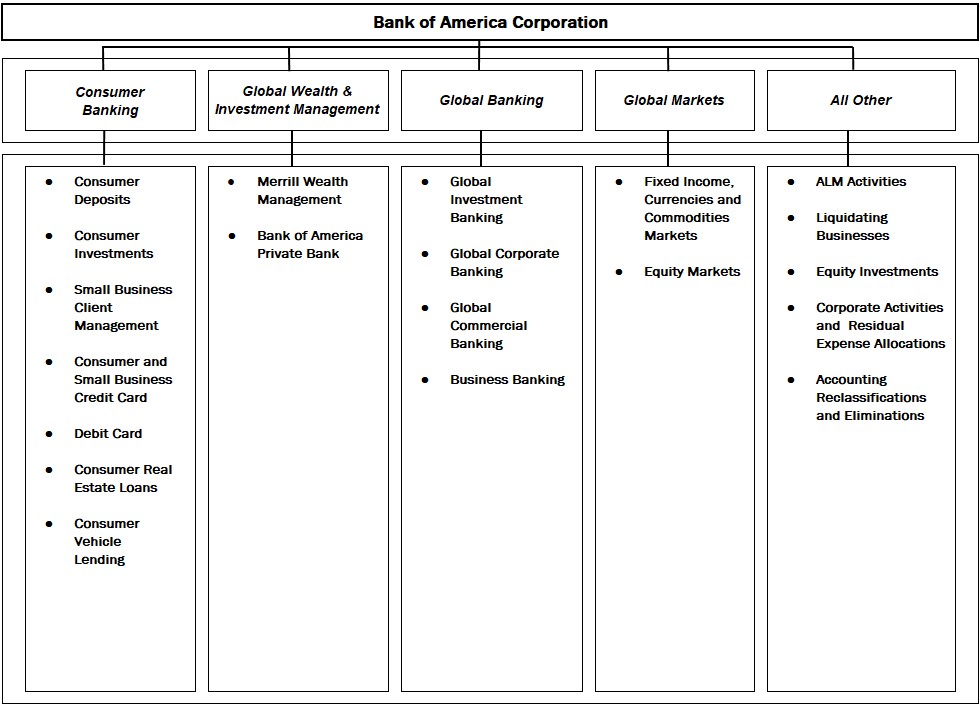
We periodically review capital allocated to our businesses and allocate capital annually during the strategic and capital planning processes. We utilize a methodology that considers the effect of regulatory capital requirements in addition to internal risk-based capital models. Our internal risk-based capital models use a risk-adjusted methodology incorporating each segment’s credit, market, interest rate, business and operational risk components. For more information on the nature of these risks, see Managing Risk on page 45. The capital allocated to the business segments is referred to as allocated capital.
For more information on our presentation of financial information on an FTE basis, see Supplemental Financial Data on page 31, and for reconciliations to consolidated total revenue, net income and year--end total assets, see Note 23 – Business Segment Information to the Consolidated Financial Statements.
Key Performance Indicators
We present certain key financial and nonfinancial performance indicators that management uses when evaluating segment results. We believe they are useful to investors because they provide additional information about our segments’ operational performance, client trends and business growth. These KPIs may not be defined or calculated in the same way as similar KPIs used by other companies.
Bank of America 36 | ||||||||
Consumer Banking
| (Dollars in millions) | 2025 | 2024 | % Change | |||||||||||||||||
| Net interest income | $ | 35,309 | $ | 33,078 | 7 | % | ||||||||||||||
| Noninterest income: | ||||||||||||||||||||
| Card income | 5,456 | 5,432 | — | |||||||||||||||||
| Service charges | 2,528 | 2,445 | 3 | |||||||||||||||||
| All other income | 380 | 481 | (21) | |||||||||||||||||
| Total noninterest income | 8,364 | 8,358 | — | |||||||||||||||||
Total revenue, net of interest expense | 43,673 | 41,436 | 5 | |||||||||||||||||
| Provision for credit losses | 4,649 | 4,987 | (7) | |||||||||||||||||
| Noninterest expense | 22,697 | 22,104 | 3 | |||||||||||||||||
| Income before income taxes | 16,327 | 14,345 | 14 | |||||||||||||||||
| Income tax expense | 4,082 | 3,586 | 14 | |||||||||||||||||
| Net income | $ | 12,245 | $ | 10,759 | 14 | |||||||||||||||
Effective tax rate | 25.0 | % | 25.0 | % | ||||||||||||||||
| Net interest yield | 3.56 | 3.34 | ||||||||||||||||||
| Efficiency ratio | 51.97 | 53.35 | ||||||||||||||||||
| Return on average allocated capital | 28 | 25 | ||||||||||||||||||
| Balance Sheet | ||||||||||||||||||||
| Average | ||||||||||||||||||||
| Total loans and leases | $ | 319,312 | $ | 313,792 | 2 | % | ||||||||||||||
Total earning assets | 992,579 | 988,950 | — | |||||||||||||||||
Total assets | 1,030,094 | 1,026,310 | — | |||||||||||||||||
| Total deposits | 948,078 | 945,549 | — | |||||||||||||||||
| Allocated capital | 44,000 | 43,250 | 2 | |||||||||||||||||
| Year End | ||||||||||||||||||||
| Total loans and leases | $ | 325,871 | $ | 318,754 | 2 | % | ||||||||||||||
Total earning assets | 998,969 | 995,369 | — | |||||||||||||||||
Total assets | 1,039,346 | 1,034,370 | — | |||||||||||||||||
| Total deposits | 956,265 | 952,311 | — | |||||||||||||||||
Consumer Banking offers a diversified range of lending, deposit and investment products and services to consumers and small businesses. Consumer Banking includes the net impact of migrating customers and their related deposit, brokerage asset and loan balances between Consumer Banking and GWIM, as well as other client-managed businesses. Our customers and clients have access to a coast-to-coast network, including financial centers in 38 states and the District of Columbia. As of December 31, 2025, our network includes approximately 3,600 financial centers, approximately 15,000 ATMs, nationwide call centers and leading digital banking platforms with approximately 49 million active users, including approximately 41 million active mobile users.
Consumer Banking Results
Net income for Consumer Banking increased $1.5 billion to $12.2 billion primarily due to higher revenue and lower provision for credit losses, partially offset by higher noninterest expense. Net interest income increased $2.2 billion to $35.3 billion primarily driven by higher deposit spreads, as well as loan and deposit balances. Noninterest income was $8.4 billion, relatively unchanged from the same period a year ago.
The provision for credit losses decreased $338 million to $4.6 billion primarily due to improved asset quality in credit card. Noninterest expense increased $593 million to $22.7 billion primarily driven by investments in the business, including people and marketing.
The return on average allocated capital was 28 percent, up from 25 percent, due to higher net income, partially offset by an increase in allocated capital. For information on capital allocated to the business segments, see Business Segment Operations on page 36.
Average loans and leases increased $5.5 billion to $319.3 billion due to growth across all products.
Average deposits increased $2.5 billion to $948.1 billion primarily due to growth in time deposits of $16.5 billion and net inflows of $7.2 billion in checking, partially offset by net outflows of $21.1 billion in money market and other savings.
Consumer investment assets increased $81.3 billion to $599.1 billion driven by higher market valuations and positive net client flows.
Key Statistics
The following table provides key performance indicators for deposit spreads, other period-end information, credit and debit card and loan production activities.
37 Bank of America | ||||||||
| Key Statistics | |||||||||||
| (Dollars in millions) | 2025 | 2024 | |||||||||
Deposit Spreads | |||||||||||
Total deposit spreads (excludes noninterest costs) | 2.92% | 2.77% | |||||||||
| Year end | |||||||||||
Consumer investment assets (in millions) (1) | $ | 599,110 | $ | 517,835 | |||||||
Active digital banking users (in thousands) (2) | 49,323 | 48,150 | |||||||||
Active mobile banking users (in thousands) (3) | 41,427 | 39,958 | |||||||||
| Financial centers | 3,628 | 3,700 | |||||||||
| ATMs | 14,909 | 14,893 | |||||||||
Credit and Debit Card | |||||||||||
Total credit card (4) | |||||||||||
Gross interest yield (5) | 12.02 | % | 12.30 | % | |||||||
Risk-adjusted margin (6) | 7.06 | 6.98 | |||||||||
| New accounts (in thousands) | 3,531 | 3,820 | |||||||||
| Purchase volumes | $ | 377,760 | $ | 368,861 | |||||||
| Debit card purchase volumes | 594,603 | 557,000 | |||||||||
Loan Production (7) | |||||||||||
| Consumer Banking: | |||||||||||
| First mortgage | $ | 12,137 | $ | 10,252 | |||||||
| Home equity | 8,560 | 7,450 | |||||||||
Total (8): | |||||||||||
| First mortgage | $ | 26,326 | $ | 21,104 | |||||||
| Home equity | 10,400 | 8,884 | |||||||||
(1)Includes client brokerage assets, deposit sweep balances, brokered CDs and AUM in Consumer Banking.
(2)Represents mobile and/or online active users over the past 90 days.
(3)Represents mobile active users over the past 90 days.
(4)Includes consumer credit card portfolios in Consumer Banking and GWIM.
(5)Calculated as the effective annual percentage rate divided by average loans.
(6)Calculated as the difference between total revenue, net of interest expense, and net charge-offs divided by average loans.
(7)The loan production amounts represent the unpaid principal balance of loans and, in the case of home equity, the principal amount of the total line of credit.
(8)In addition to loan production in Consumer Banking, there is also first mortgage and home equity loan production in GWIM.
Active mobile banking users increased by more than one million, reflecting client growth and continuing changes in our clients’ banking preferences. We had a net decrease of 72 financial centers and an increase of 16 ATMs as we continued to optimize our consumer banking network.
During 2025, the total risk-adjusted margin increased eight bps primarily driven by higher net interest margin and lower net charge-offs, partially offset by lower fee income. Total credit card purchase volumes increased $8.9 billion, and debit card purchase volumes increased $37.6 billion, reflecting higher levels of consumer spending.
During 2025, first mortgage loan originations for Consumer Banking increased $1.9 billion, and first mortgage loan originations for the total Corporation increased $5.2 billion, primarily driven by higher demand.
During 2025, home equity production in Consumer Banking increased $1.1 billion, and home equity production for the total Corporation increased $1.5 billion, primarily driven by higher demand.
Bank of America 38 | ||||||||
Global Wealth & Investment Management
| (Dollars in millions) | 2025 | 2024 | % Change | |||||||||||||||||
| Net interest income | $ | 7,197 | $ | 6,969 | 3 | % | ||||||||||||||
| Noninterest income: | ||||||||||||||||||||
| Investment and brokerage services | 17,019 | 15,238 | 12 | |||||||||||||||||
| All other income | 667 | 722 | (8) | |||||||||||||||||
| Total noninterest income | 17,686 | 15,960 | 11 | |||||||||||||||||
| Total revenue, net of interest expense | 24,883 | 22,929 | 9 | |||||||||||||||||
| Provision for credit losses | 35 | 4 | n/m | |||||||||||||||||
| Noninterest expense | 18,621 | 17,241 | 8 | |||||||||||||||||
| Income before income taxes | 6,227 | 5,684 | 10 | |||||||||||||||||
| Income tax expense | 1,557 | 1,421 | 10 | |||||||||||||||||
| Net income | $ | 4,670 | $ | 4,263 | 10 | |||||||||||||||
| Effective tax rate | 25.0 | % | 25.0 | % | ||||||||||||||||
| Net interest yield | 2.32 | 2.20 | ||||||||||||||||||
| Efficiency ratio | 74.84 | 75.19 | ||||||||||||||||||
| Return on average allocated capital | 24 | 23 | ||||||||||||||||||
| Balance Sheet | ||||||||||||||||||||
| Average | ||||||||||||||||||||
| Total loans and leases | $ | 243,123 | $ | 223,899 | 9 | % | ||||||||||||||
| Total earning assets | 309,890 | 317,283 | (2) | |||||||||||||||||
| Total assets | 323,914 | 331,014 | (2) | |||||||||||||||||
| Total deposits | 279,776 | 287,491 | (3) | |||||||||||||||||
| Allocated capital | 19,750 | 18,500 | 7 | |||||||||||||||||
| Year end | ||||||||||||||||||||
| Total loans and leases | $ | 261,303 | $ | 231,981 | 13 | % | ||||||||||||||
| Total earning assets | 320,899 | 323,496 | (1) | |||||||||||||||||
| Total assets | 335,495 | 338,367 | (1) | |||||||||||||||||
| Total deposits | 289,854 | 292,278 | (1) | |||||||||||||||||
GWIM consists of two primary businesses: Merrill Wealth Management and Bank of America Private Bank.
Merrill Wealth Management’s advisory business provides a high-touch client experience through a network of financial advisors focused on clients with over $250,000 in total investable assets. Merrill Wealth Management provides tailored solutions to meet clients’ needs through a full set of investment management, brokerage, banking and retirement products.
Bank of America Private Bank, together with Merrill Wealth Management’s Private Wealth Management business, provides comprehensive wealth management solutions targeted to high net worth and ultra high net worth clients, as well as customized solutions to meet clients’ wealth structuring, investment management, trust and banking needs, including specialty asset management services.
Net income for GWIM increased $407 million to $4.7 billion primarily due to higher revenue, partially offset by higher noninterest expense. The operating margin was 25 percent in both 2025 and 2024.
Net interest income increased $228 million to $7.2 billion primarily driven by loan growth.
Noninterest income, which primarily includes investment and brokerage services income, increased $1.7 billion to $17.7 billion. The increase was primarily driven by higher asset management fees, which increased 12 percent to $15.4 billion, reflecting higher market valuations and the impact of positive AUM flows as well as higher brokerage fees due to increased transactional volume, partially offset by the impact of lower AUM pricing.
Noninterest expense increased $1.4 billion to $18.6 billion primarily due to higher revenue-related incentives and investments in the business, including people and technology.
The return on average allocated capital was 24 percent, up from 23 percent, due to higher net income, partially offset by an increase in allocated capital. For information on capital allocated to the business segments, see Business Segment Operations on page 36.
Average loans and leases increased $19.2 billion to $243.1 billion primarily driven by custom lending, securities-based lending and residential mortgage. Average deposits decreased $7.7 billion to $279.8 billion primarily driven by clients moving deposits to higher yielding investment cash alternatives, including offerings on our investment and brokerage platforms, as well as a higher level of client tax payments.
Merrill Wealth Management revenue of $20.7 billion increased nine percent primarily driven by higher asset management fees reflecting higher market valuations and the impact of positive AUM flows, as well as higher brokerage fees due to increased transactional volume.
Bank of America Private Bank revenue of $4.2 billion increased eight percent primarily driven by higher net interest income from loan and deposit growth, as well as higher asset management fees reflecting higher market valuations and the impact of positive AUM flows.
39 Bank of America | ||||||||
Key Indicators and Metrics | |||||||||||
| (Dollars in millions) | 2025 | 2024 | |||||||||
| Revenue by Business | |||||||||||
| Merrill Wealth Management | $ | 20,716 | $ | 19,066 | |||||||
| Bank of America Private Bank | 4,167 | 3,863 | |||||||||
| Total revenue, net of interest expense | $ | 24,883 | $ | 22,929 | |||||||
| Client Balances by Business, at year end | |||||||||||
| Merrill Wealth Management | $ | 3,992,312 | $ | 3,578,513 | |||||||
Bank of America Private Bank | 759,082 | 673,593 | |||||||||
| Total client balances | $ | 4,751,394 | $ | 4,252,106 | |||||||
| Client Balances by Type, at year end | |||||||||||
| Assets under management | $ | 2,177,708 | $ | 1,882,211 | |||||||
| Brokerage and other assets | 2,067,937 | 1,888,334 | |||||||||
| Deposits | 289,854 | 292,278 | |||||||||
Loans and leases (1) | 263,819 | 234,208 | |||||||||
| Less: Managed deposits in assets under management | (47,924) | (44,925) | |||||||||
| Total client balances | $ | 4,751,394 | $ | 4,252,106 | |||||||
| Assets Under Management Rollforward | |||||||||||
| Assets under management, beginning of year | $ | 1,882,211 | $ | 1,617,740 | |||||||
| Net client flows | 81,997 | 79,227 | |||||||||
Market valuation/other | 213,500 | 185,244 | |||||||||
| Total assets under management, end of year | $ | 2,177,708 | $ | 1,882,211 | |||||||
(1)Includes margin receivables, which are classified in customer and other receivables on the Consolidated Balance Sheet.
Client Balances
Client balances managed under advisory and/or discretion of GWIM are AUM and are typically held in diversified portfolios. Fees earned on AUM are calculated as a percentage of clients’ AUM balances. The asset management fees charged to clients per year depend on various factors but are commonly driven by the breadth of the client’s relationship. The net client AUM flows
represent the net change in clients’ AUM balances over a specified period of time, excluding market appreciation/depreciation and other adjustments.
Client balances increased $499.3 billion, or 12 percent, to $4.8 trillion at December 31, 2025 compared to December 31, 2024. The increase in client balances was driven by higher market valuations and positive net client flows.
Bank of America 40 | ||||||||
Global Banking
| (Dollars in millions) | 2025 | 2024 | % Change | |||||||||||||||||
| Net interest income | $ | 12,611 | $ | 13,235 | (5) | % | ||||||||||||||
| Noninterest income: | ||||||||||||||||||||
| Service charges | 3,438 | 3,135 | 10 | |||||||||||||||||
| Investment banking fees | 3,742 | 3,453 | 8 | |||||||||||||||||
| All other income | 4,317 | 3,925 | 10 | |||||||||||||||||
| Total noninterest income | 11,497 | 10,513 | 9 | |||||||||||||||||
| Total revenue, net of interest expense | 24,108 | 23,748 | 2 | |||||||||||||||||
| Provision for credit losses | 943 | 883 | 7 | |||||||||||||||||
| Noninterest expense | 12,416 | 11,853 | 5 | |||||||||||||||||
| Income before income taxes | 10,749 | 11,012 | (2) | |||||||||||||||||
| Income tax expense | 2,956 | 3,028 | (2) | |||||||||||||||||
| Net income | $ | 7,793 | $ | 7,984 | (2) | |||||||||||||||
| Effective tax rate | 27.5 | % | 27.5 | % | ||||||||||||||||
| Net interest yield | 1.94 | 2.29 | ||||||||||||||||||
| Efficiency ratio | 51.51 | 49.91 | ||||||||||||||||||
| Return on average allocated capital | 15 | 16 | ||||||||||||||||||
| Balance Sheet | ||||||||||||||||||||
| Average | ||||||||||||||||||||
Total loans and leases | $ | 385,379 | $ | 373,227 | 3 | % | ||||||||||||||
| Total earning assets | 650,829 | 577,481 | 13 | |||||||||||||||||
| Total assets | 715,866 | 643,337 | 11 | |||||||||||||||||
| Total deposits | 616,831 | 545,769 | 13 | |||||||||||||||||
| Allocated capital | 50,750 | 49,250 | 3 | |||||||||||||||||
| Year end | ||||||||||||||||||||
| Total loans and leases | $ | 388,998 | $ | 379,473 | 3 | % | ||||||||||||||
| Total earning assets | 671,354 | 605,499 | 11 | |||||||||||||||||
| Total assets | 734,710 | 670,505 | 10 | |||||||||||||||||
| Total deposits | 641,211 | 578,159 | 11 | |||||||||||||||||
Global Banking, which includes Global Corporate Banking, Global Commercial Banking, Business Banking and Global Investment Banking, provides a wide range of lending-related products and services, integrated working capital management and treasury solutions, and underwriting and advisory services through our network of global offices and client relationship teams. Our lending products and services include commercial loans, leases, commitment facilities, trade finance, commercial real estate lending and asset-based lending. Our treasury solutions business includes deposits, treasury management, corporate credit card, merchant services, foreign exchange and short-term investment products. We also provide investment banking services to our clients such as debt and equity underwriting and distribution, and merger-related and other advisory services. Underwriting debt and equity issuances, fixed-income and equity research, and certain market-based activities are executed through our global broker-dealer affiliates, which are our primary dealers in several countries. Within Global Banking, Global Corporate Banking clients generally include large global corporations, financial institutions and leasing clients. Global Commercial Banking clients generally include middle-market companies, commercial real estate firms and not-for-profit companies. Business Banking clients include mid-sized U.S.-based businesses requiring customized and integrated financial advice and solutions.
Net income for Global Banking decreased $191 million to $7.8 billion driven by higher noninterest expense and provision for credit losses, partially offset by higher revenue.
Net interest income decreased $624 million to $12.6 billion primarily due to the impact of lower interest rates, partially offset by the benefit of higher average deposit and loan balances.
Noninterest income increased $984 million to $11.5 billion primarily due to sales of certain leveraged finance positions, higher investment banking fees and higher treasury service charges.
The provision for credit losses increased $60 million to $943 million driven by the commercial and industrial portfolio, partially offset by improvement within the commercial real estate portfolio.
Noninterest expense increased $563 million to $12.4 billion primarily due to continued investments in the business, including people, technology and operations, as well as higher regulatory costs.
The return on average allocated capital was 15 percent, down from 16 percent, due to lower net income and an increase in allocated capital. For information on capital allocated to the business segments, see Business Segment Operations on page 36.
41 Bank of America | ||||||||
Global Corporate, Global Commercial and Business Banking
Global Corporate, Global Commercial and Business Banking each include Business Lending and Global Transaction Services activities. Business Lending includes various lending-related products and services, and related hedging activities, including commercial loans, leases, commitment facilities, trade finance,
commercial real estate lending and asset-based lending. Global Transaction Services includes deposits, treasury management, corporate credit card, merchant services, foreign exchange and short-term investment products. The table below and discussion present a summary of the results, which exclude certain investment banking and other activities in Global Banking.
| Global Corporate, Global Commercial and Business Banking | ||||||||||||||||||||||||||||||||||||||||||||||||||
| Global Corporate Banking | Global Commercial Banking | Business Banking | Total | |||||||||||||||||||||||||||||||||||||||||||||||
| (Dollars in millions) | 2025 | 2024 | 2025 | 2024 | 2025 | 2024 | 2025 | 2024 | ||||||||||||||||||||||||||||||||||||||||||
| Revenue | ||||||||||||||||||||||||||||||||||||||||||||||||||
| Business Lending | $ | 4,031 | $ | 4,339 | $ | 4,566 | $ | 4,941 | $ | 216 | $ | 231 | $ | 8,813 | $ | 9,511 | ||||||||||||||||||||||||||||||||||
| Global Transaction Services | 5,299 | 5,125 | 4,224 | 3,906 | 1,488 | 1,474 | 11,011 | 10,505 | ||||||||||||||||||||||||||||||||||||||||||
Total revenue, net of interest expense | $ | 9,330 | $ | 9,464 | $ | 8,790 | $ | 8,847 | $ | 1,704 | $ | 1,705 | $ | 19,824 | $ | 20,016 | ||||||||||||||||||||||||||||||||||
| Balance Sheet | ||||||||||||||||||||||||||||||||||||||||||||||||||
| Average | ||||||||||||||||||||||||||||||||||||||||||||||||||
Total loans and leases | $ | 174,993 | $ | 164,179 | $ | 198,414 | $ | 196,650 | $ | 11,913 | $ | 12,272 | $ | 385,320 | $ | 373,101 | ||||||||||||||||||||||||||||||||||
Total deposits | 347,396 | 300,154 | 215,160 | 193,533 | 54,275 | 52,081 | 616,831 | 545,768 | ||||||||||||||||||||||||||||||||||||||||||
| Year end | ||||||||||||||||||||||||||||||||||||||||||||||||||
| Total loans and leases | $ | 179,314 | $ | 173,013 | $ | 197,313 | $ | 194,529 | $ | 12,358 | $ | 11,791 | $ | 388,985 | $ | 379,333 | ||||||||||||||||||||||||||||||||||
| Total deposits | 348,798 | 316,214 | 234,887 | 209,792 | 57,523 | 52,152 | 641,208 | 578,158 | ||||||||||||||||||||||||||||||||||||||||||
Business Lending revenue decreased $698 million in 2025 compared to 2024 primarily driven by lower net interest income.
Global Transaction Services revenue increased $506 million in 2025 compared to 2024 primarily driven by the benefit of higher average deposit balances and higher treasury service charges, partially offset by the impact of lower interest rates.
Average loans and leases of $385.3 billion increased three percent in 2025 compared to 2024 due to client demand. Average deposits of $616.8 billion increased 13 percent in 2025 compared to 2024 due to growth in deposit balances from existing clients and the addition of new clients.
Global Investment Banking
Client teams and product specialists underwrite and distribute debt, equity and loan products, and provide advisory services and tailored risk management solutions. The economics of certain investment banking and underwriting activities are shared primarily between Global Banking and Global Markets under an internal revenue-sharing arrangement. Global Banking originates certain deal-related transactions with our corporate and commercial clients that are executed and distributed by Global Markets. To provide a complete discussion of our
consolidated investment banking fees, the table below presents total Corporation investment banking fees and the portion attributable to Global Banking.
| Investment Banking Fees | |||||||||||||||||||||||
| Global Banking | Total Corporation | ||||||||||||||||||||||
| (Dollars in millions) | 2025 | 2024 | 2025 | 2024 | |||||||||||||||||||
| Products | |||||||||||||||||||||||
| Advisory | $ | 1,707 | $ | 1,504 | $ | 1,890 | $ | 1,690 | |||||||||||||||
| Debt issuance | 1,548 | 1,398 | 3,698 | 3,310 | |||||||||||||||||||
| Equity issuance | 487 | 551 | 1,259 | 1,354 | |||||||||||||||||||
Gross investment banking fees | 3,742 | 3,453 | 6,847 | 6,354 | |||||||||||||||||||
| Self-led deals | (69) | (32) | (217) | (168) | |||||||||||||||||||
Total investment banking fees | $ | 3,673 | $ | 3,421 | $ | 6,630 | $ | 6,186 | |||||||||||||||
Total Corporation investment banking fees, which exclude self-led deals and are primarily included within Global Banking and Global Markets, increased seven percent to $6.6 billion compared to the same period in 2024 primarily due to higher debt issuance and advisory fees, partially offset by lower equity issuance fees.
Bank of America 42 | ||||||||
Global Markets
| (Dollars in millions) | 2025 | 2024 | % Change | |||||||||||||||||
| Net interest income | $ | 5,690 | $ | 3,375 | 69 | % | ||||||||||||||
| Noninterest income: | ||||||||||||||||||||
| Investment and brokerage services | 2,511 | 2,128 | 18 | |||||||||||||||||
| Investment banking fees | 2,837 | 2,655 | 7 | |||||||||||||||||
| Market making and similar activities | 12,064 | 12,778 | (6) | |||||||||||||||||
| All other income | 994 | 876 | 13 | |||||||||||||||||
| Total noninterest income | 18,406 | 18,437 | — | |||||||||||||||||
| Total revenue, net of interest expense | 24,096 | 21,812 | 10 | |||||||||||||||||
| Provision for credit losses | 71 | (32) | n/m | |||||||||||||||||
| Noninterest expense | 15,418 | 13,926 | 11 | |||||||||||||||||
| Income before income taxes | 8,607 | 7,918 | 9 | |||||||||||||||||
| Income tax expense | 2,496 | 2,296 | 9 | |||||||||||||||||
| Net income | $ | 6,111 | $ | 5,622 | 9 | |||||||||||||||
| Effective tax rate | 29.0 | % | 29.0 | % | ||||||||||||||||
| Efficiency ratio | 63.99 | 63.85 | ||||||||||||||||||
| Return on average allocated capital | 13 | 12 | ||||||||||||||||||
| Balance Sheet | ||||||||||||||||||||
| Average | ||||||||||||||||||||
| Trading-related assets: | ||||||||||||||||||||
| Trading account securities | $ | 352,548 | $ | 324,065 | 9 | % | ||||||||||||||
| Reverse repurchases | 145,925 | 137,052 | 6 | |||||||||||||||||
| Securities borrowed | 138,791 | 135,108 | 3 | |||||||||||||||||
| Derivative assets | 40,699 | 37,795 | 8 | |||||||||||||||||
| Total trading-related assets | 677,963 | 634,020 | 7 | |||||||||||||||||
| Total loans and leases | 181,334 | 140,557 | 29 | |||||||||||||||||
| Total earning assets | 806,901 | 710,604 | 14 | |||||||||||||||||
| Total assets | 1,010,898 | 911,657 | 11 | |||||||||||||||||
| Total deposits | 38,074 | 34,120 | 12 | |||||||||||||||||
| Allocated capital | 49,000 | 45,500 | 8 | |||||||||||||||||
| Year end | ||||||||||||||||||||
| Total trading-related assets | $ | 670,949 | $ | 580,557 | 16 | % | ||||||||||||||
| Total loans and leases | 202,733 | 157,450 | 29 | |||||||||||||||||
| Total earning assets | 814,196 | 687,678 | 18 | |||||||||||||||||
| Total assets | 1,032,858 | 876,548 | 18 | |||||||||||||||||
| Total deposits | 40,614 | 38,848 | 5 | |||||||||||||||||
Global Markets offers sales and trading services and research services to institutional clients across fixed-income, credit, currency, commodity and equity businesses. Global Markets product coverage includes securities and derivative products in both the primary and secondary markets. Global Markets provides market-making, financing, securities clearing, settlement and custody services globally to our institutional investor clients in support of their investing and trading activities. We also work with our commercial and corporate clients to provide risk management products using interest rate, equity, credit, currency and commodity derivatives, foreign exchange, fixed-income and mortgage-related products. As a result of our market-making activities in these products, we may be required to manage risk in a broad range of financial products including government securities, equity and equity-linked securities, high-grade and high-yield corporate debt securities, syndicated loans, MBS, commodities and asset-backed securities. The economics of certain investment banking and underwriting activities are shared primarily between Global Markets and Global Banking under an internal revenue-sharing arrangement. Global Banking originates certain deal-related transactions with our corporate and commercial clients that are executed and distributed by Global Markets. For information on
investment banking fees on a consolidated basis, see page 42.
The following explanations for year-over-year changes in results for Global Markets, including those disclosed under Sales and Trading Revenue, are the same for amounts including and excluding net DVA. Amounts excluding net DVA are a non-GAAP financial measure. For more information on net DVA, see Supplemental Financial Data on page 31.
Net income for Global Markets increased $489 million to $6.1 billion. Net DVA losses were $35 million compared to $113 million in 2024. Excluding net DVA, net income increased $430 million to $6.1 billion. These increases were primarily driven by higher revenue, partially offset by higher noninterest expense.
Revenue increased $2.3 billion to $24.1 billion primarily due to higher sales and trading revenue, sales of certain leveraged finance positions and higher investment banking fees. Sales and trading revenue increased $2.1 billion, and excluding net DVA, increased $2.0 billion. These increases were driven by higher revenue in Equities and FICC. Noninterest expense increased $1.5 billion to $15.4 billion primarily driven by higher revenue-related expenses and continued investments in the business, including people and technology.
43 Bank of America | ||||||||
Average total assets increased $99.2 billion to $1.0 trillion, driven by loan growth, higher levels of inventory and increased financing activity. Year-end total assets increased $156.3 billion to $1.0 trillion driven by the same factors as average total assets.
The return on average allocated capital was 13 percent, up from 12 percent, due to an increase in net income, partially offset by higher allocated capital. For information on capital allocated to the business segments, see Business Segment Operations on page 36.
Sales and Trading Revenue
Sales and trading revenue includes unrealized and realized gains and losses on trading and other assets that are included in market making and similar activities, net interest income, and fees primarily from commissions on equity securities. Sales and trading revenue is segregated into fixed-income (government debt obligations, investment and non-investment grade corporate debt obligations, commercial MBS, residential mortgage-backed securities, collateralized loan obligations, interest rate and credit derivative contracts), currencies (interest rate and foreign exchange contracts), commodities (primarily futures, forwards, swaps and options) and equities (equity-linked derivatives and cash equity activity). The following table and related discussion present sales and trading revenue, substantially all of which is in Global Markets, with the remainder in Global Banking. In addition, the following table and related discussion also present sales and trading revenue,
excluding net DVA, which is a non-GAAP financial measure. For more information on net DVA, see Supplemental Financial Data on page 31.
Sales and Trading Revenue (1, 2, 3) | |||||||||||
| (Dollars in millions) | 2025 | 2024 | |||||||||
Sales and trading revenue (2) | |||||||||||
| Fixed-income, currencies and commodities | $ | 12,267 | $ | 11,371 | |||||||
| Equities | 8,604 | 7,436 | |||||||||
| Total sales and trading revenue | $ | 20,871 | $ | 18,807 | |||||||
Sales and trading revenue, excluding net DVA (4) | |||||||||||
| Fixed-income, currencies and commodities | $ | 12,308 | $ | 11,468 | |||||||
| Equities | 8,598 | 7,452 | |||||||||
| Total sales and trading revenue, excluding net DVA | $ | 20,906 | $ | 18,920 | |||||||
(1)For more information on sales and trading revenue, see Note 3 – Derivatives to the Consolidated Financial Statements.
(2)Includes FTE adjustments of $708 million and $890 million for 2025 and 2024.
(3)Includes Global Banking sales and trading revenue of $530 million and $677 million for 2025 and 2024.
(4)FICC and Equities sales and trading revenue, excluding net DVA, is a non-GAAP financial measure. FICC net DVA losses were $41 million and $97 million for 2025 and 2024. Equities net DVA gains (losses) were $6 million and $(16) million for 2025 and 2024.
Including and excluding net DVA, FICC revenue increased $896 million and $840 million driven by improved trading performance in macro products. Including and excluding net DVA, Equities revenue increased $1.2 billion and $1.1 billion driven by increased client activity.
All Other
| (Dollars in millions) | 2025 | 2024 | % Change | |||||||||||||||||
| Net interest income | $ | (102) | $ | 22 | n/m | |||||||||||||||
| Noninterest income (loss) | (2,952) | (3,472) | (15) | % | ||||||||||||||||
| Total revenue, net of interest expense | (3,054) | (3,450) | (11) | |||||||||||||||||
| Provision for credit losses | (23) | (21) | 10 | |||||||||||||||||
| Noninterest expense | 575 | 1,688 | (66) | |||||||||||||||||
| Loss before income taxes | (3,606) | (5,117) | (30) | |||||||||||||||||
| Income tax benefit | (3,296) | (3,462) | (5) | |||||||||||||||||
| Net loss | $ | (310) | $ | (1,655) | (81) | |||||||||||||||
| Balance Sheet | ||||||||||||||||||||
| Average | ||||||||||||||||||||
| Total loans and leases | $ | 7,639 | $ | 8,606 | (11) | % | ||||||||||||||
Total assets (1) | 329,640 | 369,727 | (11) | |||||||||||||||||
| Total deposits | 101,423 | 111,177 | (9) | |||||||||||||||||
| Year end | ||||||||||||||||||||
| Total loans and leases | $ | 6,795 | $ | 8,177 | (17) | % | ||||||||||||||
Total assets (1) | 269,329 | 341,509 | (21) | |||||||||||||||||
| Total deposits | 90,785 | 103,871 | (13) | |||||||||||||||||
(1)In segments where the total of liabilities and equity exceeds assets, which are generally deposit-taking segments, we allocate assets from All Other to those segments to match liabilities (i.e., deposits) and allocated shareholders’ equity. Average allocated assets were $990.6 billion and $956.5 billion for 2025 and 2024 and year-end allocated assets were $1.0 trillion and $980.4 billion at December 31, 2025 and 2024.
n/m = not meaningful
All Other primarily consists of asset and liability management (ALM) activities, liquidating businesses and certain expenses not otherwise allocated to a business segment, and adjustments to allocate income tax benefits from tax-related equity investments to noninterest income to present Global Banking and Global Markets on an FTE basis. For more information, see Note 23 – Business Segment Information to the Consolidated Financial Statements.
The net loss in All Other decreased $1.3 billion to $310 million primarily due to lower noninterest expense and a lower loss in noninterest income, partially offset by a lower income tax benefit.
The loss in noninterest income decreased $520 million primarily due to a reduction in the volume of tax-related equity investments and lower valuation losses on certain derivatives.
Noninterest expense decreased $1.1 billion to $575 million primarily due to a reduction in the Corporation’s accrual in 2025 for the FDIC special assessment compared to an increase in the accrual in 2024, and lower expenses related to a liquidating business activity.
The income tax benefit decreased $166 million primarily due to a lower pretax loss.
Bank of America 44 | ||||||||
Managing Risk
Risk is inherent in all our business activities. Sound risk management enables us to serve our customers and deliver for our shareholders. If not managed well, risk can result in financial loss, regulatory sanctions and penalties, litigation, and damage to our reputation, each of which may adversely impact our ability to execute our business strategies. We take a comprehensive approach to risk management with a defined Risk Framework and an articulated Risk Appetite Statement, which are approved annually by the Board’s Enterprise Risk Committee (ERC) and the Board.
The seven key types of risk faced by the Corporation are strategic, credit, market, liquidity, compliance, operational and reputational.
● Strategic risk is the risk to current or projected financial condition arising from incorrect assumptions about external or internal factors, inappropriate business plans, ineffective business strategy execution or failure to respond in a timely manner to changes in the regulatory, macroeconomic or competitive environments in the geographic locations in which we operate.
● Credit risk is the risk of loss arising from the inability or failure of a borrower or counterparty to meet its obligations.
● Market risk is the risk that changes in market conditions adversely impact the value of assets or liabilities or otherwise negatively impact earnings. Market risk is composed of price risk and interest rate risk.
● Liquidity risk is the risk of the inability to meet expected or unexpected cash flow and collateral needs while continuing to support our businesses and customers under a range of economic conditions.
● Compliance risk is the risk of legal action or regulatory sanctions, material financial loss or damage to the reputation of the Corporation arising from the failure of the Corporation to comply with the requirements of applicable laws, rules and regulations (LRRs) and our internal policies and procedures.
● Operational risk is the risk of loss resulting from inadequate or failed internal processes or systems, people or external events.
● Reputational risk is the risk that negative perception of the Corporation may materially impact its financial condition.
The following sections address in more detail the specific procedures, measures and analyses of the major categories of risk.
As set forth in our Risk Framework, a culture of managing risk well is fundamental to our values and our purpose, and how we drive Responsible Growth. It requires us to focus on risk in all activities and encourages the necessary mindset and behavior to enable effective risk management and promote sound risk-taking within our risk appetite. Sustaining a culture of managing risk well throughout the organization is critical to the success of the Corporation and is a clear expectation of our executive management team and the Board.
Our Risk Framework serves as the foundation for the consistent and effective management of risks facing the Corporation. The Risk Framework sets forth roles and responsibilities for the management of risk and provides a blueprint for how the Board, through delegation of authority to committees and executive officers, establishes risk appetite and associated limits for our activities.
Executive management assesses, with Board oversight, the risk-adjusted returns of each business. Management reviews and approves the strategic and financial operating plans, as well as the capital plan and Risk Appetite Statement, and recommends them annually to the Board for approval. Our strategic plan takes into consideration return objectives and financial resources, which must align with risk capacity and risk appetite. Management sets financial objectives for each business by allocating capital and setting a target for return on capital for each business. Capital allocations are regularly evaluated as part of our overall governance processes as the businesses and the economic environment in which we operate continue to evolve. For more information regarding capital allocations, see Business Segment Operations on page 36.
The Corporation’s risk appetite indicates the amount of capital, earnings or liquidity we are willing to put at risk to achieve our strategic objectives and business plans, consistent with applicable regulatory requirements. It also provides a common framework that includes a set of measures to assist senior management and the Board in assessing the Corporation’s risk profile across all risk types against our risk appetite and risk capacity. Our risk appetite is formally articulated in the Risk Appetite Statement, which includes both qualitative statements and quantitative limits.
Our overall capacity to take risk is limited. Accordingly, we prioritize the risks we take in order to maintain a strong and flexible financial position so we can weather challenging economic times and take advantage of organic growth opportunities while complying with all applicable regulatory requirements. Therefore, we set objectives and targets for capital and liquidity that permit us to continue to operate in a safe and sound manner at all times, including during periods of stress. We also maintain strong operational risk management and operational resiliency capabilities so we can meet the expectations of our customers and clients through a range of operating conditions.
Our lines of business operate with risk limits that align with the Corporation’s risk appetite. Management is responsible for tracking and reporting performance measurements as well as any breaches or exceptions to risk appetite limits. The Board, and its committees when appropriate, oversee financial performance, execution of the strategic and financial operating plans, adherence to risk appetite limits and the adequacy of internal controls.
For a more detailed discussion of our risk management activities, see the discussion below and pages 48 through 83.
Risk Management Governance
The Risk Framework describes delegations of authority whereby the Board and its committees may delegate authority to management-level committees or executive officers. Such delegations may authorize certain decision-making and approval functions, which may be evidenced in documents such as committee charters, job descriptions, meeting minutes and resolutions.
The chart below illustrates the interrelationship among the Board, Board committees and management committees that have the majority of risk oversight responsibilities for the Corporation.
45 Bank of America | ||||||||
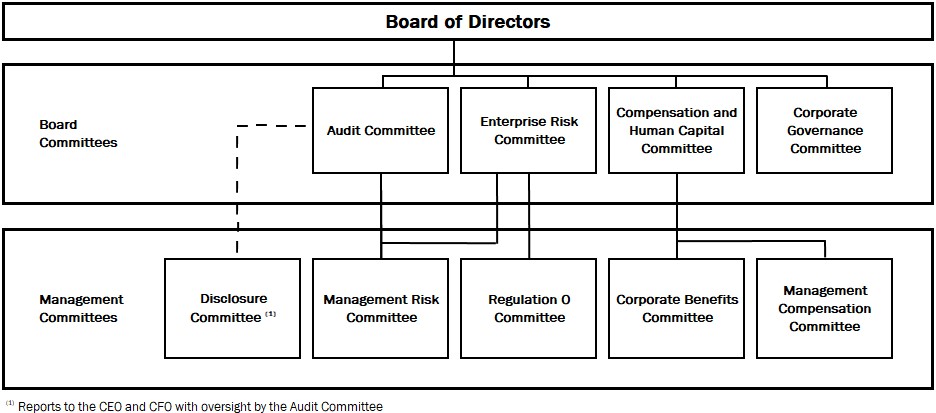
Board of Directors and Board Committees
The Board is composed of 14 directors, all but one of whom are independent. The Board oversees management’s establishment of an effective Risk Framework and oversees compliance with safe and sound banking practices. In addition, the Board and its committees make inquiries of, and receive reports from senior management on, risk-related matters to assess scope or resource limitations that could impede the ability of Global Risk Management (GRM) and/or Corporate Audit to execute their responsibilities. The Audit and Enterprise Risk Committees discussed below have the principal responsibility for enterprise-wide oversight of our risk management activities. Through these responsibilities, the Board and applicable committees are provided with information on our risk profile and oversee senior management addressing key risks we face. Other Board committees, as described below, provide additional oversight of specific risks.
The Audit and Enterprise Risk Committees regularly report to the Board on risk-related matters within the committees’ responsibilities, which are intended to collectively provide the Board with integrated insight about the Corporation’s risk profile and our management of enterprise-wide risks.
Audit Committee
The Audit Committee provides risk assessment and management oversight for compliance risk pursuant to New York Stock Exchange listing standards and regularly receives updates from management on compliance risk-related matters. In addition, the Audit Committee oversees the qualifications, performance and independence of the Independent Registered Public Accounting Firm, the performance of our Corporate Audit function, the integrity of our consolidated financial statements, our compliance with legal and regulatory requirements, and makes inquiries of the Chief Audit Executive (CAE) or other senior management to determine whether there are scope or resource limitations that impede the ability of Corporate Audit to execute its responsibilities.
Enterprise Risk Committee
The ERC oversees the Corporation’s Risk Framework, risk appetite and senior management’s identification, measurement, monitoring and control of key risks facing the Corporation. The
ERC regularly receives risk management updates from management on key risks and selected risk topics, including emerging risks. The ERC also periodically reviews the adequacy of the resources of the Corporation’s independent GRM function. The ERC may consult with other Board committees on risk-related matters such as the Audit Committee for compliance risks.
Other Board Committees
Our Corporate Governance Committee oversees corporate governance matters, including periodically reviewing and making recommendations to the Board on Board succession planning and composition matters, conducting an annual review of the Board’s performance and leading itself and the Board’s other committees in an annual assessment of their performance. The committee also oversees sustainability matters (other than human capital matters), including the Corporation’s public policy engagement, sustainability initiatives, charitable contributions, and community reinvestment activities and performance.
Our Compensation and Human Capital Committee oversees establishing, maintaining and administering our compensation programs and employee benefit plans, including approving and recommending our Chief Executive Officer’s (CEO) compensation to our Board for further approval by all independent directors; reviewing and approving our executive officers’ compensation, as well as compensation for non-management directors; and reviewing certain other human capital management topics.
Management Committees
Management committees receive their authority from the Board, a Board committee, or another management committee. Our primary management risk committee is the MRC. Subject to Board oversight, the MRC is responsible for management oversight of key risks facing the Corporation, including an integrated evaluation of risk, earnings, capital and liquidity.
Executive Officers
Executive officers lead various functions representing the functional roles. Authority for functional roles may be delegated to executive officers from the Board, Board committees or management-level committees. Executive officers, in turn, may further delegate responsibilities, as appropriate, to management-level committees, management routines or
Bank of America 46 | ||||||||
individuals. Executive officers review our activities for consistency with our Risk Framework, risk appetite, and applicable strategic, capital and financial operating plans, as well as applicable policies and standards. Executive officers and other employees make decisions individually on a day-to-day basis, consistent with the authority they have been delegated. Executive officers and other employees may also serve on committees and participate in committee decisions.
Lines of Defense
We have clear ownership and accountability for managing risk across three lines of defense: Front Line Units (FLUs), GRM and Corporate Audit. We also have control functions outside of FLUs and GRM (e.g., Legal and Public Policy, and Chief People Organization). The three lines of defense are integrated into our management-level governance structure. Each of these functional roles is further described in this section.
Front Line Units and Control Functions
FLUs, which include the business segments and underlying businesses, as well as the organizations that support technology and operations for the Corporation, are responsible for appropriately assessing and effectively managing all of the risks associated with their activities. Control functions provide guidance and subject matter expertise on day-to-day activities affecting the Corporation, as well as by overseeing and managing risks that emanate from their own respective activities.
Global Risk Management
GRM is part of our control functions and operates as our independent risk management function. GRM, led by the Chief Risk Officer (CRO), is responsible for independently assessing and overseeing risks within FLUs and other control functions. GRM establishes written enterprise policies and procedures outlining how aggregate risks are identified, measured, monitored and controlled.
The CRO has the stature, authority and independence needed to develop and implement a meaningful risk management framework and practices to guide the Corporation in managing risk. The CRO has unrestricted access to the Board and reports directly to both the ERC and the CEO. GRM is organized into horizontal risk teams that cover a specific risk area and vertical CRO teams that cover a particular FLU or control function. These teams work collaboratively in executing their respective duties.
Corporate Audit
Corporate Audit and the CAE maintain their independence from the FLUs, GRM and other control functions by reporting directly to the Audit Committee. The CAE administratively reports to the CEO. Corporate Audit provides independent assessment and validation through testing of key processes and controls across the Corporation. Corporate Audit includes Credit Review, which provides an independent assessment of credit lending decisions and the effectiveness of credit processes across the Corporation’s credit platform through examinations and monitoring.
Risk Management Processes
The Risk Framework requires that strong risk management practices are integrated in key strategic, capital and financial planning processes and in day-to-day business processes across the Corporation, thereby ensuring risks are appropriately considered, evaluated and responded to in a timely manner. We employ an effective risk management process, referred to as
Identify, Measure, Monitor and Control, as part of our daily activities.
Identify – To be effectively managed, risks must be proactively identified and well understood. Proper risk identification focuses on recognizing and understanding key risks inherent in our business activities or key risks that may arise from external factors. Each employee is expected to identify and escalate risks promptly. Risk identification is an ongoing process that incorporates input from FLUs and control functions. It is designed to be forward-looking and to capture relevant risk factors across all of our lines of business.
Measure – Once a risk is identified, it must be prioritized and accurately measured through a systematic process including qualitative statements and quantitative limits. Risk is measured at various levels, including, but not limited to, risk type, FLU and legal entity, and also on an aggregate basis. This risk measurement process helps to capture changes in our risk profile due to changes in strategic direction, concentrations, portfolio quality and the overall economic environment. Senior management considers how risk exposures might evolve under a variety of stress scenarios.
Monitor – We monitor risk levels regularly to track adherence to risk appetite, policies and standards. We also regularly update risk assessments and review risk exposures. Through our monitoring, we know our level of risk relative to limits and can take action in a timely manner. We also know when risk limits are breached and have processes to appropriately report and escalate exceptions. This includes timely requests for approval to managers and alerts to executive management, management-level committees or the Board (directly or through an appropriate committee).
Control – We establish and communicate risk limits and controls through policies, standards, procedures and processes. The limits and controls can be adjusted by senior management or the Board when conditions or risk tolerances warrant. These limits may be absolute (e.g., loan amount, trading volume, operational loss) or relative (e.g., percentage of loan book in higher-risk categories). Our FLUs are held accountable for performing within the established limits.
The formal processes used to manage risk represent a part of our overall risk management process. We instill a strong and comprehensive culture of managing risk well through communications, training, policies, procedures and organizational roles and responsibilities. Establishing a culture reflective of our purpose to help make our customers’ financial lives better and delivering on Responsible Growth is also critical to effective risk management. We are committed to the highest principles of ethical and professional conduct. Conduct risk is the risk of improper actions, behaviors or practices by the Corporation, its employees or representatives that are illegal, unethical and/or contrary to our core values that could result in harm to the Corporation, our shareholders or our customers, damage the integrity of the financial markets, or negatively impact our reputation. We have established protocols and structures so that conduct risk is governed and reported across the Corporation appropriately. All employees are held accountable for adhering to the Code of Conduct, operating within our risk appetite and managing risk in their daily business activities. In addition, our performance management and compensation practices encourage responsible risk-taking that is consistent with our Risk Framework and risk appetite.
47 Bank of America | ||||||||
Corporation-wide Stress Testing
Integral to our Capital Planning, Financial Planning and Strategic Planning processes, we conduct capital scenario management and stress forecasting on a regular basis to better understand balance sheet, earnings and capital sensitivities to a wide range of economic and business scenarios, including economic and market conditions that are more severe than anticipated. These stress forecasts provide an understanding of the potential impacts from our risk profile on the balance sheet, earnings and capital, and serve as a key component of our capital and risk management practices. The intent of stress testing is to develop a comprehensive understanding of potential impacts of on- and off-balance sheet risks at the Corporation and certain subsidiaries and how they impact financial resiliency, which provides confidence to management, regulators and our investors.
Contingency Planning
We have developed and maintain comprehensive contingency plans that are designed to prepare us in advance to respond in the event of potential adverse economic, operational, financial or market stress conditions. These contingency plans include our Financial Contingency and Recovery Plan, which provides monitoring, escalation, actions and routines designed to enable us to increase capital and/or liquidity, access funding sources and reduce risk through consideration of potential options that include asset sales, business sales, capital or debt issuances, and other risk reducing strategies at various levels of capital or liquidity depletion during a period of stress. We also maintain a Resolution Plan to limit adverse systemic impacts that could be associated with a potential resolution of Bank of America.
Strategic Risk Management
Strategic risk is embedded in every business and is one of the major risk categories along with credit, market, liquidity, compliance, operational and reputational risks. This risk results from incorrect assumptions about external or internal factors, inappropriate business plans, ineffective business strategy execution, or failure to respond in a timely manner to changes in the regulatory, macroeconomic or competitive environments in the geographic locations in which we operate (e.g., competitor actions, changing customer preferences, product obsolescence and technology developments).
An aspect of strategic risk is the risk that the Corporation’s capital levels are not adequate to meet minimum regulatory requirements and support execution of business activities or absorb losses from risks during normal or adverse economic and market conditions. As such, capital risk is managed in parallel to strategic risk.
We manage strategic risk through the Strategic Risk Enterprise Policy and integration into the strategic planning process, among other activities. Our strategic plan is consistent with our risk appetite, capital plan and liquidity requirements, and specifically addresses strategic risks impacting each business.
On an annual basis, the Board reviews and approves the strategic plan, capital plan, financial operating plan and Risk Appetite Statement. With oversight by the Board, senior management directs the lines of business to execute our strategic plan consistent with our core operating principles and risk appetite. The executive management team monitors business performance throughout the year and provides the Board with regular progress reports on whether strategic objectives and timelines are being met, including reports on strategic risks and if additional or alternative actions need to be
considered or implemented. The regular executive reviews focus on assessing forecasted earnings and returns on capital, the current risk profile, current capital and liquidity positions and related requirements, staffing levels and changes required to support the strategic plan, stress testing results, and other qualitative factors such as market growth rates and peer analysis.
Significant strategic actions, such as capital actions, material acquisitions or divestitures, and resolution plans are reviewed and approved by the Board or delegate. At the business level, processes are in place to discuss the strategic risk implications of new, expanded or modified businesses, products or services, regulatory change and other strategic initiatives, and to provide formal review and approval where required. With oversight by the Board and the ERC, executive management performs similar analyses throughout the year, and evaluates changes to the financial forecast or the risk, capital or liquidity positions as deemed appropriate to balance and optimize achieving the targeted risk appetite, shareholder returns and maintaining the targeted financial strength. Proprietary models are used to measure the capital requirements for credit, country, market, operational and strategic risks. The allocated capital assigned to each business is based on its unique risk profile. With oversight by the Board, executive management assesses the risk-adjusted returns of each business in approving strategic and financial operating plans. The businesses use allocated capital to define business strategies, and price products and transactions.
Capital Management
The Corporation manages its capital position so that its capital is more than adequate to support its business activities and aligns with risk, risk appetite and strategic planning. Additionally, we seek to maintain safety and soundness at all times, even under adverse scenarios, take advantage of organic growth opportunities, meet obligations to creditors and counterparties, maintain ready access to financial markets, continue to serve as a credit intermediary, remain a source of strength for our subsidiaries, and satisfy current and future regulatory capital requirements. Capital management is integrated into our risk and governance processes, as capital is a key consideration in the development of our strategic plan, risk appetite and risk limits.
We conduct an Internal Capital Adequacy Assessment Process (ICAAP) on a periodic basis. The ICAAP is a forward-looking assessment of our projected capital needs and resources, incorporating earnings, balance sheet and risk forecasts under baseline and adverse economic and market conditions. We utilize periodic stress tests to assess the potential impacts to our balance sheet, earnings, regulatory capital and liquidity under a variety of stress scenarios. We perform qualitative risk assessments to identify and assess material risks not fully captured in our forecasts or stress tests. We assess the potential capital impacts of proposed changes to regulatory capital requirements. Management assesses ICAAP results and provides documented quarterly assessments of the adequacy of our capital guidelines and capital position to the Board or its committees.
We periodically review capital allocated to our businesses and allocate capital annually during the strategic and capital planning processes. For more information, see Business Segment Operations on page 36.
Bank of America 48 | ||||||||
CCAR and Capital Planning
The Board of Governors of the Federal Reserve System (Federal Reserve) requires large BHCs to submit a capital plan and planned capital actions on an annual basis, consistent with the rules governing capital planning and the stress capital buffer (SCB) requirement, which include supervisory stress testing by the Federal Reserve. Based on the results of our 2025 Comprehensive Capital Analysis and Review (CCAR) stress test under the current regulatory framework, our SCB is 2.5 percent, resulting in a Common equity tier 1 (CET1) minimum requirement of 10.0 percent, effective October 1, 2025. At December 31, 2025, the Corporation’s CET1 capital ratio was 11.4 percent under the Standardized approach. As part of the Federal Reserve’s release of 2026 hypothetical stress test scenarios, the Federal Reserve announced the Corporation’s SCB will remain 2.5 percent through September 30, 2027. For more information, see Regulatory Developments in this section.
On July 24, 2024, the Corporation announced the Board’s authorization of a $25 billion common stock repurchase program, effective August 1, 2024 (2024 Repurchase Program), which replaced the Corporation’s previous repurchase program that expired on August 1, 2024. In addition, on July 23, 2025, the Corporation announced the Board’s authorization of a $40 billion common stock repurchase program, effective August 1, 2025, which replaced the 2024 Repurchase Program that expired on the same date. Pursuant to these Board-authorized repurchase programs, during 2025, the Corporation repurchased $21.4 billion of common stock. For more information, see Part II, Item 5. Market for Registrant’s Common Equity, Related Stockholder Matters and Issuer Purchases of Equity Securities on page 24.
The timing and amount of common stock repurchases are subject to various factors, including the Corporation’s capital position, liquidity, financial performance and alternative uses of capital, stock trading price, regulatory requirements and general market conditions, and may be suspended or discontinued at any time. Such repurchases may be effected through open market purchases or privately negotiated transactions, including repurchase plans that satisfy the conditions of Rule 10b5-1 of the Securities Exchange Act of 1934, as amended (Exchange Act).
Further, as part of our planned capital actions, during 2025, the Corporation paid common stock dividends of $8.1 billion.
Regulatory Capital
As a BHC, we are subject to regulatory capital rules, including Basel 3, issued by U.S. banking regulators. Basel 3 established minimum capital ratios and buffer requirements and outlined two methods of calculating risk-weighted assets (RWA), the Standardized approach and the Advanced approaches. The Standardized approach relies primarily on supervisory risk weights based on exposure type, and the Advanced approaches determine risk weights based on internal models.
The Corporation's depository institution subsidiaries are also subject to the Prompt Corrective Action (PCA) framework. The Corporation and its primary affiliated banking entity, BANA, are Advanced approaches institutions under Basel 3 and are required to report regulatory risk-based capital ratios and RWA under both the Standardized and Advanced approaches. The lower of the capital ratios under Standardized or Advanced approaches compared to their respective regulatory capital ratio requirements is used to assess capital adequacy, including under the PCA framework. As of December 31, 2025, the Corporation’s binding ratio was the Total capital ratio under the Standardized approach.
Minimum Capital Requirements
In order to avoid restrictions on capital distributions and discretionary bonus payments to executive officers, the Corporation must meet risk-based capital ratio requirements that include a capital conservation buffer of 2.5 percent (under the Advanced approaches only), an SCB (under the Standardized approach only), plus any applicable countercyclical capital buffer and a global systemically important bank (G-SIB) surcharge. The buffers and surcharge must be comprised solely of CET1 capital. For the period from October 1, 2024 through September 30, 2025, the Corporation’s minimum CET1 ratio requirements were 10.7 percent under the Standardized approach and 10.0 percent under the Advanced approaches. Effective October 1, 2025, the Corporation’s minimum CET1 requirement was 10.0 percent under both the Standardized approach and the Advanced approaches.
The Corporation is required to calculate its G-SIB surcharge on an annual basis under two methods and is subject to the higher of the resulting two surcharges. Method 1 is consistent with the approach prescribed by the Basel Committee on Banking Supervision’s assessment methodology and is calculated using specified indicators of systemic importance. Method 2 modifies the Method 1 approach for various factors. The Corporation’s Method 1 G-SIB surcharge is 1.5 percent, and its Method 2 G-SIB surcharge is 3.0 percent. On January 1, 2027, the Corporation’s G-SIB surcharge will increase by 50 bps to 2.0 percent under Method 1 and to 3.5 percent under Method 2, which will increase the Corporation’s minimum capital ratio requirements. At December 31, 2025, the Corporation’s CET1 capital ratio of 11.4 percent under the Standardized approach exceeded its minimum CET1 capital ratio requirement of 10.0 percent.
At December 31, 2025, the Corporation was also required to maintain a minimum supplementary leverage ratio (SLR) of 3.0 percent plus a leverage buffer of 2.0 percent in order to avoid certain restrictions on capital distributions and discretionary bonus payments to executive officers. Our insured depository institution subsidiaries were required to maintain a minimum SLR of 6.0 percent to be considered well capitalized under the PCA framework. At December 31, 2025, both the Corporation and its insured depository institution subsidiaries exceeded their minimum supplementary leverage requirements. Effective January 1, 2026, the minimum SLR requirement for the Corporation and its insured depository institutions is 3.75 percent. For more information, see Regulatory Developments in this section. The numerator of the SLR is quarter-end Basel 3 Tier 1 capital. The denominator is total leverage exposure based on the daily average of the sum of on-balance sheet exposures less permitted deductions and the simple average of certain off-balance sheet exposures, as of the end of each month in a quarter.
Capital Composition and Ratios
Effective in the fourth quarter of 2025, the Corporation elected to change its accounting methods related to certain tax-related equity investments and applied those changes retrospectively through a cumulative adjustment to retained earnings. For more information, see Note 1 – Summary of Significant Accounting Principles to the Consolidated Financial Statements. Under applicable bank regulatory rules, the Corporation is not required to, and accordingly, did not revise regulatory capital information as of December 31, 2024.
49 Bank of America | ||||||||
Table 10 presents Bank of America Corporation’s capital ratios and related information in accordance with Basel 3 Standardized and Advanced approaches as measured at December 31, 2025 and 2024. For the periods presented herein, the Corporation met the definition of well capitalized under current regulatory requirements.
| Table 10 | Bank of America Corporation Regulatory Capital under Basel 3 | |||||||||||||||||||
Standardized Approach (1, 2) | Advanced Approaches (1, 2) | Regulatory Minimum (3) | ||||||||||||||||||
| (Dollars in millions, except as noted) | December 31, 2025 | |||||||||||||||||||
| Risk-based capital metrics: | ||||||||||||||||||||
| Common equity tier 1 capital | $ | 201,410 | $ | 201,410 | ||||||||||||||||
| Tier 1 capital | 227,382 | 227,382 | ||||||||||||||||||
Total capital (4) | 261,232 | 250,347 | ||||||||||||||||||
| Risk-weighted assets (in billions) | 1,773 | 1,570 | ||||||||||||||||||
| Common equity tier 1 capital ratio | 11.4 | % | 12.8 | % | 10.0 | % | ||||||||||||||
| Tier 1 capital ratio | 12.8 | 14.5 | 11.5 | |||||||||||||||||
| Total capital ratio | 14.7 | 15.9 | 13.5 | |||||||||||||||||
| Leverage-based metrics: | ||||||||||||||||||||
Adjusted quarterly average assets (in billions) (5) | $ | 3,348 | $ | 3,348 | ||||||||||||||||
| Tier 1 leverage ratio | 6.8 | % | 6.8 | % | 4.0 | |||||||||||||||
| Supplementary leverage exposure (in billions) | $ | 3,986 | ||||||||||||||||||
| Supplementary leverage ratio | 5.7 | % | 5.0 | |||||||||||||||||
| December 31, 2024 | ||||||||||||||||||||
| Risk-based capital metrics: | ||||||||||||||||||||
| Common equity tier 1 capital | $ | 201,083 | $ | 201,083 | ||||||||||||||||
| Tier 1 capital | 223,458 | 223,458 | ||||||||||||||||||
Total capital (4) | 255,363 | 244,809 | ||||||||||||||||||
| Risk-weighted assets (in billions) | 1,696 | 1,490 | ||||||||||||||||||
| Common equity tier 1 capital ratio | 11.9 | % | 13.5 | % | 10.7 | % | ||||||||||||||
| Tier 1 capital ratio | 13.2 | 15.0 | 12.2 | |||||||||||||||||
| Total capital ratio | 15.1 | 16.4 | 14.2 | |||||||||||||||||
| Leverage-based metrics: | ||||||||||||||||||||
Adjusted quarterly average assets (in billions) (5) | $ | 3,240 | $ | 3,240 | ||||||||||||||||
| Tier 1 leverage ratio | 6.9 | % | 6.9 | % | 4.0 | |||||||||||||||
| Supplementary leverage exposure (in billions) | $ | 3,818 | ||||||||||||||||||
| Supplementary leverage ratio | 5.9 | % | 5.0 | |||||||||||||||||
(1)As of January 1, 2025, current expected credit losses (CECL) transition provision’s impact was fully phased-in. Capital ratios as of December 31, 2024 were calculated using the regulatory capital rule that allowed a five-year transition period related to the adoption of the CECL accounting standard on January 1, 2020.
(2)Effective in the fourth quarter of 2025, the Corporation elected to change its accounting methods for certain tax-related equity investments and applied those changes retrospectively through cumulative adjustment to retained earnings. Under applicable bank regulatory rules, the Corporation is not required to revise previously-filed regulatory capital ratios and, accordingly, did not revise regulatory capital information as of December 31, 2024.
(3)The CET1 capital regulatory minimum is the sum of the CET1 capital ratio minimum of 4.5 percent, our G-SIB surcharge of 3.0 percent, and SCB (under the Standardized approach) of 2.5 percent at December 31, 2025 and 3.2 percent at December 31, 2024. The countercyclical capital buffer was zero for both periods. The SLR regulatory minimum includes a leverage buffer of 2.0 percent.
(4)Total capital under the Advanced approaches differs from the Standardized approach due to differences in the amount permitted in Tier 2 capital related to the qualifying allowance for credit losses.
(5)Reflects total average assets adjusted for certain Tier 1 capital deductions.
At December 31, 2025, CET1 capital was $201.4 billion, an increase of $327 million from December 31, 2024, primarily due to earnings, largely offset by capital distributions and, to a lesser extent, the impact of the tax-related equity investments accounting changes. Tier 1 capital increased $3.9 billion driven by the same factors as CET1 capital as well as preferred stock issuances. Total capital under the Standardized approach increased $5.9 billion driven by the same factors as Tier 1
capital, as well as subordinated debt issuances and an increase in the adjusted allowance for credit losses included in Tier 2 capital. RWA under the Standardized approach, which drove the lower CET1 capital ratio at December 31, 2025, increased $77.2 billion during 2025 to $1,773 billion primarily driven by lending activity in GWIM, Global Banking and Global Markets. Supplementary leverage exposure at December 31, 2025 increased $167.7 billion primarily driven by increased activity in Global Markets.
Bank of America 50 | ||||||||
Table 11 shows the capital composition at December 31, 2025 and 2024.
| Table 11 | Capital Composition under Basel 3 | |||||||||||||
| December 31 | ||||||||||||||
| (Dollars in millions) | 2025 | 2024 | ||||||||||||
| Total common shareholders’ equity | $ | 277,251 | $ | 270,804 | ||||||||||
Impact of change in accounting method (1) | — | 1,596 | ||||||||||||
CECL transitional amount (2) | — | 627 | ||||||||||||
| Goodwill, net of related deferred tax liabilities | (68,651) | (68,649) | ||||||||||||
| Deferred tax assets arising from net operating loss and tax credit carryforwards | (8,761) | (8,097) | ||||||||||||
| Intangibles, other than mortgage servicing rights, net of related deferred tax liabilities | (1,386) | (1,440) | ||||||||||||
| Defined benefit pension plan net assets | (868) | (786) | ||||||||||||
| Cumulative unrealized net (gain) loss related to changes in fair value of financial liabilities attributable to own creditworthiness, net-of-tax | 1,825 | 1,491 | ||||||||||||
Accumulated net (gain) loss on certain cash flow hedges (3) | 2,020 | 5,629 | ||||||||||||
| Other | (20) | (92) | ||||||||||||
| Common equity tier 1 capital | 201,410 | 201,083 | ||||||||||||
| Qualifying preferred stock, net of issuance cost | 25,991 | 22,391 | ||||||||||||
| Other | (19) | (16) | ||||||||||||
| Tier 1 capital | 227,382 | 223,458 | ||||||||||||
| Tier 2 capital instruments | 19,627 | 18,592 | ||||||||||||
Qualifying allowance for credit losses (2) | 14,431 | 13,558 | ||||||||||||
| Other | (208) | (245) | ||||||||||||
| Total capital under the Standardized approach | 261,232 | 255,363 | ||||||||||||
Adjustment in qualifying allowance for credit losses under the Advanced approaches (2) | (10,885) | (10,554) | ||||||||||||
| Total capital under the Advanced approaches | $ | 250,347 | $ | 244,809 | ||||||||||
(1)Represents the decrease in retained earnings due to the Corporation’s election to change its accounting methods for certain tax-related equity investments in the fourth quarter of 2025. Under applicable bank regulatory rules, the Corporation is not required to revise previously-filed regulatory capital ratios and, accordingly, did not revise regulatory capital information as of December 31, 2024.
(2)The qualifying allowance for credit losses under the Standardized approach and under the Advanced approaches include the impact of transition provisions related to the CECL accounting standard. As of January 1, 2025, CECL transition provision’s impact was fully phased-in. December 31, 2024 includes 25 percent of the CECL transition provision’s impact as of December 31, 2021.
(3)Includes amounts in accumulated OCI related to the hedging of items that are not recognized at fair value on the Consolidated Balance Sheet.
Table 12 shows the components of RWA as measured under Basel 3 at December 31, 2025 and 2024.
| Table 12 | Risk-weighted Assets under Basel 3 | |||||||||||||||||||||||||
| Standardized Approach | Advanced Approaches | Standardized Approach | Advanced Approaches | |||||||||||||||||||||||
| December 31 | ||||||||||||||||||||||||||
| (Dollars in billions) | 2025 | 2024 | ||||||||||||||||||||||||
| Credit risk | $ | 1,694 | $ | 1,087 | $ | 1,623 | $ | 1,015 | ||||||||||||||||||
| Market risk | 79 | 79 | 73 | 73 | ||||||||||||||||||||||
| Operational risk | n/a | 357 | n/a | 359 | ||||||||||||||||||||||
| Risks related to credit valuation adjustments | n/a | 47 | n/a | 43 | ||||||||||||||||||||||
Total risk-weighted assets (1) | $ | 1,773 | $ | 1,570 | $ | 1,696 | $ | 1,490 | ||||||||||||||||||
(1)Effective October 1, 2025, the Corporation elected to change its accounting methods for certain tax-related equity investments and applied those changes retrospectively. Under applicable bank regulatory rules, the Corporation is not required to revise previously-filed regulatory capital ratios and, accordingly, did not revise regulatory capital information as of December 31, 2024.
n/a = not applicable
51 Bank of America | ||||||||
Bank of America, N.A. Regulatory Capital
Table 13 presents regulatory capital information for BANA in accordance with Basel 3 Standardized and Advanced approaches as measured at December 31, 2025 and 2024. BANA met the definition of well capitalized under the PCA framework for both periods.
| Table 13 | Bank of America, N.A. Regulatory Capital under Basel 3 | |||||||||||||||||||
Standardized Approach (1, 2) | Advanced Approaches (1, 2) | Regulatory Minimum (3) | ||||||||||||||||||
| (Dollars in millions, except as noted) | December 31, 2025 | |||||||||||||||||||
| Risk-based capital metrics: | ||||||||||||||||||||
| Common equity tier 1 capital | $ | 190,831 | $ | 190,831 | ||||||||||||||||
| Tier 1 capital | 190,831 | 190,831 | ||||||||||||||||||
Total capital (4) | 206,640 | 196,006 | ||||||||||||||||||
| Risk-weighted assets (in billions) | 1,530 | 1,227 | ||||||||||||||||||
| Common equity tier 1 capital ratio | 12.5 | % | 15.6 | % | 7.0 | % | ||||||||||||||
| Tier 1 capital ratio | 12.5 | 15.6 | 8.5 | |||||||||||||||||
| Total capital ratio | 13.5 | 16.0 | 10.5 | |||||||||||||||||
| Leverage-based metrics: | ||||||||||||||||||||
Adjusted quarterly average assets (in billions) (5) | $ | 2,592 | $ | 2,592 | ||||||||||||||||
| Tier 1 leverage ratio | 7.4 | % | 7.4 | % | 5.0 | |||||||||||||||
| Supplementary leverage exposure (in billions) | $ | 3,101 | ||||||||||||||||||
| Supplementary leverage ratio | 6.2 | % | 6.0 | |||||||||||||||||
| December 31, 2024 | ||||||||||||||||||||
| Risk-based capital metrics: | ||||||||||||||||||||
| Common equity tier 1 capital | $ | 194,341 | $ | 194,341 | ||||||||||||||||
| Tier 1 capital | 194,341 | 194,341 | ||||||||||||||||||
Total capital (4) | 209,256 | 198,923 | ||||||||||||||||||
| Risk-weighted assets (in billions) | 1,444 | 1,151 | ||||||||||||||||||
| Common equity tier 1 capital ratio | 13.5 | % | 16.9 | % | 7.0 | % | ||||||||||||||
| Tier 1 capital ratio | 13.5 | 16.9 | 8.5 | |||||||||||||||||
| Total capital ratio | 14.5 | 17.3 | 10.5 | |||||||||||||||||
| Leverage-based metrics: | ||||||||||||||||||||
Adjusted quarterly average assets (in billions) (5) | $ | 2,546 | $ | 2,546 | ||||||||||||||||
| Tier 1 leverage ratio | 7.6 | % | 7.6 | % | 5.0 | |||||||||||||||
| Supplementary leverage exposure (in billions) | $ | 3,015 | ||||||||||||||||||
| Supplementary leverage ratio | 6.4 | % | 6.0 | |||||||||||||||||
(1)As of January 1, 2025, CECL transition provision’s impact was fully phased-in. Capital ratios as of December 31, 2024 were calculated using the regulatory capital rule that allowed a five-year transition period related to the adoption of the CECL accounting standard on January 1, 2020.
(2)Effective in the fourth quarter of 2025, the Corporation elected to change its accounting methods for certain tax-related equity investments and applied those changes retrospectively through cumulative adjustment to retained earnings. Under applicable bank regulatory rules, the Corporation is not required to revise previously-filed regulatory capital ratios and, accordingly, did not revise regulatory capital information as of December 31, 2024.
(3)Risk-based capital regulatory minimums at both December 31, 2025 and 2024 are the minimum ratios under Basel 3 including a capital conservation buffer of 2.5 percent. The regulatory minimums for the leverage ratios as of both period ends are the percent required to be considered well capitalized under the PCA framework.
(4)Total capital under the Advanced approaches differs from the Standardized approach due to differences in the amount permitted in Tier 2 capital related to the qualifying allowance for credit losses.
(5)Reflects total average assets adjusted for certain Tier 1 capital deductions.
Total Loss-Absorbing Capacity Requirements
Total loss-absorbing capacity (TLAC) consists of the Corporation’s Tier 1 capital and eligible long-term debt issued directly by the Corporation. Eligible long-term debt for TLAC ratios is comprised of unsecured debt that has a remaining maturity of at least one year and satisfies additional requirements as prescribed in the TLAC final rule. As with the
risk-based capital ratios and SLR, the Corporation is required to maintain TLAC ratios in excess of minimum requirements plus applicable buffers to avoid restrictions on capital distributions and discretionary bonus payments to executive officers. Table 14 presents the Corporation's TLAC and long-term debt ratios and related information as of December 31, 2025 and 2024.
Bank of America 52 | ||||||||
| Table 14 | Bank of America Corporation Total Loss-Absorbing Capacity and Long-Term Debt | |||||||||||||||||||||||||
TLAC (1) | Regulatory Minimum (2) | Long-term Debt | Regulatory Minimum (3) | |||||||||||||||||||||||
| (Dollars in millions) | December 31, 2025 | |||||||||||||||||||||||||
| Total eligible balance | $ | 466,728 | $ | 225,518 | ||||||||||||||||||||||
Percentage of risk-weighted assets (4) | 26.3 | % | 22.0 | % | 12.7 | % | 9.0 | % | ||||||||||||||||||
| Percentage of supplementary leverage exposure | 11.7 | 9.5 | 5.7 | 4.5 | ||||||||||||||||||||||
| December 31, 2024 | ||||||||||||||||||||||||||
| Total eligible balance | $ | 459,857 | $ | 220,666 | ||||||||||||||||||||||
Percentage of risk-weighted assets (4) | 27.1 | % | 22.0 | % | 13.0 | % | 9.0 | % | ||||||||||||||||||
| Percentage of supplementary leverage exposure | 12.0 | 9.5 | 5.8 | 4.5 | ||||||||||||||||||||||
(1)As of January 1, 2025, CECL transition provision’s impact was fully phased-in. TLAC ratios as of December 31, 2024 were calculated using the regulatory capital rule that allowed a five-year transition period related to the adoption of the CECL accounting standard on January 1, 2020.
(2)The TLAC RWA regulatory minimum consists of 18.0 percent plus a TLAC RWA buffer comprised of 2.5 percent plus the Method 1 G-SIB surcharge of 1.5 percent. The countercyclical buffer is zero for both periods. The TLAC supplementary leverage exposure regulatory minimum consists of 7.5 percent plus a 2.0 percent TLAC leverage buffer. The TLAC RWA and leverage buffers must be comprised solely of CET1 capital and Tier 1 capital, respectively.
(3)The long-term debt RWA regulatory minimum is comprised of 6.0 percent plus the Corporation’s Method 2 G-SIB surcharge of 3.0 percent. The long-term debt leverage exposure regulatory minimum is 4.5 percent.
(4)The approach that yields the higher RWA is used to calculate TLAC and long-term debt ratios, which was the Standardized approach as of December 31, 2025 and 2024.
Regulatory Developments
On November 25, 2025, the Federal Reserve, Office of the Comptroller of the Currency and FDIC issued a final rule that modified enhanced SLR requirements for bank holding companies and their insured depository institution subsidiaries, with corresponding revisions to TLAC and long-term debt requirements. Under the final rule, static buffer requirements have been replaced with a dynamic buffer requirement equal to 50 percent of the G-SIB’s Method 1 surcharge, with the buffer capped at one percent for insured depository institutions. The Corporation elected to early adopt the final rule as of January 1, 2026, which decreased the regulatory minimum SLR requirement to 3.75 percent from 5.0 percent for the Corporation, and to 3.75 percent from 6.0 percent for BANA as of the same date. For more information on the Corporation’s Method 1 and Method 2 G-SIB surcharge, see Minimum Capital Requirements in this section.
On October 24, 2025, the Federal Reserve issued two notices of proposed rulemaking (NPRs) related to its annual stress test. The first NPR requested comment on the hypothetical scenarios that will be used in the 2026 supervisory stress test. The Federal Reserve released these scenarios on February 4, 2026. The second NPR requests comment on the models the Federal Reserve uses to conduct the supervisory stress test. This NPR also outlines proposed changes to the broader stress testing framework and codifies an enhanced disclosure process under which the Federal Reserve would annually publish and invite public comment on stress test scenarios, models and material changes to those models.
On April 17, 2025, the Federal Reserve issued an NPR to modify the capital plan rule and SCB requirements. Under this NPR, results from the two most recent annual supervisory stress tests would be averaged to determine the Corporation’s SCB requirement. In addition, the annual effective date of the SCB requirement would change from October 1st of the current year to January 1st of the following year, providing banks with additional time to comply with their new capital requirements.
Regulatory Capital and Securities Regulation
The Corporation’s principal U.S. broker-dealer subsidiaries are BofA Securities, Inc. (BofAS) and Merrill Lynch, Pierce, Fenner & Smith Incorporated (MLPF&S). The Corporation's principal European subsidiaries undertaking broker-dealer activities are Merrill Lynch International (MLI) and BofA Securities Europe SA (BofASE).
The U.S. broker-dealer subsidiaries are subject to the net capital requirements of Rule 15c3-1 under the Exchange Act. BofAS computes its capital requirements as an alternative net capital broker-dealer under Rule 15c3-1(a)(7) and Rule 15c3-1e, which permit the use of SEC-approved models, and MLPF&S computes its capital requirements in accordance with the alternative standard under Rule 15c3-1. BofAS is registered as a futures commission merchant and is subject to Commodity Futures Trading Commission (CFTC) Regulation 1.17. The U.S. broker-dealer subsidiaries are also registered with the Financial Industry Regulatory Authority, Inc. (FINRA). Pursuant to FINRA Rule 4110, FINRA may impose higher net capital requirements than Rule 15c3-1 under the Exchange Act with respect to each of the broker-dealers.
BofAS provides institutional services, and in accordance with the alternative net capital requirements, is required to regularly maintain tentative net capital in excess of $5.0 billion and net capital in excess of the greater of $1.0 billion or a certain percentage of its reserve requirement in addition to a certain percentage of securities-based swap risk margin. BofAS must also notify the SEC in the event its tentative net capital is less than $6.0 billion. BofAS is also required to hold a certain percentage of its customers' and affiliates' risk-based margin in order to meet its CFTC minimum net capital requirement. At December 31, 2025, BofAS had tentative net capital of $28.2 billion. BofAS also had regulatory net capital of $23.0 billion, which exceeded the minimum requirement of $5.1 billion.
MLPF&S provides retail services and is required to maintain net capital that is the greater of $250,000 or two percent of a certain component of its reserve calculation. At December 31, 2025, MLPF&S' regulatory net capital was $8.1 billion, which exceeded the minimum requirement of $175 million.
Our European broker-dealers are subject to requirements from U.S. and non-U.S. regulators. MLI, a U.K. investment firm, is regulated by the Prudential Regulation Authority and the Financial Conduct Authority and is subject to certain regulatory capital requirements. At December 31, 2025, MLI’s capital resources were $33.4 billion, which exceeded the minimum Pillar 1 requirement of $13.2 billion.
BofASE, an authorized credit institution with its head office located in France, is regulated by the Autorité de Contrôle Prudentiel et de Résolution and the Autorité des Marchés Financiers, and supervised under the Single Supervisory Mechanism by the European Central Bank. At December 31, 2025, BofASE's capital resources were $11.8 billion, which exceeded the minimum Pillar 1 requirement of $4.0 billion.
53 Bank of America | ||||||||
In addition, MLI and BofASE remained conditionally registered with the SEC as security-based swap dealers, and maintained net liquid assets at December 31, 2025 that exceeded the applicable minimum requirements under the Exchange Act. The entities are also registered as swap dealers with the CFTC and met applicable capital requirements at December 31, 2025.
Liquidity Risk
Funding and Liquidity Risk Management
Our primary liquidity risk management objective is to meet expected or unexpected cash flow and collateral requirements, including payments under long-term debt agreements, commitments to extend credit and customer deposit withdrawals, while continuing to support our businesses and customers under a range of economic conditions. To achieve that objective, we analyze and monitor our liquidity risk under expected and stressed conditions, maintain liquidity and access to diverse funding sources, including our stable deposit base, and seek to align liquidity-related incentives and risks. These liquidity risk management practices have allowed us to effectively manage market fluctuations from the elevated interest rate environment, inflationary pressures and changes in the macroeconomic environment.
We define liquidity as readily available assets, limited to cash and high-quality, liquid, unencumbered securities that we can use to meet our contractual and contingent financial obligations as they arise. We manage our liquidity position through line of business and ALM activities, as well as through our legal entity funding strategy, on both a forward and current (including intraday) basis under both expected and stressed conditions. We believe that a centralized approach to funding and liquidity management enhances our ability to monitor liquidity requirements, maximizes access to funding sources, minimizes borrowing costs and facilitates timely responses to liquidity events.
We provide centralized funding and liquidity management through a variety of activities, including monitoring of established limits, assessing exposures under both normal and stressed conditions and reviewing liquidity risk management processes and controls. GRM provides oversight of liquidity management across the Corporation, including FLUs and legal entities. GRM oversees the liquidity risk management governance structure, establishes liquidity risk policies, and provides independent review and challenge of the Corporation's liquidity risk management processes.
The Board, its risk committee and various management committees oversee the Corporation’s liquidity activities and risk governance. The Board and/or ERC approve our liquidity risk policy, Financial Contingency and Recovery Plan and liquidity risk appetite limits. Management committees responsible for liquidity governance include the Corporation’s Management Risk Committee, Asset and Liability Governance Committee, Liquidity Risk Committee and Asset and Liability Management Investment Committee. For more information, see Managing Risk on page 88. Under this governance framework, we developed certain funding and liquidity risk management practices which include: maintaining liquidity at Bank of America Corporation (Parent) and selected subsidiaries, including our bank subsidiaries and
other regulated entities; determining what amounts of liquidity are appropriate for these entities based on analysis of debt maturities and other potential cash outflows, including those that we may experience during stressed market conditions; diversifying funding sources, considering our asset profile and legal entity structure; and performing contingency planning.
NB Holdings Corporation
Bank of America Corporation, as the parent company (the Parent), which is a separate and distinct legal entity from our bank and nonbank subsidiaries, has an intercompany arrangement with our wholly-owned holding company subsidiary, NB Holdings Corporation (NB Holdings). We have transferred, and agreed to transfer, additional Parent assets not required to satisfy anticipated near-term expenditures to NB Holdings. The Parent is expected to continue to have access to the same flow of dividends, interest and other amounts of cash necessary to service its debt, pay dividends and perform other obligations as it would have had it not entered into these arrangements and transferred any assets. These arrangements support our preferred single point of entry resolution strategy, under which only the Parent would be resolved under the U.S. Bankruptcy Code.
In consideration for the transfer of assets, NB Holdings issued a subordinated note to the Parent in a principal amount equal to the value of the transferred assets. The aggregate principal amount of the note will increase by the amount of any future asset transfers. NB Holdings also provided the Parent with a committed line of credit that allows the Parent to draw funds necessary to service near-term cash needs. These arrangements support our preferred single point of entry resolution strategy, under which only the Parent would be resolved under the U.S. Bankruptcy Code. These arrangements include provisions to terminate the line of credit, forgive the subordinated note and require the Parent to transfer its remaining financial assets to NB Holdings if our projected liquidity resources deteriorate so severely that resolution of the Parent becomes imminent.
Global Liquidity Sources and Other Unencumbered Assets
We maintain liquidity available to the Corporation, including the Parent and selected subsidiaries, in the form of cash and high- quality, liquid, unencumbered securities. Our liquidity buffer, referred to as Global Liquidity Sources (GLS), is comprised of assets that are readily available to the Parent and selected subsidiaries, including holding company, bank and broker-dealer subsidiaries, even during stressed market conditions. Our cash is primarily on deposit with the Federal Reserve Bank and, to a lesser extent, central banks outside of the U.S. We limit the composition of high-quality, liquid, unencumbered securities to U.S. government securities, U.S. agency securities, U.S. agency mortgage-backed securities and other investment-grade securities, and a select group of non-U.S. government securities. We can obtain cash for these securities, even in stressed conditions, through repurchase agreements or outright sales. We hold our GLS in legal entities that allow us to meet the liquidity requirements of our global businesses, and we consider the impact of potential regulatory, tax, legal and other restrictions that could limit the transferability of funds among entities.
Bank of America 54 | ||||||||
Table 15 presents average GLS for the three months ended December 31, 2025 and 2024.
| Table 15 | Average Global Liquidity Sources | |||||||||||||
Three Months Ended December 31 | ||||||||||||||
| (Dollars in billions) | December 31 2025 | December 31 2024 | ||||||||||||
| Bank entities | $ | 789 | $ | 777 | ||||||||||
Nonbank and other entities (1) | 186 | 176 | ||||||||||||
Total Average Global Liquidity Sources | $ | 975 | $ | 953 | ||||||||||
(1) Nonbank includes Parent, NB Holdings and other regulated entities.
Our bank subsidiaries’ liquidity is primarily driven by deposit and lending activity, as well as securities valuation and net debt activity. Bank subsidiaries can also generate incremental liquidity by pledging a range of unencumbered loans and securities to certain FHLBs and the Federal Reserve Discount Window. The cash we could have obtained by borrowing against this pool of specifically-identified eligible assets was $343 billion and $328 billion at December 31, 2025 and 2024. We have established operational procedures to enable us to borrow against these assets, including regularly monitoring our total pool of eligible loans and securities collateral. Eligibility is defined in guidelines from the FHLBs and the Federal Reserve and is subject to change at their discretion. Due to regulatory restrictions, liquidity generated by the bank subsidiaries can generally be used only to fund obligations within the bank subsidiaries, and transfers to the Parent or nonbank subsidiaries may be subject to prior regulatory approval.
Liquidity is also held in nonbank entities, including the Parent, NB Holdings and other regulated entities. The Parent and NB Holdings liquidity is typically in the form of cash deposited at BANA, which is excluded from the liquidity at bank subsidiaries, and high-quality, liquid, unencumbered securities. Liquidity held in other regulated entities, comprised primarily of broker-dealer subsidiaries, is primarily available to meet the obligations of that entity, and transfers to the Parent or to any other subsidiary may be subject to prior regulatory approval due to regulatory restrictions and minimum requirements. Our other regulated entities also hold unencumbered investment-grade securities and equities that we believe could be used to generate additional liquidity.
Table 16 presents the composition of average GLS for the three months ended December 31, 2025 and 2024.
| Table 16 | Average Global Liquidity Sources Composition | |||||||||||||
Three Months Ended December 31 | ||||||||||||||
| (Dollars in billions) | December 31 2025 | December 31 2024 | ||||||||||||
| Cash on deposit | $ | 227 | $ | 315 | ||||||||||
| U.S. Treasury securities | 371 | 313 | ||||||||||||
U.S. agency securities, mortgage-backed securities, and other investment-grade securities | 336 | 296 | ||||||||||||
| Non-U.S. government securities | 41 | 29 | ||||||||||||
| Total Average Global Liquidity Sources | $ | 975 | $ | 953 | ||||||||||
Our GLS are substantially the same in composition to what qualifies as High Quality Liquid Assets (HQLA) under the final U.S. Liquidity Coverage Ratio (LCR) rules. However, HQLA for purposes of calculating LCR is not reported at market value, but
at a lower value that incorporates regulatory deductions and the exclusion of excess liquidity held at certain subsidiaries. The LCR is calculated as the amount of a financial institution’s unencumbered HQLA relative to the estimated net cash outflows the institution could encounter over a 30-day period of significant liquidity stress, expressed as a percentage. Our average consolidated HQLA, on a net basis, was $667 billion and $623 billion for the three months ended December 31, 2025 and 2024. For the same periods, the average consolidated LCR was 112 percent and 113 percent. Our LCR fluctuates due to normal business flows from customer activity.
Liquidity Stress Analysis
We utilize liquidity stress analysis to assist us in determining the appropriate amounts of liquidity to maintain at the Parent and our subsidiaries to meet contractual and contingent cash outflows under a range of scenarios. The scenarios we consider and utilize incorporate market-wide and Corporation-specific events, including potential credit rating downgrades for the Parent and our subsidiaries, and more severe events including potential resolution scenarios. The scenarios are based on our historical experience, experience of distressed and failed financial institutions, regulatory guidance, and both expected and unexpected future events.
The types of potential contractual and contingent cash outflows we consider in our scenarios may include, but are not limited to, upcoming contractual maturities of unsecured debt and reductions in new debt issuances; diminished access to secured financing markets; potential deposit withdrawals; increased draws on loan commitments, liquidity facilities and letters of credit; additional collateral that counterparties could call if our credit ratings were downgraded; collateral and margin requirements arising from market value changes; and potential liquidity required to maintain businesses and finance customer activities. Changes in certain market factors, including, but not limited to, credit rating downgrades, could negatively impact potential contractual and contingent outflows and the related financial instruments, and in some cases these impacts could be material to our financial results.
We consider all sources of funds that we could access during each stress scenario and focus particularly on matching available sources with corresponding liquidity requirements by legal entity. We also use the stress modeling results to manage our asset and liability profile and establish limits and guidelines on certain funding sources and businesses.
Net Stable Funding Ratio
The Net Stable Funding Ratio (NSFR) is a liquidity requirement for large banks to maintain a minimum level of stable funding over a one-year period. The requirement is intended to support the ability of banks to lend to households and businesses in both normal and adverse economic conditions and is complementary to the LCR, which focuses on short-term liquidity risks. The U.S. NSFR applies to the Corporation on a consolidated basis and to our insured depository institutions. For both the three months ended September 30, 2025 and December 31, 2025, the average consolidated NSFR was 120 percent.
Diversified Funding Sources
We fund our assets primarily with a mix of deposits, and secured and unsecured liabilities through a centralized, globally coordinated funding approach diversified across products, programs, markets, currencies and investor groups.
55 Bank of America | ||||||||
The primary benefits of our centralized funding approach include greater control, reduced funding costs, wider name recognition by investors and greater flexibility to meet the variable funding requirements of subsidiaries. Where regulations, time zone differences or other business considerations make Parent funding impractical, certain other subsidiaries may issue their own debt.
We fund a substantial portion of our lending activities through our deposits, which were $2.02 trillion and $1.97 trillion at December 31, 2025 and 2024. Deposits are primarily generated by our Consumer Banking, GWIM and Global Banking segments. These deposits are diversified by clients, product type and geography, and the majority of our U.S. deposits are insured by the FDIC.
At December 31, 2025, 47 percent of our deposits were in Consumer Banking, 14 percent in GWIM and 32 percent in Global Banking. As of the same period, approximately 70 percent of consumer and small business deposits and 81 percent of U.S. deposits in Global Banking were held by clients who have had accounts with us for 10 or more years. In addition, at December 31, 2025 and 2024, 26 percent and 27 percent of our deposits were noninterest bearing and included operating accounts of our consumer and commercial clients. During the three months ended December 31, 2025 and 2024, rates paid on deposits were 55 bps and 64 bps in Consumer Banking, 221 bps and 275 bps in GWIM, and 252 bps and 297 bps in Global Banking. For information on annual rates paid on consolidated deposit balances, see Table 6 on page 34.
We consider a substantial portion of our deposit base to be a stable, low-cost and consistent source of funding. We believe this deposit funding is generally less sensitive to interest rate
changes, market volatility or changes in our credit ratings than wholesale funding sources. Our lending activities may also be financed through secured borrowings, including credit card securitizations and securitizations with government-sponsored enterprises (GSE), the Federal Housing Administration (FHA) and private-label investors, as well as FHLB loans.
Our trading activities in other regulated entities are primarily funded on a secured basis through securities lending and repurchase agreements, and these amounts will vary based on customer activity and market conditions. We believe funding these activities in the secured financing markets is more cost-efficient and less sensitive to changes in our credit ratings than unsecured financing. Repurchase agreements are generally short-term and often overnight. Disruptions in secured financing markets for financial institutions have occurred in prior market cycles, which resulted in adverse changes in terms or significant reductions in the availability of such financing. We manage the liquidity risks arising from secured funding by sourcing funding globally from a diverse group of counterparties, providing a range of securities collateral and pursuing longer durations, when appropriate. For more information on secured financing agreements, see Note 10 – Securities Financing Agreements, Short-term Borrowings, Collateral and Restricted Cash to the Consolidated Financial Statements.
Long-term Debt
The Corporation’s long-term debt largely consists of senior, senior structured, subordinated and junior subordinated notes issued by the Parent and/or BANA. The following table provides the carrying value of long-term debt at December 31, 2025.
| Table 17 | Long-term Debt | |||||||||||||||||||
| (Dollars in millions) | December 31, 2025 | |||||||||||||||||||
| Bank of America Corporation | ||||||||||||||||||||
Senior notes | $ | 187,569 | ||||||||||||||||||
Senior structured notes | 20,369 | |||||||||||||||||||
| Subordinated notes | 25,428 | |||||||||||||||||||
Junior subordinated notes | 750 | |||||||||||||||||||
Total Bank of America Corporation (1) | 234,116 | |||||||||||||||||||
| Bank of America, N.A. | ||||||||||||||||||||
Senior notes (1) | 16,872 | |||||||||||||||||||
Subordinated notes (1) | 1,403 | |||||||||||||||||||
| Advances from Federal Home Loan Banks | 4,175 | |||||||||||||||||||
Securitizations and other bank VIEs (2) | 6,442 | |||||||||||||||||||
| Other | 600 | |||||||||||||||||||
| Total Bank of America, N.A. | 29,492 | |||||||||||||||||||
| Other debt | ||||||||||||||||||||
| Structured liabilities | 53,803 | |||||||||||||||||||
Nonbank VIEs (2) | 405 | |||||||||||||||||||
| Total other debt | 54,208 | |||||||||||||||||||
| Total | $ | 317,816 | ||||||||||||||||||
(1)As of December 31, 2025, the par values of Bank of America’s senior notes, senior structured notes, subordinated notes and junior subordinated notes were $201.5 billion, $23.5 billion, $25.2 billion and $1.3 billion, respectively. As of December 31, 2025, the par values of BANA’s senior notes and subordinated notes were $16.9 billion and $1.2 billion. The par value of long-term debt is the nominal or face value of each instrument as of December 31, 2025, and except for senior structured notes, represents the amount owed at the maturity date. The senior structured notes include zero coupon notes, whose par value increases through maturity and have a current par of $10.0 billion, compared to $28.1 billion owed at maturity. The par value of long-term debt is used by regulators and rating agencies to calculate certain resolution metrics.
(2)Represents liabilities of consolidated variable interest entities (VIEs) included in long-term debt on the Consolidated Balance Sheet.
Total long-term debt increased $34.5 billion to $317.8 billion during 2025 primarily due to debt issuances and valuation adjustments, partially offset by maturities and redemptions. We may, from time to time, purchase outstanding debt instruments in various transactions, depending on market conditions, liquidity and other factors. Our other regulated entities may also make markets in our debt instruments to provide liquidity for investors.
At December 31, 2025, Bank of America Corporation's senior notes of $187.6 billion included $177.8 billion of outstanding notes, substantially all of which are both TLAC eligible and callable at least one year before their stated maturities. Of these senior notes, $24.5 billion will be callable and become TLAC ineligible during 2026, and $27.4 billion, $28.1 billion, $8.4 billion and $21.7 billion will do so during each of 2027 through 2030, respectively, and $67.7 billion thereafter.
Bank of America 56 | ||||||||
We issue long-term unsecured debt in a variety of maturities and currencies to achieve cost-efficient funding and to maintain an appropriate maturity profile. While the cost and availability of unsecured funding may be negatively impacted by general market conditions or by matters specific to the financial services industry or the Corporation, we seek to mitigate refinancing risk by actively managing the amount of our borrowings that we anticipate will mature within any month or quarter. We may issue unsecured debt in the form of structured notes for client purposes, certain of which qualify as TLAC-eligible debt. During 2025, we issued $44.4 billion of structured notes, which are debt obligations that pay investors returns linked to other debt or equity securities, indices, currencies or commodities. We typically hedge the returns we are obligated to pay on these liabilities with derivatives and/or investments in the underlying instruments, so that from a funding perspective, the cost is similar to our other unsecured long-term debt. We could be required to settle certain structured note obligations for cash or other securities prior to maturity under certain circumstances, which we consider for liquidity planning purposes. We believe, however, that a portion of such borrowings will remain outstanding beyond the earliest put or redemption date.
Substantially all of our senior and subordinated debt obligations contain no provisions that could trigger a requirement for an early repayment, require additional collateral support, result in changes to terms, accelerate maturity or create additional financial obligations upon an adverse change in our credit ratings, financial ratios, earnings, cash flows or stock price. For more information on long-term debt funding, including issuances and maturities and redemptions, see Note 11 – Long-term Debt to the Consolidated Financial Statements.
We use derivative transactions to manage the duration, interest rate and currency risks of our borrowings, considering the characteristics of the assets they are funding. For more information on our ALM activities, see Interest Rate Risk Management for the Banking Book on page 121.
Uninsured Deposits
The FDIC insures the Corporation’s U.S. deposits up to $250,000 per depositor, per insured bank for each account ownership category, and various country-specific funds insure non-U.S. deposits up to specified limits. Deposits that exceed insurance limits are uninsured. At December 31, 2025, the Corporation’s deposits totaled $2.02 trillion, of which total estimated uninsured U.S. and non-U.S. deposits were $723.0 billion and $134.9 billion. At December 31, 2024, the Corporation’s deposits totaled $1.97 trillion, of which total estimated uninsured U.S. and non-U.S. deposits were $646.2 billion and $124.9 billion. Deposit balances exclude $11.9 billion and $16.9 billion of collateral received on certain derivative contracts that are netted against the derivative asset in the Consolidated Balance Sheet at December 31, 2025 and 2024. Estimated uninsured deposits presented in this section reflect amounts disclosed in our regulatory reports, adjusted to exclude related accrued interest and intercompany deposit balances.
The Corporation’s estimated uninsured deposits include time deposits. At December 31, 2025, the Corporation’s time deposits totaled $212.5 billion, of which estimated uninsured time deposits totaled $47.1 billion. Table 18 presents the Corporation’s estimated uninsured U.S. and non-U.S. time deposits by remaining maturity. For more information on our liquidity sources, see Global Liquidity Sources and Other Unencumbered Assets, and for more information on deposits,
see Diversified Funding Sources in this section. For more information on contractual time deposit maturities, see Note 9 – Deposits to the Consolidated Financial Statements.
| Table 18 | Uninsured Time Deposits (1) | |||||||||||||||||||
| December 31, 2025 | ||||||||||||||||||||
| (Dollars in millions) | U.S. | Non-U.S. | Total | |||||||||||||||||
| Uninsured time deposits with a maturity of: | ||||||||||||||||||||
| 3 months or less | $ | 14,364 | $ | 10,960 | $ | 25,324 | ||||||||||||||
| Over 3 months through 6 months | 8,243 | 499 | 8,742 | |||||||||||||||||
| Over 6 months through 12 months | 7,937 | 1,005 | 8,942 | |||||||||||||||||
| Over 12 months | 272 | 3,771 | 4,043 | |||||||||||||||||
| Total | $ | 30,816 | $ | 16,235 | $ | 47,051 | ||||||||||||||
(1)Amounts are estimated based on the regulatory methodologies defined by each local jurisdiction.
Contingency Planning
We maintain contingency funding plans that outline our potential responses to liquidity stress events at various levels of severity. These policies and plans are based on stress scenarios and include potential funding strategies and communication and notification procedures that we would implement in the event we experienced stressed liquidity conditions. We periodically review and test the contingency funding plans to validate efficacy and assess readiness.
Our U.S. bank subsidiaries can access contingency funding through the Federal Reserve Discount Window. Certain non-U.S. subsidiaries have access to central bank facilities in the jurisdictions in which they operate. While we do not rely on these sources in our liquidity modeling, we maintain the policies, procedures and governance processes that would enable us to access these sources if necessary.
Credit Ratings
Our borrowing costs and ability to raise funds are impacted by our credit ratings. In addition, credit ratings may be important to customers or counterparties when we compete in certain markets and when we seek to engage in certain transactions, including over-the-counter (OTC) derivatives. Thus, it is our objective to maintain high-quality credit ratings, and management maintains an active dialogue with the major rating agencies.
Credit ratings and outlooks are opinions expressed by rating agencies on our creditworthiness and that of our obligations or securities, including long-term debt, short-term borrowings, preferred stock and other securities, including asset securitizations. Our credit ratings are subject to ongoing review by the rating agencies, and they consider a number of factors, including our own financial strength, performance, prospects and operations as well as factors not under our control. The rating agencies could make adjustments to our ratings at any time, and they provide no assurances that they will maintain our ratings at current levels.
Other factors that influence our credit ratings include changes to the rating agencies’ methodologies for our industry or certain security types; the rating agencies’ assessment of the general operating environment for financial services companies; our relative positions in the markets in which we compete; our various risk exposures and risk management policies and activities; pending litigation and other contingencies or potential tail risks; our reputation; our liquidity position, diversity of funding sources and funding costs; the current and expected level and volatility of our earnings; our capital position and capital management practices; our corporate governance; the
57 Bank of America | ||||||||
sovereign credit ratings of the U.S. government; current or future regulatory and legislative initiatives; and the agencies’ views on whether the U.S. government would provide meaningful support to the Corporation or its subsidiaries in a crisis.
The ratings and outlooks from Moody's Investors Service, Standard & Poor’s Global Ratings and Fitch Ratings for the Corporation did not change in 2025. On May 19, 2025, Moody’s Investors Service downgraded its rating for the long-term senior
debt of BANA to Aa2 from Aa1, removing one notch of rating uplift for government support as a consequence of the agency’s downgrade of U.S. sovereign debt. The ratings and outlooks from Standard & Poor’s Global Ratings and Fitch Ratings for the Corporation’s rated subsidiaries did not change in 2025.
Table 19 presents the Corporation’s current long-term/short-term senior debt ratings and outlooks expressed by the rating agencies.
| Table 19 | Senior Debt Ratings | |||||||||||||||||||||||||||||||||||||||||||||||||||||||
| Moody’s Investors Service | Standard & Poor’s Global Ratings | Fitch Ratings | ||||||||||||||||||||||||||||||||||||||||||||||||||||||
| Long-term | Short-term | Outlook | Long-term | Short-term | Outlook | Long-term | Short-term | Outlook | ||||||||||||||||||||||||||||||||||||||||||||||||
| Bank of America Corporation | A1 | P-1 | Stable | A- | A-2 | Stable | AA- | F1+ | Stable | |||||||||||||||||||||||||||||||||||||||||||||||
| Bank of America, N.A. | Aa2 | P-1 | Stable | A+ | A-1 | Stable | AA | F1+ | Stable | |||||||||||||||||||||||||||||||||||||||||||||||
| Bank of America Europe Designated Activity Company | NR | NR | NR | A+ | A-1 | Stable | AA | F1+ | Stable | |||||||||||||||||||||||||||||||||||||||||||||||
| Merrill Lynch, Pierce, Fenner & Smith Incorporated | NR | NR | NR | A+ | A-1 | Stable | AA | F1+ | Stable | |||||||||||||||||||||||||||||||||||||||||||||||
| BofA Securities, Inc. | NR | NR | NR | A+ | A-1 | Stable | AA | F1+ | Stable | |||||||||||||||||||||||||||||||||||||||||||||||
| Merrill Lynch International | NR | NR | NR | A+ | A-1 | Stable | AA | F1+ | Stable | |||||||||||||||||||||||||||||||||||||||||||||||
| BofA Securities Europe SA | NR | NR | NR | A+ | A-1 | Stable | AA | F1+ | Stable | |||||||||||||||||||||||||||||||||||||||||||||||
A reduction in certain of our credit ratings or the ratings of certain asset-backed securitizations may have a material adverse effect on our liquidity, potential loss of access to credit markets, the related cost of funds, our businesses and on certain revenues, particularly in those businesses where counterparty creditworthiness is critical. In addition, under the terms of certain OTC derivative contracts and other trading agreements, in the event of downgrades of our or our rated subsidiaries’ credit ratings, the counterparties to those agreements may require us to provide additional collateral, or to terminate these contracts or agreements, which could cause us to sustain losses and/or adversely impact our liquidity. If the short-term credit ratings of our Parent, bank or broker-dealer subsidiaries were downgraded by one or more levels, the potential loss of access to short-term funding sources such as repo financing and the effect on our incremental cost of funds could be material.
While certain potential impacts are contractual and quantifiable, the full scope of the consequences of a credit rating downgrade to a financial institution is inherently uncertain, as it depends upon numerous dynamic, complex and inter-related factors and assumptions, including whether any downgrade of a company’s long-term credit ratings precipitates downgrades to its short-term credit ratings, and assumptions about the potential behaviors of various customers, investors and counterparties. For more information on potential impacts of credit rating downgrades, see Liquidity Risk – Liquidity Stress Analysis on page 55.
For more information on additional collateral and termination payments that could be required in connection with certain over-the-counter derivative contracts and other trading agreements in the event of a credit rating downgrade, see Note 3 – Derivatives to the Consolidated Financial Statements and Item 1A. Risk Factors.
Common Stock Dividends
For a summary of our declared quarterly cash dividends on common stock during 2025 and through February 25, 2026, see Note 13 – Shareholders’ Equity to the Consolidated Financial Statements.
Finance Subsidiary Issuers and Parent Guarantor
BofA Finance LLC, a Delaware limited liability company (BofA Finance), is a consolidated finance subsidiary of the Corporation that has issued and sold, and is expected to continue to issue and sell, its senior unsecured debt securities (Guaranteed Notes) that are fully and unconditionally guaranteed by the Corporation. The Corporation guarantees the due and punctual payment, on demand, of amounts payable on the Guaranteed Notes if not paid by BofA Finance. In addition, each of BAC Capital Trust XIII, BAC Capital Trust XIV and BAC Capital Trust XV, Delaware statutory trusts (collectively, the Trusts) is a 100 percent owned finance subsidiary of the Corporation that has issued and sold trust preferred securities (the Trust Preferred Securities) or capital securities (the Capital Securities and, together with the Guaranteed Notes and the Trust Preferred Securities, the Guaranteed Securities), as applicable, that remained outstanding at December 31, 2025. The Corporation guarantees the payment of amounts and distributions with respect to the Trust Preferred Securities and Capital Securities if not paid by the Trusts, to the extent of funds held by the Trusts. This guarantee, together with the Corporation’s other obligations with respect to the Trust Preferred Securities and Capital Securities, effectively constitutes a full and unconditional guarantee of the Trusts’ payment obligations on the Trust Preferred Securities or Capital Securities, as applicable. No other subsidiary of the Corporation guarantees the Guaranteed Securities.
BofA Finance and each of the Trusts are finance subsidiaries, have no independent assets, revenues or operations and are dependent upon the Corporation and/or the Corporation’s other subsidiaries to meet their respective obligations under the Guaranteed Securities in the ordinary course. If holders of the Guaranteed Securities make claims on their Guaranteed Securities in a bankruptcy, resolution or similar proceeding, any recoveries on those claims will be limited to those available under the applicable guarantee by the Corporation, as described above.
The Corporation is a holding company and depends upon its subsidiaries for liquidity. Applicable laws and regulations and intercompany arrangements entered into in connection with the Corporation’s resolution plan could restrict the availability of funds from subsidiaries to the Corporation, which could
Bank of America 58 | ||||||||
adversely affect the Corporation’s ability to make payments under its guarantees. In addition, the obligations of the Corporation under the guarantees of the Guaranteed Securities will be structurally subordinated to all existing and future liabilities of its subsidiaries, and claimants should look only to assets of the Corporation for payments. If the Corporation, as guarantor of the Guaranteed Notes, transfers all or substantially all of its assets to one or more direct or indirect majority-owned subsidiaries, under the indenture governing the Guaranteed Notes, the subsidiary or subsidiaries will not be required to assume the Corporation’s obligations under its guarantee of the Guaranteed Notes.
For more information on factors that may affect payments to holders of the Guaranteed Securities, see Liquidity Risk – NB Holdings Corporation in this section, Item 1. Business – Insolvency and the Orderly Liquidation Authority on page 6 and Item 1A. Risk Factors – Liquidity on page 6.
Representations and Warranties Obligations
For information on representations and warranties obligations in connection with the sale of mortgage loans, see Note 12 – Commitments and Contingencies to the Consolidated Financial Statements.
Credit Risk Management
Credit risk is the risk of loss arising from the inability or failure of a borrower or counterparty to meet its obligations. Credit risk can also arise from operational failures that result in an erroneous advance, commitment or investment of funds. We define the credit exposure to a borrower or counterparty as the loss potential arising from all product classifications including loans and leases, deposit overdrafts, derivatives, assets held-for-sale and unfunded lending commitments, which include loan commitments, letters of credit and financial guarantees. Derivative positions are recorded at fair value, and assets held-for-sale are recorded at either fair value or the lower of cost or fair value. Certain loans and unfunded commitments are accounted for under the fair value option. Credit risk for categories of assets carried at fair value is not accounted for as part of the allowance for credit losses but as part of the fair value adjustments recorded in earnings. For derivative positions, our credit risk is measured as the net cost in the event the counterparties with contracts in which we are in a gain position fail to perform under the terms of those contracts. We use the current fair value to represent credit exposure without giving consideration to future mark-to-market changes. The credit risk amounts take into consideration the effects of legally enforceable master netting agreements and cash collateral. Our consumer and commercial credit extension and review procedures encompass funded and unfunded credit exposures. For more information on derivatives and credit extension commitments, see Note 3 – Derivatives and Note 12 – Commitments and Contingencies to the Consolidated Financial Statements.
We manage credit risk based on the risk profile of the borrower or counterparty, repayment sources, the nature of underlying collateral and other support given current events, conditions and expectations. We classify our portfolios as either consumer or commercial and monitor credit risk in each as discussed below.
We refine our underwriting and credit risk management practices as well as credit standards to meet the changing economic environment. To mitigate losses and enhance customer support in our consumer businesses, we have in place collection programs and loan modification and customer
assistance infrastructures. We utilize a number of actions to mitigate losses in the commercial businesses including increasing the frequency and intensity of portfolio monitoring, hedging activity and our practice of transferring management of deteriorating commercial exposures to independent special asset officers as credits enter criticized categories.
As part of our credit risk management, we also monitor and assess transverse risks such as climate risk, which includes physical risk and transition risk. Physical risks related to severe weather events can increase credit risk, including by diminishing borrowers’ repayment capacity or collateral values. Transition risks related to transitioning to a lower carbon economy can amplify credit risks through the financial impacts of changes in policy, technology or the market on our counterparties. For more information on the Corporation’s climate-related risks, see the Credit and Other sections within Item 1A. Risk Factors of this Annual Report on Form 10-K.
For information on our credit risk management activities, see the following: Consumer Portfolio Credit Risk Management on page 59, Commercial Portfolio Credit Risk Management on page 64, Non-U.S. Portfolio on page 70, Allowance for Credit Losses on page 73, Note 5 – Outstanding Loans and Leases and Allowance for Credit Losses to the Consolidated Financial Statements. For information on the Corporation’s loan modification programs, see Note 5 – Outstanding Loans and Leases and Allowance for Credit Losses to the Consolidated Financial Statements. For more information on the Corporation’s credit risks, see the Credit section within Item 1A. Risk Factors of this Annual Report on Form 10-K.
During 2025, our net charge-off ratio decreased seven bps compared to the same period in 2024 primarily driven by lower commercial real estate office charge-offs. Commercial reservable criticized exposure decreased $1.7 billion, and nonperforming loans decreased $171 million compared to December 31, 2024 driven by the commercial real estate portfolio. Ongoing uncertainty surrounding international trade policies, persistent inflationary pressures, interest rates and ongoing geopolitical tensions continue to weigh on the broader economic outlook. These factors have been assessed for any impacts to the portfolio and may contribute to future deterioration in credit quality metrics as they evolve. For more information on risks related to macroeconomic conditions and political activity, see Item 1A. Risk Factors beginning on page 8.
Consumer Portfolio Credit Risk Management
Credit risk management for the consumer portfolio begins with initial underwriting and continues throughout a borrower’s credit cycle. Statistical techniques in conjunction with experiential judgment are used in all aspects of portfolio management including underwriting, product pricing, risk appetite, setting credit limits, and establishing operating processes and metrics to quantify and balance risks and returns. Statistical models are built using detailed behavioral information from external sources, such as credit bureaus, and/or internal historical experience and are a component of our consumer credit risk management process. These models are used in part to assist in making both new and ongoing credit decisions as well as portfolio management strategies, including authorizations and line management, collection practices and strategies, and determination of the allowance for loan and lease losses and allocated capital for credit risk.
Consumer Credit Portfolio
During 2025, the U.S. unemployment rate and home prices remained relatively stable. Net charge-offs decreased $90
59 Bank of America | ||||||||
million to $4.1 billion in 2025, primarily driven by the other consumer and credit card portfolios.
The consumer allowance for loan and lease losses decreased $190 million to $8.4 billion from 2024. For more information, see Allowance for Credit Losses on page 73.
For more information on our accounting policies regarding delinquencies, nonperforming status, charge-offs and loan
modifications for the consumer portfolio, see Note 1 – Summary of Significant Accounting Principles and Note 5 – Outstanding Loans and Leases and Allowance for Credit Losses to the Consolidated Financial Statements.
Table 20 presents our outstanding consumer loans and leases, consumer nonperforming loans and accruing consumer loans past due 90 days or more.
| Table 20 | Consumer Credit Quality | |||||||||||||||||||||||||||||||||||||
| Outstandings | Nonperforming | Accruing Past Due 90 Days or More | ||||||||||||||||||||||||||||||||||||
| December 31 | ||||||||||||||||||||||||||||||||||||||
| (Dollars in millions) | 2025 | 2024 | 2025 | 2024 | 2025 | 2024 | ||||||||||||||||||||||||||||||||
Residential mortgage (1) | $ | 236,302 | $ | 228,199 | $ | 2,008 | $ | 2,052 | $ | 207 | $ | 229 | ||||||||||||||||||||||||||
| Home equity | 26,823 | 25,737 | 392 | 409 | — | — | ||||||||||||||||||||||||||||||||
| Credit card | 106,027 | 103,566 | n/a | n/a | 1,351 | 1,401 | ||||||||||||||||||||||||||||||||
Direct/Indirect consumer (2) | 114,130 | 107,122 | 176 | 186 | 5 | 1 | ||||||||||||||||||||||||||||||||
| Other consumer | 144 | 151 | — | — | — | — | ||||||||||||||||||||||||||||||||
Consumer loans excluding loans accounted for under the fair value option | $ | 483,426 | $ | 464,775 | $ | 2,576 | $ | 2,647 | $ | 1,563 | $ | 1,631 | ||||||||||||||||||||||||||
Loans accounted for under the fair value option (3) | 165 | 221 | ||||||||||||||||||||||||||||||||||||
| Total consumer loans and leases | $ | 483,591 | $ | 464,996 | ||||||||||||||||||||||||||||||||||
Percentage of outstanding consumer loans and leases (4) | n/a | n/a | 0.53 | % | 0.57 | % | 0.32 | % | 0.35 | % | ||||||||||||||||||||||||||||
Percentage of outstanding consumer loans and leases, excluding fully-insured loan portfolios (4) | n/a | n/a | 0.54 | 0.58 | 0.29 | 0.31 | ||||||||||||||||||||||||||||||||
(1)Residential mortgage loans accruing past due 90 days or more are fully-insured loans. At December 31, 2025 and 2024, residential mortgage included $104 million and $119 million of loans on which interest had been curtailed by the FHA, and therefore were no longer accruing interest, although principal was still insured, and $103 million and $110 million of loans on which interest was still accruing.
(2)Outstandings primarily includes auto and specialty lending loans and leases of $55.3 billion and $54.9 billion, U.S. securities-based lending loans of $55.0 billion and $48.7 billion at December 31, 2025 and 2024, and non-U.S. consumer loans of $3.0 billion and $2.8 billion at December 31, 2025 and 2024.
(3)For more information on the fair value option, see Note 21 – Fair Value Option to the Consolidated Financial Statements.
(4)Excludes consumer loans accounted for under the fair value option. At December 31, 2025 and 2024, loans accounted for under the fair value option that were past due 90 days or more and not accruing interest were insignificant.
n/a = not applicable
Table 21 presents net charge-offs and related ratios for consumer loans and leases.
| Table 21 | Consumer Net Charge-offs and Related Ratios | |||||||||||||||||||||||||
Net Charge-offs (1) | Net Charge-off Ratios (1) | |||||||||||||||||||||||||
| (Dollars in millions) | 2025 | 2024 | 2025 | 2024 | ||||||||||||||||||||||
| Residential mortgage | $ | (1) | $ | — | — | % | — | % | ||||||||||||||||||
| Home equity | (41) | (41) | (0.16) | (0.16) | ||||||||||||||||||||||
| Credit card | 3,717 | 3,745 | 3.68 | 3.75 | ||||||||||||||||||||||
| Direct/Indirect consumer | 235 | 239 | 0.21 | 0.23 | ||||||||||||||||||||||
| Other consumer | 238 | 295 | n/m | n/m | ||||||||||||||||||||||
| Total | $ | 4,148 | $ | 4,238 | 0.88 | 0.93 | ||||||||||||||||||||
(1)Negative numbers represent net recoveries. Net charge-off ratios are calculated as net charge-offs divided by average outstanding loans and leases, excluding loans accounted for under the fair value option.
n/m = not meaningful
We believe that the presentation of information adjusted to exclude the impact of the fully-insured loan portfolio and loans accounted for under the fair value option is more representative of the ongoing operations and credit quality of the business. As a result, in the following tables and discussions of the residential mortgage and home equity portfolios, we exclude loans accounted for under the fair value option and provide information that excludes the impact of the fully-insured loan portfolio in certain credit quality statistics.
Residential Mortgage
The residential mortgage portfolio made up the largest percentage of our consumer loan portfolio at 49 percent of consumer loans and leases in 2025. Approximately 49 percent of the residential mortgage portfolio was in Consumer Banking, 47 percent was in GWIM and the remaining portion was in Global Markets and All Other.
Outstanding balances in the residential mortgage portfolio increased $8.1 billion in 2025 primarily due to a loan portfolio acquisition in the first quarter of 2025.
At December 31, 2025 and 2024, the residential mortgage portfolio included $9.1 billion and $9.9 billion of outstanding fully-insured loans, of which $1.9 billion and $2.0 billion had FHA insurance, with the remainder protected by Fannie Mae long-term standby agreements.
Table 22 presents certain residential mortgage key credit statistics on both a reported basis and excluding the fully-insured loan portfolio. The following discussion presents the residential mortgage portfolio excluding the fully-insured loan portfolio.
Bank of America 60 | ||||||||
| Table 22 | Residential Mortgage – Key Credit Statistics | |||||||||||||||||||||||||||||||||||||||||||
Reported Basis (1) | Excluding Fully-insured Loans (1) | |||||||||||||||||||||||||||||||||||||||||||
| December 31 | ||||||||||||||||||||||||||||||||||||||||||||
| (Dollars in millions) | 2025 | 2024 | 2025 | 2024 | ||||||||||||||||||||||||||||||||||||||||
| Outstandings | $ | 236,302 | $ | 228,199 | $ | 227,227 | $ | 218,287 | ||||||||||||||||||||||||||||||||||||
| Accruing past due 30 days or more | 1,609 | 1,494 | 1,159 | 1,007 | ||||||||||||||||||||||||||||||||||||||||
| Accruing past due 90 days or more | 207 | 229 | — | — | ||||||||||||||||||||||||||||||||||||||||
Nonperforming loans (2) | 2,008 | 2,052 | 2,008 | 2,052 | ||||||||||||||||||||||||||||||||||||||||
| Percent of portfolio | ||||||||||||||||||||||||||||||||||||||||||||
| Refreshed LTV greater than 90 but less than or equal to 100 | 1 | % | 1 | % | 1 | % | 1 | % | ||||||||||||||||||||||||||||||||||||
| Refreshed LTV greater than 100 | 1 | — | 1 | — | ||||||||||||||||||||||||||||||||||||||||
| Refreshed FICO below 620 | 2 | 1 | 1 | 1 | ||||||||||||||||||||||||||||||||||||||||
(1)Outstandings, accruing past due, nonperforming loans and percentages of portfolio exclude loans accounted for under the fair value option.
(2)Includes loans that are contractually current that have not yet demonstrated a sustained period of payment performance following a modification.
Nonperforming outstanding balances in the residential mortgage portfolio decreased $44 million to $2.0 billion in 2025. Of the nonperforming residential mortgage loans at December 31, 2025, $1.2 billion, or 60 percent, were current on contractual payments. Excluding fully-insured loans, loans accruing past due 30 days or more increased $152 million to $1.2 billion in 2025.
Of the $227.2 billion in total residential mortgage loans outstanding at December 31, 2025, $65.5 billion, or 29 percent, of loans were originated as interest-only. The outstanding balance of interest-only residential mortgage loans that had entered the amortization period was $3.6 billion, or six percent, at December 31, 2025. Residential mortgage loans that have entered the amortization period generally experience a higher rate of early stage delinquencies and nonperforming status compared to the residential mortgage portfolio as a whole. At December 31, 2025, $43 million, or one percent, of outstanding interest-only residential mortgages that had entered the amortization period were accruing past due 30 days or more compared to $1.2 billion, or less than one percent, for the
entire residential mortgage portfolio. In addition, at December 31, 2025, $150 million, or four percent, of outstanding interest-only residential mortgage loans that had entered the amortization period were nonperforming, of which $48 million were contractually current. Loans that have yet to enter the amortization period in our interest-only residential mortgage portfolio are primarily well-collateralized loans to our wealth management clients and have an interest-only period of three years to 10 years. Substantially all of these loans that have yet to enter the amortization period will not be required to make a fully-amortizing payment until 2027 or later.
Table 23 presents outstandings, nonperforming loans and net charge-offs by certain state concentrations for the residential mortgage portfolio. In the New York area, the New York-Northern New Jersey-Long Island Metropolitan Statistical Area (MSA) made up 15 percent of outstandings at both December 31, 2025 and 2024. The Los Angeles-Long Beach-Santa Ana MSA within California represented 14 percent of outstandings at both December 31, 2025 and 2024.
| Table 23 | Residential Mortgage State Concentrations | |||||||||||||||||||||||||||||||||||||
Outstandings (1) | Nonperforming (1) | |||||||||||||||||||||||||||||||||||||
| December 31 | Net Charge-offs (2) | |||||||||||||||||||||||||||||||||||||
| (Dollars in millions) | 2025 | 2024 | 2025 | 2024 | 2025 | 2024 | ||||||||||||||||||||||||||||||||
| California | $ | 82,719 | $ | 81,729 | $ | 601 | $ | 602 | $ | (5) | $ | 1 | ||||||||||||||||||||||||||
| New York | 25,927 | 25,827 | 277 | 318 | 1 | 2 | ||||||||||||||||||||||||||||||||
| Florida | 16,696 | 15,715 | 139 | 142 | — | (4) | ||||||||||||||||||||||||||||||||
| Massachusetts | 9,674 | 7,926 | 51 | 43 | — | — | ||||||||||||||||||||||||||||||||
| New Jersey | 9,474 | 8,568 | 83 | 88 | — | (2) | ||||||||||||||||||||||||||||||||
| Other | 82,737 | 78,522 | 857 | 859 | 3 | 3 | ||||||||||||||||||||||||||||||||
| Residential mortgage loans | $ | 227,227 | $ | 218,287 | $ | 2,008 | $ | 2,052 | $ | (1) | $ | — | ||||||||||||||||||||||||||
| Fully-insured loan portfolio | 9,075 | 9,912 | ||||||||||||||||||||||||||||||||||||
| Total residential mortgage loan portfolio | $ | 236,302 | $ | 228,199 | ||||||||||||||||||||||||||||||||||
(1)Outstandings and nonperforming loans exclude loans accounted for under the fair value option.
(2)Negative numbers represent net recoveries
Home Equity
At December 31, 2025, the home equity portfolio made up six percent of the consumer portfolio and was comprised of home equity lines of credit (HELOCs), home equity loans and reverse mortgages. HELOCs generally have an initial draw period of 10 years, and after the initial draw period ends, the loans generally convert to 15- or 20-year amortizing loans. We no longer originate home equity loans or reverse mortgages.
At December 31, 2025, 85 percent of the home equity portfolio was in Consumer Banking, 11 percent was in GWIM and the remainder of the portfolio was in All Other. Outstanding balances in the home equity portfolio increased $1.1 billion in
2025 primarily due to draws on existing lines and new originations outpacing paydowns. Of the total home equity portfolio at December 31, 2025 and 2024, $8.9 billion and $9.2 billion, or 33 percent and 36 percent, were in first-lien positions. At December 31, 2025, outstanding balances in the home equity portfolio that were in a second-lien or more junior-lien position and where we also held the first-lien loan totaled $4.8 billion, or 18 percent, of our total home equity portfolio.
Unused HELOCs totaled $43.1 billion and $44.3 billion at December 31, 2025 and 2024. The HELOC utilization rate was 38 percent and 36 percent at December 31, 2025 and 2024.
61 Bank of America | ||||||||
Table 24 presents certain home equity portfolio key credit statistics.
| Table 24 | Home Equity – Key Credit Statistics (1) | ||||||||||||||||
| December 31 | |||||||||||||||||
| (Dollars in millions) | 2025 | 2024 | |||||||||||||||
| Outstandings | $ | 26,823 | $ | 25,737 | |||||||||||||
| Accruing past due 30 days or more | 87 | 84 | |||||||||||||||
Nonperforming loans (2) | 392 | 409 | |||||||||||||||
| Percent of portfolio | |||||||||||||||||
| Refreshed CLTV greater than 90 but less than or equal to 100 | — | % | — | % | |||||||||||||
| Refreshed CLTV greater than 100 | — | — | |||||||||||||||
| Refreshed FICO below 620 | 3 | 2 | |||||||||||||||
(1)Outstandings, accruing past due, nonperforming loans and percentages of the portfolio exclude loans accounted for under the fair value option.
(2)Includes loans that are contractually current that have not yet demonstrated a sustained period of payment performance following a modification.
Nonperforming outstanding balances in the home equity portfolio decreased $17 million to $392 million at December 31, 2025. Of the nonperforming home equity loans at December 31, 2025, $238 million, or 61 percent, were current on contractual payments. In addition, $82 million, or 21 percent, were 180 days or more past due and had been written down to the estimated fair value of the collateral, less costs to sell. Accruing loans that were 30 days or more past due remained relatively unchanged in 2025 compared to 2024.
Of the $26.8 billion in total home equity portfolio outstandings at December 31, 2025, as shown in Table 24, eight percent require interest-only payments. The outstanding balance of HELOCs that had reached the end of their draw period and entered the amortization period was $3.1 billion at December 31, 2025. The HELOCs that have entered the amortization period have experienced a higher percentage of early stage delinquencies and nonperforming status when compared to the HELOC portfolio as a whole. At December 31, 2025, $26 million, or one percent, of outstanding HELOCs that
had entered the amortization period were accruing past due 30 days or more. In addition, at December 31, 2025, $217 million, or seven percent, were nonperforming.
For our interest-only HELOC portfolio, we do not actively track how many of our home equity customers pay only the minimum amount due on their home equity loans and lines; however, we can infer some of this information through a review of our HELOC portfolio that we service and is still in its revolving period. During 2025, 13 percent of these customers with an outstanding balance did not pay any principal on their HELOCs.
Table 25 presents outstandings, nonperforming balances and net recoveries by certain state concentrations for the home equity portfolio. In the New York area, the New York-Northern New Jersey-Long Island MSA made up 10 percent and 11 percent of the outstanding home equity portfolio at December 31, 2025 and 2024. The Los Angeles-Long Beach-Santa Ana MSA within California made up 10 percent and 11 percent of the outstanding home equity portfolio at December 31, 2025 and 2024.
| Table 25 | Home Equity State Concentrations | |||||||||||||||||||||||||||||||||||||
Outstandings (1) | Nonperforming (1) | |||||||||||||||||||||||||||||||||||||
| December 31 | Net Charge-offs (2) | |||||||||||||||||||||||||||||||||||||
| (Dollars in millions) | 2025 | 2024 | 2025 | 2024 | 2025 | 2024 | ||||||||||||||||||||||||||||||||
| California | $ | 7,219 | $ | 7,038 | $ | 108 | $ | 102 | $ | (8) | $ | (8) | ||||||||||||||||||||||||||
| Florida | 2,588 | 2,542 | 43 | 47 | (4) | (7) | ||||||||||||||||||||||||||||||||
| New Jersey | 1,871 | 1,817 | 27 | 34 | (4) | (5) | ||||||||||||||||||||||||||||||||
Texas | 1,674 | 1,521 | 17 | 17 | 1 | 1 | ||||||||||||||||||||||||||||||||
New York | 1,421 | 1,447 | 55 | 62 | (6) | (4) | ||||||||||||||||||||||||||||||||
| Other | 12,050 | 11,372 | 142 | 147 | (20) | (18) | ||||||||||||||||||||||||||||||||
| Total home equity loan portfolio | $ | 26,823 | $ | 25,737 | $ | 392 | $ | 409 | $ | (41) | $ | (41) | ||||||||||||||||||||||||||
(1)Outstandings and nonperforming loans exclude loans accounted for under the fair value option.
(2)Negative numbers represent net recoveries
Credit Card
At December 31, 2025, 96 percent of the credit card portfolio was managed in Consumer Banking with the remainder in GWIM. Outstandings in the credit card portfolio increased $2.5 billion during 2025 to $106.0 billion driven by purchase volume growth and card transfer demand. Net charge-offs remained relatively unchanged in 2025 at $3.7 billion. Credit card loans 30 days or
more past due decreased $34 million, and 90 days or more past due decreased $50 million at December 31, 2025.
Unused lines of credit for credit card increased to $417.6 billion at December 31, 2025 from $398.7 billion at December 31, 2024.
Bank of America 62 | ||||||||
Table 26 presents certain state concentrations for the credit card portfolio.
| Table 26 | Credit Card State Concentrations | |||||||||||||||||||||||||||||||||||||
| Outstandings | Past Due 90 Days or More | |||||||||||||||||||||||||||||||||||||
| December 31 | Net Charge-offs | |||||||||||||||||||||||||||||||||||||
| (Dollars in millions) | 2025 | 2024 | 2025 | 2024 | 2025 | 2024 | ||||||||||||||||||||||||||||||||
| California | $ | 17,664 | $ | 17,289 | $ | 241 | $ | 253 | $ | 709 | $ | 694 | ||||||||||||||||||||||||||
| Florida | 11,169 | 10,794 | 192 | 199 | 516 | 518 | ||||||||||||||||||||||||||||||||
| Texas | 9,403 | 9,121 | 142 | 142 | 367 | 369 | ||||||||||||||||||||||||||||||||
| Washington | 5,853 | 5,586 | 47 | 46 | 123 | 121 | ||||||||||||||||||||||||||||||||
| New York | 5,822 | 5,765 | 80 | 84 | 223 | 238 | ||||||||||||||||||||||||||||||||
| Other | 56,116 | 55,011 | 649 | 677 | 1,779 | 1,805 | ||||||||||||||||||||||||||||||||
| Total credit card portfolio | $ | 106,027 | $ | 103,566 | $ | 1,351 | $ | 1,401 | $ | 3,717 | $ | 3,745 | ||||||||||||||||||||||||||
Direct/Indirect Consumer
At December 31, 2025, 49 percent of the direct/indirect portfolio was included in Consumer Banking (consumer auto and recreational vehicle lending) and 51 percent was included in GWIM (principally securities-based lending loans). Outstandings
in the direct/indirect portfolio increased $7.0 billion in 2025 to $114.1 billion driven by increases in securities-based lending.
Table 27 presents certain state concentrations for the direct/indirect consumer loan portfolio.
| Table 27 | Direct/Indirect State Concentrations | |||||||||||||||||||||||||||||||||||||
| Outstandings | Nonperforming | |||||||||||||||||||||||||||||||||||||
| December 31 | Net Charge-offs | |||||||||||||||||||||||||||||||||||||
| (Dollars in millions) | 2025 | 2024 | 2025 | 2024 | 2025 | 2024 | ||||||||||||||||||||||||||||||||
| California | $ | 17,247 | $ | 16,017 | $ | 44 | $ | 38 | $ | 64 | $ | 58 | ||||||||||||||||||||||||||
| Florida | 15,127 | 14,573 | 20 | 23 | 28 | 33 | ||||||||||||||||||||||||||||||||
| Texas | 11,051 | 10,164 | 17 | 18 | 28 | 33 | ||||||||||||||||||||||||||||||||
| New York | 8,019 | 7,820 | 10 | 15 | 13 | 15 | ||||||||||||||||||||||||||||||||
| New Jersey | 4,740 | 4,429 | 6 | 7 | 5 | 8 | ||||||||||||||||||||||||||||||||
| Other | 57,946 | 54,119 | 79 | 85 | 97 | 92 | ||||||||||||||||||||||||||||||||
| Total direct/indirect loan portfolio | $ | 114,130 | $ | 107,122 | $ | 176 | $ | 186 | $ | 235 | $ | 239 | ||||||||||||||||||||||||||
Other Consumer
Other consumer primarily consists of deposit overdraft balances. Net charge-offs decreased $57 million in 2025 to $238 million, primarily driven by lower overdraft losses.
Nonperforming Consumer Loans, Leases and Foreclosed Properties Activity
Table 28 presents nonperforming consumer loans, leases and foreclosed properties activity during 2025 and 2024. During 2025, nonperforming consumer loans of $2.6 billion decreased $71 million.
At December 31, 2025, $450 million, or 17 percent, of nonperforming loans were 180 days or more past due and had been written down to their estimated property value less costs to sell. In addition, at December 31, 2025, $1.5 billion, or 58 percent, of nonperforming consumer loans were current and classified as nonperforming loans in accordance with applicable policies.
Foreclosed properties was $90 million in 2025, relatively unchanged from 2024.
| Table 28 | Nonperforming Consumer Loans, Leases and Foreclosed Properties Activity | |||||||||||||
| (Dollars in millions) | 2025 | 2024 | ||||||||||||
| Nonperforming loans and leases, January 1 | $ | 2,647 | $ | 2,712 | ||||||||||
| Additions | 1,053 | 969 | ||||||||||||
| Reductions: | ||||||||||||||
| Paydowns and payoffs | (483) | (479) | ||||||||||||
| Sales | (3) | (5) | ||||||||||||
Returns to performing status (1) | (578) | (489) | ||||||||||||
| Charge-offs | (33) | (32) | ||||||||||||
| Transfers to foreclosed properties | (27) | (29) | ||||||||||||
| Total net reductions to nonperforming loans and leases | (71) | (65) | ||||||||||||
Total nonperforming loans and leases, December 31 | 2,576 | 2,647 | ||||||||||||
Foreclosed properties, December 31 | 90 | 89 | ||||||||||||
Nonperforming consumer loans, leases and foreclosed properties, December 31 (2) | $ | 2,666 | $ | 2,736 | ||||||||||
Nonperforming consumer loans and leases as a percentage of outstanding consumer loans and leases (3) | 0.53 | % | 0.58 | % | ||||||||||
Nonperforming consumer loans, leases and foreclosed properties as a percentage of outstanding consumer loans, leases and foreclosed properties (3) | 0.55 | 0.60 | ||||||||||||
(1)Consumer loans may be returned to performing status when all principal and interest is current and full repayment of the remaining contractual principal and interest is expected, or when the loan otherwise becomes well-secured and is in the process of collection.
(2)Includes repossessed non-real estate assets of $31 million and $29 million at December 31, 2025 and 2024.
(3)Outstanding consumer loans and leases exclude loans accounted for under the fair value option.
63 Bank of America | ||||||||
Commercial Portfolio Credit Risk Management
Credit risk management for the commercial portfolio begins with an assessment of the credit risk profile of the borrower or counterparty based on an analysis of its financial position. As part of the overall credit risk assessment, our commercial credit exposures are assigned a risk rating and are subject to approval based on defined credit approval standards. Subsequent to loan origination, risk ratings are monitored on an ongoing basis, and if necessary, adjusted to reflect changes in the financial condition, cash flow, risk profile or outlook of a borrower or counterparty. In making credit decisions, we consider risk rating, collateral, country, industry and single-name concentration limits while also balancing these considerations with the total borrower or counterparty relationship. We use a variety of tools to continuously monitor the ability of a borrower or counterparty to perform under its obligations. We use risk rating aggregations to measure and evaluate concentrations within portfolios. In addition, risk ratings are a factor in determining the level of allocated capital and the allowance for credit losses.
As part of our ongoing risk mitigation initiatives, we attempt to work with clients experiencing financial difficulty to modify their loans to terms that better align with their current ability to pay. For more information on our accounting policies regarding delinquencies, nonperforming status and net charge-offs for the commercial portfolio, see Note 1 – Summary of Significant Accounting Principles to the Consolidated Financial Statements.
Management of Commercial Credit Risk Concentrations
Commercial credit risk is evaluated and managed with the goal that concentrations of credit exposure continue to be aligned with our risk appetite. We review, measure and manage concentrations of credit exposure by industry, product, geography, customer relationship and loan size. We also review, measure and manage commercial real estate loans by geographic location and property type. In addition, within our non-U.S. portfolio, we evaluate exposures by region and by country. Tables 33, 35 and 38 summarize our concentrations. We also utilize syndications of exposure to third parties, loan sales, hedging and other risk mitigation techniques to manage the size and risk profile of the commercial credit portfolio. For more information on our industry concentrations, see Table 35 and Commercial Portfolio Credit Risk Management – Industry Concentrations on page 68.
We account for certain large corporate loans and loan commitments, including issued but unfunded letters of credit which are considered utilized for credit risk management purposes, that exceed our single-name credit risk concentration guidelines under the fair value option. Lending commitments, both funded and unfunded, are actively managed and monitored, and as appropriate, credit risk for these lending relationships may be mitigated through the use of credit derivatives, with our credit view and market perspectives determining the size and timing of the hedging activity. In addition, we purchase credit protection to cover the funded portion as well as the unfunded portion of certain other credit exposures. To lessen the cost of obtaining our desired credit
protection levels, credit exposure may be added within an industry, borrower or counterparty group by selling protection. These credit derivatives do not meet the requirements for treatment as accounting hedges. They are carried at fair value with changes in fair value recorded in other income.
In addition, we are a member of various securities and derivative exchanges and clearinghouses, both in the U.S. and other countries. As a member, we may be required to pay a pro-rata share of the losses incurred by some of these organizations as a result of another member default and under other loss scenarios. For more information, see Note 12 – Commitments and Contingencies to the Consolidated Financial Statements.
Commercial Credit Portfolio
Outstanding commercial loans and leases increased $71.3 billion during 2025 due to growth in U.S. and Non-U.S. commercial, primarily in Global Markets and GWIM. During 2025, commercial credit quality improved, as the reservable criticized utilized exposure rate improved to 3.37 percent as of December 31, 2025 from 4.01 percent as of December 31, 2024. Nonperforming commercial loans decreased $100 million during 2025 primarily due to commercial real estate. Commercial net charge-offs decreased $310 million to $1.5 billion during 2025 primarily due to lower charge-offs in the commercial real estate office portfolio.
With the exception of the office property type, which is further discussed in the Commercial Real Estate section herein, credit quality of commercial borrowers has remained relatively stable since December 31, 2024; however, we are closely monitoring emerging trends, including ongoing negotiations and developments regarding tariffs and international trade policies, as well as borrower performance in the current environment. Recent demand for office space continues to be stagnant, and future demand for office space continues to be uncertain as companies evaluate space needs with employment models that utilize a mix of remote and conventional office use.
The commercial allowance for loan and lease losses increased $153 million during 2025 to $4.8 billion. For more information, see Allowance for Credit Losses on page 73.
Total commercial utilized credit exposure increased $68.9 billion during 2025 to $808.4 billion primarily driven by higher loans and leases. The utilization rate for loans and leases, standby letters of credit (SBLCs) and financial guarantees, and commercial letters of credit, in the aggregate, was 55 percent at both December 31, 2025 and 2024.
Table 29 presents commercial credit exposure by type for utilized, unfunded and total binding committed credit exposure. Commercial utilized credit exposure includes SBLCs and financial guarantees and commercial letters of credit that have been issued and for which we are legally bound to advance funds under prescribed conditions during a specified time period, and excludes exposure related to trading account assets. Although funds have not yet been advanced, these exposure types are considered utilized for credit risk management purposes.
Bank of America 64 | ||||||||
| Table 29 | Commercial Credit Exposure by Type | |||||||||||||||||||||||||||||||||||||
Commercial Utilized (1) | Commercial Unfunded (2, 3, 4) | Total Commercial Committed | ||||||||||||||||||||||||||||||||||||
| December 31 | ||||||||||||||||||||||||||||||||||||||
| (Dollars in millions) | 2025 | 2024 | 2025 | 2024 | 2025 | 2024 | ||||||||||||||||||||||||||||||||
| Loans and leases | $ | 702,109 | $ | 630,839 | $ | 596,676 | $ | 535,675 | $ | 1,298,785 | $ | 1,166,514 | ||||||||||||||||||||||||||
Derivative assets (5) | 40,881 | 40,948 | — | — | 40,881 | 40,948 | ||||||||||||||||||||||||||||||||
| Standby letters of credit and financial guarantees | 35,048 | 33,147 | 2,081 | 1,889 | 37,129 | 35,036 | ||||||||||||||||||||||||||||||||
| Debt securities and other investments | 19,155 | 19,133 | 3,391 | 4,407 | 22,546 | 23,540 | ||||||||||||||||||||||||||||||||
| Loans held-for-sale | 3,450 | 7,985 | 17,151 | 5,003 | 20,601 | 12,988 | ||||||||||||||||||||||||||||||||
| Operating leases | 5,686 | 5,608 | — | — | 5,686 | 5,608 | ||||||||||||||||||||||||||||||||
| Commercial letters of credit | 748 | 839 | — | 111 | 748 | 950 | ||||||||||||||||||||||||||||||||
| Other | 1,312 | 1,004 | — | — | 1,312 | 1,004 | ||||||||||||||||||||||||||||||||
| Total | $ | 808,389 | $ | 739,503 | $ | 619,299 | $ | 547,085 | $ | 1,427,688 | $ | 1,286,588 | ||||||||||||||||||||||||||
(1)Commercial utilized exposure includes loans of $3.3 billion and $4.0 billion accounted for under the fair value option at December 31, 2025 and 2024.
(2)Commercial unfunded exposure includes commitments accounted for under the fair value option with a notional amount of $2.3 billion and $2.2 billion at December 31, 2025 and 2024.
(3)Excludes unused business card lines, which are not legally binding.
(4)Includes the notional amount of unfunded legally binding lending commitments, net of amounts distributed (i.e., syndicated or participated) to other financial institutions. The distributed amounts were $10.6 billion and $10.4 billion at December 31, 2025 and 2024.
(5)Derivative assets are carried at fair value, reflect the effects of legally enforceable master netting agreements and have been reduced by cash collateral of $27.2 billion and $30.1 billion at December 31, 2025 and 2024. Not reflected in utilized and committed exposure is additional non-cash derivative collateral held of $71.4 billion and $59.7 billion at December 31, 2025 and 2024, which consists primarily of other marketable securities.
Nonperforming commercial loans decreased $100 million during 2025, driven by commercial real estate. Table 30 presents our commercial loans and leases portfolio and related credit quality information at December 31, 2025 and 2024.
| Table 30 | Commercial Credit Quality | |||||||||||||||||||||||||||||||||||||
| Outstandings | Nonperforming | Accruing Past Due 90 Days or More | ||||||||||||||||||||||||||||||||||||
| December 31 | ||||||||||||||||||||||||||||||||||||||
| (Dollars in millions) | December 31 2025 | December 31 2024 | December 31 2025 | December 31 2024 | December 31 2025 | December 31 2024 | ||||||||||||||||||||||||||||||||
| Commercial and industrial: | ||||||||||||||||||||||||||||||||||||||
| U.S. commercial | $ | 436,242 | $ | 386,990 | $ | 1,404 | $ | 1,204 | $ | 302 | $ | 90 | ||||||||||||||||||||||||||
| Non-U.S. commercial | 155,045 | 137,518 | 80 | 8 | 9 | 4 | ||||||||||||||||||||||||||||||||
| Total commercial and industrial | 591,287 | 524,508 | 1,484 | 1,212 | 311 | 94 | ||||||||||||||||||||||||||||||||
| Commercial real estate | 68,748 | 65,730 | 1,596 | 2,068 | 10 | 6 | ||||||||||||||||||||||||||||||||
| Commercial lease financing | 16,241 | 15,708 | 97 | 20 | 33 | 3 | ||||||||||||||||||||||||||||||||
| 676,276 | 605,946 | 3,177 | 3,300 | 354 | 103 | |||||||||||||||||||||||||||||||||
U.S. small business commercial (1) | 22,500 | 20,865 | 51 | 28 | 204 | 197 | ||||||||||||||||||||||||||||||||
| Commercial loans excluding loans accounted for under the fair value option | $ | 698,776 | $ | 626,811 | $ | 3,228 | $ | 3,328 | $ | 558 | $ | 300 | ||||||||||||||||||||||||||
Loans accounted for under the fair value option (2) | 3,333 | 4,028 | ||||||||||||||||||||||||||||||||||||
| Total commercial loans and leases | $ | 702,109 | $ | 630,839 | ||||||||||||||||||||||||||||||||||
(1)Includes card-related products.
(2)Commercial loans accounted for under the fair value option includes U.S. commercial of $2.1 billion and $2.8 billion and non-U.S. commercial of $1.2 billion and $1.3 billion at December 31, 2025 and 2024 For more information on the fair value option, see Note 21 – Fair Value Option to the Consolidated Financial Statements.
Table 31 presents net charge-offs and related ratios for our commercial loans and leases for 2025 and 2024.
| Table 31 | Commercial Net Charge-offs and Related Ratios | |||||||||||||||||||||||||
| Net Charge-offs | Net Charge-off Ratios (1) | |||||||||||||||||||||||||
| (Dollars in millions) | December 31 2025 | December 31 2024 | December 31 2025 | December 31 2024 | ||||||||||||||||||||||
| Commercial and industrial: | ||||||||||||||||||||||||||
| U.S. commercial | $ | 426 | $ | 388 | 0.10 | % | 0.11 | % | ||||||||||||||||||
| Non-U.S. commercial | 31 | 67 | 0.02 | 0.05 | ||||||||||||||||||||||
| Total commercial and industrial | 457 | 455 | 0.08 | 0.09 | ||||||||||||||||||||||
| Commercial real estate | 491 | 864 | 0.74 | 1.24 | ||||||||||||||||||||||
| Commercial lease financing | 4 | 1 | 0.02 | 0.01 | ||||||||||||||||||||||
| 952 | 1,320 | 0.15 | 0.23 | |||||||||||||||||||||||
| U.S. small business commercial | 531 | 473 | 2.44 | 2.34 | ||||||||||||||||||||||
| Total commercial | $ | 1,483 | $ | 1,793 | 0.22 | 0.30 | ||||||||||||||||||||
(1)Net charge-off ratios are calculated as net charge-offs divided by average outstanding loans and leases, excluding loans accounted for under the fair value option.
Table 32 presents commercial reservable criticized utilized exposure by loan type. Criticized exposure corresponds to the Special Mention, Substandard and Doubtful asset categories as defined by regulatory authorities. Total commercial reservable criticized utilized exposure of $24.7 billion decreased $1.7
billion, or seven percent, during 2025 primarily driven by commercial real estate and U.S. commercial. At December 31, 2025 and 2024, 87 percent and 91 percent of commercial reservable criticized utilized exposure was secured.
65 Bank of America | ||||||||
| Table 32 | Commercial Reservable Criticized Utilized Exposure (1, 2) | |||||||||||||||||||||||||
| December 31 | ||||||||||||||||||||||||||
| (Dollars in millions) | 2025 | 2024 | ||||||||||||||||||||||||
| Commercial and industrial: | ||||||||||||||||||||||||||
| U.S. commercial | $ | 12,239 | 2.63 | % | $ | 13,387 | 3.23 | % | ||||||||||||||||||
| Non-U.S. commercial | 2,803 | 1.74 | 1,955 | 1.37 | ||||||||||||||||||||||
| Total commercial and industrial | 15,042 | 2.40 | 15,342 | 2.75 | ||||||||||||||||||||||
| Commercial real estate | 8,356 | 11.91 | 10,168 | 15.17 | ||||||||||||||||||||||
| Commercial lease financing | 471 | 2.90 | 291 | 1.85 | ||||||||||||||||||||||
| 23,869 | 3.35 | 25,801 | 4.03 | |||||||||||||||||||||||
| U.S. small business commercial | 879 | 3.91 | 694 | 3.33 | ||||||||||||||||||||||
| Total commercial reservable criticized utilized exposure | $ | 24,748 | 3.37 | $ | 26,495 | 4.01 | ||||||||||||||||||||
(1)Total commercial reservable criticized utilized exposure includes loans and leases of $23.9 billion and $25.5 billion and commercial letters of credit of $869 million and $977 million at December 31, 2025 and 2024.
(2)Percentages are calculated as commercial reservable criticized utilized exposure divided by total commercial reservable utilized exposure for each exposure category.
Commercial and Industrial
Commercial and industrial loans include U.S. commercial and non-U.S. commercial portfolios.
U.S. Commercial
At December 31, 2025, 55 percent of the U.S. commercial loan portfolio, excluding small business, was managed in Global Banking, 26 percent in Global Markets, 17 percent in GWIM (loans that provide financing for asset purchases, business investments and other liquidity needs for high net worth clients) and the remainder primarily in Consumer Banking. U.S. commercial loans increased $49.3 billion, or 13 percent, during 2025 primarily driven by Global Markets and GWIM. Reservable criticized utilized exposure decreased $1.1 billion, or nine percent, driven by a broad range of industries.
Non-U.S. Commercial
At December 31, 2025, 51 percent of the non-U.S. commercial loan portfolio was managed in Global Banking and 48 percent in Global Markets. Non-U.S. commercial loans increased $17.5 billion, or 13 percent, during 2025 primarily driven by Global Markets. Reservable criticized utilized exposure increased $848 million, or 43 percent. For more information on the non-U.S. commercial portfolio, see Non-U.S. Portfolio on page 70.
Commercial Real Estate
Commercial real estate primarily includes commercial loans secured by non-owner-occupied real estate and is dependent on the sale or lease of the real estate as the primary source of
repayment. Outstanding loans increased $3.0 billion or five percent during 2025. The commercial real estate portfolio is primarily managed in Global Banking and consists of loans made primarily to public and private developers, and commercial real estate firms. The portfolio remains diversified across property types and geographic regions. California represented the largest state concentration at 20 percent and 21 percent of commercial real estate at December 31, 2025 and 2024. Industrial/Warehouse loans represented the largest property type concentration at 19 percent and 20 percent of commercial real estate at December 31, 2025 and 2024. Office loans decreased $2.6 billion, or 17 percent, during 2025 and represented approximately one percent of total loans for the Corporation.
Reservable criticized utilized exposure for commercial real estate decreased $1.8 billion, or 18 percent, during 2025. Reservable criticized exposure for the office property type was $3.5 billion at December 31, 2025, representing a decrease of $1.6 billion, or 32 percent, from December 31, 2024. Approximately $5.2 billion of office loans are scheduled to mature by the end of 2026.
During 2025, net charge-offs decreased $373 million to $491 million driven by office loans. We use a number of proactive risk mitigation initiatives designed to reduce adversely rated exposure in the commercial real estate portfolio, including transfers of deteriorating exposures for management by independent special asset officers and the pursuit of loan restructurings or asset sales to achieve the best results for our customers and the Corporation.
Bank of America 66 | ||||||||
Table 33 presents outstanding commercial real estate loans by geographic region, based on the geographic location of the collateral, and by property type.
| Table 33 | Outstanding Commercial Real Estate Loans | |||||||||||||
| December 31 | ||||||||||||||
| (Dollars in millions) | 2025 | 2024 | ||||||||||||
| By Geographic Region | ||||||||||||||
| Northeast | $ | 17,044 | $ | 14,708 | ||||||||||
| California | 13,916 | 13,712 | ||||||||||||
| Southwest | 8,412 | 7,719 | ||||||||||||
| Southeast | 6,958 | 6,914 | ||||||||||||
| Florida | 5,167 | 4,410 | ||||||||||||
| Midsouth | 2,962 | 2,487 | ||||||||||||
| Midwest | 2,862 | 2,468 | ||||||||||||
| Illinois | 2,513 | 2,996 | ||||||||||||
| Northwest | 1,451 | 1,979 | ||||||||||||
| Non-U.S. | 6,021 | 6,109 | ||||||||||||
| Other | 1,442 | 2,228 | ||||||||||||
Total outstanding commercial real estate loans | $ | 68,748 | $ | 65,730 | ||||||||||
| By Property Type | ||||||||||||||
| Non-residential | ||||||||||||||
| Industrial / Warehouse | $ | 13,031 | $ | 13,166 | ||||||||||
| Office | 12,447 | 15,061 | ||||||||||||
| Multi-family rental | 10,986 | 11,022 | ||||||||||||
| Shopping centers / Retail | 6,947 | 5,603 | ||||||||||||
| Hotel / Motels | 4,629 | 4,680 | ||||||||||||
| Multi-use | 2,509 | 2,162 | ||||||||||||
| Other | 17,295 | 13,179 | ||||||||||||
| Total non-residential | 67,844 | 64,873 | ||||||||||||
| Residential | 904 | 857 | ||||||||||||
Total outstanding commercial real estate loans | $ | 68,748 | $ | 65,730 | ||||||||||
U.S. Small Business Commercial
The U.S. small business commercial loan portfolio is comprised of small business card loans and small business loans primarily managed in Consumer Banking. Credit card-related products were 51 percent and 53 percent of the U.S. small business commercial portfolio at December 31, 2025 and 2024 and represented 98 percent and 99 percent of net charge-offs for 2025 and 2024. Accruing loans that were past due 90 days or more remained relatively unchanged during 2025.
Nonperforming Commercial Loans, Leases and Foreclosed Properties Activity
Table 34 presents the nonperforming commercial loans, leases and foreclosed properties activity during 2025 and 2024. Nonperforming loans do not include loans accounted for under the fair value option. During 2025, nonperforming commercial loans and leases decreased $100 million to $3.2 billion. At December 31, 2025, 98 percent of commercial nonperforming loans, leases and foreclosed properties were secured, and 48 percent were contractually current. Commercial nonperforming loans were carried at 81 percent of their unpaid principal balance, as the carrying value of these loans has been reduced to the estimated collateral value less costs to sell.
67 Bank of America | ||||||||
| Table 34 | Nonperforming Commercial Loans, Leases and Foreclosed Properties Activity (1, 2) | |||||||||||||
| (Dollars in millions) | 2025 | 2024 | ||||||||||||
| Nonperforming loans and leases, beginning of period | $ | 3,328 | $ | 2,773 | ||||||||||
| Additions | 3,182 | 3,914 | ||||||||||||
| Reductions: | ||||||||||||||
| Paydowns | (1,852) | (1,669) | ||||||||||||
| Sales | (156) | (32) | ||||||||||||
Returns to performing status (3) | (245) | (182) | ||||||||||||
| Charge-offs | (1,029) | (1,361) | ||||||||||||
| Transfers to foreclosed properties | — | (115) | ||||||||||||
| Total net (reductions) additions to nonperforming loans and leases | (100) | 555 | ||||||||||||
| Total nonperforming loans and leases, December 31 | 3,228 | 3,328 | ||||||||||||
| Foreclosed properties, December 31 | 11 | 56 | ||||||||||||
| Nonperforming commercial loans, leases and foreclosed properties, December 31 | $ | 3,239 | $ | 3,384 | ||||||||||
Nonperforming commercial loans and leases as a percentage of outstanding commercial loans and leases (4) | 0.46 | % | 0.53 | % | ||||||||||
Nonperforming commercial loans, leases and foreclosed properties as a percentage of outstanding commercial loans, leases and foreclosed properties (4) | 0.46 | 0.54 | ||||||||||||
(1)Balances do not include nonperforming loans held-for-sale of $517 million and $731 million at December 31, 2025 and 2024.
(2)Includes U.S. small business commercial activity. Small business card loans are excluded as they are not classified as nonperforming.
(3)Commercial loans and leases may be returned to performing status when all principal and interest is current and full repayment of the remaining contractual principal and interest is expected, when the loan otherwise becomes well-secured and is in the process of collection, or when a modified loan demonstrates a sustained period of payment performance.
(4)Outstanding commercial loans exclude loans accounted for under the fair value option.
Industry Concentrations
Table 35 presents commercial committed and utilized credit exposure by industry. For information on net notional credit protection purchased to hedge funded and unfunded exposures for which we elected the fair value option, as well as certain other credit exposures, see Commercial Portfolio Credit Risk Management – Risk Mitigation.
Commercial credit exposure is diversified across a broad range of industries. Total commercial committed exposure increased $141.1 billion during 2025 to $1.4 trillion. The increase in commercial committed exposure was concentrated in Asset managers and funds, Finance companies and Media.
Industry limits are used internally to manage industry concentrations and are based on committed exposure that is determined on an industry-by-industry basis. A risk management framework is in place to set and approve industry limits as well as to provide ongoing monitoring.
Asset managers and funds, our largest industry concentration with committed exposure of $234.3 billion, increased $40.4 billion, or 21 percent, during 2025, which was primarily driven by investment-grade exposures.
Finance companies, our second largest industry concentration with committed exposure of $129.7 billion, increased $27.8 billion, or 27 percent, during 2025. The increase in committed exposure was primarily driven by increases in Consumer finance, Thrifts and mortgage finance and Diversified financials.
Capital goods, our third largest industry concentration with committed exposure of $108.7 billion, increased $9.9 billion, or ten percent, during 2025. The increase in committed exposure was driven by increases in Trading companies and distributors, Machinery, and Construction and engineering.
Various macroeconomic challenges, including geopolitical tensions, higher costs associated with inflationary pressures experienced over the past several years, interest rates and ongoing negotiations and developments regarding international trade policies have led to uncertainty in the U.S. and global economies and have adversely impacted, and may continue to adversely impact, a number of industries. We continue to monitor these risks.
Bank of America 68 | ||||||||
| Table 35 | Commercial Credit Exposure by Industry (1) | |||||||||||||||||||||||||
| Commercial Utilized | Total Commercial Committed (2) | |||||||||||||||||||||||||
| December 31 | ||||||||||||||||||||||||||
| (Dollars in millions) | 2025 | 2024 | 2025 | 2024 | ||||||||||||||||||||||
| Asset managers and funds | $ | 149,178 | $ | 118,123 | $ | 234,323 | $ | 193,947 | ||||||||||||||||||
| Finance companies | 94,444 | 74,975 | 129,652 | 101,828 | ||||||||||||||||||||||
| Capital goods | 54,293 | 51,367 | 108,722 | 98,780 | ||||||||||||||||||||||
Real estate (3) | 69,939 | 69,841 | 99,454 | 95,981 | ||||||||||||||||||||||
| Healthcare equipment and services | 35,417 | 35,964 | 71,944 | 65,819 | ||||||||||||||||||||||
| Materials | 29,094 | 26,797 | 61,872 | 58,128 | ||||||||||||||||||||||
| Individuals and trusts | 43,556 | 35,457 | 59,713 | 50,353 | ||||||||||||||||||||||
| Retailing | 25,648 | 24,449 | 55,313 | 53,471 | ||||||||||||||||||||||
| Consumer services | 29,757 | 28,391 | 55,291 | 53,054 | ||||||||||||||||||||||
| Food, beverage and tobacco | 25,561 | 25,763 | 51,016 | 54,370 | ||||||||||||||||||||||
| Government and public education | 33,874 | 32,682 | 50,898 | 48,204 | ||||||||||||||||||||||
| Commercial services and supplies | 24,680 | 24,409 | 46,058 | 43,451 | ||||||||||||||||||||||
| Media | 11,324 | 12,130 | 43,691 | 24,023 | ||||||||||||||||||||||
| Utilities | 18,670 | 18,186 | 43,554 | 42,107 | ||||||||||||||||||||||
| Energy | 13,199 | 13,857 | 39,122 | 35,510 | ||||||||||||||||||||||
| Transportation | 24,772 | 24,135 | 37,707 | 35,743 | ||||||||||||||||||||||
| Software and services | 15,317 | 11,158 | 32,070 | 27,383 | ||||||||||||||||||||||
| Technology hardware and equipment | 11,488 | 11,526 | 30,519 | 30,093 | ||||||||||||||||||||||
| Global commercial banks | 22,377 | 22,641 | 25,327 | 25,220 | ||||||||||||||||||||||
| Vehicle dealers | 19,222 | 18,194 | 24,669 | 23,855 | ||||||||||||||||||||||
| Insurance | 11,443 | 12,640 | 23,762 | 23,445 | ||||||||||||||||||||||
| Pharmaceuticals and biotechnology | 7,166 | 7,378 | 23,325 | 21,717 | ||||||||||||||||||||||
| Consumer durables and apparel | 9,612 | 8,987 | 23,299 | 21,823 | ||||||||||||||||||||||
| Automobiles and components | 8,129 | 8,172 | 17,284 | 16,268 | ||||||||||||||||||||||
| Telecommunication services | 6,525 | 8,571 | 15,686 | 18,759 | ||||||||||||||||||||||
| Food and staples retailing | 5,313 | 7,206 | 10,836 | 12,777 | ||||||||||||||||||||||
| Financial markets infrastructure (clearinghouses) | 6,101 | 4,219 | 8,336 | 6,413 | ||||||||||||||||||||||
| Religious and social organizations | 2,290 | 2,285 | 4,245 | 4,066 | ||||||||||||||||||||||
| Total commercial credit exposure by industry | $ | 808,389 | $ | 739,503 | $ | 1,427,688 | $ | 1,286,588 | ||||||||||||||||||
(1)Includes U.S. small business commercial exposure.
(2)Includes the notional amount of unfunded legally binding lending commitments, net of amounts distributed (i.e., syndicated or participated) to other financial institutions. The distributed amounts were $10.6 billion and $10.4 billion at December 31, 2025 and 2024.
(3)Industries are viewed from a variety of perspectives to best isolate the perceived risks. For purposes of this table, the real estate industry is defined based on the primary business activity of the borrowers or counterparties using operating cash flows and primary source of repayment as key factors.
Risk Mitigation
We purchase credit protection to cover the funded portion as well as the unfunded portion of certain credit exposures. To lower the cost of obtaining our desired credit protection levels, we may add credit exposure within an industry, borrower or counterparty group by selling protection.
At December 31, 2025 and 2024, net notional credit default protection purchased in our credit derivatives portfolio to hedge our funded and unfunded exposures for which we elected the fair value option, as well as certain other credit exposures, was $14.5 billion and $10.4 billion. We recorded net losses of $100 million in 2025 compared to net losses of $87 million in 2024. The gains and losses on these instruments were largely offset by gains and losses on the related exposures. The Value-at-Risk (VaR) results for these exposures are included in the fair value option portfolio information in Table 42. For more information, see Trading Risk Management on page 76.
Tables 36 and 37 present the maturity profiles and the credit exposure debt ratings of the net credit default protection portfolio at December 31, 2025 and 2024.
| Table 36 | Net Credit Default Protection by Maturity | |||||||||||||
| December 31 | ||||||||||||||
| 2025 | 2024 | |||||||||||||
| Less than or equal to one year | 37 | % | 24 | % | ||||||||||
Greater than one year and less than or equal to five years | 61 | 76 | ||||||||||||
| Greater than five years | 2 | — | ||||||||||||
| Total net credit default protection | 100 | % | 100 | % | ||||||||||
69 Bank of America | ||||||||
| Table 37 | Net Credit Default Protection by Credit Exposure Debt Rating | |||||||||||||||||||||||||
Net Notional (1) | Percent of Total | Net Notional (1) | Percent of Total | |||||||||||||||||||||||
| December 31 | ||||||||||||||||||||||||||
| (Dollars in millions) | 2025 | 2024 | ||||||||||||||||||||||||
Ratings (2, 3) | ||||||||||||||||||||||||||
| AAA | $ | (145) | 1.0 | % | $ | (120) | 1.1 | % | ||||||||||||||||||
| AA | (1,968) | 13.5 | (960) | 9.2 | ||||||||||||||||||||||
| A | (6,348) | 43.7 | (4,978) | 47.7 | ||||||||||||||||||||||
| BBB | (4,639) | 31.9 | (3,385) | 32.4 | ||||||||||||||||||||||
| BB | (697) | 4.8 | (526) | 5.0 | ||||||||||||||||||||||
| B | (441) | 3.0 | (385) | 3.7 | ||||||||||||||||||||||
| CCC and below | (17) | 0.1 | (82) | 0.8 | ||||||||||||||||||||||
NR (4) | (270) | 2.0 | — | 0.1 | ||||||||||||||||||||||
Total net credit default protection | $ | (14,525) | 100.0 | % | $ | (10,436) | 100.0 | % | ||||||||||||||||||
(1)Represents net credit default protection purchased.
(2)Ratings are refreshed on a quarterly basis.
(3)Ratings of BBB- or higher are considered to meet the definition of investment grade.
(4)NR is comprised of index positions held and any names that have not been rated.
In addition to our net notional credit default protection purchased to cover the funded and unfunded portion of certain credit exposures, credit derivatives are used for market-making activities for clients and establishing positions intended to profit from directional or relative value changes. We execute the majority of our credit derivative trades in the OTC market with large, multinational financial institutions, including broker-dealers and, to a lesser degree, with a variety of other investors. Because these transactions are executed in the OTC market, we are subject to settlement risk. We are also subject to credit risk in the event that these counterparties fail to perform under the terms of these contracts. In order to properly reflect counterparty credit risk, we record counterparty credit risk valuation adjustments on certain derivative assets, including our purchased credit default protection. In most cases, credit derivative transactions are executed on a daily margin basis. Therefore, events such as a credit downgrade, depending on the ultimate rating level, or a breach of credit covenants would typically require an increase in the amount of collateral required by the counterparty, where applicable, and/or allow us to take additional protective measures such as early termination of all trades. For more information on credit derivatives and counterparty credit risk valuation adjustments, see Note 3 – Derivatives to the Consolidated Financial Statements.
Non-U.S. Portfolio
Our non-U.S. credit and trading portfolios are subject to country risk. We define country risk as the risk of loss from unfavorable economic and political conditions, currency fluctuations, social instability and changes in government policies. A risk management framework is in place to measure, monitor and manage non-U.S. risk and exposures. In addition to the direct risk of doing business in a country, we also are exposed to indirect country risks (e.g., related to the collateral received on secured financing transactions or related to client clearing activities). These indirect exposures are managed in the normal course of business through credit, market and operational risk governance rather than through country risk governance.
Table 38 presents our 20 largest non-U.S. country exposures at December 31, 2025. These exposures accounted for 88 percent of our total non-U.S. exposure at December 31, 2025 and 89 percent at December 31, 2024. Net country exposure for these 20 countries increased $32.9 billion from December 31, 2024 primarily driven by increases in Australia, the Netherlands, the United Kingdom and Ireland.
Non-U.S. exposure is presented on an internal risk management basis and includes sovereign and non-sovereign credit exposure, securities and other investments issued by or domiciled in countries other than the U.S.
Funded loans and loan equivalents include loans, leases, and other extensions of credit and funds, including letters of credit and due from placements. Unfunded commitments are the undrawn portion of legally binding commitments related to loans and loan equivalents. Net counterparty exposure includes the fair value of derivatives, including the counterparty risk associated with credit default swaps (CDS), and secured financing transactions. Securities and other investments are carried at fair value, and long securities exposures are netted against short exposures with the same underlying issuer to, but not below, zero. Net country exposure represents country exposure less hedges and credit default protection purchased, net of credit default protection sold.
Bank of America 70 | ||||||||
| Table 38 | Top 20 Non-U.S. Countries Exposure | |||||||||||||||||||||||||||||||||||||||||||||||||
| (Dollars in millions) | Funded Loans and Loan Equivalents | Unfunded Loan Commitments | Net Counterparty Exposure | Securities/ Other Investments | Country Exposure at December 31 2025 | Hedges and Credit Default Protection | Net Country Exposure at December 31 2025 | Increase (Decrease) from December 31 2024 | ||||||||||||||||||||||||||||||||||||||||||
| United Kingdom | $ | 35,666 | $ | 17,879 | $ | 4,682 | $ | 8,637 | $ | 66,864 | $ | (2,249) | $ | 64,615 | $ | 2,570 | ||||||||||||||||||||||||||||||||||
| Germany | 24,262 | 12,686 | 3,504 | 2,252 | 42,704 | (3,596) | 39,108 | 2,070 | ||||||||||||||||||||||||||||||||||||||||||
| Australia | 23,570 | 6,313 | 540 | 2,861 | 33,284 | (412) | 32,872 | 10,736 | ||||||||||||||||||||||||||||||||||||||||||
| Canada | 15,356 | 11,449 | 1,866 | 3,700 | 32,371 | (608) | 31,763 | 291 | ||||||||||||||||||||||||||||||||||||||||||
| France | 14,617 | 11,869 | 1,633 | 2,044 | 30,163 | (2,601) | 27,562 | 1,408 | ||||||||||||||||||||||||||||||||||||||||||
| Japan | 10,882 | 1,593 | 3,074 | 4,033 | 19,582 | (603) | 18,979 | (262) | ||||||||||||||||||||||||||||||||||||||||||
| Brazil | 11,105 | 1,382 | 953 | 4,679 | 18,119 | (125) | 17,994 | 1,256 | ||||||||||||||||||||||||||||||||||||||||||
| Switzerland | 5,372 | 6,447 | 832 | 278 | 12,929 | (250) | 12,679 | 2,078 | ||||||||||||||||||||||||||||||||||||||||||
| Netherlands | 6,925 | 4,504 | 661 | 1,193 | 13,283 | (624) | 12,659 | 4,530 | ||||||||||||||||||||||||||||||||||||||||||
| India | 6,406 | 246 | 636 | 4,118 | 11,406 | (30) | 11,376 | (2,410) | ||||||||||||||||||||||||||||||||||||||||||
| Singapore | 4,991 | 686 | 242 | 5,599 | 11,518 | (145) | 11,373 | 1,486 | ||||||||||||||||||||||||||||||||||||||||||
| China | 4,636 | 591 | 915 | 5,088 | 11,230 | (297) | 10,933 | 1,711 | ||||||||||||||||||||||||||||||||||||||||||
| Ireland | 8,159 | 1,994 | 338 | 392 | 10,883 | (263) | 10,620 | 2,359 | ||||||||||||||||||||||||||||||||||||||||||
| Mexico | 5,512 | 2,192 | 610 | 1,662 | 9,976 | (217) | 9,759 | 1,717 | ||||||||||||||||||||||||||||||||||||||||||
| South Korea | 4,516 | 1,320 | 607 | 3,359 | 9,802 | (269) | 9,533 | 1,090 | ||||||||||||||||||||||||||||||||||||||||||
| Italy | 5,741 | 3,019 | 212 | 698 | 9,670 | (812) | 8,858 | 969 | ||||||||||||||||||||||||||||||||||||||||||
| Spain | 3,235 | 2,555 | 99 | 1,248 | 7,137 | (373) | 6,764 | 661 | ||||||||||||||||||||||||||||||||||||||||||
| Hong Kong | 2,856 | 540 | 997 | 1,322 | 5,715 | (35) | 5,680 | 590 | ||||||||||||||||||||||||||||||||||||||||||
| Sweden | 1,628 | 1,897 | 177 | 263 | 3,965 | (497) | 3,468 | 18 | ||||||||||||||||||||||||||||||||||||||||||
| Belgium | 1,060 | 1,359 | 656 | 407 | 3,482 | (121) | 3,361 | (14) | ||||||||||||||||||||||||||||||||||||||||||
Total top 20 non-U.S. countries exposure | $ | 196,495 | $ | 90,521 | $ | 23,234 | $ | 53,833 | $ | 364,083 | $ | (14,127) | $ | 349,956 | $ | 32,854 | ||||||||||||||||||||||||||||||||||
Our largest non-U.S. country exposure at December 31, 2025 was the United Kingdom with net exposure of $64.6 billion, which increased $2.6 billion from December 31, 2024 primarily due to increased exposure to financial institutions. Our second largest non-U.S. country exposure was Germany with net exposure of $39.1 billion at December 31, 2025, which increased $2.1 billion from December 31, 2024 primarily due to increased exposure to financial institutions.
71 Bank of America | ||||||||
Loan and Lease Contractual Maturities
Table 39 disaggregates total outstanding loans and leases by remaining scheduled principal due dates and interest rates. The amounts provided do not reflect prepayment assumptions or hedging activities related to the loan portfolio. For information on the asset sensitivity of our total banking book balance sheet, see Interest Rate Risk Management for the Banking Book on page 79.
| Table 39 | Loan and Lease Contractual Maturities (1) | |||||||||||||||||||||||||||||||
| December 31, 2025 | ||||||||||||||||||||||||||||||||
| (Dollars in millions) | Due in One Year or Less | Due After One Year Through Five Years | Due After Five Years Through 15 Years | Due After 15 Years | Total | |||||||||||||||||||||||||||
| Residential mortgage | $ | 6,043 | $ | 36,432 | $ | 101,819 | $ | 92,066 | $ | 236,360 | ||||||||||||||||||||||
| Home equity | 574 | 627 | 1,822 | 23,907 | 26,930 | |||||||||||||||||||||||||||
| Credit card | 106,027 | — | — | — | 106,027 | |||||||||||||||||||||||||||
| Direct/Indirect consumer | 72,094 | 36,728 | 4,668 | 640 | 114,130 | |||||||||||||||||||||||||||
| Other consumer | 144 | — | — | — | 144 | |||||||||||||||||||||||||||
| Total consumer loans | 184,882 | 73,787 | 108,309 | 116,613 | 483,591 | |||||||||||||||||||||||||||
| U.S. commercial | 133,448 | 286,555 | 16,082 | 2,303 | 438,388 | |||||||||||||||||||||||||||
| Non-U.S. commercial | 51,894 | 64,501 | 35,703 | 4,134 | 156,232 | |||||||||||||||||||||||||||
| Commercial real estate | 27,454 | 39,702 | 1,573 | 19 | 68,748 | |||||||||||||||||||||||||||
| Commercial lease financing | 3,970 | 10,002 | 1,283 | 986 | 16,241 | |||||||||||||||||||||||||||
| U.S. small business commercial | 13,067 | 5,286 | 4,014 | 133 | 22,500 | |||||||||||||||||||||||||||
| Total commercial loans | 229,833 | 406,046 | 58,655 | 7,575 | 702,109 | |||||||||||||||||||||||||||
| Total loans and leases | $ | 414,715 | $ | 479,833 | $ | 166,964 | $ | 124,188 | $ | 1,185,700 | ||||||||||||||||||||||
| Amount due in one year or less at: | Amount due after one year at: | |||||||||||||||||||||||||||||||
| (Dollars in millions) | Variable Interest Rates | Fixed Interest Rates | Variable Interest Rates | Fixed Interest Rates | Total | |||||||||||||||||||||||||||
| Residential mortgage | $ | 1,247 | $ | 4,796 | $ | 91,627 | $ | 138,690 | $ | 236,360 | ||||||||||||||||||||||
| Home equity | 98 | 476 | 24,083 | 2,273 | 26,930 | |||||||||||||||||||||||||||
| Credit card | 100,130 | 5,897 | — | — | 106,027 | |||||||||||||||||||||||||||
| Direct/Indirect consumer | 53,104 | 18,990 | 2,889 | 39,147 | 114,130 | |||||||||||||||||||||||||||
| Other consumer | 25 | 119 | — | — | 144 | |||||||||||||||||||||||||||
| Total consumer loans | 154,604 | 30,278 | 118,599 | 180,110 | 483,591 | |||||||||||||||||||||||||||
| U.S. commercial | 104,248 | 29,200 | 251,959 | 52,981 | 438,388 | |||||||||||||||||||||||||||
| Non-U.S. commercial | 40,483 | 11,411 | 98,512 | 5,826 | 156,232 | |||||||||||||||||||||||||||
| Commercial real estate | 25,065 | 2,389 | 39,859 | 1,435 | 68,748 | |||||||||||||||||||||||||||
| Commercial lease financing | 243 | 3,727 | 2,586 | 9,685 | 16,241 | |||||||||||||||||||||||||||
| U.S. small business commercial | 7,911 | 5,156 | 131 | 9,302 | 22,500 | |||||||||||||||||||||||||||
| Total commercial loans | 177,950 | 51,883 | 393,047 | 79,229 | 702,109 | |||||||||||||||||||||||||||
| Total loans and leases | $ | 332,554 | $ | 82,161 | $ | 511,646 | $ | 259,339 | $ | 1,185,700 | ||||||||||||||||||||||
(1)Includes loans accounted for under the fair value option.
Bank of America 72 | ||||||||
Allowance for Credit Losses
The allowance for credit losses increased $44 million from December 31, 2024 to $14.4 billion at December 31, 2025, which included a $185 million reserve decrease and
$229 million reserve increase related to the consumer and commercial portfolios, respectively.
Table 40 presents an allocation of the allowance for credit losses by product type at December 31, 2025 and 2024.
| Table 40 | Allocation of the Allowance for Credit Losses by Product Type | |||||||||||||||||||||||||||||||||||||
| Amount | Percent of Total | Percent of Loans and Leases Outstanding (1) | Amount | Percent of Total | Percent of Loans and Leases Outstanding (1) | |||||||||||||||||||||||||||||||||
| (Dollars in millions) | December 31, 2025 | December 31, 2024 | ||||||||||||||||||||||||||||||||||||
| Allowance for loan and lease losses | ||||||||||||||||||||||||||||||||||||||
| Residential mortgage | $ | 294 | 2.23 | % | 0.12 | % | $ | 264 | 1.99 | % | 0.12 | % | ||||||||||||||||||||||||||
| Home equity | 122 | 0.92 | 0.46 | 29 | 0.22 | 0.11 | ||||||||||||||||||||||||||||||||
| Credit card | 7,197 | 54.51 | 6.79 | 7,515 | 56.76 | 7.26 | ||||||||||||||||||||||||||||||||
| Direct/Indirect consumer | 713 | 5.40 | 0.63 | 700 | 5.29 | 0.65 | ||||||||||||||||||||||||||||||||
| Other consumer | 54 | 0.41 | n/m | 62 | 0.47 | n/m | ||||||||||||||||||||||||||||||||
| Total consumer | 8,380 | 63.47 | 1.73 | 8,570 | 64.73 | 1.84 | ||||||||||||||||||||||||||||||||
U.S. commercial (2) | 2,967 | 22.47 | 0.65 | 2,637 | 19.91 | 0.65 | ||||||||||||||||||||||||||||||||
| Non-U.S. commercial | 801 | 6.07 | 0.52 | 778 | 5.88 | 0.57 | ||||||||||||||||||||||||||||||||
| Commercial real estate | 1,007 | 7.63 | 1.46 | 1,219 | 9.21 | 1.85 | ||||||||||||||||||||||||||||||||
| Commercial lease financing | 48 | 0.36 | 0.29 | 36 | 0.27 | 0.23 | ||||||||||||||||||||||||||||||||
| Total commercial | 4,823 | 36.53 | 0.69 | 4,670 | 35.27 | 0.75 | ||||||||||||||||||||||||||||||||
| Allowance for loan and lease losses | 13,203 | 100.00 | % | 1.12 | 13,240 | 100.00 | % | 1.21 | ||||||||||||||||||||||||||||||
| Reserve for unfunded lending commitments | 1,177 | 1,096 | ||||||||||||||||||||||||||||||||||||
| Allowance for credit losses | $ | 14,380 | $ | 14,336 | ||||||||||||||||||||||||||||||||||
(1)Ratios are calculated as allowance for loan and lease losses as a percentage of loans and leases outstanding excluding loans accounted for under the fair value option.
(2)Includes allowance for loan and lease losses for U.S. small business commercial loans of $1.4 billion and $1.2 billion at December 31, 2025 and 2024.
n/m = not meaningful
Net charge-offs for 2025 were $5.6 billion compared to $6.0 billion in 2024 driven by asset quality improvement in commercial real estate office. The provision for credit losses decreased $146 million to $5.7 billion during 2025 compared to 2024. The provision for credit losses in 2025 was impacted by improved asset quality in credit card and commercial real estate, partially offset by loan growth. The provision for credit losses for the consumer portfolio, including unfunded lending commitments, decreased $299 million to $4.0 billion during 2025 compared to 2024. The provision for credit losses for the commercial portfolio, including unfunded lending commitments,
increased $153 million to $1.7 billion during 2025 compared to 2024.
Table 41 presents a rollforward of the allowance for credit losses, including certain loan and allowance ratios for 2025 and 2024. For more information on the Corporation’s credit loss accounting policies and activity related to the allowance for credit losses, see Note 1 – Summary of Significant Accounting Principles and Note 5 – Outstanding Loans and Leases and Allowance for Credit Losses to the Consolidated Financial Statements.
73 Bank of America | ||||||||
| Table 41 | Allowance for Credit Losses | |||||||||||||
| (Dollars in millions) | 2025 | 2024 | ||||||||||||
| Allowance for loan and lease losses, January 1 | $ | 13,240 | $ | 13,342 | ||||||||||
| Loans and leases charged off | ||||||||||||||
| Residential mortgage | (24) | (21) | ||||||||||||
| Home equity | (16) | (21) | ||||||||||||
| Credit card | (4,498) | (4,365) | ||||||||||||
| Direct/Indirect consumer | (373) | (399) | ||||||||||||
| Other consumer | (256) | (313) | ||||||||||||
| Total consumer charge-offs | (5,167) | (5,119) | ||||||||||||
U.S. commercial (1) | (1,123) | (958) | ||||||||||||
| Non-U.S. commercial | (33) | (81) | ||||||||||||
| Commercial real estate | (520) | (894) | ||||||||||||
| Commercial lease financing | (8) | (2) | ||||||||||||
| Total commercial charge-offs | (1,684) | (1,935) | ||||||||||||
| Total loans and leases charged off | (6,851) | (7,054) | ||||||||||||
| Recoveries of loans and leases previously charged off | ||||||||||||||
| Residential mortgage | 25 | 21 | ||||||||||||
| Home equity | 57 | 62 | ||||||||||||
| Credit card | 781 | 620 | ||||||||||||
| Direct/Indirect consumer | 138 | 160 | ||||||||||||
| Other consumer | 18 | 18 | ||||||||||||
| Total consumer recoveries | 1,019 | 881 | ||||||||||||
U.S. commercial (2) | 166 | 97 | ||||||||||||
| Non-U.S. commercial | 2 | 14 | ||||||||||||
| Commercial real estate | 29 | 30 | ||||||||||||
| Commercial lease financing | 4 | 1 | ||||||||||||
| Total commercial recoveries | 201 | 142 | ||||||||||||
| Total recoveries of loans and leases previously charged off | 1,220 | 1,023 | ||||||||||||
| Net charge-offs | (5,631) | (6,031) | ||||||||||||
| Provision for loan and lease losses | 5,595 | 5,935 | ||||||||||||
| Other | (1) | (6) | ||||||||||||
Allowance for loan and lease losses, December 31 | 13,203 | 13,240 | ||||||||||||
| Reserve for unfunded lending commitments, January 1 | 1,096 | 1,209 | ||||||||||||
| Provision for unfunded lending commitments | 80 | (114) | ||||||||||||
| Other | 1 | 1 | ||||||||||||
Reserve for unfunded lending commitments, December 31 | 1,177 | 1,096 | ||||||||||||
Allowance for credit losses, December 31 | $ | 14,380 | $ | 14,336 | ||||||||||
Loan and allowance ratios (3): | ||||||||||||||
Loans and leases outstanding at December 31 | $ | 1,182,202 | $ | 1,091,586 | ||||||||||
Allowance for loan and lease losses as a percentage of total loans and leases outstanding at December 31 | 1.12 | % | 1.21 | % | ||||||||||
Consumer allowance for loan and lease losses as a percentage of total consumer loans and leases outstanding at December 31 | 1.73 | 1.84 | ||||||||||||
Commercial allowance for loan and lease losses as a percentage of total commercial loans and leases outstanding at December 31 | 0.69 | 0.75 | ||||||||||||
| Average loans and leases outstanding | $ | 1,130,593 | $ | 1,056,507 | ||||||||||
Net charge-offs as a percentage of average loans and leases outstanding | 0.50 | % | 0.57 | % | ||||||||||
Allowance for loan and lease losses as a percentage of total nonperforming loans and leases at December 31 | 228 | 222 | ||||||||||||
Ratio of the allowance for loan and lease losses at December 31 to net charge-offs | 2.34 | 2.20 | ||||||||||||
Amounts included in allowance for loan and lease losses for loans and leases that are excluded from nonperforming loans and leases at December 31 (4) | $ | 8,473 | $ | 8,689 | ||||||||||
Allowance for loan and lease losses as a percentage of total nonperforming loans and leases, excluding the allowance for loan and lease losses for loans and leases that are excluded from nonperforming loans and leases at December 31 (4) | 82 | % | 76 | % | ||||||||||
(1)Includes U.S. small business commercial charge-offs of $587 million in 2025 compared to $519 million in 2024.
(2)Includes U.S. small business commercial recoveries of $56 million in 2025 compared to $46 million in 2024.
(3)Ratios are calculated as allowance for loan and lease losses as a percentage of loans and leases outstanding excluding loans accounted for under the fair value option.
(4)Primarily includes amounts related to credit card and unsecured consumer lending portfolios in Consumer Banking.
Bank of America 74 | ||||||||
Market Risk Management
Market risk is the risk that changes in market conditions may adversely impact the value of assets or liabilities, or otherwise negatively impact earnings. This risk is inherent in the financial instruments associated with our operations, primarily within our Global Markets segment. We are also exposed to these risks in other areas of the Corporation (e.g., our ALM activities). In the event of market stress, these risks could have a material impact on our results. For more information, see Interest Rate Risk Management for the Banking Book on page 79.
Our traditional banking loan and deposit products are non-trading positions and are generally reported at amortized cost for assets or the amount owed for liabilities (historical cost). However, these positions are still subject to changes in economic value based on varying market conditions, with one of the primary risks being changes in the levels of interest rates. The risk of adverse changes in the economic value of our non-trading positions arising from changes in interest rates is managed through our ALM activities. We have elected to account for certain assets and liabilities under the fair value option.
Our trading positions are reported at fair value with changes reflected in income. Trading positions are subject to various changes in market-based risk factors. The majority of this risk is generated by our activities in the interest rate, foreign exchange, credit, equity and commodities markets. In addition, the values of assets and liabilities could change due to market liquidity, correlations across markets and expectations of market volatility. We seek to manage these risk exposures by using a variety of techniques that encompass a broad range of financial instruments. The key risk management techniques are discussed in more detail in the Trading Risk Management section.
GRM is responsible for providing senior management with a clear and comprehensive understanding of the trading risks to which we are exposed. These responsibilities include ownership of market risk policy, developing and maintaining quantitative risk models, calculating aggregated risk measures, establishing and monitoring position limits consistent with risk appetite, conducting daily reviews and analysis of trading inventory, approving material risk exposures and fulfilling regulatory requirements. Market risks that impact businesses outside of Global Markets are monitored and governed by their respective governance functions.
Model risk is the potential for adverse consequences from decisions based on incorrect or misused model outputs and reports. Given that models are used across the Corporation, model risk impacts all risk types including credit, market and operational risks. The Enterprise Model Risk Policy defines model risk standards, consistent with our Risk Framework and risk appetite, prevailing regulatory guidance and industry best practice. All models, including risk management, valuation and regulatory capital models, must meet certain validation criteria, including effective challenge of the conceptual soundness of the model, independent model testing and ongoing monitoring through outcomes analysis and benchmarking. The Enterprise Model Risk Committee, a subcommittee of the MRC, oversees that model standards are consistent with model risk requirements and monitors the effective challenge in the model validation process across the Corporation.
Interest Rate Risk
Interest rate risk represents exposures to instruments whose values vary with the level or volatility of interest rates. These instruments include, but are not limited to, loans, debt securities, certain trading-related assets and liabilities, deposits, borrowings and derivatives. Hedging instruments used to mitigate these risks include derivatives such as options, futures, forwards and swaps.
Foreign Exchange Risk
Foreign exchange risk represents exposures to changes in the values of current holdings and future cash flows denominated in currencies other than the U.S. dollar. The types of instruments exposed to this risk include investments in non-U.S. subsidiaries, foreign currency-denominated loans and securities, future cash flows in foreign currencies arising from foreign exchange transactions, foreign currency-denominated debt and various foreign exchange derivatives whose values fluctuate with changes in the level or volatility of currency exchange rates or non-U.S. interest rates. Hedging instruments used to mitigate this risk include foreign exchange options, currency swaps, futures, forwards, and foreign currency-denominated debt and deposits.
Mortgage Risk
Mortgage risk represents exposures to changes in the values of mortgage-related instruments. The values of these instruments are sensitive to prepayment rates, mortgage rates, agency debt ratings, default, market liquidity, government participation and interest rate volatility. Our exposure to these instruments takes several forms. For example, we trade and engage in market-making activities in a variety of mortgage securities including whole loans, pass-through certificates, commercial mortgages and collateralized mortgage obligations, including collateralized debt obligations using mortgages as underlying collateral. In addition, we originate a variety of MBS, which involves the accumulation of mortgage-related loans in anticipation of eventual securitization, and we may hold positions in mortgage securities and residential mortgage loans as part of the ALM portfolio. We also record MSRs as part of our mortgage origination activities. Hedging instruments used to mitigate this risk include derivatives such as options, swaps, futures and forwards, as well as securities including MBS and U.S. Treasury securities. For more information, see Mortgage Banking Risk Management on page 81.
Equity Market Risk
Equity market risk represents exposures to securities that represent an ownership interest in a corporation in the form of domestic and foreign common stock or other equity-linked instruments. Instruments that would lead to this exposure include, but are not limited to, the following: common stock, exchange-traded funds, American Depositary Receipts, convertible bonds, listed equity options (puts and calls), OTC equity options, equity total return swaps, equity index futures and other equity derivative products. Hedging instruments used to mitigate this risk include options, futures, swaps, convertible bonds and cash positions.
Commodity Risk
Commodity risk represents exposures to instruments traded in the petroleum, natural gas, power and metals markets. These instruments consist primarily of futures, forwards, swaps and options. Hedging instruments used to mitigate this risk include
75 Bank of America | ||||||||
options, futures and swaps in the same or similar commodity product, as well as cash positions.
Issuer Credit Risk
Issuer credit risk represents exposures to changes in the creditworthiness of individual issuers or groups of issuers. Our portfolio is exposed to issuer credit risk where the value of an asset may be adversely impacted by changes in the levels of credit spreads, by credit migration or by defaults. Hedging instruments used to mitigate this risk include bonds, CDS and other credit fixed-income instruments.
Market Liquidity Risk
Market liquidity risk represents the risk that the level of expected market activity changes dramatically and, in certain cases, may even cease. This exposes us to the risk that we will not be able to transact business and execute trades in an orderly manner, which may impact our results. This impact could be further exacerbated if expected hedging or pricing correlations are compromised by disproportionate demand or lack of demand for certain instruments. We utilize various risk mitigating techniques as discussed in more detail in Trading Risk Management.
Trading Risk Management
To evaluate risks in our trading activities, we focus on the actual and potential volatility of revenues generated by individual positions as well as portfolios of positions. Various techniques and procedures are utilized to enable the most complete understanding of these risks. Quantitative measures of market risk are evaluated on a daily basis from a single position to the portfolio of the Corporation. These measures include sensitivities of positions to various market risk factors, such as the potential impact on revenue from a one basis point change in interest rates, and statistical measures utilizing both actual and hypothetical market moves, such as VaR and stress testing. Periods of extreme market stress influence the reliability of these techniques to varying degrees. Qualitative evaluations of market risk utilize the suite of quantitative risk measures while understanding each of their respective limitations. Additionally, risk managers independently evaluate the risk of the portfolios under the current market environment and potential future environments.
VaR is a common statistic used to measure market risk as it allows the aggregation of market risk factors, including the effects of portfolio diversification. A VaR model simulates the value of a portfolio under a range of scenarios in order to generate a distribution of potential gains and losses. VaR represents the loss a portfolio is not expected to exceed more than a certain number of times per period, based on a specified holding period, confidence level and window of historical data. We use one VaR model consistently across the trading portfolios, and it uses a historical simulation approach based on a three-year window of historical data. Our primary VaR statistic is equivalent to a 99 percent confidence level, which means that for a VaR with a one-day holding period, there should not be losses in excess of VaR, on average, 99 out of 100 trading days.
Within any VaR model, there are significant and numerous assumptions that will differ from company to company. The accuracy of a VaR model depends on the availability and quality of historical data for each of the risk factors in the portfolio. A VaR model may require additional modeling assumptions for new products that do not have the necessary historical market data or for less liquid positions for which accurate daily prices
are not consistently available. For positions with insufficient historical data for the VaR calculation, the process for establishing an appropriate proxy is based on fundamental and statistical analysis of the new product or less liquid position. This analysis identifies reasonable alternatives that replicate both the expected volatility and correlation to other market risk factors that the missing data would be expected to experience.
VaR may not be indicative of realized revenue volatility, as changes in market conditions or in the composition of the portfolio can have a material impact on the results. In particular, the historical data used for the VaR calculation might indicate higher or lower levels of portfolio diversification than will be experienced. In order for the VaR model to reflect current market conditions, we update the historical data underlying our VaR model on a weekly basis, or more frequently during periods of market stress, and regularly review the assumptions underlying the model. A minor portion of risks related to our trading positions is not included in VaR. These risks are reviewed as part of our ICAAP. For more information regarding ICAAP, see Capital Management on page 48.
GRM continually reviews, evaluates and enhances our VaR model so that it reflects the material risks in our trading portfolio. Changes to the VaR model are reviewed and approved prior to implementation, and any material changes are reported to management through the appropriate management committees.
Trading limits on quantitative risk measures, including VaR, are independently set by Global Markets Risk Management and reviewed on a regular basis so that trading limits remain relevant and within our overall risk appetite for market risks. Trading limits are reviewed in the context of market liquidity, volatility and strategic business priorities. Trading limits are set at both a granular level to allow for extensive coverage of risks as well as at aggregated portfolios to account for correlations among risk factors. All trading limits are approved at least annually. Approved trading limits are stored and tracked in a centralized limits management system. Trading limit excesses are communicated to management for review. Certain quantitative market risk measures and corresponding limits have been identified as critical in the Corporation’s Risk Appetite Statement. These risk appetite limits are reported on a daily basis and are approved at least annually by the ERC and the Board.
In periods of market stress, Global Markets senior leadership communicates daily to discuss losses, key risk positions and any limit excesses. As a result of this process, the businesses may selectively reduce risk.
Table 42 presents the total market-based portfolio VaR, which is the combination of the total trading positions portfolio and the fair value option portfolio. Prior to the first quarter of 2025, the Corporation presented its VaR using a total market-based portfolio VaR, which was primarily a combination of our total covered positions and certain less liquid trading positions. An insignificant amount of banking book positions was included in these portfolios. Beginning in the first quarter of 2025, the VaR amounts for all periods presented in Table 42 and Table 43 exclude those banking book positions and include only the financial instruments used in the Corporation’s market risk management of its trading portfolios.
In addition, Table 42 presents our fair value option portfolio, which includes substantially all of the funded and unfunded exposures for which we elect the fair value option, and their corresponding hedges. Additionally, market risk VaR for trading activities, as presented in Table 42, differs from VaR used for regulatory capital calculations due to the holding period used.
Bank of America 76 | ||||||||
The holding period for VaR used for regulatory capital calculations is 10 days, while for the market risk VaR presented below, it is one day. Both measures utilize the same process and methodology.
The total market-based portfolio VaR results in Table 42 include market risk to which we are exposed from all business segments’ trading activities, which exclude credit valuation
adjustment (CVA), DVA and related hedges. The majority of this portfolio is within the Global Markets segment.
Table 42 presents year-end, average, high and low daily trading VaR for 2025 and 2024 using a 99 percent confidence level. The annual average of total trading positions portfolio VaR marginally increased for 2025 compared to 2024, with modest changes across asset classes.
| Table 42 | Market Risk VaR for Trading Activities | |||||||||||||||||||||||||||||||||||||||||||||||||
| 2025 | 2024 | |||||||||||||||||||||||||||||||||||||||||||||||||
| (Dollars in millions) | Year End | Average | High (1) | Low (1) | Year End | Average | High (1) | Low (1) | ||||||||||||||||||||||||||||||||||||||||||
| Foreign exchange | $ | 14 | $ | 16 | $ | 36 | $ | 9 | $ | 24 | 15 | $ | 27 | $ | 5 | |||||||||||||||||||||||||||||||||||
| Interest rate | 37 | 52 | 90 | 29 | 65 | 58 | 94 | 31 | ||||||||||||||||||||||||||||||||||||||||||
| Credit | 34 | 46 | 67 | 32 | 56 | 51 | 60 | 44 | ||||||||||||||||||||||||||||||||||||||||||
| Mortgage | 26 | 32 | 43 | 26 | 27 | 36 | 51 | 26 | ||||||||||||||||||||||||||||||||||||||||||
| Equity | 20 | 24 | 63 | 13 | 20 | 21 | 34 | 12 | ||||||||||||||||||||||||||||||||||||||||||
| Commodities | 10 | 9 | 13 | 7 | 9 | 10 | 17 | 7 | ||||||||||||||||||||||||||||||||||||||||||
| Portfolio diversification | (97) | (107) | n/a | n/a | (114) | (124) | n/a | n/a | ||||||||||||||||||||||||||||||||||||||||||
| Total trading positions portfolio VaR | 44 | 72 | 119 | 42 | 87 | 67 | 89 | 53 | ||||||||||||||||||||||||||||||||||||||||||
| Fair value option loans | 17 | 20 | 35 | 12 | 31 | 19 | 45 | 12 | ||||||||||||||||||||||||||||||||||||||||||
| Fair value option hedges | 7 | 13 | 28 | 6 | 22 | 10 | 26 | 5 | ||||||||||||||||||||||||||||||||||||||||||
| Fair value option portfolio diversification | (10) | (20) | n/a | n/a | (34) | (16) | n/a | n/a | ||||||||||||||||||||||||||||||||||||||||||
| Total fair value option portfolio | 14 | 13 | 20 | 8 | 19 | 13 | 24 | 10 | ||||||||||||||||||||||||||||||||||||||||||
| Portfolio diversification | (9) | (7) | n/a | n/a | (8) | (7) | n/a | n/a | ||||||||||||||||||||||||||||||||||||||||||
| Total market-based portfolio | $ | 49 | $ | 78 | 127 | 46 | $ | 98 | $ | 73 | 100 | 59 | ||||||||||||||||||||||||||||||||||||||
(1)The high and low for each portfolio may have occurred on different trading days than the high and low for the components. Therefore, the amount of portfolio diversification, which is the difference between the total portfolio and the sum of the individual components, is not relevant.
n/a = not applicable
The following graph presents the trading positions portfolio VaR for 2025, corresponding to the data in Table 42.
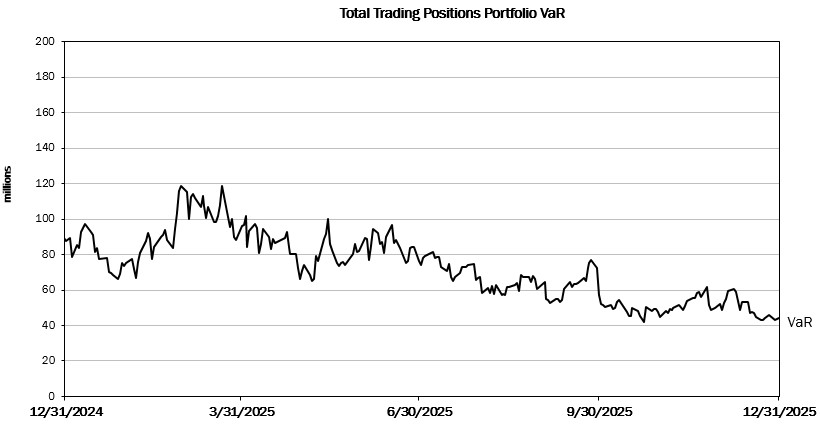
77 Bank of America | ||||||||
Additional VaR statistics produced within our single VaR model are provided in Table 43 at the same level of detail as in Table 42. Evaluating VaR with additional statistics allows for an increased understanding of the risks in the portfolio, as the historical market data used in the VaR calculation does not necessarily follow a predefined statistical distribution. Table 43 presents average trading VaR statistics at 99 percent and 95 percent confidence levels for 2025 and 2024.
| Table 43 | Average Market Risk VaR for Trading Activities – 99 percent and 95 percent VaR Statistics | ||||||||||||||||||||||||||||
| December 31, 2025 | December 31, 2024 | ||||||||||||||||||||||||||||
| (Dollars in millions) | 99 percent | 95 percent | 99 percent | 95 percent | |||||||||||||||||||||||||
| Foreign exchange | $ | 16 | $ | 8 | $ | 15 | $ | 7 | |||||||||||||||||||||
| Interest rate | 52 | 27 | 58 | 32 | |||||||||||||||||||||||||
| Credit | 46 | 20 | 51 | 27 | |||||||||||||||||||||||||
| Mortgage | 32 | 17 | 36 | 20 | |||||||||||||||||||||||||
| Equity | 24 | 12 | 21 | 10 | |||||||||||||||||||||||||
| Commodities | 9 | 6 | 10 | 6 | |||||||||||||||||||||||||
| Portfolio diversification | (107) | (58) | (124) | (68) | |||||||||||||||||||||||||
| Total trading positions portfolio VaR | 72 | 32 | 67 | 34 | |||||||||||||||||||||||||
| Fair value option loans | 20 | 11 | 19 | 11 | |||||||||||||||||||||||||
| Fair value option hedges | 13 | 7 | 10 | 6 | |||||||||||||||||||||||||
| Fair value option portfolio diversification | (20) | (11) | (16) | (10) | |||||||||||||||||||||||||
| Total fair value option portfolio | 13 | 7 | 13 | 7 | |||||||||||||||||||||||||
| Portfolio diversification | (7) | (5) | (7) | (3) | |||||||||||||||||||||||||
| Total market-based portfolio | $ | 78 | $ | 34 | $ | 73 | $ | 38 | |||||||||||||||||||||
Backtesting
The accuracy of the VaR methodology is evaluated by backtesting, which compares the daily VaR results, utilizing a one-day holding period, against a comparable subset of trading revenue. A backtesting excess occurs when a trading loss exceeds the VaR for the corresponding day. These excesses are evaluated to understand the positions and market moves that produced the trading loss with a goal to help confirm that the VaR methodology accurately represents those losses. We expect the frequency of trading losses in excess of VaR to be in line with the confidence level of the VaR statistic being tested. For example, with a 99 percent confidence level, we expect one trading loss in excess of VaR every 100 days or between two to three trading losses in excess of VaR over the course of a year. The number of backtesting excesses observed can differ from the statistically expected number of excesses if the current level of market volatility is materially different than the level of market volatility that existed during the three years of historical data used in the VaR calculation.
The trading revenue used for backtesting is defined by regulatory agencies in order to most closely align with the VaR component of the regulatory capital calculation. This revenue differs from total trading-related revenue in that it excludes revenue from trading activities that either do not generate market risk or for which the market risk cannot be included in VaR. Some examples of the types of revenue excluded for backtesting are fees, commissions, reserves, net interest income and intra-day trading revenues.
We conduct daily backtesting on the VaR results used for regulatory capital calculations as well as at the level of key legal entities. These results are reported to senior management, who regularly review and evaluate the results of these tests.
During 2025, there were no days where this subset of trading revenue had losses that exceeded our total covered portfolio VaR, utilizing a one-day holding period.
Total Trading-related Revenue
Total trading-related revenue, excluding brokerage fees, and CVA, DVA and funding valuation adjustment gains (losses), represents the total amount earned from trading positions, including net interest income associated with Global Markets trading activities, which are taken in a diverse range of financial instruments and markets. For more information on fair value, see Note 20 – Fair Value Measurements to the Consolidated Financial Statements. Trading-related revenue can be volatile and is largely driven by general market conditions and customer demand. Also, trading-related revenue is dependent on the volume and type of transactions, the level of risk assumed, and the volatility of price and rate movements at any given time within the ever-changing market environment. Significant daily revenue by business is monitored and the primary drivers of these are reviewed.
The following histogram is a graphic depiction of trading volatility and illustrates the daily level of trading-related revenue for 2025 and 2024. During 2025, positive trading-related revenue was recorded for more than 99 percent of the trading days, of which 95 percent were daily trading gains of over $25 million, and the largest loss was $2 million. This compares to 2024 where positive trading-related revenue was recorded for more than 99 percent of the trading days, of which 94 percent were daily trading gains of over $25 million, and the largest loss was $12 million.
Bank of America 78 | ||||||||
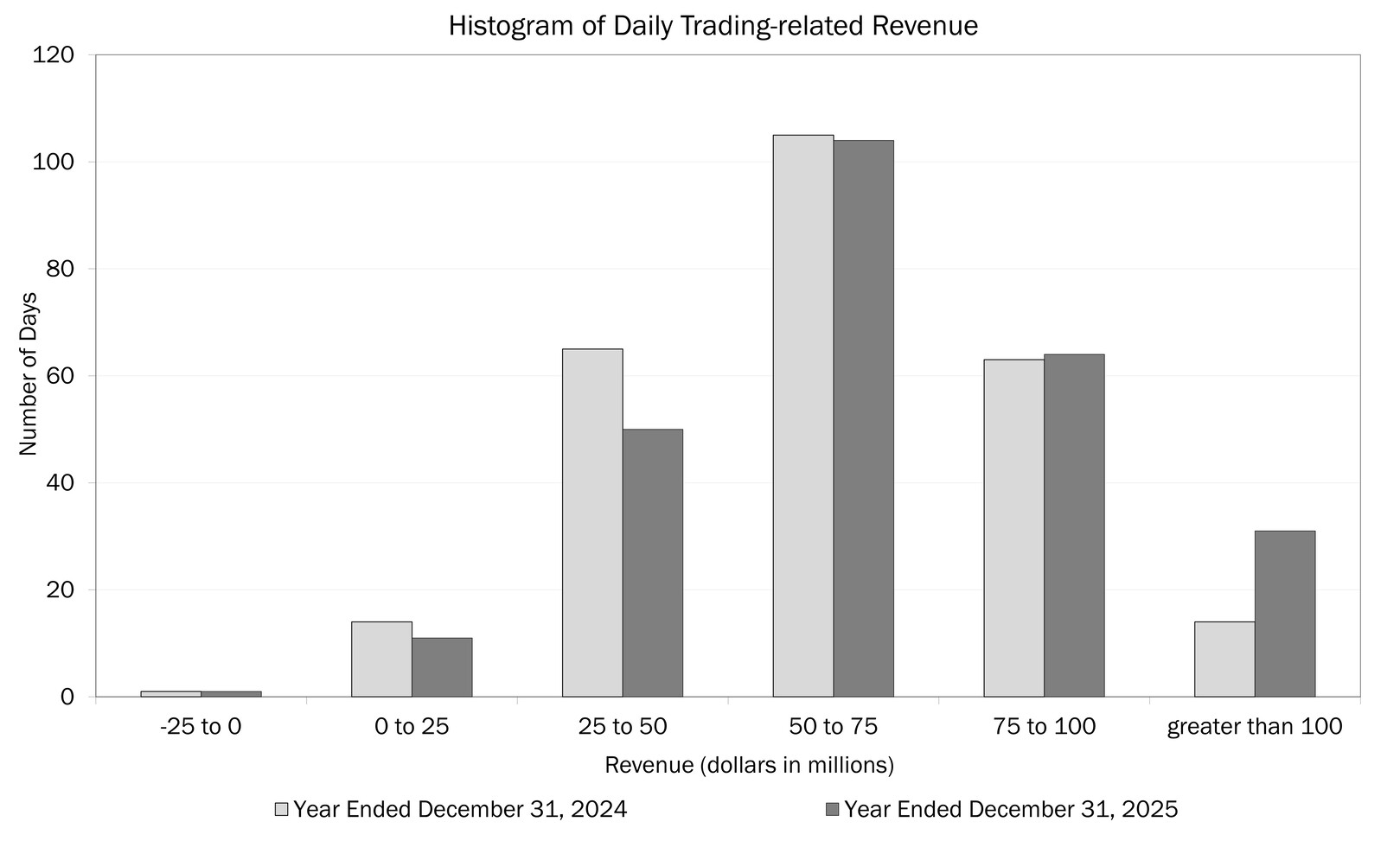
Trading Portfolio Stress Testing
Because the very nature of a VaR model suggests results can exceed our estimates and it is dependent on a limited historical window, we also stress test our portfolio using scenario analysis. This analysis estimates the change in the value of our trading portfolio that may result from abnormal market movements.
A set of scenarios, categorized as either historical or hypothetical, are computed daily for the overall trading portfolio and individual businesses. These scenarios include shocks to underlying market risk factors that may be well beyond the shocks found in the historical data used to calculate VaR. Historical scenarios simulate the impact of the market moves that occurred during a period of extended historical market stress. Generally, a multi-week period representing the most severe point during a crisis is selected for each historical scenario. Hypothetical scenarios provide estimated portfolio impacts from potential future market stress events. Scenarios are reviewed and updated in response to changing positions and new economic or political information. In addition, new or ad hoc scenarios are developed to address specific potential market events or particular vulnerabilities in the portfolio. The stress tests are reviewed on a regular basis and the results are presented to senior management.
Stress testing for the trading portfolio is integrated with enterprise-wide stress testing and incorporated into the limits framework. The macroeconomic scenarios used for enterprise-wide stress testing purposes differ from the typical trading portfolio scenarios in that they have a longer time horizon and the results are forecasted over multiple periods for use in consolidated capital and liquidity planning. For more information, see Managing Risk on page 88.
Interest Rate Risk Management for the Banking Book
The following discussion presents net interest income for banking book activities.
Interest rate risk represents the most significant market risk exposure to our banking book balance sheet. Interest rate risk is measured as the potential change in net interest income caused by movements in market interest rates. Client-facing
activities, primarily lending and deposit-taking, create interest rate sensitive positions on our balance sheet.
We prepare forward-looking forecasts of net interest income. The baseline forecast takes into consideration expected future business growth, ALM positioning and the future direction of interest rate movements as implied by market-based forward curves.
We then measure and evaluate the impact that alternative interest rate scenarios have on the baseline forecast in order to assess interest rate sensitivity under varied conditions. The net interest income forecast is frequently updated for changing assumptions and differing outlooks based on economic trends, market conditions and business strategies. Thus, we continually monitor our banking book balance sheet position in order to maintain an acceptable level of exposure to interest rate changes.
The interest rate scenarios that we analyze incorporate balance sheet assumptions such as loan and deposit growth and pricing, changes in funding mix, product repricing, maturity characteristics and investment securities premium amortization. Our overall goal is to manage interest rate risk so that movements in interest rates do not significantly adversely affect earnings and capital.
Table 44 presents the spot and 12-month forward rates used in developing the forward curve used in our baseline forecasts at December 31, 2025 and 2024.
| Table 44 | Forward Rates | |||||||||||||||||||
| December 31, 2025 | ||||||||||||||||||||
| Federal Funds | SOFR | 10-Year SOFR | ||||||||||||||||||
| Spot rates | 3.75 | % | 3.87 | % | 3.80 | % | ||||||||||||||
| 12-month forward rates | 3.25 | 3.11 | 3.89 | |||||||||||||||||
| December 31, 2024 | ||||||||||||||||||||
| Spot rates | 4.50 | % | 4.49 | % | 4.07 | % | ||||||||||||||
| 12-month forward rates | 4.00 | 3.94 | 4.07 | |||||||||||||||||
Table 45 shows the potential pretax impact to forecasted net interest income over the next 12 months from December 31, 2025 and 2024 resulting from instantaneous parallel and non-parallel shocks to the market-based forward curve.
79 Bank of America | ||||||||
Periodically, we evaluate the scenarios presented so that they are meaningful in the context of the current rate environment. Amounts presented reflect dynamic deposit sensitivities, which
incorporate behavioral customer deposit balance changes that could occur under various scenarios.
| Table 45 | Estimated Banking Book Net Interest Income Sensitivity to Curve Changes | |||||||||||||||||||||||||
| Short Rate (bps) | Long Rate (bps) | |||||||||||||||||||||||||
| December 31 | ||||||||||||||||||||||||||
| (Dollars in billions) | 2025 | 2024 | ||||||||||||||||||||||||
| Parallel Shifts | ||||||||||||||||||||||||||
+100 bps instantaneous shift | +100 | +100 | $ | 0.7 | $ | 1.1 | ||||||||||||||||||||
-100 bps instantaneous shift | -100 | -100 | (2.0) | (2.3) | ||||||||||||||||||||||
+200 bps instantaneous shift | +200 | +200 | 0.8 | 2.0 | ||||||||||||||||||||||
-200 bps instantaneous shift | -200 | -200 | (4.9) | (5.4) | ||||||||||||||||||||||
| Flatteners | ||||||||||||||||||||||||||
Short-end instantaneous change | +100 | — | 0.5 | 1.1 | ||||||||||||||||||||||
Long-end instantaneous change | — | -100 | (0.3) | (0.1) | ||||||||||||||||||||||
| Steepeners | ||||||||||||||||||||||||||
Short-end instantaneous change | -100 | — | (1.7) | (2.1) | ||||||||||||||||||||||
Long-end instantaneous change | — | +100 | 0.3 | 0.1 | ||||||||||||||||||||||
We continue to be asset sensitive to a parallel move in interest rates, with the majority of that impact coming from the short end of the yield curve. Additionally, higher interest rates negatively impact the fair value of our debt securities classified as available for sale and adversely affect accumulated OCI, and thus capital levels under the Basel 3 capital rules. Under instantaneous upward parallel shifts, the near-term adverse impact to Basel 3 capital would be reduced over time by offsetting positive impacts to net interest income generated from banking book activities. For more information on Basel 3, see Capital Management – Regulatory Capital on page 49.
As part of our ALM activities, we use securities, certain residential mortgages, and interest rate and foreign exchange derivatives in managing interest rate sensitivity. The sensitivity analysis in Table 45 assumes that we take no action in response to these rate shocks and does not assume any change in other macroeconomic variables normally correlated with changes in interest rates. In higher rate scenarios, the analysis assumes that a portion of low-cost or noninterest-bearing deposits are replaced with higher yielding deposits or market-based funding. Conversely, in lower rate scenarios, the analysis assumes that a portion of higher yielding deposits or market-based funding are replaced with low-cost or noninterest-bearing deposits.
For larger interest rate shift scenarios, the interest rate sensitivity may behave in a non-linear manner as there are numerous estimates and assumptions, which require a high degree of judgment and are often interrelated, that could impact the outcome. Pertaining to the mortgage-backed securities and residential mortgage portfolio, if long-end interest rates were to significantly decrease over the next twelve months, for example over 200 bps, there would generally be an increase in customer prepayment behaviors with an incremental reduction to net interest income, noting that the extent of changes in customer prepayment activity can be impacted by multiple factors and is not necessarily limited to long-end interest rates. Conversely, if long-end interest rates were to significantly increase over the next twelve months, for example, over 200 bps, customer prepayments would likely modestly decrease and result in an incremental increase to net interest income. In addition, deposit pricing is rate sensitive in nature. This sensitivity is assumed to have non-linear impacts to larger short-end rate movements. In decreasing interest rate scenarios, and particularly where interest rates have decreased to small amounts, the ability to further reduce rates paid is reduced as customer rates near zero. In higher short-end rate scenarios, deposit pricing will
likely increase at a faster rate, leading to incremental interest expense and reducing asset sensitivity. While the impact related to the above assumptions used in the asset sensitivity analysis can provide directional analysis on how net interest income will be impacted in changing environments, the ultimate impact is dependent upon the interrelationship of the assumptions and factors, which vary in different macroeconomic scenarios.
Economic Value of Equity
In addition to interest rate sensitivity described above, the Corporation’s management of its interest rate exposures in the banking book also considers a long-term view of interest rate sensitivity through the measurement of Economic Value of Equity (EVE). EVE captures changes in the net present value of banking book assets and liabilities under various interest rate scenarios and its impact to Tier 1 capital. Similar to net interest income, the Corporation establishes limits for EVE. EVE is largely driven by the Corporation’s longer duration fixed-rate products, such as investment securities, residential mortgages and deposits. For assets or liabilities that have no stated maturity, such as deposits, the Corporation estimates the duration for measurement purposes.
Interest Rate and Foreign Exchange Derivative Contracts
We use interest rate and foreign exchange derivative contracts in our ALM activities to manage our interest rate and foreign exchange risks. Specifically, we use those derivatives to manage both the variability in cash flows and changes in fair value of various assets and liabilities arising from those risks. Our interest rate derivative contracts are generally non-leveraged swaps tied to various benchmark interest rates and foreign exchange basis swaps, options, futures and forwards, and our foreign exchange contracts include cross-currency interest rate swaps, foreign currency futures contracts, foreign currency forward contracts and options.
The derivatives used in our ALM activities can be split into two broad categories: designated accounting hedges and other risk management derivatives. Designated accounting hedges are primarily used to manage our exposure to interest rates as described in the Interest Rate Risk Management for the Banking Book section and are included in the sensitivities presented in Table 45. The Corporation also uses foreign currency derivatives in accounting hedges to manage substantially all of the foreign exchange risk of our foreign operations. By hedging the foreign
Bank of America 80 | ||||||||
exchange risk of our foreign operations, the Corporation's market risk exposure in this area is not significant.
Risk management derivatives are predominantly used to hedge foreign exchange risks related to various foreign currency-denominated assets and liabilities and eliminate substantially all foreign currency exposures in the cash flows of the Corporation’s non-trading foreign currency-denominated financial instruments. These foreign exchange derivatives are sensitive to other market risk exposures such as cross-currency basis spreads and interest rate risk. However, as these features are not a significant component of these foreign exchange derivatives, the market risk related to this exposure is not significant. For more information on the accounting for derivatives, see Note 3 – Derivatives to the Consolidated Financial Statements.
Mortgage Banking Risk Management
We originate, fund and service mortgage loans, which subject us to credit, liquidity and interest rate risks, among others. We determine whether loans will be held for investment or held for sale at the time of commitment and manage credit and liquidity risks by selling or securitizing a portion of the loans we originate.
Interest rate risk and market risk can be substantial in the mortgage business. Changes in interest rates and other market factors impact the volume of mortgage originations. Changes in interest rates also impact the value of interest rate lock commitments and the related residential first mortgage loans held-for-sale, as well as the value of the MSRs. An increase in mortgage interest rates typically leads to a decrease in the value of these instruments. Conversely, when there is an increase in interest rates, the value of the MSRs will increase driven by lower prepayment expectations. Because the interest rate risks of these hedged items offset, we combine them into one overall hedged item with one combined economic hedge portfolio consisting of derivative contracts and securities.
Compliance and Operational Risk Management
Compliance risk is the risk of legal or regulatory sanctions, material financial loss or damage to the reputation of the Corporation arising from the failure of the Corporation to comply with the requirements of applicable LRRs and our internal policies and procedures (collectively, applicable LRRs). We are subject to comprehensive and evolving regulation under federal and state laws, rules and regulations in the U.S. and the laws of the various jurisdictions in which we operate, including those related to financial crimes and anti-money laundering, market conduct, trading activities, fair lending, privacy, data protection, development and use of AI, and unfair, deceptive or abusive acts or practices.
Operational risk is the risk of loss resulting from inadequate or failed internal processes or systems, people or external events, and includes legal risk. Operational risk may occur anywhere in the Corporation, including third-party business processes, and is not limited to operations functions. The Corporation faces a number of key operational risks including third-party risk, model risk, conduct risk, technology risk, information security risk and data risk. The pace of technological change, including in the field of AI, may heighten risks in those areas. Operational risk can result in financial losses and reputational impacts and is a component in the calculation of total RWA used in the Basel 3 capital calculation. For more information on Basel 3 calculations, see Capital Management on page 48.
FLUs and control functions are first and foremost responsible for managing all aspects of their businesses, including their compliance and operational risk. FLUs and control functions are required to understand their business processes and related risks and controls, including third-party dependencies and the related regulatory requirements, and monitor and report on the effectiveness of the control environment. In order to actively monitor and assess the performance of their processes and controls, they must conduct comprehensive quality assurance activities and identify issues and risks to remediate control gaps and weaknesses. FLUs and control functions must also adhere to compliance and operational risk appetite limits to meet strategic, capital and financial planning objectives. Finally, FLUs and control functions are responsible for the proactive identification, management and escalation of compliance and operational risks across the Corporation. Collectively, these efforts are important to strengthen their compliance and operational resiliency, which is the ability to deliver critical operations through disruption. To address AI-related risks, we have implemented internal processes and governance frameworks. These measures help with regulatory compliance and responsible use of AI across our operations.
Global Compliance and Operational Risk teams independently assess compliance and operational risk, monitor business activities and processes and evaluate FLUs and control functions for adherence to applicable LRRs, including identifying issues and risks, and reporting on the state of the control environment. Corporate Audit provides an independent assessment and validation through testing of key compliance and operational risk processes and controls across the Corporation.
The Corporation's Global Compliance – Enterprise Policy and Operational Risk Management – Enterprise Policy set the requirements for reporting compliance and operational risk information to executive management as well as the Board or appropriate Board-level committees and reflect Global Compliance and Operational Risk’s responsibilities for conducting independent oversight of the Corporation’s compliance and operational risk management activities. The Board provides oversight of compliance risk through its Audit Committee and the ERC, and operational risk through its ERC.
Cybersecurity
Risk Management and Strategy
Cybersecurity is a key operational risk facing the Corporation. We, our employees, customers, regulators, third parties and other entities, platforms, systems and networks upon which we rely to operate our business are ongoing targets of an increasing number of cybersecurity threats and cyberattacks and, accordingly, the Corporation devotes considerable resources to the establishment and maintenance of processes for assessing, identifying and managing cybersecurity risk through its global workforce and 24/7 cyber operations centers. The Corporation takes a cross-functional approach to addressing cybersecurity risk, with our Global Technology, Global Risk Management, Legal and Corporate Audit functions playing key roles. In addition, the Corporation’s processes related to cybersecurity risk are an element of and integrated with the Corporation’s comprehensive risk program, including our risk framework. For more information on the Corporation’s Cybersecurity risk, see Item 1A. Risk Factors – Business Operations beginning on page 14. For more information on our approach to risk management, including our risk management governance framework, see Managing Risk on page 45.
81 Bank of America | ||||||||
As part of the Corporation’s overall risk management program, the Corporation’s Global Information Security (GIS) Program is supported by three lines of defense. As the first line of defense, the GIS team is responsible for the day-to-day management of the GIS Program, which includes defining policies and procedures designed to safeguard the Corporation’s information systems and the information those systems collect, process, maintain, use, share, disseminate and dispose of. As the second line of defense, Global Compliance and Operational Risk independently assesses, monitors and tests cybersecurity risk across the Corporation, as well as the effectiveness of the GIS Program. As the third line of defense, Corporate Audit conducts additional independent review and validation of the first-line and second-line processes and functions.
The Corporation seeks to mitigate cybersecurity risk and associated legal, financial, reputational, operational and/or regulatory risks by employing a multi-faceted GIS Program, through various policies and procedures, that are focused on governing, preparing for, identifying, preventing, detecting, mitigating, responding to and recovering from cybersecurity threats and incidents, including those suffered by the Corporation and its third-party service providers, as well as effectively operating the Corporation’s processes. Our business continuity policies and procedures are designed to maintain the availability of business functions and enable impacted units within the Corporation and its third-party service providers to achieve strategic objectives in the event of a cybersecurity incident. In accordance with the Corporation’s cyber incident response framework, GIS, including its incident response team, tracks, documents, responds to and analyzes cybersecurity threats and cybersecurity incidents, including those experienced by the Corporation’s third-party service providers that may impact the Corporation. Additionally, the Corporation has a process for assembling multi-stakeholder executive response teams to monitor and coordinate cross-functional responses to certain cybersecurity incidents.
As part of the GIS Program, the Corporation leverages both internal and external assessments and industry partnerships. The Corporation engages third-party assessors, consultants, auditors and other third-party professionals to evaluate and test its cybersecurity program and provide guidance on operating and improving the GIS Program, including the design and operational effectiveness of the security and resiliency of our information systems.
Governance
Through established governance structures, the Corporation has policies and procedures to help facilitate oversight of cybersecurity risk. In accordance with these policies and procedures, the Corporation’s three lines of defense, and management, strive to prepare for, identify, prevent, detect, mitigate, respond to and recover from cybersecurity threats and incidents, monitor performance, and escalate to executive management, the committees of the Corporation’s Board and/or to the Board, as appropriate. Additionally, GIS reports cybersecurity incidents that meet certain criteria to the Legal Department for evaluation of materiality and potential escalation and disclosure, which includes the consideration of relevant quantitative and qualitative factors.
The Board is actively engaged in the oversight of the GIS Program and devotes time and attention to the oversight and mitigation of cybersecurity risk. The Board, which includes members with technology and cybersecurity experience, oversees management’s approach to staffing and the policies and procedures to address cybersecurity risk. The Board and its ERC, which is responsible for reviewing cybersecurity risk, each receive regular presentations, memoranda and reports from our Chief Technology and Information Officer (CTIO) and our Chief Information Security Officer (CISO) on internal and external cybersecurity developments, threats and risks.
The Board receives prompt and timely information from management on cybersecurity incidents, including cybersecurity incidents experienced by the Corporation’s third-party service providers, that may pose significant risk to the Corporation, and continues to receive regular reports on any such incidents until their conclusion. Additionally, the Board receives quarterly reports on the performance metrics for the GIS Program and the performance of the Corporation’s cybersecurity risk appetite metrics, including metrics on vulnerabilities and third-party cybersecurity risks and incidents, and is notified promptly if a Board-level cybersecurity risk limit is breached.
Our ERC also annually reviews and approves our GIS Program and our Information Security Policy, which establish administrative, technical, and physical safeguards designed to protect the security, confidentiality, availability and integrity of customer records and information in accordance with the Gramm-Leach-Bliley Act and the interagency guidelines issued thereunder, and applicable laws globally.
Under the Board’s oversight, management works closely with key stakeholders, including regulators, government agencies, law enforcement, peer institutions and industry groups, and develops and invests in talent and innovative technology in order to better manage cybersecurity risk.
Our most senior cybersecurity employees are the CTIO and CISO, who are primarily responsible for managing and assessing cybersecurity risk. The CISO oversees a team of more than 3,400 information security professionals spanning the globe. The CISO and the GIS senior leadership team have deep cybersecurity expertise, with over 200 years of collective
Bank of America 82 | ||||||||
experience working in the cybersecurity field, at the Corporation, in government, and other companies in various industries. Additionally, certain members of the GIS leadership team hold leadership roles in sector-specific information and infrastructure security organizations, including the Financial Services Information Sharing and Analysis Center and the Financial Services Sector Coordinating Council. Employees across the Corporation also play a role in protecting the Corporation from cybersecurity threats and receive periodic training and education on cybersecurity-related topics.
Reputational Risk Management
Reputational risk is the risk that negative perception of the Corporation may materially impact its financial condition. Reputational risk may result from many of the Corporation’s activities, including those related to the management of strategic, operational, compliance, liquidity, market (price and interest rate) and credit risks.
The Corporation manages reputational risk through established policies and controls embedded throughout its business and risk management processes. We proactively monitor and identify potential reputational risk events and have processes established to mitigate reputational risks in a timely manner. If reputational risk events occur, we focus on remediating the underlying issue and taking action to minimize damage to the Corporation’s reputation. The Corporation has processes in place to respond to events that give rise to reputational risk, including implementing communication strategies to mitigate the impact. The Corporation’s organization and governance structure provides oversight of reputational risks through management and Board committees. Each FLU has an MRC that is responsible for the oversight of reputational risk, including decisions where elevated levels of reputational risks are present. Additionally, reputational risk reporting is provided to senior management and the Board regularly.
Critical Accounting Estimates
Our significant accounting principles are described in Note 1 – Summary of Significant Accounting Principles to the Consolidated Financial Statements and are essential in understanding the MD&A. The application of the accounting principles may involve the use of complex judgments, significant subjectivity, and extensive modeling techniques to estimate the values of assets and liabilities, particularly those related to credit exposures, fair value measurements, and other areas sensitive to changes in economic, market or borrower-specific conditions. These estimates are critical to the application of GAAP and are essential to understanding our reported financial condition, operating performance, and the comparability of results across reporting periods.
In developing these estimates, the Corporation employs established governance frameworks, including formal model‑risk management, independent validation and internal control processes to assess and select the relevant variables, assumptions and inputs that most appropriately reflect reasonable expectations at the time the estimates are made. Because these estimates involve matters that may be difficult to measure or that are sensitive to evolving credit, economic or market conditions, actual results may differ from estimated amounts as new information becomes available or as underlying conditions change.
Key variables, assumptions and inputs used in these estimates may fluctuate after the balance sheet date due to changes in credit conditions, interest rates, liquidity dynamics and broader market developments, which may materially impact
our financial condition or operating performance. These changes reflect inherent uncertainty in the economic and market environment and should not be interpreted as deficiencies in the Corporation’s models, methodologies or inputs. The Corporation’s critical accounting estimates, including the nature of the underlying estimation uncertainty and their potential effect on our results, are disclosed in the following discussion.
Allowance for Credit Losses
The allowance for credit losses includes the allowance for loan and lease losses and the reserve for unfunded lending commitments. Our process for determining the allowance for credit losses is discussed in Note 1 – Summary of Significant Accounting Principles and Note 5 – Outstanding Loans and Leases and Allowance for Credit Losses to the Consolidated Financial Statements.
The determination of the allowance for credit losses is based on numerous estimates and assumptions, which require a high degree of judgment and are often interrelated. A critical judgment in the process is the weighting of our forward-looking macroeconomic scenarios that are incorporated into our quantitative models. As any one economic outlook is inherently uncertain, the Corporation uses multiple macroeconomic scenarios in its CECL calculation, which have included a baseline scenario derived from consensus estimates, an adverse scenario reflecting a moderate recession, a downside scenario reflecting continued inflation, a tail risk scenario similar to the severely adverse scenario used in stress testing and an upside scenario that considers the potential for improvement above the baseline scenario. The overall economic outlook is weighted to reflect a moderate growth environment, with lower gross domestic product (GDP) growth and higher unemployment rate expectations as compared to what we experienced in 2025. Generally, as the consensus estimates improve or deteriorate, the allowance for credit losses will change in a similar direction.
There are multiple variables that drive the macroeconomic scenarios with the key variables including, but not limited to, U.S. real GDP and unemployment rates. As of December 31, 2025, the latest consensus estimate for the U.S. average unemployment rate for the fourth quarter of 2025 was 4.5 percent, and U.S. real GDP was forecasted to grow 1.7 percent year-over-year in the fourth quarter of 2025, reflecting a strong labor market and consistent levels of growth compared to our macroeconomic outlook as of December 31, 2024, and were factored into our allowance for credit losses estimate as of December 31, 2025. In addition, the table below presents the weighted macroeconomic outlook for U.S. average unemployment rate and U.S. real GDP growth rate.
| Table 46 | Key Allowance Variables | ||||||||||
| Quarterly Average | |||||||||||
4Q Year 1 (1) | 4Q Year 2 (1) | ||||||||||
| U.S. Unemployment | |||||||||||
| December 31, 2024 forecast | 4.8 | % | 4.7 | % | |||||||
| December 31, 2025 forecast | 5.0 | 4.9 | |||||||||
| Year-Over-Year | |||||||||||
4Q Year 1 (1) | 4Q Year 2 (1) | ||||||||||
| U.S. Real GDP Growth | |||||||||||
| December 31, 2024 forecast | 1.4 | % | 1.8 | % | |||||||
| December 31, 2025 forecast | 1.4 | 1.8 | |||||||||
(1)Represents the forecasted weighted economic outlook one and two years out from the reporting date.
83 Bank of America | ||||||||
In addition to the above judgments and estimates, the allowance for credit losses can also be impacted by unanticipated changes in asset quality of the portfolio, such as increases or decreases in credit and/or internal risk ratings in our commercial portfolio, improvement or deterioration in borrower delinquencies or credit scores in our credit card portfolio and increases or decreases in home prices, which is a primary driver of LTVs, in our consumer real estate portfolio, all of which have some degree of uncertainty. The allowance for credit losses increased $44 million from $14.3 billion at December 31, 2024 to $14.4 billion as of December 31, 2025, as increases in the U.S. Commercial allowance were partially offset by decreases in the credit card and commercial real estate portfolios.
To provide an illustration of the sensitivity of the macroeconomic scenarios and other assumptions on the estimate of our allowance for credit losses, the Corporation compared the December 31, 2025 modeled CECL from the baseline scenario to our adverse scenario. Relative to the baseline scenario, the adverse scenario assumed a peak U.S. unemployment rate of approximately two percentage points higher than the baseline scenario, a decline in U.S. real GDP followed by a prolonged recovery and a lower home price outlook with a difference of approximately 18 percent at the trough. This sensitivity analysis resulted in a hypothetical increase in the allowance for credit losses of approximately $4.2 billion.
While the sensitivity analysis may be useful to consider how changes in certain macroeconomic assumptions could impact our baseline CECL, it should not be relied upon as a forecast of how our allowance for credit losses is expected to change in a different macroeconomic outlook. Ultimately, the estimate of the allowance for credit losses is dependent upon a variety of potential factors including, but not limited to, qualitative assessments, weighting of alternate macroeconomic scenarios and changes in portfolio mix that would need to be considered comprehensively in determining the allowance for credit losses. Due to the uncertainty in predicting these factors, they are not incorporated into the sensitivity analysis.
Fair Value of Financial Instruments
Under applicable accounting standards, we are required to maximize the use of observable inputs and minimize the use of unobservable inputs in measuring fair value. We classify fair value measurements of financial instruments and MSRs based on the three-level fair value hierarchy in the accounting standards.
The fair values of assets and liabilities may include adjustments, such as market liquidity and credit quality, where appropriate. Valuations of products using models or other techniques are sensitive to assumptions used for the significant inputs. Where market data is available, the inputs used for valuation reflect that information as of our valuation date. Inputs to valuation models are considered unobservable if they are supported by little or no market activity. In periods of extreme volatility, lessened liquidity or in illiquid markets, there may be more variability in market pricing or a lack of market data to use in the valuation process. In keeping with the prudent application of estimates and management judgment in determining the fair value of assets and liabilities, we have in place various processes and controls that include: a model validation policy that requires review and approval of quantitative models used for deal pricing, financial statement fair value determination and risk quantification; a trading product valuation policy that requires verification of all traded product valuations; and a periodic review and substantiation of daily profit and loss
reporting for all traded products. Primarily through validation controls, we utilize both broker and pricing service inputs which can and do include both market-observable and internally-modeled values and/or valuation inputs. Our reliance on this information is affected by our understanding of how the broker and/or pricing service develops its data with a higher degree of reliance applied to those that are more directly observable and lesser reliance applied to those developed through their own internal modeling. For example, broker quotes in less active markets may only be indicative and therefore less reliable. These processes and controls are performed independently of the business. For more information, see Note 20 – Fair Value Measurements and Note 21 – Fair Value Option to the Consolidated Financial Statements.
Level 3 Assets and Liabilities
Financial assets and liabilities, and MSRs, where values are based on valuation techniques that require inputs that are both unobservable and are significant to the overall fair value measurement are classified as Level 3 under the fair value hierarchy established in applicable accounting standards. The fair value of these Level 3 financial assets and liabilities and MSRs is determined using pricing models, discounted cash flow methodologies or similar techniques for which the determination of fair value requires significant management judgment or estimation.
Level 3 financial instruments may be hedged with derivatives classified as Level 1 or 2; therefore, gains or losses associated with Level 3 financial instruments may be offset by gains or losses associated with financial instruments classified in other levels of the fair value hierarchy. The Level 3 gains and losses recorded in earnings did not have a significant impact on our liquidity or capital. We conduct a review of our fair value hierarchy classifications on a quarterly basis. Transfers into or out of Level 3 are made if the significant inputs used in financial models measuring the fair values of the assets and liabilities became unobservable or observable, respectively, in the current marketplace, or when previously insignificant unobservable and observable inputs become significant, respectively. For more information on transfers into and out of Level 3 during 2025, 2024 and 2023, see Note 20 – Fair Value Measurements to the Consolidated Financial Statements.
Accrued Income Taxes and Deferred Tax Assets
Accrued income taxes, reported as a component of either other assets or accrued expenses and other liabilities on the Consolidated Balance Sheet, represent the net amount of current income taxes we expect to pay to or receive from various taxing jurisdictions attributable to our operations to date. We currently file income tax returns in more than 60 states and municipalities and more than 40 non-U.S. jurisdictions and consider many factors, including statutory, judicial and regulatory guidance, in estimating the appropriate accrued income taxes for each jurisdiction.
Net deferred tax assets, reported as a component of other assets on the Consolidated Balance Sheet, represent the net decrease in taxes expected to be paid in the future because of net operating loss (NOL) and tax credit carryforwards and because of future reversals of temporary differences in the bases of assets and liabilities as measured by tax laws and their bases as reported in the financial statements. NOL and tax credit carryforwards result in reductions to future tax liabilities, and many of these attributes can expire if not utilized within certain periods. We consider the need for valuation allowances
Bank of America 84 | ||||||||
to reduce net deferred tax assets to the amounts that we estimate are more likely than not to be realized.
Consistent with the applicable accounting guidance, we monitor relevant tax authorities and change our estimates of accrued income taxes and/or net deferred tax assets due to changes in income tax laws and their interpretation by the courts and regulatory authorities. These revisions of our estimates, which also may result from our income tax planning and from the resolution of income tax audit matters, may be material to our operating results for any given period.
See Note 19 – Income Taxes to the Consolidated Financial Statements for a table of significant tax attributes and additional information. For more information, see Item 1A. Risk Factors – Regulatory, Compliance and Legal.
Goodwill and Intangible Assets
The nature of and accounting for goodwill and intangible assets are discussed in Note 1 – Summary of Significant Accounting Principles and Note 7 – Goodwill and Intangible Assets to the Consolidated Financial Statements.
| Table 47 | Goodwill by Reporting Segment | |||||||||||||
| December 31 | ||||||||||||||
| (Dollars in millions) | 2025 | 2024 | ||||||||||||
| Consumer Banking | $ | 30,137 | $ | 30,137 | ||||||||||
| Global Wealth and Investment Management | 9,677 | 9,677 | ||||||||||||
| Global Banking | 24,026 | 24,026 | ||||||||||||
| Global Markets | 5,181 | 5,181 | ||||||||||||
| Total | $ | 69,021 | $ | 69,021 | ||||||||||
We completed our annual goodwill impairment test as of June 30, 2025 using a quantitative assessment for the Consumer Banking reporting unit and a qualitative assessment for the remaining six reporting units. The quantitative assessment was performed for Consumer Banking because the Corporation combined its Consumer Lending and Deposits reporting units into a single reporting unit to correspond with the change in reporting structure that occurred in the Consumer Banking segment in the first quarter of 2025.
For the quantitative assessment, we compared the fair value of the reporting unit to its carrying value, as measured by allocated equity. The fair value was estimated based on the combination of an income approach (which utilizes the present value of cash flows to estimate fair value) and a market multiplier approach (which utilizes observable market prices and metrics of peer companies to estimate fair value). The cash flows used in the income approach were based on the Corporation’s three-year internal forecasts along with long-term terminal growth values, which were discounted at 10.50 percent. The discount rate was derived from a capital asset pricing model that incorporates the risk and uncertainty in the cash flow forecasts, the financial markets and industries similar to the reporting units. The market multiplier approach utilized various market multiples, primarily pricing multiples, from comparable publicly-traded companies in industries similar to the reporting unit. In addition, a control premium was factored in based upon observed comparable premiums paid for change-in-control transactions for financial institutions.
For the qualitative assessment, we used various factors, including macroeconomic conditions and outlook, industry and market pricing multiples, financial performance and other relevant reporting unit considerations, to support that it is not more likely than not that the fair value of the reporting units is less than the reporting units’ carrying value.
Based on our assessments, we have concluded that none of our reporting units are at risk of impairment, as each of the reporting units’ fair values are substantially in excess of their carrying values.
Certain Contingent Liabilities
For more information on the complex judgments associated with certain contingent liabilities, see Note 12 – Commitments and Contingencies to the Consolidated Financial Statements.
85 Bank of America | ||||||||
Non-GAAP Reconciliations
Tables 48 and 49 provide reconciliations of certain non-GAAP financial measures to GAAP financial measures.
| Table 48 | Annual Reconciliations to GAAP Financial Measures (1) | |||||||||||||||||||
| (Dollars in millions, shares in thousands) | 2025 | 2024 | 2023 | |||||||||||||||||
Reconciliation of average shareholders’ equity to average tangible shareholders’ equity and average tangible common shareholders’ equity | ||||||||||||||||||||
| Shareholders’ equity | $ | 298,474 | $ | 292,467 | $ | 281,861 | ||||||||||||||
| Goodwill | (69,021) | (69,021) | (69,022) | |||||||||||||||||
| Intangible assets (excluding MSRs) | (1,883) | (1,961) | (2,039) | |||||||||||||||||
| Related deferred tax liabilities | 841 | 866 | 893 | |||||||||||||||||
| Tangible shareholders’ equity | $ | 228,411 | $ | 222,351 | $ | 211,693 | ||||||||||||||
| Preferred stock | (24,039) | (26,487) | (28,397) | |||||||||||||||||
| Tangible common shareholders’ equity | $ | 204,372 | $ | 195,864 | $ | 183,296 | ||||||||||||||
Reconciliation of year-end shareholders’ equity to year-end tangible shareholders’ equity and year-end tangible common shareholders’ equity | ||||||||||||||||||||
| Shareholders’ equity | $ | 303,243 | $ | 293,963 | $ | 290,209 | ||||||||||||||
| Goodwill | (69,021) | (69,021) | (69,021) | |||||||||||||||||
| Intangible assets (excluding MSRs) | (1,841) | (1,919) | (1,997) | |||||||||||||||||
| Related deferred tax liabilities | 825 | 851 | 874 | |||||||||||||||||
| Tangible shareholders’ equity | $ | 233,206 | $ | 223,874 | $ | 220,065 | ||||||||||||||
| Preferred stock | (25,992) | (23,159) | (28,397) | |||||||||||||||||
| Tangible common shareholders’ equity | $ | 207,214 | $ | 200,715 | $ | 191,668 | ||||||||||||||
Reconciliation of year-end assets to year-end tangible assets | ||||||||||||||||||||
| Assets | $ | 3,411,738 | $ | 3,261,299 | $ | 3,180,515 | ||||||||||||||
| Goodwill | (69,021) | (69,021) | (69,021) | |||||||||||||||||
| Intangible assets (excluding MSRs) | (1,841) | (1,919) | (1,997) | |||||||||||||||||
| Related deferred tax liabilities | 825 | 851 | 874 | |||||||||||||||||
| Tangible assets | $ | 3,341,701 | $ | 3,191,210 | $ | 3,110,371 | ||||||||||||||
(1)Presents reconciliations of non-GAAP financial measures to GAAP financial measures. For more information on non-GAAP financial measures and ratios we use in assessing the results of the Corporation, see Supplemental Financial Data on page 31.
| Table 49 | Quarterly Reconciliations to GAAP Financial Measures (1) | |||||||||||||||||||||||||||||||||||||||||||||||||
| 2025 Quarters | 2024 Quarters | |||||||||||||||||||||||||||||||||||||||||||||||||
| (Dollars in millions) | Fourth | Third | Second | First | Fourth | Third | Second | First | ||||||||||||||||||||||||||||||||||||||||||
Reconciliation of average shareholders’ equity to average tangible shareholders’ equity and average tangible common shareholders’ equity | ||||||||||||||||||||||||||||||||||||||||||||||||||
| Shareholders’ equity | $ | 303,873 | $ | 300,381 | $ | 295,329 | $ | 294,187 | $ | 293,398 | $ | 293,431 | $ | 291,943 | $ | 291,074 | ||||||||||||||||||||||||||||||||||
| Goodwill | (69,021) | (69,021) | (69,021) | (69,021) | (69,021) | (69,021) | (69,021) | (69,021) | ||||||||||||||||||||||||||||||||||||||||||
| Intangible assets (excluding MSRs) | (1,853) | (1,873) | (1,893) | (1,912) | (1,932) | (1,951) | (1,971) | (1,990) | ||||||||||||||||||||||||||||||||||||||||||
| Related deferred tax liabilities | 827 | 839 | 846 | 851 | 859 | 864 | 869 | 874 | ||||||||||||||||||||||||||||||||||||||||||
| Tangible shareholders’ equity | $ | 233,826 | $ | 230,326 | $ | 225,261 | $ | 224,105 | $ | 223,304 | $ | 223,323 | $ | 221,820 | $ | 220,937 | ||||||||||||||||||||||||||||||||||
| Preferred stock | (25,992) | (25,232) | (22,573) | (22,307) | (23,493) | (25,984) | (28,113) | (28,397) | ||||||||||||||||||||||||||||||||||||||||||
| Tangible common shareholders’ equity | $ | 207,834 | $ | 205,094 | $ | 202,688 | $ | 201,798 | $ | 199,811 | $ | 197,339 | $ | 193,707 | $ | 192,540 | ||||||||||||||||||||||||||||||||||
Reconciliation of period-end shareholders’ equity to period-end tangible shareholders’ equity and period-end tangible common shareholders’ equity | ||||||||||||||||||||||||||||||||||||||||||||||||||
| Shareholders’ equity | $ | 303,243 | $ | 302,437 | $ | 298,021 | $ | 293,949 | $ | 293,963 | $ | 294,774 | $ | 292,340 | $ | 292,094 | ||||||||||||||||||||||||||||||||||
| Goodwill | (69,021) | (69,021) | (69,021) | (69,021) | (69,021) | (69,021) | (69,021) | (69,021) | ||||||||||||||||||||||||||||||||||||||||||
| Intangible assets (excluding MSRs) | (1,841) | (1,860) | (1,880) | (1,899) | (1,919) | (1,938) | (1,958) | (1,977) | ||||||||||||||||||||||||||||||||||||||||||
| Related deferred tax liabilities | 825 | 828 | 842 | 846 | 851 | 859 | 864 | 869 | ||||||||||||||||||||||||||||||||||||||||||
| Tangible shareholders’ equity | $ | 233,206 | $ | 232,384 | $ | 227,962 | $ | 223,875 | $ | 223,874 | $ | 224,674 | $ | 222,225 | $ | 221,965 | ||||||||||||||||||||||||||||||||||
| Preferred stock | (25,992) | (25,992) | (23,495) | (20,499) | (23,159) | (24,554) | (26,548) | (28,397) | ||||||||||||||||||||||||||||||||||||||||||
| Tangible common shareholders’ equity | $ | 207,214 | $ | 206,392 | $ | 204,467 | $ | 203,376 | $ | 200,715 | $ | 200,120 | $ | 195,677 | $ | 193,568 | ||||||||||||||||||||||||||||||||||
Reconciliation of period-end assets to period-end tangible assets | ||||||||||||||||||||||||||||||||||||||||||||||||||
| Assets | $ | 3,411,738 | $ | 3,403,149 | $ | 3,440,798 | $ | 3,349,039 | $ | 3,261,299 | $ | 3,323,917 | $ | 3,257,896 | $ | 3,273,884 | ||||||||||||||||||||||||||||||||||
| Goodwill | (69,021) | (69,021) | (69,021) | (69,021) | (69,021) | (69,021) | (69,021) | (69,021) | ||||||||||||||||||||||||||||||||||||||||||
| Intangible assets (excluding MSRs) | (1,841) | (1,860) | (1,880) | (1,899) | (1,919) | (1,938) | (1,958) | (1,977) | ||||||||||||||||||||||||||||||||||||||||||
| Related deferred tax liabilities | 825 | 828 | 842 | 846 | 851 | 859 | 864 | 869 | ||||||||||||||||||||||||||||||||||||||||||
| Tangible assets | $ | 3,341,701 | $ | 3,333,096 | $ | 3,370,739 | $ | 3,278,965 | $ | 3,191,210 | $ | 3,253,817 | $ | 3,187,781 | $ | 3,203,755 | ||||||||||||||||||||||||||||||||||
(1)Presents reconciliations of non-GAAP financial measures to GAAP financial measures. For more information on non-GAAP financial measures and ratios we use in assessing the results of the Corporation, see Supplemental Financial Data on page 31.
Bank of America 86 | ||||||||
Item 7A. Quantitative and Qualitative Disclosures about Market Risk
See Market Risk Management on page 75 in the MD&A and the sections referenced therein for Quantitative and Qualitative Disclosures about Market Risk.
| Item 8. Financial Statements and Supplementary Data | ||||||||||||||
| Table of Contents | ||||||||||||||
| Page | |||||
Note 5 – Outstanding Loans and Leases and Allowance for Credit Losses | |||||
87 Bank of America | ||||||||
Report of Management on Internal Control Over Financial Reporting
The management of Bank of America Corporation is responsible for establishing and maintaining adequate internal control over financial reporting.
The Corporation’s internal control over financial reporting is a process designed to provide reasonable assurance regarding the reliability of financial reporting and the preparation of financial statements for external purposes in accordance with accounting principles generally accepted in the United States of America. The Corporation’s internal control over financial reporting includes those policies and procedures that (i) pertain to the maintenance of records that, in reasonable detail, accurately and fairly reflect the transactions and dispositions of the assets of the Corporation; (ii) provide reasonable assurance that transactions are recorded as necessary to permit preparation of financial statements in accordance with accounting principles generally accepted in the United States of America, and that receipts and expenditures of the Corporation are being made only in accordance with authorizations of management and directors of the Corporation; and (iii) provide reasonable assurance regarding prevention or timely detection of unauthorized acquisition, use, or disposition of the Corporation’s assets that could have a material effect on the financial statements.
Because of its inherent limitations, internal control over financial reporting may not prevent or detect misstatements. Also, projections of any evaluation of effectiveness to future periods are subject to the risk that controls may become inadequate because of changes in conditions, or that the degree of compliance with the policies or procedures may deteriorate.
Management assessed the effectiveness of the Corporation’s internal control over financial reporting as of December 31, 2025 based on the framework set forth by the Committee of Sponsoring Organizations of the Treadway Commission in Internal Control – Integrated Framework (2013). Based on that assessment, management concluded that, as of December 31, 2025, the Corporation’s internal control over financial reporting is effective.
The Corporation’s internal control over financial reporting as of December 31, 2025 has been audited by PricewaterhouseCoopers , LLP , an independent registered public accounting firm, as stated in their accompanying report which expresses an unqualified opinion on the effectiveness of the Corporation’s internal control over financial reporting as of December 31, 2025.
Brian T. Moynihan
Chair and Chief Executive Officer
Alastair M. Borthwick
Executive Vice President and Chief Financial Officer
Bank of America 88 | ||||||||
Report of Independent Registered Public Accounting Firm
To the Board of Directors and Shareholders of Bank of America Corporation
Opinions on the Financial Statements and Internal Control over Financial Reporting
We have audited the accompanying consolidated balance sheets of Bank of America Corporation and its subsidiaries (the “Corporation”) as of December 31, 2025 and 2024, and the related consolidated statements of income, of comprehensive income, of changes in shareholders’ equity and of cash flows for each of the three years in the period ended December 31, 2025, including the related notes (collectively referred to as the “consolidated financial statements”). We also have audited the Corporation's internal control over financial reporting as of December 31, 2025, based on criteria established in Internal Control - Integrated Framework (2013) issued by the Committee of Sponsoring Organizations of the Treadway Commission (COSO).
In our opinion, the consolidated financial statements referred to above present fairly, in all material respects, the financial position of the Corporation as of December 31, 2025 and 2024, and the results of its operations and its cash flows for each of the three years in the period ended December 31, 2025 in conformity with accounting principles generally accepted in the United States of America. Also in our opinion, the Corporation maintained, in all material respects, effective internal control over financial reporting as of December 31, 2025, based on criteria established in Internal Control - Integrated Framework (2013) issued by the COSO.
Basis for Opinions
The Corporation’s management is responsible for these consolidated financial statements, for maintaining effective internal control over financial reporting, and for its assessment of the effectiveness of internal control over financial reporting, included in Report of Management on Internal Control Over Financial Reporting appearing under Item 8. Our responsibility is to express opinions on the Corporation’s consolidated financial statements and on the Corporation's internal control over financial reporting based on our audits. We are a public accounting firm registered with the Public Company Accounting Oversight Board (United States) (PCAOB) and are required to be independent with respect to the Corporation in accordance with the U.S. federal securities laws and the applicable rules and regulations of the Securities and Exchange Commission and the PCAOB.
We conducted our audits in accordance with the standards of the PCAOB. Those standards require that we plan and perform the audits to obtain reasonable assurance about whether the consolidated financial statements are free of material misstatement, whether due to error or fraud, and whether effective internal control over financial reporting was maintained in all material respects. Our audits of the consolidated financial statements included performing procedures to assess the risks of material misstatement of the consolidated financial statements, whether due to error or fraud, and performing procedures that respond to those risks. Such procedures included examining, on a test basis, evidence regarding the amounts and disclosures in the consolidated financial statements. Our audits also included evaluating the accounting principles used and significant estimates made by management, as well as evaluating the overall presentation of the consolidated financial statements. Our audit of internal
control over financial reporting included obtaining an understanding of internal control over financial reporting, assessing the risk that a material weakness exists, and testing and evaluating the design and operating effectiveness of internal control based on the assessed risk. Our audits also included performing such other procedures as we considered necessary in the circumstances. We believe that our audits provide a reasonable basis for our opinions.
Definition and Limitations of Internal Control over Financial Reporting
A company’s internal control over financial reporting is a process designed to provide reasonable assurance regarding the reliability of financial reporting and the preparation of financial statements for external purposes in accordance with generally accepted accounting principles. A company’s internal control over financial reporting includes those policies and procedures that (i) pertain to the maintenance of records that, in reasonable detail, accurately and fairly reflect the transactions and dispositions of the assets of the company; (ii) provide reasonable assurance that transactions are recorded as necessary to permit preparation of financial statements in accordance with generally accepted accounting principles, and that receipts and expenditures of the company are being made only in accordance with authorizations of management and directors of the company; and (iii) provide reasonable assurance regarding prevention or timely detection of unauthorized acquisition, use, or disposition of the company’s assets that could have a material effect on the financial statements.
Because of its inherent limitations, internal control over financial reporting may not prevent or detect misstatements. Also, projections of any evaluation of effectiveness to future periods are subject to the risk that controls may become inadequate because of changes in conditions, or that the degree of compliance with the policies or procedures may deteriorate.
Critical Audit Matters
The critical audit matter communicated below is a matter arising from the current period audit of the consolidated financial statements that was communicated or required to be communicated to the audit committee and that (i) relates to accounts or disclosures that are material to the consolidated financial statements and (ii) involved our especially challenging, subjective, or complex judgments. The communication of critical audit matters does not alter in any way our opinion on the consolidated financial statements, taken as a whole, and we are not, by communicating the critical audit matter below, providing a separate opinion on the critical audit matter or on the accounts or disclosures to which it relates.
Allowance for Loan and Lease Losses - Commercial and Consumer Card Loans
As described in Notes 1 and 5 to the consolidated financial statements, the allowance for loan and lease losses represents management’s estimate of current expected credit losses (CECL) in the Corporation’s loan and lease portfolio, excluding loans and unfunded lending commitments accounted for under the fair value option. As of December 31, 2025, the allowance for loan and lease losses was $13.2 billion on total loans and leases of $1,182.2 billion, which excludes loans accounted for under the fair value option. For commercial and consumer card loans, CECL is typically estimated using quantitative methods
89 Bank of America | ||||||||
that consider a variety of factors such as historical loss experience, the current credit quality of the portfolio as well as an economic outlook over the life of the loan. In its loss forecasting framework, the Corporation incorporates forward looking information through the use of macroeconomic scenarios applied over the forecasted life of the assets. These macroeconomic scenarios include variables that have historically been key drivers of increases and decreases in credit losses. These variables include, but are not limited to, unemployment rates, real estate prices, gross domestic product growth rates and corporate bond spreads. The scenarios that are chosen and the weighting given to each scenario depend on a variety of factors including recent economic events, leading economic indicators, views of internal as well as third-party economists and industry trends. Also included in the allowance for loan and lease losses are qualitative reserves to cover losses that are expected but, in the Corporation's assessment, may not be adequately reflected in the quantitative methods or the economic assumptions. Factors that the Corporation considers include changes in lending policies and procedures, business conditions, the nature and size of the portfolio, portfolio concentrations, the volume and severity of past due loans and nonaccrual loans, the effect of external factors such as competition, and legal and regulatory requirements, among others. Further, the Corporation considers the inherent uncertainty in quantitative models that are built on historical data.
The principal considerations for our determination that performing procedures relating to the allowance for loan and lease losses for the commercial and consumer card portfolios is a critical audit matter are (i) the significant judgment and estimation by management in developing lifetime economic forecast scenarios and related weightings to each scenario, which in turn led to a high degree of auditor judgment, subjectivity and effort in performing procedures and in evaluating audit evidence obtained, and (ii) the audit effort involved professionals with specialized skill and knowledge.
Addressing the matter involved performing procedures and evaluating audit evidence in connection with forming our overall opinion on the consolidated financial statements. These procedures included testing the effectiveness of controls relating to the allowance for loan and lease losses, including controls over the evaluation and approval of models, forecast scenarios and related weightings, and qualitative reserves. These procedures also included, among others, testing management’s process for estimating the allowance for loan and lease losses, including (i) evaluating the appropriateness of the loss forecast models and methodology, (ii) evaluating the reasonableness of certain macroeconomic variables, (iii) evaluating the reasonableness of management’s development, selection and weighting of lifetime economic forecast scenarios used in the loss forecast models, (iv) testing the completeness and accuracy of data used in the estimate, and (v) evaluating the reasonableness of certain qualitative reserves made to the model output results to determine the overall allowance for loan and lease losses. The procedures also included the involvement of professionals with specialized skill and knowledge to assist in evaluating the appropriateness of certain loss forecast models, the reasonableness of economic forecast scenarios and related weightings and the reasonableness of certain qualitative reserves.

February 25, 2026
We have served as the Corporation’s auditor since 1958.
Bank of America 90 | ||||||||
Bank of America Corporation and Subsidiaries
Consolidated Statement of Income | |||||||||||||||||
| (In millions, except per share information) | 2025 | 2024 | 2023 | ||||||||||||||
| Net interest income | |||||||||||||||||
| Interest income | $ | $ | $ | ||||||||||||||
| Interest expense | |||||||||||||||||
| Net interest income | |||||||||||||||||
| Noninterest income | |||||||||||||||||
| Fees and commissions | |||||||||||||||||
| Market making and similar activities | |||||||||||||||||
| Other income (loss) | |||||||||||||||||
| Total noninterest income | |||||||||||||||||
| Total revenue, net of interest expense | |||||||||||||||||
| Provision for credit losses | |||||||||||||||||
| Noninterest expense | |||||||||||||||||
| Compensation and benefits | |||||||||||||||||
| Information processing and communications | |||||||||||||||||
| Occupancy and equipment | |||||||||||||||||
| Product delivery and transaction related | |||||||||||||||||
| Professional fees | |||||||||||||||||
| Marketing | |||||||||||||||||
| Other general operating | |||||||||||||||||
| Total noninterest expense | |||||||||||||||||
| Income before income taxes | |||||||||||||||||
| Income tax expense | |||||||||||||||||
| Net income | $ | $ | $ | ||||||||||||||
| Preferred stock dividends | |||||||||||||||||
| Net income applicable to common shareholders | $ | $ | $ | ||||||||||||||
| Per common share information | |||||||||||||||||
| Earnings | $ | $ | $ | ||||||||||||||
| Diluted earnings | |||||||||||||||||
| Average common shares issued and outstanding | |||||||||||||||||
| Average diluted common shares issued and outstanding | |||||||||||||||||
Consolidated Statement of Comprehensive Income | |||||||||||||||||
| (Dollars in millions) | 2025 | 2024 | 2023 | ||||||||||||||
| Net income | $ | $ | $ | ||||||||||||||
| Other comprehensive income (loss), net-of-tax: | |||||||||||||||||
| Net change in debt securities | |||||||||||||||||
| Net change in debit valuation adjustments | ( | ( | ( | ||||||||||||||
| Net change in derivatives | |||||||||||||||||
| Employee benefit plan adjustments | ( | ||||||||||||||||
| Net change in foreign currency translation adjustments | ( | ||||||||||||||||
| Other comprehensive income (loss) | |||||||||||||||||
Comprehensive income | $ | $ | $ | ||||||||||||||
See accompanying Notes to Consolidated Financial Statements.
91 Bank of America | ||||||||
Bank of America Corporation and Subsidiaries
Consolidated Balance Sheet | ||||||||||||||
| December 31 | ||||||||||||||
| (Dollars in millions) | 2025 | 2024 | ||||||||||||
| Assets | ||||||||||||||
| Cash and due from banks | $ | $ | ||||||||||||
| Interest-bearing deposits with the Federal Reserve, non-U.S. central banks and other banks | ||||||||||||||
| Cash and cash equivalents | ||||||||||||||
| Time deposits placed and other short-term investments | ||||||||||||||
Federal funds sold and securities borrowed or purchased under agreements to resell (includes $ | ||||||||||||||
Trading account assets (includes $ | ||||||||||||||
| Derivative assets | ||||||||||||||
| Debt securities: | ||||||||||||||
| Carried at fair value | ||||||||||||||
Held-to-maturity, at cost (fair value $ | ||||||||||||||
| Total debt securities | ||||||||||||||
Loans and leases (includes $ | ||||||||||||||
| Allowance for loan and lease losses | ( | ( | ||||||||||||
| Loans and leases, net of allowance | ||||||||||||||
| Premises and equipment, net | ||||||||||||||
| Goodwill | ||||||||||||||
Loans held-for-sale (includes $ | ||||||||||||||
| Customer and other receivables | ||||||||||||||
Other assets (includes $ | ||||||||||||||
| Total assets | $ | $ | ||||||||||||
| Liabilities | ||||||||||||||
| Deposits in U.S. offices: | ||||||||||||||
| Noninterest-bearing | $ | $ | ||||||||||||
Interest-bearing (includes $ | ||||||||||||||
| Deposits in non-U.S. offices: | ||||||||||||||
| Noninterest-bearing | ||||||||||||||
| Interest-bearing | ||||||||||||||
| Total deposits | ||||||||||||||
Federal funds purchased and securities loaned or sold under agreements to repurchase (includes $ | ||||||||||||||
| Trading account liabilities | ||||||||||||||
| Derivative liabilities | ||||||||||||||
Short-term borrowings (includes $ | ||||||||||||||
Accrued expenses and other liabilities (includes $ and $ | ||||||||||||||
Long-term debt (includes $ | ||||||||||||||
| Total liabilities | ||||||||||||||
Commitments and contingencies (Note 6 – Securitizations and Other Variable Interest Entities and Note 12 – Commitments and Contingencies) | ||||||||||||||
| Shareholders’ equity | ||||||||||||||
Preferred stock, $ | ||||||||||||||
Common stock and additional paid-in capital, $ issued and outstanding – | ||||||||||||||
| Retained earnings | ||||||||||||||
| Accumulated other comprehensive income (loss) | ( | ( | ||||||||||||
| Total shareholders’ equity | ||||||||||||||
| Total liabilities and shareholders’ equity | $ | $ | ||||||||||||
| Assets of consolidated variable interest entities included in total assets above (isolated to settle the liabilities of the variable interest entities) | ||||||||||||||
| Trading account assets | $ | $ | ||||||||||||
| Loans and leases | ||||||||||||||
| Allowance for loan and lease losses | ( | ( | ||||||||||||
| Loans and leases, net of allowance | ||||||||||||||
| All other assets | ||||||||||||||
| Total assets of consolidated variable interest entities | $ | $ | ||||||||||||
| Liabilities of consolidated variable interest entities included in total liabilities above | ||||||||||||||
Short-term borrowings (includes $ | $ | $ | ||||||||||||
Long-term debt (includes $ | ||||||||||||||
All other liabilities (includes $ | ||||||||||||||
| Total liabilities of consolidated variable interest entities | $ | $ | ||||||||||||
See accompanying Notes to Consolidated Financial Statements.
Bank of America 92 | ||||||||
| Consolidated Statement of Changes in Shareholders’ Equity | |||||||||||||||||||||||||||||||||||
| Preferred Stock | Common Stock and Additional Paid-in Capital | Retained Earnings | Accumulated Other Comprehensive Income (Loss) | Total Shareholders’ Equity | |||||||||||||||||||||||||||||||
| (In millions) | Shares | Amount | |||||||||||||||||||||||||||||||||
| Balance, December 31, 2022 | $ | $ | $ | $ | ( | $ | |||||||||||||||||||||||||||||
| Cumulative adjustment for tax-related equity investment accounting changes | ( | ( | |||||||||||||||||||||||||||||||||
| Net income | |||||||||||||||||||||||||||||||||||
| Net change in debt securities | |||||||||||||||||||||||||||||||||||
| Net change in debit valuation adjustments | ( | ( | |||||||||||||||||||||||||||||||||
| Net change in derivatives | |||||||||||||||||||||||||||||||||||
| Employee benefit plan adjustments | ( | ( | |||||||||||||||||||||||||||||||||
| Net change in foreign currency translation adjustments | |||||||||||||||||||||||||||||||||||
| Dividends declared: | |||||||||||||||||||||||||||||||||||
| Common | ( | ( | |||||||||||||||||||||||||||||||||
| Preferred | ( | ( | |||||||||||||||||||||||||||||||||
| Common stock issued under employee plans, net, and other | ( | ||||||||||||||||||||||||||||||||||
| Common stock repurchased | ( | ( | ( | ||||||||||||||||||||||||||||||||
| Balance, December 31, 2023 | $ | $ | $ | $ | ( | $ | |||||||||||||||||||||||||||||
| Net income | |||||||||||||||||||||||||||||||||||
| Net change in debt securities | |||||||||||||||||||||||||||||||||||
| Net change in debit valuation adjustments | ( | ( | |||||||||||||||||||||||||||||||||
| Net change in derivatives | |||||||||||||||||||||||||||||||||||
| Employee benefit plan adjustments | |||||||||||||||||||||||||||||||||||
| Net change in foreign currency translation adjustments | ( | ( | |||||||||||||||||||||||||||||||||
| Dividends declared: | |||||||||||||||||||||||||||||||||||
| Common | ( | ( | |||||||||||||||||||||||||||||||||
| Preferred | ( | ( | |||||||||||||||||||||||||||||||||
| Redemption of preferred stock | ( | ( | ( | ||||||||||||||||||||||||||||||||
| Common stock issued under employee plans, net, and other | ( | ||||||||||||||||||||||||||||||||||
| Common stock repurchased | ( | ( | ( | ||||||||||||||||||||||||||||||||
| Balance, December 31, 2024 | $ | $ | $ | $ | ( | $ | |||||||||||||||||||||||||||||
| Net income | |||||||||||||||||||||||||||||||||||
| Net change in debt securities | |||||||||||||||||||||||||||||||||||
| Net change in debit valuation adjustments | ( | ( | |||||||||||||||||||||||||||||||||
| Net change in derivatives | |||||||||||||||||||||||||||||||||||
| Employee benefit plan adjustments | |||||||||||||||||||||||||||||||||||
| Net change in foreign currency translation adjustments | |||||||||||||||||||||||||||||||||||
| Dividends declared: | |||||||||||||||||||||||||||||||||||
| Common | ( | ( | |||||||||||||||||||||||||||||||||
| Preferred | ( | ( | |||||||||||||||||||||||||||||||||
| Issuance of preferred stock | |||||||||||||||||||||||||||||||||||
| Redemption of preferred stock | ( | ( | ( | ||||||||||||||||||||||||||||||||
| Common stock issued under employee plans, net, and other | ( | ||||||||||||||||||||||||||||||||||
| Common stock repurchased | ( | ( | ( | ||||||||||||||||||||||||||||||||
| Balance, December 31, 2025 | $ | $ | $ | $ | ( | $ | |||||||||||||||||||||||||||||
See accompanying Notes to Consolidated Financial Statements.
93 Bank of America | ||||||||
Bank of America Corporation and Subsidiaries
Consolidated Statement of Cash Flows | |||||||||||||||||
| (Dollars in millions) | 2025 | 2024 | 2023 | ||||||||||||||
| Operating activities | |||||||||||||||||
| Net income | $ | $ | $ | ||||||||||||||
| Adjustments to reconcile net income to net cash provided by operating activities: | |||||||||||||||||
| Provision for credit losses | |||||||||||||||||
| Losses on sales of debt securities | |||||||||||||||||
| Depreciation and amortization | |||||||||||||||||
Net accretion of discount/premium on debt securities | ( | ( | ( | ||||||||||||||
| Deferred income taxes | ( | ( | |||||||||||||||
| Amortization of stock-based compensation | |||||||||||||||||
| Net change in: | |||||||||||||||||
| Trading and derivative assets/liabilities | ( | ( | |||||||||||||||
Loans held-for-sale | ( | ||||||||||||||||
| Other assets | ( | ( | ( | ||||||||||||||
| Accrued expenses and other liabilities | ( | ||||||||||||||||
| Other operating activities, net | |||||||||||||||||
| Net cash provided by (used in) operating activities | ( | ||||||||||||||||
| Investing activities | |||||||||||||||||
| Net change in: | |||||||||||||||||
| Time deposits placed and other short-term investments | ( | ( | |||||||||||||||
| Federal funds sold and securities borrowed or purchased under agreements to resell | ( | ( | |||||||||||||||
| Debt securities carried at fair value: | |||||||||||||||||
| Proceeds from sales | |||||||||||||||||
| Proceeds from paydowns and maturities | |||||||||||||||||
| Purchases | ( | ( | ( | ||||||||||||||
| Held-to-maturity debt securities: | |||||||||||||||||
| Proceeds from paydowns and maturities | |||||||||||||||||
| Purchases | ( | ||||||||||||||||
| Loans and leases: | |||||||||||||||||
Proceeds from sales of loans originally classified as held for investment and instruments from related securitization activities | |||||||||||||||||
| Purchases | ( | ( | ( | ||||||||||||||
| Other changes in loans and leases, net | ( | ( | ( | ||||||||||||||
| Other investing activities, net | ( | ( | ( | ||||||||||||||
| Net cash used in investing activities | ( | ( | ( | ||||||||||||||
| Financing activities | |||||||||||||||||
| Net change in: | |||||||||||||||||
| Deposits | ( | ||||||||||||||||
| Federal funds purchased and securities loaned or sold under agreements to repurchase | |||||||||||||||||
| Short-term borrowings | |||||||||||||||||
| Long-term debt: | |||||||||||||||||
| Proceeds from issuance | |||||||||||||||||
| Retirement | ( | ( | ( | ||||||||||||||
| Preferred stock: | |||||||||||||||||
| Proceeds from issuance | |||||||||||||||||
| Redemption | ( | ( | |||||||||||||||
| Common stock repurchased | ( | ( | ( | ||||||||||||||
| Cash dividends paid | ( | ( | ( | ||||||||||||||
| Other financing activities, net | ( | ( | ( | ||||||||||||||
| Net cash provided by financing activities | |||||||||||||||||
| Effect of exchange rate changes on cash and cash equivalents | ( | ( | |||||||||||||||
| Net increase (decrease) in cash and cash equivalents | ( | ( | |||||||||||||||
| Cash and cash equivalents at January 1 | |||||||||||||||||
| Cash and cash equivalents at December 31 | $ | $ | $ | ||||||||||||||
| Supplemental cash flow disclosures | |||||||||||||||||
| Interest paid | $ | $ | $ | ||||||||||||||
See accompanying Notes to Consolidated Financial Statements.
Bank of America 94 | ||||||||
Bank of America Corporation and Subsidiaries
Notes to Consolidated Financial Statements
NOTE 1 Summary of Significant Accounting Principles
Bank of America Corporation, a bank holding company and a financial holding company, provides a diverse range of financial services and products throughout the U.S. and in certain international markets. The term “the Corporation” as used herein may refer to Bank of America Corporation, individually, Bank of America Corporation and its subsidiaries, or certain of Bank of America Corporation’s subsidiaries or affiliates.
Principles of Consolidation and Basis of Presentation
The Consolidated Financial Statements include the accounts of the Corporation and its majority-owned subsidiaries and those variable interest entities (VIEs) where the Corporation is the primary beneficiary. Intercompany accounts and transactions have been eliminated. Results of operations of acquired companies are included from the dates of acquisition, and for VIEs, from the dates that the Corporation became the primary beneficiary. Assets held in an agency or fiduciary capacity are not included in the Consolidated Financial Statements.
The preparation of the Consolidated Financial Statements in conformity with accounting principles generally accepted in the United States of America requires management to make estimates and assumptions that affect reported amounts and disclosures. Actual results could materially differ from those estimates and assumptions.
Change in Accounting Policy
Effective in the fourth quarter of 2025, the Corporation has elected to change its accounting methods related to its affordable housing, eligible wind renewable energy and solar renewable energy equity investments. The Corporation determined that the new accounting methods are preferable as they better align the financial statement presentation with the economic impact of the tax-related equity investments.
For its affordable housing and eligible wind renewable energy equity investments, the Corporation changed its accounting from the equity method of accounting to the proportional amortization method. For its solar renewable energy equity investments, the Corporation changed its accounting for the investment tax credits (ITCs) to the deferral method, where previously the ITCs and applicable equity investment costs were recognized when the underlying facilities were placed in service. The new accounting methods are described more fully herein within the Equity Securities section of the Significant Accounting Principles.
Significant Accounting Principles
Cash and Cash Equivalents
Cash and cash equivalents include cash on hand, cash items in the process of collection, cash segregated under federal and other brokerage regulations, and amounts due from correspondent banks, the Federal Reserve Bank and certain non-U.S. central banks. Certain cash balances are restricted as to withdrawal or usage by legally binding contractual agreements or regulatory requirements.
Securities Financing Agreements
Securities borrowed or purchased under agreements to resell and securities loaned or sold under agreements to repurchase (securities financing agreements) are treated as collateralized financing transactions except in instances where the transaction is required to be accounted for as individual sale and purchase transactions. Generally, these agreements are recorded at acquisition or sale price plus accrued interest. In instances where the interest is negative, the Corporation’s policy is to present negative interest on financial assets as interest income and negative interest on financial liabilities as interest expense. For securities financing agreements that are accounted for under the fair value option, the changes in the fair value of these securities financing agreements are recorded in market making and similar activities in the Consolidated Statement of Income.
The Corporation’s policy is to monitor the market value of the principal amount loaned under resale agreements and obtain collateral from or return collateral pledged to counterparties when appropriate. Securities financing agreements do not create material credit risk due to these collateral provisions; therefore, any allowance for loan losses is insignificant.
In transactions where the Corporation acts as the lender in a securities lending agreement and receives securities that can be pledged or sold as collateral, it recognizes an asset on the Consolidated Balance Sheet at fair value, representing the securities received, and a liability, representing the obligation to return those securities.
Trading Instruments
Financial instruments utilized in trading activities are carried at fair value. Fair value is generally based on quoted market prices for the same or similar assets and liabilities. If these market prices are not available, fair values are estimated based on dealer quotes, pricing models, discounted cash flow methodologies, or similar techniques where the determination of fair value may require significant management judgment or estimation. Realized gains and losses are recorded on a trade-date basis. Realized and unrealized gains and losses are recognized in market making and similar activities.
Derivatives and Hedging Activities
Derivatives are entered into on behalf of customers, for trading or to support risk management activities. Derivatives used in risk management activities include derivatives that are both designated in qualifying accounting hedge relationships and derivatives used to hedge market risks in relationships that are not designated in qualifying accounting hedge relationships (referred to as other risk management activities). The Corporation manages interest rate and foreign currency exchange rate sensitivity predominantly through the use of derivatives. Derivatives utilized by the Corporation include swaps, futures and forward settlement contracts, and option contracts.
All derivatives are recorded on the Consolidated Balance Sheet at fair value, taking into consideration the effects of legally enforceable master netting agreements that allow the Corporation to settle positive and negative positions and offset cash collateral held with the same counterparty on a net basis. For exchange-traded contracts, fair value is based on quoted market prices in active or inactive markets or is derived from observable market-based pricing parameters, similar to those applied to over-the-counter (OTC) derivatives. For non-exchange traded contracts, fair value is based on dealer quotes, pricing
95 Bank of America | ||||||||
models, discounted cash flow methodologies or similar techniques for which the determination of fair value may require significant management judgment or estimation.
Valuations of derivative assets and liabilities reflect the fair value of the instrument including counterparty credit risk and the Corporation’s own credit standing, as applicable.
Trading Derivatives and Other Risk Management Activities
Derivatives held for trading purposes are included in derivative assets or derivative liabilities on the Consolidated Balance Sheet with changes in fair value included in market making and similar activities.
Derivatives used for other risk management activities are included in derivative assets or derivative liabilities. Derivatives used in other risk management activities have not been designated in qualifying accounting hedge relationships because they did not qualify or the risk that is being mitigated pertains to an item that is reported at fair value through earnings so that the effect of measuring the derivative instrument and the asset or liability to which the risk exposure pertains will offset in the Consolidated Statement of Income to the extent effective. The changes in the fair value of derivatives that serve to mitigate certain risks associated with mortgage servicing rights (MSRs), interest rate lock commitments (IRLCs) and first-lien mortgage loans held-for-sale (LHFS) that are originated by the Corporation are recorded in other income. Changes in the fair value of derivatives that serve to mitigate interest rate risk and foreign currency risk are included in market making and similar activities. Credit derivatives are also used by the Corporation to mitigate the risk associated with various credit exposures. The changes in the fair value of these derivatives are included in market making and similar activities and other income.
Derivatives Used For Hedge Accounting Purposes
(Accounting Hedges)
For accounting hedges, the Corporation formally documents at inception all relationships between hedging instruments and hedged items, as well as the risk management objectives and strategies for undertaking various accounting hedges. The Corporation primarily uses regression analysis at the inception of a hedge and for each reporting period thereafter to assess whether the derivative used in an accounting hedge transaction is expected to be and has been highly effective in offsetting changes in the fair value or cash flows of a hedged item or forecasted transaction. The Corporation discontinues hedge accounting when it is determined that a derivative is not expected to be or has ceased to be highly effective as a hedge. Additionally, the Corporation may choose to discontinue a hedge relationship at any time.
Fair value hedges are used to protect against changes in the fair value of the Corporation’s assets and liabilities that are attributable to interest rate or foreign exchange volatility. Changes in the fair value of derivatives designated as fair value hedges are recorded in earnings, together and in the same income statement line item with changes in the fair value of the related hedged item. If a derivative instrument in a fair value hedge is terminated or the hedge designation removed, the previous adjustments to the carrying value of the hedged asset or liability are subsequently accounted for in the same manner as other components of the carrying value of that asset or liability. For interest-earning assets and interest-bearing liabilities, such adjustments are amortized to earnings over the remaining life of the respective asset or liability.
Cash flow hedges are used primarily to minimize the variability in cash flows of assets and liabilities or forecasted transactions caused by interest rate or foreign exchange rate
fluctuations. The Corporation also uses cash flow hedges to hedge the price risk associated with deferred compensation. Changes in the fair value of derivatives used in cash flow hedges are recorded in accumulated other comprehensive income (OCI) and are reclassified into the line item in the income statement in which the hedged item is recorded in the same period the hedged item affects earnings. Components of a derivative that are excluded in assessing hedge effectiveness are recorded in the same income statement line item as the hedged item.
Net investment hedges are used to manage the foreign exchange rate sensitivity arising from a net investment in a foreign operation. Changes in the spot prices of derivatives that are designated as net investment hedges of foreign operations are recorded as a component of accumulated OCI. The remaining components of these derivatives are excluded in assessing hedge effectiveness and are recorded in market making and similar activities.
Debt Securities
The Corporation purchases debt securities for trading purposes as well as for use in the Corporation’s asset and liability management (ALM) activities. These debt securities are reported and measured on the Consolidated Balance Sheet based on management’s intent to hold the securities as follows:
Debt Securities Carried at Fair Value
Debt securities carried at fair value consist of debt securities classified as available for sale (AFS) and other debt securities carried at fair value. AFS debt securities are debt securities that are not intended to be held until maturity or for trading purposes and are recognized on their trade date and carried at fair value with unrealized gains and losses, net-of-tax, included in accumulated OCI. Other debt securities carried at fair value are debt securities where the Corporation has elected to carry at fair value with unrealized gains and losses included in market making and similar activities. Interest, including amortization of premiums and accretion of discounts, is included in interest income. Premiums and discounts are amortized or accreted to interest income at a constant effective yield over the contractual lives of the securities. Realized gains and losses from the sales or dispositions of debt securities are determined using the specific identification method.
The Corporation evaluates each AFS debt security where the value has declined below amortized cost. If the Corporation intends to sell or believes it is more likely than not that it will be required to sell the debt security, it is written down to fair value through other income.
The Corporation evaluates AFS debt securities for current expected credit losses (CECL). For debt securities guaranteed by the U.S. Treasury, U.S. government agencies or sovereign entities of high credit quality, the Corporation applies a zero credit loss assumption. For the remaining AFS debt securities, the Corporation considers qualitative parameters such as internal and external credit ratings and the value of underlying collateral. If an AFS debt security fails any of the qualitative parameters, the Corporation performs a discounted cash flow analysis to estimate any credit losses to determine if a portion of the unrealized loss is a result of a CECL. The Corporation will then recognize either credit loss expense or a reversal of credit loss expense in other income for the amount necessary to adjust the debt securities valuation allowance to its current estimate of expected credit losses. If any of the decline in fair value is related to market factors, that amount is recognized in accumulated OCI. In certain instances, the credit loss may
Bank of America 96 | ||||||||
exceed the total decline in fair value, in which case, the allowance recorded is limited to the difference between the amortized cost and the fair value of the asset.
Held-to-Maturity Debt Securities
Held-to-maturity (HTM) debt securities are debt securities that management has the intent and ability to hold to maturity and are recognized at their trade date and reported at amortized cost. Interest is recognized in the same manner as debt securities carried at fair value. For certain U.S. Agency mortgage-backed-securities, if more than 85 percent of the principal has been collected on level-payment mortgage-backed debt securities since their acquisition, the HTM debt securities, if disposed, are treated as matured for classification purposes. The Corporation separately evaluates its HTM debt securities for any credit losses, of which substantially all qualify for the zero-loss credit assumption. For the remaining securities, the Corporation performs a discounted cash flow analysis to estimate any credit losses, which are then recognized as either credit loss expense or a reversal of credit loss expense in other income for the amount necessary to adjust the debt securities valuation allowance to its current estimate of expected credit losses.
Equity Securities
The Corporation makes strategic investments through the acquisition of equity securities that are reported and measured on the Consolidated Balance Sheet as follows:
Equity Method Investments
Investments in companies for which the Corporation has the ability to exercise significant influence over operating and financing decisions are accounted for under the equity method of accounting. Under this method, the Corporation initially records the investment at cost and subsequently adjusts the carrying amount for its share of the investee’s earnings or losses and OCI, as well as for any dividends received. The Corporation’s share of earnings (losses) from these investments is included in other income. The carrying value of the equity method investments is subject to impairment testing. If an equity method investment is impaired, the loss on the investment is recorded in other income.
Investment in Equity Securities
Equity securities that have readily determinable fair values that are not held for trading purposes are carried at fair value with unrealized gains and losses included in other income. For equity securities without a readily determinable fair value, the investment is recorded at cost and the carrying value is adjusted for impairment, if any, plus or minus changes in value resulting from observable price changes in orderly transactions for identical or similar instruments of the same issuer. Adjustments to fair value, dividends and distributions received on these investments are included in other income.
Tax-related Equity investments
The Corporation holds equity investments in unconsolidated limited partnerships and similar entities that construct, own and operate affordable housing and renewable energy projects that generate income tax credits and other income tax benefits. These tax-related equity investments are included in other assets on the Consolidated Balance Sheet.
For those that qualify, the Corporation accounts for its investments in affordable housing that generate low-income housing tax credits (LIHTCs) and wind renewable energy entities that generate production tax credits (PTCs) under the
proportional amortization method. Under this method, the investment is initially recorded at cost and subsequently amortized in proportion to the income tax credits and other income tax benefits received over the life of the investment. Amortization of the investment cost and the recognition of income tax credits are presented net within income tax expense. Investments accounted for using the proportional amortization method are evaluated for impairment when events or circumstances indicate that it is more likely than not that the carrying value will not be recovered. If an impairment is identified, the carrying amount of the investment is written down to the amount expected to be recovered, with the impairment recognized as a component of income tax expense.
The Corporation accounts for its investments in solar renewable energy entities that generate ITCs under the deferral method. Under this method, the income tax credits and applicable equity investment cost are deferred and amortized over the productive life of the underlying facilities. The amortization of the income tax credits and investment expense are presented net within other income.
Loans and Leases
Loans, with the exception of loans accounted for under the fair value option, are reported at their outstanding principal balances net of any unearned income, charge-offs, unamortized deferred fees and costs on originated loans, and for purchased loans, net of any unamortized premiums or discounts. Loan origination fees and certain direct origination costs are deferred and recognized as adjustments to interest income over the lives of the related loans. Unearned income, discounts and premiums are amortized to interest income using a constant effective yield methodology. The Corporation elects to account for certain consumer and commercial loans under the fair value option with interest reported in interest income and changes in fair value reported in market making and similar activities or other income.
Under applicable accounting guidance, for reporting purposes, the loan and lease portfolio is categorized by portfolio segment and, within each portfolio segment, by class of financing receivable. A portfolio segment is defined as the level at which an entity develops and documents a systematic methodology to determine the allowance for credit losses, and a class of financing receivable is defined as the level of disaggregation of portfolio segments based on the initial measurement attribute, risk characteristics and methods for assessing risk. The Corporation’s three portfolio segments are Consumer Real Estate, Credit Card and Other Consumer, and Commercial. The classes within the Consumer Real Estate portfolio segment are residential mortgage and home equity. The classes within the Credit Card and Other Consumer portfolio segment are credit card, direct/indirect consumer and other consumer. The classes within the Commercial portfolio segment are U.S. commercial, non-U.S. commercial, commercial real estate, commercial lease financing and U.S. small business commercial.
Leases
The Corporation provides equipment financing to its customers through a variety of lessor arrangements. Direct financing leases and sales-type leases are carried at the aggregate of lease payments receivable plus the estimated residual value of the leased property less unearned income, which is accreted to interest income over the lease terms using methods that approximate the interest method. Operating lease income is recognized on a straight-line basis in other income. The
97 Bank of America | ||||||||
Corporation's lease arrangements generally do not contain non-lease components.
Allowance for Credit Losses
CECL on funded consumer and commercial loans and leases is referred to as the allowance for loan and lease losses and is reported separately as a contra-asset to loans and leases on the Consolidated Balance Sheet. CECL for unfunded lending commitments, including home equity lines of credit (HELOCs), standby letters of credit (SBLCs) and binding unfunded loan commitments is reported on the Consolidated Balance Sheet in accrued expenses and other liabilities. The provision for credit losses related to the loan and lease portfolio and unfunded lending commitments is reported in the Consolidated Statement of Income at the amount necessary to adjust the allowance for credit losses to the current estimate of CECL.
For loans and leases, CECL is typically estimated using quantitative methods that consider a variety of factors such as historical loss experience, the current credit quality of the portfolio as well as an economic outlook over the life of the loan. The life of the loan for closed-ended products is based on the contractual maturity of the loan adjusted for any expected prepayments. The contractual maturity includes any extension options that are at the sole discretion of the borrower. For open- ended products (e.g., lines of credit), CECL is determined based on the maximum repayment term associated with future draws from credit lines unless those lines of credit are unconditionally cancellable (e.g., credit cards) in which case the Corporation does not record any allowance.
In its loss forecasting framework, the Corporation incorporates forward-looking information through the use of macroeconomic scenarios applied over the forecasted life of the assets. These macroeconomic scenarios include variables that have historically been key drivers of increases and decreases in credit losses. These variables include, but are not limited to, unemployment rates, real estate prices, gross domestic product growth rates and corporate bond spreads. As any one economic outlook is inherently uncertain, the Corporation leverages multiple scenarios. The scenarios that are chosen each quarter and the weighting given to each scenario depend on a variety of factors including recent economic events, leading economic indicators, views of internal and third-party economists and industry trends.
The estimate of credit losses includes expected recoveries of amounts previously charged off (i.e., negative allowance). If a loan has been charged off, the expected cash flows on the loan are not limited by the current amortized cost balance. Instead, expected cash flows can be assumed up to the unpaid principal balance immediately prior to the charge-off.
Included in the allowance for loan and lease losses are qualitative reserves to cover losses that are expected but, in the Corporation's assessment, may not be adequately reflected in the quantitative methods or the economic assumptions described above. For example, factors that the Corporation considers include changes in lending policies and procedures, business conditions, the nature and size of the portfolio, portfolio concentrations, the volume and severity of past due loans and nonaccrual loans, the effect of external factors such as competition, and legal and regulatory requirements, among others. Further, the Corporation considers the inherent uncertainty in quantitative models that are built on historical data.
With the exception of the Corporation's credit card portfolio, the Corporation does not include reserves for interest receivable in the measurement of the allowance for credit losses as the
Corporation generally classifies consumer loans as nonperforming at 90 days past due and reverses interest income for these loans at that time. For credit card loans, the Corporation reserves for interest and fees as part of the allowance for loan and lease losses. Upon charge-off of a credit card loan, the Corporation reverses the interest and fee income against the income statement line item where it was originally recorded.
The Corporation has identified the following three portfolio segments and measures the allowance for credit losses using the following methods.
Consumer Real Estate
To estimate CECL for consumer loans secured by residential real estate, the Corporation estimates the number of loans that will default over the life of the existing portfolio, after factoring in estimated prepayments, using quantitative modeling methodologies. The attributes that are most significant in estimating the Corporation’s CECL include refreshed loan-to-value (LTV) or, in the case of a subordinated lien, refreshed combined LTV (CLTV), borrower credit score, months since origination and geography, all of which are further broken down by present collection status (whether the loan is current, delinquent, in default, or in bankruptcy). The estimates are based on the Corporation’s historical experience with the loan portfolio, adjusted to reflect the economic outlook. The outlook on the unemployment rate and consumer real estate prices are key factors that impact the frequency and severity of loss estimates. The Corporation does not reserve for credit losses on the unpaid principal balance of loans insured by the Federal Housing Administration (FHA) and long-term standby loans, as these loans are fully insured. The Corporation records a reserve for unfunded lending commitments for CECL associated with the undrawn portion of the Corporation’s HELOCs, which can only be canceled by the Corporation if certain criteria are met. CECL associated with these unfunded lending commitments is calculated using the same models and methodologies noted above and incorporate utilization assumptions at time of default.
For loans that are more than 180 days past due, the Corporation bases the allowance on the estimated fair value of the underlying collateral as of the reporting date less costs to sell. The fair value of the collateral securing these loans is generally determined using an automated valuation model (AVM) that estimates the value of a property by reference to market data including sales of comparable properties and price trends specific to the Metropolitan Statistical Area in which the property being valued is located. In the event that an AVM value is not available, the Corporation utilizes publicized indices or if these methods provide less reliable valuations, the Corporation uses appraisals or broker price opinions to estimate the fair value of the collateral. While there is inherent imprecision in these valuations, the Corporation believes that they are representative of this portfolio in the aggregate.
For loans that are more than 180 days past due, with the exception of the Corporation’s fully insured portfolio, the outstanding balance of loans that is in excess of the estimated property value after adjusting for costs to sell is charged off. If the estimated property value decreases in periods subsequent to the initial charge-off, the Corporation will record an additional charge-off; however, if the value increases in periods subsequent to the charge-off, the Corporation will adjust the allowance to account for the increase but not to a level above the cumulative charge-off amount.
Bank of America 98 | ||||||||
Credit Cards and Other Consumer
Credit cards are revolving lines of credit without a defined maturity date. The estimated life of a credit card receivable is determined by estimating the amount and timing of expected future payments (e.g., borrowers making full payments, minimum payments or somewhere in between) that it will take for a receivable balance to pay off. CECL on the future payments incorporates the spending behavior of a borrower through time using key borrower-specific factors and the economic outlook described above. The Corporation applies all expected payments in accordance with the Credit Card Accountability Responsibility and Disclosure Act of 2009 (i.e., paying down the highest interest rate bucket first). Then forecasted future payments are prioritized to pay off the oldest balance until it is brought to zero or an expected charge-off amount. Unemployment rate outlook, borrower credit score, delinquency status and historical payment behavior are all key inputs into the credit card receivable loss forecasting model. Future draws on the credit card lines are excluded from CECL as they are unconditionally cancellable.
CECL for the consumer vehicle lending portfolio is also determined using quantitative methods supplemented with qualitative analysis. The quantitative model estimates CECL giving consideration to key borrower and loan characteristics such as delinquency status, borrower credit score, LTV ratio, underlying collateral type and collateral value.
Commercial
CECL on commercial loans is forecasted using models that estimate credit losses over the loan’s contractual life at an individual loan level. The models use the contractual terms to forecast future principal cash flows while also considering expected prepayments. For open-ended commitments such as revolving lines of credit, changes in funded balance are captured by forecasting a borrower’s draw and payment behavior over the remaining life of the commitment. For loans collateralized with commercial real estate and for which the underlying asset is the primary source of repayment, the loss forecasting models consider key loan and customer attributes such as LTV ratio, net operating income and debt service coverage, and captures variations in behavior according to property type and region. The outlook on the unemployment rate, gross domestic product, and forecasted real estate prices are utilized to determine indicators such as rent levels and vacancy rates, which impact the CECL estimate. For all other commercial loans and leases, the loss forecasting model determines the probabilities of transition to different credit risk ratings or default at each point over the life of the asset based on the borrower’s current credit risk rating, industry sector, size of the exposure and the geographic market. The severity of loss is determined based on the type of collateral securing the exposure, the size of the exposure, the borrower’s industry sector, any guarantors and the geographic market. Assumptions of expected loss are conditioned to the economic outlook, and the model considers key economic variables such as unemployment rate, gross domestic product, corporate bond spreads, real estate and other asset prices and equity market returns.
In addition to the allowance for loan and lease losses, the Corporation also estimates CECL related to unfunded lending commitments such as letters of credit, financial guarantees, unfunded bankers acceptances and binding loan commitments, excluding commitments accounted for under the fair value option. Reserves are estimated for the unfunded exposure using the same models and methodologies as the funded exposure and are reported as reserves for unfunded lending commitments.
Nonperforming Loans and Leases, Charge-offs and
Delinquencies
Nonperforming loans and leases generally include loans and leases that have been placed on nonaccrual status. Loans accounted for under the fair value option and LHFS are not reported as nonperforming. When a nonaccrual loan is deemed uncollectible, it is charged off against the allowance for credit losses. If the charged-off amount is later recovered, the amount is reversed through the allowance for credit losses at the recovery date. Charge-offs are reported net of recoveries (net charge-offs). If recoveries for the period are greater than charge- offs, net charge-offs are reported as a negative amount.
In accordance with the Corporation’s policies, consumer real estate-secured loans, including residential mortgages and home equity loans, are generally placed on nonaccrual status and classified as nonperforming at 90 days past due unless repayment of the loan is insured by the FHA or through individually insured long-term standby agreements with Fannie Mae (FNMA) or Freddie Mac (FHLMC) (the fully-insured portfolio). Residential mortgage loans in the fully-insured portfolio are not placed on nonaccrual status and, therefore, are not reported as nonperforming. Junior-lien home equity loans are placed on nonaccrual status and classified as nonperforming when the underlying first-lien mortgage loan becomes 90 days past due even if the junior-lien loan is current. The outstanding balance of real estate-secured loans that is in excess of the estimated property value less costs to sell is charged off no later than the end of the month in which the loan becomes 180 days past due unless the loan is fully insured, or for loans in bankruptcy, within 60 days of receipt of notification of filing, with the remaining balance classified as nonperforming.
Credit card loans are charged off when the loan becomes 180 days past due, within 60 days after receipt of notification of death or bankruptcy or upon confirmation of fraud. These loans continue to accrue interest until they are charged off and, therefore, are not reported as nonperforming loans. Consumer vehicle loans are placed on nonaccrual status when they become 90 days past due, within 60 days after receipt of notification of bankruptcy or death or upon confirmation of fraud, unless the borrower’s performance indicates that repayment is likely to occur. These loans are charged off to the estimated fair value of the collateral less expected disposal costs when the loans become 120 days past due, upon repossession of the collateral, within 60 days after receipt of notification of bankruptcy or death or upon confirmation of fraud, and when the borrower’s ability to pay cannot be validated. If repossession of the collateral is not expected or the loan is unsecured, the loans are fully charged off. Other consumer loans, substantially all of which are consumer overdrafts, are charged off when the loan becomes 60 days past due, and therefore are not reported as nonperforming loans.
Commercial loans and leases, excluding business card loans, that are past due 90 days or more as to principal or interest, or where reasonable doubt exists as to timely collection, including loans that are individually identified as being impaired, are generally placed on nonaccrual status and classified as nonperforming unless well-secured and in the process of collection.
Business card loans are charged off in the same manner as consumer credit card loans. Other commercial loans and leases are generally charged off when all or a portion of the principal amount is determined to be uncollectible.
The entire balance of a consumer loan or commercial loan or lease is contractually delinquent if the minimum payment is not received by the specified due date on the customer’s billing
99 Bank of America | ||||||||
statement. Interest and fees continue to accrue on past due loans and leases until the date the loan is placed on nonaccrual status, if applicable. Accrued interest receivable is reversed when loans and leases are placed on nonaccrual status. Interest collections on nonaccruing loans and leases for which the ultimate collectability of principal is uncertain are applied as principal reductions; otherwise, such collections are credited to income when received. Loans and leases may be restored to accrual status when all principal and interest is current and full repayment of the remaining contractual principal and interest is expected.
Loans Held-for-sale
Loans that the Corporation intends to sell in the foreseeable future, including residential mortgages, loan syndications, and to a lesser degree, commercial real estate, consumer finance and other loans, are reported as LHFS and are carried at the lower of aggregate cost or fair value. The Corporation accounts for certain LHFS, including residential mortgage LHFS, under the fair value option. Loan origination costs for LHFS carried at the lower of cost or fair value are capitalized as part of the carrying value of the loans and, upon the sale of a loan, are recognized as part of the gain or loss in other income. LHFS that are on nonaccrual status and are reported as nonperforming, as defined in the policy herein, are reported separately from nonperforming loans and leases.
Premises and Equipment
Premises and equipment are carried at cost less accumulated depreciation and amortization. Depreciation and amortization are recognized using the straight-line method over the estimated useful lives of the assets. Estimated lives range up to 40 years for buildings, up to 12 years for furniture and equipment, and the shorter of lease term or estimated useful life for leasehold improvements.
Other Assets
For the Corporation’s financial assets that are measured at amortized cost and are not included in debt securities or loans and leases on the Consolidated Balance Sheet, the Corporation evaluates these assets for CECL using various techniques. For assets that are subject to collateral maintenance provisions, including federal funds sold and securities borrowed or purchased under agreements to resell, where the collateral consists of daily margining of liquid and marketable assets where the margining is expected to be maintained into the foreseeable future, the expected losses are assumed to be zero . For all other assets, the Corporation performs qualitative analyses, including consideration of historical losses and current economic conditions, to estimate any CECL which are then included in a valuation account that is recorded as a contra-asset against the amortized cost basis of the financial asset.
Lessee Arrangements
Substantially all of the Corporation’s lessee arrangements are operating leases. Under these arrangements, the Corporation records right-of-use assets and lease liabilities at lease commencement. Right-of-use assets are reported in on the Consolidated Balance Sheet, and the related lease liabilities are reported in . All leases are recorded on the Consolidated Balance Sheet except leases with an initial term less than 12 months for which the Corporation made the short-term lease election. Lease expense is recognized on a straight-line basis over the
lease term and is recorded in occupancy and equipment expense in the Consolidated Statement of Income.
The Corporation made an accounting policy election not to separate lease and non-lease components of a contract that is or contains a lease for its real estate and equipment leases. As such, lease payments represent payments on both lease and non-lease components. At lease commencement, lease liabilities are recognized based on the present value of the remaining lease payments and discounted using the Corporation’s incremental borrowing rate. Right-of-use assets initially equal the lease liability, adjusted for any lease payments made prior to lease commencement and for any lease incentives.
Goodwill and Intangible Assets
Goodwill is the purchase premium after adjusting for the fair value of net assets acquired. Goodwill is not amortized but is reviewed for potential impairment on an annual basis, or when events or circumstances indicate a potential impairment, at the reporting unit level. A reporting unit is a business segment or one level below a business segment.
The Corporation assesses the fair value of each reporting unit against its carrying value, including goodwill, as measured by allocated equity. For purposes of goodwill impairment testing, the Corporation utilizes allocated equity as a proxy for the carrying value of its reporting units. Allocated equity in the reporting units is comprised of allocated capital plus capital for the portion of goodwill and intangibles specifically assigned to the reporting unit.
In performing its goodwill impairment testing, the Corporation first assesses qualitative factors to determine whether it is more likely than not that the fair value of a reporting unit is less than its carrying value. Qualitative factors include, among other things, macroeconomic conditions, industry and market considerations, financial performance of the respective reporting unit and other relevant entity- and reporting-unit specific considerations.
If the Corporation concludes it is more likely than not that the fair value of a reporting unit is less than its carrying value, a quantitative assessment is performed. The Corporation has an unconditional option to bypass the qualitative assessment for any reporting unit in any period and proceed directly to performing the quantitative goodwill impairment test. The Corporation may resume performing the qualitative assessment in any subsequent period.
When performing the quantitative assessment, if the fair value of the reporting unit exceeds its carrying value, goodwill of the reporting unit would not be considered impaired. If the carrying value of the reporting unit exceeds its fair value, a goodwill impairment loss would be recognized for the amount by which the reporting unit’s allocated equity exceeds its fair value. An impairment loss recognized cannot exceed the amount of goodwill assigned to a reporting unit. An impairment loss establishes a new basis in the goodwill, and subsequent reversals of goodwill impairment losses are not permitted under applicable accounting guidance.
For intangible assets subject to amortization, an impairment loss is recognized if the carrying value of the intangible asset is not recoverable and exceeds fair value. The carrying value of the intangible asset is considered not recoverable if it exceeds the sum of the undiscounted cash flows expected to result from the use of the asset. Intangible assets deemed to have indefinite useful lives are not subject to amortization and are assessed for impairment when events or circumstances indicate the carrying value of the intangible asset exceeds its fair value.
Bank of America 100 | ||||||||
Variable Interest Entities
A VIE is an entity that lacks equity investors or whose equity investors do not have a controlling financial interest in the entity through their equity investments. The Corporation consolidates a VIE if it has both the power to direct the activities of the VIE that most significantly impact the VIE’s economic performance and an obligation to absorb losses or the right to receive benefits that could potentially be significant to the VIE. On a quarterly basis, the Corporation reassesses its involvement with the VIE and evaluates the impact of changes in governing documents and its financial interests in the VIE. The consolidation status of the VIEs with which the Corporation is involved may change as a result of such reassessments.
The Corporation primarily uses VIEs for its securitization activities, in which the Corporation transfers whole loans or debt securities into a trust or other vehicle. When the Corporation is the servicer of whole loans held in a securitization trust, including non-agency residential mortgages, home equity loans, credit cards, and other loans, the Corporation has the power to direct the most significant activities of the trust. The Corporation generally does not have the power to direct the most significant activities of a residential mortgage agency trust except in certain circumstances in which the Corporation holds substantially all of the issued securities and has the unilateral right to liquidate the trust. The power to direct the most significant activities of a commercial mortgage securitization trust is typically held by the special servicer or by the party holding specific subordinate securities which embody certain controlling rights. The Corporation consolidates a whole-loan securitization trust if it has the power to direct the most significant activities and also holds securities issued by the trust or has other contractual arrangements, other than standard representations and warranties, that could potentially be significant to the trust.
The Corporation may also transfer trading account securities and AFS securities into municipal bond or resecuritization trusts. The Corporation consolidates a municipal bond or resecuritization trust if it has control over the ongoing activities of the trust such as the remarketing of the trust’s liabilities or, if there are no ongoing activities, sole discretion over the design of the trust, including the identification of securities to be transferred in and the structure of securities to be issued, and also retains securities or has liquidity or other commitments that could potentially be significant to the trust. The Corporation does not consolidate a municipal bond or resecuritization trust if one or a limited number of third-party investors share responsibility for the design of the trust or have control over the significant activities of the trust through liquidation or other substantive rights.
Other VIEs used by the Corporation include collateralized debt obligations (CDOs), collateralized loan obligations (CLOs), investment vehicles created on behalf of customers and other investment vehicles. The Corporation does not routinely serve as collateral manager for CDOs or CLOs and, therefore, does not typically have the power to direct the activities that most significantly impact the economic performance of a CDO or CLO. However, for CDOs, following an event of default, if the Corporation is a majority holder of senior securities issued by a CDO and acquires the power to manage its assets, the Corporation consolidates the CDO.
The Corporation consolidates a customer or other investment vehicle if it has control over the initial design of the vehicle or manages the assets in the vehicle and also absorbs potentially significant gains or losses through an investment in the vehicle, derivative contracts or other arrangements. The Corporation does not consolidate an investment vehicle if a
single investor controlled the initial design of the vehicle or manages the assets in the vehicles or if the Corporation does not have a variable interest that could potentially be significant to the vehicle.
Retained interests in securitized assets are initially recorded at fair value. In addition, the Corporation may invest in debt securities issued by unconsolidated VIEs. Fair values of these debt securities, which are classified as trading account assets, debt securities carried at fair value or HTM securities, are based primarily on quoted market prices in active or inactive markets. Generally, quoted market prices for retained residual interests are not available; therefore, the Corporation estimates fair values based on the present value of the associated expected future cash flows.
Fair Value
The Corporation measures the fair values of its assets and liabilities, where applicable, in accordance with accounting guidance that requires an entity to base fair value on exit price. Under this guidance, an entity is required to maximize the use of observable inputs and minimize the use of unobservable inputs in measuring fair value. Under applicable accounting standards, fair value measurements are categorized into one of three levels based on the inputs to the valuation technique with the highest priority given to unadjusted quoted prices in active markets and the lowest priority given to unobservable inputs. The Corporation categorizes its fair value measurements of financial instruments based on this three-level hierarchy.
Level 1Unadjusted quoted prices in active markets for identical assets or liabilities. Level 1 assets and liabilities include debt and equity securities and derivative contracts that are traded in an active exchange market, as well as certain U.S. Treasury securities that are highly liquid and are actively traded in OTC markets.
Level 2Observable inputs other than Level 1 prices, such as quoted prices for similar assets or liabilities, quoted prices in markets that are not active, or other inputs that are observable or can be corroborated by observable market data for substantially the full term of the assets or liabilities. Level 2 assets and liabilities include debt securities with quoted prices that are traded less frequently than exchange-traded instruments and derivative contracts where fair value is determined using a pricing model with inputs that are observable in the market or can be derived principally from or corroborated by observable market data. This category generally includes U.S. government and agency mortgage-backed (MBS) and asset-backed securities (ABS), corporate debt securities, derivative contracts, certain loans and LHFS.
Level 3Unobservable inputs that are supported by little or no market activity and that are significant to the overall fair value of the assets or liabilities. Level 3 assets and liabilities include financial instruments for which the determination of fair value requires significant management judgment or estimation. The fair value for such assets and liabilities is generally determined using pricing models, discounted cash flow methodologies or similar techniques that incorporate the assumptions a market participant would use in pricing the asset or liability. This category generally includes retained residual interests in securitizations, consumer MSRs, certain ABS, highly structured,
101 Bank of America | ||||||||
complex or long-dated derivative contracts, certain loans and LHFS, IRLCs and certain CDOs where independent pricing information cannot be obtained for a significant portion of the underlying assets.
Income Taxes
There are two components of income tax expense: current and deferred. Current income tax expense reflects taxes to be paid or refunded for the current period. Deferred income tax expense results from changes in deferred tax assets and liabilities between periods. These gross deferred tax assets and liabilities represent decreases or increases in taxes expected to be paid in the future because of future reversals of temporary differences in the bases of assets and liabilities as measured by tax laws and their bases as reported in the financial statements. Deferred tax assets are also recognized for tax attributes such as net operating loss carryforwards and tax credit carryforwards. Valuation allowances are recorded to reduce deferred tax assets to the amounts management concludes are more likely than not to be realized.
Income tax benefits are recognized and measured based upon a two-step model: first, a tax position must be more likely than not to be sustained based solely on its technical merits in order to be recognized, and second, the benefit is measured as the largest dollar amount of that position that is more likely than not to be sustained upon settlement. The difference between the benefit recognized and the tax benefit claimed on a tax return is referred to as an unrecognized tax benefit. The Corporation records income tax-related interest and penalties, if applicable, within income tax expense.
Revenue Recognition
The following summarizes the Corporation’s revenue recognition accounting policies for certain noninterest income activities.
Card Income
Card income includes annual, late and over-limit fees as well as interchange, cash advances and other miscellaneous items from credit and debit card transactions and from processing card transactions for merchants. Card income is presented net of direct costs. Interchange fees are recognized upon settlement of the credit and debit card payment transactions and are generally determined on a percentage basis for credit cards and fixed rates for debit cards based on the corresponding payment network’s rates. Substantially all card fees are recognized at the transaction date, except for certain time-based fees such as annual fees, which are recognized over 12 months. Fees charged to cardholders and merchants that are estimated to be uncollectible are reserved in the allowance
for loan and lease losses. Included in direct cost are rewards and credit card partner payments. Rewards paid to cardholders are related to points earned by the cardholder that can be redeemed for a broad range of rewards including cash, travel and gift cards. The points to be redeemed are estimated based on past redemption behavior, card product type, account transaction activity and other historical card performance. The liability is reduced as the points are redeemed. The Corporation also makes payments to credit card partners. The payments are based on revenue-sharing agreements that are generally driven by cardholder transactions and partner sales volumes. As part of the revenue-sharing agreements, the credit card partner provides the Corporation exclusive rights to market to the credit card partner’s members or customers on behalf of the Corporation.
Service Charges
Service charges include deposit and lending-related fees. Deposit-related fees consist of fees earned on consumer and commercial deposit activities and are generally recognized when the transactions occur or as the service is performed. Consumer fees are earned on consumer deposit accounts for account maintenance and various transaction-based services, such as ATM transactions, wire transfer activities, check and money order processing and insufficient funds/overdraft transactions. Commercial deposit-related fees are from the Corporation’s Global Transaction Services business and consist of commercial deposit and treasury management services, including account maintenance and other services, such as payroll, sweep account and other cash management services. Lending-related fees generally represent transactional fees earned from certain loan commitments, financial guarantees and SBLCs.
Investment and Brokerage Services
Investment and brokerage services consist of asset management and brokerage fees. Asset management fees are earned from the management of client assets under advisory agreements or the full discretion of the Corporation’s financial advisors (collectively referred to as assets under management (AUM)). Asset management fees are earned as a percentage of the client’s AUM and generally range from 50 basis points (bps) to 150 bps of the AUM. In cases where a third party is used to obtain a client’s investment allocation, the fee remitted to the third party is recorded net and is not reflected in the transaction price, as the Corporation is an agent for those services.
Brokerage fees include income earned from transaction-based services that are performed as part of investment management services and are based on a fixed price per unit or as a percentage of the total transaction amount. Brokerage fees
Bank of America 102 | ||||||||
also include distribution fees and sales commissions that are primarily in the Global Wealth & Investment Management (GWIM) segment and are earned over time. In addition, primarily in the Global Markets segment, brokerage fees are earned when the Corporation fills customer orders to buy or sell various financial products or when it acknowledges, affirms, settles and clears transactions and/or submits trade information to the appropriate clearing broker. Certain customers pay brokerage, clearing and/or exchange fees imposed by relevant regulatory bodies or exchanges in order to execute or clear trades. These fees are recorded net and are not reflected in the transaction price, as the Corporation is an agent for those services.
Investment Banking Income
Investment banking income includes underwriting income and financial advisory services income. Underwriting consists of fees earned for the placement of a customer’s debt or equity securities. The revenue is generally earned based on a percentage of the fixed number of shares or principal placed. Once the number of shares or notes is determined and the service is completed, the underwriting fees are recognized. The Corporation incurs certain out-of-pocket expenses, such as legal costs, in performing these services. These expenses are recovered through the revenue the Corporation earns from the customer and are included in operating expenses. Syndication fees represent fees earned as the agent or lead lender responsible for structuring, arranging and administering a loan syndication.
Financial advisory services consist of fees earned for assisting clients with transactions related to mergers and acquisitions and financial restructurings. Revenue varies depending on the size of the transaction and scope of services performed and is generally contingent on successful completion of the transaction. Revenue is typically recognized once the transaction is completed and all services have been rendered. Additionally, the Corporation may earn a fixed fee in merger and acquisition transactions to provide a fairness opinion, with the fees recognized when the opinion is delivered to the client.
Other Revenue Measurement and Recognition Policies
The Corporation did not disclose the value of any open performance obligations at December 31, 2025, as its contracts with customers generally have a fixed term that is less than one year, an open term with a cancellation period that is less than one year, or provisions that allow the Corporation to recognize revenue at the amount it has the right to invoice.
Earnings Per Common Share
Earnings per common share (EPS) is computed by dividing net income allocated to common shareholders by the weighted-average common shares outstanding, excluding unvested common shares subject to repurchase or cancellation. Net income allocated to common shareholders is net income adjusted for preferred stock dividends including dividends declared, accretion of discounts on preferred stock including accelerated accretion when preferred stock is repaid early, and cumulative dividends related to the current dividend period that have not been declared as of period end, less income allocated to participating securities. Diluted EPS is computed by dividing income allocated to common shareholders plus dividends on dilutive convertible preferred stock, by the weighted-average common shares outstanding plus amounts representing the dilutive effect of stock options outstanding, restricted stock, restricted stock units (RSUs), outstanding warrants and the dilution resulting from the conversion of convertible preferred stock, if applicable.
Foreign Currency Translation
Assets, liabilities and operations of foreign branches and subsidiaries are recorded based on the functional currency of each entity. When the functional currency of a foreign operation is the local currency, the assets, liabilities and operations are translated, for consolidation purposes, from the local currency to the U.S. dollar reporting currency at period-end rates for assets and liabilities and generally at average rates for results of operations. The resulting unrealized gains and losses are reported as a component of accumulated OCI, net-of-tax. When the foreign entity’s functional currency is the U.S. dollar, the resulting remeasurement gains or losses on foreign currency-denominated assets or liabilities are included in earnings.
103 Bank of America | ||||||||
NOTE 2 Net Interest Income and Noninterest Income
The table below presents the Corporation’s net interest income and noninterest income disaggregated by revenue source for 2025, 2024 and 2023. For more information, see Note 1 – Summary of Significant Accounting Principles. For a disaggregation of noninterest income by business segment and All Other, see Note 23 – Business Segment Information.
| (Dollars in millions) | 2025 | 2024 | 2023 | ||||||||||||||
| Net interest income | |||||||||||||||||
| Interest income | |||||||||||||||||
| Loans and leases | $ | $ | $ | ||||||||||||||
| Debt securities | |||||||||||||||||
| Federal funds sold and securities borrowed or purchased under agreements to resell | |||||||||||||||||
| Trading account assets | |||||||||||||||||
Other interest income (1) | |||||||||||||||||
| Total interest income | |||||||||||||||||
| Interest expense | |||||||||||||||||
| Deposits | |||||||||||||||||
| Short-term borrowings | |||||||||||||||||
| Trading account liabilities | |||||||||||||||||
| Long-term debt | |||||||||||||||||
| Total interest expense | |||||||||||||||||
| Net interest income | $ | $ | $ | ||||||||||||||
| Noninterest income | |||||||||||||||||
| Fees and commissions | |||||||||||||||||
| Card income | |||||||||||||||||
Interchange fees (2) | $ | $ | $ | ||||||||||||||
| Other card income | |||||||||||||||||
| Total card income | |||||||||||||||||
| Service charges | |||||||||||||||||
| Deposit-related fees | |||||||||||||||||
| Lending-related fees | |||||||||||||||||
| Total service charges | |||||||||||||||||
| Investment and brokerage services | |||||||||||||||||
| Asset management fees | |||||||||||||||||
| Brokerage fees | |||||||||||||||||
| Total investment and brokerage services | |||||||||||||||||
| Investment banking fees | |||||||||||||||||
| Underwriting income | |||||||||||||||||
| Syndication fees | |||||||||||||||||
| Financial advisory services | |||||||||||||||||
| Total investment banking fees | |||||||||||||||||
| Total fees and commissions | |||||||||||||||||
| Market making and similar activities | |||||||||||||||||
| Other income (loss) | |||||||||||||||||
| Total noninterest income | $ | $ | $ | ||||||||||||||
(1)Includes interest income on interest-bearing deposits with the Federal Reserve, non-U.S. central banks and other banks of $10.5 billion, $16.8 billion and $16.0 billion for 2025, 2024 and 2023.
(2)Gross interchange fees and merchant income were $13.8 billion, $13.6 billion and $13.3 billion for 2025, 2024 and 2023, respectively and are presented net of $9.9 billion, $9.5 billion and $9.3 billion of expenses for rewards and partner payments as well as certain other card costs for the same periods.
Bank of America 104 | ||||||||
NOTE 3 Derivatives
Derivative Balances
Derivatives are entered into on behalf of customers, for trading or to support risk management activities. Derivatives used in risk management activities include derivatives that may or may not be designated in qualifying hedge accounting relationships. Derivatives that are not designated in qualifying hedge accounting relationships are referred to as other risk management derivatives. For more information on the
Corporation’s derivatives and hedging activities, see Note 1 – Summary of Significant Accounting Principles. The following tables present derivative instruments included on the Consolidated Balance Sheet in derivative assets and liabilities at December 31, 2025 and 2024. Balances are presented on a gross basis, prior to the application of counterparty and cash collateral netting. Total derivative assets and liabilities are adjusted on an aggregate basis to take into consideration the effects of legally enforceable master netting agreements and have been reduced by cash collateral received or paid.
| December 31, 2025 | |||||||||||||||||||||||||||||||||||||||||
| Gross Derivative Assets | Gross Derivative Liabilities | ||||||||||||||||||||||||||||||||||||||||
| (Dollars in billions) | Contract/ Notional (1) | Trading and Other Risk Management Derivatives | Qualifying Accounting Hedges | Total | Trading and Other Risk Management Derivatives | Qualifying Accounting Hedges | Total | ||||||||||||||||||||||||||||||||||
| Interest rate contracts | |||||||||||||||||||||||||||||||||||||||||
| Swaps | $ | $ | $ | $ | $ | $ | $ | ||||||||||||||||||||||||||||||||||
| Futures and forwards | |||||||||||||||||||||||||||||||||||||||||
Written options (2) | |||||||||||||||||||||||||||||||||||||||||
Purchased options (3) | |||||||||||||||||||||||||||||||||||||||||
| Foreign exchange contracts | |||||||||||||||||||||||||||||||||||||||||
| Swaps | |||||||||||||||||||||||||||||||||||||||||
| Spot, futures and forwards | |||||||||||||||||||||||||||||||||||||||||
Written options (2) | |||||||||||||||||||||||||||||||||||||||||
Purchased options (3) | |||||||||||||||||||||||||||||||||||||||||
| Equity contracts | |||||||||||||||||||||||||||||||||||||||||
| Swaps | |||||||||||||||||||||||||||||||||||||||||
| Futures and forwards | |||||||||||||||||||||||||||||||||||||||||
Written options (2) | |||||||||||||||||||||||||||||||||||||||||
Purchased options (3) | |||||||||||||||||||||||||||||||||||||||||
| Commodity contracts | |||||||||||||||||||||||||||||||||||||||||
| Swaps | |||||||||||||||||||||||||||||||||||||||||
| Futures and forwards | |||||||||||||||||||||||||||||||||||||||||
Written options (2) | |||||||||||||||||||||||||||||||||||||||||
Purchased options (3) | |||||||||||||||||||||||||||||||||||||||||
Credit derivatives (4) | |||||||||||||||||||||||||||||||||||||||||
| Purchased credit derivatives: | |||||||||||||||||||||||||||||||||||||||||
| Credit default swaps | |||||||||||||||||||||||||||||||||||||||||
| Total return swaps/options | |||||||||||||||||||||||||||||||||||||||||
| Written credit derivatives: | |||||||||||||||||||||||||||||||||||||||||
| Credit default swaps | |||||||||||||||||||||||||||||||||||||||||
| Total return swaps/options | |||||||||||||||||||||||||||||||||||||||||
| Gross derivative assets/liabilities | $ | $ | $ | $ | $ | $ | |||||||||||||||||||||||||||||||||||
| Less: Legally enforceable master netting agreements | ( | ( | |||||||||||||||||||||||||||||||||||||||
| Less: Cash collateral received/paid | ( | ( | |||||||||||||||||||||||||||||||||||||||
| Total derivative assets/liabilities | $ | $ | |||||||||||||||||||||||||||||||||||||||
(1)Represents the total contract/notional amount of derivative assets and liabilities outstanding.
(2)Includes certain out-of-the-money purchased options that have a liability amount primarily due to the deferral of option premiums to the end of the contract.
(3)Includes certain out-of-the-money written options that have an asset amount primarily due to the deferral of option premiums to the end of the contract.
(4)The net derivative asset (liability) and notional amount of written credit derivatives for which the Corporation held purchased credit derivatives with identical underlying referenced names were $1.0 billion and $421.3 billion, respectively, at December 31, 2025.
105 Bank of America | ||||||||
| December 31, 2024 | |||||||||||||||||||||||||||||||||||||||||
| Gross Derivative Assets | Gross Derivative Liabilities | ||||||||||||||||||||||||||||||||||||||||
| (Dollars in billions) | Contract/ Notional (1) | Trading and Other Risk Management Derivatives | Qualifying Accounting Hedges | Total | Trading and Other Risk Management Derivatives | Qualifying Accounting Hedges | Total | ||||||||||||||||||||||||||||||||||
| Interest rate contracts | |||||||||||||||||||||||||||||||||||||||||
| Swaps | $ | $ | $ | $ | $ | $ | $ | ||||||||||||||||||||||||||||||||||
| Futures and forwards | |||||||||||||||||||||||||||||||||||||||||
Written options (2) | |||||||||||||||||||||||||||||||||||||||||
Purchased options (3) | |||||||||||||||||||||||||||||||||||||||||
| Foreign exchange contracts | |||||||||||||||||||||||||||||||||||||||||
| Swaps | |||||||||||||||||||||||||||||||||||||||||
| Spot, futures and forwards | |||||||||||||||||||||||||||||||||||||||||
Written options (2) | |||||||||||||||||||||||||||||||||||||||||
Purchased options (3) | |||||||||||||||||||||||||||||||||||||||||
| Equity contracts | |||||||||||||||||||||||||||||||||||||||||
| Swaps | |||||||||||||||||||||||||||||||||||||||||
| Futures and forwards | |||||||||||||||||||||||||||||||||||||||||
Written options (2) | |||||||||||||||||||||||||||||||||||||||||
Purchased options (3) | |||||||||||||||||||||||||||||||||||||||||
| Commodity contracts | |||||||||||||||||||||||||||||||||||||||||
| Swaps | |||||||||||||||||||||||||||||||||||||||||
| Futures and forwards | |||||||||||||||||||||||||||||||||||||||||
Written options (2) | |||||||||||||||||||||||||||||||||||||||||
Purchased options (3) | |||||||||||||||||||||||||||||||||||||||||
Credit derivatives (4) | |||||||||||||||||||||||||||||||||||||||||
| Purchased credit derivatives: | |||||||||||||||||||||||||||||||||||||||||
| Credit default swaps | |||||||||||||||||||||||||||||||||||||||||
| Total return swaps/options | |||||||||||||||||||||||||||||||||||||||||
| Written credit derivatives: | |||||||||||||||||||||||||||||||||||||||||
| Credit default swaps | |||||||||||||||||||||||||||||||||||||||||
| Total return swaps/options | |||||||||||||||||||||||||||||||||||||||||
| Gross derivative assets/liabilities | $ | $ | $ | $ | $ | $ | |||||||||||||||||||||||||||||||||||
| Less: Legally enforceable master netting agreements | ( | ( | |||||||||||||||||||||||||||||||||||||||
| Less: Cash collateral received/paid | ( | ( | |||||||||||||||||||||||||||||||||||||||
| Total derivative assets/liabilities | $ | $ | |||||||||||||||||||||||||||||||||||||||
(1)Represents the total contract/notional amount of derivative assets and liabilities outstanding.
(2)Includes certain out-of-the-money purchased options that have a liability amount primarily due to the deferral of option premiums to the end of the contract.
(3)Includes certain out-of-the-money written options that have an asset amount primarily due to the deferral of option premiums to the end of the contract.
(4)The net derivative asset (liability) and notional amount of written credit derivatives for which the Corporation held purchased credit derivatives with identical underlying referenced names were $406 million and $361.2 billion, respectively, at December 31, 2024.
Offsetting of Derivatives
The Corporation enters into International Swaps and Derivatives Association, Inc. (ISDA) master netting agreements or similar agreements with substantially all of the Corporation’s derivative counterparties. Where legally enforceable, these master netting agreements give the Corporation, in the event of default by the counterparty, the right to liquidate securities held as collateral and to offset receivables and payables with the same counterparty. For purposes of the Consolidated Balance Sheet, the Corporation offsets derivative assets and liabilities and cash collateral held with the same counterparty where it has such a legally enforceable master netting agreement.
The following table presents derivative instruments included in derivative assets and liabilities on the Consolidated Balance
Sheet at December 31, 2025 and 2024 by primary risk (e.g., interest rate risk) and the platform, where applicable, on which these derivatives are transacted. Balances are presented on a gross basis, prior to the application of counterparty and cash collateral netting. Total gross derivative assets and liabilities are adjusted on an aggregate basis to take into consideration the effects of legally enforceable master netting agreements, which include reducing the balance for counterparty netting and cash collateral received or paid.
For more information on offsetting of securities financing agreements, see Note 10 – Securities Financing Agreements, Short-term Borrowings, Collateral and Restricted Cash.
Bank of America 106 | ||||||||
Offsetting of Derivatives (1) | |||||||||||||||||||||||
| Derivative Assets | Derivative Liabilities | Derivative Assets | Derivative Liabilities | ||||||||||||||||||||
| (Dollars in billions) | December 31, 2025 | December 31, 2024 | |||||||||||||||||||||
| Interest rate contracts | |||||||||||||||||||||||
| Over-the-counter | $ | $ | $ | $ | |||||||||||||||||||
| Exchange-traded | |||||||||||||||||||||||
| Over-the-counter cleared | |||||||||||||||||||||||
| Foreign exchange contracts | |||||||||||||||||||||||
| Over-the-counter | |||||||||||||||||||||||
| Over-the-counter cleared | |||||||||||||||||||||||
| Equity contracts | |||||||||||||||||||||||
| Over-the-counter | |||||||||||||||||||||||
| Exchange-traded | |||||||||||||||||||||||
| Commodity contracts | |||||||||||||||||||||||
| Over-the-counter | |||||||||||||||||||||||
| Exchange-traded | |||||||||||||||||||||||
| Over-the-counter cleared | |||||||||||||||||||||||
| Credit derivatives | |||||||||||||||||||||||
| Over-the-counter | |||||||||||||||||||||||
| Total gross derivative assets/liabilities, before netting | |||||||||||||||||||||||
| Over-the-counter | |||||||||||||||||||||||
| Exchange-traded | |||||||||||||||||||||||
| Over-the-counter cleared | |||||||||||||||||||||||
| Less: Legally enforceable master netting agreements and cash collateral received/paid | |||||||||||||||||||||||
| Over-the-counter | ( | ( | ( | ( | |||||||||||||||||||
| Exchange-traded | ( | ( | ( | ( | |||||||||||||||||||
| Over-the-counter cleared | ( | ( | ( | ( | |||||||||||||||||||
| Derivative assets/liabilities, after netting | |||||||||||||||||||||||
Other gross derivative assets/liabilities (2) | |||||||||||||||||||||||
| Total derivative assets/liabilities | |||||||||||||||||||||||
Less: Financial instruments collateral (3) | ( | ( | ( | ( | |||||||||||||||||||
| Total net derivative assets/liabilities | $ | $ | $ | $ | |||||||||||||||||||
(1)Over-the-counter derivatives include bilateral transactions between the Corporation and a particular counterparty. Over-the-counter cleared derivatives include bilateral transactions between the Corporation and a counterparty where the transaction is cleared through a clearinghouse. Exchange-traded derivatives include listed options transacted on an exchange.
(2)Consists of derivatives entered into under master netting agreements where the enforceability of these agreements is uncertain under bankruptcy laws in some countries or industries.
(3)Amounts are limited to the derivative asset/liability balance and, accordingly, do not include excess collateral received/pledged. Financial instruments collateral includes securities collateral received or pledged and cash securities held and posted at third-party custodians that are not offset on the Consolidated Balance Sheet but shown as a reduction to derive net derivative assets and liabilities.
ALM and Risk Management Derivatives
The Corporation’s ALM and risk management activities include the use of derivatives to mitigate risk to the Corporation, including derivatives designated in qualifying hedge accounting relationships and derivatives used in other risk management activities. Interest rate, foreign exchange, equity, commodity and credit contracts are utilized in the Corporation's ALM and risk management activities.
The Corporation maintains an overall interest rate risk management strategy that incorporates the use of interest rate contracts, which are generally non-leveraged generic interest rate and basis swaps, options, futures and forwards, to minimize significant fluctuations in earnings caused by interest rate volatility. The Corporation’s goal is to manage interest rate sensitivity and volatility so that movements in interest rates do not significantly adversely affect earnings or capital. As a result of interest rate fluctuations, hedged fixed-rate assets and liabilities appreciate or depreciate in fair value. Gains or losses on the derivative instruments that are linked to the hedged fixed-rate assets and liabilities are expected to substantially offset this unrealized appreciation or depreciation.
Market risk, including interest rate risk, can be substantial in the mortgage business. Market risk in the mortgage business is the risk that values of mortgage assets or revenues will be adversely affected by changes in market conditions such as interest rate movements. To mitigate the interest rate risk in mortgage banking production income, the Corporation utilizes forward loan sale commitments and other derivative
instruments, including purchased options, and certain debt securities. The Corporation also utilizes derivatives such as interest rate options, interest rate swaps, forward settlement contracts and eurodollar futures to hedge certain market risks of MSRs.
The Corporation uses foreign exchange contracts to manage the foreign exchange risk associated with certain foreign currency-denominated assets and liabilities, as well as the Corporation’s investments in non-U.S. subsidiaries. Exposure to loss on these contracts will increase or decrease over their respective lives as currency exchange and interest rates fluctuate.
The Corporation purchases credit derivatives to manage credit risk related to certain funded and unfunded credit exposures. Credit derivatives include credit default swaps (CDS), total return swaps and swaptions. These derivatives are recorded on the Consolidated Balance Sheet at fair value with changes in fair value recorded in other income.
Derivatives Designated as Accounting Hedges
The Corporation uses various types of interest rate and foreign exchange derivative contracts to protect against changes in the fair value of its assets and liabilities due to fluctuations in interest rates and foreign exchange rates (fair value hedges). The Corporation also uses these types of contracts to protect against changes in the cash flows of its assets and liabilities, and other forecasted transactions (cash flow hedges). The Corporation hedges its net investment in consolidated non-U.S. operations determined to have functional currencies other than
107 Bank of America | ||||||||
the U.S. dollar using forward exchange contracts and cross-currency basis swaps, and by issuing foreign currency- denominated debt (net investment hedges).
Fair Value Hedges
The table below summarizes information related to fair value hedges for 2025, 2024 and 2023.
| Gains and Losses on Derivatives and Hedged Items Designated in Fair Value Hedges | |||||||||||||||||||||||||||||||||||
| Derivative | Hedged Item | ||||||||||||||||||||||||||||||||||
| (Dollars in millions) | 2025 | 2024 | 2023 | 2025 | 2024 | 2023 | |||||||||||||||||||||||||||||
Interest rate risk on long-term debt (1) | $ | $ | ( | $ | $ | ( | $ | $ | ( | ||||||||||||||||||||||||||
Interest rate and foreign currency risk (2) | ( | ( | ( | ||||||||||||||||||||||||||||||||
Interest rate risk on available-for-sale securities (3) | ( | ( | ( | ||||||||||||||||||||||||||||||||
Price risk on commodity inventory (4) | ( | ( | ( | ||||||||||||||||||||||||||||||||
| Total | $ | ( | $ | ( | $ | $ | $ | $ | ( | ||||||||||||||||||||||||||
(1)Amounts are recorded in interest expense in the Consolidated Statement of Income.
(2)Represents cross-currency interest rate swaps related to available-for-sale debt securities and long-term debt. For 2025, 2024 and 2023, the derivative amount includes gains (losses) of $(3 ) million, $22 million and $6 million in interest income, $0 , $0 and $13 million in interest expense, $(10 ) million, $463 million and $(51 ) million in market making and similar activities, and $(8 ) million, $15 million and $15 million in accumulated OCI. Line item totals are in the Consolidated Statement of Income and on the Consolidated Balance Sheet.
(3)Amounts are recorded in interest income in the Consolidated Statement of Income.
(4)Amounts are recorded in market making and similar activities in the Consolidated Statement of Income.
The table below summarizes the carrying value of hedged assets and liabilities that are designated in fair value hedging relationships, along with the cumulative amount of gains and losses on the hedged assets and liabilities that are included in their carrying value. There is no impact to earnings for the cumulative amount of these fair value hedging adjustments as long as the hedging relationships remain open through the
hedged period. Instead, the open hedges have the effect of synthetically converting the hedged assets and liabilities into variable-rate instruments. If an open hedge is de-designated prior to the derivative’s maturity, any cumulative fair value adjustments at the de-designation date are then amortized or accreted into earnings over the remaining life of the hedged assets or liabilities.
| Designated Fair Value Hedged Assets and Liabilities | |||||||||||||||||||||||
| December 31, 2025 | December 31, 2024 | ||||||||||||||||||||||
| (Dollars in millions) | Carrying Value | Cumulative Fair Value Adjustments (1) | Carrying Value | Cumulative Fair Value Adjustments (1) | |||||||||||||||||||
| $ | $ | ( | $ | $ | ( | ||||||||||||||||||
Available-for-sale debt securities (2, 3) | ( | ||||||||||||||||||||||
Trading account assets (4) | |||||||||||||||||||||||
(1)Increase (decrease) to carrying value.
(2)These amounts include the amortized cost of the financial assets in closed portfolios used to designate hedging relationships in which the hedged item is a stated layer that is expected to be remaining at the end of the hedging relationship (i.e. portfolio layer hedging relationship). At December 31, 2025 and 2024, the amortized cost of the closed portfolios used in these hedging relationships was $35.8 billion and $34.8 billion, of which $23.7 billion and $26.1 billion were designated in a portfolio layer hedging relationship. At December 31, 2025 and 2024, the cumulative adjustment associated with these hedging relationships was a decrease of $46 million and $435 million.
(3)Carrying value represents amortized cost.
(4)Represents hedging activities related to certain commodities inventory.
At December 31, 2025 and 2024, the fair value adjustments from de-designated long-term debt hedges decreased the long-term debt carrying value by $12.9 billion and $11.2 billion. The fair value adjustments from de-designated AFS debt securities hedges decreased the AFS debt securities carrying value by $2.7 billion and $4.4 billion at December 31, 2025 and 2024. The fair value adjustments are being amortized or accreted into interest over the contractual lives of the assets or liabilities.
Cash Flow and Net Investment Hedges
The following table summarizes certain information related to cash flow hedges and net investment hedges for 2025, 2024 and 2023. Of the $2.0 billion after-tax net loss ($2.6 billion pretax) on derivatives in accumulated OCI at December 31, 2025, losses of $1.7 billion after-tax ($2.2 billion pretax) related to both open and closed cash flow hedges are expected to be reclassified into earnings in the next 12 months. These net losses reclassified into earnings are expected to primarily decrease net interest income related to the respective hedged
items. For open cash flow hedges, the maximum length of time over which forecasted transactions are hedged is approximately three years . For terminated cash flow hedges, the time period over which the forecasted transactions will be recognized in interest income is approximately three years , with the aggregated amount beyond this time period being insignificant.
On November 15, 2023, Bloomberg Index Services Limited announced the permanent cessation of the Bloomberg Short-Term Bank Yield Index (BSBY) and all its tenors effective after final publication on November 15, 2024. The Corporation determined that certain forecasted BSBY-indexed interest payments, which had been designated in cash flow hedges, were no longer expected to occur beyond November 15, 2024 as they would transition to a new reference rate. Accordingly, during the fourth quarter of 2023, the Corporation reclassified $2.0 billion of pretax loss from accumulated OCI into market making and similar activities for the amount related to these forecasted transactions.
Bank of America 108 | ||||||||
| Gains and Losses on Derivatives Designated as Cash Flow and Net Investment Hedges | |||||||||||||||||||||||||||||||||||
| Gains (Losses) Recognized in Accumulated OCI on Derivatives | Gains (Losses) in Income Reclassified from Accumulated OCI | ||||||||||||||||||||||||||||||||||
| (Dollars in millions, amounts pretax) | 2025 | 2024 | 2023 | 2025 | 2024 | 2023 | |||||||||||||||||||||||||||||
| Cash flow hedges | |||||||||||||||||||||||||||||||||||
Interest rate risk on variable-rate portfolios (1) | $ | $ | $ | $ | ( | $ | ( | $ | ( | ||||||||||||||||||||||||||
Price risk on forecasted MBS purchases (1) | ( | ( | ( | ||||||||||||||||||||||||||||||||
Price risk on certain compensation plans (2) | |||||||||||||||||||||||||||||||||||
| Total | $ | $ | $ | $ | ( | $ | ( | $ | ( | ||||||||||||||||||||||||||
| Net investment hedges | |||||||||||||||||||||||||||||||||||
Foreign exchange risk (3) | $ | ( | $ | $ | ( | $ | ( | $ | ( | $ | |||||||||||||||||||||||||
(1)Amounts reclassified from accumulated OCI are recorded in interest income and market making and similar activities in the Consolidated Statement of Income.
(2)Amounts reclassified from accumulated OCI are recorded in compensation and benefits expense in the Consolidated Statement of Income.
(3)Amounts reclassified from accumulated OCI are recorded in other income in the Consolidated Statement of Income. Amounts excluded from effectiveness testing and recognized in market making and similar activities were gains of $184 million, $252 million and $195 million in 2025, 2024 and 2023, respectively.
Other Risk Management Derivatives
Other risk management derivatives are used by the Corporation to reduce certain risk exposures by economically hedging various assets and liabilities. The table below presents gains (losses) on these derivatives for 2025, 2024 and 2023. These gains (losses) are largely offset by the income or expense recorded on the hedged item.
Gains and Losses on Other Risk Management Derivatives | |||||||||||||||||
| (Dollars in millions) | 2025 | 2024 | 2023 | ||||||||||||||
Interest rate risk on mortgage activities (1, 2) | $ | $ | ( | $ | |||||||||||||
Credit risk on loans (2) | ( | ( | ( | ||||||||||||||
Interest rate and foreign currency risk on asset and liability management activities (3) | ( | ||||||||||||||||
Price risk on certain compensation plans (4) | |||||||||||||||||
(1)Includes hedges of interest rate risk on MSRs and IRLCs to originate mortgage loans that will be held for sale.
(2)Gains (losses) on these derivatives are recorded in other income.
(3)Gains (losses) on these derivatives are recorded in market making and similar activities. For 2023, includes $447 million of positive fair value adjustments related to the interest rate swaps that occurred after de-designation of BSBY hedges and prior to re-designation of the interest rate swaps into new hedges.
(4)Gains (losses) on these derivatives are recorded in compensation and benefits expense.
Transfers of Financial Assets with Risk Retained through Derivatives
The Corporation enters into certain transactions involving the transfer of financial assets that are accounted for as sales where substantially all of the economic exposure to the transferred financial assets is retained through derivatives (e.g., interest rate and/or credit), but the Corporation does not retain control over the assets transferred. At both December 31, 2025 and 2024, the Corporation had transferred $3.9 3.9 3.8 billion and $3.6 billion.
Sales and Trading Revenue
The Corporation enters into trading derivatives to facilitate client transactions and to manage risk exposures arising from trading account assets and liabilities. It is the Corporation’s policy to
include these derivative instruments in its trading activities, which include derivatives and non-derivative cash instruments. The resulting risk from these derivatives is managed on a portfolio basis as part of the Corporation’s Global Markets business segment. The related sales and trading revenue generated within Global Markets is recorded in various income statement line items, including market making and similar activities and net interest income as well as other revenue categories.
Sales and trading revenue includes changes in the fair value and realized gains and losses on the sales of trading and other assets, net interest income, and fees primarily from commissions on equity securities. Revenue is generated by the difference in the client price for an instrument and the price at which the trading desk can execute the trade in the dealer market. For equity securities, commissions related to purchases and sales are recorded in the “Other” column in the Sales and Trading Revenue table. Changes in the fair value of these securities are included in market making and similar activities. For debt securities, revenue, with the exception of interest associated with the debt securities, is typically included in market making and similar activities. Unlike commissions for equity securities, the initial revenue related to broker-dealer services for debt securities is typically included in the pricing of the instrument rather than being charged through separate fee arrangements. Therefore, this revenue is recorded in market making and similar activities as part of the initial mark to fair value. For derivatives, the majority of revenue is included in market making and similar activities. In transactions where the Corporation acts as agent, which include exchange-traded futures and options, fees are recorded in other income.
The following table, which includes both derivatives and non-derivative cash instruments, identifies the amounts in the respective income statement line items attributable to the Corporation’s sales and trading revenue in Global Markets, categorized by primary risk, for 2025, 2024 and 2023. This table includes debit valuation adjustment (DVA) and funding valuation adjustment (FVA) gains (losses). Global Markets results in Note 23 – Business Segment Information are presented on a fully taxable-equivalent (FTE) basis. The following table is not presented on an FTE basis.
109 Bank of America | ||||||||
| Sales and Trading Revenue | |||||||||||||||||||||||
| Market making and similar activities | Net Interest Income | Other (1) | Total | ||||||||||||||||||||
| (Dollars in millions) | 2025 | ||||||||||||||||||||||
| Interest rate risk | $ | $ | $ | $ | |||||||||||||||||||
| Foreign exchange risk | |||||||||||||||||||||||
| Equity risk | ( | ||||||||||||||||||||||
| Credit risk | |||||||||||||||||||||||
Other risk (2) | ( | ( | |||||||||||||||||||||
Total sales and trading revenue | $ | $ | $ | $ | |||||||||||||||||||
| 2024 | |||||||||||||||||||||||
| Interest rate risk | $ | $ | $ | $ | |||||||||||||||||||
| Foreign exchange risk | |||||||||||||||||||||||
| Equity risk | ( | ||||||||||||||||||||||
| Credit risk | |||||||||||||||||||||||
Other risk (2) | ( | ||||||||||||||||||||||
Total sales and trading revenue | $ | $ | $ | $ | |||||||||||||||||||
| 2023 | |||||||||||||||||||||||
| Interest rate risk | $ | $ | $ | $ | |||||||||||||||||||
| Foreign exchange risk | |||||||||||||||||||||||
| Equity risk | ( | ||||||||||||||||||||||
| Credit risk | |||||||||||||||||||||||
Other risk (2) | ( | ( | |||||||||||||||||||||
| Total sales and trading revenue | $ | $ | $ | $ | |||||||||||||||||||
(1)Represents amounts in investment and brokerage services and other income that are recorded in Global Markets and included in the definition of sales and trading revenue. Includes investment and brokerage services revenue of $2.5 billion, $2.1 billion and $2.0 billion in 2025, 2024 and 2023, respectively.
Credit Derivatives
The Corporation enters into credit derivatives primarily to facilitate client transactions and to manage credit risk exposures. Credit derivatives derive value based on an underlying third-party referenced obligation or a portfolio of referenced obligations and generally require the Corporation, as the seller of credit protection, to make payments to a buyer upon the occurrence of a predefined credit event. Such credit events generally include bankruptcy of the referenced credit entity and failure to pay under the obligation, as well as acceleration of indebtedness and payment repudiation or moratorium. For credit derivatives based on a portfolio of referenced credits or credit indices, the Corporation may not be required to make payment until a specified amount of loss has occurred and/or may only be required to make payment up to a specified amount.
Credit derivatives are classified as investment and non-investment grade based on the credit quality of the underlying referenced obligation. The Corporation considers ratings of BBB- or higher as investment grade. Non-investment grade includes non-rated credit derivative instruments. The Corporation discloses internal categorizations of investment grade and non-investment grade consistent with how risk is managed for these instruments.
Credit derivative instruments where the Corporation is the seller of credit protection and their expiration at December 31, 2025 and 2024 are summarized in the following table.
Bank of America 110 | ||||||||
| Credit Derivative Instruments | |||||||||||||||||||||||||||||
| Less than One Year | One to Three Years | Three to Five Years | Over Five Years | Total | |||||||||||||||||||||||||
| December 31, 2025 | |||||||||||||||||||||||||||||
| (Dollars in millions) | Carrying Value | ||||||||||||||||||||||||||||
| Credit default swaps: | |||||||||||||||||||||||||||||
| Investment grade | $ | $ | $ | $ | $ | ||||||||||||||||||||||||
| Non-investment grade | |||||||||||||||||||||||||||||
| Total | |||||||||||||||||||||||||||||
| Total return swaps/options: | |||||||||||||||||||||||||||||
| Investment grade | |||||||||||||||||||||||||||||
| Non-investment grade | |||||||||||||||||||||||||||||
| Total | |||||||||||||||||||||||||||||
| Total credit derivatives | $ | $ | $ | $ | $ | ||||||||||||||||||||||||
| Credit-related notes: | |||||||||||||||||||||||||||||
| Investment grade | $ | $ | $ | $ | $ | ||||||||||||||||||||||||
| Non-investment grade | |||||||||||||||||||||||||||||
| Total credit-related notes | $ | $ | $ | $ | $ | ||||||||||||||||||||||||
| Maximum Payout/Notional | |||||||||||||||||||||||||||||
| Credit default swaps: | |||||||||||||||||||||||||||||
| Investment grade | $ | $ | $ | $ | $ | ||||||||||||||||||||||||
| Non-investment grade | |||||||||||||||||||||||||||||
| Total | |||||||||||||||||||||||||||||
| Total return swaps/options: | |||||||||||||||||||||||||||||
| Investment grade | |||||||||||||||||||||||||||||
| Non-investment grade | |||||||||||||||||||||||||||||
| Total | |||||||||||||||||||||||||||||
| Total credit derivatives | $ | $ | $ | $ | $ | ||||||||||||||||||||||||
| December 31, 2024 | |||||||||||||||||||||||||||||
| Carrying Value | |||||||||||||||||||||||||||||
| Credit default swaps: | |||||||||||||||||||||||||||||
| Investment grade | $ | $ | $ | $ | $ | ||||||||||||||||||||||||
| Non-investment grade | |||||||||||||||||||||||||||||
| Total | |||||||||||||||||||||||||||||
| Total return swaps/options: | |||||||||||||||||||||||||||||
| Investment grade | |||||||||||||||||||||||||||||
| Non-investment grade | |||||||||||||||||||||||||||||
| Total | |||||||||||||||||||||||||||||
| Total credit derivatives | $ | $ | $ | $ | $ | ||||||||||||||||||||||||
| Credit-related notes: | |||||||||||||||||||||||||||||
| Investment grade | $ | $ | $ | $ | $ | ||||||||||||||||||||||||
| Non-investment grade | |||||||||||||||||||||||||||||
| Total credit-related notes | $ | $ | $ | $ | $ | ||||||||||||||||||||||||
| Maximum Payout/Notional | |||||||||||||||||||||||||||||
| Credit default swaps: | |||||||||||||||||||||||||||||
| Investment grade | $ | $ | $ | $ | $ | ||||||||||||||||||||||||
| Non-investment grade | |||||||||||||||||||||||||||||
| Total | |||||||||||||||||||||||||||||
| Total return swaps/options: | |||||||||||||||||||||||||||||
| Investment grade | |||||||||||||||||||||||||||||
| Non-investment grade | |||||||||||||||||||||||||||||
| Total | |||||||||||||||||||||||||||||
| Total credit derivatives | $ | $ | $ | $ | $ | ||||||||||||||||||||||||
The notional amount represents the maximum amount payable by the Corporation for most credit derivatives. However, the Corporation does not monitor its exposure to credit derivatives based solely on the notional amount because this measure does not take into consideration the probability of occurrence. As such, the notional amount is not a reliable indicator of the Corporation’s exposure to these contracts. Instead, a risk framework is used to define risk tolerances and establish limits so that certain credit risk-related losses occur within acceptable, predefined limits.
Credit-related notes in the table above include investments in securities issued by CDO, CLO and credit-linked note vehicles. These instruments are primarily classified as trading
securities. The carrying value of these instruments equals the Corporation’s maximum exposure to loss. The Corporation is not obligated to make any payments to the entities under the terms of the securities owned.
Credit-related Contingent Features and Collateral
The Corporation executes the majority of its derivative contracts in the OTC market with large, international financial institutions, including broker-dealers and, to a lesser degree, with a variety of nonfinancial companies. A significant majority of the derivative transactions are executed on a daily margin basis. Therefore, events such as a credit rating downgrade (depending on the ultimate rating level) or a breach of credit covenants would typically require an increase in the amount of collateral
111 Bank of America | ||||||||
required of the counterparty, where applicable, and/or allow the Corporation to take additional protective measures such as early termination of all trades. Further, as previously discussed on page 158, the Corporation enters into legally enforceable master netting agreements that reduce risk by permitting closeout and netting of transactions with the same counterparty upon the occurrence of certain events.
Certain of the Corporation’s derivative contracts contain credit risk-related contingent features, primarily in the form of ISDA master netting agreements and credit support documentation that enhance the creditworthiness of these instruments compared to other obligations of the respective counterparty with whom the Corporation has transacted. These contingent features may be for the benefit of the Corporation as well as its counterparties with respect to changes in the Corporation’s creditworthiness and the mark-to-market exposure under the derivative transactions. At December 31, 2025 and 2024, the Corporation held cash and securities collateral of $119.7 billion and $105.9 billion and posted cash and securities collateral of $97.8 billion and $83.1 billion in the normal course of business under derivative agreements, excluding cross-product margining agreements where clients are permitted to margin on a net basis for both derivative and secured financing arrangements.
In connection with certain OTC derivative contracts and other trading agreements, the Corporation can be required to provide additional collateral or to terminate transactions with certain counterparties in the event of a downgrade of the senior debt ratings of the Corporation or certain subsidiaries. The amount of additional collateral required depends on the contract and is usually a fixed incremental amount and/or the market value of the exposure.
At December 31, 2025, the amount of collateral, calculated based on the terms of the contracts, that the Corporation and certain subsidiaries could be required to post to counterparties but had not yet posted to counterparties was $2.8 billion, including $1.2 billion for Bank of America, National Association (BANA).
Some counterparties are currently able to unilaterally terminate certain contracts, or the Corporation or certain subsidiaries may be required to take other action such as find a suitable replacement or obtain a guarantee. At December 31, 2025 and 2024, the liability recorded for these derivative contracts was not significant.
The following table presents the amount of additional collateral that would have been contractually required by derivative contracts and other trading agreements at December 31, 2025 if the rating agencies had downgraded their long-term senior debt ratings for the Corporation or certain subsidiaries by one incremental notch and by an additional second incremental notch. The table also presents derivative liabilities that would be subject to unilateral termination by counterparties upon downgrade of the Corporation's or certain subsidiaries’ long-term senior debt ratings.
| Additional Collateral Required to be Posted and Derivative Liabilities Subject to Unilateral Termination Upon Downgrade at December 31, 2025 | |||||||||||
| (Dollars in millions) | One Incremental Notch | Second Incremental Notch | |||||||||
| Additional collateral required to be posted upon downgrade | |||||||||||
| Bank of America Corporation | $ | $ | |||||||||
Bank of America, N.A. and subsidiaries (1) | |||||||||||
| Derivative liabilities subject to unilateral termination upon downgrade | |||||||||||
| Derivative liabilities | $ | $ | |||||||||
| Collateral posted | |||||||||||
(1)Included in Bank of America Corporation collateral requirements in this table.
Valuation Adjustments on Derivatives
The Corporation records credit risk valuation adjustments on derivatives in order to properly reflect the credit quality of the counterparties and its own credit quality. The Corporation calculates valuation adjustments on derivatives based on a modeled expected exposure that incorporates current market risk factors. The exposure also takes into consideration credit mitigants such as enforceable master netting agreements and collateral. CDS spread data is used to estimate the default probabilities and severities that are applied to the exposures. Where no observable credit default data is available for counterparties, the Corporation uses proxies and other market data to estimate default probabilities and severity.
The table below presents credit valuation adjustment (CVA), DVA and FVA gains (losses) on derivatives (excluding the effect of any related hedge activities), which are recorded in market making and similar activities, for 2025, 2024 and 2023. CVA gains reduce the cumulative CVA thereby increasing the derivative assets balance. DVA gains increase the cumulative DVA thereby decreasing the derivative liabilities balance. CVA and DVA losses have the opposite impact. FVA gains related to derivative assets reduce the cumulative FVA thereby increasing the derivative assets balance. FVA gains related to derivative liabilities increase the cumulative FVA thereby decreasing the derivative liabilities balance. FVA losses have the opposite impact.
Valuation Adjustments Gains (Losses) on Derivatives (1) | |||||||||||||||||
| (Dollars in millions) | 2025 | 2024 | 2023 | ||||||||||||||
| Derivative assets (CVA) | $ | ( | $ | $ | |||||||||||||
Derivative assets/liabilities (FVA) | ( | ( | |||||||||||||||
| Derivative liabilities (DVA) | ( | ( | ( | ||||||||||||||
(1)At December 31, 2025, 2024 and 2023, cumulative CVA reduced the derivative assets balance by $336 million, $328 million and $359 million, cumulative FVA reduced the net derivative balance by $116 million, $66 million and $87 million and cumulative DVA reduced the derivative liabilities balance by $270 million, $272 million and $299 million, respectively.
Bank of America 112 | ||||||||
NOTE 4 Securities
The table below presents the amortized cost, gross unrealized gains and losses, and fair value of AFS debt securities, other debt securities carried at fair value and HTM debt securities at December 31, 2025 and 2024.
| Debt Securities | |||||||||||||||||||||||||||||||||||||||||||||||
| Amortized Cost | Gross Unrealized Gains | Gross Unrealized Losses | Fair Value | Amortized Cost | Gross Unrealized Gains | Gross Unrealized Losses | Fair Value | ||||||||||||||||||||||||||||||||||||||||
| (Dollars in millions) | December 31, 2025 | December 31, 2024 | |||||||||||||||||||||||||||||||||||||||||||||
| Available-for-sale debt securities | |||||||||||||||||||||||||||||||||||||||||||||||
| Mortgage-backed securities: | |||||||||||||||||||||||||||||||||||||||||||||||
| Agency | $ | $ | $ | ( | $ | $ | $ | $ | ( | $ | |||||||||||||||||||||||||||||||||||||
| Agency-collateralized mortgage obligations | ( | ( | |||||||||||||||||||||||||||||||||||||||||||||
| Commercial | ( | ( | |||||||||||||||||||||||||||||||||||||||||||||
Non-agency residential (1) | ( | ( | |||||||||||||||||||||||||||||||||||||||||||||
| Total mortgage-backed securities | ( | ( | |||||||||||||||||||||||||||||||||||||||||||||
| U.S. Treasury and government agencies | ( | ( | |||||||||||||||||||||||||||||||||||||||||||||
| Non-U.S. securities | ( | ( | |||||||||||||||||||||||||||||||||||||||||||||
| Other taxable securities | ( | ( | |||||||||||||||||||||||||||||||||||||||||||||
| Tax-exempt securities | ( | ( | |||||||||||||||||||||||||||||||||||||||||||||
| Total available-for-sale debt securities | ( | ( | |||||||||||||||||||||||||||||||||||||||||||||
Other debt securities carried at fair value (2) | ( | ( | |||||||||||||||||||||||||||||||||||||||||||||
| Total debt securities carried at fair value | ( | ( | |||||||||||||||||||||||||||||||||||||||||||||
| Held-to-maturity debt securities | |||||||||||||||||||||||||||||||||||||||||||||||
| Agency mortgage-backed securities | ( | ( | |||||||||||||||||||||||||||||||||||||||||||||
| U.S. Treasury and government agencies | ( | ( | |||||||||||||||||||||||||||||||||||||||||||||
| Other taxable securities | ( | ( | |||||||||||||||||||||||||||||||||||||||||||||
| Total held-to-maturity debt securities | ( | ( | |||||||||||||||||||||||||||||||||||||||||||||
Total debt securities (3,4) | $ | $ | $ | ( | $ | $ | $ | $ | ( | $ | |||||||||||||||||||||||||||||||||||||
(1)At December 31, 2025 and 2024, the underlying collateral type included approximately 27 percent and 25 percent prime and 73 percent and 75 percent subprime.
(2)Primarily includes non-U.S. securities used to satisfy certain international regulatory requirements. Any changes in value are reported in market making and similar activities. For detail on the components, see Note 20 – Fair Value Measurements.
(3)Includes securities pledged as collateral of $153.8 billion and $184.6 billion at December 31, 2025 and 2024.
(4)The Corporation held debt securities from FNMA and FHLMC that each exceeded 10 246.9 billion and $158.5 billion, and a fair value of $208.0 billion and $133.6 billion at December 31, 2025, and an amortized cost of $260.9 billion and $169.0 billion, and a fair value of $209.6 billion and $136.5 billion at December 31, 2024.
At December 31, 2025, the accumulated net unrealized loss on AFS debt securities, excluding the amount related to debt securities previously transferred to held to maturity, included in accumulated OCI was $1.3 billion, net of the related income tax benefit of $437 million. At December 31, 2025 and 2024, nonperforming AFS debt securities held by the Corporation were not significant.
At December 31, 2025 and 2024, $863.7 billion and $871.1 billion of AFS and HTM debt securities, which were predominantly U.S. agency and U.S. Treasury securities, had a zero credit loss assumption. For the same periods, the CECL on the remaining $47.6 billion and $37.5 billion of AFS and HTM debt securities were insignificant. For more information on the zero credit loss assumption, see Note 1 – Summary of Significant Accounting Principles.
At December 31, 2025 and 2024, the Corporation held equity securities at an aggregate fair value of $253 million and $247 million and other equity securities, as valued under the measurement alternative, at a carrying value of $479 million
and $438 million, both of which are included in other assets. At December 31, 2025 and 2024, the Corporation also held money market investments at a fair value of $1.2 billion and $1.3 billion, which are included in time deposits placed and other short-term investments.
The gross realized gains and losses on sales of AFS debt securities for 2025, 2024 and 2023 are presented in the table below.
| Gains and Losses on Sales of AFS Debt Securities | |||||||||||||||||
| (Dollars in millions) | 2025 | 2024 | 2023 | ||||||||||||||
| Gross gains | $ | $ | $ | ||||||||||||||
| Gross losses | ( | ( | ( | ||||||||||||||
Net losses on sales of AFS debt securities | $ | ( | $ | ( | $ | ( | |||||||||||
| Income tax expense (benefit) attributable to realized net gains (losses) on sales of AFS debt securities | $ | ( | $ | ( | $ | ( | |||||||||||
113 Bank of America | ||||||||
The table below presents the fair value and the associated gross unrealized losses on AFS debt securities and whether these securities have had gross unrealized losses for less than 12 months or for 12 months or longer at December 31, 2025 and 2024. Substantially all of the unrealized losses relate to debt securities that have a zero credit loss assumption.
Total AFS Debt Securities in a Continuous Unrealized Loss Position | |||||||||||||||||||||||||||||||||||
| Less than Twelve Months | Twelve Months or Longer | Total | |||||||||||||||||||||||||||||||||
| Fair Value | Gross Unrealized Losses | Fair Value | Gross Unrealized Losses | Fair Value | Gross Unrealized Losses | ||||||||||||||||||||||||||||||
| (Dollars in millions) | December 31, 2025 | ||||||||||||||||||||||||||||||||||
| Continuously unrealized loss-positioned AFS debt securities | |||||||||||||||||||||||||||||||||||
| Mortgage-backed securities: | |||||||||||||||||||||||||||||||||||
| Agency | $ | $ | $ | $ | ( | $ | $ | ( | |||||||||||||||||||||||||||
| Agency-collateralized mortgage obligations | ( | ( | ( | ||||||||||||||||||||||||||||||||
| Commercial | ( | ( | ( | ||||||||||||||||||||||||||||||||
| Non-agency residential | ( | ( | |||||||||||||||||||||||||||||||||
| Total mortgage-backed securities | ( | ( | ( | ||||||||||||||||||||||||||||||||
| U.S. Treasury and government agencies | ( | ( | ( | ||||||||||||||||||||||||||||||||
| Non-U.S. securities | ( | ( | ( | ||||||||||||||||||||||||||||||||
| Other taxable securities | ( | ( | ( | ||||||||||||||||||||||||||||||||
| Tax-exempt securities | ( | ( | ( | ||||||||||||||||||||||||||||||||
Total AFS debt securities in a continuous unrealized loss position | $ | $ | ( | $ | $ | ( | $ | $ | ( | ||||||||||||||||||||||||||
| December 31, 2024 | |||||||||||||||||||||||||||||||||||
| Continuously unrealized loss-positioned AFS debt securities | |||||||||||||||||||||||||||||||||||
| Mortgage-backed securities: | |||||||||||||||||||||||||||||||||||
| Agency | $ | $ | ( | $ | $ | ( | $ | $ | ( | ||||||||||||||||||||||||||
| Agency-collateralized mortgage obligations | ( | ( | ( | ||||||||||||||||||||||||||||||||
| Commercial | ( | ( | ( | ||||||||||||||||||||||||||||||||
| Non-agency residential | ( | ( | |||||||||||||||||||||||||||||||||
| Total mortgage-backed securities | ( | ( | ( | ||||||||||||||||||||||||||||||||
| U.S. Treasury and government agencies | ( | ( | ( | ||||||||||||||||||||||||||||||||
| Non-U.S. securities | ( | ( | ( | ||||||||||||||||||||||||||||||||
| Other taxable securities | ( | ( | ( | ||||||||||||||||||||||||||||||||
| Tax-exempt securities | ( | ( | ( | ||||||||||||||||||||||||||||||||
| Total AFS debt securities in a continuous unrealized loss position | $ | $ | ( | $ | $ | ( | $ | $ | ( | ||||||||||||||||||||||||||
Bank of America 114 | ||||||||
The remaining contractual maturity distribution and yields of the Corporation’s debt securities carried at fair value and HTM debt securities at December 31, 2025 are summarized in the table below. Actual duration and yields may differ as prepayments on the loans underlying the MBS or other ABS are passed through to the Corporation.
| Maturities of Debt Securities Carried at Fair Value and Held-to-maturity Debt Securities | |||||||||||||||||||||||||||||||||||||||||||||||||||||||||||
| Due in One Year or Less | Due after One Year through Five Years | Due after Five Years through Ten Years | Due after Ten Years | Total | |||||||||||||||||||||||||||||||||||||||||||||||||||||||
| (Dollars in millions) | Amount | Yield (1) | Amount | Yield (1) | Amount | Yield (1) | Amount | Yield (1) | Amount | Yield (1) | |||||||||||||||||||||||||||||||||||||||||||||||||
| Amortized cost of debt securities carried at fair value | |||||||||||||||||||||||||||||||||||||||||||||||||||||||||||
| Mortgage-backed securities: | |||||||||||||||||||||||||||||||||||||||||||||||||||||||||||
| Agency | $ | % | $ | % | $ | % | $ | % | $ | % | |||||||||||||||||||||||||||||||||||||||||||||||||
| Agency-collateralized mortgage obligations | |||||||||||||||||||||||||||||||||||||||||||||||||||||||||||
| Commercial | |||||||||||||||||||||||||||||||||||||||||||||||||||||||||||
| Non-agency residential | |||||||||||||||||||||||||||||||||||||||||||||||||||||||||||
| Total mortgage-backed securities | |||||||||||||||||||||||||||||||||||||||||||||||||||||||||||
| U.S. Treasury and government agencies | |||||||||||||||||||||||||||||||||||||||||||||||||||||||||||
| Non-U.S. securities | |||||||||||||||||||||||||||||||||||||||||||||||||||||||||||
| Other taxable securities | |||||||||||||||||||||||||||||||||||||||||||||||||||||||||||
| Tax-exempt securities | |||||||||||||||||||||||||||||||||||||||||||||||||||||||||||
| Total amortized cost of debt securities carried at fair value | $ | $ | $ | $ | $ | ||||||||||||||||||||||||||||||||||||||||||||||||||||||
| Amortized cost of HTM debt securities | |||||||||||||||||||||||||||||||||||||||||||||||||||||||||||
| Agency mortgage-backed securities | $ | % | $ | % | $ | % | $ | % | $ | % | |||||||||||||||||||||||||||||||||||||||||||||||||
| U.S. Treasury and government agencies | |||||||||||||||||||||||||||||||||||||||||||||||||||||||||||
| Other taxable securities | |||||||||||||||||||||||||||||||||||||||||||||||||||||||||||
| Total amortized cost of HTM debt securities | $ | $ | $ | $ | $ | ||||||||||||||||||||||||||||||||||||||||||||||||||||||
| Debt securities carried at fair value | |||||||||||||||||||||||||||||||||||||||||||||||||||||||||||
| Mortgage-backed securities: | |||||||||||||||||||||||||||||||||||||||||||||||||||||||||||
| Agency | $ | $ | $ | $ | $ | ||||||||||||||||||||||||||||||||||||||||||||||||||||||
| Agency-collateralized mortgage obligations | |||||||||||||||||||||||||||||||||||||||||||||||||||||||||||
| Commercial | |||||||||||||||||||||||||||||||||||||||||||||||||||||||||||
| Non-agency residential | |||||||||||||||||||||||||||||||||||||||||||||||||||||||||||
| Total mortgage-backed securities | |||||||||||||||||||||||||||||||||||||||||||||||||||||||||||
| U.S. Treasury and government agencies | |||||||||||||||||||||||||||||||||||||||||||||||||||||||||||
| Non-U.S. securities | |||||||||||||||||||||||||||||||||||||||||||||||||||||||||||
| Other taxable securities | |||||||||||||||||||||||||||||||||||||||||||||||||||||||||||
| Tax-exempt securities | |||||||||||||||||||||||||||||||||||||||||||||||||||||||||||
| Total debt securities carried at fair value | $ | $ | $ | $ | $ | ||||||||||||||||||||||||||||||||||||||||||||||||||||||
| Fair value of HTM debt securities | |||||||||||||||||||||||||||||||||||||||||||||||||||||||||||
| Agency mortgage-backed securities | $ | $ | $ | $ | $ | ||||||||||||||||||||||||||||||||||||||||||||||||||||||
| U.S. Treasury and government agencies | |||||||||||||||||||||||||||||||||||||||||||||||||||||||||||
| Other taxable securities | |||||||||||||||||||||||||||||||||||||||||||||||||||||||||||
| Total fair value of HTM debt securities | $ | $ | $ | $ | $ | ||||||||||||||||||||||||||||||||||||||||||||||||||||||
(1)The weighted-average yield is computed based on a constant effective yield over the contractual life of each security. The yield considers the contractual coupon and the amortization of premiums and accretion of discounts, excluding the effect of related open hedging derivatives.
115 Bank of America | ||||||||
NOTE 5 Outstanding Loans and Leases and Allowance for Credit Losses
The following tables present total outstanding loans and leases and an aging analysis for the Consumer Real Estate, Credit Card and Other Consumer, and Commercial portfolio segments, by class of financing receivables, at December 31, 2025 and 2024.
30-59 Days Past Due (1) | 60-89 Days Past Due (1) | 90 Days or More Past Due (1) | Total Past Due 30 Days or More | Total Current or Less Than 30 Days Past Due (1) | Loans Accounted for Under the Fair Value Option | Total Outstandings | |||||||||||||||||||||||||||||||||||
| (Dollars in millions) | December 31, 2025 | ||||||||||||||||||||||||||||||||||||||||
| Consumer real estate | |||||||||||||||||||||||||||||||||||||||||
| Residential mortgage | $ | $ | $ | $ | $ | $ | |||||||||||||||||||||||||||||||||||
| Home equity | |||||||||||||||||||||||||||||||||||||||||
| Credit card and other consumer | |||||||||||||||||||||||||||||||||||||||||
| Credit card | |||||||||||||||||||||||||||||||||||||||||
Direct/Indirect consumer (2) | |||||||||||||||||||||||||||||||||||||||||
| Other consumer | |||||||||||||||||||||||||||||||||||||||||
| Total consumer | |||||||||||||||||||||||||||||||||||||||||
Consumer loans accounted for under the fair value option (3) | $ | ||||||||||||||||||||||||||||||||||||||||
| Total consumer loans and leases | |||||||||||||||||||||||||||||||||||||||||
| Commercial | |||||||||||||||||||||||||||||||||||||||||
| U.S. commercial | |||||||||||||||||||||||||||||||||||||||||
| Non-U.S. commercial | |||||||||||||||||||||||||||||||||||||||||
Commercial real estate (4) | |||||||||||||||||||||||||||||||||||||||||
| Commercial lease financing | |||||||||||||||||||||||||||||||||||||||||
| U.S. small business commercial | |||||||||||||||||||||||||||||||||||||||||
| Total commercial | |||||||||||||||||||||||||||||||||||||||||
Commercial loans accounted for under the fair value option (3) | |||||||||||||||||||||||||||||||||||||||||
| Total commercial loans and leases | |||||||||||||||||||||||||||||||||||||||||
Total loans and leases (5) | $ | $ | $ | $ | $ | $ | $ | ||||||||||||||||||||||||||||||||||
| Percentage of outstandings | % | % | % | % | % | % | % | ||||||||||||||||||||||||||||||||||
(1)Consumer real estate loans 30-59 days past due includes fully-insured loans of $179 million and nonperforming loans of $164 million. Consumer real estate loans 60-89 days past due includes fully-insured loans of $63 million and nonperforming loans of $105 million. Consumer real estate loans 90 days or more past due includes fully-insured loans of $207 million and nonperforming loans of $687 million. Consumer real estate loans current or less than 30 days past due includes $1.4 billion, and direct/indirect consumer includes $45 million of nonperforming loans.
(2)Total outstandings primarily includes auto and specialty lending loans and leases of $55.3 billion, U.S. securities-based lending loans of $55.0 billion and non-U.S. consumer loans of $3.0 billion.
(3)Consumer loans accounted for under the fair value option includes residential mortgage loans of $58 million and home equity loans of $107 million. Commercial loans accounted for under the fair value option includes U.S. commercial loans of $2.1 billion and non-U.S. commercial loans of $1.2 billion. For more information, see Note 20 – Fair Value Measurements and Note 21 – Fair Value Option.
(4)Total outstandings includes U.S. commercial real estate loans of $62.7 billion and non-U.S. commercial real estate loans of $6.0 billion.
(5)Total outstandings includes loans and leases pledged as collateral of $39.5 billion. The Corporation also pledged $313.7 billion of loans with no related outstanding borrowings to secure potential borrowing capacity with the Federal Reserve Bank and Federal Home Loan Bank.
Bank of America 116 | ||||||||
30-59 Days Past Due (1) | 60-89 Days Past Due (1) | 90 Days or More Past Due (1) | Total Past Due 30 Days or More | Total Current or Less Than 30 Days Past Due (1) | Loans Accounted for Under the Fair Value Option | Total Outstandings | |||||||||||||||||||||||||||||||||||
| (Dollars in millions) | December 31, 2024 | ||||||||||||||||||||||||||||||||||||||||
| Consumer real estate | |||||||||||||||||||||||||||||||||||||||||
| Residential mortgage | $ | $ | $ | $ | $ | $ | |||||||||||||||||||||||||||||||||||
| Home equity | |||||||||||||||||||||||||||||||||||||||||
| Credit card and other consumer | |||||||||||||||||||||||||||||||||||||||||
| Credit card | |||||||||||||||||||||||||||||||||||||||||
Direct/Indirect consumer (2) | |||||||||||||||||||||||||||||||||||||||||
| Other consumer | |||||||||||||||||||||||||||||||||||||||||
| Total consumer | |||||||||||||||||||||||||||||||||||||||||
Consumer loans accounted for under the fair value option (3) | $ | ||||||||||||||||||||||||||||||||||||||||
| Total consumer loans and leases | |||||||||||||||||||||||||||||||||||||||||
| Commercial | |||||||||||||||||||||||||||||||||||||||||
| U.S. commercial | |||||||||||||||||||||||||||||||||||||||||
| Non-U.S. commercial | |||||||||||||||||||||||||||||||||||||||||
Commercial real estate (4) | |||||||||||||||||||||||||||||||||||||||||
| Commercial lease financing | |||||||||||||||||||||||||||||||||||||||||
| U.S. small business commercial | |||||||||||||||||||||||||||||||||||||||||
| Total commercial | |||||||||||||||||||||||||||||||||||||||||
Commercial loans accounted for under the fair value option (3) | |||||||||||||||||||||||||||||||||||||||||
Total commercial loans and leases | |||||||||||||||||||||||||||||||||||||||||
Total loans and leases (5) | $ | $ | $ | $ | $ | $ | $ | ||||||||||||||||||||||||||||||||||
| Percentage of outstandings | % | % | % | % | % | % | % | ||||||||||||||||||||||||||||||||||
(1)Consumer real estate loans 30-59 days past due includes fully-insured loans of $188 million and nonperforming loans of $174 million. Consumer real estate loans 60-89 days past due includes fully-insured loans of $71 million and nonperforming loans of $107 million. Consumer real estate loans 90 days or more past due includes fully-insured loans of $229 million and nonperforming loans of $686 million. Consumer real estate loans current or less than 30 days past due includes $1.5 billion, and direct/indirect consumer includes $54 million of nonperforming loans.
(2)Total outstandings primarily includes auto and specialty lending loans and leases of $54.9 billion, U.S. securities-based lending loans of $48.7 billion and non-U.S. consumer loans of $2.8 billion.
(3)Consumer loans accounted for under the fair value option includes residential mortgage loans of $59 million and home equity loans of $162 million. Commercial loans accounted for under the fair value option includes U.S. commercial loans of $2.8 billion and non-U.S. commercial loans of $1.3 billion. For more information, see Note 20 – Fair Value Measurements and Note 21 – Fair Value Option.
(4)Total outstandings includes U.S. commercial real estate loans of $59.6 billion and non-U.S. commercial real estate loans of $6.1 billion.
(5)Total outstandings includes loans and leases pledged as collateral of $26.8 billion. The Corporation also pledged $305.2 billion of loans with no related outstanding borrowings to secure potential borrowing capacity with the Federal Reserve Bank and Federal Home Loan Bank.
The Corporation has entered into long-term credit protection agreements with FNMA and FHLMC on loans totaling $7.2 billion and $8.0 billion at December 31, 2025 and 2024, providing full credit protection on residential mortgage loans that become severely delinquent. All of these loans are individually insured, and therefore the Corporation does not record an allowance for credit losses related to these loans.
Nonperforming Loans and Leases
Nonperforming loans were $5.8 billion and $6.0 billion at December 31, 2025 and 2024. Commercial nonperforming loans were $3.2 billion and $3.3 billion at December 31, 2025 and 2024, primarily comprised of commercial real estate and
U.S. commercial. Consumer nonperforming loans were $2.6
The following table presents the Corporation’s nonperforming loans and leases and loans accruing past due 90 days or more at December 31, 2025 and 2024. Nonperforming LHFS are excluded from nonperforming loans and leases, as they are recorded at either fair value or the lower of cost or fair value. For more information on the criteria for classification as nonperforming, see Note 1 – Summary of Significant Accounting Principles.
117 Bank of America | ||||||||
| Credit Quality | |||||||||||||||||||||||
| Nonperforming Loans and Leases | Accruing Past Due 90 Days or More | ||||||||||||||||||||||
| December 31 | |||||||||||||||||||||||
| (Dollars in millions) | 2025 | 2024 | 2025 | 2024 | |||||||||||||||||||
Residential mortgage (1) | $ | $ | $ | $ | |||||||||||||||||||
With no related allowance (2) | |||||||||||||||||||||||
Home equity (1) | |||||||||||||||||||||||
With no related allowance (2) | |||||||||||||||||||||||
| Credit Card | n/a | n/a | |||||||||||||||||||||
| Direct/indirect consumer | |||||||||||||||||||||||
| Total consumer | |||||||||||||||||||||||
| U.S. commercial | |||||||||||||||||||||||
| Non-U.S. commercial | |||||||||||||||||||||||
| Commercial real estate | |||||||||||||||||||||||
| Commercial lease financing | |||||||||||||||||||||||
| U.S. small business commercial | |||||||||||||||||||||||
| Total commercial | |||||||||||||||||||||||
| Total nonperforming loans | $ | $ | $ | $ | |||||||||||||||||||
Percentage of outstanding loans and leases | % | % | % | % | |||||||||||||||||||
(1)Residential mortgage loans accruing past due 90 days or more are fully-insured loans. At December 31, 2025 and 2024 residential mortgage included $104 million and $119 million of loans on which interest had been curtailed by the FHA, and therefore were no longer accruing interest, although principal was still insured, and $103 million and $110 million of loans on which interest was still accruing.
(2)Primarily relates to loans for which the estimated fair value of the underlying collateral less any costs to sell is greater than the amortized cost of the loans as of the reporting date.
n/a = not applicable
Credit Quality Indicators
The Corporation monitors credit quality within its Consumer Real Estate, Credit Card and Other Consumer, and Commercial portfolio segments based on primary credit quality indicators. For more information on the portfolio segments, see Note 1 – Summary of Significant Accounting Principles. Within the Consumer Real Estate portfolio segment, the primary credit quality indicators are refreshed LTV and refreshed Fair Isaac Corporation (FICO) score. Refreshed LTV measures the carrying value of the loan as a percentage of the value of the property securing the loan, refreshed quarterly. Home equity loans are evaluated using CLTV, which measures the carrying value of the Corporation’s loan and available line of credit combined with any outstanding senior liens against the property as a percentage of the value of the property securing the loan, refreshed quarterly. FICO score measures the creditworthiness of the borrower based on the financial obligations of the borrower and the borrower’s credit history. FICO scores are typically refreshed quarterly or more frequently. Certain borrowers (e.g., borrowers that have had debts discharged in a bankruptcy proceeding) may not have their FICO scores updated. FICO scores are also a
primary credit quality indicator for the Credit Card and Other Consumer portfolio segment and the business card portfolio within U.S. small business commercial. Within the Commercial portfolio segment, loans are evaluated using the internal classifications of pass rated or reservable criticized as the primary credit quality indicators. The term reservable criticized refers to those commercial loans that are internally classified or listed by the Corporation as Special Mention, Substandard or Doubtful, which are asset quality categories defined by regulatory authorities. These assets have an elevated level of risk and may have a high probability of default or total loss. Pass rated refers to all loans not considered reservable criticized. In addition to these primary credit quality indicators, the Corporation uses other credit quality indicators for certain types of loans.
The following tables present certain credit quality indicators and gross charge-offs for the Corporation's Consumer Real Estate, Credit Card and Other Consumer, and Commercial portfolio segments by year of origination, except for revolving loans and revolving loans that were modified into term loans, which are shown on an aggregate basis at December 31, 2025.
Bank of America 118 | ||||||||
Residential Mortgage – Credit Quality Indicators By Vintage | |||||||||||||||||||||||||||||||||||||||||
| Term Loans by Origination Year | |||||||||||||||||||||||||||||||||||||||||
| (Dollars in millions) | Total as of December 31, 2025 | 2025 | 2024 | 2023 | 2022 | 2021 | Prior | ||||||||||||||||||||||||||||||||||
| Residential Mortgage | |||||||||||||||||||||||||||||||||||||||||
Refreshed LTV | |||||||||||||||||||||||||||||||||||||||||
| Less than or equal to 90 percent | $ | $ | $ | $ | $ | $ | $ | ||||||||||||||||||||||||||||||||||
Greater than 90 percent but less than or equal to 100 percent | |||||||||||||||||||||||||||||||||||||||||
Greater than 100 percent | |||||||||||||||||||||||||||||||||||||||||
Fully-insured loans | |||||||||||||||||||||||||||||||||||||||||
| Total Residential Mortgage | $ | $ | $ | $ | $ | $ | $ | ||||||||||||||||||||||||||||||||||
| Residential Mortgage | |||||||||||||||||||||||||||||||||||||||||
| Refreshed FICO score | |||||||||||||||||||||||||||||||||||||||||
| Less than 620 | $ | $ | $ | $ | $ | $ | $ | ||||||||||||||||||||||||||||||||||
| Greater than or equal to 620 and less than 660 | |||||||||||||||||||||||||||||||||||||||||
| Greater than or equal to 660 and less than 740 | |||||||||||||||||||||||||||||||||||||||||
Greater than or equal to 740 | |||||||||||||||||||||||||||||||||||||||||
Fully-insured loans | |||||||||||||||||||||||||||||||||||||||||
| Total Residential Mortgage | $ | $ | $ | $ | $ | $ | $ | ||||||||||||||||||||||||||||||||||
| Gross charge-offs for the year ended December 31, 2025 | $ | $ | $ | $ | $ | $ | $ | ||||||||||||||||||||||||||||||||||
| Home Equity - Credit Quality Indicators | |||||||||||||||||||||||
| Total | Home Equity Loans and Reverse Mortgages (1) | Revolving Loans | Revolving Loans Converted to Term Loans | ||||||||||||||||||||
| (Dollars in millions) | December 31, 2025 | ||||||||||||||||||||||
| Home Equity | |||||||||||||||||||||||
Refreshed LTV | |||||||||||||||||||||||
| Less than or equal to 90 percent | $ | $ | $ | $ | |||||||||||||||||||
Greater than 90 percent but less than or equal to 100 percent | |||||||||||||||||||||||
Greater than 100 percent | |||||||||||||||||||||||
| Total Home Equity | $ | $ | $ | $ | |||||||||||||||||||
| Home Equity | |||||||||||||||||||||||
| Refreshed FICO score | |||||||||||||||||||||||
| Less than 620 | $ | $ | $ | $ | |||||||||||||||||||
| Greater than or equal to 620 and less than 660 | |||||||||||||||||||||||
| Greater than or equal to 660 and less than 740 | |||||||||||||||||||||||
Greater than or equal to 740 | |||||||||||||||||||||||
| Total Home Equity | $ | $ | $ | $ | |||||||||||||||||||
| Gross charge-offs for the year ended December 31, 2025 | $ | $ | $ | $ | |||||||||||||||||||
(1)Includes reverse mortgages of $457 million and home equity loans of $240 million, which are no longer originated.
| Credit Card and Direct/Indirect Consumer – Credit Quality Indicators By Vintage | |||||||||||||||||||||||||||||||||||||||||||||||||||||||||||||||||
| Direct/Indirect | |||||||||||||||||||||||||||||||||||||||||||||||||||||||||||||||||
| Term Loans by Origination Year | Credit Card | ||||||||||||||||||||||||||||||||||||||||||||||||||||||||||||||||
| (Dollars in millions) | Total Direct/ Indirect as of December 31, 2025 | Revolving Loans | 2025 | 2024 | 2023 | 2022 | 2021 | Prior | Total Credit Card as of December 31, 2025 | Revolving Loans | Revolving Loans Converted to Term Loans (1) | ||||||||||||||||||||||||||||||||||||||||||||||||||||||
| Refreshed FICO score | |||||||||||||||||||||||||||||||||||||||||||||||||||||||||||||||||
| Less than 620 | $ | $ | $ | $ | $ | $ | $ | $ | $ | $ | $ | ||||||||||||||||||||||||||||||||||||||||||||||||||||||
| Greater than or equal to 620 and less than 660 | |||||||||||||||||||||||||||||||||||||||||||||||||||||||||||||||||
| Greater than or equal to 660 and less than 740 | |||||||||||||||||||||||||||||||||||||||||||||||||||||||||||||||||
| Greater than or equal to 740 | |||||||||||||||||||||||||||||||||||||||||||||||||||||||||||||||||
Other internal credit metrics (2,3) | |||||||||||||||||||||||||||||||||||||||||||||||||||||||||||||||||
| Total credit card and other consumer | $ | $ | $ | $ | $ | $ | $ | $ | $ | $ | $ | ||||||||||||||||||||||||||||||||||||||||||||||||||||||
| Gross charge-offs for the year ended December 31, 2025 | $ | $ | $ | $ | $ | $ | $ | $ | $ | $ | $ | ||||||||||||||||||||||||||||||||||||||||||||||||||||||
(1)Represents loans that were modified into term loans.
(2)Other internal credit metrics may include delinquency status, geography or other factors.
(3)Direct/indirect consumer includes $58.0 billion of securities-based lending, which is typically supported by highly liquid collateral with market value greater than or equal to the outstanding loan balance and therefore has minimal credit risk at December 31, 2025.
119 Bank of America | ||||||||
Commercial – Credit Quality Indicators By Vintage (1) | |||||||||||||||||||||||||||||||||||||||||||||||
| Term Loans | |||||||||||||||||||||||||||||||||||||||||||||||
| Amortized Cost Basis by Origination Year | |||||||||||||||||||||||||||||||||||||||||||||||
| (Dollars in millions) | Total as of December 31, 2025 | 2025 | 2024 | 2023 | 2022 | 2021 | Prior | Revolving Loans | |||||||||||||||||||||||||||||||||||||||
| U.S. Commercial | |||||||||||||||||||||||||||||||||||||||||||||||
| Risk ratings | |||||||||||||||||||||||||||||||||||||||||||||||
| Pass rated | $ | $ | $ | $ | $ | $ | $ | $ | |||||||||||||||||||||||||||||||||||||||
| Reservable criticized | |||||||||||||||||||||||||||||||||||||||||||||||
Total U.S. Commercial | $ | $ | $ | $ | $ | $ | $ | $ | |||||||||||||||||||||||||||||||||||||||
| Gross charge-offs for the year ended December 31, 2025 | $ | $ | $ | $ | $ | $ | $ | $ | |||||||||||||||||||||||||||||||||||||||
| Non-U.S. Commercial | |||||||||||||||||||||||||||||||||||||||||||||||
| Risk ratings | |||||||||||||||||||||||||||||||||||||||||||||||
| Pass rated | $ | $ | $ | $ | $ | $ | $ | $ | |||||||||||||||||||||||||||||||||||||||
| Reservable criticized | |||||||||||||||||||||||||||||||||||||||||||||||
Total Non-U.S. Commercial | $ | $ | $ | $ | $ | $ | $ | $ | |||||||||||||||||||||||||||||||||||||||
| Gross charge-offs for the year ended December 31, 2025 | $ | $ | $ | $ | $ | $ | $ | $ | |||||||||||||||||||||||||||||||||||||||
| Commercial Real Estate | |||||||||||||||||||||||||||||||||||||||||||||||
| Risk ratings | |||||||||||||||||||||||||||||||||||||||||||||||
| Pass rated | $ | $ | $ | $ | $ | $ | $ | $ | |||||||||||||||||||||||||||||||||||||||
| Reservable criticized | |||||||||||||||||||||||||||||||||||||||||||||||
Total Commercial Real Estate | $ | $ | $ | $ | $ | $ | $ | $ | |||||||||||||||||||||||||||||||||||||||
| Gross charge-offs for the year ended December 31, 2025 | $ | $ | $ | $ | $ | $ | $ | $ | |||||||||||||||||||||||||||||||||||||||
| Commercial Lease Financing | |||||||||||||||||||||||||||||||||||||||||||||||
| Risk ratings | |||||||||||||||||||||||||||||||||||||||||||||||
| Pass rated | $ | $ | $ | $ | $ | $ | $ | $ | |||||||||||||||||||||||||||||||||||||||
| Reservable criticized | |||||||||||||||||||||||||||||||||||||||||||||||
Total Commercial Lease Financing | $ | $ | $ | $ | $ | $ | $ | $ | |||||||||||||||||||||||||||||||||||||||
| Gross charge-offs for the year ended December 31, 2025 | $ | $ | $ | $ | $ | $ | $ | $ | |||||||||||||||||||||||||||||||||||||||
U.S. Small Business Commercial (2) | |||||||||||||||||||||||||||||||||||||||||||||||
| Risk ratings | |||||||||||||||||||||||||||||||||||||||||||||||
| Pass rated | $ | $ | $ | $ | $ | $ | $ | $ | |||||||||||||||||||||||||||||||||||||||
| Reservable criticized | |||||||||||||||||||||||||||||||||||||||||||||||
Total U.S. Small Business Commercial | $ | $ | $ | $ | $ | $ | $ | $ | |||||||||||||||||||||||||||||||||||||||
| Gross charge-offs for the year ended December 31, 2025 | $ | $ | $ | $ | $ | $ | $ | $ | |||||||||||||||||||||||||||||||||||||||
| Total | $ | $ | $ | $ | $ | $ | $ | $ | |||||||||||||||||||||||||||||||||||||||
| Gross charge-offs for the year ended December 31, 2025 | $ | $ | $ | $ | $ | $ | $ | $ | |||||||||||||||||||||||||||||||||||||||
(1)Excludes $3.3 billion of loans accounted for under the fair value option at December 31, 2025.
(2)Excludes U.S. Small Business Card loans of $10.9 billion. Refreshed FICO scores for this portfolio are $785 million for less than 620; $651 million for greater than or equal to 620 and less than 660; $3.6 billion for greater than or equal to 660 and less than 740; and $5.9 billion greater than or equal to 740. Excludes U.S. Small Business Card loans gross charge-offs of $555 million.
Bank of America 120 | ||||||||
The following tables present certain credit quality indicators for the Corporation's Consumer Real Estate, Credit Card and Other Consumer, and Commercial portfolio segments by year of origination, except for revolving loans and revolving loans that were modified into term loans, which are shown on an aggregate basis at December 31, 2024.
Residential Mortgage – Credit Quality Indicators By Vintage | |||||||||||||||||||||||||||||||||||||||||
| Term Loans by Origination Year | |||||||||||||||||||||||||||||||||||||||||
| (Dollars in millions) | Total as of December 31, 2024 | 2024 | 2023 | 2022 | 2021 | 2020 | Prior | ||||||||||||||||||||||||||||||||||
| Residential Mortgage | |||||||||||||||||||||||||||||||||||||||||
Refreshed LTV | |||||||||||||||||||||||||||||||||||||||||
| Less than or equal to 90 percent | $ | $ | $ | $ | $ | $ | $ | ||||||||||||||||||||||||||||||||||
Greater than 90 percent but less than or equal to 100 percent | |||||||||||||||||||||||||||||||||||||||||
Greater than 100 percent | |||||||||||||||||||||||||||||||||||||||||
Fully-insured loans | |||||||||||||||||||||||||||||||||||||||||
| Total Residential Mortgage | $ | $ | $ | $ | $ | $ | $ | ||||||||||||||||||||||||||||||||||
| Residential Mortgage | |||||||||||||||||||||||||||||||||||||||||
| Refreshed FICO score | |||||||||||||||||||||||||||||||||||||||||
| Less than 620 | $ | $ | $ | $ | $ | $ | $ | ||||||||||||||||||||||||||||||||||
| Greater than or equal to 620 and less than 660 | |||||||||||||||||||||||||||||||||||||||||
| Greater than or equal to 660 and less than 740 | |||||||||||||||||||||||||||||||||||||||||
| Greater than or equal to 740 | |||||||||||||||||||||||||||||||||||||||||
Fully-insured loans | |||||||||||||||||||||||||||||||||||||||||
| Total Residential Mortgage | $ | $ | $ | $ | $ | $ | $ | ||||||||||||||||||||||||||||||||||
| Gross charge-offs for the year ended December 31, 2024 | $ | $ | $ | $ | $ | $ | $ | ||||||||||||||||||||||||||||||||||
| Home Equity - Credit Quality Indicators | |||||||||||||||||||||||
| Total | Home Equity Loans and Reverse Mortgages (1) | Revolving Loans | Revolving Loans Converted to Term Loans | ||||||||||||||||||||
| (Dollars in millions) | December 31, 2024 | ||||||||||||||||||||||
| Home Equity | |||||||||||||||||||||||
Refreshed LTV | |||||||||||||||||||||||
| Less than or equal to 90 percent | $ | $ | $ | $ | |||||||||||||||||||
Greater than 90 percent but less than or equal to 100 percent | |||||||||||||||||||||||
Greater than 100 percent | |||||||||||||||||||||||
| Total Home Equity | $ | $ | $ | $ | |||||||||||||||||||
| Home Equity | |||||||||||||||||||||||
| Refreshed FICO score | |||||||||||||||||||||||
| Less than 620 | $ | $ | $ | $ | |||||||||||||||||||
| Greater than or equal to 620 and less than 660 | |||||||||||||||||||||||
| Greater than or equal to 660 and less than 740 | |||||||||||||||||||||||
Greater than or equal to 740 | |||||||||||||||||||||||
| Total Home Equity | $ | $ | $ | $ | |||||||||||||||||||
| Gross charge-offs for the year ended December 31, 2024 | $ | $ | $ | $ | |||||||||||||||||||
(1)Includes reverse mortgages of $500 million and home equity loans of $287 million, which are no longer originated.
121 Bank of America | ||||||||
| Credit Card and Direct/Indirect Consumer – Credit Quality Indicators By Vintage | |||||||||||||||||||||||||||||||||||||||||||||||||||||||||||||||||
| Direct/Indirect | |||||||||||||||||||||||||||||||||||||||||||||||||||||||||||||||||
| Term Loans by Origination Year | Credit Card | ||||||||||||||||||||||||||||||||||||||||||||||||||||||||||||||||
| (Dollars in millions) | Total Direct/Indirect as of December 31, 2024 | Revolving Loans | 2024 | 2023 | 2022 | 2021 | 2020 | Prior | Total Credit Card as of December 31, 2024 | Revolving Loans | Revolving Loans Converted to Term Loans (1) | ||||||||||||||||||||||||||||||||||||||||||||||||||||||
| Refreshed FICO score | |||||||||||||||||||||||||||||||||||||||||||||||||||||||||||||||||
| Less than 620 | $ | $ | $ | $ | $ | $ | $ | $ | $ | $ | $ | ||||||||||||||||||||||||||||||||||||||||||||||||||||||
| Greater than or equal to 620 and less than 660 | |||||||||||||||||||||||||||||||||||||||||||||||||||||||||||||||||
| Greater than or equal to 660 and less than 740 | |||||||||||||||||||||||||||||||||||||||||||||||||||||||||||||||||
| Greater than or equal to 740 | |||||||||||||||||||||||||||||||||||||||||||||||||||||||||||||||||
Other internal credit metrics (2, 3) | |||||||||||||||||||||||||||||||||||||||||||||||||||||||||||||||||
| Total credit card and other consumer | $ | $ | $ | $ | $ | $ | $ | $ | $ | $ | $ | ||||||||||||||||||||||||||||||||||||||||||||||||||||||
| Gross charge-offs for the year ended December 31, 2024 | $ | $ | $ | $ | $ | $ | $ | $ | $ | $ | $ | ||||||||||||||||||||||||||||||||||||||||||||||||||||||
(1)Represents loans that were modified into term loans.
(2)Other internal credit metrics may include delinquency status, geography or other factors.
(3)Direct/indirect consumer includes $51.4 billion of securities-based lending, which is typically supported by highly liquid collateral with market value greater than or equal to the outstanding loan balance and therefore has minimal credit risk at December 31, 2024.
Commercial – Credit Quality Indicators By Vintage (1) | |||||||||||||||||||||||||||||||||||||||||||||||
| Term Loans | |||||||||||||||||||||||||||||||||||||||||||||||
| Amortized Cost Basis by Origination Year | |||||||||||||||||||||||||||||||||||||||||||||||
| (Dollars in millions) | Total as of December 31, 2024 | 2024 | 2023 | 2022 | 2021 | 2020 | Prior | Revolving Loans | |||||||||||||||||||||||||||||||||||||||
| U.S. Commercial | |||||||||||||||||||||||||||||||||||||||||||||||
| Risk ratings | |||||||||||||||||||||||||||||||||||||||||||||||
| Pass rated | $ | $ | $ | $ | $ | $ | $ | $ | |||||||||||||||||||||||||||||||||||||||
| Reservable criticized | |||||||||||||||||||||||||||||||||||||||||||||||
Total U.S. Commercial | $ | $ | $ | $ | $ | $ | $ | $ | |||||||||||||||||||||||||||||||||||||||
| Gross charge-offs for the year ended December 31, 2024 | $ | $ | $ | $ | $ | $ | $ | $ | |||||||||||||||||||||||||||||||||||||||
| Non-U.S. Commercial | |||||||||||||||||||||||||||||||||||||||||||||||
| Risk ratings | |||||||||||||||||||||||||||||||||||||||||||||||
| Pass rated | $ | $ | $ | $ | $ | $ | $ | $ | |||||||||||||||||||||||||||||||||||||||
| Reservable criticized | |||||||||||||||||||||||||||||||||||||||||||||||
Total Non-U.S. Commercial | $ | $ | $ | $ | $ | $ | $ | $ | |||||||||||||||||||||||||||||||||||||||
| Gross charge-offs for the year ended December 31, 2024 | $ | $ | $ | $ | $ | $ | $ | $ | |||||||||||||||||||||||||||||||||||||||
| Commercial Real Estate | |||||||||||||||||||||||||||||||||||||||||||||||
| Risk ratings | |||||||||||||||||||||||||||||||||||||||||||||||
| Pass rated | $ | $ | $ | $ | $ | $ | $ | $ | |||||||||||||||||||||||||||||||||||||||
| Reservable criticized | |||||||||||||||||||||||||||||||||||||||||||||||
Total Commercial Real Estate | $ | $ | $ | $ | $ | $ | $ | $ | |||||||||||||||||||||||||||||||||||||||
| Gross charge-offs for the year ended December 31, 2024 | $ | $ | $ | $ | $ | $ | $ | $ | |||||||||||||||||||||||||||||||||||||||
| Commercial Lease Financing | |||||||||||||||||||||||||||||||||||||||||||||||
| Risk ratings | |||||||||||||||||||||||||||||||||||||||||||||||
| Pass rated | $ | $ | $ | $ | $ | $ | $ | $ | |||||||||||||||||||||||||||||||||||||||
| Reservable criticized | |||||||||||||||||||||||||||||||||||||||||||||||
Total Commercial Lease Financing | $ | $ | $ | $ | $ | $ | $ | $ | |||||||||||||||||||||||||||||||||||||||
| Gross charge-offs for the year ended December 31, 2024 | $ | $ | $ | $ | $ | $ | $ | $ | |||||||||||||||||||||||||||||||||||||||
U.S. Small Business Commercial (2) | |||||||||||||||||||||||||||||||||||||||||||||||
| Risk ratings | |||||||||||||||||||||||||||||||||||||||||||||||
| Pass rated | $ | $ | $ | $ | $ | $ | $ | $ | |||||||||||||||||||||||||||||||||||||||
| Reservable criticized | |||||||||||||||||||||||||||||||||||||||||||||||
Total U.S. Small Business Commercial | $ | $ | $ | $ | $ | $ | $ | $ | |||||||||||||||||||||||||||||||||||||||
| Gross charge-offs for the year ended December 31, 2024 | $ | $ | $ | $ | $ | $ | $ | $ | |||||||||||||||||||||||||||||||||||||||
| Total | $ | $ | $ | $ | $ | $ | $ | $ | |||||||||||||||||||||||||||||||||||||||
| Gross charge-offs for the year ended December 31, 2024 | $ | $ | $ | $ | $ | $ | $ | $ | |||||||||||||||||||||||||||||||||||||||
(1) Excludes $4.0 billion of loans accounted for under the fair value option at December 31, 2024.
(2) Excludes U.S. Small Business Card loans of $10.6 billion. Refreshed FICO scores for this portfolio are $699 million for less than 620; $600 million for greater than or equal to 620 and less than 660; $3.6 billion for greater than or equal to 660 and less than 740; and $5.8 billion greater than or equal to 740. Excludes U.S. Small Business Card loans gross charge-offs of $489 million.
Bank of America 122 | ||||||||
During 2025, commercial reservable criticized utilized exposure decreased to $24.7 billion at December 31, 2025 from $26.5 billion (to 3.37 percent from 4.01 percent of total commercial reservable utilized exposure) at December 31, 2024, primarily driven by commercial real estate.
Loan Modifications to Borrowers in Financial Difficulty
As part of its credit risk management, the Corporation may modify a loan agreement with a borrower experiencing financial difficulties through a refinancing or restructuring of the borrower’s loan agreement (modification programs).
Consumer Real Estate
The following modification programs are offered for consumer real estate loans to borrowers experiencing financial difficulties, in addition to borrowers affected by natural disasters.
Forbearance and Other Payment Plans: Forbearance plans generally consist of the Corporation suspending the borrower’s payments for a defined period, with those payments then due over a defined period of time or at the conclusion of the forbearance period. The aging status of a loan is generally frozen when it enters into a forbearance plan. If a borrower is unable to fulfill their obligations under the forbearance plans, they may be offered a trial offer or permanent modification.
Trial Offer and Permanent Modifications: Trial offer for modification plans generally consist of the Corporation offering a borrower modified loan terms that reduce their contractual payments temporarily over a -to-four-month trial period. If the customer successfully makes the modified payments during the trial period and formally accepts the modified terms, the modified loan terms become permanent. Some borrowers may enter into permanent modifications without a trial period. In a permanent modification, the borrower’s payment terms are typically modified in more than one manner, but generally include a term extension and an interest rate reduction. At times, the permanent modification may also include principal forgiveness and/or a deferral of past due principal and interest amounts to the end of the loan term. The combinations utilized are based on modifying the terms that give the borrower an improved ability to meet the contractual obligations. The term extensions granted for residential mortgage and home equity permanent modifications vary widely and can be up to 30 years, but mostly are in the range of 1 20
The table below provides the ending amortized cost of the Corporation’s modified consumer real estate loans at December 31, 2025 and 2024.
Consumer Real Estate - Modifications to Borrowers in Financial Difficulty | |||||||||||||||||||||||
| Forbearance and Other Payment Plans | Permanent Modification | Total | As a % of Financing Receivables | ||||||||||||||||||||
(Dollars in millions) | Year Ended December 31, 2025 | ||||||||||||||||||||||
| Residential Loans | $ | $ | $ | % | |||||||||||||||||||
| Home Equity | |||||||||||||||||||||||
| Total | $ | $ | $ | ||||||||||||||||||||
| Year Ended December 31, 2024 | |||||||||||||||||||||||
| Residential Loans | $ | $ | $ | % | |||||||||||||||||||
| Home Equity | |||||||||||||||||||||||
| Total | $ | $ | $ | ||||||||||||||||||||
The table below presents the financial effect of modified consumer real estate loans.
| Financial Effect of Modified Consumer Real Estate Loans | |||||||||||
| Year Ended December 31 | |||||||||||
| 2025 | 2024 | ||||||||||
| Forbearance and Other Payment Plans | |||||||||||
| Weighted-average duration | |||||||||||
| Residential Mortgage | |||||||||||
| Home Equity | n/m | n/m | |||||||||
| Permanent Modifications | |||||||||||
| Weighted-average Term Extension | |||||||||||
| Residential Mortgage | |||||||||||
| Home Equity | |||||||||||
| Weighted-average Interest Rate Reduction | |||||||||||
| Residential Mortgage | % | % | |||||||||
| Home Equity | % | % | |||||||||
n/m = not meaningful
For consumer real estate borrowers in financial difficulty that received a forbearance, trial or permanent modification, commitments to lend additional funds were not significant at December 31, 2025 and 2024.
123 Bank of America | ||||||||
The Corporation tracks the performance of modified loans to assess effectiveness of modification programs. During 2025 and 2024, defaults of residential and home equity loans that had been modified within 12 months were $110 million and
$128 million. The table below provides aging information as of December 31, 2025 and 2024 for consumer real estate loans that were modified over the last 12 months.
Consumer Real Estate - Payment Status of Modifications to Borrowers in Financial Difficulty | |||||||||||||||||||||||
| Current | 30–89 Days Past Due | 90+ Days Past Due | Total | ||||||||||||||||||||
| (Dollars in millions) | December 31, 2025 | ||||||||||||||||||||||
| Residential mortgage | $ | $ | $ | $ | |||||||||||||||||||
| Home equity | |||||||||||||||||||||||
| Total | $ | $ | $ | $ | |||||||||||||||||||
| December 31, 2024 | |||||||||||||||||||||||
| Residential mortgage | $ | $ | $ | $ | |||||||||||||||||||
| Home equity | |||||||||||||||||||||||
| Total | $ | $ | $ | $ | |||||||||||||||||||
Consumer real estate foreclosed properties totaled $58 million and $60 million at December 31, 2025 and 2024. The carrying value of consumer real estate loans, including fully-insured loans, for which formal foreclosure proceedings were in process at December 31, 2025 and 2024, was $411 million and $464 million. During 2025 and 2024, the Corporation reclassified $51 million and $89 million of consumer real estate loans to foreclosed properties or, for properties acquired upon foreclosure of certain government-guaranteed loans (principally FHA-insured loans), to other assets. The reclassifications represent non-cash investing activities and, accordingly, are not reflected in the Consolidated Statement of Cash Flows.
Credit Card and Other Consumer
Credit card and other consumer loans are primarily modified by placing the customer on a fixed payment plan with a significantly reduced fixed interest rate, with terms ranging from 6 months to 72 months, most of which had a 60-month term at December 31, 2025. In certain circumstances, the Corporation will forgive a portion of the outstanding balance if the borrower makes payments up to a set amount. The Corporation makes modifications directly with borrowers for loans held by the Corporation (internal programs) as well as through third-party renegotiation agencies that provide solutions to customers’ entire unsecured debt structures (external programs). The December 31, 2025 amortized cost of credit card and other consumer loans that were modified through these programs during 2025 was $705 million compared to $650 million in 2024. These modifications represented 0.32 percent of outstanding credit card and other consumer loans for 2025 compared to 0.31 percent for 2024. During 2025, the financial effect of modifications resulted in a weighted-average interest rate reduction of 17.77 percent compared to 18.89 percent in 2024, and principal forgiveness of $101 million compared to $113 million in 2024.
The Corporation tracks the performance of modified loans to assess effectiveness of modification programs. During 2025 and 2024, defaults of credit card and other consumer loans that had been modified within 12 months were insignificant. At December 31, 2025, modified credit card and other consumer loans to borrowers experiencing financial difficulty over the last 12 months totaled $705 million, of which $602 million were current, $59 million were 30-89 days past due, and $44 million were greater than 90 days past due. At December 31, 2024, modified credit card and other consumer loans to borrowers experiencing financial difficulty totaled $650 million, of which $546 million were current, $58 million were 30-89 days past due, and $46 million were greater than 90 days past due.
Commercial Loans
Modifications of loans to commercial borrowers experiencing financial difficulty are designed to reduce the Corporation’s loss exposure while providing borrowers with an opportunity to work through financial difficulties, often to avoid foreclosure or bankruptcy. Each modification is unique, reflects the borrower’s individual circumstances and is designed to benefit the borrower while mitigating the Corporation’s risk exposure. Commercial modifications are primarily term extensions and payment forbearances. Payment forbearances involve the Corporation forbearing its contractual right to collect certain payments or payment in full (maturity forbearance) for a defined period of time. Reductions in interest rates and principal forgiveness occur infrequently for commercial borrowers. Principal forgiveness may occur in connection with foreclosure, short sales or other settlement agreements, leading to termination or sale of the loan. The following table provides the ending amortized cost of commercial loans modified during 2025 and 2024.
Bank of America 124 | ||||||||
| Commercial Loans - Modifications to Borrowers in Financial Difficulty | |||||||||||||||||
| Term Extension | Forbearances | Interest Rate Reduction | Total | As a % of Financing Receivables | |||||||||||||
| (Dollars in millions) | Year Ended December 31, 2025 | ||||||||||||||||
| U.S. commercial | $ | $ | $ | $ | % | ||||||||||||
| Non-U.S. commercial | |||||||||||||||||
| Commercial real estate | |||||||||||||||||
| Total | $ | $ | $ | $ | |||||||||||||
| Year Ended December 31, 2024 | |||||||||||||||||
| U.S. commercial | $ | $ | $ | $ | % | ||||||||||||
| Non-U.S. commercial | |||||||||||||||||
| Commercial real estate | |||||||||||||||||
| Total | $ | $ | $ | $ | |||||||||||||
Term extensions granted increased the weighted-average life of the impacted loans by 1.3 years during 2025 compared to 1.7 years in 2024. The weighted-average duration of loan payments deferred under the Corporation’s commercial loan forbearance program was 1.3 years and 9 months during 2025 and 2024. The deferral period for loan payments can vary, but are mostly in the range of 8 months to 2 years. Modifications of loans to troubled borrowers for Commercial Lease Financing and U.S. Small Business Commercial were not significant during 2025.
The Corporation tracks the performance of modified loans to assess effectiveness of modification programs. In 2025 and 2024, defaults of commercial loans that had been modified within 12 months were $296 million and $102 million. The table below provides aging information as of December 31, 2025 and 2024 for commercial loans that were modified over the last 12 months.
Commercial - Payment Status of Modified Loans to Borrowers in Financial Difficulty | |||||||||||||||||||||||
| Current | 30–89 Days Past Due | 90+ Days Past Due | Total | ||||||||||||||||||||
| (Dollars in millions) | December 31, 2025 | ||||||||||||||||||||||
| U.S. Commercial | $ | $ | $ | $ | |||||||||||||||||||
| Non-U.S. Commercial | |||||||||||||||||||||||
Commercial Real Estate | |||||||||||||||||||||||
| Total | $ | $ | $ | $ | |||||||||||||||||||
| December 31, 2024 | |||||||||||||||||||||||
| U.S. Commercial | $ | $ | $ | $ | |||||||||||||||||||
| Non-U.S. Commercial | |||||||||||||||||||||||
| Commercial Real Estate | |||||||||||||||||||||||
| Total | $ | $ | $ | $ | |||||||||||||||||||
For 2025 and 2024, the Corporation had commitments to lend $966 million and $1.3 billion to commercial borrowers experiencing financial difficulty whose loans were modified during the period.
Loans Held-for-sale
The Corporation had LHFS of $5.2 billion and $9.5 billion at December 31, 2025 and 2024. Cash and non-cash proceeds from sales and paydowns of loans originally classified as LHFS were $35.6 billion, $32.3 billion and $16.3 billion for 2025, 2024 and 2023. Cash used for originations and purchases of LHFS totaled $30.4 billion, $36.2 billion and $15.6 billion for 2025, 2024 and 2023. Also included were non-cash net transfers into LHFS of $79 million, $0 and $632 million during 2025, 2024 and 2023, which are not reflected in the Consolidated Statement of Cash Flows.
Accrued Interest Receivable
Accrued interest receivable for loans and leases and LHFS was $4.2 billion and $4.3 billion at December 31, 2025 and 2024 and is reported in on the Consolidated Balance Sheet.
Outstanding credit card loan balances include unpaid principal, interest and fees. Credit card loans are not classified as nonperforming but are charged off no later than the end of the month in which the account becomes 180 days past due, within 60 days after receipt of notification of death or bankruptcy, or upon confirmation of fraud. During 2025, the Corporation reversed $870 million of interest and fee income against the income statement line item in which it was originally recorded upon charge-off of the principal balance of the loan compared to $856 million in 2024.
Allowance for Credit Losses
The allowance for credit losses is estimated using quantitative and qualitative methods that consider a variety of factors, such as historical loss experience, the current credit quality of the portfolio and an economic outlook over the life of the loan.
125 Bank of America | ||||||||
Qualitative reserves cover losses that are expected but, in the Corporation's assessment, may not adequately be reflected in the quantitative methods or the economic assumptions. The economic outlook is a significant factor and incorporates forward-looking information through the use of several macroeconomic scenarios in determining the weighted economic outlook over the forecasted life of the assets. These scenarios include key macroeconomic variables such as gross domestic product, unemployment rate, real estate prices and corporate bond spreads. The scenarios that are chosen each quarter and the weighting given to each scenario depend on a variety of factors including recent economic events, leading economic indicators, internal and third-party economist views, and industry trends. For more information on the Corporation's credit loss accounting policies including the allowance for credit losses, see Note 1 – Summary of Significant Accounting Principles.
The December 31, 2025 estimate for allowance for credit losses was based on various economic scenarios, including a baseline scenario derived from consensus estimates, an adverse scenario reflecting a moderate recession, a downside scenario reflecting continued inflation, a tail risk scenario similar to the severely adverse scenario used in stress testing and an upside scenario that considers the potential for improvement above the baseline scenario. The Corporation’s overall weighted economic outlook as of December 31, 2025 remained relatively stable as compared to the weighted economic outlook estimated as of December 31, 2024. The weighted economic outlook for the Corporation’s quantitative reserves assumes that the U.S. average unemployment rate will be approximately five percent in the fourth quarter of 2026 and will remain near this level through the fourth quarter of 2027. It also assumes U.S. real gross domestic product will grow at 1.4 percent and 1.8 percent year-over-year in the fourth quarters of 2026 and 2027.
The allowance for credit losses increased $44 million from December 31, 2024 to $14.4 billion at December 31, 2025. There were no significant changes to the qualitative reserves at December 31, 2025 compared to December 31, 2024. The change in the allowance for credit losses was comprised of a net decrease of $37 million in the allowance for loan and lease losses and an increase of $81 million in the reserve for unfunded lending commitments. The increase in the allowance for credit losses was attributed to increases in the commercial portfolio of $229 million and the consumer real estate portfolio of $128 million, partially offset by a decrease in the credit card and other consumer portfolios of $313 million.
The provision for credit losses decreased $146 million to $5.7 billion in 2025 compared to $5.8 billion in 2024 and $4.4 billion in 2023. The decline in provision for credit losses in 2025 was primarily driven by improved asset quality in credit card and commercial real estate, partially offset by loan growth. The increase in provision for credit losses in 2024 was primarily driven by credit card as well as small business loan growth, and asset quality deterioration in the commercial real estate office and credit card portfolios.
Net charge-offs decreased $400 million to $5.6 billion in 2025 compared to $6.0 billion in 2024. The decrease in net charge-offs in 2025 was driven by asset quality improvement in commercial real estate office.
Outstanding loans and leases excluding loans accounted for under the fair value option increased $90.6 billion in 2025 primarily driven by commercial, which increased $72.0 billion due to broad-based growth.
The changes in the allowance for credit losses, including net charge-offs and provision for loan and lease losses, are detailed in the following table.
Bank of America 126 | ||||||||
| Consumer Real Estate | Credit Card and Other Consumer | Commercial | Total | ||||||||||||||||||||
| (Dollars in millions) | 2025 | ||||||||||||||||||||||
| Allowance for loan and lease losses, January 1 | $ | $ | $ | $ | |||||||||||||||||||
| Loans and leases charged off | ( | ( | ( | ( | |||||||||||||||||||
| Recoveries of loans and leases previously charged off | |||||||||||||||||||||||
| Net charge-offs | ( | ( | ( | ||||||||||||||||||||
| Provision for loan and lease losses | |||||||||||||||||||||||
| Other | ( | ( | ( | ||||||||||||||||||||
Allowance for loan and lease losses, December 31 | |||||||||||||||||||||||
| Reserve for unfunded lending commitments, January 1 | |||||||||||||||||||||||
| Provision for unfunded lending commitments | |||||||||||||||||||||||
| Other | |||||||||||||||||||||||
Reserve for unfunded lending commitments, December 31 | |||||||||||||||||||||||
Allowance for credit losses, December 31 | $ | $ | $ | $ | |||||||||||||||||||
| 2024 | |||||||||||||||||||||||
| Allowance for loan and lease losses, January 1 | $ | $ | $ | $ | |||||||||||||||||||
| Loans and leases charged off | ( | ( | ( | ( | |||||||||||||||||||
| Recoveries of loans and leases previously charged off | |||||||||||||||||||||||
| Net charge-offs | ( | ( | ( | ||||||||||||||||||||
| Provision for loan and lease losses | ( | ||||||||||||||||||||||
| Other | ( | ( | |||||||||||||||||||||
Allowance for loan and lease losses, December 31 | |||||||||||||||||||||||
| Reserve for unfunded lending commitments, January 1 | |||||||||||||||||||||||
| Provision for unfunded lending commitments | ( | ( | ( | ||||||||||||||||||||
| Other | |||||||||||||||||||||||
Reserve for unfunded lending commitments, December 31 | |||||||||||||||||||||||
Allowance for credit losses, December 31 | $ | $ | $ | $ | |||||||||||||||||||
| 2023 | |||||||||||||||||||||||
| Allowance for loan and lease losses, December 31 | $ | $ | $ | $ | |||||||||||||||||||
| January 1, 2023 adoption of credit loss standard | ( | ( | ( | ( | |||||||||||||||||||
| Allowance for loan and lease losses, January 1 | |||||||||||||||||||||||
| Loans and leases charged off | ( | ( | ( | ( | |||||||||||||||||||
| Recoveries of loans and leases previously charged off | |||||||||||||||||||||||
| Net charge-offs | ( | ( | ( | ||||||||||||||||||||
| Provision for loan and lease losses | ( | ||||||||||||||||||||||
| Other | ( | ( | |||||||||||||||||||||
Allowance for loan and lease losses, December 31 | |||||||||||||||||||||||
| Reserve for unfunded lending commitments, January 1 | |||||||||||||||||||||||
| Provision for unfunded lending commitments | ( | ( | ( | ||||||||||||||||||||
Reserve for unfunded lending commitments, December 31 | |||||||||||||||||||||||
Allowance for credit losses, December 31 | $ | $ | $ | $ | |||||||||||||||||||
NOTE 6 Securitizations and Other Variable Interest Entities
The Corporation utilizes VIEs in the ordinary course of business to support its own and its customers’ financing and investing needs. The Corporation routinely securitizes loans and debt securities using VIEs as a source of funding for the Corporation and as a means of transferring the economic risk of the loans or debt securities to third parties. The assets are transferred into a trust or other securitization vehicle such that the assets are legally isolated from the creditors of the Corporation and are not available to satisfy its obligations. These assets can only be used to settle obligations of the trust or other securitization vehicle. The Corporation also administers, structures or invests in other VIEs including CDOs, investment vehicles and other entities. For more information on the Corporation’s use of VIEs, see Note 1 – Summary of Significant Accounting Principles.
The tables in this Note present the assets and liabilities of consolidated and unconsolidated VIEs at December 31, 2025 and 2024 in situations where the Corporation has a loan or security interest and involvement with transferred assets or if the Corporation otherwise has an additional interest in the VIE. The tables also present the Corporation’s maximum loss
exposure at December 31, 2025 and 2024 resulting from its involvement with consolidated VIEs and unconsolidated VIEs. The Corporation’s maximum loss exposure is based on the unlikely event that all of the assets in the VIEs become worthless and incorporates not only potential losses associated with assets recorded on the Consolidated Balance Sheet but also potential losses associated with off-balance sheet commitments, such as unfunded liquidity commitments and other contractual arrangements. The Corporation’s maximum loss exposure does not include losses previously recognized through write-downs of assets.
The Corporation invests in ABS, CLOs and other similar investments issued by third-party VIEs with which it has no other form of involvement other than a loan or debt security issued by the VIE. In addition, the Corporation also enters into certain commercial lending arrangements that may utilize VIEs for activities secondary to the lending arrangement, for example to hold collateral. The Corporation’s maximum loss exposure to these VIEs is the investment balances. These securities and loans are included in Note 4 – Securities or Note 5 – Outstanding Loans and Leases and Allowance for Credit Losses and are not included in the following tables.
127 Bank of America | ||||||||
The Corporation did not provide financial support to consolidated or unconsolidated VIEs during 2025, 2024 and 2023 that it was not previously contractually required to provide, nor does it intend to do so.
The Corporation had liquidity commitments, including written put options and collateral value guarantees, with certain unconsolidated VIEs of $1.1 billion and $1.0 billion at December 31, 2025 and 2024.
First-lien Mortgage Securitizations
As part of its mortgage banking activities, the Corporation securitizes a portion of the first-lien residential mortgage loans it originates or purchases from third parties, generally in the form of residential mortgage-backed securities (RMBS) guaranteed by government-sponsored enterprises, FNMA and FHLMC (collectively the GSEs), or the Government National Mortgage Association (GNMA) primarily in the case of FHA-
insured and U.S. Department of Veterans Affairs (VA)-guaranteed mortgage loans. Securitization usually occurs in conjunction with or shortly after origination or purchase, and the Corporation may also securitize loans held in its residential mortgage portfolio. In addition, the Corporation may, from time to time, securitize commercial mortgages it originates or purchases from other entities. The Corporation typically services the loans it securitizes. Further, the Corporation may retain beneficial interests in the securitization trusts including senior and subordinate securities and equity tranches issued by the trusts. Except as described in Note 12 – Commitments and Contingencies, the Corporation does not provide guarantees or recourse to the securitization trusts other than standard representations and warranties.
The table below summarizes select information related to first-lien mortgage securitizations for 2025, 2024 and 2023.
| First-lien Mortgage Securitizations | |||||||||||||||||||||||||||||||||||
| Residential Mortgage - Agency | Commercial Mortgage | ||||||||||||||||||||||||||||||||||
| (Dollars in millions) | 2025 | 2024 | 2023 | 2025 | 2024 | 2023 | |||||||||||||||||||||||||||||
Proceeds from loan sales (1) | $ | $ | $ | $ | $ | $ | |||||||||||||||||||||||||||||
Gains (losses) on securitizations (2) | ( | ( | ( | ||||||||||||||||||||||||||||||||
Repurchases from securitization trusts (3) | |||||||||||||||||||||||||||||||||||
(1)The Corporation transfers residential mortgage loans to securitizations sponsored primarily by the GSEs or GNMA in the normal course of business and primarily receives residential mortgage-backed securities in exchange. Substantially all of these securities are classified as Level 2 within the fair value hierarchy and are typically sold shortly after receipt.
(2)A majority of the first-lien residential mortgage loans securitized are initially classified as LHFS and accounted for under the fair value option. Gains recognized on these LHFS prior to securitization, which totaled $39 million, $33 million and $49 million, net of hedges, during 2025, 2024 and 2023, respectively, are not included in the table above.
(3)The Corporation may have the option to repurchase delinquent loans out of securitization trusts, which reduces the amount of servicing advances it is required to make. The Corporation may also repurchase loans from securitization trusts to perform modifications. Repurchased loans include FHA-insured mortgages collateralizing GNMA securities.
The Corporation recognizes consumer MSRs from the sale or securitization of consumer real estate loans. The unpaid principal balance of loans serviced for investors, including residential mortgage and home equity loans, totaled $78.7 billion and $84.1 billion at December 31, 2025 and 2024. Servicing fee and ancillary fee income on serviced loans was $215 million, $231 million and $248 million during 2025, 2024 and 2023, respectively. Servicing advances on serviced loans, including loans serviced for others and loans held for investment, were $894 million and $1.0 billion at December 31, 2025 and 2024. For more information on MSRs, see Note 20 – Fair Value Measurements.
Home Equity Loans
The Corporation retains interests, primarily senior securities, in home equity securitization trusts to which it transferred home
equity loans. In addition, the Corporation may be obligated to provide subordinate funding to the trusts during a rapid amortization event. This obligation is included in the maximum loss exposure in the preceding table. The charges that will ultimately be recorded as a result of the rapid amortization events depend on the undrawn portion of the home equity lines of credit, performance of the loans, the amount of subsequent draws and the timing of related cash flows.
Mortgage and Home Equity Securitizations
The following table summarizes select information related to mortgage and home equity securitization trusts in which the Corporation held a variable interest and had continuing involvement at December 31, 2025 and 2024.
Bank of America 128 | ||||||||
| Mortgage and Home Equity Securitizations | ||||||||||||||||||||||||||||||||||||||||||||
| Residential Mortgage | ||||||||||||||||||||||||||||||||||||||||||||
| Non-agency | ||||||||||||||||||||||||||||||||||||||||||||
| Agency | Prime and Alt-A | Subprime | Home Equity (1) | Commercial Mortgage | ||||||||||||||||||||||||||||||||||||||||
| December 31 | ||||||||||||||||||||||||||||||||||||||||||||
| (Dollars in millions) | 2025 | 2024 | 2025 | 2024 | 2025 | 2024 | 2025 | 2024 | 2025 | 2024 | ||||||||||||||||||||||||||||||||||
| Unconsolidated VIEs | ||||||||||||||||||||||||||||||||||||||||||||
Maximum loss exposure (2) | $ | $ | $ | $ | $ | $ | $ | $ | $ | $ | ||||||||||||||||||||||||||||||||||
On-balance sheet assets | ||||||||||||||||||||||||||||||||||||||||||||
Senior securities: | ||||||||||||||||||||||||||||||||||||||||||||
Trading account assets | $ | $ | $ | $ | $ | $ | $ | $ | $ | $ | ||||||||||||||||||||||||||||||||||
Debt securities carried at fair value | ||||||||||||||||||||||||||||||||||||||||||||
Held-to-maturity securities | ||||||||||||||||||||||||||||||||||||||||||||
| All other assets | ||||||||||||||||||||||||||||||||||||||||||||
Total retained positions | $ | $ | $ | $ | $ | $ | $ | $ | $ | $ | ||||||||||||||||||||||||||||||||||
Principal balance outstanding (3) | $ | $ | $ | $ | $ | $ | $ | $ | $ | $ | ||||||||||||||||||||||||||||||||||
| Consolidated VIEs | ||||||||||||||||||||||||||||||||||||||||||||
Maximum loss exposure (2) | $ | $ | $ | $ | $ | $ | $ | $ | $ | $ | ||||||||||||||||||||||||||||||||||
On-balance sheet assets | ||||||||||||||||||||||||||||||||||||||||||||
Trading account assets | $ | $ | $ | $ | $ | $ | $ | $ | $ | $ | ||||||||||||||||||||||||||||||||||
| Loans and leases | ||||||||||||||||||||||||||||||||||||||||||||
| Allowance for loan and lease losses | ||||||||||||||||||||||||||||||||||||||||||||
| All other assets | ||||||||||||||||||||||||||||||||||||||||||||
| Total assets | $ | $ | $ | $ | $ | $ | $ | $ | $ | $ | ||||||||||||||||||||||||||||||||||
| Total liabilities | $ | $ | $ | $ | $ | $ | $ | $ | $ | $ | ||||||||||||||||||||||||||||||||||
(1)For unconsolidated home equity loan VIEs, the maximum loss exposure includes outstanding trust certificates issued by trusts in rapid amortization, net of recorded reserves. For both consolidated and unconsolidated home equity loan VIEs, the maximum loss exposure excludes the reserve for representations and warranties obligations and corporate guarantees. For more information, see Note 12 – Commitments and Contingencies.
(2)Maximum loss exposure includes obligations under loss-sharing reinsurance and other arrangements for non-agency residential mortgage and commercial mortgage securitizations, but excludes the reserve for representations and warranties obligations and corporate guarantees and also excludes servicing advances and other servicing rights and obligations. For more information, see Note 12 – Commitments and Contingencies and Note 20 – Fair Value Measurements.
(3)Principal balance outstanding includes loans where the Corporation was the transferor to securitization VIEs with which it has continuing involvement, which may include servicing the loans.
Other Asset-backed Securitizations
The following paragraphs summarize select information related to other asset-backed VIEs in which the Corporation had a variable interest at December 31, 2025 and 2024.
Credit Card and Automobile Loan Securitizations
The Corporation securitizes originated and purchased credit card and automobile loans as a source of financing. The loans are sold on a non-recourse basis to consolidated trusts. The securitizations are ongoing, whereas additional receivables will be funded into the trusts by either loan repayments or proceeds from securities issued to third parties, depending on the securitization structure. The Corporation’s continuing involvement with the securitization trusts includes servicing the receivables and holding various subordinated interests, including an undivided seller’s interest in the credit card receivables and owning certain retained interests.
At December 31, 2025 and 2024, the carrying values of the receivables in the trusts totaled $17.1 billion and $18.1 billion, which are included in loans and leases, and the carrying values of senior debt securities that were issued to third-party investors from the trusts totaled $6.4 billion and $8.0 billion, which are included in long-term debt.
Resecuritization Trusts
The Corporation transfers securities, typically MBS, into resecuritization VIEs generally at the request of customers seeking securities with specific characteristics. Generally, there are no significant ongoing activities performed in a resecuritization trust, and no single investor has the unilateral ability to liquidate the trust.
The Corporation resecuritized $32.4 billion, $23.9 billion and $8.6 billion of securities during 2025, 2024 and 2023, respectively. Securities transferred into resecuritization VIEs were measured at fair value with changes in fair value recorded
in market making and similar activities prior to the resecuritization and, accordingly, no gain or loss on sale was recorded. Securities received from the resecuritization VIEs were recognized at their fair value of $4.5 billion, $3.6 billion and $2.4 billion during 2025, 2024 and 2023, respectively. In 2025, 2024 and 2023, substantially all of the securities were classified as trading account assets. Substantially all of the trading account securities carried at fair value were categorized as Level 2 within the fair value hierarchy.
During 2025, 2024 and 2023, the Corporation deconsolidated resecuritization trusts with total assets of $580 million, $1.1 billion and $685 million.
Customer VIEs
Customer VIEs include credit-linked, equity-linked and commodity-linked note VIEs, repackaging VIEs and asset acquisition VIEs, which are typically created on behalf of customers who wish to obtain market or credit exposure to a specific company, index, commodity or financial instrument.
The Corporation’s involvement in the VIE is limited to its loss exposure. The Corporation’s maximum loss exposure to consolidated and unconsolidated customer VIEs totaled $1.7 billion and $1.1 billion at December 31, 2025 and 2024, including the notional amount of derivatives to which the Corporation is a counterparty, net of losses previously recorded, and the Corporation’s investment, if any, in securities issued by the VIEs.
Municipal Bond Trusts
The Corporation administers municipal bond trusts that hold highly-rated, long-term, fixed-rate municipal bonds. The trusts obtain financing by issuing floating-rate trust certificates that reprice on a weekly or other short-term basis to third-party investors.
129 Bank of America | ||||||||
The Corporation’s liquidity commitments to unconsolidated municipal bond trusts, including those for which the Corporation was transferor, totaled $3.0 billion and $1.8 billion at December 31, 2025 and 2024. The weighted-average remaining life of bonds held in the trusts at December 31, 2025 was 9.7 years. There were no significant write-downs or downgrades of assets or issuers during 2025, 2024 and 2023.
Collateralized Debt Obligation VIEs
The Corporation receives fees for structuring CDO VIEs, which hold diversified pools of fixed-income securities, typically corporate debt or ABS, which the CDO VIEs fund by issuing multiple tranches of debt and equity securities. CDOs are generally managed by third-party portfolio managers. The Corporation typically transfers assets to these CDOs, holds securities issued by the CDOs and may be a derivative counterparty to the CDOs. The Corporation’s maximum loss exposure to consolidated and unconsolidated CDOs totaled $60 million and $65 million at December 31, 2025 and 2024.
Investment VIEs
The Corporation sponsors, invests in or provides financing, which may be in connection with the sale of assets, to a variety of investment VIEs that hold loans, real estate, debt securities or other financial instruments and are designed to provide the desired investment profile to investors or the Corporation. At
December 31, 2025 and 2024, the Corporation’s consolidated investment VIEs had total assets of $58 million and $6 million. The Corporation also held investments in unconsolidated VIEs with total assets of $30.0 billion and $23.0 billion at December 31, 2025 and 2024. The Corporation’s maximum loss exposure associated with both consolidated and unconsolidated investment VIEs totaled $2.8 billion and $2.5 billion at December 31, 2025 and 2024 comprised primarily of on-balance sheet assets less non-recourse liabilities.
Leveraged Lease Trusts
The Corporation’s net investment in consolidated leveraged lease trusts totaled $850 million and $1.0 billion at December 31, 2025 and 2024. The trusts hold long-lived equipment such as rail cars, power generation and distribution equipment, and commercial aircraft. The Corporation structures the trusts and holds a significant residual interest. The net investment represents the Corporation’s maximum loss exposure to the trusts in the unlikely event that the leveraged lease investments become worthless. Debt issued by the leveraged lease trusts is non-recourse to the Corporation.
The table below summarizes the maximum loss exposure and assets held by the Corporation that related to other asset-backed VIEs at December 31, 2025 and 2024.
| Other Asset-backed VIEs | |||||||||||||||||||||||||||||||||||
Credit Card and Automobile (1) | Resecuritization Trusts and Customer VIEs | Municipal Bond Trusts and CDOs | Investment VIEs and Leveraged Lease Trusts | ||||||||||||||||||||||||||||||||
| December 31 | |||||||||||||||||||||||||||||||||||
| (Dollars in millions) | 2025 | 2024 | 2025 | 2024 | 2025 | 2024 | 2025 | 2024 | |||||||||||||||||||||||||||
| Unconsolidated VIEs | |||||||||||||||||||||||||||||||||||
| Maximum loss exposure | $ | $ | $ | $ | $ | $ | $ | $ | |||||||||||||||||||||||||||
| On-balance sheet assets | |||||||||||||||||||||||||||||||||||
Securities (2): | |||||||||||||||||||||||||||||||||||
| Trading account assets | $ | $ | $ | $ | $ | $ | $ | $ | |||||||||||||||||||||||||||
Debt securities carried at fair value | |||||||||||||||||||||||||||||||||||
| Held-to-maturity securities | |||||||||||||||||||||||||||||||||||
| Loans and leases | |||||||||||||||||||||||||||||||||||
| Allowance for loan and lease losses | ( | ( | |||||||||||||||||||||||||||||||||
| All other assets | |||||||||||||||||||||||||||||||||||
| Total retained positions | $ | $ | $ | $ | $ | $ | $ | $ | |||||||||||||||||||||||||||
| Total assets of VIEs | $ | $ | $ | $ | $ | $ | $ | $ | |||||||||||||||||||||||||||
| Consolidated VIEs | |||||||||||||||||||||||||||||||||||
| Maximum loss exposure | $ | $ | $ | $ | $ | $ | $ | $ | |||||||||||||||||||||||||||
| On-balance sheet assets | |||||||||||||||||||||||||||||||||||
| Trading account assets | $ | $ | $ | $ | $ | $ | $ | $ | |||||||||||||||||||||||||||
| Debt securities carried at fair value | |||||||||||||||||||||||||||||||||||
| Loans and leases | |||||||||||||||||||||||||||||||||||
Allowance for loan and lease losses | ( | ( | ( | ( | |||||||||||||||||||||||||||||||
| All other assets | |||||||||||||||||||||||||||||||||||
| Total assets | $ | $ | $ | $ | $ | $ | $ | $ | |||||||||||||||||||||||||||
| On-balance sheet liabilities | |||||||||||||||||||||||||||||||||||
Short-term borrowings | $ | $ | $ | $ | $ | $ | $ | $ | |||||||||||||||||||||||||||
| Long-term debt | |||||||||||||||||||||||||||||||||||
| All other liabilities | |||||||||||||||||||||||||||||||||||
| Total liabilities | $ | $ | $ | $ | $ | $ | $ | $ | |||||||||||||||||||||||||||
(1)At December 31, 2025 and 2024 loans and leases in the consolidated credit card trust included $5.4 billion and $4.5 billion of seller’s interest.
(2)The retained senior securities were valued using quoted market prices or observable market inputs (Level 2 of the fair value hierarchy).
Bank of America 130 | ||||||||
Tax Credit VIEs
The Corporation holds equity investments in unconsolidated limited partnerships and similar entities that construct, own and operate affordable housing, renewable energy and certain other projects. The total assets of these unconsolidated tax credit VIEs were $86.5 billion and $85.7 billion as of December 31, 2025 and 2024. An unrelated third party is typically the general partner or managing member and has control over the significant activities of the VIE. As an investor, tax credits associated with the investments in these entities are allocated to the Corporation, as provided by the U.S. Internal Revenue Code and related regulations, and are recognized as income tax benefits in the Corporation’s Consolidated Statement of Income in the year they are earned, which varies based on the type of investments.
The Corporation has investments in affordable housing, renewable energy and certain other projects that have a carrying value of $24.4 billion and $26.0 billion at December 31, 2025 and 2024, which includes unfunded capital contributions of $8.1 billion and $8.9 billion that are probable to be paid.
For the investments that qualify, the Corporation has elected to account for its equity investments in affordable housing, renewable wind energy and certain other projects income tax credits and other tax benefits 4.6 billion, $4.7 billion and $4.6 billion. For investments accounted for under the proportional amortization method, the Corporation recognized investment amortization of $3.3 billion, $3.5 billion and $3.4 billion in during 2025, 2024 and 2023, and additional gains, losses and other returns totaling $133 million, $171 million and $171 million in other income for the same periods. The Corporation also has equity investments in solar renewable energy projects that are accounted for under either the equity method or at fair value when the Corporation has elected to account for the investment at fair value. These investments totaled $1.0 billion and $1.1 billion at December 31, 2025 and 2024. The Corporation’s unfunded commitments that are not included in the carrying value of its tax-related equity investment VIEs totaled $2.6 billion and $2.7 billion at December 31, 2025 and 2024, which are contingent on various conditions precedent to funding over the next 10 years. The Corporation’s risk of loss is generally mitigated by
policies requiring the project to qualify for the expected tax credits prior to making its investment. For investments accounted for under the proportional amortization method, there were no significant modifications or events that resulted in a change in the nature of those investments or in the relationship with the underlying project. The Corporation may also enter into power purchase agreements with renewable energy tax credit entities.
The table below summarizes select information related to unconsolidated tax credit VIEs in which the Corporation held a variable interest at December 31, 2025 and 2024.
| Unconsolidated Tax Credit VIEs | |||||||||||
| December 31 | |||||||||||
| (Dollars in millions) | 2025 | 2024 | |||||||||
| Maximum loss exposure | $ | $ | |||||||||
| On-balance sheet assets | |||||||||||
| All other assets | |||||||||||
| Total | $ | $ | |||||||||
| On-balance sheet liabilities | |||||||||||
| All other liabilities | |||||||||||
| Total | $ | $ | |||||||||
| Total assets of VIEs | $ | $ | |||||||||
NOTE 7 Goodwill and Intangible Assets
Goodwill
The table below presents goodwill balances by business segment at December 31, 2025 and 2024. The reporting units utilized for goodwill impairment testing are the operating segments or one level below.
| Goodwill | |||||||||||
| December 31 | |||||||||||
| (Dollars in millions) | 2025 | 2024 | |||||||||
| Consumer Banking | $ | $ | |||||||||
| Global Wealth & Investment Management | |||||||||||
| Global Banking | |||||||||||
| Global Markets | |||||||||||
| Total goodwill | $ | $ | |||||||||
131 Bank of America | ||||||||
During 2025, the Corporation completed its annual goodwill impairment test as of June 30, 2025 by using a quantitative assessment for the Consumer Banking reporting unit and a qualitative assessment for the remaining six reporting units. Based on the assessments, the Corporation concluded that none of its reporting units are at risk of impairment, as each of the reporting units’ fair values are substantially in excess of their carrying values. For more information regarding the nature of and accounting for the Corporation’s annual goodwill impairment testing, see Note 1 – Summary of Significant Accounting Principles.
Intangible Assets
At December 31, 2025 and 2024, the net carrying value of intangible assets was $1.8 billion and $2.0 billion. At December 31, 2025 and 2024, intangible assets included $1.5 billion and $1.6 billion of intangible assets associated with trade names, substantially all of which had an indefinite life and, accordingly, are not being amortized. Amortization of intangibles expense was $78
NOTE 8 Leases
The Corporation enters into both lessor and lessee arrangements. For more information on lease accounting, see Note 1 – Summary of Significant Accounting Principles and on lease financing receivables, see Note 5 – Outstanding Loans and Leases and Allowance for Credit Losses.
Lessor Arrangements
The Corporation’s lessor arrangements primarily consist of operating, sales-type and direct financing leases for equipment. Lease agreements may include options to renew and for the lessee to purchase the leased equipment at the end of the lease term.
The table below presents the net investment in sales-type and direct financing leases at December 31, 2025 and 2024.
Net Investment (1) | |||||||||||
| December 31 | |||||||||||
| (Dollars in millions) | 2025 | 2024 | |||||||||
| Lease receivables | $ | $ | |||||||||
| Unguaranteed residuals | |||||||||||
| Total net investment in sales-type and direct financing leases | $ | $ | |||||||||
(1)In certain cases, the Corporation obtains third-party residual value insurance to reduce its residual asset risk. The carrying value of residual assets with third-party residual value insurance for at least a portion of the asset value was $9.4 billion and $8.0 billion at December 31, 2025 and 2024.
The table below presents lease income for 2025, 2024 and 2023.
| Lease Income | |||||||||||
| (Dollars in millions) | 2025 | 2024 | 2023 | ||||||||
| Sales-type and direct financing leases | $ | $ | $ | ||||||||
| Total lease income | $ | $ | $ | ||||||||
Lessee Arrangements
The Corporation's lessee arrangements predominantly consist of operating leases for premises and equipment; the Corporation's financing leases are not significant.
Lease terms may contain renewal and extension options and early termination features. Generally, these options do not impact the lease term because the Corporation is not reasonably certain that it will exercise the options.
Bank of America 132 | ||||||||
The table below provides information on the right-of-use assets, lease liabilities and weighted-average discount rates and lease terms December 31, 2025 and 2024.
| Supplemental Information for Lessee Arrangements | ||||||||||||||
| December 31 | ||||||||||||||
| (Dollars in millions) | 2025 | 2024 | ||||||||||||
| Right-of-use assets | $ | $ | ||||||||||||
| Lease liabilities | ||||||||||||||
| Weighted-average discount rate used to calculate present value of future minimum lease payments | % | % | ||||||||||||
| Weighted-average lease term (in years) | ||||||||||||||
Right-of-use assets obtained in exchange for new operating lease liabilities (1) | $ | $ | ||||||||||||
| 2025 | 2024 | 2023 | ||||||||||||
Operating cash flows from operating leases (2) | $ | $ | $ | |||||||||||
| Lease Cost and Supplemental Information: | ||||||||||||||
| Operating lease cost | $ | $ | $ | |||||||||||
Variable lease cost (3) | ||||||||||||||
Total lease cost (4) | $ | $ | $ | |||||||||||
(1)Represents non-cash activity and, accordingly, is not reflected in the Consolidated Statement of Cash Flows.
(2)Represents cash paid for amounts included in the measurements of lease liabilities.
(3)Primarily consists of payments for common area maintenance and property taxes.
(4)Amounts are recorded in occupancy and equipment expense in the Consolidated Statement of Income.
Maturity Analysis
The maturities of lessor and lessee arrangements outstanding at December 31, 2025 are presented in the table below based on undiscounted cash flows.
| Maturities of Lessor and Lessee Arrangements | |||||||||||||||||
| Lessor | Lessee (1) | ||||||||||||||||
| Operating Leases | Sales-type and Direct Financing Leases (2) | Operating Leases | |||||||||||||||
| (Dollars in millions) | December 31, 2025 | ||||||||||||||||
| 2026 | $ | $ | $ | ||||||||||||||
| 2027 | |||||||||||||||||
| 2028 | |||||||||||||||||
| 2029 | |||||||||||||||||
| 2030 | |||||||||||||||||
| Thereafter | |||||||||||||||||
Total undiscounted cash flows | $ | ||||||||||||||||
Less: Net present value adjustment | |||||||||||||||||
Total (3) | $ | $ | |||||||||||||||
(1)Excludes $594 million in commitments under lessee arrangements that have not yet commenced with lease terms that will begin in 2026.
(2)Includes $11.9 billion in commercial lease financing receivables and $7.3 billion in direct/indirect consumer lease financing receivables.
(3)Represents lease receivables for lessor arrangements and lease liabilities for lessee arrangements.
NOTE 9 Deposits
The table below presents total deposits at December 31, 2025 and 2024.
Noninterest-bearing and Interest-bearing Deposits | |||||||||||
| December 31 | |||||||||||
| (Dollars in millions) | 2025 | 2024 | |||||||||
Noninterest-bearing deposits | $ | $ | |||||||||
Interest-bearing deposits | |||||||||||
Total deposits | $ | $ | |||||||||
The scheduled contractual maturities for total time deposits at December 31, 2025 are presented in the table below.
Contractual Maturities of Total Time Deposits | |||||||||||||||||
| (Dollars in millions) | U.S. | Non-U.S. | Total | ||||||||||||||
| Due in 2026 | $ | $ | $ | ||||||||||||||
| Due in 2027 | |||||||||||||||||
| Due in 2028 | |||||||||||||||||
| Due in 2029 | |||||||||||||||||
| Due in 2030 | |||||||||||||||||
| Thereafter | |||||||||||||||||
| Total time deposits | $ | $ | $ | ||||||||||||||
At December 31, 2025 and 2024, the Corporation had aggregate U.S. time deposits of $129.3 billion and $138.1 billion and non-U.S. time deposits of $16.2 billion and $13.0 billion, respectively, in denominations that met or exceeded insurance limits.
133 Bank of America | ||||||||
NOTE 10 Securities Financing Agreements, Short-term Borrowings, Collateral and Restricted Cash
The Corporation enters into securities financing agreements which include securities borrowed or purchased under agreements to resell and securities loaned or sold under agreements to repurchase. These financing agreements (also referred to as “matched-book transactions”) are to accommodate customers, obtain securities to cover short positions and finance inventory positions. The Corporation elects to account for certain securities financing agreements under the fair value option. For more information on the fair value option, see Note 21 – Fair Value Option.
Offsetting of Securities Financing Agreements
Substantially all of the Corporation’s securities financing activities are transacted under legally enforceable master repurchase agreements or legally enforceable master securities lending agreements that give the Corporation, in the event of
default by the counterparty, the right to liquidate securities held and to offset receivables and payables with the same counterparty. The Corporation offsets securities financing transactions with the same counterparty on the Consolidated Balance Sheet where it has such a legally enforceable master netting agreement and the transactions have the same maturity date.
The Securities Financing Agreements table presents securities financing agreements included on the Consolidated Balance Sheet in federal funds sold and securities borrowed or purchased under agreements to resell, and in federal funds purchased and securities loaned or sold under agreements to repurchase at December 31, 2025 and 2024. Balances are presented on a gross basis, prior to the application of counterparty netting. Gross assets and liabilities are adjusted on an aggregate basis to take into consideration the effects of legally enforceable master netting agreements. For more information on the offsetting of derivatives, see Note 3 – Derivatives.
| Securities Financing Agreements | |||||||||||||||||||||||||||||
Gross Assets/Liabilities (1) | Amounts Offset | Net Balance Sheet Amount | Financial Instruments (2) | Net Assets/Liabilities | |||||||||||||||||||||||||
| (Dollars in millions) | December 31, 2025 | ||||||||||||||||||||||||||||
Securities borrowed or purchased under agreements to resell (3) | $ | $ | ( | $ | $ | ( | $ | ||||||||||||||||||||||
| Securities loaned or sold under agreements to repurchase | $ | $ | ( | $ | $ | ( | $ | ||||||||||||||||||||||
Other (4) | ( | ||||||||||||||||||||||||||||
| Total | $ | $ | ( | $ | $ | ( | $ | ||||||||||||||||||||||
| December 31, 2024 | |||||||||||||||||||||||||||||
Securities borrowed or purchased under agreements to resell (3) | $ | $ | ( | $ | $ | ( | $ | ||||||||||||||||||||||
| Securities loaned or sold under agreements to repurchase | $ | $ | ( | $ | $ | ( | $ | ||||||||||||||||||||||
Other (4) | ( | ||||||||||||||||||||||||||||
| Total | $ | $ | ( | $ | $ | ( | $ | ||||||||||||||||||||||
(1)Includes activity where uncertainty exists as to the enforceability of certain master netting agreements under bankruptcy laws in some countries or industries.
(2)Includes securities collateral received or pledged under repurchase or securities lending agreements where there is a legally enforceable master netting agreement. These amounts are not offset on the Consolidated Balance Sheet, but are shown as a reduction to derive a net asset or liability. Securities collateral received or pledged where the legal enforceability of the master netting agreements is uncertain is excluded from the table.
(3)Excludes repurchase activity of $19.6 billion and $12.3 billion reported in loans and leases on the Consolidated Balance Sheet for December 31, 2025 and 2024.
(4)Balance is reported in accrued expenses and other liabilities on the Consolidated Balance Sheet and relates to transactions where the Corporation acts as the lender in a securities lending agreement and receives securities that can be pledged as collateral or sold. In these transactions, the Corporation recognizes an asset at fair value, representing the securities received, and a liability, representing the obligation to return those securities.
Repurchase Agreements and Securities Loaned Transactions Accounted for as Secured Borrowings
The following tables present securities sold under agreements to repurchase and securities loaned by remaining contractual term to maturity and class of collateral pledged. Included in “Other” are transactions where the Corporation acts as the
lender in a securities lending agreement and receives securities that can be pledged as collateral or sold. Certain agreements contain a right to substitute collateral and/or terminate the agreement prior to maturity at the option of the Corporation or the counterparty. Such agreements are included in the table below based on the remaining contractual term to maturity.
| Remaining Contractual Maturity | |||||||||||||||||||||||||||||
| Overnight and Continuous | 30 Days or Less | After 30 Days Through 90 Days | Greater than 90 Days (1) | Total | |||||||||||||||||||||||||
| (Dollars in millions) | December 31, 2025 | ||||||||||||||||||||||||||||
| Securities sold under agreements to repurchase | $ | $ | $ | $ | $ | ||||||||||||||||||||||||
| Securities loaned | |||||||||||||||||||||||||||||
| Other | |||||||||||||||||||||||||||||
| Total | $ | $ | $ | $ | $ | ||||||||||||||||||||||||
| December 31, 2024 | |||||||||||||||||||||||||||||
| Securities sold under agreements to repurchase | $ | $ | $ | $ | $ | ||||||||||||||||||||||||
| Securities loaned | |||||||||||||||||||||||||||||
| Other | |||||||||||||||||||||||||||||
| Total | $ | $ | $ | $ | $ | ||||||||||||||||||||||||
(1)No four years
Bank of America 134 | ||||||||
| Class of Collateral Pledged | |||||||||||||||||||||||
| Securities Sold Under Agreements to Repurchase | Securities Loaned | Other | Total | ||||||||||||||||||||
| (Dollars in millions) | December 31, 2025 | ||||||||||||||||||||||
| U.S. government and agency securities | $ | $ | $ | $ | |||||||||||||||||||
| Corporate securities, trading loans and other | |||||||||||||||||||||||
| Equity securities | |||||||||||||||||||||||
| Non-U.S. sovereign debt | |||||||||||||||||||||||
| Mortgage trading loans and ABS | |||||||||||||||||||||||
| Total | $ | $ | $ | $ | |||||||||||||||||||
| December 31, 2024 | |||||||||||||||||||||||
| U.S. government and agency securities | $ | $ | $ | $ | |||||||||||||||||||
| Corporate securities, trading loans and other | |||||||||||||||||||||||
| Equity securities | |||||||||||||||||||||||
| Non-U.S. sovereign debt | |||||||||||||||||||||||
| Mortgage trading loans and ABS | |||||||||||||||||||||||
| Total | $ | $ | $ | $ | |||||||||||||||||||
Under repurchase agreements, the Corporation is required to post collateral with a market value equal to or in excess of the principal amount borrowed. For securities loaned transactions, the Corporation receives collateral in the form of cash, letters of credit or other securities. To determine whether the market value of the underlying collateral remains sufficient, collateral is generally valued daily, and the Corporation may be required to deposit additional collateral or may receive or return collateral pledged when appropriate. Repurchase agreements and securities loaned transactions are generally either overnight, continuous (i.e., no stated term) or short-term. The Corporation manages liquidity risks related to these agreements by sourcing funding from a diverse group of counterparties, providing a range of securities collateral and pursuing longer durations, when appropriate. Securities financing agreements do not create material credit risk due to these collateral provisions; therefore, any allowance for loan losses is insignificant.
Short-term Borrowings
The Corporation classifies borrowings with an original maturity of less than one year as short-term borrowings on the Consolidated Balance Sheet. At December 31, 2025 and 2024, the majority of short-term borrowings consisted of Federal Home Loan Bank advances, which totaled $7.9 billion and $12.7 billion, and commercial paper, which totaled $20.4 billion and $24.2 billion.
Collateral
The Corporation accepts securities and loans as collateral that it is permitted by contract or practice to sell or repledge. At December 31, 2025 and 2024, the fair value of this collateral was $1.1 trillion and $925.7 billion, of which $1.0 trillion and $882.2 billion were sold or repledged. The primary source of this collateral is securities borrowed or purchased under agreements to resell.
The Corporation also pledges company-owned securities and loans as collateral in transactions that include repurchase agreements, securities loaned, public and trust deposits, U.S. Treasury tax and loan notes, and short-term borrowings. This collateral, which in some cases can be sold or repledged by the counterparties to the transactions, is parenthetically disclosed on the Consolidated Balance Sheet.
In certain cases, the Corporation has transferred assets to consolidated VIEs where those restricted assets serve as collateral for the interests issued by the VIEs. These assets are included on the Consolidated Balance Sheet in Assets of Consolidated VIEs.
In addition, the Corporation obtains collateral in connection with its derivative contracts. Required collateral levels vary depending on the credit risk rating and the type of counterparty. Generally, the Corporation accepts collateral in the form of cash, U.S. Treasury securities and other marketable securities. Based on provisions contained in master netting agreements, the Corporation nets cash collateral received against derivative assets. The Corporation also pledges collateral on its own derivative positions which can be applied against derivative liabilities. For more information on the collateral of derivatives, see Note 3 – Derivatives.
Restricted Cash
At December 31, 2025 and 2024, the Corporation held restricted cash included within cash and cash equivalents on the Consolidated Balance Sheet of $6.5 billion and $6.1 billion, predominantly related to cash segregated in compliance with securities regulations and cash held on deposit with central banks to meet reserve requirements.
135 Bank of America | ||||||||
NOTE 11 Long-term Debt
Long-term debt consists of borrowings having an original maturity of one year or more. The table below presents the balance of long-term debt at December 31, 2025 and 2024, and the related contractual rates and maturity dates as of December 31, 2025.
| Weighted-average Rate | December 31 | ||||||||||||||||||||||||||||||||||
| (Dollars in millions) | Interest Rates | Maturity Dates | 2025 | 2024 | |||||||||||||||||||||||||||||||
Notes issued by Bank of America Corporation (1) | |||||||||||||||||||||||||||||||||||
| Senior notes: | |||||||||||||||||||||||||||||||||||
| Fixed | % | % | 2026 - 2052 | $ | $ | ||||||||||||||||||||||||||||||
| Floating | 2027 - 2075 | ||||||||||||||||||||||||||||||||||
| Senior structured notes | |||||||||||||||||||||||||||||||||||
| Subordinated notes: | |||||||||||||||||||||||||||||||||||
| Fixed | 2026 - 2045 | ||||||||||||||||||||||||||||||||||
| Floating | 2026 - 2037 | ||||||||||||||||||||||||||||||||||
| Junior subordinated notes: | |||||||||||||||||||||||||||||||||||
| Fixed | 2027 - 2066 | ||||||||||||||||||||||||||||||||||
| Floating | 2056 | ||||||||||||||||||||||||||||||||||
| Total notes issued by Bank of America Corporation | |||||||||||||||||||||||||||||||||||
| Notes issued by Bank of America, N.A. | |||||||||||||||||||||||||||||||||||
| Senior notes: | |||||||||||||||||||||||||||||||||||
| Fixed | 2026 - 2028 | ||||||||||||||||||||||||||||||||||
| Floating | 2026 - 2028 | ||||||||||||||||||||||||||||||||||
| Subordinated notes | 2036 | ||||||||||||||||||||||||||||||||||
| Advances from Federal Home Loan Banks: | |||||||||||||||||||||||||||||||||||
| Fixed | 2026 - 2034 | ||||||||||||||||||||||||||||||||||
| Floating | 2026 | ||||||||||||||||||||||||||||||||||
Securitizations and other BANA VIEs (2) | |||||||||||||||||||||||||||||||||||
| Other | |||||||||||||||||||||||||||||||||||
| Total notes issued by Bank of America, N.A. | |||||||||||||||||||||||||||||||||||
| Other debt | |||||||||||||||||||||||||||||||||||
Structured liabilities (3) | |||||||||||||||||||||||||||||||||||
Nonbank VIEs (2) | |||||||||||||||||||||||||||||||||||
| Total notes issued by nonbank and other entities | |||||||||||||||||||||||||||||||||||
| Total long-term debt | $ | $ | |||||||||||||||||||||||||||||||||
(1)Includes total loss-absorbing capacity compliant debt.
(2)Represents liabilities of consolidated VIEs included in total long-term debt on the Consolidated Balance Sheet. Long-term debt of VIEs is collateralized by the assets of the VIEs. At December 31, 2025, amount includes debt from credit card and automobile securitizations of $6.4 billion and other VIEs of $472 million. For more information, see Note 6 – Securitizations and Other Variable Interest Entities.
(3)Includes debt outstanding of $19.2 billion and $11.7 billion at December 31, 2025 and 2024 that was issued by BofA Finance LLC, a consolidated finance subsidiary of Bank of America Corporation, the parent company, and is fully and unconditionally guaranteed by the parent company.
During 2025, the Corporation issued $98.1 billion of long-term debt consisting of $36.5 billion of notes issued by Bank of America Corporation, $26.3 billion of notes issued by Bank of America, N.A. and $35.3 billion of other debt. During 2024, the Corporation issued $54.8 billion of long-term debt consisting of $17.8 billion of notes issued by Bank of America Corporation, $15.6 billion of notes issued by Bank of America, N.A. and $21.4 billion of other debt.
During 2025, the Corporation had total long-term debt maturities and redemptions in the aggregate of $74.6 billion consisting of $38.8 billion for Bank of America Corporation, $18.6 billion for Bank of America, N.A. and $17.2 billion of other debt. During 2024, the Corporation had total long-term debt maturities and redemptions in the aggregate of $66.6 billion consisting of $36.4 billion for Bank of America Corporation, $16.8 billion for Bank of America, N.A. and $13.4 billion of other debt.
Bank of America Corporation and Bank of America, N.A. maintain various U.S. and non-U.S. debt programs to offer both senior and subordinated notes. The notes may be denominated in U.S. dollars or foreign currencies. At December 31, 2025 and 2024, the amount of foreign currency-denominated debt translated into U.S. dollars included in total long-term debt was $57.5 billion and $43.8 billion. Foreign currency contracts may
be used to convert certain foreign currency-denominated debt into U.S. dollars.
The weighted-average effective interest rates for total long-term debt (excluding senior structured notes), total fixed-rate debt and total floating-rate debt were 3.90 percent, 3.91 percent and 3.81 percent, respectively, at December 31, 2025, and 3.80 percent, 3.71 percent and 4.45 percent, respectively, at December 31, 2024. The Corporation’s ALM activities maintain an overall interest rate risk management strategy that incorporates the use of interest rate contracts to manage fluctuations in earnings caused by interest rate volatility. The Corporation’s goal is to manage interest rate sensitivity so that movements in interest rates do not have a significantly adverse effect on earnings and capital. The weighted-average rates are the contractual interest rates on the debt and do not reflect the impacts of derivative transactions.
The following table shows the carrying value for aggregate annual contractual maturities of long-term debt as of December 31, 2025. Included in the table are certain structured notes issued by the Corporation that contain provisions whereby the borrowings are redeemable at the option of the holder (put options) at specified dates prior to maturity. Other structured notes have coupon or repayment terms linked to the performance of debt or equity securities, indices, currencies or
Bank of America 136 | ||||||||
commodities, and the maturity may be accelerated based on the value of a referenced index or security. In both cases, the Corporation or a subsidiary may be required to settle the
obligation for cash or other securities prior to the contractual maturity date. These borrowings are reflected in the table as maturing at their contractual maturity date.
| Long-term Debt by Maturity | ||||||||||||||||||||||||||||||||||||||||||||
| (Dollars in millions) | 2026 | 2027 | 2028 | 2029 | 2030 | Thereafter | Total | |||||||||||||||||||||||||||||||||||||
| Bank of America Corporation | ||||||||||||||||||||||||||||||||||||||||||||
| Senior notes | $ | $ | $ | $ | $ | $ | $ | |||||||||||||||||||||||||||||||||||||
| Senior structured notes | ||||||||||||||||||||||||||||||||||||||||||||
| Subordinated notes | ||||||||||||||||||||||||||||||||||||||||||||
| Junior subordinated notes | ||||||||||||||||||||||||||||||||||||||||||||
| Total Bank of America Corporation | ||||||||||||||||||||||||||||||||||||||||||||
| Bank of America, N.A. | ||||||||||||||||||||||||||||||||||||||||||||
| Senior notes | ||||||||||||||||||||||||||||||||||||||||||||
| Subordinated notes | ||||||||||||||||||||||||||||||||||||||||||||
| Advances from Federal Home Loan Banks | ||||||||||||||||||||||||||||||||||||||||||||
Securitizations and other Bank VIEs (1) | ||||||||||||||||||||||||||||||||||||||||||||
| Other | ||||||||||||||||||||||||||||||||||||||||||||
| Total Bank of America, N.A. | ||||||||||||||||||||||||||||||||||||||||||||
| Other debt | ||||||||||||||||||||||||||||||||||||||||||||
| Structured Liabilities | ||||||||||||||||||||||||||||||||||||||||||||
Nonbank VIEs (1) | ||||||||||||||||||||||||||||||||||||||||||||
| Total other debt | ||||||||||||||||||||||||||||||||||||||||||||
| Total long-term debt | $ | $ | $ | $ | $ | $ | $ | |||||||||||||||||||||||||||||||||||||
(1) Represents liabilities of consolidated VIEs included in total long-term debt on the Consolidated Balance Sheet.
NOTE 12 Commitments and Contingencies
In the normal course of business, the Corporation enters into a number of off-balance sheet commitments. These commitments expose the Corporation to varying degrees of credit and market risk and are subject to the same credit and market risk limitation reviews as those instruments recorded on the Consolidated Balance Sheet.
Credit Extension Commitments
The Corporation enters into commitments to extend credit such as loan commitments, SBLCs and commercial letters of credit to meet the financing needs of its customers. The following table includes the notional amount of unfunded legally binding lending commitments net of amounts distributed (i.e., syndicated or participated) to other financial institutions. The distributed amounts were $10.6 billion and $10.4 billion at December 31, 2025 and 2024. The carrying value of the Corporation’s credit extension commitments at December 31, 2025 and 2024, excluding commitments accounted for under
the fair value option, was $1.2 billion and $1.1 billion, which predominantly related to the reserve for unfunded lending commitments. The carrying value of these commitments is classified in accrued expenses and other liabilities on the Consolidated Balance Sheet.
Legally binding commitments to extend credit generally have specified rates and maturities. Certain of these commitments have adverse change clauses that help to protect the Corporation against deterioration in the borrower’s ability to pay.
The following table includes the notional amount of commitments of $2.4 billion and $2.2 billion at December 31, 2025 and 2024 that are accounted for under the fair value option. However, the table excludes the cumulative net fair value for these commitments of $67 million and $144 million at December 31, 2025 and 2024, which is classified in accrued expenses and other liabilities. For more information regarding the Corporation’s loan commitments accounted for under the fair value option, see Note 21 – Fair Value Option.
137 Bank of America | ||||||||
| Credit Extension Commitments | |||||||||||||||||||||||||||||
| Expire in One Year or Less | Expire After One Year Through Three Years | Expire After Three Years Through Five Years | Expire After Five Years | Total | |||||||||||||||||||||||||
| (Dollars in millions) | December 31, 2025 | ||||||||||||||||||||||||||||
| Notional amount of credit extension commitments | |||||||||||||||||||||||||||||
Loan commitments (1) | $ | $ | $ | $ | $ | ||||||||||||||||||||||||
| Home equity lines of credit | |||||||||||||||||||||||||||||
Standby letters of credit and financial guarantees (2) | |||||||||||||||||||||||||||||
| Letters of credit | |||||||||||||||||||||||||||||
Other commitments (3) | |||||||||||||||||||||||||||||
| Legally binding commitments | |||||||||||||||||||||||||||||
Credit card lines (4) | |||||||||||||||||||||||||||||
| Total credit extension commitments | $ | $ | $ | $ | $ | ||||||||||||||||||||||||
| December 31, 2024 | |||||||||||||||||||||||||||||
| Notional amount of credit extension commitments | |||||||||||||||||||||||||||||
Loan commitments (1) | $ | $ | $ | $ | $ | ||||||||||||||||||||||||
| Home equity lines of credit | |||||||||||||||||||||||||||||
Standby letters of credit and financial guarantees (2) | |||||||||||||||||||||||||||||
| Letters of credit | |||||||||||||||||||||||||||||
Other commitments (3) | |||||||||||||||||||||||||||||
| Legally binding commitments | |||||||||||||||||||||||||||||
Credit card lines (4) | |||||||||||||||||||||||||||||
| Total credit extension commitments | $ | $ | $ | $ | $ | ||||||||||||||||||||||||
(1) At December 31, 2025 and 2024, $3.4 billion and $4.4 billion of these loan commitments were held in the form of a security.
(2) The notional amounts of SBLCs and financial guarantees classified as investment grade and non-investment grade based on the credit quality of the underlying reference name within the instrument were $26.8 billion and $10.4 billion at December 31, 2025, and $25.0 billion and $10.1 billion at December 31, 2024. Amounts in the table include consumer SBLCs of $987 million and $1.0 billion at December 31, 2025 and 2024.
(3) Primarily includes second-loss positions on lease-end residual value guarantees.
(4) Includes business card unused lines of credit.
Other Commitments
At December 31, 2025 and 2024, the Corporation had commitments to purchase loans (e.g., residential mortgage and commercial real estate) of $700 million and $242 million, which upon settlement will be included in trading account assets, loans or LHFS, and commitments to purchase commercial loans, net of amounts sold, of $558 million and $768 million, which upon settlement will be included in trading account assets.
At December 31, 2025 and 2024, the Corporation had commitments to enter into resale and forward-dated resale and securities borrowing agreements of $149.0 billion and $109.8 billion, and commitments to enter into forward-dated repurchase and securities lending agreements of $108.9 billion and $87.1 billion. A significant portion of these commitments will expire within the next 12 months.
At both December 31, 2025 and 2024, the Corporation had a commitment to originate or purchase up to $4.0 12 months prior notice.
At December 31, 2025 and 2024, the Corporation had debt and equity security commitments totaling $884 million and $787 million.
As a Federal Reserve member bank, the Corporation is required to subscribe to a certain amount of shares issued by its Federal Reserve district bank, which pays cumulative dividends at a prescribed rate. At both December 31, 2025 and 2024, the Corporation had paid $5.4
Other Guarantees
Bank-owned Life Insurance Book Value Protection
The Corporation sells products that offer book value protection to insurance carriers who offer group life insurance policies to corporations, primarily banks. At December 31, 2025 and 2024, these guarantees, which are accounted for as derivatives, had a notional amount of $2.4 billion and $3.3 billion and an insignificant fair value. At December 31, 2025 and 2024, the Corporation’s maximum exposure related to these guarantees totaled $377 million and $506 million, with an estimated maturity in 2034.
Indemnifications
In the ordinary course of business, the Corporation enters into various agreements that contain indemnifications, such as tax indemnifications, whereupon payment may become due if certain external events occur, such as a change in tax law. The indemnification clauses are often standard contractual terms and were entered into in the normal course of business based on an assessment that the risk of loss would be remote. These agreements typically contain an early termination clause that permits the Corporation to exit the agreement upon these events. The maximum potential future payment under indemnification agreements is difficult to assess for several reasons, including the occurrence of an external event, the inability to predict future changes in tax and other laws, the difficulty in determining how such laws would apply to parties in contracts, the absence of exposure limits contained in standard contract language and the timing of any early termination clauses. Historically, any payments made under these guarantees have been de minimis. The Corporation has assessed the probability of making such payments in the future as remote.
Bank of America 138 | ||||||||
Merchant Services
The Corporation in its role as merchant acquirer or as a sponsor of other merchant acquirers may be held liable for any reversed charges that cannot be collected from the merchants due to, among other things, merchant fraud or insolvency. If charges are properly reversed after a purchase and cannot be collected from either the merchants or merchant acquirers, the Corporation may be held liable for these reversed charges. The ability to reverse a charge is primarily governed by the applicable payment network rules and regulations, which include, but are not limited to, the type of charge, type of payment used and time limits. The total amount of transactions subject to reversal under payment network rules and regulations processed for the preceding six-month period, which was approximately $194 billion, is an estimate of the Corporation’s maximum potential exposure as of December 31, 2025. The Corporation’s risk in this area primarily relates to circumstances where a cardholder has purchased goods or services for future delivery. The Corporation mitigates this risk by requiring cash deposits, guarantees, letters of credit or other types of collateral from certain merchants. The Corporation’s reserves for contingent losses, and the losses incurred related to the merchant processing activity were not significant.
Exchange and Clearing House Member Guarantees
The Corporation is a member of various securities and derivative exchanges and clearinghouses, both in the U.S. and other countries. As a member, the Corporation may be required to pay a pro-rata share of the losses incurred by some of these organizations as a result of another member default and under other loss scenarios. The Corporation’s potential obligations may be limited to its membership interests in such exchanges and clearinghouses, to the amount (or multiple) of the Corporation’s contribution to the guarantee fund or, in limited instances, to the full pro-rata share of the residual losses after applying the guarantee fund. The Corporation’s maximum potential exposure under these membership agreements is difficult to estimate; however, the Corporation has assessed the probability of making any such payments as remote.
Prime Brokerage and Securities Clearing Services
In connection with its prime brokerage and clearing businesses, the Corporation performs securities clearance and settlement services with other brokerage firms and clearinghouses on behalf of its clients. Under these arrangements, the Corporation stands ready to meet the obligations of its clients with respect to securities transactions. The Corporation’s obligations in this respect are secured by the assets in the clients’ accounts and the accounts of their customers as well as by any proceeds received from the transactions cleared and settled by the Corporation on behalf of clients or their customers. The Corporation’s maximum potential exposure under these arrangements is difficult to estimate; however, the potential for the Corporation to incur material losses pursuant to these arrangements is remote.
Fixed Income Clearing Corporation Sponsored Member Repo Program
The Corporation acts as a sponsoring member in a repo program whereby the Corporation clears certain eligible resale and repurchase agreements through the Government Securities Division of the Fixed Income Clearing Corporation on behalf of clients that are sponsored members in accordance with the Fixed Income Clearing Corporation’s rules. As part of this program, the Corporation guarantees the payment and
performance of its sponsored members to the Fixed Income Clearing Corporation. The Corporation’s guarantee obligation is secured by a security interest in cash or high-quality securities collateral placed by clients with the clearinghouse and therefore, the potential for the Corporation to incur significant losses under this arrangement is remote. The Corporation’s maximum potential exposure, without taking into consideration the related collateral, was $339.1 billion and $191.9 billion at December 31, 2025 and 2024.
Other Guarantees
In the normal course of business, the Corporation periodically guarantees the obligations of its affiliates in a variety of transactions including ISDA-related transactions and non-ISDA related transactions such as commodities trading, repurchase agreements, prime brokerage agreements and other transactions.
Guarantees of Certain Long-term Debt
The Corporation, as the parent company, fully and unconditionally guarantees the securities issued by BofA Finance LLC, a consolidated finance subsidiary of the Corporation, and effectively provides for the full and unconditional guarantee of trust securities and capital securities issued by certain statutory trust companies that are 100 percent owned finance subsidiaries of the Corporation.
Representations and Warranties Obligations and Corporate Guarantees
The Corporation securitizes first-lien residential mortgage loans generally in the form of RMBS guaranteed by the GSEs or by GNMA in the case of FHA-insured, VA-guaranteed and Rural Housing Service-guaranteed mortgage loans, and sells pools of first-lien residential mortgage loans in the form of whole loans. In addition, in prior years, legacy companies and certain subsidiaries sold pools of first-lien residential mortgage loans and home equity loans as private-label securitizations or in the form of whole loans. In connection with these transactions, the Corporation or certain of its subsidiaries or legacy companies make and have made various representations and warranties. Breaches of these representations and warranties have resulted in and may continue to result in the requirement to repurchase mortgage loans or to otherwise make whole or provide indemnification or other remedies to sponsors, investors, securitization trusts, guarantors, insurers or other parties (collectively, repurchases).
Unresolved Repurchase Claims
Unresolved representations and warranties repurchase claims represent the notional amount of repurchase claims made by counterparties, typically the outstanding principal balance or the unpaid principal balance at the time of default. In the case of first-lien mortgages, the claim amount is often significantly greater than the expected loss amount due to the benefit of collateral and, in some cases, mortgage insurance or mortgage guarantee payments.
The notional amount of unresolved repurchase claims at both December 31, 2025 and 2024 was $2.1 837
During 2025, the Corporation received $39 million in new repurchase claims that were not time-barred. During 2025, $37 million in claims were resolved.
139 Bank of America | ||||||||
Reserve and Related Provision
The reserve for representations and warranties obligations and corporate guarantees was $184
Other Contingencies
In 2023, the Federal Deposit Insurance Corporation (FDIC) issued a final rule to impose a special assessment to recover certain estimated losses to the Deposit Insurance Fund (DIF) arising from the closures of Silicon Valley Bank and Signature Bank. The estimated losses will be recovered through quarterly special assessments collected from certain insured depository institutions, including the Corporation, and collection began during the three months ended June 30, 2024. At December 31, 2025 and 2024, the Corporation’s accrual for its estimated share of the FDIC special assessment was $244 million and $1.7 billion. The decrease in the Corporation’s accrual as of December 31, 2025 reflects quarterly assessments paid during 2025, as well as a $323 million reduction in the Corporation’s estimated share of the FDIC special assessment during the second half of 2025. The final quarterly special assessment payment is scheduled for the first quarter of 2026. The FDIC retains the authority to impose a one‑time supplemental assessment should actual losses to the DIF exceed the total amount collected, or provide an offset against regular deposit insurance assessments if collections exceed actual losses to the DIF. The Corporation would recognize any such adjustment in the period in which the underlying determination is made.
Litigation and Regulatory Matters
In the ordinary course of business, the Corporation and its subsidiaries are routinely defendants in or parties to many pending and threatened legal, regulatory and governmental actions and proceedings. In view of the inherent difficulty of predicting the outcome of such matters, particularly where the claimants seek very large or indeterminate damages or where the matters present novel legal theories or involve a large number of parties, the Corporation generally cannot predict the eventual outcome of the pending matters, timing of the ultimate resolution of these matters, or eventual loss, fines or penalties related to each pending matter.
As a matter develops, the Corporation, in conjunction with any outside counsel handling the matter, evaluates whether such matter presents a loss contingency that is probable and estimable, and, for the matters disclosed below, whether a loss in excess of any accrued liability is reasonably possible in future periods. Once the loss contingency is deemed to be both probable and estimable, the Corporation will establish an
accrued liability and record a corresponding amount of litigation-related expense. The Corporation continues to monitor the matter for further developments that could affect the amount of the accrued liability that has been previously established. Excluding expenses of internal and external legal service providers, litigation and regulatory investigation-related expense of $422 million, $266 million and $519 million was recognized in 2025, 2024 and 2023.
For any matter disclosed in this Note for which a loss in future periods is reasonably possible and estimable (whether in excess of an accrued liability or where there is no accrued liability), the Corporation’s estimated range of possible loss is $0 to $0.5 billion in excess of the accrued liability, if any, as of December 31, 2025.
The accrued liability and estimated range of possible loss are based upon currently available information and subject to significant judgment, a variety of assumptions and known and unknown uncertainties. The matters underlying the accrued liability and estimated range of possible loss are unpredictable and may change from time to time, and actual losses may vary significantly from the current estimate and accrual. The estimated range of possible loss does not represent the Corporation’s maximum loss exposure.
Information is provided below regarding the nature of the litigation or other contingency and, where specified, associated claimed damages. Based on current knowledge, and taking into account accrued liabilities, management does not believe that loss contingencies arising from pending matters, including the matters described below, will have a material adverse effect on the consolidated financial condition or liquidity of the Corporation. However, in light of the significant judgment, variety of assumptions and uncertainties involved in those matters, some of which are beyond the Corporation’s control, and the very large or indeterminate damages sought in some of those matters, an adverse outcome in one or more of those matters could be material to the Corporation’s business or results of operations for any particular reporting period, or cause significant reputational harm.
Bank Secrecy Act/Anti-Money Laundering and Economic Sanctions Compliance
BANA agreed to a Consent Order announced by the Office of the Comptroller of the Currency (OCC) on December 23, 2024, and the Corporation continues to respond to requests for information from other regulators, relating to certain aspects of its BSA/AML and Economic Sanctions Compliance Programs (Programs). Since late 2023, the Corporation has been working with regulators to make changes to its Programs and has already completed significant steps to satisfy requirements of the Consent Order. The Corporation does not believe that these issues relating to the Programs will have a material adverse financial impact on the Corporation.
Deposit Insurance Assessment
In 2017, the FDIC filed suit against BANA in the U.S. District Court for the District of Columbia (DC District Court) alleging that BANA underpaid assessments to the DIF in the 2012-2014 time frame and asserting claims under the Federal Deposit Insurance Act and for unjust enrichment. The FDIC Enforcement Section has also conducted a parallel investigation related to the same alleged underpayments. On March 31, 2025, the DC District Court granted the FDIC’s motion for summary judgment
Bank of America 140 | ||||||||
in the amount of $540 million plus interest, related to assessments to the DIF. At the same time, the DC District Court granted BANA’s motion for summary judgment, finding that the FDIC is not entitled to recover with respect to assessments to the DIF totaling $583 million. The DC District Court denied the other claims and counterclaims in the case. On July 3, 2025, BANA paid the FDIC a total of $657 million which reflects the judgment and BANA’s calculation of interest, which had been previously accrued by the Corporation. The FDIC seeks an additional payment of approximately $255 million and additional interest that continues to accrue based on the FDIC’s methodology for calculating interest, which BANA disputes. Pending the DC District Court’s resolution, BANA has pledged security satisfactory to the FDIC with respect to the disputed amount of interest.
Fair Access to Banking
The Corporation is responding to demands and requests regarding “fair access to banking,” including those resulting from Executive Order 14331 “Guaranteeing Fair Banking for All Americans” which directed government agencies to review financial institutions’ policies and practices for providing, maintaining, or discontinuing financial products or services to certain clients or potential clients.
LIBOR
Beginning in 2011, multiple class actions were filed against the Corporation, BANA and certain Merrill Lynch entities, as well as other banks on the U.S. Dollar LIBOR panel. These actions alleged that defendants manipulated LIBOR during the financial crisis and asserted a variety of antitrust and other claims and
sought monetary and injunctive relief. The relevant cases were consolidated in the U.S. District Court for the Southern District of New York (NY District Court) and on September 25, 2025, the NY District Court granted Defendants’ motion for summary judgment and dismissed all remaining claims against the Corporation, BANA, the Merrill Lynch entities and all other defendant banks. Plaintiffs have appealed to the U.S. Court of Appeals for the Second Circuit.
Unemployment Insurance Prepaid Cards
Beginning in January 2021, BANA was named as a defendant in putative class action and mass action lawsuits related to its administration of prepaid debit cards to distribute unemployment and other state benefits, including for the State of California, which was the largest program administered by BANA as measured by total benefits and number of participants. The California lawsuits have been consolidated into a multidistrict litigation in the U.S. District Court for the Southern District of California where plaintiffs assert claims for violations of the Electronic Fund Transfer Act, state statutory and common law claims and due process, and seek monetary damages and injunctive relief based on allegations that BANA failed to properly investigate and remediate cardholder claims of fraudulent transactions and to prevent fraud, among other allegations.
On June 16, 2025, the U.S. District Court for the Southern District of California (CA District Court) issued an order certifying classes of certain individuals who received California unemployment benefits via BANA prepaid debit cards. On October 17, 2025, BANA filed a motion for partial summary judgment. The motion remains pending.
141 Bank of America | ||||||||
NOTE 13 Shareholders’ Equity
Common Stock
(1) In 2025, and through February 25, 2026.
Declared Quarterly Cash Dividends on Common Stock (1) | ||||||||||||||||||||
| Declaration Date | Record Date | Payment Date | Dividend Per Share | |||||||||||||||||
| February 3, 2026 | March 6, 2026 | March 27, 2026 | $ | |||||||||||||||||
| October 23, 2025 | December 5, 2025 | December 26,2025 | ||||||||||||||||||
| July 23, 2025 | September 5, 2025 | September 26, 2025 | ||||||||||||||||||
| April 23, 2025 | June 6, 2025 | June 27, 2025 | ||||||||||||||||||
| January 29, 2025 | March 7, 2025 | March 28, 2025 | ||||||||||||||||||
The cash dividends paid per share of common stock were $1.08 , $1.00 and $0.92 for 2025, 2024 and 2023, respectively.
The table below summarizes common stock repurchases during 2025, 2024 and 2023.
| Common Stock Repurchase Summary | ||||||||||||||||||||
| (in millions) | 2025 | 2024 | 2023 | |||||||||||||||||
| Total share repurchases, including CCAR capital plan repurchases | ||||||||||||||||||||
Purchase price of shares repurchased and retired (1) | $ | $ | $ | |||||||||||||||||
(1)Consists of repurchases pursuant to the Corporation’s CCAR capital plans and includes excise taxes.
During 2025, in connection with employee stock plans, the Corporation issued 86 million shares of its common stock and, to satisfy tax withholding obligations, repurchased 33 million shares of common stock. At December 31, 2025, the Corporation had reserved 586 million unissued shares of common stock for future issuances under employee stock plans, convertible notes and preferred stock.
Preferred Stock
The cash dividends declared on preferred stock were $1.4 billion in 2025 and $1.6
On April 29, 2025, the Corporation issued 120,000 shares of 6.625 % Fixed-Rate Reset Non-Cumulative Preferred Stock, Series OO for $3.0 billion, with quarterly dividends commencing in August 2025. Series OO Preferred Stock has a liquidation preference of $25,000 per share and is subject to certain restrictions in the event the Corporation fails to declare and pay full dividends.
On July 24, 2025, the Corporation issued 100,000 shares of 6.250 % Fixed-Rate Reset Non-Cumulative Preferred Stock, Series UU for $2.5 billion, with quarterly dividends commencing
in October 2025. The Series UU Preferred Stock has a liquidation preference of $25,000 per share and is subject to certain restrictions in the event the Corporation fails to declare and pay full dividends.
During 2025, the Corporation fully redeemed Series MM and Series AA Preferred Stock at their liquidation preference values for a total of $2.7 billion.
All series of preferred stock in the Preferred Stock Summary table have a par value of $0.01 per share, are not subject to the operation of a sinking fund, have no participation rights, and with the exception of the Series L Preferred Stock, are not convertible. The holders of the Series B Preferred Stock and Series 1 through 5 Preferred Stock have general voting rights and vote together with the common stock. The holders of the other series included in the table have no general voting rights. All outstanding series of preferred stock of the Corporation have preference over the Corporation’s common stock with respect to the payment of dividends and distribution of the Corporation’s assets in the event of a liquidation or dissolution. With the exception of the Series B, F and G Preferred Stock, if any dividend payable on these series is in arrears for three or more semi-annual or six or more quarterly dividend periods, as applicable (whether consecutive or not), the holders of these series and any other class or series of preferred stock ranking equally as to payment of dividends and upon which equivalent voting rights have been conferred and are exercisable (voting as a single class) will be entitled to vote for the election of two additional directors. These voting rights terminate when the Corporation has paid in full dividends on these series for at least two semi-annual or four quarterly dividend periods, as applicable, following the dividend arrearage.
The 7.25 % Non-Cumulative Perpetual Convertible Preferred Stock, Series L (Series L Preferred Stock) does not have early redemption/call rights. Each share of the Series L Preferred Stock may be converted at any time, at the option of the holder, into 20 shares of the Corporation’s common stock plus cash in lieu of fractional shares. The Corporation may cause some or all of the Series L Preferred Stock, at its option, at any time or from time to time, to be converted into shares of common stock at the then-applicable conversion rate if, for 20 trading days during any period of 30 consecutive trading days, the closing price of common stock exceeds 130 percent of the then-applicable conversion price of the Series L Preferred Stock. If a conversion of Series L Preferred Stock occurs at the option of the holder, subsequent to a dividend record date but prior to the dividend payment date, the Corporation will still pay any accrued dividends payable.
The following table presents a summary of perpetual preferred stock outstanding at December 31, 2025.
Bank of America 142 | ||||||||
Preferred Stock Summary | |||||||||||||||||||||||||||||||||||||||||||||||||||||
| (Dollars in millions, except as noted) | |||||||||||||||||||||||||||||||||||||||||||||||||||||
| Series | Description | Initial Issuance Date | Total Shares Outstanding | Liquidation Preference per Share (in dollars) | Carrying Value | Per Annum Dividend Rate | Dividend per Share (in dollars)(1) | Annual Dividend | Redemption Period (2) | ||||||||||||||||||||||||||||||||||||||||||||
| Series B | June 1997 | $ | $ | % | $ | $ | n/a | ||||||||||||||||||||||||||||||||||||||||||||||
Series E (3) | Floating Rate Non-Cumulative | November 2006 | 3-mo. CME Term SOFR + | On or after November 15, 2011 | |||||||||||||||||||||||||||||||||||||||||||||||||
| Series F | Floating Rate Non-Cumulative | March 2012 | 3-mo. CME Term SOFR + | On or after March 15, 2012 | |||||||||||||||||||||||||||||||||||||||||||||||||
| Series G | Adjustable Rate Non-Cumulative | March 2012 | 3-mo. CME Term SOFR + | On or after March 15, 2012 | |||||||||||||||||||||||||||||||||||||||||||||||||
| Series L | January 2008 | % | n/a | ||||||||||||||||||||||||||||||||||||||||||||||||||
Series DD (6)(7) | Fixed-to-Floating Rate Non-Cumulative | March 2016 | On or after March 10, 2026 | ||||||||||||||||||||||||||||||||||||||||||||||||||
Series FF (6) | Fixed-to-Floating Rate Non-Cumulative | March 2018 | On or after March 15, 2028 | ||||||||||||||||||||||||||||||||||||||||||||||||||
Series GG (3) | May 2018 | % | On or after May 16, 2023 | ||||||||||||||||||||||||||||||||||||||||||||||||||
Series HH (3) | July 2018 | % | On or after July 24, 2023 | ||||||||||||||||||||||||||||||||||||||||||||||||||
Series KK (3) | June 2019 | % | On or after June 25, 2024 | ||||||||||||||||||||||||||||||||||||||||||||||||||
Series LL (3) | September 2019 | % | On or after September 17, 2024 | ||||||||||||||||||||||||||||||||||||||||||||||||||
Series NN (3) | October 2020 | % | On or after November 3, 2025 | ||||||||||||||||||||||||||||||||||||||||||||||||||
Series OO (8) | April 2025 | 5/1/30; 5-yr U.S. Treasury Rate + | On or after May 1, 2030 | ||||||||||||||||||||||||||||||||||||||||||||||||||
Series PP (3) | January 2021 | % | On or after February 2, 2026 | ||||||||||||||||||||||||||||||||||||||||||||||||||
Series QQ (3) | October 2021 | % | On or after November 17, 2026 | ||||||||||||||||||||||||||||||||||||||||||||||||||
Series RR (8) | January 2022 | On or after January 27, 2027 | |||||||||||||||||||||||||||||||||||||||||||||||||||
Series SS (3) | January 2022 | % | On or after February 17, 2027 | ||||||||||||||||||||||||||||||||||||||||||||||||||
Series TT (8) | April 2022 | On or after April 27, 2027 | |||||||||||||||||||||||||||||||||||||||||||||||||||
Series UU (8) | July 2025 | On or after July 26, 2030 | |||||||||||||||||||||||||||||||||||||||||||||||||||
Series 1 (9) | Floating Rate Non-Cumulative | November 2004 | 3-mo. CME Term SOFR + | On or after November 28, 2009 | |||||||||||||||||||||||||||||||||||||||||||||||||
Series 2 (9) | Floating Rate Non-Cumulative | March 2005 | 3-mo. CME Term SOFR + | On or after November 28, 2009 | |||||||||||||||||||||||||||||||||||||||||||||||||
Series 4 (9) | Floating Rate Non-Cumulative | November 2005 | 3-mo. CME Term SOFR + | On or after November 28, 2010 | |||||||||||||||||||||||||||||||||||||||||||||||||
Series 5 (9) | Floating Rate Non-Cumulative | March 2007 | 3-mo. CME Term SOFR + | On or after May 21, 2012 | |||||||||||||||||||||||||||||||||||||||||||||||||
| Issuance costs and certain adjustments | ( | ||||||||||||||||||||||||||||||||||||||||||||||||||||
| Total | $ | ||||||||||||||||||||||||||||||||||||||||||||||||||||
(1)For all series of preferred stock other than Series B, Series F, Series G and Series L, “Dividend per Share” means the amount of dividends per depositary share of such series.
(2)The Corporation may redeem series of preferred stock on or after the redemption date, in whole or in part, at its option, at the liquidation preference plus declared and unpaid dividends. Series B and Series L Preferred Stock do not have early redemption/call rights.
(3)Ownership is held in the form of depositary shares, each representing a 1/1,000th interest in a share of preferred stock, paying a quarterly cash dividend, if and when declared.
(4)Subject to 4.00 % minimum rate per annum.
(5)The number of basis points to be added to 3-mo. Term SOFR is equal to the original basis point spread applicable to floating rate periods when the preferred stock was originally issued, plus a tenor spread adjustment of 26.161 bps relating to the transition from 3-mo. LIBOR to 3-mo. Term SOFR.
(6)Ownership is held in the form of depositary shares, each representing a 1/25th interest in a share of preferred stock, paying a semi-annual cash dividend, if and when declared, until the first redemption date at which time, it adjusts to a quarterly cash dividend, if and when declared, thereafter.
(7)Notice of redemption was sent on February 5, 2026, with redemption to occur on March 10, 2026.
(8)Ownership is held in the form of depositary shares, each representing a 1/25th interest in a share of preferred stock, paying a quarterly cash dividend, if and when declared.
(9)Ownership is held in the form of depositary shares, each representing a 1/1,200th interest in a share of preferred stock, paying a quarterly cash dividend, if and when declared.
(10)Subject to 3.00 % minimum rate per annum.
n/a = not applicable
143 Bank of America | ||||||||
NOTE 14 Accumulated Other Comprehensive Income (Loss)
The table below presents the changes in accumulated OCI after-tax for 2025, 2024 and 2023.
| (Dollars in millions) | Debt Securities | Debit Valuation Adjustments | Derivatives | Employee Benefit Plans | Foreign Currency | Total | |||||||||||||||||||||||||||||
| Balance, December 31, 2022 | $ | ( | $ | ( | $ | ( | $ | ( | $ | ( | $ | ( | |||||||||||||||||||||||
| Net change | ( | ( | |||||||||||||||||||||||||||||||||
| Balance, December 31, 2023 | $ | ( | $ | ( | $ | ( | $ | ( | $ | ( | $ | ( | |||||||||||||||||||||||
| Net change | ( | ( | |||||||||||||||||||||||||||||||||
| Balance, December 31, 2024 | $ | ( | $ | ( | $ | ( | $ | ( | $ | ( | $ | ( | |||||||||||||||||||||||
| Net change | ( | ||||||||||||||||||||||||||||||||||
| Balance, December 31, 2025 | $ | ( | $ | ( | $ | ( | $ | ( | $ | ( | $ | ( | |||||||||||||||||||||||
The table below presents the net change in fair value recorded in accumulated OCI, net realized gains and losses reclassified into earnings and other changes for each component of OCI pre- and after-tax for 2025, 2024 and 2023.
| Pretax | Tax effect | After- tax | Pretax | Tax effect | After- tax | Pretax | Tax effect | After- tax | |||||||||||||||||||||||||||||||||||||||||||||
| (Dollars in millions) | 2025 | 2024 | 2023 | ||||||||||||||||||||||||||||||||||||||||||||||||||
| Debt securities: | |||||||||||||||||||||||||||||||||||||||||||||||||||||
| Net increase (decrease) in fair value | $ | $ | ( | $ | $ | $ | ( | $ | $ | $ | ( | $ | |||||||||||||||||||||||||||||||||||||||||
Net realized (gains) losses reclassified into earnings (1) | ( | ( | ( | ||||||||||||||||||||||||||||||||||||||||||||||||||
| Net change | ( | ( | ( | ||||||||||||||||||||||||||||||||||||||||||||||||||
| Debit valuation adjustments: | |||||||||||||||||||||||||||||||||||||||||||||||||||||
| Net increase (decrease) in fair value | ( | ( | ( | ( | ( | ( | |||||||||||||||||||||||||||||||||||||||||||||||
Net realized (gains) losses reclassified into earnings (1) | ( | ( | |||||||||||||||||||||||||||||||||||||||||||||||||||
| Net change | ( | ( | ( | ( | ( | ( | |||||||||||||||||||||||||||||||||||||||||||||||
| Derivatives: | |||||||||||||||||||||||||||||||||||||||||||||||||||||
| Net increase (decrease) in fair value | ( | ( | ( | ||||||||||||||||||||||||||||||||||||||||||||||||||
Reclassifications into earnings: | |||||||||||||||||||||||||||||||||||||||||||||||||||||
| Net interest income | ( | ( | ( | ||||||||||||||||||||||||||||||||||||||||||||||||||
| Market making and similar activities | ( | ( | |||||||||||||||||||||||||||||||||||||||||||||||||||
| Compensation and benefits expense | ( | ( | ( | ( | ( | ( | |||||||||||||||||||||||||||||||||||||||||||||||
| Net realized (gains) losses reclassified into earnings | ( | ( | ( | ||||||||||||||||||||||||||||||||||||||||||||||||||
| Net change | ( | ( | ( | ||||||||||||||||||||||||||||||||||||||||||||||||||
| Employee benefit plans: | |||||||||||||||||||||||||||||||||||||||||||||||||||||
| Net increase (decrease) in fair value | ( | ( | ( | ( | |||||||||||||||||||||||||||||||||||||||||||||||||
Net actuarial losses and other reclassified into earnings (2) | ( | ( | ( | ||||||||||||||||||||||||||||||||||||||||||||||||||
| Settlements, curtailments and other | ( | ( | |||||||||||||||||||||||||||||||||||||||||||||||||||
| Net change | ( | ( | ( | ( | |||||||||||||||||||||||||||||||||||||||||||||||||
| Foreign currency: | |||||||||||||||||||||||||||||||||||||||||||||||||||||
| Net increase (decrease) in fair value | ( | ( | ( | ( | |||||||||||||||||||||||||||||||||||||||||||||||||
Net realized (gains) losses reclassified into earnings (1) | ( | ( | ( | ( | |||||||||||||||||||||||||||||||||||||||||||||||||
| Net change | ( | ( | ( | ( | |||||||||||||||||||||||||||||||||||||||||||||||||
| Total other comprehensive income (loss) | $ | $ | ( | $ | $ | $ | ( | $ | $ | $ | ( | $ | |||||||||||||||||||||||||||||||||||||||||
(1) Reclassifications of pretax debt securities, DVA and foreign currency (gains) losses are recorded in other income in the Consolidated Statement of Income.
(2) Reclassifications of pretax employee benefit plan costs are recorded in other general operating expense in the Consolidated Statement of Income.
Bank of America 144 | ||||||||
NOTE 15 Earnings Per Common Share
The calculation of EPS and diluted EPS for 2025, 2024 and 2023 is presented below. For more information on the calculation of EPS, see Note 1 – Summary of Significant Accounting Principles.
| (In millions, except per share information) | 2025 | 2024 | 2023 | ||||||||||||||
| Earnings per common share | |||||||||||||||||
| Net income | $ | $ | $ | ||||||||||||||
Preferred stock dividends and other | ( | ( | ( | ||||||||||||||
| Net income applicable to common shareholders | $ | $ | $ | ||||||||||||||
| Average common shares issued and outstanding | |||||||||||||||||
| Earnings per common share | $ | $ | $ | ||||||||||||||
| Diluted earnings per common share | |||||||||||||||||
| Net income applicable to common shareholders | $ | $ | $ | ||||||||||||||
| Add preferred stock dividends due to assumed conversions | |||||||||||||||||
| Net income allocated to common shareholders | $ | $ | $ | ||||||||||||||
| Average common shares issued and outstanding | |||||||||||||||||
Dilutive potential common shares | |||||||||||||||||
Total average diluted common shares issued and outstanding | |||||||||||||||||
| Diluted earnings per common share | $ | $ | $ | ||||||||||||||
Diluted EPS is calculated by adjusting net income applicable to common shareholders and average common shares issued and outstanding for the potential impact, if dilutive, of any instruments that are exercisable or convertible into common shares. As the Corporation’s Series L convertible preferred stock (Series L) was dilutive to EPS for 2025, total average dilutive common shares issued and outstanding included 62 223 million were included in net income allocated to common shareholders, as they would have been paid if the Series L was converted. For 2024 and 2023, the Corporation’s Series L was antidilutive, and therefore, there was no assumed conversion of any shares.
NOTE 16 Regulatory Requirements and Restrictions
The Board of Governors of the Federal Reserve System (Federal Reserve), Office of the Comptroller of the Currency (OCC) and FDIC (collectively, U.S. banking regulators) jointly establish regulatory capital adequacy rules, including Basel 3, for U.S. banking organizations. As a financial holding company, the
Corporation is subject to capital adequacy rules issued by the Federal Reserve. The Corporation’s banking entity affiliates are subject to capital adequacy rules issued by the OCC.
The Corporation and its primary affiliated banking entity, BANA, are Advanced approaches institutions under Basel 3 and are required to report regulatory risk-based capital ratios and risk-weighted assets under both the Standardized and Advanced approaches. The lower of the capital ratios under Standardized or Advanced approaches compared to their respective regulatory capital ratio requirements is used to assess capital adequacy, including under the Prompt Corrective Action (PCA) framework.
At December 31, 2025 and 2024, the Corporation was also required to maintain a minimum supplementary leverage ratio (SLR) of 3.0 percent plus a leverage buffer of 2.0 percent in order to avoid certain restrictions on capital distributions and discretionary bonus payments to executive officers. The Corporation’s insured depository institution subsidiaries were also required to maintain a minimum SLR of 6.0 percent to be considered well capitalized under the PCA framework.
The following table presents capital ratios and related information in accordance with Basel 3 Standardized and Advanced approaches as measured at December 31, 2025 and 2024 for the Corporation and BANA.
145 Bank of America | ||||||||
Regulatory Capital under Basel 3 | |||||||||||||||||||||||||||||||||||
| Bank of America Corporation | Bank of America, N.A. | ||||||||||||||||||||||||||||||||||
Standardized Approach (1) | Advanced Approaches (1) | Regulatory Minimum (2) | Standardized Approach (1) | Advanced Approaches (1) | Regulatory Minimum (3) | ||||||||||||||||||||||||||||||
| (Dollars in millions, except as noted) | December 31, 2025 | ||||||||||||||||||||||||||||||||||
| Risk-based capital metrics: | |||||||||||||||||||||||||||||||||||
| Common equity tier 1 capital | $ | $ | $ | $ | |||||||||||||||||||||||||||||||
| Tier 1 capital | |||||||||||||||||||||||||||||||||||
Total capital (4) | |||||||||||||||||||||||||||||||||||
| Risk-weighted assets (in billions) | |||||||||||||||||||||||||||||||||||
| Common equity tier 1 capital ratio | % | % | % | % | % | % | |||||||||||||||||||||||||||||
| Tier 1 capital ratio | |||||||||||||||||||||||||||||||||||
| Total capital ratio | |||||||||||||||||||||||||||||||||||
| Leverage-based metrics: | |||||||||||||||||||||||||||||||||||
Adjusted quarterly average assets (in billions) (5) | $ | $ | $ | $ | |||||||||||||||||||||||||||||||
| Tier 1 leverage ratio | % | % | % | % | |||||||||||||||||||||||||||||||
| Supplementary leverage exposure (in billions) | $ | $ | |||||||||||||||||||||||||||||||||
| Supplementary leverage ratio | % | % | |||||||||||||||||||||||||||||||||
| December 31, 2024 | |||||||||||||||||||||||||||||||||||
Risk-based capital metrics (6): | |||||||||||||||||||||||||||||||||||
| Common equity tier 1 capital | $ | $ | $ | $ | |||||||||||||||||||||||||||||||
| Tier 1 capital | |||||||||||||||||||||||||||||||||||
Total capital (4) | |||||||||||||||||||||||||||||||||||
| Risk-weighted assets (in billions) | |||||||||||||||||||||||||||||||||||
| Common equity tier 1 capital ratio | % | % | % | % | % | % | |||||||||||||||||||||||||||||
| Tier 1 capital ratio | |||||||||||||||||||||||||||||||||||
| Total capital ratio | |||||||||||||||||||||||||||||||||||
| Leverage-based metrics: | |||||||||||||||||||||||||||||||||||
Adjusted quarterly average assets (in billions) (5) | $ | $ | $ | $ | |||||||||||||||||||||||||||||||
| Tier 1 leverage ratio | % | % | % | % | |||||||||||||||||||||||||||||||
| Supplementary leverage exposure (in billions) | $ | $ | |||||||||||||||||||||||||||||||||
| Supplementary leverage ratio | % | % | |||||||||||||||||||||||||||||||||
(1)As of January 1, 2025, CECL transition provision’s impact was fully phased-in. Capital ratios as of December 31, 2024 were calculated using the regulatory capital rule that allowed a five-year transition period related to the adoption of the CECL accounting standard on January 1, 2020.
(2)The CET1 capital regulatory minimum is the sum of the CET1 capital ratio minimum of 4.5 percent, the Corporation’s G-SIB surcharge of 3.0 percent, and SCB (under the Standardized approach) of 2.5 percent at December 31, 2025 and 3.2 percent at December 31, 2024. The countercyclical capital buffer was zero for both periods. The SLR regulatory minimum includes a leverage buffer of 2.0 percent.
(3)Risk-based capital regulatory minimums at both December 31, 2025 and 2024 are the minimum ratios under Basel 3 including a capital conservation buffer of 2.5
(4)Total capital under the Advanced approaches differs from the Standardized approach due to differences in the amount permitted in Tier 2 capital related to the qualifying allowance for credit losses.
(5)Reflects total average assets adjusted for certain Tier 1 capital deductions.
(6)Effective in the fourth quarter of 2025, the Corporation elected to change its accounting methods for certain tax-related equity investments and applied those changes retrospectively through cumulative adjustment to retained earnings. Under applicable bank regulatory rules, the Corporation is not required to revise previously-filed regulatory capital ratios and, accordingly, did not revise regulatory capital information as of December 31, 2024.
The capital adequacy rules issued by the U.S. banking regulators require institutions to meet the established minimums outlined in the table above. Failure to meet the minimum requirements can lead to certain mandatory and discretionary actions by regulators that could have a material adverse impact on the Corporation’s financial position. At December 31, 2025 and 2024, the Corporation and its banking entity affiliates were well capitalized.
Other Regulatory Matters
At December 31, 2025 and 2024, the Corporation had cash and cash equivalents in the amount of $4.4 billion and $4.0 billion, and securities with a fair value of $13.2 billion and $18.3 billion that were segregated in compliance with securities regulations. Cash and cash equivalents segregated in compliance with securities regulations are a component of restricted cash. For more information, see Note 10 – Securities Financing Agreements, Short-term Borrowings, Collateral and Restricted Cash. In addition, at December 31, 2025 and 2024, the Corporation had cash deposited with clearing organizations
of $28.3 billion and $21.5 billion primarily recorded in other assets on the Consolidated Balance Sheet.
Bank Subsidiary Distributions
The primary sources of funds for cash distributions by the Corporation to its shareholders are capital distributions received from its bank subsidiaries, BANA and Bank of America California, N.A. In 2025, the Corporation received dividends of $33.6 billion from BANA. No dividends were received from Bank of America California, N.A in 2025.
The amount of dividends that a subsidiary bank may declare in a calendar year without OCC approval is the subsidiary bank’s net profits for that year combined with its retained net profits for the preceding two years . Retained net profits, as defined by the OCC, consist of net income less dividends declared during the period. In 2026, BANA can declare and pay dividends of approximately $6.3 billion to the Corporation plus an additional amount equal to its retained net profits for 2026 up to the date of any such dividend declaration.
Bank of America 146 | ||||||||
NOTE 17 Employee Benefit Plans
Pension and Postretirement Plans
The Corporation sponsors a qualified noncontributory trusteed pension plan (Qualified Pension Plan), a number of noncontributory nonqualified pension plans and postretirement health and life plans that cover eligible employees. Non-U.S. pension plans sponsored by the Corporation vary based on the country and local practices.
The Qualified Pension Plan has a balance guarantee feature for account balances with participant-selected investments, applied at the time a benefit payment is made from the plan that effectively provides principal protection for participant balances transferred and certain compensation credits. The Corporation is responsible for funding any shortfall on the guarantee feature.
Benefits earned under the Qualified Pension Plan have been frozen. Thereafter, the cash balance accounts continue to earn investment credits or interest credits in accordance with the terms of the plan document.
The Corporation has an annuity contract that guarantees the payment of benefits vested under a terminated U.S. pension plan (Other Pension Plan). The Corporation, under a supplemental agreement, may be responsible for or benefit from actual experience and investment performance of the annuity assets. The Corporation made no
The Corporation’s noncontributory, nonqualified pension plans are unfunded and provide supplemental defined pension benefits to certain eligible employees.
In addition to retirement pension benefits, certain benefits-eligible employees may become eligible to continue participation as retirees in health care and/or life insurance plans sponsored by the Corporation. These plans are referred to as the Postretirement Health and Life Plans.
The Pension and Postretirement Plans table summarizes the changes in the fair value of plan assets, changes in the projected benefit obligation (PBO), the funded status of both the accumulated benefit obligation (ABO) and the PBO, and the weighted-average assumptions used to determine benefit obligations for the pension plans and postretirement plans at December 31, 2025 and 2024. The estimate of the Corporation’s PBO associated with these plans considers various actuarial assumptions, including assumptions for mortality rates and discount rates. The discount rate assumptions are derived from a cash flow matching technique that utilizes rates that are based on Aa-rated corporate bonds with cash flows that match estimated benefit payments of each of the plans. The decreases in the weighted-average discount rates in 2025 resulted in an increase to the PBO of $225 million at December 31, 2025. The increases in the weighted-average discount rates in 2024 resulted in a decrease to the PBO of $767 million at December 31, 2024. Significant gains and losses related to changes in the PBO for 2025 and 2024 primarily resulted from changes in the discount rate.
Pension and Postretirement Plans (1) | |||||||||||||||||||||||||||||||||||||||||||||||
| Qualified Pension Plan | Non-U.S. Pension Plans | Nonqualified and Other Pension Plans | Postretirement Health and Life Plans | ||||||||||||||||||||||||||||||||||||||||||||
| (Dollars in millions) | 2025 | 2024 | 2025 | 2024 | 2025 | 2024 | 2025 | 2024 | |||||||||||||||||||||||||||||||||||||||
| Fair value, January 1 | $ | $ | $ | $ | $ | $ | $ | $ | |||||||||||||||||||||||||||||||||||||||
| Actual return on plan assets | ( | ||||||||||||||||||||||||||||||||||||||||||||||
| Company contributions | |||||||||||||||||||||||||||||||||||||||||||||||
| Plan participant contributions | |||||||||||||||||||||||||||||||||||||||||||||||
| Settlements and curtailments | ( | ( | |||||||||||||||||||||||||||||||||||||||||||||
| Benefits paid | ( | ( | ( | ( | ( | ( | ( | ( | |||||||||||||||||||||||||||||||||||||||
| Foreign currency exchange rate changes | n/a | n/a | ( | n/a | n/a | n/a | n/a | ||||||||||||||||||||||||||||||||||||||||
| Fair value, December 31 | $ | $ | $ | $ | $ | $ | $ | $ | |||||||||||||||||||||||||||||||||||||||
| Change in projected benefit obligation | |||||||||||||||||||||||||||||||||||||||||||||||
| Projected benefit obligation, January 1 | $ | $ | $ | $ | $ | $ | $ | $ | |||||||||||||||||||||||||||||||||||||||
| Service cost | |||||||||||||||||||||||||||||||||||||||||||||||
| Interest cost | |||||||||||||||||||||||||||||||||||||||||||||||
| Plan participant contributions | |||||||||||||||||||||||||||||||||||||||||||||||
| Plan amendments | ( | ||||||||||||||||||||||||||||||||||||||||||||||
| Settlements and curtailments | ( | ( | |||||||||||||||||||||||||||||||||||||||||||||
| Actuarial loss (gain) | ( | ( | ( | ( | ( | ||||||||||||||||||||||||||||||||||||||||||
| Benefits paid | ( | ( | ( | ( | ( | ( | ( | ( | |||||||||||||||||||||||||||||||||||||||
| Foreign currency exchange rate changes | n/a | n/a | ( | n/a | n/a | ||||||||||||||||||||||||||||||||||||||||||
| Projected benefit obligation, December 31 | $ | $ | $ | $ | $ | $ | $ | $ | |||||||||||||||||||||||||||||||||||||||
| Amounts recognized on Consolidated Balance Sheet | |||||||||||||||||||||||||||||||||||||||||||||||
| Other assets | $ | $ | $ | $ | $ | $ | $ | $ | |||||||||||||||||||||||||||||||||||||||
| Accrued expenses and other liabilities | ( | ( | ( | ( | ( | ( | |||||||||||||||||||||||||||||||||||||||||
| Net amount recognized, December 31 | $ | $ | $ | ( | $ | ( | $ | ( | $ | ( | $ | ( | $ | ( | |||||||||||||||||||||||||||||||||
| Funded status, December 31 | |||||||||||||||||||||||||||||||||||||||||||||||
| Accumulated benefit obligation | $ | $ | $ | $ | $ | $ | n/a | n/a | |||||||||||||||||||||||||||||||||||||||
| Overfunded (unfunded) status of ABO | ( | ( | ( | ( | n/a | n/a | |||||||||||||||||||||||||||||||||||||||||
| Provision for future salaries | n/a | n/a | |||||||||||||||||||||||||||||||||||||||||||||
| Projected benefit obligation | $ | $ | |||||||||||||||||||||||||||||||||||||||||||||
| Weighted-average assumptions, December 31 | |||||||||||||||||||||||||||||||||||||||||||||||
| Discount rate | % | % | % | % | % | % | % | % | |||||||||||||||||||||||||||||||||||||||
| Rate of compensation increase | n/a | n/a | n/a | n/a | |||||||||||||||||||||||||||||||||||||||||||
| Interest-crediting rate | % | % | n/a | n/a | |||||||||||||||||||||||||||||||||||||||||||
(1)The measurement date for all of the above plans was December 31 of each year reported.
n/a = not applicable
147 Bank of America | ||||||||
The Corporation’s estimate of its contributions to be made to the Non-U.S. Pension Plans, Nonqualified and Other Pension Plans, and Postretirement Health and Life Plans in 2026 is $40 million, $90 million and $33 million, respectively. The Corporation does not expect to make a contribution to the Qualified Pension Plan in 2026. It is the policy of the Corporation to fund no less than the minimum funding amount
required by the Employee Retirement Income Security Act of 1974 (ERISA).
Pension Plans with ABO and PBO in excess of plan assets as of December 31, 2025 and 2024 are presented in the table below. For these plans, funding strategies vary due to legal requirements and local practices.
| Plans with ABO and PBO in Excess of Plan Assets | |||||||||||||||||||||||
| Non-U.S. Pension Plans | |||||||||||||||||||||||
| (Dollars in millions) | 2025 | 2024 | 2025 | 2024 | |||||||||||||||||||
| PBO | $ | $ | $ | $ | |||||||||||||||||||
| ABO | |||||||||||||||||||||||
| Fair value of plan assets | |||||||||||||||||||||||
| Components of Net Periodic Benefit Cost | |||||||||||||||||||||||||||||||||||
| Qualified Pension Plan | Non-U.S. Pension Plans | ||||||||||||||||||||||||||||||||||
| (Dollars in millions) | 2025 | 2024 | 2023 | 2025 | 2024 | 2023 | |||||||||||||||||||||||||||||
| Components of net periodic benefit cost (income) | |||||||||||||||||||||||||||||||||||
| Service cost | $ | $ | $ | $ | $ | $ | |||||||||||||||||||||||||||||
| Interest cost | |||||||||||||||||||||||||||||||||||
| Expected return on plan assets | ( | ( | ( | ( | ( | ( | |||||||||||||||||||||||||||||
| Amortization of actuarial loss (gain) and prior service cost | |||||||||||||||||||||||||||||||||||
| Recognized loss (gain) due to settlements, curtailments, and other | ( | ||||||||||||||||||||||||||||||||||
| Net periodic benefit cost (income) | $ | ( | $ | ( | $ | ( | $ | $ | $ | ||||||||||||||||||||||||||
Weighted-average assumptions used to determine net cost for years ended December 31 | |||||||||||||||||||||||||||||||||||
| Discount rate | % | % | % | % | % | % | |||||||||||||||||||||||||||||
| Expected return on plan assets | |||||||||||||||||||||||||||||||||||
| Rate of compensation increase | n/a | n/a | n/a | ||||||||||||||||||||||||||||||||
| Nonqualified and Other Pension Plans | Postretirement Health and Life Plans | ||||||||||||||||||||||||||||||||||
| (Dollars in millions) | 2025 | 2024 | 2023 | 2025 | 2024 | 2023 | |||||||||||||||||||||||||||||
| Components of net periodic benefit cost (income) | |||||||||||||||||||||||||||||||||||
| Service cost | $ | $ | $ | $ | $ | $ | |||||||||||||||||||||||||||||
| Interest cost | |||||||||||||||||||||||||||||||||||
| Expected return on plan assets | ( | ( | ( | ( | ( | ( | |||||||||||||||||||||||||||||
| Amortization of actuarial loss (gain) and prior service cost | ( | ( | ( | ||||||||||||||||||||||||||||||||
| Net periodic benefit cost (income) | $ | $ | $ | $ | $ | ( | $ | ( | |||||||||||||||||||||||||||
Weighted-average assumptions used to determine net cost for years ended December 31 | |||||||||||||||||||||||||||||||||||
| Discount rate | % | % | % | % | % | % | |||||||||||||||||||||||||||||
| Expected return on plan assets | |||||||||||||||||||||||||||||||||||
| Rate of compensation increase | n/a | n/a | n/a | ||||||||||||||||||||||||||||||||
n/a = not applicable
The asset valuation method used to calculate the expected return on plan assets component of net periodic benefit cost for the Qualified Pension Plan recognizes 60 percent of the prior year’s market gains or losses at the next measurement date with the remaining 40 percent spread equally over the subsequent four years.
Gains and losses for all benefit plans except postretirement health care are recognized in accordance with the standard amortization provisions of the applicable accounting guidance. Net periodic postretirement health and life expense was determined using the “projected unit credit” actuarial method. For the U.S. Postretirement Health Plans, 50 percent of the unrecognized gain or loss at the beginning of the year (or at subsequent remeasurement) is recognized on a level basis during the year.
Assumed health care cost trend rates affect the postretirement benefit obligation and benefit cost reported for the Postretirement Health and Life Plans. The assumed health care cost trend rate used to measure the expected cost of benefits covered by the U.S. Postretirement Health and Life Plans is 7.00 percent for 2026, reducing in steps to 5.00 percent in 2032 and later years.
The Corporation’s net periodic benefit cost (income) recognized for the plans is sensitive to the discount rate and expected return on plan assets. For the Qualified Pension Plan, Non-U.S. Pension Plans, Nonqualified and Other Pension Plans, and Postretirement Health and Life Plans, a 25 bps decline in discount rates and expected return on assets would not have had a significant impact on the net periodic benefit cost for 2025.
Bank of America 148 | ||||||||
| Pretax Amounts included in Accumulated OCI and OCI | |||||||||||||||||||||||||||||||||||||||||||||||||||||||||||
| Qualified Pension Plan | Non-U.S. Pension Plans | Nonqualified and Other Pension Plans | Postretirement Health and Life Plans | Total | |||||||||||||||||||||||||||||||||||||||||||||||||||||||
| (Dollars in millions) | 2025 | 2024 | 2025 | 2024 | 2025 | 2024 | 2025 | 2024 | 2025 | 2024 | |||||||||||||||||||||||||||||||||||||||||||||||||
| Net actuarial loss (gain) | $ | $ | $ | $ | $ | $ | $ | ( | $ | ( | $ | $ | |||||||||||||||||||||||||||||||||||||||||||||||
| Prior service cost (credits) | |||||||||||||||||||||||||||||||||||||||||||||||||||||||||||
| Amounts recognized in accumulated OCI | $ | $ | $ | $ | $ | $ | $ | ( | $ | ( | $ | $ | |||||||||||||||||||||||||||||||||||||||||||||||
| Current year actuarial loss (gain) | $ | ( | $ | ( | $ | ( | $ | $ | $ | $ | $ | ( | $ | ( | $ | ( | |||||||||||||||||||||||||||||||||||||||||||
Amortization of actuarial gain (loss) and prior service cost | ( | ( | ( | ( | ( | ( | ( | ( | |||||||||||||||||||||||||||||||||||||||||||||||||||
| Current year prior service cost (credit) | ( | ( | |||||||||||||||||||||||||||||||||||||||||||||||||||||||||
| Amounts recognized in OCI | $ | ( | $ | ( | $ | ( | $ | ( | $ | $ | $ | $ | ( | $ | ( | $ | ( | ||||||||||||||||||||||||||||||||||||||||||
Plan Assets
The Qualified Pension Plan has been established as a retirement vehicle for participants, and trusts have been established to secure benefits promised under the Qualified Pension Plan. The Corporation’s policy is to invest the trust assets in a prudent manner for the exclusive purpose of providing benefits to participants and defraying reasonable expenses of administration. The Corporation’s investment strategy is designed to provide a total return that, over the long term, increases the ratio of assets to liabilities. The strategy attempts to maximize the investment return on assets at a level of risk deemed appropriate by the Corporation while complying with ERISA and any applicable regulations and laws. The investment strategy utilizes asset allocation as a principal determinant for establishing the risk/return profile of the assets. Asset allocation ranges are established, periodically reviewed and adjusted as funding levels and liability characteristics change. Active and passive investment managers are employed to help enhance the risk/return profile of the assets. An additional aspect of the investment strategy used to minimize risk (part of the asset allocation plan) includes matching the exposure of participant-selected investment measures.
The assets of the Non-U.S. Pension Plans are primarily attributable to a U.K. pension plan. This U.K. pension plan’s assets are invested prudently so that the benefits promised to members are provided with consideration given to the nature and the duration of the plans’ liabilities. The selected asset
allocation strategy is designed to achieve a higher return than the lowest risk strategy.
The expected rate of return on plan assets assumption was developed through analysis of historical market returns, historical asset class volatility and correlations, current market conditions, anticipated future asset allocations, the funds’ past experience and expectations on potential future market returns. The expected return on plan assets assumption is determined using the calculated market-related value for the Qualified Pension Plan and the Other Pension Plan and the fair value for the Non-U.S. Pension Plans and Postretirement Health and Life Plans. The expected return on plan assets assumption represents a long-term average view of the performance of the assets in the Qualified Pension Plan, the Non-U.S. Pension Plans, the Other Pension Plan, and Postretirement Health and Life Plans, a return that may or may not be achieved during any one calendar year. The Other Pension Plan is invested solely in an annuity contract, which is primarily invested in fixed-income securities structured such that asset maturities match the duration of the plan’s obligations.
The target allocations for 2026 by asset category for the Qualified Pension Plan, Non-U.S. Pension Plans, and Nonqualified and Other Pension Plans are presented in the table below. Equity securities for the Qualified Pension Plan include common stock of the Corporation in the amounts of $491 million (2.66 percent of total plan assets) and $386 million (2.19 percent of total plan assets) at December 31, 2025 and 2024.
| 2026 Target Allocation | |||||||||||
| Percentage | |||||||||||
| Asset Category | Qualified Pension Plan | Non-U.S. Pension Plans | Nonqualified and Other Pension Plans | ||||||||
| Equity securities | |||||||||||
| Debt securities | |||||||||||
| Real estate | |||||||||||
| Other | |||||||||||
Fair Value Measurements
For more information on fair value measurements, including descriptions of Level 1, 2 and 3 of the fair value hierarchy and the valuation methods employed by the Corporation, see Note 1 – Summary of Significant Accounting Principles and Note 20 – Fair Value Measurements. Combined plan investment assets measured at fair value by level and in total at December 31, 2025 and 2024 are summarized in the Fair Value Measurements table.
149 Bank of America | ||||||||
| Fair Value Measurements | |||||||||||||||||||||||||||||||||||||||||||||||
| Level 1 | Level 2 | Level 3 | Total | Level 1 | Level 2 | Level 3 | Total | ||||||||||||||||||||||||||||||||||||||||
| (Dollars in millions) | December 31, 2025 | December 31, 2024 | |||||||||||||||||||||||||||||||||||||||||||||
| Money market and interest-bearing cash | $ | $ | $ | $ | $ | $ | $ | $ | |||||||||||||||||||||||||||||||||||||||
| U.S. government and government agency obligations | |||||||||||||||||||||||||||||||||||||||||||||||
| Corporate debt | |||||||||||||||||||||||||||||||||||||||||||||||
| Non-U.S. debt securities | |||||||||||||||||||||||||||||||||||||||||||||||
| Asset-backed securities | |||||||||||||||||||||||||||||||||||||||||||||||
| Mutual and exchange-traded funds | |||||||||||||||||||||||||||||||||||||||||||||||
| Collective investment funds | |||||||||||||||||||||||||||||||||||||||||||||||
| Common and preferred stocks | |||||||||||||||||||||||||||||||||||||||||||||||
| Real estate investment trusts | |||||||||||||||||||||||||||||||||||||||||||||||
| Participant loans | |||||||||||||||||||||||||||||||||||||||||||||||
Other investments (1) | |||||||||||||||||||||||||||||||||||||||||||||||
Total plan investment assets, at fair value (2) | $ | $ | $ | $ | $ | $ | $ | $ | |||||||||||||||||||||||||||||||||||||||
(1)Other investments includes insurance annuity contracts of $452 million and $432 million and other various investments of $38 million and $31 million at December 31, 2025 and 2024.
(2)At December 31, 2025 and 2024, excludes $2.0 billion and $1.8 billion of certain investments that are measured at fair value using the net asset value per share (or its equivalent) as a practical expedient and are not required to be classified in the fair value hierarchy.
Level 3 Fair Value Measurements
Investments classified in level 3 of the fair value hierarchy increased $19 million in 2025 to $479 million due to $5 million in positive asset returns and $14 million of net purchases. In 2024, level 3 investments increased $23 million to $460 million due to $5 million in negative asset returns and $28 million of net purchases. In 2023, level 3 investments increased $16 million to $437 million due to $4 million in positive asset returns and $12 million of net purchases.
Projected Benefit Payments
Benefit payments projected to be made from the Qualified Pension Plan, Non-U.S. Pension Plans, Nonqualified and Other Pension Plans, and Postretirement Health and Life Plans are presented in the table below.
| Projected Benefit Payments | |||||||||||||||||||||||
| (Dollars in millions) | Qualified Pension Plan (1) | Non-U.S. Pension Plans (2) | Nonqualified and Other Pension Plans (2) | Postretirement Health and Life Plans (3) | |||||||||||||||||||
| 2026 | $ | $ | $ | $ | |||||||||||||||||||
| 2027 | |||||||||||||||||||||||
| 2028 | |||||||||||||||||||||||
| 2029 | |||||||||||||||||||||||
| 2030 | |||||||||||||||||||||||
| 2031-2035 | |||||||||||||||||||||||
(1)Benefit payments expected to be made from the plan’s assets.
(2)Benefit payments expected to be made from a combination of the plans’ and the Corporation’s assets.
(3)Benefit payments (net of retiree contributions) expected to be made from a combination of the plans’ and the Corporation’s assets.
Bank of America 150 | ||||||||
Defined Contribution Plans
The Corporation maintains qualified and nonqualified defined contribution retirement plans. The Corporation recorded expense of $1.3 1.2 billion in 2023 related to the qualified defined contribution plans. At December 31, 2025 and 2024, 139 million and 153 million shares of the Corporation’s common stock were held by these plans. Payments to the plans for dividends on common stock were $158 million, $165 million and $166 million in 2025, 2024 and 2023, respectively.
Certain non-U.S. employees are covered under defined contribution pension plans that are separately administered in accordance with local laws.
NOTE 18 Stock-based Compensation Plans
The Corporation administers a number of equity compensation plans, with awards being granted predominantly from the Bank of America Corporation Equity Plan (BACEP). Under this plan, 990 million shares of the Corporation’s common stock are authorized to be used for grants of awards.
During 2025 and 2024, the Corporation granted 107 million and 121 million RSUs to certain employees under the BACEP. These RSUs were authorized to settle predominantly in shares of common stock of the Corporation. Certain RSUs will be settled in cash or contain settlement provisions that subject these awards to variable accounting whereby compensation expense is adjusted to fair value based on changes in the share price of the Corporation’s common stock up to the settlement date. The RSUs granted in 2025 and 2024 predominantly vest over four years 38 million and 42 million do not include retirement eligibility. For all other RSUs granted to employees who are retirement eligible, they are deemed authorized as of the beginning of the year preceding the grant date when the incentive award plans are generally approved. As a result, the estimated value is expensed ratably over the year preceding the grant date. The compensation cost for the stock-based plans was $4.2 billion, $3.6 billion and $3.1 billion, and the related income tax benefit was $1.0 billion, $872 million and $733 million for 2025, 2024 and 2023, respectively. At December 31, 2025, there was an estimated $4.7 billion of total unrecognized compensation cost related to certain share-based compensation awards that is expected to be recognized generally over a period of up to 4 years, with a weighted-average period of 2.5 years.
Restricted Stock and Restricted Stock Units
The total fair value of restricted stock and restricted stock units vested in 2025, 2024 and 2023 was $4.0 billion, $2.6 billion and $2.6 billion, respectively. The following table presents the status at December 31, 2025 of the share-settled restricted stock and restricted stock units and changes during 2025.
| Stock-settled Restricted Stock and Restricted Stock Units | |||||||||||
| Shares/Units | Weighted- average Grant Date Fair Value | ||||||||||
| Outstanding at January 1, 2025 | $ | ||||||||||
| Granted | |||||||||||
| Vested | ( | ||||||||||
| Canceled | ( | ||||||||||
| Outstanding at December 31, 2025 | |||||||||||
NOTE 19 Income Taxes
The Corporation pays taxes in U.S. and Non-U.S. jurisdictions based on income. The table below presents income before income tax expense disaggregated by U.S. and Non-U.S. jurisdictions for 2025, 2024 and 2023.
| Income Before Income Tax Expense | |||||||||||||||||
| December 31 | |||||||||||||||||
| (Dollars in millions) | 2025 | 2024 | 2023 | ||||||||||||||
| U.S. | $ | $ | $ | ||||||||||||||
Non-U.S. (1) | |||||||||||||||||
| Income before income tax expense | $ | $ | $ | ||||||||||||||
The components of income tax expense for 2025, 2024 and 2023 are presented in the table below.
| Income Tax Expense | |||||||||||||||||
| (Dollars in millions) | 2025 | 2024 | 2023 | ||||||||||||||
| Current income tax expense | |||||||||||||||||
| U.S. federal | $ | $ | $ | ||||||||||||||
| U.S. state and local | |||||||||||||||||
| Non-U.S. | |||||||||||||||||
| Total current expense | |||||||||||||||||
Deferred income tax expense (benefit) | |||||||||||||||||
| U.S. federal | ( | ( | ( | ||||||||||||||
| U.S. state and local | ( | ||||||||||||||||
| Non-U.S. | |||||||||||||||||
Total deferred expense (benefit) | ( | ( | |||||||||||||||
| Total income tax expense | $ | $ | $ | ||||||||||||||
Total income tax expense does not reflect the tax effects of items that are included in OCI each period. For more information, see Note 14 – Accumulated Other Comprehensive Income (Loss)). Other tax effects included in OCI each period resulted in an expense of $1.0 billion, $1.5 billion and $892 million in 2025, 2024 and 2023, respectively.
Income tax expense for 2025, 2024 and 2023 varied from the amount computed by applying the statutory income tax rate to income before income taxes. The Corporation’s federal statutory tax rate was 21 percent for 2025, 2024 and 2023. A reconciliation of the expected U.S. federal income tax expense, calculated by applying the federal statutory tax rate, to the Corporation’s actual income tax expense, and the effective tax rates for 2025, 2024 and 2023 are presented in the following table.
151 Bank of America | ||||||||
| Reconciliation of Income Tax Expense | |||||||||||||||||||||||||||||||||||
| Amount | Percent | Amount | Percent | Amount | Percent | ||||||||||||||||||||||||||||||
| (Dollars in millions) | 2025 | 2024 | 2023 | ||||||||||||||||||||||||||||||||
| Expected U.S. federal income tax expense | $ | % | $ | % | $ | % | |||||||||||||||||||||||||||||
| Increase (decrease) in taxes resulting from: | |||||||||||||||||||||||||||||||||||
| State and local income tax, net of federal income tax deduction | |||||||||||||||||||||||||||||||||||
| Tax credits | |||||||||||||||||||||||||||||||||||
| PTCs and LIHTCs accounted for under PAM | ( | ( | ( | ( | ( | ( | |||||||||||||||||||||||||||||
| ITCs and other PTCs | ( | ( | ( | ( | ( | ( | |||||||||||||||||||||||||||||
| Other | ( | ( | ( | ( | ( | ( | |||||||||||||||||||||||||||||
| Nontaxable or nondeductible items | |||||||||||||||||||||||||||||||||||
| Tax-exempt income, including dividends | ( | ( | ( | ( | ( | ( | |||||||||||||||||||||||||||||
| Nondeductible expenses | |||||||||||||||||||||||||||||||||||
| Other | ( | ( | ( | ( | ( | ||||||||||||||||||||||||||||||
| Changes in unrecognized tax benefits | ( | ( | ( | ( | ( | ( | |||||||||||||||||||||||||||||
| Foreign tax effects | |||||||||||||||||||||||||||||||||||
| Effect of cross-border tax laws | ( | ( | ( | ( | ( | ( | |||||||||||||||||||||||||||||
| Changes in valuation allowances | |||||||||||||||||||||||||||||||||||
| Other | ( | ( | ( | ( | ( | ||||||||||||||||||||||||||||||
| Total income tax expense (benefit) | $ | % | $ | % | $ | % | |||||||||||||||||||||||||||||
Tax credits originate from investments in affordable housing and renewable energy partnerships and similar entities. Increases in tax credits recognized in 2025 and 2024, compared to 2023, were primarily driven by the Corporation’s growth in the volume of investments in wind and solar renewable energy production facilities. For more information, see Note 6 – Securitizations and Other Variable Interest Entities.
The majority (greater than 50 percent) of the state and local income taxes, net of federal income tax deduction, in the respective periods above were attributable to New York City, New York State and California in 2025; California, New York State and New York City in 2024; and New York State and New York City in 2023.
The reconciliation of the beginning unrecognized tax benefits (UTB) balance to the ending balance is presented in the table below.
| Reconciliation of the Change in Unrecognized Tax Benefits | |||||||||||||||||
| (Dollars in millions) | 2025 | 2024 | 2023 | ||||||||||||||
| Balance, January 1 | $ | $ | $ | ||||||||||||||
Increases related to positions taken during the current year | |||||||||||||||||
Increases related to positions taken during prior years (1) | |||||||||||||||||
Decreases related to positions taken during prior years (1) | ( | ( | ( | ||||||||||||||
| Settlements | ( | ( | ( | ||||||||||||||
| Expiration of statute of limitations | ( | ( | ( | ||||||||||||||
| Balance, December 31 | $ | $ | $ | ||||||||||||||
(1) The sum of the positions taken during prior years differs from the $(187 ) million, $(99 ) million and $(26 ) million in the Reconciliation of Income Tax Expense table due to temporary items, state items and jurisdictional offsets, as well as the inclusion of interest in the Reconciliation of Income Tax Expense table.
At December 31, 2025, 2024 and 2023, the balance of the Corporation’s UTBs which would, if recognized, affect the Corporation’s effective tax rate was $415 million, $573 million and $671 million, respectively. Included in the UTB balance are some items the recognition of which would not affect the effective tax rate, such as the tax effect of certain temporary differences, the portion of gross state UTBs that would be offset by the tax benefit of the associated federal deduction and the portion of gross non-U.S. UTBs that would be offset by tax reductions in other jurisdictions.
The Corporation recognized an interest benefit of $26 million in 2025, interest benefit of $9 million in 2024 and interest expense of $35 million in 2023. At 2025 and 2024, the Corporation’s accrual for interest and penalties that related to income taxes, net of taxes and remittances, was $72 million and $105 million.
The Corporation files income tax returns in more than 60 states and municipalities and more than 40 non-U.S. jurisdictions each year. The IRS and other tax authorities in countries and states in which the Corporation has significant business operations examine tax returns periodically (continuously in some jurisdictions). The table below summarizes the status of examinations by major jurisdiction for the Corporation and various subsidiaries at December 31, 2025.
| Tax Examination Status | |||||||||||
Years under Examination (1) | Status at December 31, 2025 | ||||||||||
| United States | 2017-2023 | Field Examination | |||||||||
| California | 2018-2021 | Field Examination | |||||||||
| New York | 2022-2024 | Field Examination | |||||||||
| New York City | 2022-2024 | To begin in 2026 | |||||||||
United Kingdom (2) | 2021-2023 | Field Examination | |||||||||
(1) All tax years subsequent to the years shown remain subject to examination.
(2) Field examination for tax year 2024 to begin in 2026.
Significant components of the Corporation’s net deferred tax assets and liabilities at December 31, 2025 and 2024 are presented in the following table.
Bank of America 152 | ||||||||
| Deferred Tax Assets and Liabilities | |||||||||||
| December 31 | |||||||||||
| (Dollars in millions) | 2025 | 2024 | |||||||||
| Deferred tax assets | |||||||||||
| Tax attribute carryforwards | $ | ||||||||||
| Allowance for credit losses | |||||||||||
| Lease liability | |||||||||||
| Employee compensation and retirement benefits | |||||||||||
| Accrued expenses | |||||||||||
| Security, loan and debt valuations | |||||||||||
| Other | |||||||||||
| Gross deferred tax assets | |||||||||||
| Valuation allowance | ( | ( | |||||||||
| Total deferred tax assets, net of valuation allowance | |||||||||||
| Deferred tax liabilities | |||||||||||
| Equipment lease financing | |||||||||||
| Right-of-use asset | |||||||||||
| Other | |||||||||||
| Gross deferred tax liabilities | |||||||||||
| Net deferred tax assets | $ | ||||||||||
The table below summarizes the deferred tax assets and related valuation allowances recognized for the net operating loss (NOL) and tax credit carryforwards at December 31, 2025.
| Net Operating Loss and Tax Credit Carryforward Deferred Tax Assets | |||||||||||||||||||||||
| (Dollars in millions) | Deferred Tax Asset | Valuation Allowance | Net Deferred Tax Asset | First Year Expiring | |||||||||||||||||||
Net operating losses - U.K. (1) | $ | $ | $ | None | |||||||||||||||||||
Net operating losses - other non-U.S. | ( | Various | |||||||||||||||||||||
Net operating losses - U.S. states (2) | ( | Various | |||||||||||||||||||||
| General business credits | After 2045 | ||||||||||||||||||||||
| Foreign tax credits | ( | After 2028 | |||||||||||||||||||||
(1)Represents U.K. broker-dealer net operating losses that may be carried forward indefinitely.
(2)The net operating losses and related valuation allowances for U.S. states before considering the benefit of federal deductions were $492 million and $307 million.
Management concluded that no valuation allowance was necessary to reduce the deferred tax assets related to the U.K. NOL carryforwards and U.S. federal and certain state NOL carryforwards since estimated future taxable income will be sufficient to utilize these assets prior to their expiration. Additionally, the Corporation’s U.K. net deferred tax assets consist primarily of NOLs that are expected to be realized in a U.K. subsidiary over an extended number of years. Management’s conclusion is supported by financial results, profit forecasts for the relevant entity and the indefinite period to carry forward NOLs. However, a material change in those estimates could lead management to reassess such valuation allowance conclusions.
At December 31, 2025, the Corporation did not record U.S. federal income taxes on temporary differences related to certain investments in non‑U.S. subsidiaries because these investments are considered to be permanently reinvested. If a deferred tax liability had been recognized, the amount would be approximately $1.0 billion.
The following table summarizes cash taxes paid, net of refunds received, for jurisdictions that represented five percent or more of total income taxes paid, net of refunds received.
| Income Taxes Paid | |||||||||||||||||
| (Dollars in millions) | 2025 | 2024 | 2023 | ||||||||||||||
Taxes paid by jurisdiction | |||||||||||||||||
U.S. federal | $ | $ | $ | ||||||||||||||
U.S. state and local | |||||||||||||||||
California (1) | not required | not required | |||||||||||||||
| Other | |||||||||||||||||
Total U.S. state and local | |||||||||||||||||
| Non-U.S. | |||||||||||||||||
| United Kingdom | |||||||||||||||||
| India | |||||||||||||||||
| Other | |||||||||||||||||
Total Non-U.S. | |||||||||||||||||
Total income taxes paid | $ | $ | $ | ||||||||||||||
(1)Amounts are not required as the total for the periods presented is less than five percent of the total income taxes paid.
NOTE 20 Fair Value Measurements
Under applicable accounting standards, fair value is defined as the exchange price that would be received for an asset or paid to transfer a liability (an exit price) in the principal or most advantageous market for the asset or liability in an orderly transaction between market participants on the measurement date. The Corporation determines the fair values of its financial instruments under applicable accounting standards that require an entity to maximize the use of observable inputs and minimize the use of unobservable inputs. The Corporation categorizes its financial instruments into three levels based on the established fair value hierarchy and conducts a review of fair value hierarchy classifications on a quarterly basis. Transfers into or out of a particular level of hierarchy occur when there is a change in the observability or unobservability of the inputs that are significant to the valuation. For more information regarding the fair value hierarchy and how the Corporation measures fair value, see Note 1 – Summary of Significant Accounting Principles. The Corporation accounts for certain financial instruments under the fair value option. For more information, see Note 21 – Fair Value Option.
Valuation Techniques
The following sections outline the valuation methodologies for the Corporation’s assets and liabilities. While the Corporation believes its valuation methods are appropriate and consistent with other market participants, the use of different methodologies or assumptions to determine the fair value of certain financial instruments could result in a different estimate of fair value at the reporting date.
During 2025, there were no significant changes to valuation approaches or techniques that had, or are expected to have, a material impact on the Corporation’s consolidated financial position or results of operations.
Trading Account Assets and Liabilities and Debt Securities
The fair values of trading account assets and liabilities are primarily based on actively traded markets where prices are based on either direct market quotes or observed transactions. The fair values of debt securities are generally based on quoted market prices or market prices for similar assets. Liquidity is a significant factor in the determination of the fair values of trading account assets and liabilities and debt securities. Market price quotes may not be readily available for some positions such as positions within a market sector where trading activity has slowed significantly or ceased. Some of these instruments are valued using a discounted cash flow
153 Bank of America | ||||||||
model, which estimates the fair value of the securities using internal credit risk, and interest rate and prepayment risk models that incorporate management’s best estimate of current key assumptions such as default rates, loss severity and prepayment rates. Principal and interest cash flows are discounted using an observable discount rate for similar instruments with adjustments that management believes a market participant would consider in determining fair value for the specific security. Other instruments are valued using a net asset value approach that considers the value of the underlying securities. Underlying assets are valued using external pricing services, where available, or matrix pricing based on the vintages and ratings. Situations of illiquidity generally are triggered by the market’s perception of credit uncertainty regarding a single company or a specific market sector. In these instances, fair value is determined based on limited available market information and other factors, principally from reviewing the issuer’s financial statements and changes in credit ratings made by one or more rating agencies.
Derivative Assets and Liabilities
The fair values of derivative assets and liabilities traded in the OTC market are determined using quantitative models that utilize multiple market inputs including interest rates, prices and indices to generate continuous yield or pricing curves and volatility factors to value the position. The majority of market inputs are actively quoted and can be validated through external sources, including brokers, market transactions and third-party pricing services. When third-party pricing services are used, the methods and assumptions are reviewed by the Corporation. Estimation risk is greater for derivative asset and liability positions that are either option-based or have longer maturity dates where observable market inputs are less readily available, or are unobservable, in which case, quantitative-based extrapolations of rate, price or index scenarios are used in determining fair values. The fair values of derivative assets and liabilities include adjustments for market liquidity, counterparty credit quality and other instrument-specific factors, where appropriate. In addition, the Corporation incorporates within its fair value measurements of OTC derivatives a valuation adjustment to reflect the credit risk associated with the net position. Positions are netted by counterparty, and fair value for net long exposures is adjusted for counterparty credit risk while the fair value for net short exposures is adjusted for the Corporation’s own credit risk. The Corporation also incorporates FVA within its fair value measurements to include funding costs on uncollateralized derivatives and derivatives where the Corporation is not permitted to use the collateral it receives. An estimate of severity of loss is also used in the determination of fair value, primarily based on market data.
Loans and Loan Commitments
The fair values of loans and loan commitments are based on market prices, where available, or discounted cash flow analyses using market-based credit spreads of comparable debt instruments or credit derivatives of the specific borrower or comparable borrowers. Results of discounted cash flow analyses may be adjusted, as appropriate, to reflect other market conditions or the perceived credit risk of the borrower.
Mortgage Servicing Rights
The fair values of MSRs are primarily determined using an option-adjusted spread valuation approach, which factors in prepayment risk to determine the fair value of MSRs. This approach consists of projecting servicing cash flows under multiple interest rate scenarios and discounting these cash flows using risk-adjusted discount rates.
Loans Held-for-sale
The fair values of LHFS are based on quoted market prices, where available, or are determined by discounting estimated cash flows using interest rates approximating the Corporation’s current origination rates for similar loans adjusted to reflect the inherent credit risk. The borrower-specific credit risk is embedded within the market prices, where available, or is implied by considering loan performance when selecting comparables.
Short-term Borrowings and Long-term Debt
The Corporation issues structured liabilities that have coupons or repayment terms linked to the performance of debt or equity securities, interest rates, indices, currencies or commodities. The fair values of these structured liabilities are estimated using quantitative models for the combined derivative and debt portions of the notes. These models incorporate observable and, in some instances, unobservable inputs including security prices, interest rate yield curves, option volatility, currency, commodity or equity rates and correlations among these inputs. The Corporation also considers the impact of its own credit spread in determining the discount rate used to value these liabilities. The credit spread is determined by reference to observable spreads in the secondary bond market.
Securities Financing Agreements
The fair values of certain reverse repurchase agreements, repurchase agreements and securities borrowed transactions are determined using quantitative models, including discounted cash flow models that require the use of multiple market inputs including interest rates and spreads to generate continuous yield or pricing curves, and volatility factors. The majority of market inputs are actively quoted and can be validated through external sources, including brokers, market transactions and third-party pricing services.
Deposits
The fair values of deposits are determined using quantitative models, including discounted cash flow models that require the use of multiple market inputs including interest rates and spreads to generate continuous yield or pricing curves, and volatility factors. The majority of market inputs are actively quoted and can be validated through external sources, including brokers, market transactions and third-party pricing services. The Corporation considers the impact of its own credit spread in the valuation of these liabilities. The credit risk is determined by reference to observable credit spreads in the secondary cash market.
Asset-backed Secured Financings
The fair values of asset-backed secured financings are based on external broker bids, where available, or are determined by discounting estimated cash flows using interest rates approximating the Corporation’s current origination rates for similar loans, adjusted to reflect the inherent credit risk.
Bank of America 154 | ||||||||
Recurring Fair Value
Assets and liabilities carried at fair value on a recurring basis at December 31, 2025 and 2024, including financial instruments that the Corporation accounts for under the fair value option, are summarized in the following tables.
| December 31, 2025 | |||||||||||||||||||||||||||||
| Fair Value Measurements | |||||||||||||||||||||||||||||
| (Dollars in millions) | Level 1 | Level 2 | Level 3 | Netting Adjustments (1) | Assets/Liabilities at Fair Value | ||||||||||||||||||||||||
| Assets | |||||||||||||||||||||||||||||
Time deposits placed and other short-term investments | $ | $ | $ | $ | — | $ | |||||||||||||||||||||||
Federal funds sold and securities borrowed or purchased under agreements to resell | ( | ||||||||||||||||||||||||||||
| Trading account assets: | |||||||||||||||||||||||||||||
| U.S. Treasury and government agencies | — | ||||||||||||||||||||||||||||
| Corporate securities, trading loans and other | — | ||||||||||||||||||||||||||||
| Equity securities | — | ||||||||||||||||||||||||||||
| Non-U.S. sovereign debt | — | ||||||||||||||||||||||||||||
| Mortgage trading loans, MBS and ABS: | |||||||||||||||||||||||||||||
| U.S. government-sponsored agency guaranteed | — | ||||||||||||||||||||||||||||
| Mortgage trading loans, ABS and other MBS | — | ||||||||||||||||||||||||||||
Total trading account assets (2) | — | ||||||||||||||||||||||||||||
| Derivative assets | ( | ||||||||||||||||||||||||||||
| AFS debt securities: | |||||||||||||||||||||||||||||
| U.S. Treasury and government agencies | — | ||||||||||||||||||||||||||||
| Mortgage-backed securities: | |||||||||||||||||||||||||||||
| Agency | — | ||||||||||||||||||||||||||||
| Agency-collateralized mortgage obligations | — | ||||||||||||||||||||||||||||
| Non-agency residential | — | ||||||||||||||||||||||||||||
| Commercial | — | ||||||||||||||||||||||||||||
| Non-U.S. securities | — | ||||||||||||||||||||||||||||
| Other taxable securities | — | ||||||||||||||||||||||||||||
| Tax-exempt securities | — | ||||||||||||||||||||||||||||
| Total AFS debt securities | — | ||||||||||||||||||||||||||||
| Other debt securities carried at fair value: | |||||||||||||||||||||||||||||
| U.S. Treasury and government agencies | — | ||||||||||||||||||||||||||||
| Non-agency residential MBS | — | ||||||||||||||||||||||||||||
Non-U.S. and other securities | — | ||||||||||||||||||||||||||||
| Total other debt securities carried at fair value | — | ||||||||||||||||||||||||||||
| Loans and leases | — | ||||||||||||||||||||||||||||
| Loans held-for-sale | — | ||||||||||||||||||||||||||||
Other assets (3) | — | ||||||||||||||||||||||||||||
Total assets (4) | $ | $ | $ | $ | ( | $ | |||||||||||||||||||||||
| Liabilities | |||||||||||||||||||||||||||||
| Interest-bearing deposits in U.S. offices | $ | $ | $ | $ | — | $ | |||||||||||||||||||||||
Federal funds purchased and securities loaned or sold under agreements to repurchase | ( | ||||||||||||||||||||||||||||
| Trading account liabilities: | |||||||||||||||||||||||||||||
| U.S. Treasury and government agencies | — | ||||||||||||||||||||||||||||
| Equity securities | — | ||||||||||||||||||||||||||||
| Non-U.S. sovereign debt | — | ||||||||||||||||||||||||||||
| Corporate securities and other | — | ||||||||||||||||||||||||||||
| Mortgage trading loans and ABS | — | ||||||||||||||||||||||||||||
| Total trading account liabilities | — | ||||||||||||||||||||||||||||
| Derivative liabilities | ( | ||||||||||||||||||||||||||||
| Short-term borrowings | — | ||||||||||||||||||||||||||||
| Accrued expenses and other liabilities | — | ||||||||||||||||||||||||||||
| Long-term debt | — | ||||||||||||||||||||||||||||
Total liabilities (4) | $ | $ | $ | $ | ( | $ | |||||||||||||||||||||||
(1)Amounts represent the impact of legally enforceable master netting agreements and also cash collateral held or placed with the same counterparties.
(2)Includes securities with a fair value of $13.2 billion that were segregated in compliance with securities regulations or deposited with clearing organizations. This amount is included in the parenthetical disclosure on the Consolidated Balance Sheet. Trading account assets also includes certain commodities inventory of $27 million that is accounted for at the lower of cost or net realizable value, which is the current selling price less any costs to sell.
(3)Includes MSRs, which are classified as Level 3 assets, of $946 million.
(4)Total recurring Level 3 assets were 0.29 percent of total consolidated assets, and total recurring Level 3 liabilities were 0.19 percent of total consolidated liabilities.
155 Bank of America | ||||||||
| December 31, 2024 | |||||||||||||||||||||||||||||
| Fair Value Measurements | |||||||||||||||||||||||||||||
| (Dollars in millions) | Level 1 | Level 2 | Level 3 | Netting Adjustments (1) | Assets/Liabilities at Fair Value | ||||||||||||||||||||||||
| Assets | |||||||||||||||||||||||||||||
Time deposits placed and other short-term investments | $ | $ | $ | $ | — | $ | |||||||||||||||||||||||
| Federal funds sold and securities borrowed or purchased under agreements to resell | ( | ||||||||||||||||||||||||||||
| Trading account assets: | |||||||||||||||||||||||||||||
| U.S. Treasury and government agencies | — | ||||||||||||||||||||||||||||
| Corporate securities, trading loans and other | — | ||||||||||||||||||||||||||||
| Equity securities | — | ||||||||||||||||||||||||||||
| Non-U.S. sovereign debt | — | ||||||||||||||||||||||||||||
| Mortgage trading loans, MBS and ABS: | |||||||||||||||||||||||||||||
| U.S. government-sponsored agency guaranteed | — | ||||||||||||||||||||||||||||
| Mortgage trading loans, ABS and other MBS | — | ||||||||||||||||||||||||||||
Total trading account assets (2) | — | ||||||||||||||||||||||||||||
| Derivative assets | ( | ||||||||||||||||||||||||||||
| AFS debt securities: | |||||||||||||||||||||||||||||
| U.S. Treasury and government agencies | — | ||||||||||||||||||||||||||||
| Mortgage-backed securities: | |||||||||||||||||||||||||||||
| Agency | — | ||||||||||||||||||||||||||||
| Agency-collateralized mortgage obligations | — | ||||||||||||||||||||||||||||
| Non-agency residential | — | ||||||||||||||||||||||||||||
| Commercial | — | ||||||||||||||||||||||||||||
| Non-U.S. securities | — | ||||||||||||||||||||||||||||
| Other taxable securities | — | ||||||||||||||||||||||||||||
| Tax-exempt securities | — | ||||||||||||||||||||||||||||
| Total AFS debt securities | — | ||||||||||||||||||||||||||||
| Other debt securities carried at fair value: | |||||||||||||||||||||||||||||
| U.S. Treasury and government agencies | — | ||||||||||||||||||||||||||||
| Non-agency residential MBS | — | ||||||||||||||||||||||||||||
| Non-U.S. and other securities | — | ||||||||||||||||||||||||||||
| Total other debt securities carried at fair value | — | ||||||||||||||||||||||||||||
| Loans and leases | — | ||||||||||||||||||||||||||||
| Loans held-for-sale | — | ||||||||||||||||||||||||||||
Other assets (3) | — | ||||||||||||||||||||||||||||
Total assets (4) | $ | $ | $ | $ | ( | $ | |||||||||||||||||||||||
| Liabilities | |||||||||||||||||||||||||||||
| Interest-bearing deposits in U.S. offices | $ | $ | $ | $ | — | $ | |||||||||||||||||||||||
| Federal funds purchased and securities loaned or sold under agreements to repurchase | ( | ||||||||||||||||||||||||||||
| Trading account liabilities: | |||||||||||||||||||||||||||||
| U.S. Treasury and government agencies | — | ||||||||||||||||||||||||||||
| Equity securities | — | ||||||||||||||||||||||||||||
| Non-U.S. sovereign debt | — | ||||||||||||||||||||||||||||
| Corporate securities and other | — | ||||||||||||||||||||||||||||
| Mortgage trading loans and ABS | — | ||||||||||||||||||||||||||||
| Total trading account liabilities | — | ||||||||||||||||||||||||||||
| Derivative liabilities | ( | ||||||||||||||||||||||||||||
| Short-term borrowings | — | ||||||||||||||||||||||||||||
| Accrued expenses and other liabilities | — | ||||||||||||||||||||||||||||
| Long-term debt | — | ||||||||||||||||||||||||||||
Total liabilities (4) | $ | $ | $ | $ | ( | $ | |||||||||||||||||||||||
(1)Amounts represent the impact of legally enforceable master netting agreements and also cash collateral held or placed with the same counterparties.
(2)Includes securities with a fair value of $18.3 billion that were segregated in compliance with securities regulations or deposited with clearing organizations. This amount is included in the parenthetical disclosure on the Consolidated Balance Sheet. Trading account assets also includes certain commodities inventory of $99 million that is accounted for at the lower of cost or net realizable value, which is the current selling price less any costs to sell.
(3)Includes MSRs, which are classified as Level 3 assets, of $972 million.
(4)Total recurring Level 3 assets were 0.31 percent of total consolidated assets, and total recurring Level 3 liabilities were 0.21 percent of total consolidated liabilities.
Bank of America 156 | ||||||||
The following tables present a reconciliation of all assets and liabilities measured at fair value on a recurring basis using significant unobservable inputs (Level 3) during 2025, 2024 and 2023, including net realized and unrealized gains (losses) included in earnings and accumulated OCI. Transfers into Level 3 occur primarily due to decreased price observability, and
transfers out of Level 3 occur primarily due to increased price observability. Transfers occur on a regular basis for long-term debt instruments due to changes in the impact of unobservable inputs on the value of the embedded derivative in relation to the instrument as a whole.
Level 3 – Fair Value Measurements (1) | |||||||||||||||||||||||||||||||||||
| Balance January 1 | Total Realized/Unrealized Gains (Losses) in Net Income (2) | Gains (Losses) in OCI (3) | Gross | Gross Transfers into Level 3 | Gross Transfers out of Level 3 | Balance December 31 | Change in Unrealized Gains (Losses) in Net Income Related to Financial Instruments Still Held (2) | ||||||||||||||||||||||||||||
(Dollars in millions) | Purchases | Sales | Issuances | Settlements | |||||||||||||||||||||||||||||||
| Year Ended December 31, 2025 | |||||||||||||||||||||||||||||||||||
| Trading account assets: | |||||||||||||||||||||||||||||||||||
Corporate securities, trading loans and other | $ | $ | $ | $ | $ | ( | $ | $ | ( | $ | $ | ( | $ | $ | ( | ||||||||||||||||||||
Equity securities | ( | ( | ( | ( | |||||||||||||||||||||||||||||||
Non-U.S. sovereign debt | ( | ( | |||||||||||||||||||||||||||||||||
| Mortgage trading loans, MBS and ABS | ( | ( | ( | ( | ( | ||||||||||||||||||||||||||||||
| Total trading account assets | ( | ( | ( | ( | |||||||||||||||||||||||||||||||
Net derivative assets (liabilities) (4) | ( | ( | ( | ( | ( | ||||||||||||||||||||||||||||||
| AFS debt securities: | |||||||||||||||||||||||||||||||||||
| Non-agency residential MBS | ( | ||||||||||||||||||||||||||||||||||
Commercial MBS | ( | ( | ( | ( | |||||||||||||||||||||||||||||||
| Non-U.S. and other taxable securities | ( | ( | ( | ( | ( | ( | |||||||||||||||||||||||||||||
| Total AFS debt securities | ( | ( | ( | ( | ( | ||||||||||||||||||||||||||||||
Other debt securities carried at fair value – Non-agency residential MBS | ( | ( | |||||||||||||||||||||||||||||||||
Loans and leases (5,6) | ( | ||||||||||||||||||||||||||||||||||
Loans held-for-sale (5,6) | ( | ( | ( | ( | |||||||||||||||||||||||||||||||
Other assets (6,7) | ( | ( | ( | ||||||||||||||||||||||||||||||||
Trading account liabilities – Equity securities | ( | ( | ( | ( | ( | ( | |||||||||||||||||||||||||||||
Trading account liabilities – Corporate securities and other | ( | ( | ( | ( | ( | ||||||||||||||||||||||||||||||
Short-term borrowings (5) | ( | ( | |||||||||||||||||||||||||||||||||
Accrued expenses and other liabilities (5) | ( | ( | ( | ( | ( | ( | |||||||||||||||||||||||||||||
Long-term debt (5) | ( | ( | ( | ( | ( | ( | |||||||||||||||||||||||||||||
| Year Ended December 31, 2024 | |||||||||||||||||||||||||||||||||||
| Trading account assets: | |||||||||||||||||||||||||||||||||||
Corporate securities, trading loans and other | $ | $ | $ | ( | $ | $ | ( | $ | $ | ( | $ | $ | ( | $ | $ | ||||||||||||||||||||
| Equity securities | ( | ( | ( | ( | |||||||||||||||||||||||||||||||
| Non-U.S. sovereign debt | ( | ( | ( | ( | |||||||||||||||||||||||||||||||
| Mortgage trading loans, MBS and ABS | ( | ( | ( | ( | ( | ||||||||||||||||||||||||||||||
| Total trading account assets | ( | ( | ( | ( | ( | ||||||||||||||||||||||||||||||
Net derivative assets (liabilities) (4) | ( | ( | ( | ( | ( | ( | |||||||||||||||||||||||||||||
| AFS debt securities: | |||||||||||||||||||||||||||||||||||
| Non-agency residential MBS | ( | ( | |||||||||||||||||||||||||||||||||
| Commercial MBS | ( | ( | ( | ||||||||||||||||||||||||||||||||
| Non-U.S. and other taxable securities | ( | ( | ( | ||||||||||||||||||||||||||||||||
| Total AFS debt securities | ( | ( | ( | ( | |||||||||||||||||||||||||||||||
Other debt securities carried at fair value – Non-agency residential MBS | ( | ( | ( | ||||||||||||||||||||||||||||||||
Loans and leases (5,6) | ( | ||||||||||||||||||||||||||||||||||
Loans held-for-sale (5,6) | ( | ( | ( | ( | |||||||||||||||||||||||||||||||
Other assets (6,7) | ( | ( | ( | ||||||||||||||||||||||||||||||||
| Trading account liabilities – Equity securities | ( | ( | ( | ( | |||||||||||||||||||||||||||||||
Trading account liabilities – Corporate securities and other | ( | ( | ( | ( | ( | ( | ( | ( | |||||||||||||||||||||||||||
Short-term borrowings (5) | ( | ( | |||||||||||||||||||||||||||||||||
Accrued expenses and other liabilities (5) | ( | ( | ( | ( | |||||||||||||||||||||||||||||||
Long-term debt (5) | ( | ( | ( | ( | |||||||||||||||||||||||||||||||
(1)Assets (liabilities). For assets, increase (decrease) to Level 3 and for liabilities, (increase) decrease to Level 3.
(2)Includes gains (losses) reported in earnings in the following income statement line items: Trading account assets/liabilities - market making and similar activities and other income; Net derivative assets (liabilities) - ; AFS debt securities - other income; Other debt securities carried at fair value - other income; Loans and leases - other income; Loans held-for-sale - market making and similar activities and other income; Other assets - market making and similar activities and other income; Short-term borrowings - market making and similar activities; Accrued expenses and other liabilities - other income; Long-term debt - market making and similar activities.
(3)Includes unrealized gains (losses) in on AFS debt securities, foreign currency translation adjustments, derivatives designated in cash flow hedges and the impact of changes in the Corporation’s credit spreads on long-term debt accounted for under the fair value option. Amounts include net unrealized gains (losses) of $50 million and $(104 ) million related to financial instruments still held at December 31, 2025 and 2024.
(4)Net derivative assets (liabilities) include derivative assets of $3.8 billion and $3.6 billion and derivative liabilities of $5.1 billion and $5.5 billion at December 31, 2025 and 2024.
(5)Amounts represent instruments that are accounted for under the fair value option.
(6)Issuances represent loan originations and MSRs recognized following securitizations or whole-loan sales.
(7)Settlements primarily represent the net change in fair value of the MSR asset due to the recognition of modeled cash flows and the passage of time.
157 Bank of America | ||||||||
Level 3 – Fair Value Measurements (1) | |||||||||||||||||||||||||||||||||||
| (Dollars in millions) | Balance January 1 | Total Realized/Unrealized Gains (Losses) in Net Income (2) | Gains (Losses) in OCI (3) | Gross | Gross Transfers into Level 3 | Gross Transfers out of Level 3 | Balance December 31 | Change in Unrealized Gains (Losses) in Net Income Related to Financial Instruments Still Held (2) | |||||||||||||||||||||||||||
| Purchases | Sales | Issuances | Settlements | ||||||||||||||||||||||||||||||||
| Year Ended December 31, 2023 | |||||||||||||||||||||||||||||||||||
| Federal funds sold and securities borrowed or purchased under agreements to resell | $ | $ | $ | $ | $ | $ | $ | $ | $ | ( | $ | $ | |||||||||||||||||||||||
| Trading account assets: | |||||||||||||||||||||||||||||||||||
| Corporate securities, trading loans and other | ( | ( | ( | ||||||||||||||||||||||||||||||||
| Equity securities | ( | ( | ( | ( | |||||||||||||||||||||||||||||||
| Non-U.S. sovereign debt | ( | ( | ( | ||||||||||||||||||||||||||||||||
| Mortgage trading loans, MBS and ABS | ( | ( | ( | ( | ( | ||||||||||||||||||||||||||||||
| Total trading account assets | ( | ( | ( | ||||||||||||||||||||||||||||||||
Net derivative assets (liabilities) (4) | ( | ( | ( | ( | ( | ( | ( | ||||||||||||||||||||||||||||
| AFS debt securities: | |||||||||||||||||||||||||||||||||||
| Non-agency residential MBS | ( | ||||||||||||||||||||||||||||||||||
| Non-U.S. and other taxable securities | ( | ( | |||||||||||||||||||||||||||||||||
| Tax-exempt securities | ( | ||||||||||||||||||||||||||||||||||
| Total AFS debt securities | ( | ( | |||||||||||||||||||||||||||||||||
| Other debt securities carried at fair value - Non-agency residential MBS | ( | ( | ( | ( | ( | ||||||||||||||||||||||||||||||
Loans and leases (5,6) | ( | ( | ( | ( | ( | ||||||||||||||||||||||||||||||
Loans held-for-sale (5,6) | ( | ( | |||||||||||||||||||||||||||||||||
Other assets (6,7) | ( | ( | |||||||||||||||||||||||||||||||||
| Trading account liabilities – Equity securities | ( | ( | |||||||||||||||||||||||||||||||||
| Trading account liabilities – Corporate securities and other | ( | ( | ( | ( | ( | ( | ( | ( | |||||||||||||||||||||||||||
Short-term borrowings (5) | ( | ( | ( | ( | ( | ||||||||||||||||||||||||||||||
Accrued expenses and other liabilities (6) | ( | ( | ( | ||||||||||||||||||||||||||||||||
Long-term debt (5) | ( | ( | ( | ( | |||||||||||||||||||||||||||||||
(1)Assets (liabilities). For assets, increase (decrease) to Level 3 and for liabilities, (increase) decrease to Level 3.
(2)Includes gains (losses) reported in earnings in the following income statement line items: Trading account assets/liabilities - predominantly market making and similar activities; Net derivative assets (liabilities) - market making and similar activities and other income; AFS debt securities - other income; Other debt securities carried at fair value - other income; Loans and leases - market making and similar activities and other income; Loans held-for-sale - other income; Other assets - market making and similar activities and other income primarily related to MSRs; Long-term debt - market making and similar activities.
(3)Includes unrealized losses in OCI on AFS debt securities, foreign currency translation adjustments and the impact of changes in the Corporation’s credit spreads on long-term debt accounted for under the fair value option. Amounts include net unrealized losses of $324 million related to financial instruments still held at December 31, 2023.
(4)Net derivative assets (liabilities) include derivative assets of $3.4 billion and derivative liabilities of $5.9 billion.
(5)Amounts represent instruments that are accounted for under the fair value option.
(6)Issuances represent loan originations and MSRs recognized following securitizations or whole-loan sales.
(7)Settlements primarily represent the net change in fair value of the MSR asset due to the recognition of modeled cash flows and the passage of time.
Bank of America 158 | ||||||||
The following tables present information about significant unobservable inputs related to the Corporation’s material categories of Level 3 financial assets and liabilities at December 31, 2025 and 2024.
Quantitative Information about Level 3 Fair Value Measurements at December 31, 2025 | |||||||||||||||||
| (Dollars in millions) | Inputs | ||||||||||||||||
| Financial Instrument | Fair Value | Valuation Technique | Significant Unobservable Inputs | Ranges of Inputs | Weighted Average (1) | ||||||||||||
Loans and Securities (2) | |||||||||||||||||
| Instruments backed by residential real estate assets | $ | Discounted cash flow, Market comparables | Yield | % | |||||||||||||
| Trading account assets – Mortgage trading loans, MBS and ABS | Prepayment speed | ||||||||||||||||
| Loans and leases | Default rate | ||||||||||||||||
AFS debt securities – Non-agency residential | Price | $ | $ | ||||||||||||||
Other debt securities carried at fair value – Non-agency residential | Loss severity | % | |||||||||||||||
| Instruments backed by commercial real estate assets | $ | Discounted cash flow, Asset-based approach | Yield | % | |||||||||||||
| Trading account assets – Corporate securities, trading loans and other | Price | $ | $ | ||||||||||||||
| Trading account assets – Mortgage trading loans, MBS and ABS | |||||||||||||||||
| AFS debt securities – Commercial | |||||||||||||||||
| Commercial loans, debt securities and other | $ | Discounted cash flow, Market comparables | Yield | % | |||||||||||||
Trading account assets – Corporate securities, trading loans and other | Prepayment speed | n/a | |||||||||||||||
| Trading account assets – Non-U.S. sovereign debt | Default rate | n/a | |||||||||||||||
| Trading account assets – Mortgage trading loans, MBS and ABS | Loss severity | n/a | |||||||||||||||
| AFS debt securities – Non-U.S. and other taxable securities | Price | $ | $ | ||||||||||||||
| Loans and leases | |||||||||||||||||
| Loans held-for-sale | |||||||||||||||||
Other assets, primarily MSRs and tax-related equity investments | $ | Discounted cash flow, Market comparables | Price | $ | $ | ||||||||||||
Yield | % | ||||||||||||||||
Weighted-average life, fixed rate (5) | |||||||||||||||||
Weighted-average life, variable rate (5) | |||||||||||||||||
| Option-adjusted spread, fixed rate | % | ||||||||||||||||
| Option-adjusted spread, variable rate | % | ||||||||||||||||
| Structured liabilities | |||||||||||||||||
| Long-term debt | $ | ( | Discounted cash flow, Market comparables | Yield | % | ||||||||||||
| Price | $ | $ | |||||||||||||||
| Natural gas forward price | $ | $ | |||||||||||||||
| Net derivative assets (liabilities) | |||||||||||||||||
| Credit derivatives | $ | ( | Market comparables, Discounted cash flow, Stochastic recovery correlation model | Credit spreads | |||||||||||||
| Default rate | n/a | ||||||||||||||||
| Credit correlation | % | ||||||||||||||||
| Price | $ | $ | |||||||||||||||
| Equity derivatives | $ | ( | Industry standard derivative pricing (3) | Equity correlation | |||||||||||||
| Long-dated equity volatilities | |||||||||||||||||
| Commodity derivatives | $ | ( | Discounted cash flow | Natural gas forward price | $ | $ | |||||||||||
Commodities volatilities | % | ||||||||||||||||
| Power forward price | $ | $ | |||||||||||||||
| Interest rate derivatives | $ | Industry standard derivative pricing (4) | Correlation (IR/IR) | ( | % | ||||||||||||
| Correlation (FX/IR) | ( | % | |||||||||||||||
| Long-dated inflation rates | ( | % | |||||||||||||||
| Long-dated inflation volatilities | n/a | ||||||||||||||||
| Interest rate volatilities | ( | % | |||||||||||||||
| Total net derivative assets (liabilities) | $ | ( | |||||||||||||||
(1)For loans and securities, structured liabilities and net derivative assets (liabilities), the weighted average is calculated based upon the absolute fair value of the instruments.
(2)The categories are aggregated based upon product type, which differs from financial statement classification. The following is a reconciliation to the line items in the table on page 155: Trading account assets – Corporate securities, trading loans and other of $1.9 billion, Trading account assets – Non-U.S. sovereign debt of $240 million, Trading account assets – Mortgage trading loans, MBS and ABS of $935 million, AFS debt securities of $353 million, Other debt securities carried at fair value - Non-agency residential of $125 million, Other assets of $2.1 billion, Loans and leases of $76 million and LHFS of $55 million.
(3)Includes models such as Monte Carlo simulation and Black-Scholes.
(4)Includes models such as Monte Carlo simulation, Black-Scholes and other methods that model the joint dynamics of interest, inflation and foreign exchange rates.
(5)The weighted-average life is a product of changes in market rates of interest, prepayment rates and other model and cash flow assumptions.
CPR = Constant Prepayment Rate
CDR = Constant Default Rate
MMBtu = Million British thermal units
IR = Interest Rate
FX = Foreign Exchange
n/a = not applicable
159 Bank of America | ||||||||
| Quantitative Information about Level 3 Fair Value Measurements at December 31, 2024 | |||||||||||||||||
| (Dollars in millions) | Inputs | ||||||||||||||||
| Financial Instrument | Fair Value | Valuation Technique | Significant Unobservable Inputs | Ranges of Inputs | Weighted Average (1) | ||||||||||||
Loans and Securities (2) | |||||||||||||||||
| Instruments backed by residential real estate assets | $ | Discounted cash flow, Market comparables | Yield | % | |||||||||||||
| Trading account assets – Mortgage trading loans, MBS and ABS | Prepayment speed | ||||||||||||||||
| Loans and leases | Default rate | ||||||||||||||||
| AFS debt securities - Non-agency residential | Price | $ | $ | ||||||||||||||
| Other debt securities carried at fair value - Non-agency residential | Loss severity | % | |||||||||||||||
| Instruments backed by commercial real estate assets | $ | Discounted cash flow | Yield | n/a | |||||||||||||
| Trading account assets – Corporate securities, trading loans and other | Price | $ | $ | ||||||||||||||
| Trading account assets – Mortgage trading loans, MBS and ABS | |||||||||||||||||
AFS debt securities – Commercial | |||||||||||||||||
| Commercial loans, debt securities and other | $ | Discounted cash flow, Market comparables | Yield | % | |||||||||||||
Trading account assets – Corporate securities, trading loans and other | Prepayment speed | n/a | |||||||||||||||
| Trading account assets – Non-U.S. sovereign debt | Default rate | n/a | |||||||||||||||
| Trading account assets – Mortgage trading loans, MBS and ABS | Loss severity | n/a | |||||||||||||||
| AFS debt securities – Non-U.S. and other taxable securities | Price | $ | $ | ||||||||||||||
| Loans and leases | |||||||||||||||||
| Loans held-for-sale | |||||||||||||||||
Other assets, primarily MSRs and tax-related equity investments | $ | Discounted cash flow, Market comparables | Price | $ | $ | ||||||||||||
Yield | % | ||||||||||||||||
Weighted-average life, fixed rate (5) | |||||||||||||||||
Weighted-average life, variable rate (5) | |||||||||||||||||
| Option-adjusted spread, fixed rate | % | ||||||||||||||||
| Option-adjusted spread, variable rate | % | ||||||||||||||||
| Structured liabilities | |||||||||||||||||
| Long-term debt | $ | ( | Discounted cash flow, Market comparables | Yield | % | ||||||||||||
| Price | $ | $ | |||||||||||||||
| Natural gas forward price | $ | $ | |||||||||||||||
| Net derivative assets (liabilities) | |||||||||||||||||
Credit derivatives | $ | ( | Discounted cash flow, Stochastic recovery correlation model | Credit spreads | |||||||||||||
Prepayment speed | n/a | ||||||||||||||||
Default rate | n/a | ||||||||||||||||
| Credit correlation | % | ||||||||||||||||
Price | $ | $ | |||||||||||||||
Equity derivatives | $ | ( | Industry standard derivative pricing (3) | Equity correlation | % | ||||||||||||
Long-dated equity volatilities | % | ||||||||||||||||
Commodity derivatives | $ | ( | Discounted cash flow | Natural gas forward price | $ | $ | |||||||||||
| Power forward price | $ | $ | |||||||||||||||
Interest rate derivatives | $ | ( | Industry standard derivative pricing (4) | Correlation (IR/IR) | ( | % | |||||||||||
Correlation (FX/IR) | ( | % | |||||||||||||||
Long-dated inflation rates | G( | % | |||||||||||||||
Long-dated inflation volatilities | % | ||||||||||||||||
| Interest rates volatilities | ( | % | |||||||||||||||
| Total net derivative assets (liabilities) | $ | ( | |||||||||||||||
(1)For loans and securities, structured liabilities and net derivative assets (liabilities), the weighted average is calculated based upon the absolute fair value of the instruments.
(2)The categories are aggregated based upon product type, which differs from financial statement classification. The following is a reconciliation to the line items in the table on page 156: Trading account assets – Corporate securities, trading loans and other of $1.8 billion, Trading account assets – Non-U.S. sovereign debt of $344 million, Trading account assets – Mortgage trading loans, MBS and ABS of $978 million, AFS debt securities of $611 million, Other debt securities carried at fair value - Non-agency residential of $149 million, Other assets of $2.0 billion, Loans and leases of $82 million and LHFS of $132 million.
(3)Includes models such as Monte Carlo simulation and Black-Scholes.
(4)Includes models such as Monte Carlo simulation, Black-Scholes and other methods that model the joint dynamics of interest, inflation and foreign exchange rates.
(5)The weighted-average life is a product of changes in market rates of interest, prepayment rates and other model and cash flow assumptions.
CPR = Constant Prepayment Rate
CDR = Constant Default Rate
MMBtu = Million British thermal units
IR = Interest Rate
FX = Foreign Exchange
n/a = not applicable
Bank of America 160 | ||||||||
In the previous tables, instruments backed by residential and commercial real estate assets include RMBS, commercial MBS, whole loans and mortgage CDOs. Commercial loans, debt securities and other include corporate CLOs and CDOs, commercial loans and bonds, and securities backed by non-real estate assets. Structured liabilities primarily include equity-linked notes that are accounted for under the fair value option.
The Corporation uses multiple market approaches in valuing certain of its Level 3 financial instruments. For example, market comparables and discounted cash flows are used together. For a given product, such as corporate debt securities, market comparables may be used to estimate some of the unobservable inputs, and then these inputs are incorporated into a discounted cash flow model. Therefore, the balances disclosed encompass both of these techniques.
The levels of aggregation and diversity within the products disclosed in the tables result in certain ranges of inputs being wide and unevenly distributed across asset and liability categories.
Uncertainty of Fair Value Measurements from Unobservable Inputs
Loans and Securities
A significant increase in market yields, default rates, loss severities or duration would have resulted in a significantly lower fair value for long positions. Short positions would have been impacted in a directionally opposite way. The impact of changes in prepayment speeds would have resulted in differing impacts depending on the seniority of the instrument and, in the case of CLOs, whether prepayments can be reinvested. A significant increase in price would have resulted in a significantly higher fair value for long positions, and short positions would have been impacted in a directionally opposite way.
Structured Liabilities and Derivatives
For credit derivatives, a significant increase in market yield, upfront points (i.e., a single upfront payment made by a
protection buyer at inception), credit spreads, default rates or loss severities would have resulted in a significantly lower fair value for protection sellers and higher fair value for protection buyers. The impact of changes in prepayment speeds would have resulted in differing impacts depending on the seniority of the instrument.
Structured credit derivatives are impacted by credit correlation. Default correlation is a parameter that describes the degree of dependence among credit default rates within a credit portfolio that underlies a credit derivative instrument. The sensitivity of this input on the fair value varies depending on the level of subordination of the tranche. For senior tranches that are net purchases of protection, a significant increase in default correlation would have resulted in a significantly higher fair value. Net short protection positions would have been impacted in a directionally opposite way.
For equity derivatives, commodity derivatives, interest rate derivatives and structured liabilities, a significant change in long-dated rates and volatilities and correlation inputs (i.e., the degree of correlation between an equity security and an index, between two different commodities, between two different interest rates, or between interest rates and foreign exchange rates) would have resulted in a significant impact to the fair value; however, the magnitude and direction of the impact depend on whether the Corporation is long or short the exposure. For structured liabilities, a significant increase in yield or decrease in price would have resulted in a significantly lower fair value.
Nonrecurring Fair Value
The Corporation holds certain assets that are measured at fair value only in certain situations (e.g., the impairment of an asset), and these measurements are referred to herein as nonrecurring. The amounts below represent assets still held as of the reporting date for which a nonrecurring fair value adjustment was recorded during 2025, 2024 and 2023.
Assets Measured at Fair Value on a Nonrecurring Basis | ||||||||||||||||||||
| December 31, 2025 | December 31, 2024 | |||||||||||||||||||
| (Dollars in millions) | Level 2 | Level 3 | Level 2 | Level 3 | ||||||||||||||||
| Assets | ||||||||||||||||||||
Loans held-for-sale (1) | $ | $ | $ | $ | ||||||||||||||||
Loans and leases (2) | ||||||||||||||||||||
Foreclosed properties (3, 4) | ||||||||||||||||||||
| Gains (Losses) | ||||||||||||||||||||
| 2025 | 2024 | 2023 | ||||||||||||||||||
| Assets | ||||||||||||||||||||
| Loans held-for-sale | $ | $ | ( | $ | ( | |||||||||||||||
Loans and leases (2) | ( | ( | ( | |||||||||||||||||
| Foreclosed properties | ( | ( | ||||||||||||||||||
(1)The Level 3 balance at December 31, 2024 includes certain leveraged finance positions that were written down to fair value during 2024 and subsequently written up and sold during 2025.
(2)Includes $7 million, $8 million, and $10 million of losses on loans that were written down to a collateral value of zero during 2025, 2024 and 2023, respectively.
(3)Amounts are included in other assets on the Consolidated Balance Sheet and represent the carrying value of foreclosed properties that were written down subsequent to their initial classification as foreclosed properties. Losses on foreclosed properties include losses recorded during the first 90 days after transfer of a loan to foreclosed properties.
(4)Excludes $17 million and $16 million of properties acquired upon foreclosure of certain government-guaranteed loans (principally FHA-insured loans) at December 31, 2025 and 2024.
161 Bank of America | ||||||||
The table below presents information about significant unobservable inputs utilized in the Corporation's nonrecurring Level 3 fair value measurements at December 31, 2025 and 2024.
Quantitative Information about Nonrecurring Level 3 Fair Value Measurements | |||||||||||||||||
| Inputs | |||||||||||||||||
| Financial Instrument | Fair Value | Valuation Technique | Significant Unobservable Inputs | Ranges of Inputs | Weighted Average (1) | ||||||||||||
| (Dollars in millions) | Year Ended December 31, 2025 | ||||||||||||||||
Loans and leases (2) | $ | Market comparables | OREO discount | % | |||||||||||||
| Costs to sell | % | ||||||||||||||||
Year Ended December 31, 2024 | |||||||||||||||||
| Loans held-for-sale | $ | Pricing model | Implied yield | n/a | |||||||||||||
Loans and leases (2) | Market comparables | OREO discount | % | ||||||||||||||
| Costs to sell | % | ||||||||||||||||
(1)The weighted average is calculated based upon the fair value of the loans.
(2)Represents residential mortgages where the loan has been written down to the fair value of the underlying collateral.
NOTE 21 Fair Value Option
Loans and Loan Commitments
The Corporation elects to account for certain loans and loan commitments that exceed the Corporation’s single-name credit risk concentration guidelines under the fair value option. Lending commitments are actively managed and, as appropriate, credit risk for these lending relationships may be mitigated through the use of credit derivatives, with the Corporation’s public side credit view and market perspectives determining the size and timing of the hedging activity. These credit derivatives do not meet the requirements for designation as accounting hedges and are carried at fair value. The fair value option allows the Corporation to carry these loans and loan commitments at fair value, which is more consistent with management’s view of the underlying economics and the manner in which they are managed. In addition, the fair value option allows the Corporation to reduce the accounting volatility that would otherwise result from the asymmetry created by accounting for the financial instruments at historical cost and the credit derivatives at fair value.
Loans Held-for-sale
The Corporation elects to account for residential mortgage LHFS, commercial mortgage LHFS and certain other LHFS under the fair value option. These loans are actively managed and monitored and, as appropriate, certain market risks of the loans may be mitigated through the use of derivatives. The Corporation has elected not to designate the derivatives as qualifying accounting hedges, and therefore, they are carried at fair value. The changes in fair value of the loans are largely offset by changes in the fair value of the derivatives. The fair value option allows the Corporation to reduce the accounting volatility that would otherwise result from the asymmetry created by accounting for the financial instruments at the lower of cost or fair value and the derivatives at fair value. The Corporation has not elected to account for certain other LHFS under the fair value option primarily because these loans are floating-rate loans that are not hedged using derivative instruments.
Loans Reported as Trading Account Assets
The Corporation elects to account for certain loans that are held for the purpose of trading and are risk-managed on a fair value basis under the fair value option.
Other Assets
The Corporation elects to account for certain long-term fixed-rate margin loans that are hedged with derivatives under the fair value option. Election of the fair value option allows the Corporation to reduce the accounting volatility that would otherwise result from the asymmetry created by accounting for the financial instruments at historical cost and the derivatives at fair value.
Securities Financing Agreements
The Corporation elects to account for certain securities financing agreements, including resale and repurchase agreements, under the fair value option. These elections include certain agreements collateralized by the U.S. government and its agencies, which are generally short-dated and have minimal interest rate risk.
Long-term Deposits
The Corporation elects to account for certain long-term fixed-rate and rate-linked deposits that are hedged with derivatives that do not qualify for hedge accounting. Election of the fair value option allows the Corporation to reduce the accounting volatility that would otherwise result from the asymmetry created by accounting for the financial instruments at historical cost and the derivatives at fair value. The Corporation has not elected to carry other long-term deposits at fair value because they are not hedged using derivatives.
Short-term Borrowings
The Corporation elects to account for certain short-term borrowings, primarily short-term structured liabilities, under the fair value option because this debt is risk-managed on a fair value basis.
Bank of America 162 | ||||||||
The Corporation also elects to account for certain asset-backed secured financings, which are also classified in short-term borrowings, under the fair value option. Election of the fair value option allows the Corporation to reduce the accounting volatility that would otherwise result from the asymmetry created by accounting for the asset-backed secured financings at historical cost and the corresponding mortgage LHFS securing these financings at fair value.
Long-term Debt
The Corporation elects to account for certain long-term debt, primarily structured liabilities, under the fair value option. This long-term debt is either risk-managed on a fair value basis or the related hedges do not qualify for hedge accounting.
Fair Value Option Elections
The following tables provide information about the fair value carrying amount and the contractual principal outstanding of assets and liabilities accounted for under the fair value option at December 31, 2025 and 2024, and information about where changes in the fair value of assets and liabilities accounted for under the fair value option are included in the Consolidated Statement of Income for 2025, 2024 and 2023.
Fair Value Option Elections | |||||||||||||||||||||||||||||||||||
| December 31, 2025 | December 31, 2024 | ||||||||||||||||||||||||||||||||||
(Dollars in millions) | Fair Value Carrying Amount | Contractual Principal Outstanding | Fair Value Carrying Amount Less Unpaid Principal | Fair Value Carrying Amount | Contractual Principal Outstanding | Fair Value Carrying Amount Less Unpaid Principal | |||||||||||||||||||||||||||||
Federal funds sold and securities borrowed or purchased under agreements to resell | $ | $ | $ | $ | $ | $ | |||||||||||||||||||||||||||||
Loans reported as trading account assets (1) | ( | ( | |||||||||||||||||||||||||||||||||
| Trading inventory – other | n/a | n/a | n/a | n/a | |||||||||||||||||||||||||||||||
| Consumer and commercial loans | ( | ( | |||||||||||||||||||||||||||||||||
Loans held-for-sale (1) | ( | ( | |||||||||||||||||||||||||||||||||
| Other assets | n/a | n/a | n/a | n/a | |||||||||||||||||||||||||||||||
| Long-term deposits | ( | ( | |||||||||||||||||||||||||||||||||
Federal funds purchased and securities loaned or sold under agreements to repurchase | ( | ( | |||||||||||||||||||||||||||||||||
| Short-term borrowings | ( | ||||||||||||||||||||||||||||||||||
| Unfunded loan commitments | n/a | n/a | n/a | n/a | |||||||||||||||||||||||||||||||
| Accrued expenses and other liabilities | |||||||||||||||||||||||||||||||||||
| Long-term debt | ( | ( | |||||||||||||||||||||||||||||||||
(1)A significant portion of the loans reported as trading account assets and LHFS are distressed loans that were purchased at a deep discount to par, and the remainder are loans with a fair value near contractual principal outstanding.
n/a = not applicable
163 Bank of America | ||||||||
| Gains (Losses) Related to Assets and Liabilities Accounted for Under the Fair Value Option | |||||||||||||||||
| Market making and similar activities | Other Income | Total | |||||||||||||||
| (Dollars in millions) | 2025 | ||||||||||||||||
| Federal funds sold and securities borrowed or purchased under agreements to resell | $ | $ | ( | $ | |||||||||||||
| Loans reported as trading account assets | |||||||||||||||||
Trading inventory – other (1) | |||||||||||||||||
| Consumer and commercial loans | |||||||||||||||||
Loans held-for-sale (2) | |||||||||||||||||
| Short-term borrowings | |||||||||||||||||
| Unfunded loan commitments | ( | ( | |||||||||||||||
| Accrued expenses and other liabilities | ( | ( | ( | ||||||||||||||
Long-term debt (3) | ( | ( | ( | ||||||||||||||
Other (4) | ( | ( | ( | ||||||||||||||
| Total | $ | $ | ( | $ | |||||||||||||
| 2024 | |||||||||||||||||
| Federal funds sold and securities borrowed or purchased under agreements to resell | $ | $ | ( | $ | |||||||||||||
| Loans reported as trading account assets | ( | ||||||||||||||||
Trading inventory – other (1) | |||||||||||||||||
| Consumer and commercial loans | |||||||||||||||||
Loans held-for-sale (2) | ( | ( | |||||||||||||||
| Short-term borrowings | |||||||||||||||||
| Unfunded loan commitments | ( | ( | |||||||||||||||
| Accrued expenses and other liabilities | |||||||||||||||||
Long-term debt (3) | ( | ||||||||||||||||
Other (4) | ( | ( | ( | ||||||||||||||
| Total | $ | $ | ( | $ | |||||||||||||
| 2023 | |||||||||||||||||
| Federal funds sold and securities borrowed or purchased under agreements to resell | $ | $ | ( | $ | |||||||||||||
| Loans reported as trading account assets | |||||||||||||||||
Trading inventory – other (1) | |||||||||||||||||
| Consumer and commercial loans | ( | ( | |||||||||||||||
Loans held-for-sale (2) | |||||||||||||||||
| Short-term borrowings | |||||||||||||||||
| Unfunded loan commitments | ( | ||||||||||||||||
| Accrued expenses and other liabilities | |||||||||||||||||
Long-term debt (3) | ( | ( | ( | ||||||||||||||
Other (4) | ( | ||||||||||||||||
| Total | $ | $ | $ | ||||||||||||||
(1) The gains (losses) in market making and similar activities are primarily offset by (losses) gains on trading liabilities that hedge these assets.
(2) Includes the value of IRLCs on funded loans, including those sold during the period.
(3) The net gains (losses) in market making and similar activities relate to the embedded derivatives in structured liabilities and are typically offset by (losses) gains on derivatives and securities that hedge these liabilities. For the cumulative impact of changes in the Corporation’s own credit spreads and the amount recognized in accumulated OCI, see Note 14 – Accumulated Other Comprehensive Income (Loss). For more information on how the Corporation’s own credit spread is determined, see Note 20 – Fair Value Measurements.
(4) Includes gains (losses) on other assets, long-term deposits and federal funds purchased and securities loaned or sold under agreements to repurchase.
Gains (Losses) Related to Borrower-specific Credit Risk for Assets and Liabilities Accounted for Under the Fair Value Option | |||||||||||||||||
| (Dollars in millions) | 2025 | 2024 | 2023 | ||||||||||||||
| Loans reported as trading account assets | $ | $ | ( | $ | ( | ||||||||||||
| Consumer and commercial loans | |||||||||||||||||
| Loans held-for-sale | ( | ( | |||||||||||||||
| Unfunded loan commitments | ( | ( | |||||||||||||||
| Long-term debt | ( | ||||||||||||||||
NOTE 22 Fair Value of Financial Instruments
Financial instruments are classified within the fair value hierarchy using the methodologies described in Note 20 – Fair Value Measurements. Certain loans, deposits, long-term debt, unfunded lending commitments and other financial instruments are accounted for under the fair value option. For more information, see Note 21 – Fair Value Option. The following disclosures include financial instruments that are not carried at fair value or only a portion of the ending balance is carried at fair value on the Consolidated Balance Sheet.
Short-term Financial Instruments
The carrying value of short-term financial instruments, including cash and cash equivalents, certain time deposits placed and other short-term investments, federal funds sold and purchased, certain resale and repurchase agreements and short-term borrowings, approximates the fair value of these instruments. These financial instruments generally expose the Corporation to limited credit risk and have no stated maturities or have short-term maturities and carry interest rates that approximate
Bank of America 164 | ||||||||
market. The Corporation accounts for certain resale and repurchase agreements under the fair value option.
Under the fair value hierarchy, cash and cash equivalents are classified as Level 1. Time deposits placed and other short-term investments, such as U.S. government securities and short-term commercial paper, are classified as Level 1 or Level 2. Federal funds sold and purchased are classified as Level 2. Resale and repurchase agreements are classified as Level 2 because they are generally short-dated and/or variable-rate instruments collateralized by U.S. government or agency securities. Short-term borrowings are generally classified as Level 2.
Fair Value of Financial Instruments
The carrying values and fair values by fair value hierarchy of certain financial instruments where only a portion of the ending balance was carried at fair value at December 31, 2025 and 2024 are presented in the table below.
Fair Value of Financial Instruments | |||||||||||||||||||||||
| Fair Value | |||||||||||||||||||||||
| Carrying Value | Level 2 | Level 3 | Total | ||||||||||||||||||||
| (Dollars in millions) | December 31, 2025 | ||||||||||||||||||||||
| Financial assets | |||||||||||||||||||||||
Loans | $ | $ | $ | $ | |||||||||||||||||||
| Loans held-for-sale | |||||||||||||||||||||||
| Financial liabilities | |||||||||||||||||||||||
Deposits (1) | |||||||||||||||||||||||
| Long-term debt | |||||||||||||||||||||||
Commercial unfunded lending commitments (2) | |||||||||||||||||||||||
| December 31, 2024 | |||||||||||||||||||||||
| Financial assets | |||||||||||||||||||||||
Loans | $ | $ | $ | $ | |||||||||||||||||||
| Loans held-for-sale | |||||||||||||||||||||||
| Financial liabilities | |||||||||||||||||||||||
Deposits (1) | |||||||||||||||||||||||
| Long-term debt | |||||||||||||||||||||||
Commercial unfunded lending commitments (2) | |||||||||||||||||||||||
(1) Includes demand deposits of $1.1 trillion and $892.9 billion with no
NOTE 23 Business Segment Information
The Corporation reports its results of operations through the following four
Consumer Banking
Consumer Banking offers a diversified range of credit, banking and investment products and services to consumers and small businesses. Consumer Banking product offerings include traditional savings accounts, money market savings accounts, CDs and IRAs, checking accounts, and investment accounts and products, as well as credit and debit cards, residential mortgages and home equity loans, and direct and indirect loans to consumers and small businesses in the U.S. Consumer Banking includes the impact of servicing residential mortgages and home equity loans.
Global Wealth & Investment Management
GWIM provides a high-touch client experience through a network of financial advisors focused on clients with over $250,000 in total investable assets, including tailored solutions to meet clients’ needs through a full set of investment management, brokerage, banking and retirement products. GWIM also provides comprehensive wealth management solutions targeted to high net worth and ultra high net worth clients, as well as customized solutions to meet clients’ wealth structuring, investment management, trust and banking needs, including specialty asset management services.
Global Banking
Global Banking provides a wide range of lending-related products and services, integrated working capital management and treasury solutions, and underwriting and advisory services through the Corporation’s network of offices and client relationship teams. Global Banking also provides investment banking products to clients. The economics of certain investment banking and underwriting activities are shared primarily between Global Banking and Global Markets under an internal revenue-sharing arrangement. Global Banking clients generally include middle-market companies, commercial real estate firms, not-for-profit companies, large global corporations, financial institutions, leasing clients, and mid-sized U.S.-based businesses requiring customized and integrated financial advice and solutions.
Global Markets
Global Markets offers sales and trading services and research services to institutional clients across fixed-income, credit, currency, commodity and equity businesses. Global Markets provides market-making, financing, securities clearing, settlement and custody services globally to institutional investor clients in support of their investing and trading activities. Global Markets product coverage includes securities and derivative products in both the primary and secondary markets. Global Markets also works with commercial and corporate clients to provide risk management products. As a result of market-making activities, Global Markets may be required to manage risk in a broad range of financial products. In addition, the economics of certain investment banking and underwriting activities are shared primarily between Global Markets and Global Banking under an internal revenue-sharing arrangement.
All Other
All Other primarily consists of ALM activities, liquidating businesses and certain expenses not otherwise allocated to a business segment, and adjustments to allocate income tax benefits related to tax-related equity investments to noninterest income to present Global Banking and Global Markets on an FTE basis.
165 Bank of America | ||||||||
Basis of Presentation
The management accounting and reporting process derives segment and business results by utilizing allocation methodologies for revenue and expense. The net income derived for the businesses is dependent upon revenue and cost allocations based on application usage, transaction and volume activity, time studies, and other methodologies and assumptions management believes are appropriate to reflect the results of the business.
Total revenue, net of interest expense, includes net interest income on an FTE basis and noninterest income. The adjustment of net interest income to an FTE basis results in a corresponding increase in income tax expense. The segment results also reflect certain revenue and expense methodologies that are utilized to determine net income. The net interest income of the businesses includes the results of a funds transfer pricing process that matches assets and liabilities with similar interest rate sensitivity and maturity characteristics. In segments where the total of liabilities and equity exceeds assets, which are generally deposit-taking segments, the Corporation allocates assets to match liabilities. Net interest income of the business segments also includes an allocation of net interest income generated by certain of the Corporation’s ALM activities.
The Corporation’s ALM activities include an overall interest rate risk management strategy that incorporates the use of
various derivatives and cash instruments to manage fluctuations in earnings and capital that are caused by interest rate volatility. The Corporation’s goal is to manage interest rate sensitivity so that movements in interest rates do not adversely affect earnings and capital. The results of a majority of the Corporation’s ALM activities are allocated to the business segments and fluctuate based on the performance of the ALM activities. ALM activities include external product pricing decisions including deposit pricing strategies, the effects of the Corporation’s internal funds transfer pricing process and the net effects of other ALM activities.
The segment noninterest expenses consist of the same expenses as those shown in the Consolidated Statement of Income and contain both direct expenses and certain expenses not directly attributable to a specific business segment, including indirect compensation and benefits expenses, that are allocated to the segments. The costs of certain centralized or shared functions are allocated based on methodologies that reflect utilization.
The following table presents net income (loss) and the components thereto (with net interest income on an FTE basis for the business segments, All Other and the total Corporation) for 2025, 2024 and 2023, and total assets at December 31, 2025 and 2024 for each business segment, as well as All Other.
Bank of America 166 | ||||||||
Results of Business Segments and All Other (1) | |||||||||||||||||||||||||||||||||||
At and for the year ended December 31 | Total Corporation (2) | Consumer Banking | |||||||||||||||||||||||||||||||||
| (Dollars in millions) | 2025 | 2024 | 2023 | 2025 | 2024 | 2023 | |||||||||||||||||||||||||||||
| Net interest income | $ | $ | $ | $ | $ | $ | |||||||||||||||||||||||||||||
| Noninterest income | |||||||||||||||||||||||||||||||||||
| Total revenue, net of interest expense | |||||||||||||||||||||||||||||||||||
| Provision for credit losses | |||||||||||||||||||||||||||||||||||
| Noninterest expense | |||||||||||||||||||||||||||||||||||
Compensation and benefits (3,4) | |||||||||||||||||||||||||||||||||||
Other noninterest expense(4) | |||||||||||||||||||||||||||||||||||
| Total noninterest expense | |||||||||||||||||||||||||||||||||||
| Income before income taxes | |||||||||||||||||||||||||||||||||||
| Income tax expense | |||||||||||||||||||||||||||||||||||
| Net income | $ | $ | $ | $ | $ | $ | |||||||||||||||||||||||||||||
| Year-end total assets | $ | $ | $ | $ | |||||||||||||||||||||||||||||||
| Global Wealth & Investment Management | Global Banking | ||||||||||||||||||||||||||||||||||
| 2025 | 2024 | 2023 | 2025 | 2024 | 2023 | ||||||||||||||||||||||||||||||
| Net interest income | $ | $ | $ | $ | $ | $ | |||||||||||||||||||||||||||||
| Noninterest income | |||||||||||||||||||||||||||||||||||
| Total revenue, net of interest expense | |||||||||||||||||||||||||||||||||||
| Provision for credit losses | ( | ||||||||||||||||||||||||||||||||||
| Noninterest expense | |||||||||||||||||||||||||||||||||||
Compensation and benefits (3,4) | |||||||||||||||||||||||||||||||||||
Other noninterest expense(4) | |||||||||||||||||||||||||||||||||||
| Total noninterest expense | |||||||||||||||||||||||||||||||||||
| Income before income taxes | |||||||||||||||||||||||||||||||||||
| Income tax expense | |||||||||||||||||||||||||||||||||||
| Net income | $ | $ | $ | $ | $ | $ | |||||||||||||||||||||||||||||
| Year-end total assets | $ | $ | $ | $ | |||||||||||||||||||||||||||||||
| Global Markets | All Other | ||||||||||||||||||||||||||||||||||
| 2025 | 2024 | 2023 | 2025 | 2024 | 2023 | ||||||||||||||||||||||||||||||
| Net interest income | $ | $ | $ | $ | ( | $ | $ | ||||||||||||||||||||||||||||
| Noninterest income | ( | ( | ( | ||||||||||||||||||||||||||||||||
| Total revenue, net of interest expense | ( | ( | ( | ||||||||||||||||||||||||||||||||
| Provision for credit losses | ( | ( | ( | ( | ( | ||||||||||||||||||||||||||||||
| Noninterest expense | |||||||||||||||||||||||||||||||||||
Compensation and benefits (3) | |||||||||||||||||||||||||||||||||||
| Other noninterest expense | |||||||||||||||||||||||||||||||||||
| Total noninterest expense | |||||||||||||||||||||||||||||||||||
| Income (loss) before income taxes | ( | ( | ( | ||||||||||||||||||||||||||||||||
| Income tax expense (benefit) | ( | ( | ( | ||||||||||||||||||||||||||||||||
| Net income (loss) | $ | $ | $ | $ | ( | $ | ( | $ | ( | ||||||||||||||||||||||||||
| Year-end total assets | $ | $ | $ | $ | |||||||||||||||||||||||||||||||
(1)Segment results are presented on an FTE basis and include additional net interest income and income tax expense, related to tax-exempt securities, of $609 million, $619 million and $567 million in 2025, 2024 and 2023, respectively, as compared to the Consolidated Statement of Income.
(2)There were no material intersegment revenues.
(3)Represents the compensation and benefits directly incurred by each segment. Corporate overhead compensation and benefits are allocated to the segments through other noninterest expense.
(4)Prior periods have been revised to reflect realignment of certain headcount between segments.
167 Bank of America | ||||||||
The table below presents noninterest income and the associated components for 2025, 2024 and 2023, for each business segment, All Other and the total Corporation. For more information, see Note 2 – Net Interest Income and Noninterest Income.
| Noninterest Income by Business Segment and All Other | |||||||||||||||||||||||||||||||||||||||||||||||||||||
| Total Corporation | Consumer Banking | Global Wealth & Investment Management | |||||||||||||||||||||||||||||||||||||||||||||||||||
| (Dollars in millions) | 2025 | 2024 | 2023 | 2025 | 2024 | 2023 | 2025 | 2024 | 2023 | ||||||||||||||||||||||||||||||||||||||||||||
| Fees and commissions: | |||||||||||||||||||||||||||||||||||||||||||||||||||||
| Card income | |||||||||||||||||||||||||||||||||||||||||||||||||||||
| Interchange fees | $ | $ | $ | $ | $ | $ | $ | ( | $ | ( | $ | ( | |||||||||||||||||||||||||||||||||||||||||
| Other card income | |||||||||||||||||||||||||||||||||||||||||||||||||||||
| Total card income | |||||||||||||||||||||||||||||||||||||||||||||||||||||
| Service charges | |||||||||||||||||||||||||||||||||||||||||||||||||||||
| Deposit-related fees | |||||||||||||||||||||||||||||||||||||||||||||||||||||
| Lending-related fees | |||||||||||||||||||||||||||||||||||||||||||||||||||||
| Total service charges | |||||||||||||||||||||||||||||||||||||||||||||||||||||
| Investment and brokerage services | |||||||||||||||||||||||||||||||||||||||||||||||||||||
| Asset management fees | |||||||||||||||||||||||||||||||||||||||||||||||||||||
| Brokerage fees | |||||||||||||||||||||||||||||||||||||||||||||||||||||
Total investment and brokerage services | |||||||||||||||||||||||||||||||||||||||||||||||||||||
| Investment banking fees | |||||||||||||||||||||||||||||||||||||||||||||||||||||
| Underwriting income | |||||||||||||||||||||||||||||||||||||||||||||||||||||
| Syndication fees | |||||||||||||||||||||||||||||||||||||||||||||||||||||
| Financial advisory services | |||||||||||||||||||||||||||||||||||||||||||||||||||||
| Total investment banking fees | |||||||||||||||||||||||||||||||||||||||||||||||||||||
| Total fees and commissions | |||||||||||||||||||||||||||||||||||||||||||||||||||||
| Market making and similar activities | |||||||||||||||||||||||||||||||||||||||||||||||||||||
| Other income (loss) | ( | ||||||||||||||||||||||||||||||||||||||||||||||||||||
| Total noninterest income | $ | $ | $ | $ | $ | $ | $ | $ | $ | ||||||||||||||||||||||||||||||||||||||||||||
| Global Banking | Global Markets | All Other | |||||||||||||||||||||||||||||||||||||||||||||||||||
| 2025 | 2024 | 2023 | 2025 | 2024 | 2023 | 2025 | 2024 | 2023 | |||||||||||||||||||||||||||||||||||||||||||||
| Fees and commissions: | |||||||||||||||||||||||||||||||||||||||||||||||||||||
| Card income | |||||||||||||||||||||||||||||||||||||||||||||||||||||
| Interchange fees | $ | $ | $ | $ | $ | $ | $ | $ | $ | ||||||||||||||||||||||||||||||||||||||||||||
| Other card income | ( | ( | ( | ||||||||||||||||||||||||||||||||||||||||||||||||||
| Total card income | ( | ( | ( | ||||||||||||||||||||||||||||||||||||||||||||||||||
| Service charges | |||||||||||||||||||||||||||||||||||||||||||||||||||||
| Deposit-related fees | |||||||||||||||||||||||||||||||||||||||||||||||||||||
| Lending-related fees | |||||||||||||||||||||||||||||||||||||||||||||||||||||
| Total service charges | |||||||||||||||||||||||||||||||||||||||||||||||||||||
| Investment and brokerage services | |||||||||||||||||||||||||||||||||||||||||||||||||||||
| Asset management fees | ( | ||||||||||||||||||||||||||||||||||||||||||||||||||||
| Brokerage fees | ( | ( | |||||||||||||||||||||||||||||||||||||||||||||||||||
Total investment and brokerage services | ( | ( | ( | ||||||||||||||||||||||||||||||||||||||||||||||||||
| Investment banking fees | |||||||||||||||||||||||||||||||||||||||||||||||||||||
| Underwriting income | ( | ( | ( | ||||||||||||||||||||||||||||||||||||||||||||||||||
| Syndication fees | |||||||||||||||||||||||||||||||||||||||||||||||||||||
| Financial advisory services | ( | ||||||||||||||||||||||||||||||||||||||||||||||||||||
| Total investment banking fees | ( | ( | ( | ||||||||||||||||||||||||||||||||||||||||||||||||||
| Total fees and commissions | ( | ( | ( | ||||||||||||||||||||||||||||||||||||||||||||||||||
| Market making and similar activities | ( | ( | ( | ||||||||||||||||||||||||||||||||||||||||||||||||||
| Other income (loss) | ( | ( | ( | ||||||||||||||||||||||||||||||||||||||||||||||||||
| Total noninterest income | $ | $ | $ | $ | $ | $ | $ | ( | $ | ( | $ | ( | |||||||||||||||||||||||||||||||||||||||||
Bank of America 168 | ||||||||
NOTE 24 Parent Company Information
The following tables present the Parent Company-only financial information.
| Condensed Statement of Income | |||||||||||||||||
| (Dollars in millions) | 2025 | 2024 | 2023 | ||||||||||||||
| Income | |||||||||||||||||
| Dividends from subsidiaries: | |||||||||||||||||
| Bank holding companies and related subsidiaries | $ | $ | $ | ||||||||||||||
| Interest from subsidiaries | |||||||||||||||||
| Other income (loss) | ( | ( | ( | ||||||||||||||
| Total income | |||||||||||||||||
| Expense | |||||||||||||||||
| Interest on borrowed funds from subsidiaries | |||||||||||||||||
| Other interest expense | |||||||||||||||||
| Noninterest expense | |||||||||||||||||
| Total expense | |||||||||||||||||
| Income before income taxes and equity in undistributed earnings of subsidiaries | |||||||||||||||||
| Income tax expense | |||||||||||||||||
| Income before equity in undistributed earnings of subsidiaries | |||||||||||||||||
| Equity in undistributed earnings (losses) of subsidiaries: | |||||||||||||||||
| Bank holding companies and related subsidiaries | ( | ||||||||||||||||
| Nonbank companies and related subsidiaries | |||||||||||||||||
| Total equity in undistributed earnings (losses) of subsidiaries | ( | ||||||||||||||||
| Net income | $ | $ | $ | ||||||||||||||
| Condensed Balance Sheet | |||||||||||
| December 31 | |||||||||||
| (Dollars in millions) | 2025 | 2024 | |||||||||
| Assets | |||||||||||
| Cash held at bank subsidiaries | $ | $ | |||||||||
| Securities | |||||||||||
| Receivables from subsidiaries: | |||||||||||
| Bank holding companies and related subsidiaries | |||||||||||
| Banks and related subsidiaries | |||||||||||
| Nonbank companies and related subsidiaries | |||||||||||
| Investments in subsidiaries: | |||||||||||
| Bank holding companies and related subsidiaries | |||||||||||
| Nonbank companies and related subsidiaries | |||||||||||
| Other assets | |||||||||||
| Total assets | $ | $ | |||||||||
| Liabilities and shareholders’ equity | |||||||||||
| Accrued expenses and other liabilities | $ | $ | |||||||||
| Payables to subsidiaries: | |||||||||||
| Banks and related subsidiaries | |||||||||||
| Bank holding companies and related subsidiaries | |||||||||||
| Nonbank companies and related subsidiaries | |||||||||||
| Long-term debt | |||||||||||
| Total liabilities | |||||||||||
| Shareholders’ equity | |||||||||||
| Total liabilities and shareholders’ equity | $ | $ | |||||||||
169 Bank of America | ||||||||
| Condensed Statement of Cash Flows | |||||||||||||||||
| (Dollars in millions) | 2025 | 2024 | 2023 | ||||||||||||||
| Operating activities | |||||||||||||||||
| Net income | $ | $ | $ | ||||||||||||||
Reconciliation of net income (loss) to net cash provided by operating activities: | |||||||||||||||||
| Equity in undistributed (earnings) losses of subsidiaries | ( | ( | |||||||||||||||
| Other operating activities, net | |||||||||||||||||
Net cash provided by operating activities | |||||||||||||||||
| Investing activities | |||||||||||||||||
Net purchases of securities | ( | ( | ( | ||||||||||||||
| Net payments from (to) subsidiaries | ( | ( | |||||||||||||||
| Other investing activities, net | ( | ( | |||||||||||||||
| Net cash provided by (used in) investing activities | ( | ( | |||||||||||||||
| Financing activities | |||||||||||||||||
Net increase in short-term borrowings | |||||||||||||||||
| Net increase in other advances | |||||||||||||||||
| Proceeds from issuance of long-term debt | |||||||||||||||||
| Retirement of long-term debt | ( | ( | ( | ||||||||||||||
| Proceeds from issuance of preferred stock and warrants | |||||||||||||||||
| Redemption of preferred stock | ( | ( | |||||||||||||||
| Common stock repurchased | ( | ( | ( | ||||||||||||||
| Cash dividends paid | ( | ( | ( | ||||||||||||||
Net cash used in financing activities | ( | ( | ( | ||||||||||||||
| Net increase (decrease) in cash held at bank subsidiaries | ( | ||||||||||||||||
| Cash held at bank subsidiaries at January 1 | |||||||||||||||||
| Cash held at bank subsidiaries at December 31 | $ | $ | $ | ||||||||||||||
NOTE 25 Performance by Geographical Area
The Corporation’s operations are highly integrated with operations in both U.S. and non-U.S. markets. The non-U.S. business activities are largely conducted in Europe, the Middle East and Africa and in Asia. The Corporation identifies its geographic performance based on the business unit structure used to manage the capital or expense deployed in the region
as applicable. This requires certain judgments related to the allocation of revenue so that revenue can be appropriately matched with the related capital or expense deployed in the region. Certain asset, liability, income and expense amounts have been allocated to arrive at total assets, total revenue, net of interest expense, income before income taxes and net income by geographic area as presented below.
| (Dollars in millions) | Total Assets at Year End (1) | Total Revenue, Net of Interest Expense (2) | Income Before Income Taxes | Net Income | |||||||||||||||||||||||||
U.S. (3) | 2025 | $ | $ | $ | $ | ||||||||||||||||||||||||
| 2024 | |||||||||||||||||||||||||||||
| 2023 | |||||||||||||||||||||||||||||
| Asia | 2025 | ||||||||||||||||||||||||||||
| 2024 | |||||||||||||||||||||||||||||
| 2023 | |||||||||||||||||||||||||||||
| Europe, Middle East and Africa | 2025 | ||||||||||||||||||||||||||||
| 2024 | |||||||||||||||||||||||||||||
| 2023 | |||||||||||||||||||||||||||||
| Latin America and the Caribbean | 2025 | ||||||||||||||||||||||||||||
| 2024 | |||||||||||||||||||||||||||||
| 2023 | |||||||||||||||||||||||||||||
| Total Non-U.S. | 2025 | ||||||||||||||||||||||||||||
| 2024 | |||||||||||||||||||||||||||||
| 2023 | |||||||||||||||||||||||||||||
| Total Consolidated | 2025 | $ | $ | $ | $ | ||||||||||||||||||||||||
| 2024 | |||||||||||||||||||||||||||||
| 2023 | |||||||||||||||||||||||||||||
(1)Total assets include long-lived assets, which are primarily located in the U.S.
(2)There were no material intercompany revenues between geographic regions for any of the periods presented.
(3)Substantially reflects the U.S.
Bank of America 170 | ||||||||
Glossary
Alt-A Mortgage – A type of U.S. mortgage that is considered riskier than A-paper, or “prime,” and less risky than “subprime,” the riskiest category. Typically, Alt-A mortgages are characterized by borrowers with less than full documentation, lower credit scores and higher LTVs.
Assets Under Management (AUM) – The total market value of assets under the investment advisory and/or discretion of GWIM which generate asset management fees based on a percentage of the assets’ market values. AUM reflects assets that are generally managed for institutional, high net worth and retail clients, and are distributed through various investment products including mutual funds, other commingled vehicles and separate accounts.
Banking Book – All on- and off-balance sheet financial instruments of the Corporation except for those positions that are held for trading purposes.
Brokerage and Other Assets – Non-discretionary client assets which are held in brokerage accounts or held for safekeeping.
Committed Credit Exposure – Any funded portion of a facility plus the unfunded portion of a facility on which the lender is legally bound to advance funds during a specified period under prescribed conditions.
Credit Derivatives – Contractual agreements that provide protection against a specified credit event on one or more referenced obligations.
Credit Valuation Adjustment (CVA) – A portfolio adjustment required to properly reflect the counterparty credit risk exposure as part of the fair value of derivative instruments.
Debit Valuation Adjustment (DVA) – A portfolio adjustment required to properly reflect the Corporation’s own credit risk exposure as part of the fair value of derivative instruments and/or structured liabilities.
Funding Valuation Adjustment (FVA) – A portfolio adjustment required to include funding costs on uncollateralized derivatives and derivatives where the Corporation is not permitted to use the collateral it receives.
Interest Rate Lock Commitment (IRLC) – Commitment with a loan applicant in which the loan terms are guaranteed for a designated period of time subject to credit approval.
Letter of Credit – A document issued on behalf of a customer to a third party promising to pay the third party upon presentation of specified documents. A letter of credit effectively substitutes the issuer’s credit for that of the customer.
Loan-to-value (LTV) – A commonly used credit quality metric. LTV is calculated as the outstanding carrying value of the loan divided by the estimated value of the property securing the loan.
Macro Products – Include currencies, interest rates and commodities products.
Margin Receivable – An extension of credit secured by eligible securities in certain brokerage accounts.
Matched Book – Repurchase and resale agreements or securities borrowed and loaned transactions where the overall asset and liability position is similar in size and/or maturity. Generally, these are entered into to accommodate customers where the Corporation earns the interest rate spread.
Mortgage Servicing Right (MSR) – The right to service a mortgage loan when the underlying loan is sold or securitized. Servicing includes collections for principal, interest and escrow payments from borrowers and accounting for and remitting principal and interest payments to investors.
Nonperforming Loans and Leases – Includes loans and leases that have been placed on nonaccrual status, including nonaccruing loans whose contractual terms have been restructured in a manner that grants a concession to a borrower experiencing financial difficulties.
Prompt Corrective Action (PCA) – A framework established by the U.S. banking regulators requiring banks to maintain certain levels of regulatory capital ratios, comprised of five categories of capitalization: “well capitalized,” “adequately capitalized,” “undercapitalized,” “significantly undercapitalized” and “critically undercapitalized.” Insured depository institutions that fail to meet certain of these capital levels are subject to increasingly strict limits on their activities, including their ability to make capital distributions, pay management compensation, grow assets and take other actions.
Subprime Loans – Although a standard industry definition for subprime loans (including subprime mortgage loans) does not exist, the Corporation defines subprime loans as specific product offerings for higher risk borrowers.
Value-at-Risk (VaR) – VaR is a model that simulates the value of a portfolio under a range of hypothetical scenarios in order to generate a distribution of potential gains and losses. VaR represents the loss the portfolio is expected to experience with a given confidence level based on historical data. A VaR model is an effective tool in estimating ranges of potential gains and losses on our trading portfolios.
171 Bank of America | ||||||||
Key Metrics
Active Digital Banking Users – Mobile and/or online active users over the past 90 days.
Active Mobile Banking Users – Mobile active users over the past 90 days.
Book Value – Ending common shareholders’ equity divided by ending common shares outstanding.
Common Equity Ratio - Ending common shareholders’ equity divided by ending total assets.
Deposit Spread – Annualized net interest income divided by average deposits.
Dividend Payout Ratio – Common dividends declared divided by net income applicable to common shareholders.
Efficiency Ratio – Noninterest expense divided by total revenue, net of interest expense.
Gross Interest Yield – Effective annual percentage rate divided by average loans.
Net Interest Yield – Net interest income divided by average total interest-earning assets.
Operating Margin – Income before income taxes divided by total revenue, net of interest expense.
Return on Average Allocated Capital – Adjusted net income divided by allocated capital.
Return on Average Assets – Net income divided by total average assets.
Return on Average Common Shareholders’ Equity – Net income applicable to common shareholders divided by average common shareholders’ equity.
Return on Average Shareholders’ Equity – Net income divided by average shareholders’ equity.
Risk-adjusted Margin – Difference between total revenue, net of interest expense, and net charge-offs divided by average loans.
Bank of America 172 | ||||||||
Acronyms
| ABS | Asset-backed securities | ||||
| AFS | Available-for-sale | ||||
| AI | Artificial intelligence | ||||
| ALM | Asset and liability management | ||||
| AUM | Assets under management | ||||
| AVM | Automated valuation model | ||||
| BANA | Bank of America, National Association | ||||
| BHC | Bank holding company | ||||
| BofAS | BofA Securities, Inc. | ||||
| BofASE | BofA Securities Europe SA | ||||
| bps | Basis points | ||||
| BSBY | Bloomberg Short-Term Bank Yield Index | ||||
| CAE | Chief Audit Executive | ||||
| CCAR | Comprehensive Capital Analysis and Review | ||||
| CCP | Central counterparty clearinghouses | ||||
| CCPA | California’s Consumer Privacy Act | ||||
| CDO | Collateralized debt obligation | ||||
| CECL | Current expected credit losses | ||||
| CEO | Chief Executive Officer | ||||
| CET1 | Common equity tier 1 | ||||
| CFPB | Consumer Financial Protection Bureau | ||||
| CFTC | Commodity Futures Trading Commission | ||||
| CLO | Collateralized loan obligation | ||||
| CLTV | Combined loan-to-value | ||||
| CRO | Chief Risk Officer | ||||
| CVA | Credit valuation adjustment | ||||
| DIF | Deposit Insurance Fund | ||||
| DTA | Deferred tax assets | ||||
| DVA | Debit valuation adjustment | ||||
| ECB | European Central Bank | ||||
| EPS | Earnings per common share | ||||
| ERC | Enterprise Risk Committee | ||||
| EU | European Union | ||||
| FDIC | Federal Deposit Insurance Corporation | ||||
| FDICIA | Federal Deposit Insurance Corporation Improvement Act of 1991 | ||||
| FHA | Federal Housing Administration | ||||
| FHLB | Federal Home Loan Bank | ||||
| FHLMC | Freddie Mac | ||||
| FICC | Fixed income, currencies and commodities | ||||
| FICO | Fair Isaac Corporation (credit score) | ||||
| FLUs | Front line units | ||||
| FNMA | Fannie Mae | ||||
| FTE | Fully taxable-equivalent | ||||
| FVA | Funding valuation adjustment | ||||
| GAAP | Accounting principles generally accepted in the United States of America | ||||
| GDPR | General Data Protection Regulation | ||||
| GHG | Greenhouse gas | ||||
| GLS | Global Liquidity Sources | ||||
| GNMA | Government National Mortgage Association | ||||
| GRM | Global Risk Management | ||||
| G-SIB | Global systemically important bank | ||||
| GWIM | Global Wealth & Investment Management | ||||
| HELOC | Home equity line of credit | ||||
| HQLA | High Quality Liquid Assets | ||||
| HTM | Held-to-maturity | ||||
| ICAAP | Internal Capital Adequacy Assessment Process | ||||
| IRLC | Interest rate lock commitment | ||||
| ISDA | International Swaps and Derivatives Association, Inc. | ||||
| LCR | Liquidity Coverage Ratio | ||||
| LHFS | Loans held-for-sale | ||||
| LRR | Laws, Rules and Regulations | ||||
| LTV | Loan-to-value | ||||
| MBS | Mortgage-backed securities | ||||
| MD&A | Management’s Discussion and Analysis of Financial Condition and Results of Operations | ||||
| MLI | Merrill Lynch International | ||||
| MLPF&S | Merrill Lynch, Pierce, Fenner & Smith Incorporated | ||||
| MRC | Management Risk Committee | ||||
| MSA | Metropolitan Statistical Area | ||||
| MSR | Mortgage servicing right | ||||
| NOL | Net operating loss | ||||
| NSFR | Net Stable Funding Ratio | ||||
| OCC | Office of the Comptroller of the Currency | ||||
| OCI | Other comprehensive income | ||||
| OECD | Organization for Economic Cooperation and Development | ||||
| OREO | Other real estate owned | ||||
| OTC | Over-the-counter | ||||
| PCA | Prompt Corrective Action | ||||
| RMBS | Residential mortgage-backed securities | ||||
| RSU | Restricted stock unit | ||||
| RWA | Risk-weighted assets | ||||
| SBLC | Standby letter of credit | ||||
| SCB | Stress capital buffer | ||||
| SEC | Securities and Exchange Commission | ||||
| SIFI | Systemically important financial institution | ||||
| SLR | Supplementary leverage ratio | ||||
| SOFR | Secured Overnight Financing Rate | ||||
| TLAC | Total loss-absorbing capacity | ||||
| UDAAP | Unfair, deceptive, or abusive acts or practices | ||||
| UTB | Unrecognized tax benefits | ||||
| VA | U.S. Department of Veterans Affairs | ||||
| VaR | Value-at-Risk | ||||
| VIE | Variable interest entity | ||||
173 Bank of America | ||||||||
Item 9. Changes in and Disagreements with Accountants on Accounting and Financial Disclosure
None
Item 9A. Controls and Procedures
Disclosure Controls and Procedures
As of the end of the period covered by this report and pursuant to Rule 13a-15 of the Securities Exchange Act of 1934, as amended (Exchange Act), Bank of America’s management, including the Chief Executive Officer and Chief Financial Officer, conducted an evaluation of the effectiveness and design of our disclosure controls and procedures (as that term is defined in Rule 13a-15(e) of the Exchange Act). Based upon that evaluation, Bank of America’s Chief Executive Officer and Chief Financial Officer concluded that Bank of America’s disclosure controls and procedures were effective, as of the end of the period covered by this report.
Report of Management on Internal Control Over Financial Reporting
The Report of Management on Internal Control Over Financial Reporting is set forth on page 88 and incorporated herein by reference. The Report of Independent Registered Public Accounting Firm with respect to the Corporation’s internal control over financial reporting is set forth on pages 89 and 90 and incorporated herein by reference.
Changes in Internal Control Over Financial Reporting
There have been no changes in our internal control over financial reporting (as defined in Rule 13a-15(f) of the Exchange Act) during the quarter ended December 31, 2025, that materially affected, or are reasonably likely to materially affect, our internal control over financial reporting.
Item 9B. Other Information
Trading Arrangements
During the fiscal quarter ended December 31, 2025, none of the Corporation’s directors or officers (as defined in Rule 16a-1(f) of the Securities Exchange Act of 1934, as amended) adopted terminated
Disclosure Pursuant to Section 13(r) of the Securities Exchange Act of 1934
Pursuant to Section 13(r) of the Exchange Act, an issuer is required to disclose in its annual or quarterly reports, as applicable, whether it or any of its affiliates knowingly engaged in certain activities, transactions or dealings relating to Iran or with individuals or entities designated pursuant to certain Executive Orders. Disclosure may be required even where the activities, transactions or dealings were conducted in compliance with applicable law. As previously disclosed in its related quarterly reports on Form 10-Q, the Corporation identified and reported certain activities pursuant to Section 13(r) for the first, second and third quarters of 2025. The information provided pursuant to Section 13(r) of the Exchange Act in Item 5 of the quarters ended March 31, 2025, June 30, 2025 and September 30, 2025 is hereby incorporated by reference to such reports. Except as set forth below, as of the
date of this Annual Report on Form 10-K, the Corporation is not aware of any other activity, transaction or dealing by any of its affiliates during the quarter ended December 31, 2025 that requires disclosure under Section 13(r) of the Exchange Act.
During the fourth quarter of 2025, Bank of America, National Association (BANA), a U.S. subsidiary of Bank of America Corporation, processed one authorized wire payment totaling $3,254 pursuant to a general license issued by the U.S. Department of the Treasury’s Office of Foreign Assets Control (OFAC) regarding certain activities in support of nongovernmental organizations. This payment was processed to a beneficiary bank subject to Executive Order 13224. There was no measurable gross revenue or net profit to the Corporation relating to these transactions, except nominal fees received by BANA for processing payments. The Corporation may in the future engage in similar transactions for its clients to the extent permitted by U.S. law.
Item 9C. Disclosure Regarding Foreign Jurisdictions that Prevent Inspections
Not applicable.
Part III
Bank of America Corporation and Subsidiaries
Item 10. Directors, Executive Officers and Corporate Governance
Information about our Executive Officers
The name, age, position and office, and business experience of our current executive officers are:
Dean C. Athanasia (59) Co-President since September 2025; President, Regional Banking from October 2021 to September 2025; President, Retail and Preferred & Small Business Banking from January 2019 to October 2021; Co-Head -- Consumer Banking from September 2014 to January 2019; and Preferred and Small Business Banking Executive from April 2011 to September 2014.
Alastair M. Borthwick (57) Executive Vice President and Chief Financial Officer since September 2025; Chief Financial Officer from November 2021 to September 2025; President of Global Commercial Banking from October 2012 to October 2021.
Sheri Bronstein (57) Chief People Officer since March 2025; Chief Human Resources Officer from January 2019 to March 2025; Global Human Resources Executive from July 2015 to January 2019; and HR Executive for Global Banking & Markets from March 2010 to July 2015.
James P. DeMare (56) Co-President since September 2025; President, Global Markets from September 2020 to September 2025; Global Co-Head of FICC Trading and Commercial Real Estate Banking from February 2015 to September 2020.
Hari Gopalkrishnan (57) Chief Technology and Information Officer since August 2025; Chief Information Officer for Consumer, Business & Wealth Management Technology from July 2023 to August 2025; Chief Information Officer for Retail, Preferred, Small Business, and Wealth Management Technology from September 2021 to July 2023; Head of Client Facing & Operations Technology Executive from July 2021 to September 2021; Head of Client Facing Platforms Technology from April 2015 to July 2021; Head of Consumer & Wealth Management eCommerce Tech & Consumer Banking Architecture & Strategy from September 2011 to April 2015.
Bank of America 174 | ||||||||
Geoffrey S. Greener (61) Chief Risk Officer since April 2014; Head of Enterprise Capital Management from April 2011 to April 2014.
Bernard A. Mensah (57) President, International, CEO of Merrill Lynch International (MLI), BANA London Branch Head since August 2020. President of UK and Central and Eastern Europe, the Middle East, Africa, CEO of MLI, BANA London Branch and Co-Head of Global Fixed Income Currency and Commodities (FICC) Trading from September 2019 to August 2020; Co-Head of Global FICC Trading from March 2015 to September 2019.
Lauren A. Mogensen (63) Global General Counsel since November 2021; Head of Global Compliance & Operational Risk, and Reputational Risk from December 2013 to October 2021.
Brian T. Moynihan (66) Chair of the Board since October 2014, and Chief Executive Officer, and member of the Board of Directors since January 2010. President, January 2010 to September 2025.
Thong M. Nguyen (67) Vice Chair, Head of Global Strategy & Enterprise Platforms since October 2021; Vice Chairman from January 2019 to October 2021; Co-Head -- Consumer Banking from September 2014 to January 2019; Retail Banking Executive from April 2014 to September 2014; and Retail Strategy, and Operations & Digital Banking Executive from September 2012 to April 2014.
Thomas M. Scrivener (54) Chief Operations Executive since October 2021; Head of Consumer, Small Business & Wealth Management Operations from October 2019 to October 2021; Global Real Estate and Enterprise Initiatives Executive from September 2018 to October 2019; Enterprise Scenario Planning and Execution Executive from May 2016 to September 2018; Enterprise Stress Testing, Recovery & Resolution Planning Executive from June 2014 to March 2016.
Bruce R. Thompson (61) Vice Chair, Head of Enterprise Credit since October 2021; Vice Chairman, Head of Institutional Credit Exposure Management (from December 2020) and Wholesale Credit Underwriting and Monitoring (from May 2021) to October 2021; Vice Chairman, President of the EU & Switzerland and
CEO of Bank of America Europe DAC from May 2018 to December 2020; Vice Chairman of Bank of America Corporation from March 2016 to May 2018; Managing Director from July 2015 to March 2016; Chief Financial Officer from July 2011 to July 2015.
Information included under the following captions in the Corporation’s proxy statement relating to its 2026 annual meeting of shareholders (the 2026 Proxy Statement) is incorporated herein by reference:
● “Proposal 1: Electing directors – Our director nominees;”
● “Corporate governance – Additional corporate governance information;”
● “Corporate governance – Committees and membership;” and
● “Corporate governance – Board meetings and attendance.”
● “Stock ownership of directors, executive officers, and certain beneficial owners - Delinquent Section 16(a) Reports.”
The Corporation has an insider trading policy (Insider Trading Policy) that governs the purchase, sale and other dispositions of its securities by its directors, officers, employees and the Corporation itself. We believe the Insider Trading Policy is reasonably designed to promote compliance with insider trading laws, rules and regulations, and any applicable listing standards. A copy of the Insider Trading Policy is filed as Exhibit 19 to this Form 10-K (incorporated by reference to Exhibit 19 to the Corporation’s Annual Report on Form 10-K filed with the SEC on February 25, 2025).
Item 11. Executive Compensation
Information included under the following captions in the 2026 Proxy Statement is incorporated herein by reference:
● “Compensation discussion and analysis;”
● “Compensation and Human Capital Committee Report;”
● “Executive compensation;”
● “CEO pay ratio;”
● “Corporate governance;” and
● “Director compensation.”
175 Bank of America | ||||||||
Item 12. Security Ownership of Certain Beneficial Owners and Management and Related Stockholder Matters
Information included under the following caption in the 2026 Proxy Statement is incorporated herein by reference:
● “Stock ownership of directors, executive officers, and certain beneficial owners.”
The table below presents information on equity compensation plans at December 31, 2025:
Plan Category (1) | (a) Number of Shares to be Issued Under Outstanding Options, Warrants and Rights (2) | (b) Weighted-average Exercise Price of Outstanding Options, Warrants and Rights (3) | (c) Number of Shares Remaining for Future Issuance Under Equity Compensation Plans (excluding securities reflected in column (a)) (4) | ||||||||||||||
| Plans approved by shareholders | 276,043,362 | — | 198,266,120 | ||||||||||||||
| Plans not approved by shareholders | — | — | — | ||||||||||||||
| Total | 276,043,362 | — | 198,266,120 | ||||||||||||||
(1)This table does not include 385,927 vested restricted stock units (RSUs) and stock option gain deferrals at December 31, 2025 that were assumed by the Corporation in connection with prior acquisitions under whose plans the awards were originally granted.
(2)Consists of outstanding RSUs. Includes 5,546,991 vested RSUs subject to a required post-vest holding period.
(3)RSUs do not have an exercise price and are delivered without any payment or consideration.
(4)Amount represents shares of common stock available for future issuance under the Bank of America Corporation Equity Plan.
Item 13. Certain Relationships and Related Transactions, and Director Independence
Information included under the following captions in the 2026 Proxy Statement is incorporated herein by reference:
● “Related person and certain other transactions;” and
● “Corporate governance – Director independence.”
Item 14. Principal Accounting Fees and Services
Information included under the following caption in the 2026 Proxy Statement is incorporated herein by reference:
● “Proposal 3: Ratifying the appointment of our independent registered public accounting firm for 2026.”
Bank of America 176 | ||||||||
Part IV
Bank of America Corporation and Subsidiaries
Item 15. Exhibits, Financial Statement Schedules
The following documents are filed as part of this report:
(1) Financial Statements:
Report of Independent Registered Public Accounting Firm (PCAOB ID 238 )
Consolidated Statement of Income for the years ended December 31, 2025, 2024 and 2023
Consolidated Statement of Comprehensive Income for the years ended December 31, 2025, 2024 and 2023
Consolidated Balance Sheet at December 31, 2025 and 2024
Consolidated Statement of Changes in Shareholders’ Equity for the years ended December 31, 2025, 2024 and 2023
Consolidated Statement of Cash Flows for the years ended December 31, 2025, 2024 and 2023
Notes to Consolidated Financial Statements
(2) Schedules:
None
(3) Index to Exhibits
With the exception of the information expressly incorporated herein by reference, the 2026 Proxy Statement shall not be deemed filed as part of this Annual Report on Form 10-K.
| Incorporated by Reference | ||||||||||||||||||||
| Exhibit No. | Description | Notes | Form | Exhibit | Filing Date | File No. | ||||||||||||||
| 3.1 | 10-Q | 3.1 | 7/31/25 | 1-6523 | ||||||||||||||||
| 3.2 | 10-Q | 3.2 | 7/30/24 | 1-6523 | ||||||||||||||||
| 4.1 | S-3 | 4.1 | 2/1/95 | 33-57533 | ||||||||||||||||
| 4.2 | 8-K | 4.3 | 11/18/98 | 1-6523 | ||||||||||||||||
| 4.3 | 8-K | 4.4 | 6/14/01 | 1-6523 | ||||||||||||||||
| 4.4 | 8-K | 4.2 | 8/27/04 | 1-6523 | ||||||||||||||||
| 4.5 | S-3 | 4.6 | 5/5/06 | 333-133852 | ||||||||||||||||
| 4.6 | 8-K | 4.1 | 12/5/08 | 1-6523 | ||||||||||||||||
| 4.7 | 10-K | 4(ee) | 2/25/11 | 1-6523 | ||||||||||||||||
| 4.8 | 8-K | 4.1 | 1/13/17 | 1-6523 | ||||||||||||||||
| 4.9 | 10-K | 4(a) | 2/23/17 | 1-6523 | ||||||||||||||||
| 4.10 | S-3 | 4.2 | 6/28/96 | 333-07229 | ||||||||||||||||
| 4.11 | 10-K | 4(aaa) | 2/28/07 | 1-6523 | ||||||||||||||||
| 4.12 | S-3 | 4.12 | 5/1/15 | 333-202354 | ||||||||||||||||
| 4.13 | S-3 | 4.13 | 5/1/15 | 333-202354 | ||||||||||||||||
| 4.14 | S-3 | 4.14 | 5/1/15 | 333-202354 | ||||||||||||||||
| 4.15 | 8-K | 4.2 | 1/13/17 | 1-6523 | ||||||||||||||||
| 4.16 | 8-K | 4.3 | 1/13/17 | 1-6523 | ||||||||||||||||
| 4.17 | S-3 | 4.5 | 2/1/95 | 33-57533 | ||||||||||||||||
| 4.18 | 8-K | 4.7 | 11/18/98 | 1-6523 | ||||||||||||||||
177 Bank of America | ||||||||
| Incorporated by Reference | ||||||||||||||||||||
| Exhibit No. | Description | Notes | Form | Exhibit | Filing Date | File No. | ||||||||||||||
| 4.19 | S-4 | 4.3 | 3/16/07 | 333-141361 | ||||||||||||||||
| 4.20 | 10-K | 4(ff) | 2/25/11 | 1-6523 | ||||||||||||||||
| 4.21 | 10-K | 4(i) | 2/23/17 | 1-6523 | ||||||||||||||||
| 4.22 | S-3 | 4.3 | 6/27/18 | 333-224523 | ||||||||||||||||
| 4.23 | Form of Registered Global Senior Medium-Term Note, Series N (prior to August 2021) | S-3 | 4.4 | 6/27/18 | 333-224523 | |||||||||||||||
| 4.24 | Form of Master Registered Global Senior Medium-Term Note, Series N (prior to August 2021) | S-3 | 4.5 | 6/27/18 | 333-224523 | |||||||||||||||
| 4.25 | Form of Registered Global Senior Medium-Term Note, Series N (from August 2021 to March 2024) | S-3 | 4.4 | 8/2/21 | 333-257399 | |||||||||||||||
| 4.26 | Form of Master Registered Global Senior Medium-Term Note, Series N (from August 2021) | S-3 | 4.5 | 8/2/21 | 333-257399 | |||||||||||||||
| 4.27 | Form of Registered Global Senior Medium-Term Note, Series N (from April 2024) | S-3 | 4.4 | 3/5/24 | 333-277673 | |||||||||||||||
| 4.28 | S-3 | 4.6 | 6/27/18 | 333-224523 | ||||||||||||||||
| 4.29 | S-3 | 4.7 | 6/27/18 | 333-224523 | ||||||||||||||||
| 4.30 | S-3 | 4.7 | 8/2/21 | 333-257399 | ||||||||||||||||
| 4.31 | Form of Registered Global Subordinated Medium-Term Note, Series N (from April 2024) | S-3 | 4.6 | 3/5/24 | 333-277673 | |||||||||||||||
| Registrant and its subsidiaries have other long-term debt agreements, but these are omitted pursuant to Item 601(b)(4)(iii) of Regulation S-K. Copies of these agreements will be furnished to the Commission on request | ||||||||||||||||||||
| 4.32 | 1 | |||||||||||||||||||
| 10.1 | 2 | 10-K | 10(c) | 2/27/09 | 1-6523 | |||||||||||||||
| 10.2 | 2 | 10-K | 10(c) | 2/26/10 | 1-6523 | |||||||||||||||
| 10.3 | 2 | 10-K | 10(a) | 2/28/13 | 1-6523 | |||||||||||||||
| 10.4 | 2 | 10-K | 10.4 | 2/19/20 | 1-6523 | |||||||||||||||
| 10.5 | 2 | 10-K | 10.5 | 2/19/20 | 1-6523 | |||||||||||||||
| 10.6 | 2 | 10-K | 10.6 | 2/19/20 | 1-6523 | |||||||||||||||
| 10.7 | 2 | 10-K | 10.7 | 2/19/20 | 1-6523 | |||||||||||||||
| 10.8 | 2 | 10-K | 10(c) | 2/25/15 | 1-6523 | |||||||||||||||
| 10.9 | 2 | 10-K | 10(vv) | 2/24/16 | 1-6523 | |||||||||||||||
| 10.10 | 2 | S-8 | 4(c) | 11/19/19 | 333-234780 | |||||||||||||||
| 10.11 | 2 | 10-K | 10.14 | 2/19/20 | 1-6523 | |||||||||||||||
| 10.12 | 2 | 10-K | 10.15 | 2/24/21 | 1-6523 | |||||||||||||||
| 10.13 | 1,2 | |||||||||||||||||||
| 10.14 | 1,2 | |||||||||||||||||||
| 10.15 | 2 | 10-K | 10(g) | 3/3/03 | 1-6523 | |||||||||||||||
| 10.16 | 2 | 10-K | 10(d) | 2/28/13 | 1-6523 | |||||||||||||||
| 10.17 | 2 | 10-K | 10(g) | 2/28/07 | 1-6523 | |||||||||||||||
| 10.18 | 2 | 10-K | 10(f) | 2/26/19 | 1-6523 | |||||||||||||||
| 10.19 | 2 | 8-K | 10.2 | 5/7/15 | 1-6523 | |||||||||||||||
Bank of America 178 | ||||||||
| Incorporated by Reference | ||||||||||||||||||||
| Exhibit No. | Description | Notes | Form | Exhibit | Filing Date | File No. | ||||||||||||||
| 10.20 | 2 | 10-K | 10(mm) | 2/26/19 | 1-6523 | |||||||||||||||
| 10.21 | 2 | 8-K | 10.1 | 4/24/19 | 1-6523 | |||||||||||||||
| 10.22 | 2 | 8-K | 10.1 | 4/22/21 | 1-6523 | |||||||||||||||
| 10.23 | 2 | 8-K | 10.1 | 4/28/23 | 1-6523 | |||||||||||||||
| 10.24 | 2 | 8-K | 10.1 | 4/26/24 | 1-6523 | |||||||||||||||
| 10.25 | 2 | 8-K | 10.1 | 4/24/25 | 1-6523 | |||||||||||||||
| 10.26 | 2 | 10-K | 10.24 | 2/25/25 | 1-6523 | |||||||||||||||
| 10.27 | 2 | 10-Q | 10.1 | 4/29/21 | 1-6523 | |||||||||||||||
| 10.28 | 2 | 10-Q | 10.2 | 4/29/21 | 1-6523 | |||||||||||||||
| 10.29 | 2 | 10-K | 10.32 | 2/22/22 | 1-6523 | |||||||||||||||
| 10.30 | 2 | 10-K | 10.33 | 2/22/22 | 1-6523 | |||||||||||||||
| 10.31 | 2 | 10-K | 10.34 | 2/22/22 | 1-6523 | |||||||||||||||
| 10.32 | 2 | 10-Q | 10.1 | 4/30/24 | 1-6523 | |||||||||||||||
| 10.33 | 2 | 10-Q | 10.2 | 4/30/24 | 1-6523 | |||||||||||||||
| 10.34 | 2 | 10-Q | 10.3 | 4/30/24 | 1-6523 | |||||||||||||||
| 10.35 | 2 | 10-Q | 10.4 | 4/30/24 | 1-6523 | |||||||||||||||
| 10.36 | 2 | 10-Q | 10.1 | 4/30/25 | 1-6523 | |||||||||||||||
| 10.37 | 2 | 10-Q | 10.2 | 4/30/25 | 1-6523 | |||||||||||||||
| 10.38 | 2 | 10-Q | 10.3 | 4/30/25 | 1-6523 | |||||||||||||||
| 10.39 | 2 | 10-Q | 10.4 | 4/30/25 | 1-6523 | |||||||||||||||
| 10.40 | 2 | 10-K | 10.35 | 2/22/22 | 1-6523 | |||||||||||||||
| 10.41 | 2 | 10-K | 10(v) | 3/1/04 | 1-6523 | |||||||||||||||
| 10.42 | 2 | 10-K | 10(r) | 3/1/05 | 1-6523 | |||||||||||||||
| 10.43 | 2 | 10-K | 10(u) | 3/1/05 | 1-6523 | |||||||||||||||
| 10.44 | 2 | 10-K | 10(v) | 3/1/05 | 1-6523 | |||||||||||||||
| 10.45 | 2 | 10-K | 10(p) | 2/26/10 | 1-6523 | |||||||||||||||
| 10.46 | 2 | 10-K | 10(I) | 2/28/13 | 1-6523 | |||||||||||||||
10.47 | 2 | 10-K | 10(oo) | 3/1/05 | 1-6523 | |||||||||||||||
10.48 | 2 | S-4 | 10(d) | 12/4/03 | 333-110924 | |||||||||||||||
10.49 | 2 | 8-K | 10.1 | 10/26/05 | 1-6523 | |||||||||||||||
10.50 | 2 | 8-K | 10.2 | 10/26/05 | 1-6523 | |||||||||||||||
10.51 | 8-K | 1.1 | 8/25/11 | 1-6523 | ||||||||||||||||
10.52 | 2 | 10-Q | 10(c) | 4/26/19 | 1-6523 | |||||||||||||||
10.53 | 2, 3 | 10-Q | 10.1 | 4/29/22 | 1-6523 | |||||||||||||||
10.54 | 2, 3 | 10-Q | 10.2 | 4/29/22 | 1-6523 | |||||||||||||||
179 Bank of America | ||||||||
| Incorporated by Reference | ||||||||||||||||||||
| Exhibit No. | Description | Notes | Form | Exhibit | Filing Date | File No. | ||||||||||||||
10.55 | 2, 3 | 10-Q | 10.3 | 4/29/22 | 1-6523 | |||||||||||||||
10.56 | 2 | 10-Q | 10.5 | 4/30/24 | 1-6523 | |||||||||||||||
10.57 | 1,2,3 | |||||||||||||||||||
10.58 | 1,2 | |||||||||||||||||||
| 18 | 1 | |||||||||||||||||||
| 19 | 10-K | 19 | 2/25/25 | 1-6523 | ||||||||||||||||
| 21 | 1 | |||||||||||||||||||
| 22 | 1 | |||||||||||||||||||
| 23 | 1 | |||||||||||||||||||
| 24 | 1 | |||||||||||||||||||
| 31.1 | 1 | |||||||||||||||||||
| 31.2 | 1 | |||||||||||||||||||
| 32.1 | 4 | |||||||||||||||||||
| 32.2 | 4 | |||||||||||||||||||
| 97.1 | 10-K | 97.1 | 2/20/24 | 1-6523 | ||||||||||||||||
| 99.1 | 10-K | 99.1 | 2/22/23 | 1-6523 | ||||||||||||||||
| 101.INS | Inline XBRL Instance Document | 5 | ||||||||||||||||||
| 101.SCH | Inline XBRL Taxonomy Extension Schema Document | 1 | ||||||||||||||||||
| 101.CAL | Inline XBRL Taxonomy Extension Calculation Linkbase Document | 1 | ||||||||||||||||||
| 101.LAB | Inline XBRL Taxonomy Extension Label Linkbase Document | 1 | ||||||||||||||||||
| 101.PRE | Inline XBRL Taxonomy Extension Presentation Linkbase Document | 1 | ||||||||||||||||||
| 101.DEF | Inline XBRL Taxonomy Extension Definitions Linkbase Document | 1 | ||||||||||||||||||
| 104 | Cover Page Interactive Data File (formatted as Inline XBRL and contained in Exhibit 101) | |||||||||||||||||||
(1)Filed Herewith.
(2)Exhibit is a management contract or compensatory plan or arrangement.
(3)As permitted by Regulation S-K, Item 601(b)(10)(iv) of the Securities Exchange Act of 1934, as amended, certain portions of this exhibit have been redacted from the publicly filed document.
(4)Furnished herewith. This exhibit shall not be deemed “filed” for purposes of Section 18 of the Securities Exchange Act of 1934, or otherwise subject to the liability of that Section. Such exhibit shall not be deemed incorporated into any filing under the Securities Act of 1933 or the Securities Exchange Act of 1934.
(5)The instance document does not appear in the interactive data file because its XBRL tags are embedded within the inline XBRL document.
Item 16. Form 10-K Summary
Not applicable.
Bank of America 180 | ||||||||
Signatures
Pursuant to the requirements of Section 13 of the Securities Exchange Act of 1934, the registrant has duly caused this report to be signed on its behalf by the undersigned, thereunto duly authorized.
Date: February 25, 2026
| Bank of America Corporation | |||||
| By: | /s/ Brian T. Moynihan | ||||
Brian T. Moynihan | |||||
| Chief Executive Officer | |||||
Pursuant to the requirements of the Securities Exchange Act of 1934, this report has been signed below by the following persons on behalf of the registrant and in the capacities and on the dates indicated.
| Signature | Title | Date | |||||||||||||||
/s/ Brian T. Moynihan | Chief Executive Officer, Chair and Director (Principal Executive Officer) | February 25, 2026 | |||||||||||||||
Brian T. Moynihan | |||||||||||||||||
| */s/ Alastair M. Borthwick | Executive Vice President and Chief Financial Officer (Principal Financial Officer) | February 25, 2026 | |||||||||||||||
| Alastair M. Borthwick | |||||||||||||||||
| */s/ Johnbull E. Okpara | Chief Accounting Officer (Principal Accounting Officer) | February 25, 2026 | |||||||||||||||
| Johnbull E. Okpara | |||||||||||||||||
| */s/ Sharon L. Allen | Director | February 25, 2026 | |||||||||||||||
| Sharon L. Allen | |||||||||||||||||
| */s/ José E. Almeida | Director | February 25, 2026 | |||||||||||||||
| José E. Almeida | |||||||||||||||||
| */s/ Pierre J.P. de Weck | Director | February 25, 2026 | |||||||||||||||
| Pierre J.P. de Weck | |||||||||||||||||
| */s/ Arnold W. Donald | Director | February 25, 2026 | |||||||||||||||
| Arnold W. Donald | |||||||||||||||||
*/s/ Linda P. Hudson | Director | February 25, 2026 | |||||||||||||||
Linda P. Hudson | |||||||||||||||||
| */s/ Monica C. Lozano | Director | February 25, 2026 | |||||||||||||||
| Monica C. Lozano | |||||||||||||||||
| */s/ Maria N. Martinez | Director | February 25, 2026 | |||||||||||||||
| Maria N. Martinez | |||||||||||||||||
| */s/ Lionel L. Nowell III | Director | February 25, 2026 | |||||||||||||||
| Lionel L. Nowell III | |||||||||||||||||
181 Bank of America | ||||||||
| Signature | Title | Date | |||||||||||||||
| */s/ Denise L. Ramos | Director | February 25, 2026 | |||||||||||||||
| Denise L. Ramos | |||||||||||||||||
| */s/ Clayton S. Rose | Director | February 25, 2026 | |||||||||||||||
| Clayton S. Rose | |||||||||||||||||
| */s/ Michael D. White | Director | February 25, 2026 | |||||||||||||||
| Michael D. White | |||||||||||||||||
| */s/ Thomas D. Woods | Director | February 25, 2026 | |||||||||||||||
| Thomas D. Woods | |||||||||||||||||
*/s/ Maria T. Zuber | Director | February 25, 2026 | |||||||||||||||
Maria T. Zuber | |||||||||||||||||
| *By | /s/ Ross E. Jeffries, Jr. | ||||||||||||||||
| Ross E. Jeffries, Jr. Attorney-in-Fact | |||||||||||||||||
Bank of America 182 | ||||||||