THE PRESENTATION MATERIALS
Published on April 15, 2026
Bank of America 1Q26 Financial Results April 15, 2026
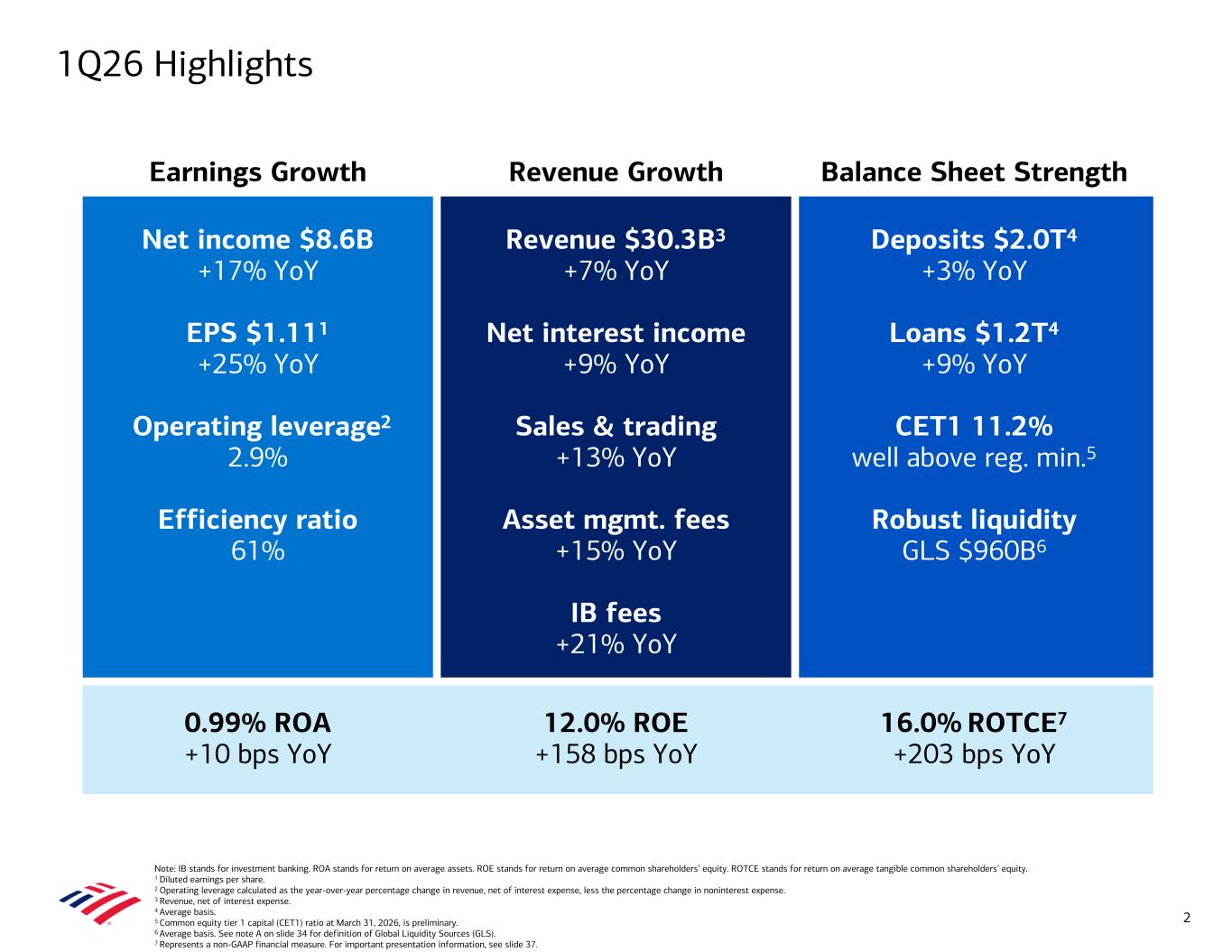
Note: IB stands for investment banking. ROA stands for return on average assets. ROE stands for return on average common shareholders’ equity. ROTCE stands for return on average tangible common shareholders’ equity. 1 Diluted earnings per share. 2 Operating leverage calculated as the year-over-year percentage change in revenue, net of interest expense, less the percentage change in noninterest expense. 3 Revenue, net of interest expense. 4 Average basis. 5 Common equity tier 1 capital (CET1) ratio at March 31, 2026, is preliminary. 6 Average basis. See note A on slide 34 for definition of Global Liquidity Sources (GLS). 7 Represents a non-GAAP financial measure. For important presentation information, see slide 37. Earnings Growth Revenue Growth Balance Sheet Strength Net income $8.6B +17% YoY EPS $1.111 +25% YoY Operating leverage2 2.9% Efficiency ratio 61% Revenue $30.3B3 +7% YoY Net interest income +9% YoY Sales & trading +13% YoY Asset mgmt. fees +15% YoY IB fees +21% YoY Deposits $2.0T4 +3% YoY Loans $1.2T4 +9% YoY CET1 11.2% well above reg. min.5 Robust liquidity GLS $960B6 0.99% ROA +10 bps YoY 12.0% ROE +158 bps YoY 16.0% ROTCE7 +203 bps YoY 1Q26 Highlights 2
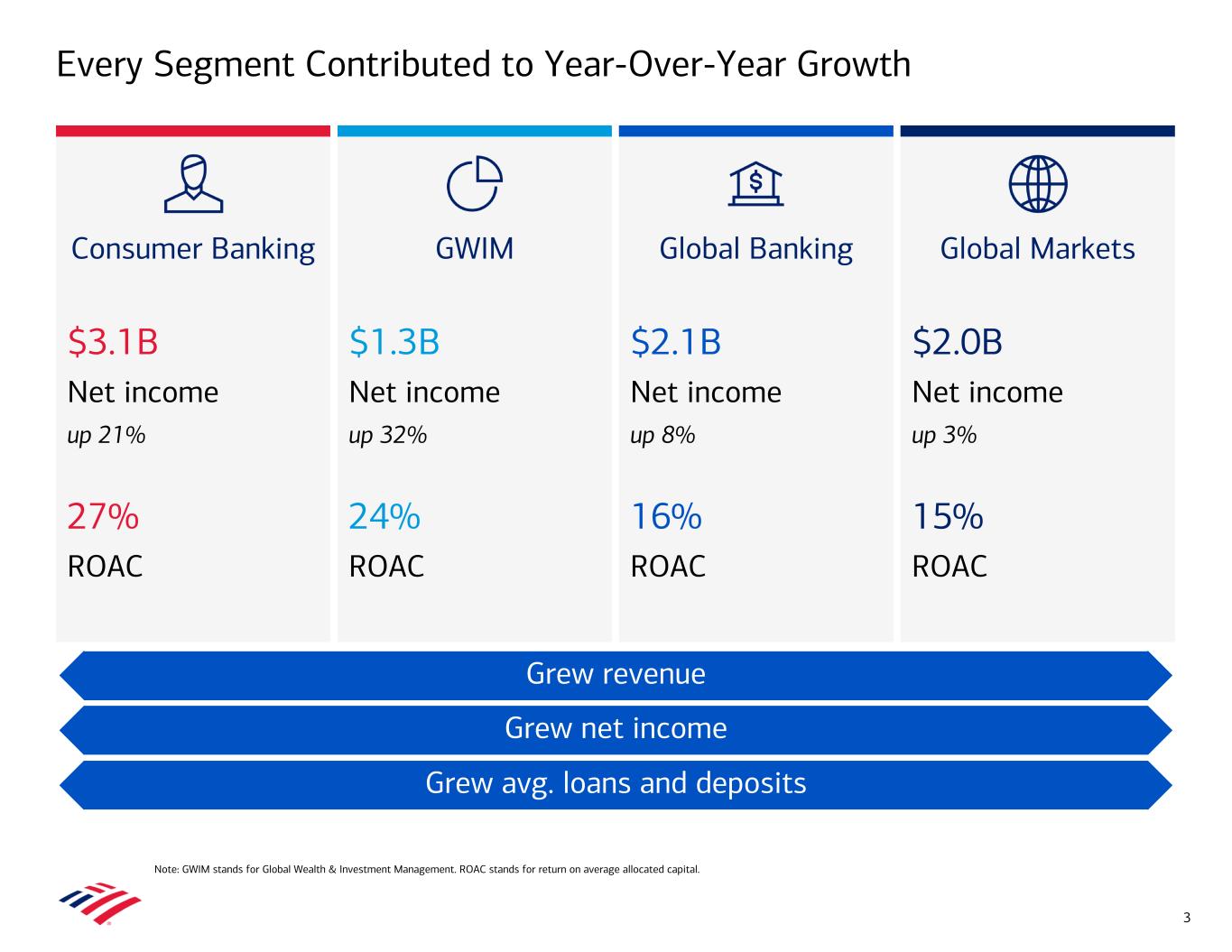
Note: GWIM stands for Global Wealth & Investment Management. ROAC stands for return on average allocated capital. Every Segment Contributed to Year-Over-Year Growth 3 Consumer Banking $3.1B Net income up 21% 27% ROAC GWIM $1.3B Net income up 32% 24% ROAC Global Markets $2.0B Net income up 3% 15% ROAC Global Banking $2.1B Net income up 8% 16% ROAC Grew revenue Grew net income Grew avg. loans and deposits
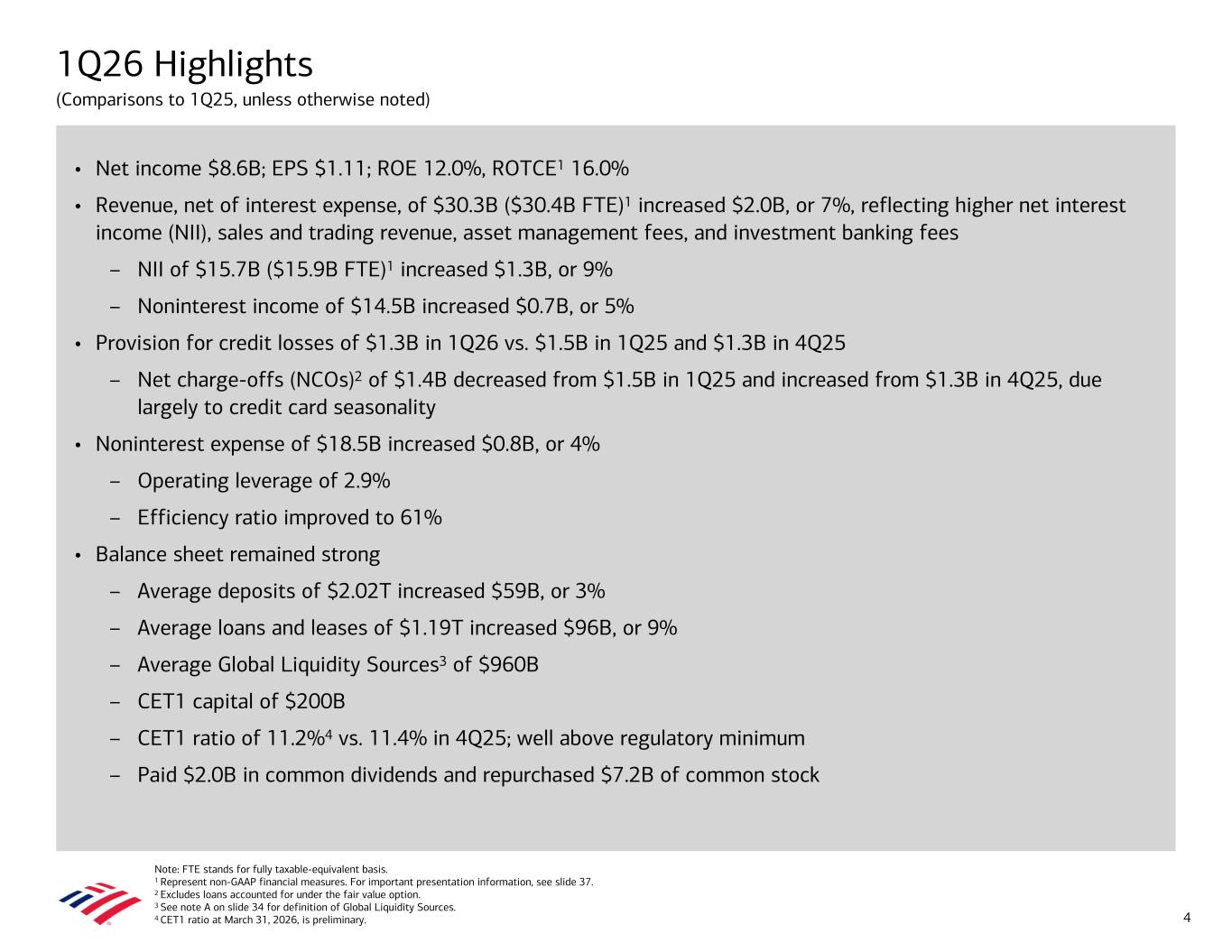
• Net income $8.6B; EPS $1.11; ROE 12.0%, ROTCE1 16.0% • Revenue, net of interest expense, of $30.3B ($30.4B FTE)1 increased $2.0B, or 7%, reflecting higher net interest income (NII), sales and trading revenue, asset management fees, and investment banking fees – NII of $15.7B ($15.9B FTE)1 increased $1.3B, or 9% – Noninterest income of $14.5B increased $0.7B, or 5% • Provision for credit losses of $1.3B in 1Q26 vs. $1.5B in 1Q25 and $1.3B in 4Q25 – Net charge-offs (NCOs)2 of $1.4B decreased from $1.5B in 1Q25 and increased from $1.3B in 4Q25, due largely to credit card seasonality • Noninterest expense of $18.5B increased $0.8B, or 4% – Operating leverage of 2.9% – Efficiency ratio improved to 61% • Balance sheet remained strong – Average deposits of $2.02T increased $59B, or 3% – Average loans and leases of $1.19T increased $96B, or 9% – Average Global Liquidity Sources3 of $960B – CET1 capital of $200B – CET1 ratio of 11.2%4 vs. 11.4% in 4Q25; well above regulatory minimum – Paid $2.0B in common dividends and repurchased $7.2B of common stock Note: FTE stands for fully taxable-equivalent basis. 1 Represent non-GAAP financial measures. For important presentation information, see slide 37. 2 Excludes loans accounted for under the fair value option. 3 See note A on slide 34 for definition of Global Liquidity Sources. 4 CET1 ratio at March 31, 2026, is preliminary. 1Q26 Highlights (Comparisons to 1Q25, unless otherwise noted) 4
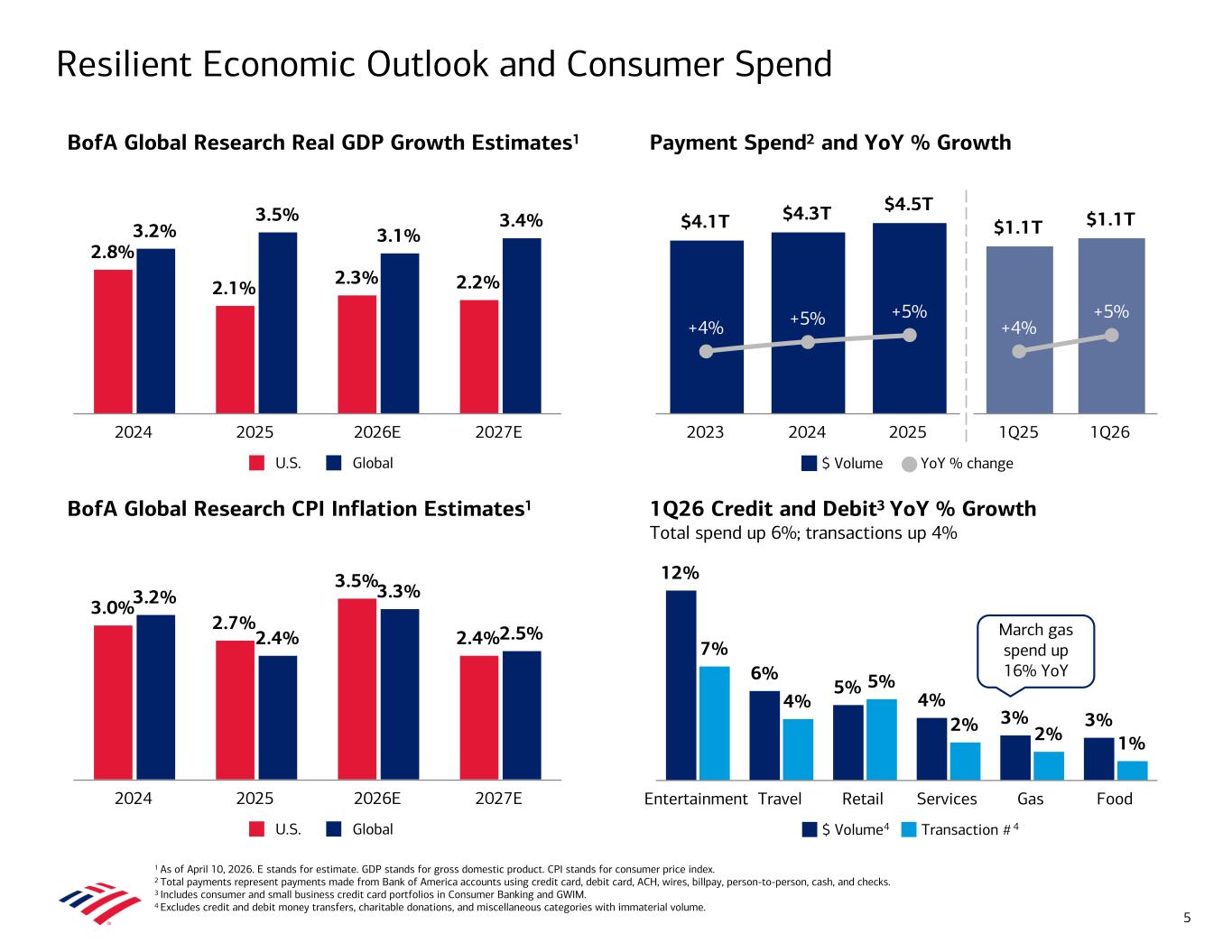
Resilient Economic Outlook and Consumer Spend BofA Global Research CPI Inflation Estimates1 5 1Q26 Credit and Debit3 YoY % Growth Total spend up 6%; transactions up 4% 12% 6% 5% 4% 3% 3% 7% 4% 5% 2% 2% 1% $ Volume Transaction # Entertainment Travel Retail Services Gas Food Payment Spend2 and YoY % Growth $4.1T $4.3T $4.5T +4% +5% +5% 2023 2024 2025 BofA Global Research Real GDP Growth Estimates1 1 As of April 10, 2026. E stands for estimate. GDP stands for gross domestic product. CPI stands for consumer price index. 2 Total payments represent payments made from Bank of America accounts using credit card, debit card, ACH, wires, billpay, person-to-person, cash, and checks. 3 Includes consumer and small business credit card portfolios in Consumer Banking and GWIM. 4 Excludes credit and debit money transfers, charitable donations, and miscellaneous categories with immaterial volume. 4 4 2.8% 2.1% 2.3% 2.2% 3.2% 3.5% 3.1% 3.4% U.S. Global 2024 2025 2026E 2027E 3.0% 2.7% 3.5% 2.4% 3.2% 2.4% 3.3% 2.5% U.S. Global 2024 2025 2026E 2027E $1.1T $1.1T +4% +5% 1Q25 1Q26 $ Volume YoY % change March gas spend up 16% YoY
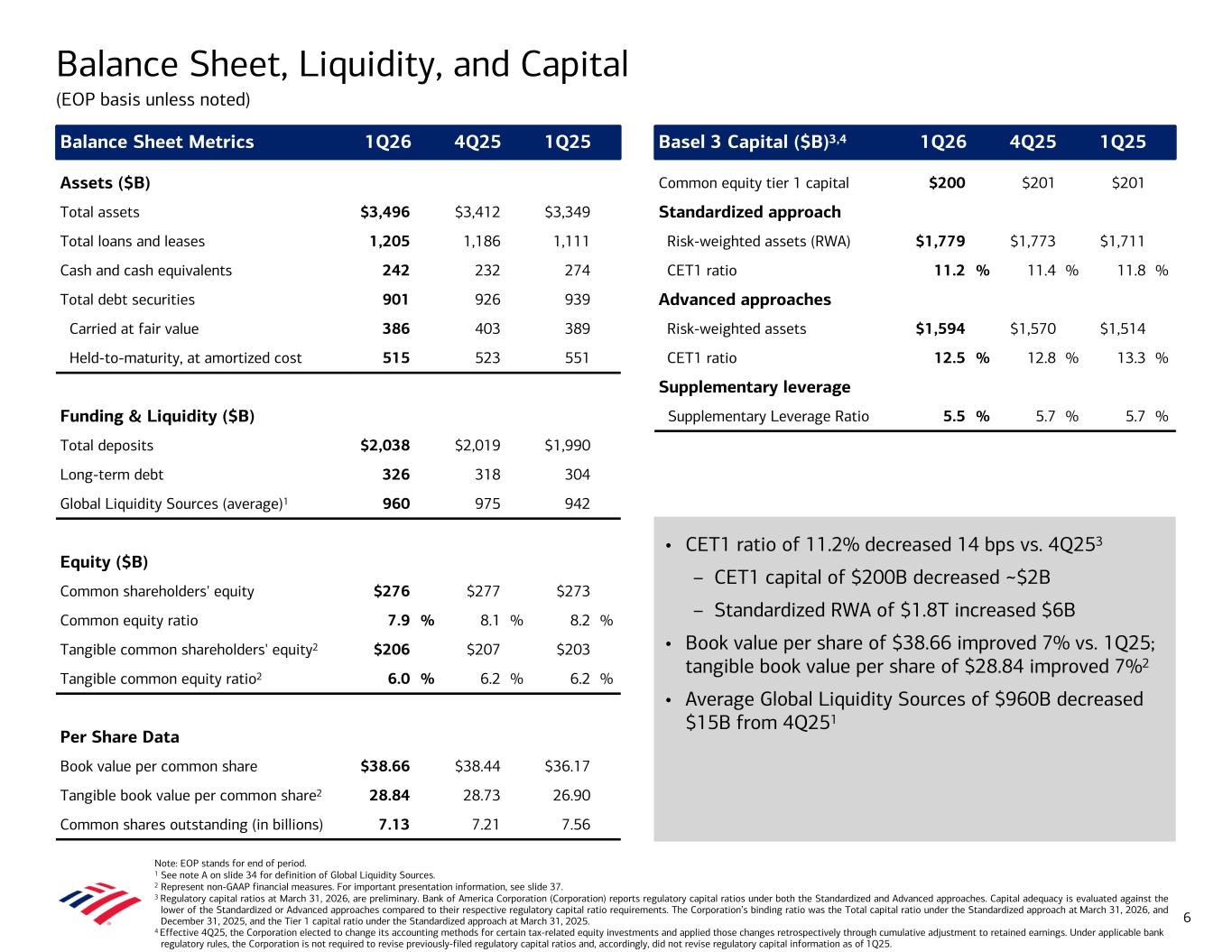
Balance Sheet Metrics 1Q26 4Q25 1Q25 Basel 3 Capital ($B)3,4 1Q26 4Q25 1Q25 Assets ($B) Common equity tier 1 capital $200 $201 $201 Total assets $3,496 $3,412 $3,349 Standardized approach Total loans and leases 1,205 1,186 1,111 Risk-weighted assets (RWA) $1,779 $1,773 $1,711 Cash and cash equivalents 242 232 274 CET1 ratio 11.2 % 11.4 % 11.8 % Total debt securities 901 926 939 Advanced approaches Carried at fair value 386 403 389 Risk-weighted assets $1,594 $1,570 $1,514 Held-to-maturity, at amortized cost 515 523 551 CET1 ratio 12.5 % 12.8 % 13.3 % Supplementary leverage Funding & Liquidity ($B) Supplementary Leverage Ratio 5.5 % 5.7 % 5.7 % Total deposits $2,038 $2,019 $1,990 Long-term debt 326 318 304 Global Liquidity Sources (average)1 960 975 942 Equity ($B) Common shareholders' equity $276 $277 $273 Common equity ratio 7.9 % 8.1 % 8.2 % Tangible common shareholders' equity2 $206 $207 $203 Tangible common equity ratio2 6.0 % 6.2 % 6.2 % Per Share Data Book value per common share $38.66 $38.44 $36.17 Tangible book value per common share2 28.84 28.73 26.90 Common shares outstanding (in billions) 7.13 7.21 7.56 Balance Sheet, Liquidity, and Capital (EOP basis unless noted) 6 • CET1 ratio of 11.2% decreased 14 bps vs. 4Q253 – CET1 capital of $200B decreased ~$2B – Standardized RWA of $1.8T increased $6B • Book value per share of $38.66 improved 7% vs. 1Q25; tangible book value per share of $28.84 improved 7%2 • Average Global Liquidity Sources of $960B decreased $15B from 4Q251 Note: EOP stands for end of period. 1 See note A on slide 34 for definition of Global Liquidity Sources. 2 Represent non-GAAP financial measures. For important presentation information, see slide 37. 3 Regulatory capital ratios at March 31, 2026, are preliminary. Bank of America Corporation (Corporation) reports regulatory capital ratios under both the Standardized and Advanced approaches. Capital adequacy is evaluated against the lower of the Standardized or Advanced approaches compared to their respective regulatory capital ratio requirements. The Corporation’s binding ratio was the Total capital ratio under the Standardized approach at March 31, 2026, and December 31, 2025, and the Tier 1 capital ratio under the Standardized approach at March 31, 2025. 4 Effective 4Q25, the Corporation elected to change its accounting methods for certain tax-related equity investments and applied those changes retrospectively through cumulative adjustment to retained earnings. Under applicable bank regulatory rules, the Corporation is not required to revise previously-filed regulatory capital ratios and, accordingly, did not revise regulatory capital information as of 1Q25.
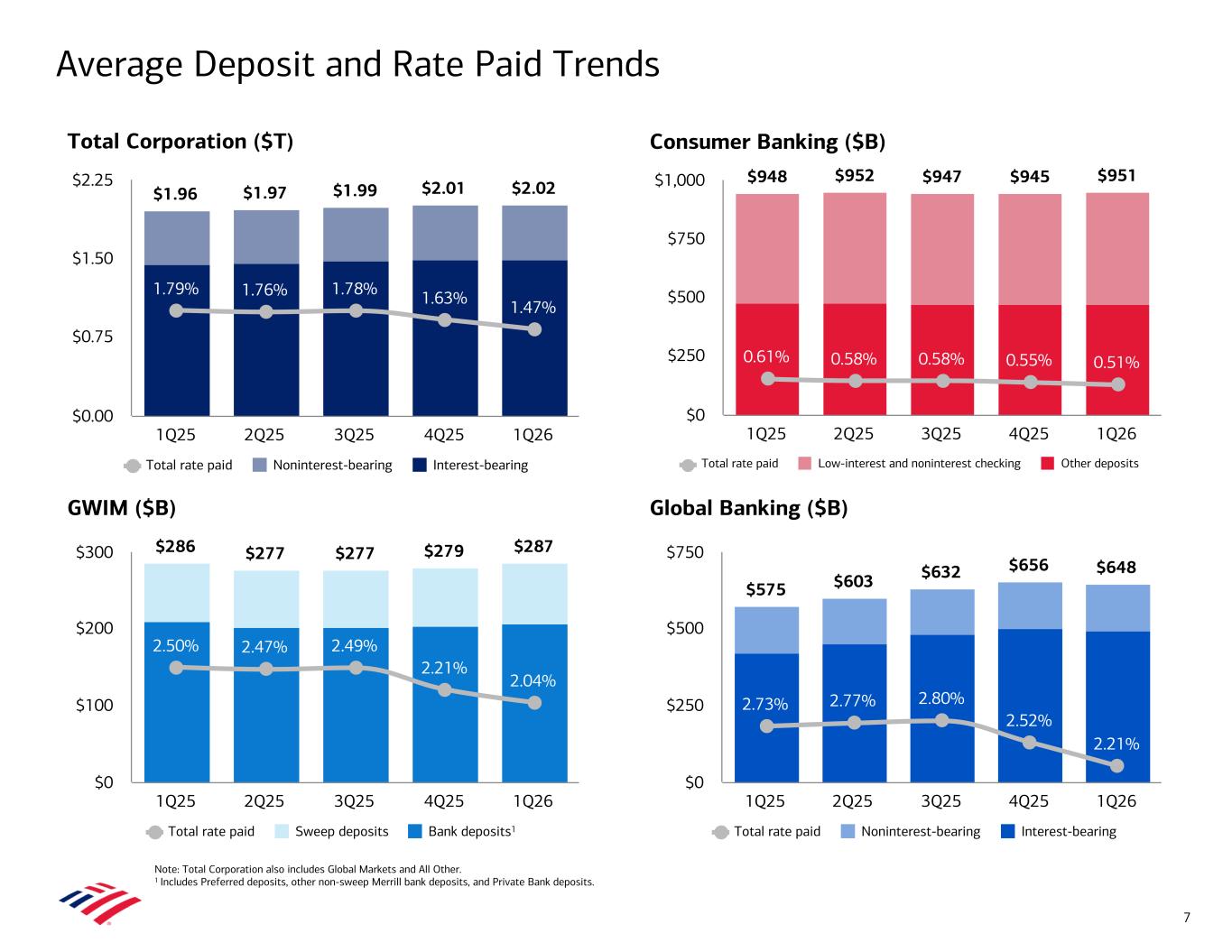
$1.96 $1.97 $1.99 $2.01 $2.02 1.79% 1.76% 1.78% 1.63% 1.47% Total rate paid Noninterest-bearing Interest-bearing 1Q25 2Q25 3Q25 4Q25 1Q26 $0.00 $0.75 $1.50 $2.25 Consumer Banking ($B) GWIM ($B) Global Banking ($B) Total Corporation ($T) Average Deposit and Rate Paid Trends 7 $948 $952 $947 $945 $951 0.61% 0.58% 0.58% 0.55% 0.51% Total rate paid Low-interest and noninterest checking Other deposits 1Q25 2Q25 3Q25 4Q25 1Q26 $0 $250 $500 $750 $1,000 $286 $277 $277 $279 $287 2.50% 2.47% 2.49% 2.21% 2.04% Total rate paid Sweep deposits Bank deposits 1Q25 2Q25 3Q25 4Q25 1Q26 $0 $100 $200 $300 $575 $603 $632 $656 $648 2.73% 2.77% 2.80% 2.52% 2.21% Total rate paid Noninterest-bearing Interest-bearing 1Q25 2Q25 3Q25 4Q25 1Q26 $0 $250 $500 $750 Note: Total Corporation also includes Global Markets and All Other. 1 Includes Preferred deposits, other non-sweep Merrill bank deposits, and Private Bank deposits. 1
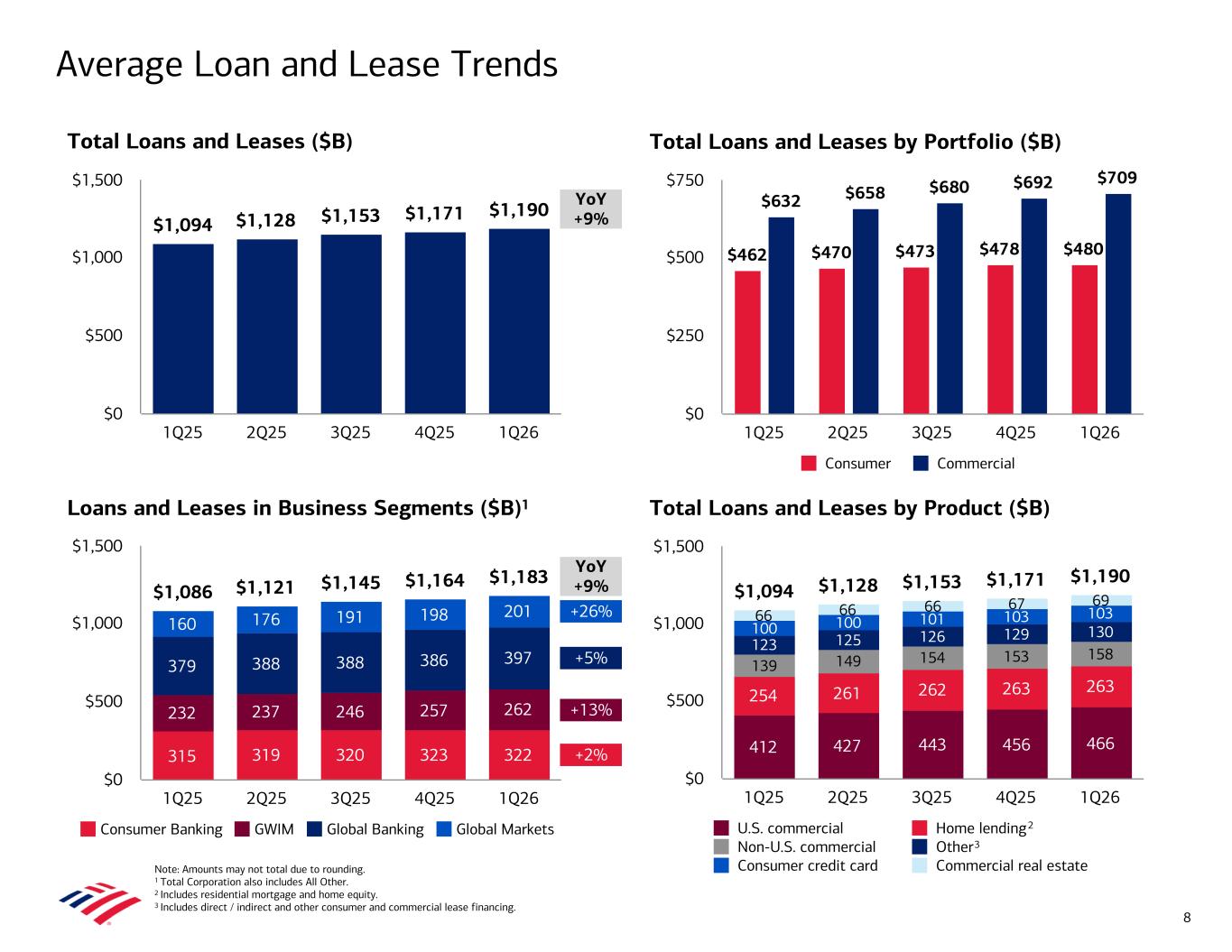
$1,086 $1,121 $1,145 $1,164 $1,183 315 319 320 323 322 232 237 246 257 262 379 388 388 386 397 160 176 191 198 201 Consumer Banking GWIM Global Banking Global Markets 1Q25 2Q25 3Q25 4Q25 1Q26 $0 $500 $1,000 $1,500 $1,094 $1,128 $1,153 $1,171 $1,190 1Q25 2Q25 3Q25 4Q25 1Q26 $0 $500 $1,000 $1,500 +2% +13% +5% +26% Average Loan and Lease Trends YoY +9% YoY +9% Note: Amounts may not total due to rounding. 1 Total Corporation also includes All Other. 2 Includes residential mortgage and home equity. 3 Includes direct / indirect and other consumer and commercial lease financing. Total Loans and Leases by Product ($B) Loans and Leases in Business Segments ($B)1 Total Loans and Leases by Portfolio ($B)Total Loans and Leases ($B) $462 $470 $473 $478 $480 $632 $658 $680 $692 $709 Consumer Commercial 1Q25 2Q25 3Q25 4Q25 1Q26 $0 $250 $500 $750 8 $1,094 $1,128 $1,153 $1,171 $1,190 412 427 443 456 466 254 261 262 263 263 139 149 154 153 158 123 125 126 129 130100 100 101 103 10366 66 66 67 69 U.S. commercial Home lending Non-U.S. commercial Other Consumer credit card Commercial real estate 1Q25 2Q25 3Q25 4Q25 1Q26 $0 $500 $1,000 $1,500 3 2
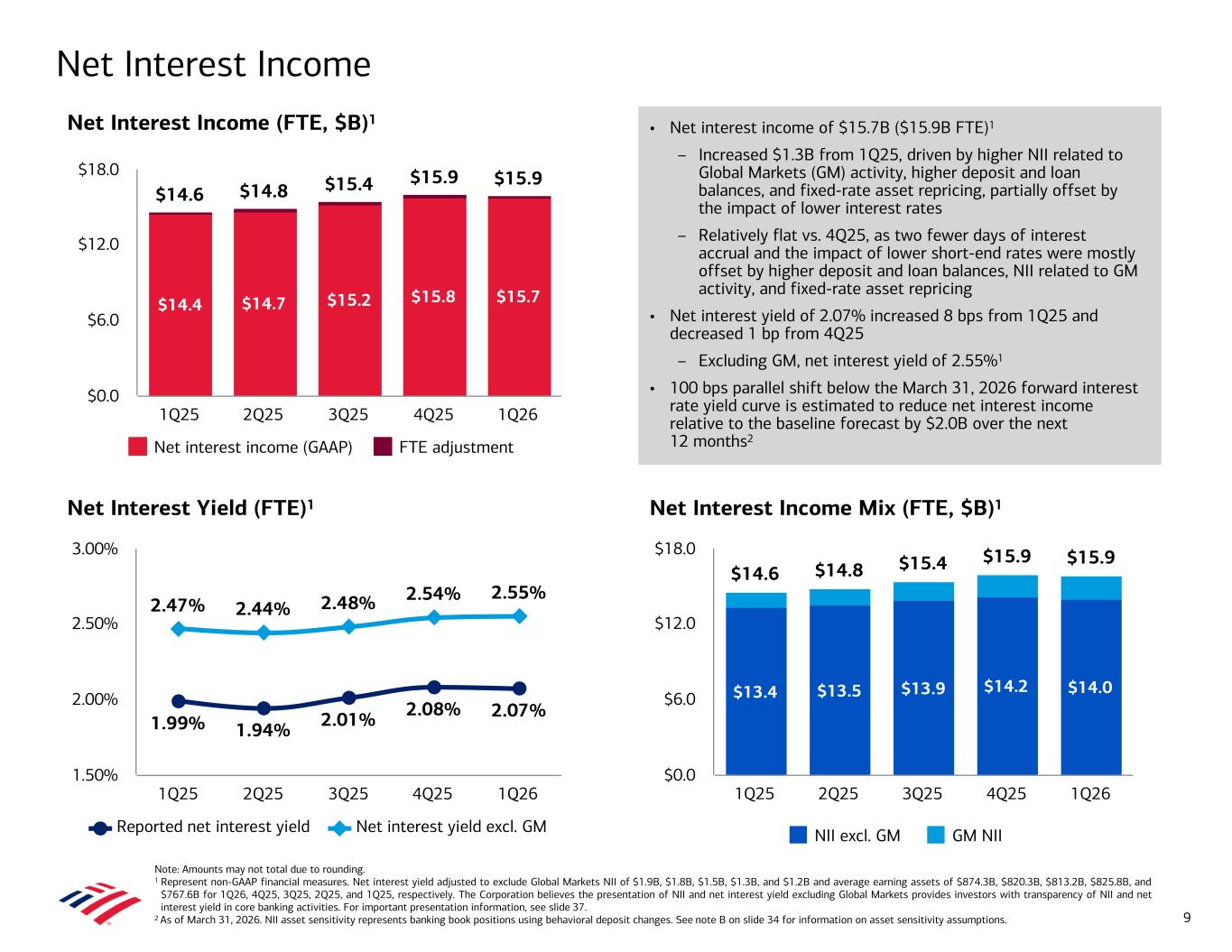
• Net interest income of $15.7B ($15.9B FTE)1 – Increased $1.3B from 1Q25, driven by higher NII related to Global Markets (GM) activity, higher deposit and loan balances, and fixed-rate asset repricing, partially offset by the impact of lower interest rates – Relatively flat vs. 4Q25, as two fewer days of interest accrual and the impact of lower short-end rates were mostly offset by higher deposit and loan balances, NII related to GM activity, and fixed-rate asset repricing • Net interest yield of 2.07% increased 8 bps from 1Q25 and decreased 1 bp from 4Q25 – Excluding GM, net interest yield of 2.55%1 • 100 bps parallel shift below the March 31, 2026 forward interest rate yield curve is estimated to reduce net interest income relative to the baseline forecast by $2.0B over the next 12 months2 Net Interest Income (FTE, $B)1 Net Interest Income Note: Amounts may not total due to rounding. 1 Represent non-GAAP financial measures. Net interest yield adjusted to exclude Global Markets NII of $1.9B, $1.8B, $1.5B, $1.3B, and $1.2B and average earning assets of $874.3B, $820.3B, $813.2B, $825.8B, and $767.6B for 1Q26, 4Q25, 3Q25, 2Q25, and 1Q25, respectively. The Corporation believes the presentation of NII and net interest yield excluding Global Markets provides investors with transparency of NII and net interest yield in core banking activities. For important presentation information, see slide 37. 2 As of March 31, 2026. NII asset sensitivity represents banking book positions using behavioral deposit changes. See note B on slide 34 for information on asset sensitivity assumptions. Net Interest Yield (FTE)1 1.99% 1.94% 2.01% 2.08% 2.07% 2.47% 2.44% 2.48% 2.54% 2.55% Reported net interest yield Net interest yield excl. GM 1Q25 2Q25 3Q25 4Q25 1Q26 1.50% 2.00% 2.50% 3.00% $14.6 $14.8 $15.4 $15.9 $15.9 $14.4 $14.7 $15.2 $15.8 $15.7 Net interest income (GAAP) FTE adjustment 1Q25 2Q25 3Q25 4Q25 1Q26 $0.0 $6.0 $12.0 $18.0 9 Net Interest Income Mix (FTE, $B)1 $14.6 $14.8 $15.4 $15.9 $15.9 $13.4 $13.5 $13.9 $14.2 $14.0 NII excl. GM GM NII 1Q25 2Q25 3Q25 4Q25 1Q26 $0.0 $6.0 $12.0 $18.0
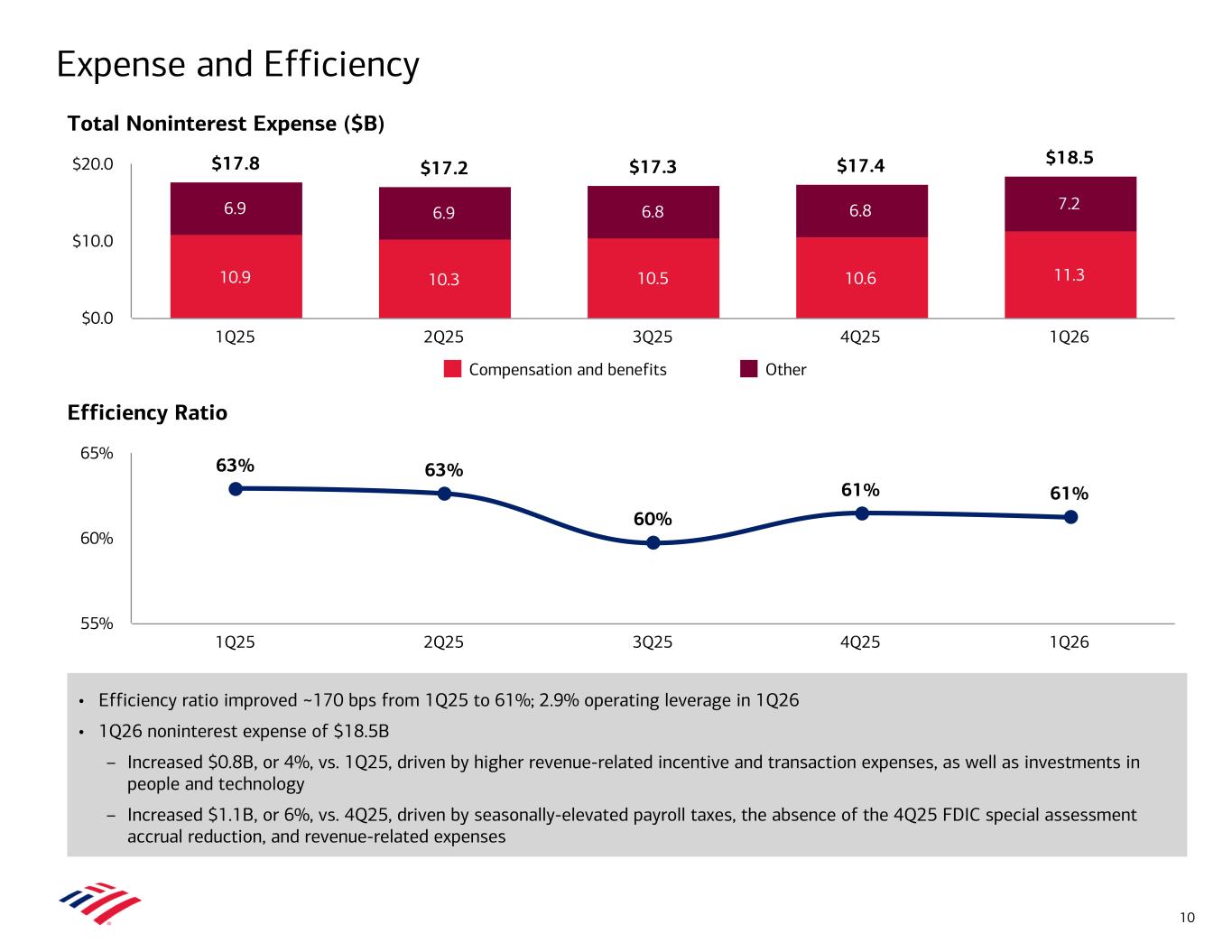
• Efficiency ratio improved ~170 bps from 1Q25 to 61%; 2.9% operating leverage in 1Q26 • 1Q26 noninterest expense of $18.5B – Increased $0.8B, or 4%, vs. 1Q25, driven by higher revenue-related incentive and transaction expenses, as well as investments in people and technology – Increased $1.1B, or 6%, vs. 4Q25, driven by seasonally-elevated payroll taxes, the absence of the 4Q25 FDIC special assessment accrual reduction, and revenue-related expenses $17.8 $17.2 $17.3 $17.4 $18.5 10.9 10.3 10.5 10.6 11.3 6.9 6.9 6.8 6.8 7.2 Compensation and benefits Other 1Q25 2Q25 3Q25 4Q25 1Q26 $0.0 $10.0 $20.0 63% 63% 60% 61% 61% 1Q25 2Q25 3Q25 4Q25 1Q26 55% 60% 65% Total Noninterest Expense ($B) Efficiency Ratio Expense and Efficiency 10
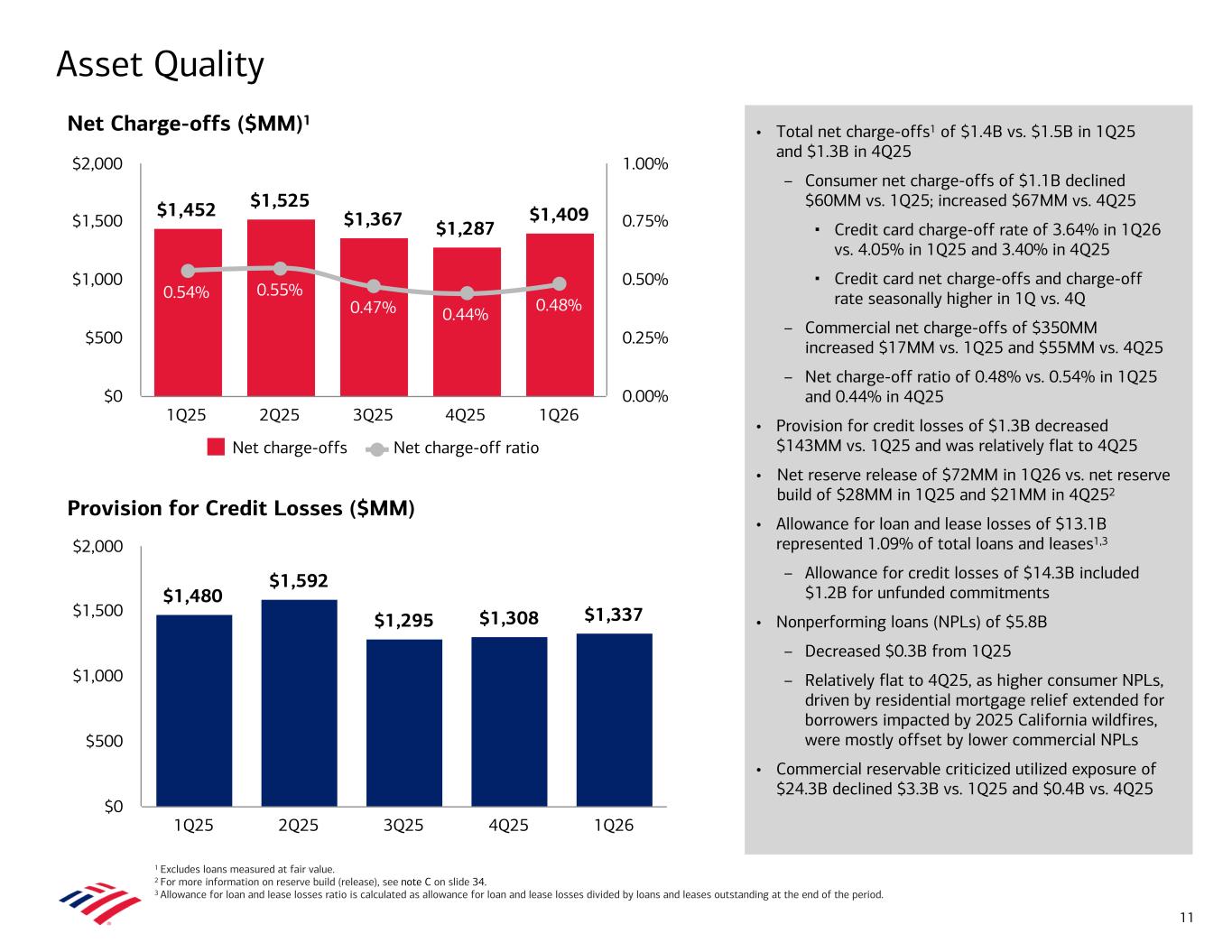
Asset Quality 1 Excludes loans measured at fair value. 2 For more information on reserve build (release), see note C on slide 34. 3 Allowance for loan and lease losses ratio is calculated as allowance for loan and lease losses divided by loans and leases outstanding at the end of the period. Provision for Credit Losses ($MM) Net Charge-offs ($MM)1 $1,480 $1,592 $1,295 $1,308 $1,337 1Q25 2Q25 3Q25 4Q25 1Q26 $0 $500 $1,000 $1,500 $2,000 $1,452 $1,525 $1,367 $1,287 $1,409 0.54% 0.55% 0.47% 0.44% 0.48% Net charge-offs Net charge-off ratio 1Q25 2Q25 3Q25 4Q25 1Q26 $0 $500 $1,000 $1,500 $2,000 0.00% 0.25% 0.50% 0.75% 1.00% 11 • Total net charge-offs1 of $1.4B vs. $1.5B in 1Q25 and $1.3B in 4Q25 – Consumer net charge-offs of $1.1B declined $60MM vs. 1Q25; increased $67MM vs. 4Q25 ▪ Credit card charge-off rate of 3.64% in 1Q26 vs. 4.05% in 1Q25 and 3.40% in 4Q25 ▪ Credit card net charge-offs and charge-off rate seasonally higher in 1Q vs. 4Q – Commercial net charge-offs of $350MM increased $17MM vs. 1Q25 and $55MM vs. 4Q25 – Net charge-off ratio of 0.48% vs. 0.54% in 1Q25 and 0.44% in 4Q25 • Provision for credit losses of $1.3B decreased $143MM vs. 1Q25 and was relatively flat to 4Q25 • Net reserve release of $72MM in 1Q26 vs. net reserve build of $28MM in 1Q25 and $21MM in 4Q252 • Allowance for loan and lease losses of $13.1B represented 1.09% of total loans and leases1,3 – Allowance for credit losses of $14.3B included $1.2B for unfunded commitments • Nonperforming loans (NPLs) of $5.8B – Decreased $0.3B from 1Q25 – Relatively flat to 4Q25, as higher consumer NPLs, driven by residential mortgage relief extended for borrowers impacted by 2025 California wildfires, were mostly offset by lower commercial NPLs • Commercial reservable criticized utilized exposure of $24.3B declined $3.3B vs. 1Q25 and $0.4B vs. 4Q25
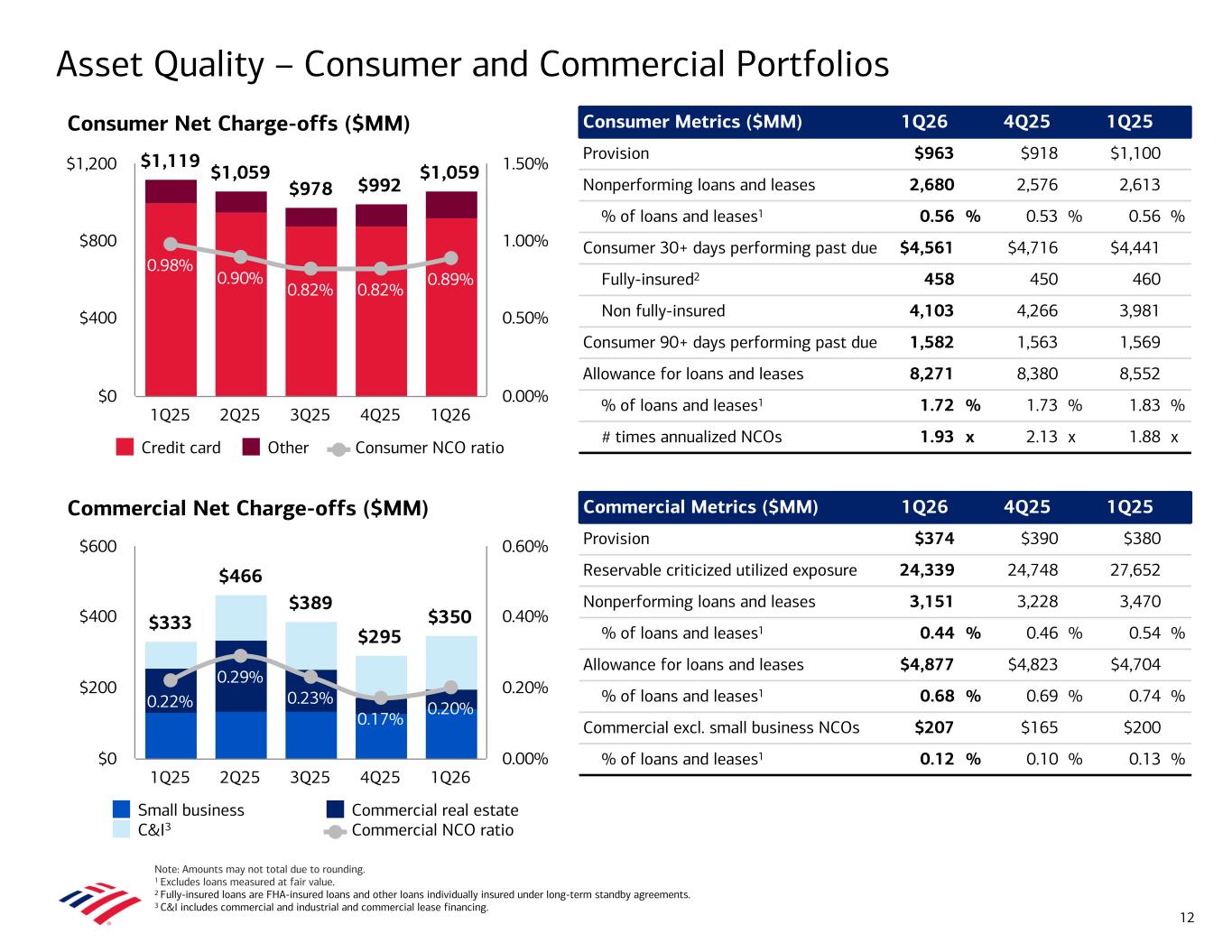
Commercial Net Charge-offs ($MM) Consumer Net Charge-offs ($MM) Asset Quality – Consumer and Commercial Portfolios $333 $466 $389 $295 $350 0.22% 0.29% 0.23% 0.17% 0.20% Small business Commercial real estate C&I Commercial NCO ratio 1Q25 2Q25 3Q25 4Q25 1Q26 $0 $200 $400 $600 0.00% 0.20% 0.40% 0.60% $1,119 $1,059 $978 $992 $1,059 0.98% 0.90% 0.82% 0.82% 0.89% Credit card Other Consumer NCO ratio 1Q25 2Q25 3Q25 4Q25 1Q26 $0 $400 $800 $1,200 0.00% 0.50% 1.00% 1.50% Commercial Metrics ($MM) 1Q26 4Q25 1Q25 Provision $374 $390 $380 Reservable criticized utilized exposure 24,339 24,748 27,652 Nonperforming loans and leases 3,151 3,228 3,470 % of loans and leases1 0.44 % 0.46 % 0.54 % Allowance for loans and leases $4,877 $4,823 $4,704 % of loans and leases1 0.68 % 0.69 % 0.74 % Commercial excl. small business NCOs $207 $165 $200 % of loans and leases1 0.12 % 0.10 % 0.13 % Consumer Metrics ($MM) 1Q26 4Q25 1Q25 Provision $963 $918 $1,100 Nonperforming loans and leases 2,680 2,576 2,613 % of loans and leases1 0.56 % 0.53 % 0.56 % Consumer 30+ days performing past due $4,561 $4,716 $4,441 Fully-insured2 458 450 460 Non fully-insured 4,103 4,266 3,981 Consumer 90+ days performing past due 1,582 1,563 1,569 Allowance for loans and leases 8,271 8,380 8,552 % of loans and leases1 1.72 % 1.73 % 1.83 % # times annualized NCOs 1.93 x 2.13 x 1.88 x 12 3 Note: Amounts may not total due to rounding. 1 Excludes loans measured at fair value. 2 Fully-insured loans are FHA-insured loans and other loans individually insured under long-term standby agreements. 3 C&I includes commercial and industrial and commercial lease financing.
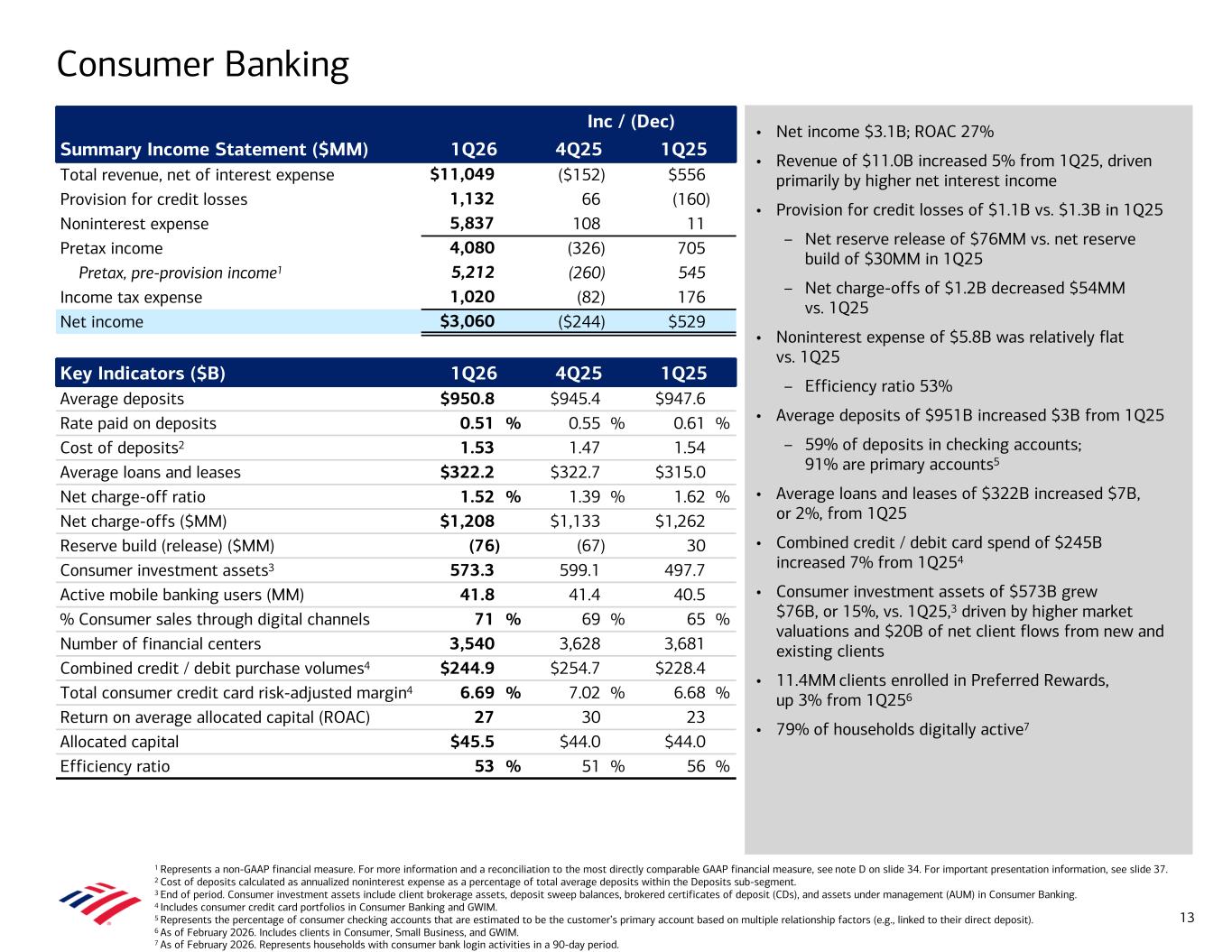
Consumer Banking 1 Represents a non-GAAP financial measure. For more information and a reconciliation to the most directly comparable GAAP financial measure, see note D on slide 34. For important presentation information, see slide 37. 2 Cost of deposits calculated as annualized noninterest expense as a percentage of total average deposits within the Deposits sub-segment. 3 End of period. Consumer investment assets include client brokerage assets, deposit sweep balances, brokered certificates of deposit (CDs), and assets under management (AUM) in Consumer Banking. 4 Includes consumer credit card portfolios in Consumer Banking and GWIM. 5 Represents the percentage of consumer checking accounts that are estimated to be the customer’s primary account based on multiple relationship factors (e.g., linked to their direct deposit). 6 As of February 2026. Includes clients in Consumer, Small Business, and GWIM. 7 As of February 2026. Represents households with consumer bank login activities in a 90-day period. Inc / (Dec) Summary Income Statement ($MM) 1Q26 4Q25 1Q25 Total revenue, net of interest expense $11,049 ($152) $556 Provision for credit losses 1,132 66 (160) Noninterest expense 5,837 108 11 Pretax income 4,080 (326) 705 Pretax, pre-provision income1 5,212 (260) 545 Income tax expense 1,020 (82) 176 Net income $3,060 ($244) $529 Key Indicators ($B) 1Q26 4Q25 1Q25 Average deposits $950.8 $945.4 $947.6 Rate paid on deposits 0.51 % 0.55 % 0.61 % Cost of deposits2 1.53 1.47 1.54 Average loans and leases $322.2 $322.7 $315.0 Net charge-off ratio 1.52 % 1.39 % 1.62 % Net charge-offs ($MM) $1,208 $1,133 $1,262 Reserve build (release) ($MM) (76) (67) 30 Consumer investment assets3 573.3 599.1 497.7 Active mobile banking users (MM) 41.8 41.4 40.5 % Consumer sales through digital channels 71 % 69 % 65 % Number of financial centers 3,540 3,628 3,681 Combined credit / debit purchase volumes4 $244.9 $254.7 $228.4 Total consumer credit card risk-adjusted margin4 6.69 % 7.02 % 6.68 % Return on average allocated capital (ROAC) 27 30 23 Allocated capital $45.5 $44.0 $44.0 Efficiency ratio 53 % 51 % 56 % 13 • Net income $3.1B; ROAC 27% • Revenue of $11.0B increased 5% from 1Q25, driven primarily by higher net interest income • Provision for credit losses of $1.1B vs. $1.3B in 1Q25 – Net reserve release of $76MM vs. net reserve build of $30MM in 1Q25 – Net charge-offs of $1.2B decreased $54MM vs. 1Q25 • Noninterest expense of $5.8B was relatively flat vs. 1Q25 – Efficiency ratio 53% • Average deposits of $951B increased $3B from 1Q25 – 59% of deposits in checking accounts; 91% are primary accounts5 • Average loans and leases of $322B increased $7B, or 2%, from 1Q25 • Combined credit / debit card spend of $245B increased 7% from 1Q254 • Consumer investment assets of $573B grew $76B, or 15%, vs. 1Q25,3 driven by higher market valuations and $20B of net client flows from new and existing clients • 11.4MM clients enrolled in Preferred Rewards, up 3% from 1Q256 • 79% of households digitally active7
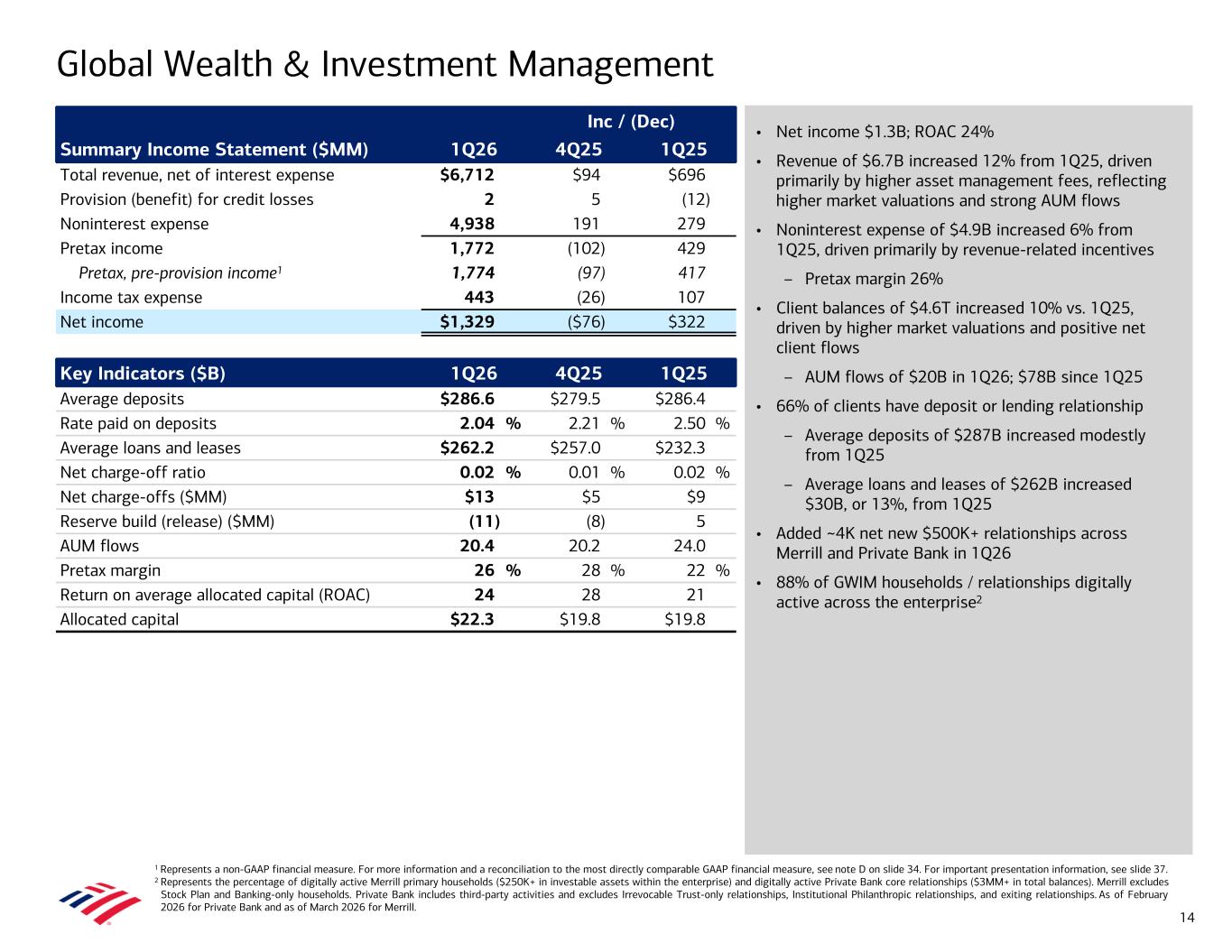
• Net income $1.3B; ROAC 24% • Revenue of $6.7B increased 12% from 1Q25, driven primarily by higher asset management fees, reflecting higher market valuations and strong AUM flows • Noninterest expense of $4.9B increased 6% from 1Q25, driven primarily by revenue-related incentives – Pretax margin 26% • Client balances of $4.6T increased 10% vs. 1Q25, driven by higher market valuations and positive net client flows – AUM flows of $20B in 1Q26; $78B since 1Q25 • 66% of clients have deposit or lending relationship – Average deposits of $287B increased modestly from 1Q25 – Average loans and leases of $262B increased $30B, or 13%, from 1Q25 • Added ~4K net new $500K+ relationships across Merrill and Private Bank in 1Q26 • 88% of GWIM households / relationships digitally active across the enterprise2 Global Wealth & Investment Management 1 Represents a non-GAAP financial measure. For more information and a reconciliation to the most directly comparable GAAP financial measure, see note D on slide 34. For important presentation information, see slide 37. 2 Represents the percentage of digitally active Merrill primary households ($250K+ in investable assets within the enterprise) and digitally active Private Bank core relationships ($3MM+ in total balances). Merrill excludes Stock Plan and Banking-only households. Private Bank includes third-party activities and excludes Irrevocable Trust-only relationships, Institutional Philanthropic relationships, and exiting relationships. As of February 2026 for Private Bank and as of March 2026 for Merrill. Inc / (Dec) Summary Income Statement ($MM) 1Q26 4Q25 1Q25 Total revenue, net of interest expense $6,712 $94 $696 Provision (benefit) for credit losses 2 5 (12) Noninterest expense 4,938 191 279 Pretax income 1,772 (102) 429 Pretax, pre-provision income1 1,774 (97) 417 Income tax expense 443 (26) 107 Net income $1,329 ($76) $322 Key Indicators ($B) 1Q26 4Q25 1Q25 Average deposits $286.6 $279.5 $286.4 Rate paid on deposits 2.04 % 2.21 % 2.50 % Average loans and leases $262.2 $257.0 $232.3 Net charge-off ratio 0.02 % 0.01 % 0.02 % Net charge-offs ($MM) $13 $5 $9 Reserve build (release) ($MM) (11) (8) 5 AUM flows 20.4 20.2 24.0 Pretax margin 26 % 28 % 22 % Return on average allocated capital (ROAC) 24 28 21 Allocated capital $22.3 $19.8 $19.8 14
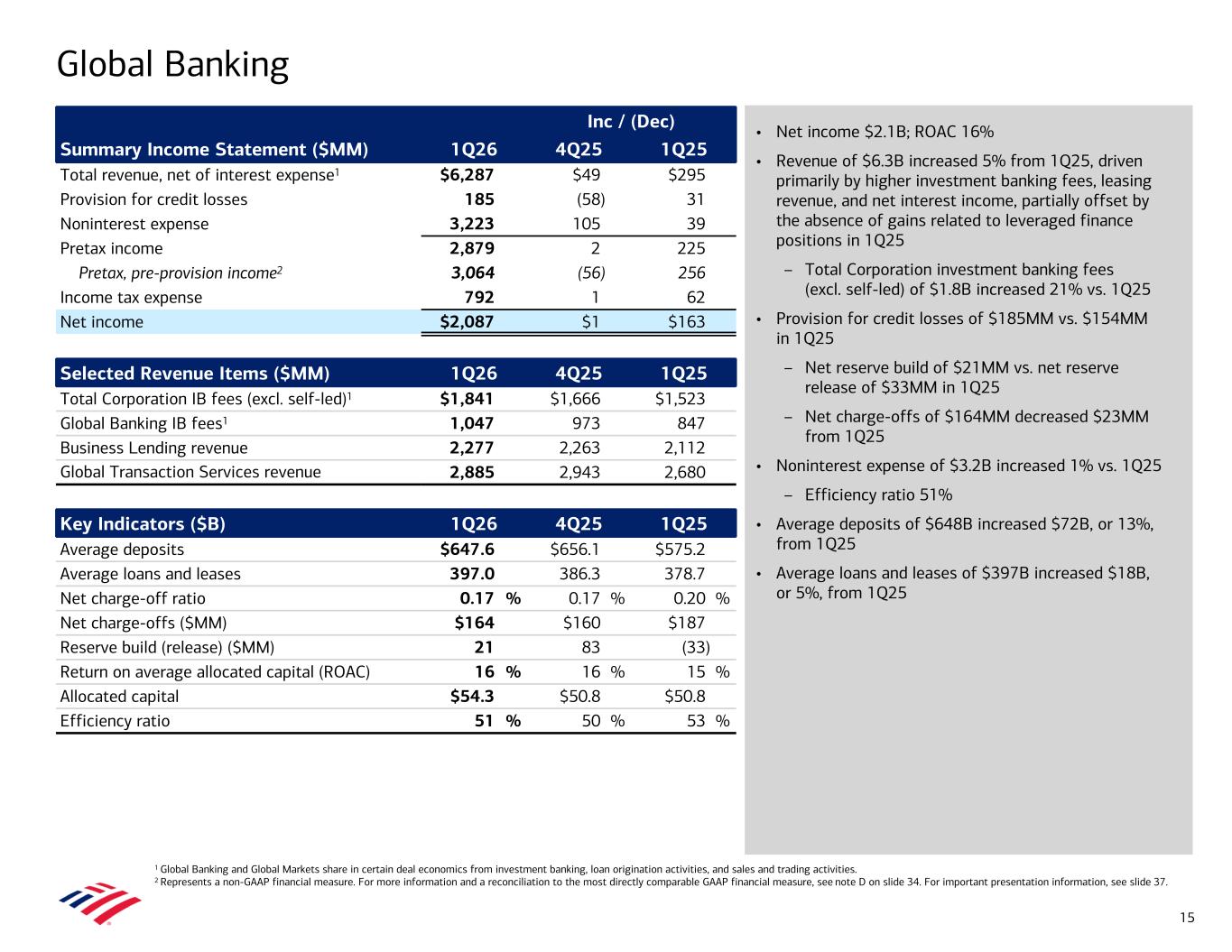
Global Banking 1 Global Banking and Global Markets share in certain deal economics from investment banking, loan origination activities, and sales and trading activities. 2 Represents a non-GAAP financial measure. For more information and a reconciliation to the most directly comparable GAAP financial measure, see note D on slide 34. For important presentation information, see slide 37. Inc / (Dec) Summary Income Statement ($MM) 1Q26 4Q25 1Q25 Total revenue, net of interest expense1 $6,287 $49 $295 Provision for credit losses 185 (58) 31 Noninterest expense 3,223 105 39 Pretax income 2,879 2 225 Pretax, pre-provision income2 3,064 (56) 256 Income tax expense 792 1 62 Net income $2,087 $1 $163 Selected Revenue Items ($MM) 1Q26 4Q25 1Q25 Total Corporation IB fees (excl. self-led)1 $1,841 $1,666 $1,523 Global Banking IB fees1 1,047 973 847 Business Lending revenue 2,277 2,263 2,112 Global Transaction Services revenue 2,885 2,943 2,680 Key Indicators ($B) 1Q26 4Q25 1Q25 Average deposits $647.6 $656.1 $575.2 Average loans and leases 397.0 386.3 378.7 Net charge-off ratio 0.17 % 0.17 % 0.20 % Net charge-offs ($MM) $164 $160 $187 Reserve build (release) ($MM) 21 83 (33) Return on average allocated capital (ROAC) 16 % 16 % 15 % Allocated capital $54.3 $50.8 $50.8 Efficiency ratio 51 % 50 % 53 % 15 • Net income $2.1B; ROAC 16% • Revenue of $6.3B increased 5% from 1Q25, driven primarily by higher investment banking fees, leasing revenue, and net interest income, partially offset by the absence of gains related to leveraged finance positions in 1Q25 – Total Corporation investment banking fees (excl. self-led) of $1.8B increased 21% vs. 1Q25 • Provision for credit losses of $185MM vs. $154MM in 1Q25 – Net reserve build of $21MM vs. net reserve release of $33MM in 1Q25 – Net charge-offs of $164MM decreased $23MM from 1Q25 • Noninterest expense of $3.2B increased 1% vs. 1Q25 – Efficiency ratio 51% • Average deposits of $648B increased $72B, or 13%, from 1Q25 • Average loans and leases of $397B increased $18B, or 5%, from 1Q25
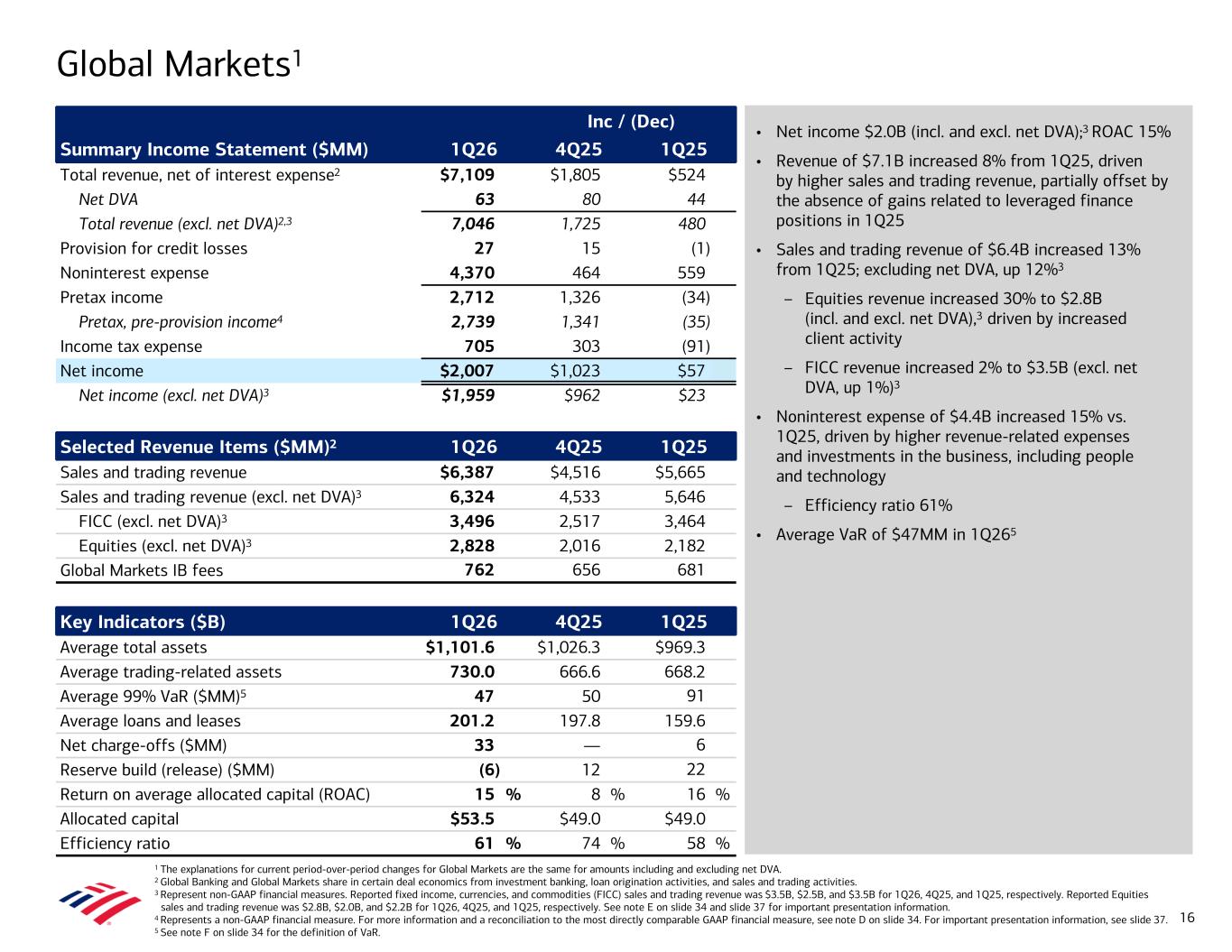
Global Markets1 1 The explanations for current period-over-period changes for Global Markets are the same for amounts including and excluding net DVA. 2 Global Banking and Global Markets share in certain deal economics from investment banking, loan origination activities, and sales and trading activities. 3 Represent non-GAAP financial measures. Reported fixed income, currencies, and commodities (FICC) sales and trading revenue was $3.5B, $2.5B, and $3.5B for 1Q26, 4Q25, and 1Q25, respectively. Reported Equities sales and trading revenue was $2.8B, $2.0B, and $2.2B for 1Q26, 4Q25, and 1Q25, respectively. See note E on slide 34 and slide 37 for important presentation information. 4 Represents a non-GAAP financial measure. For more information and a reconciliation to the most directly comparable GAAP financial measure, see note D on slide 34. For important presentation information, see slide 37. 5 See note F on slide 34 for the definition of VaR. Inc / (Dec) Summary Income Statement ($MM) 1Q26 4Q25 1Q25 Total revenue, net of interest expense2 $7,109 $1,805 $524 Net DVA 63 80 44 Total revenue (excl. net DVA)2,3 7,046 1,725 480 Provision for credit losses 27 15 (1) Noninterest expense 4,370 464 559 Pretax income 2,712 1,326 (34) Pretax, pre-provision income4 2,739 1,341 (35) Income tax expense 705 303 (91) Net income $2,007 $1,023 $57 Net income (excl. net DVA)3 $1,959 $962 $23 Selected Revenue Items ($MM)2 1Q26 4Q25 1Q25 Sales and trading revenue $6,387 $4,516 $5,665 Sales and trading revenue (excl. net DVA)3 6,324 4,533 5,646 FICC (excl. net DVA)3 3,496 2,517 3,464 Equities (excl. net DVA)3 2,828 2,016 2,182 Global Markets IB fees 762 656 681 Key Indicators ($B) 1Q26 4Q25 1Q25 Average total assets $1,101.6 $1,026.3 $969.3 Average trading-related assets 730.0 666.6 668.2 Average 99% VaR ($MM)5 47 50 91 Average loans and leases 201.2 197.8 159.6 Net charge-offs ($MM) 33 — 6 Reserve build (release) ($MM) (6) 12 22 Return on average allocated capital (ROAC) 15 % 8 % 16 % Allocated capital $53.5 $49.0 $49.0 Efficiency ratio 61 % 74 % 58 % 16 • Net income $2.0B (incl. and excl. net DVA);3 ROAC 15% • Revenue of $7.1B increased 8% from 1Q25, driven by higher sales and trading revenue, partially offset by the absence of gains related to leveraged finance positions in 1Q25 • Sales and trading revenue of $6.4B increased 13% from 1Q25; excluding net DVA, up 12%3 – Equities revenue increased 30% to $2.8B (incl. and excl. net DVA),3 driven by increased client activity – FICC revenue increased 2% to $3.5B (excl. net DVA, up 1%)3 • Noninterest expense of $4.4B increased 15% vs. 1Q25, driven by higher revenue-related expenses and investments in the business, including people and technology – Efficiency ratio 61% • Average VaR of $47MM in 1Q265
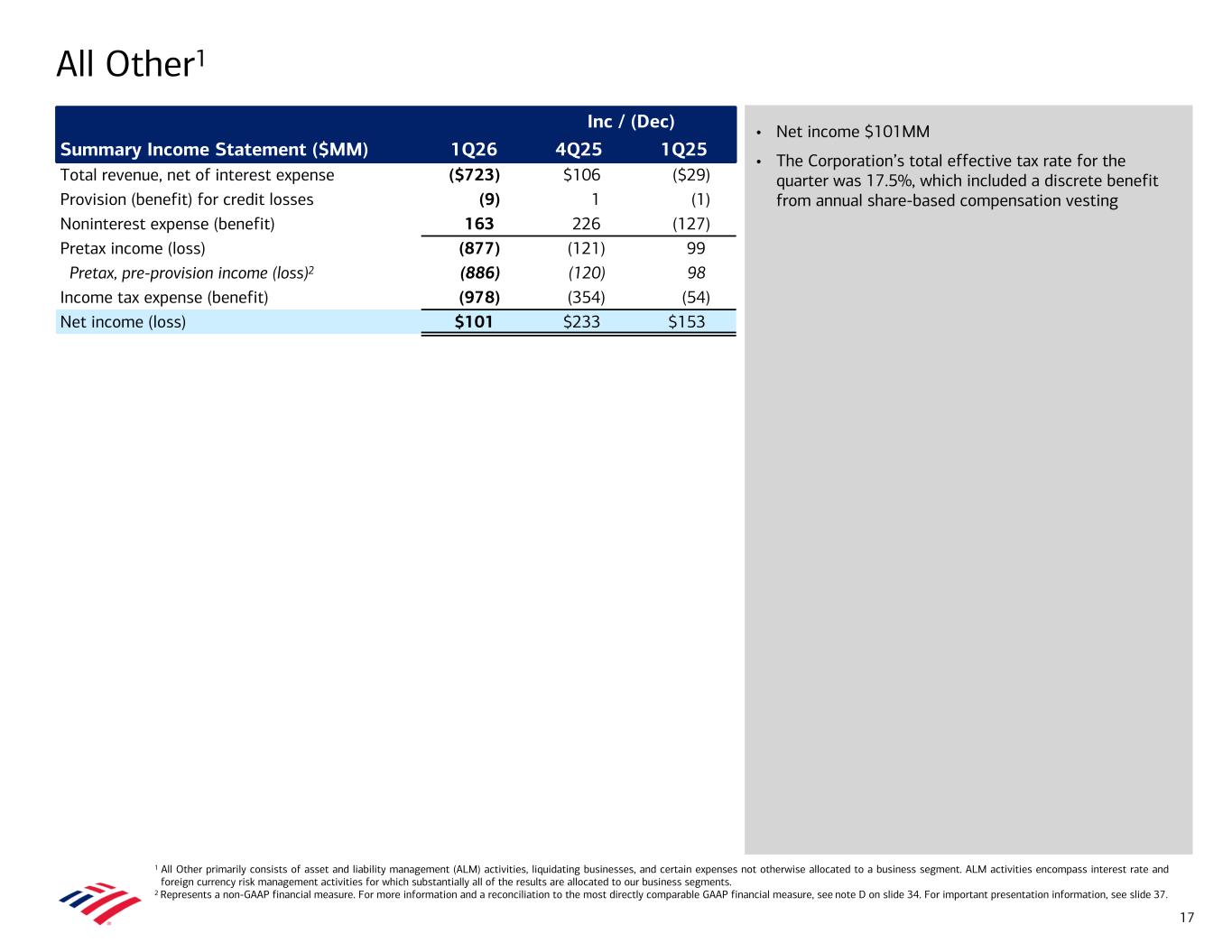
• Net income $101MM • The Corporation’s total effective tax rate for the quarter was 17.5%, which included a discrete benefit from annual share-based compensation vesting All Other1 1 All Other primarily consists of asset and liability management (ALM) activities, liquidating businesses, and certain expenses not otherwise allocated to a business segment. ALM activities encompass interest rate and foreign currency risk management activities for which substantially all of the results are allocated to our business segments. 2 Represents a non-GAAP financial measure. For more information and a reconciliation to the most directly comparable GAAP financial measure, see note D on slide 34. For important presentation information, see slide 37. Inc / (Dec) Summary Income Statement ($MM) 1Q26 4Q25 1Q25 Total revenue, net of interest expense ($723) $106 ($29) Provision (benefit) for credit losses (9) 1 (1) Noninterest expense (benefit) 163 226 (127) Pretax income (loss) (877) (121) 99 Pretax, pre-provision income (loss)2 (886) (120) 98 Income tax expense (benefit) (978) (354) (54) Net income (loss) $101 $233 $153 17

Additional Presentation Information
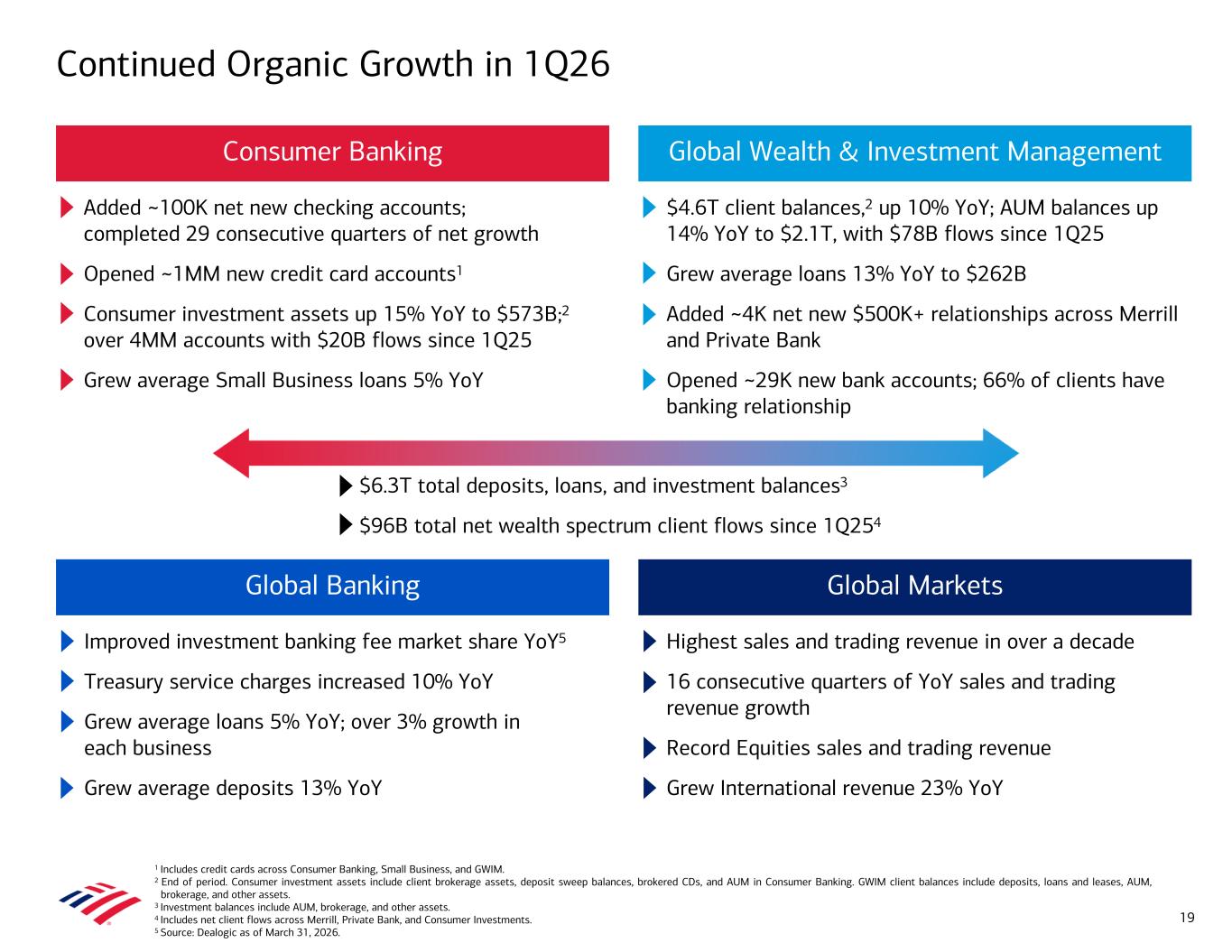
Added ~100K net new checking accounts; completed 29 consecutive quarters of net growth Opened ~1MM new credit card accounts1 Consumer investment assets up 15% YoY to $573B;2 over 4MM accounts with $20B flows since 1Q25 Grew average Small Business loans 5% YoY 1 Includes credit cards across Consumer Banking, Small Business, and GWIM. 2 End of period. Consumer investment assets include client brokerage assets, deposit sweep balances, brokered CDs, and AUM in Consumer Banking. GWIM client balances include deposits, loans and leases, AUM, brokerage, and other assets. 3 Investment balances include AUM, brokerage, and other assets. 4 Includes net client flows across Merrill, Private Bank, and Consumer Investments. 5 Source: Dealogic as of March 31, 2026. Improved investment banking fee market share YoY5 Treasury service charges increased 10% YoY Grew average loans 5% YoY; over 3% growth in each business Grew average deposits 13% YoY Continued Organic Growth in 1Q26 19 Consumer Banking Global Wealth & Investment Management Global Banking Global Markets $6.3T total deposits, loans, and investment balances3 $96B total net wealth spectrum client flows since 1Q254 $4.6T client balances,2 up 10% YoY; AUM balances up 14% YoY to $2.1T, with $78B flows since 1Q25 Grew average loans 13% YoY to $262B Added ~4K net new $500K+ relationships across Merrill and Private Bank Opened ~29K new bank accounts; 66% of clients have banking relationship Highest sales and trading revenue in over a decade 16 consecutive quarters of YoY sales and trading revenue growth Record Equities sales and trading revenue Grew International revenue 23% YoY
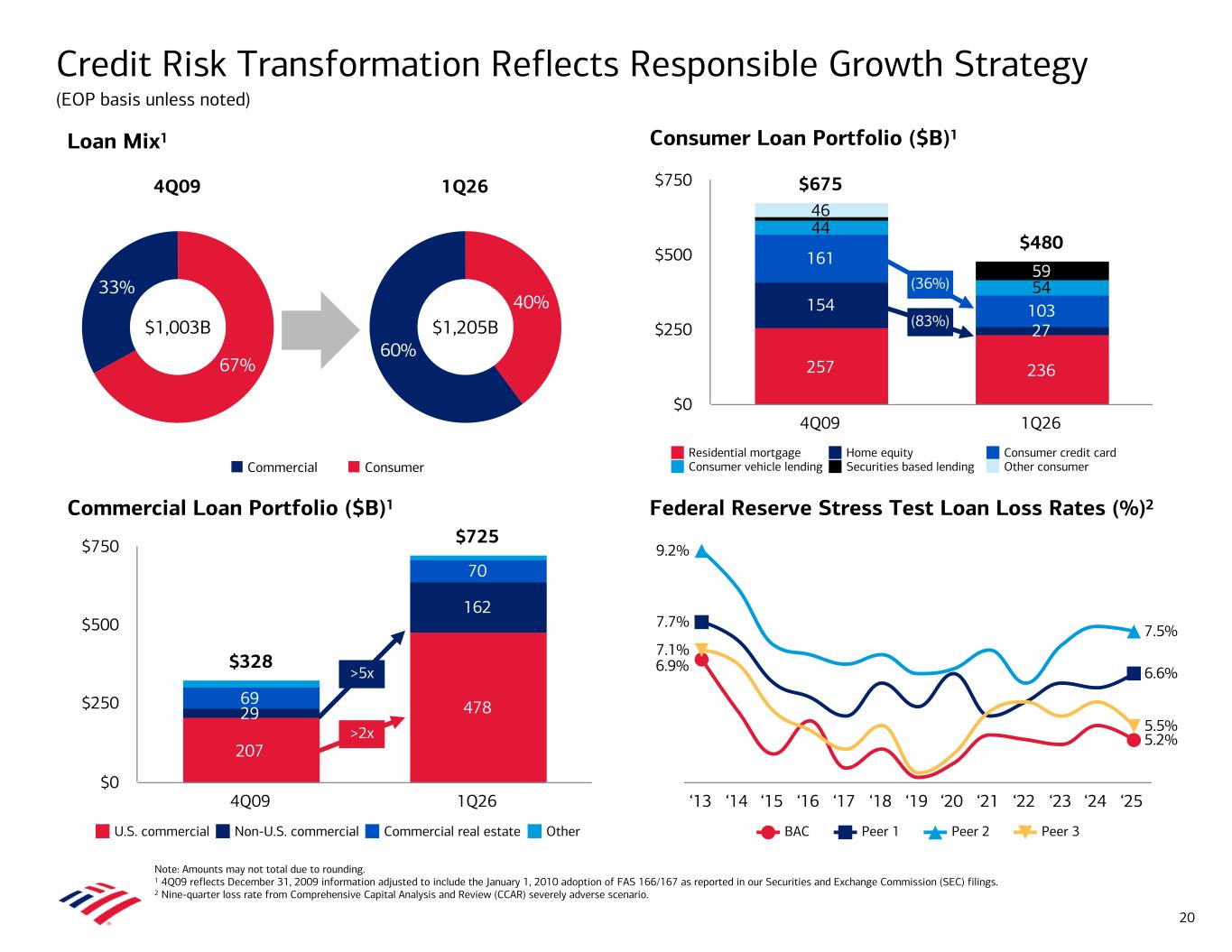
$675 $480 257 236 154 27 161 103 44 54 59 46 Residential mortgage Home equity Consumer credit card Consumer vehicle lending Securities based lending Other consumer 4Q09 1Q26 $0 $250 $500 $750 Credit Risk Transformation Reflects Responsible Growth Strategy (EOP basis unless noted) Note: Amounts may not total due to rounding. 1 4Q09 reflects December 31, 2009 information adjusted to include the January 1, 2010 adoption of FAS 166/167 as reported in our Securities and Exchange Commission (SEC) filings. 2 Nine-quarter loss rate from Comprehensive Capital Analysis and Review (CCAR) severely adverse scenario. Consumer Loan Portfolio ($B)1 Commercial Loan Portfolio ($B)1 Federal Reserve Stress Test Loan Loss Rates (%)2 Loan Mix1 20 $328 $725 207 47829 162 69 70 U.S. commercial Non-U.S. commercial Commercial real estate Other 4Q09 1Q26 $0 $250 $500 $750 4Q09 67% 33% 1Q26 40% 60% $1,205B$1,003B 5.2% 7.7% 6.6% 9.2% 7.5% 7.1% 5.5% BAC Peer 1 Peer 2 Peer 3 ‘13 ‘14 ‘15 ‘16 ‘17 ‘18 ‘19 ‘20 ‘21 ‘22 ‘23 ‘24 ‘25 (36%) (83%) >2x >5x Commercial Consumer 6.9%
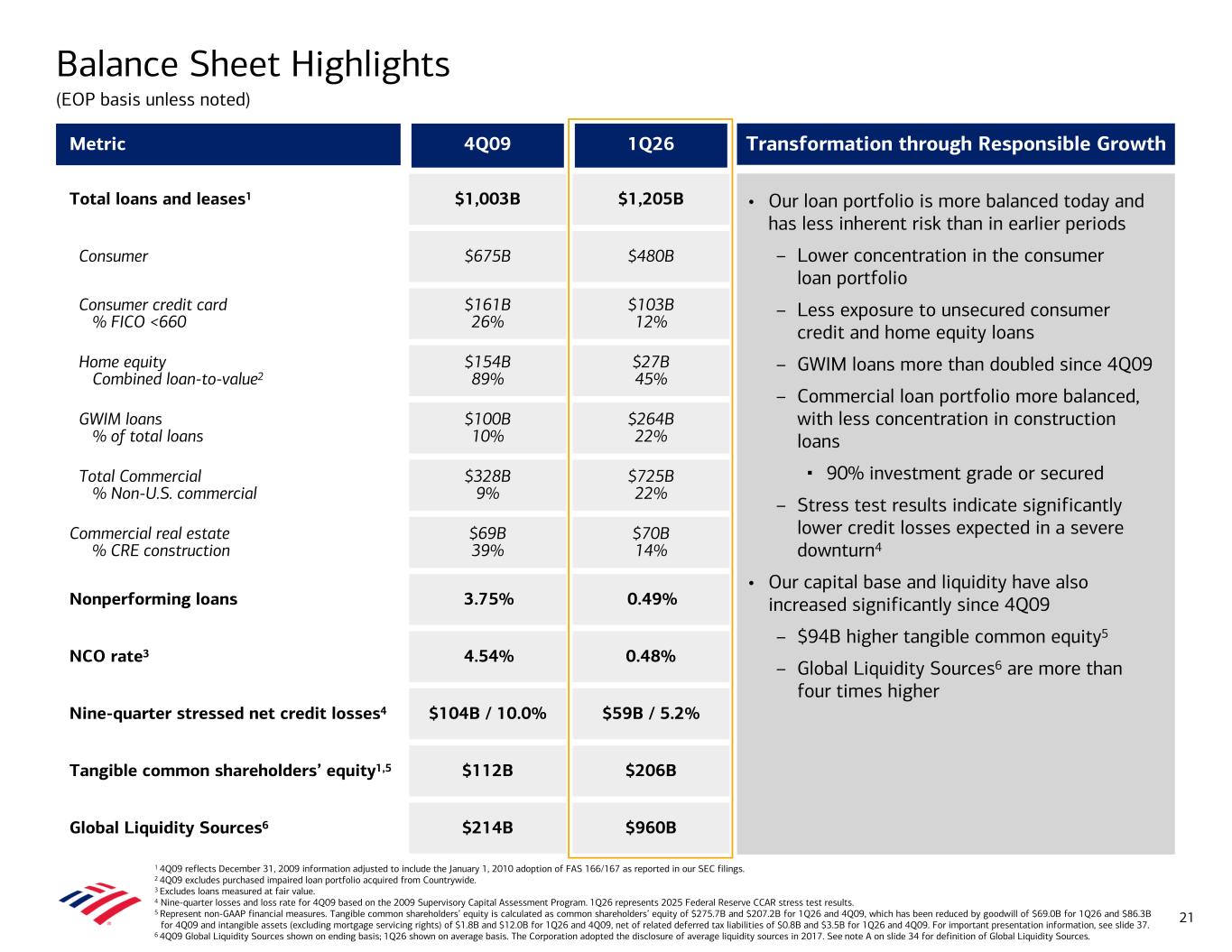
Metric 4Q09 1Q26 Total loans and leases1 $1,003B $1,205B Consumer $675B $480B Consumer credit card % FICO <660 $161B 26% $103B 12% Home equity Combined loan-to-value2 $154B 89% $27B 45% GWIM loans % of total loans $100B 10% $264B 22% Total Commercial % Non-U.S. commercial $328B 9% $725B 22% Commercial real estate % CRE construction $69B 39% $70B 14% Nonperforming loans 3.75% 0.49% NCO rate3 4.54% 0.48% Nine-quarter stressed net credit losses4 $104B / 10.0% $59B / 5.2% Tangible common shareholders’ equity1,5 $112B $206B Global Liquidity Sources6 $214B $960B • Our loan portfolio is more balanced today and has less inherent risk than in earlier periods – Lower concentration in the consumer loan portfolio – Less exposure to unsecured consumer credit and home equity loans – GWIM loans more than doubled since 4Q09 – Commercial loan portfolio more balanced, with less concentration in construction loans ▪ 90% investment grade or secured – Stress test results indicate significantly lower credit losses expected in a severe downturn4 • Our capital base and liquidity have also increased significantly since 4Q09 – $94B higher tangible common equity5 – Global Liquidity Sources6 are more than four times higher Balance Sheet Highlights (EOP basis unless noted) 21 Transformation through Responsible Growth 1 4Q09 reflects December 31, 2009 information adjusted to include the January 1, 2010 adoption of FAS 166/167 as reported in our SEC filings. 2 4Q09 excludes purchased impaired loan portfolio acquired from Countrywide. 3 Excludes loans measured at fair value. 4 Nine-quarter losses and loss rate for 4Q09 based on the 2009 Supervisory Capital Assessment Program. 1Q26 represents 2025 Federal Reserve CCAR stress test results. 5 Represent non-GAAP financial measures. Tangible common shareholders’ equity is calculated as common shareholders’ equity of $275.7B and $207.2B for 1Q26 and 4Q09, which has been reduced by goodwill of $69.0B for 1Q26 and $86.3B for 4Q09 and intangible assets (excluding mortgage servicing rights) of $1.8B and $12.0B for 1Q26 and 4Q09, net of related deferred tax liabilities of $0.8B and $3.5B for 1Q26 and 4Q09. For important presentation information, see slide 37. 6 4Q09 Global Liquidity Sources shown on ending basis; 1Q26 shown on average basis. The Corporation adopted the disclosure of average liquidity sources in 2017. See note A on slide 34 for definition of Global Liquidity Sources.
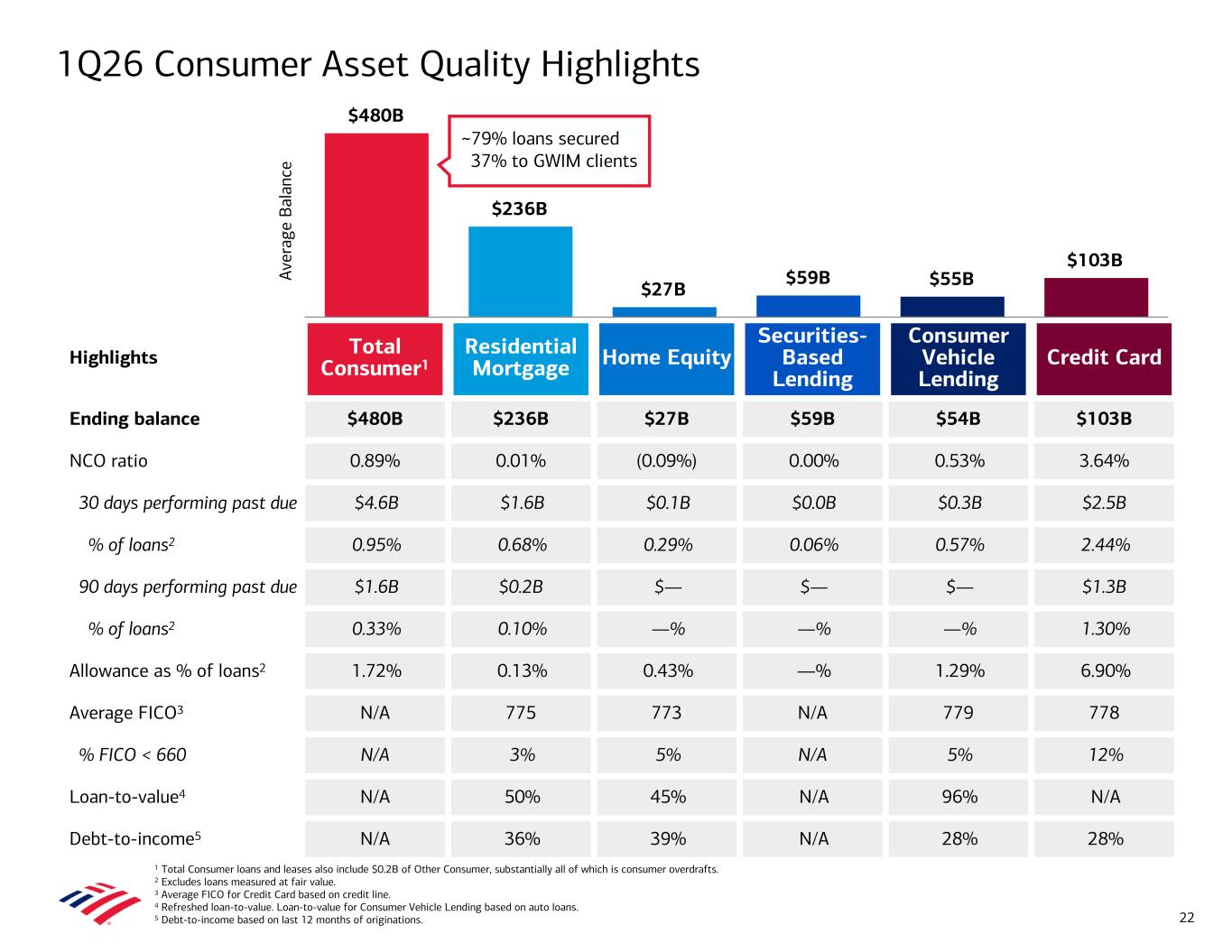
1 Total Consumer loans and leases also include $0.2B of Other Consumer, substantially all of which is consumer overdrafts. 2 Excludes loans measured at fair value. 3 Average FICO for Credit Card based on credit line. 4 Refreshed loan-to-value. Loan-to-value for Consumer Vehicle Lending based on auto loans. 5 Debt-to-income based on last 12 months of originations. Highlights Total Consumer1 Residential Mortgage Home Equity Securities- Based Lending Consumer Vehicle Lending Credit Card Ending balance $480B $236B $27B $59B $54B $103B NCO ratio 0.89% 0.01% (0.09%) 0.00% 0.53% 3.64% 30 days performing past due $4.6B $1.6B $0.1B $0.0B $0.3B $2.5B % of loans2 0.95% 0.68% 0.29% 0.06% 0.57% 2.44% 90 days performing past due $1.6B $0.2B $— $— $— $1.3B % of loans2 0.33% 0.10% —% —% —% 1.30% Allowance as % of loans2 1.72% 0.13% 0.43% —% 1.29% 6.90% Average FICO3 N/A 775 773 N/A 779 778 % FICO < 660 N/A 3% 5% N/A 5% 12% Loan-to-value4 N/A 50% 45% N/A 96% N/A Debt-to-income5 N/A 36% 39% N/A 28% 28% 1Q26 Consumer Asset Quality Highlights 22 Av er ag e B al an ce $480B $236B $27B $59B $55B $103B ~79% loans secured 37% to GWIM clients
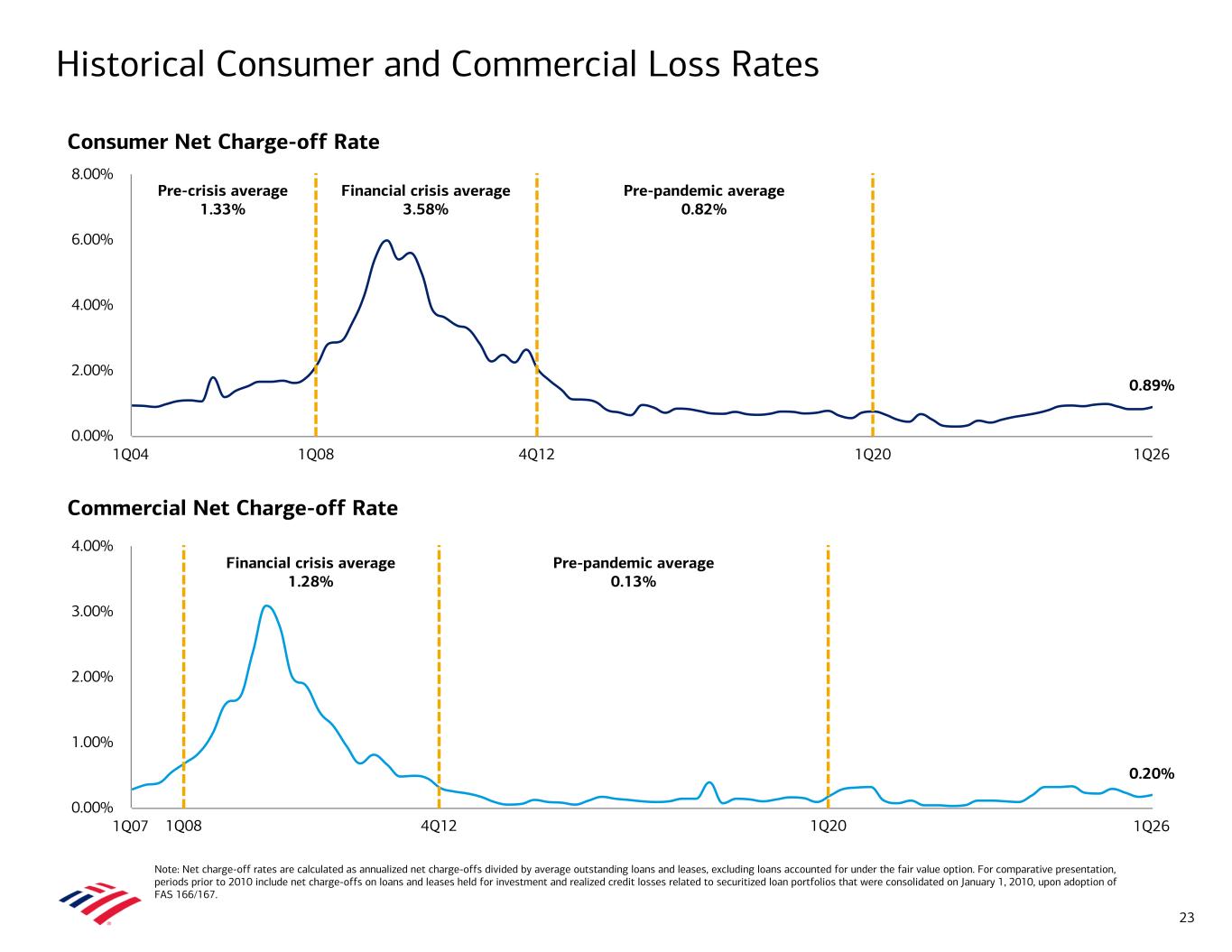
0.89% 1Q04 1Q26 0.00% 2.00% 4.00% 6.00% 8.00% Historical Consumer and Commercial Loss Rates 23 0.20% 1Q07 1Q26 0.00% 1.00% 2.00% 3.00% 4.00% Consumer Net Charge-off Rate Commercial Net Charge-off Rate Pre-crisis average 1.33% Financial crisis average 3.58% Pre-pandemic average 0.82% Financial crisis average 1.28% Pre-pandemic average 0.13% 1Q08 4Q12 1Q20 1Q08 4Q12 1Q20 Note: Net charge-off rates are calculated as annualized net charge-offs divided by average outstanding loans and leases, excluding loans accounted for under the fair value option. For comparative presentation, periods prior to 2010 include net charge-offs on loans and leases held for investment and realized credit losses related to securitized loan portfolios that were consolidated on January 1, 2010, upon adoption of FAS 166/167.
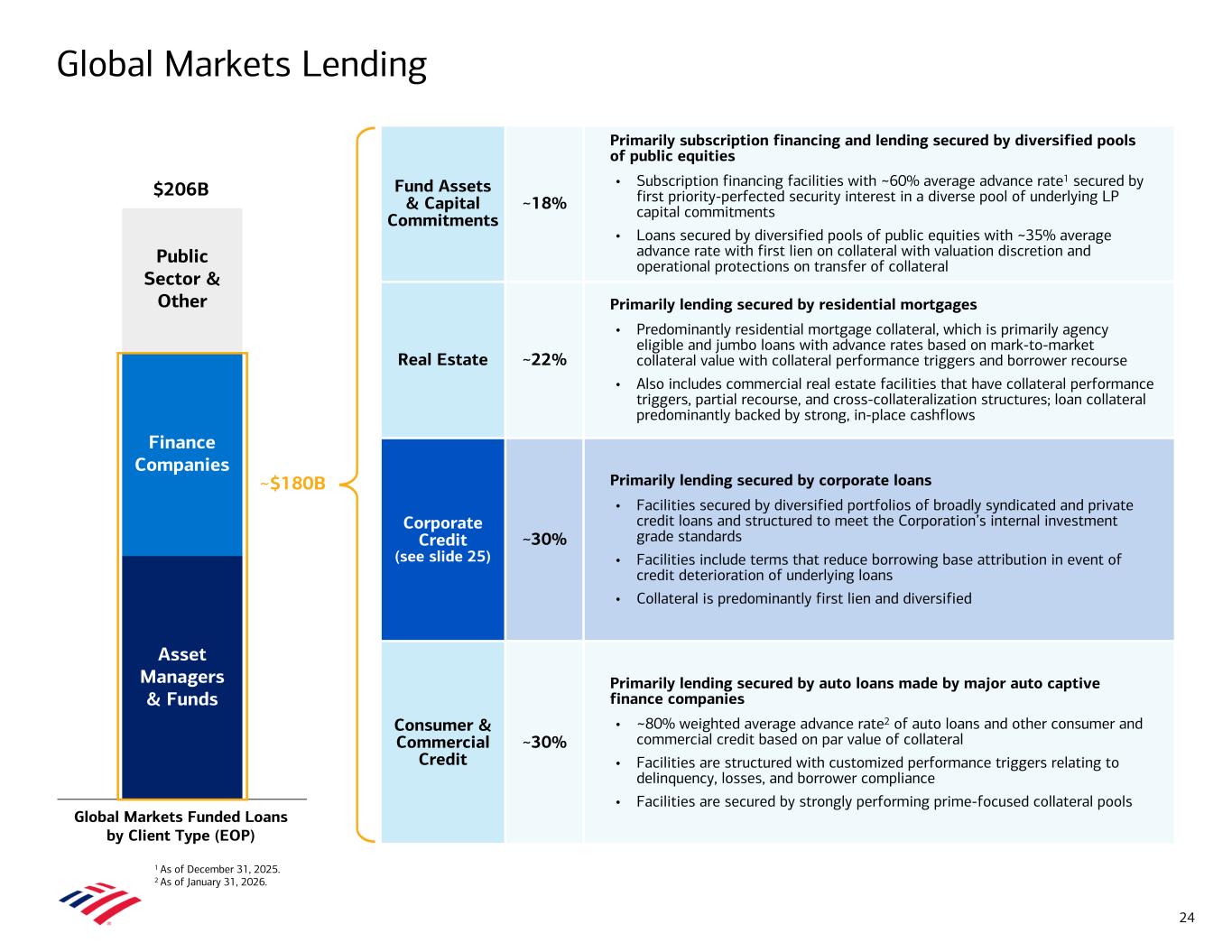
Fund Assets & Capital Commitments ~18% Primarily subscription financing and lending secured by diversified pools of public equities • Subscription financing facilities with ~60% average advance rate1 secured by first priority-perfected security interest in a diverse pool of underlying LP capital commitments • Loans secured by diversified pools of public equities with ~35% average advance rate with first lien on collateral with valuation discretion and operational protections on transfer of collateral Real Estate ~22% Primarily lending secured by residential mortgages • Predominantly residential mortgage collateral, which is primarily agency eligible and jumbo loans with advance rates based on mark-to-market collateral value with collateral performance triggers and borrower recourse • Also includes commercial real estate facilities that have collateral performance triggers, partial recourse, and cross-collateralization structures; loan collateral predominantly backed by strong, in-place cashflows Corporate Credit (see slide 25) ~30% Primarily lending secured by corporate loans • Facilities secured by diversified portfolios of broadly syndicated and private credit loans and structured to meet the Corporation’s internal investment grade standards • Facilities include terms that reduce borrowing base attribution in event of credit deterioration of underlying loans • Collateral is predominantly first lien and diversified Consumer & Commercial Credit ~30% Primarily lending secured by auto loans made by major auto captive finance companies • ~80% weighted average advance rate2 of auto loans and other consumer and commercial credit based on par value of collateral • Facilities are structured with customized performance triggers relating to delinquency, losses, and borrower compliance • Facilities are secured by strongly performing prime-focused collateral pools Global Markets Lending 24 $206B Global Markets Funded Loans by Client Type (EOP) Public Sector & Other Asset Managers & Funds Finance Companies ~$180B 1 As of December 31, 2025. 2 As of January 31, 2026.
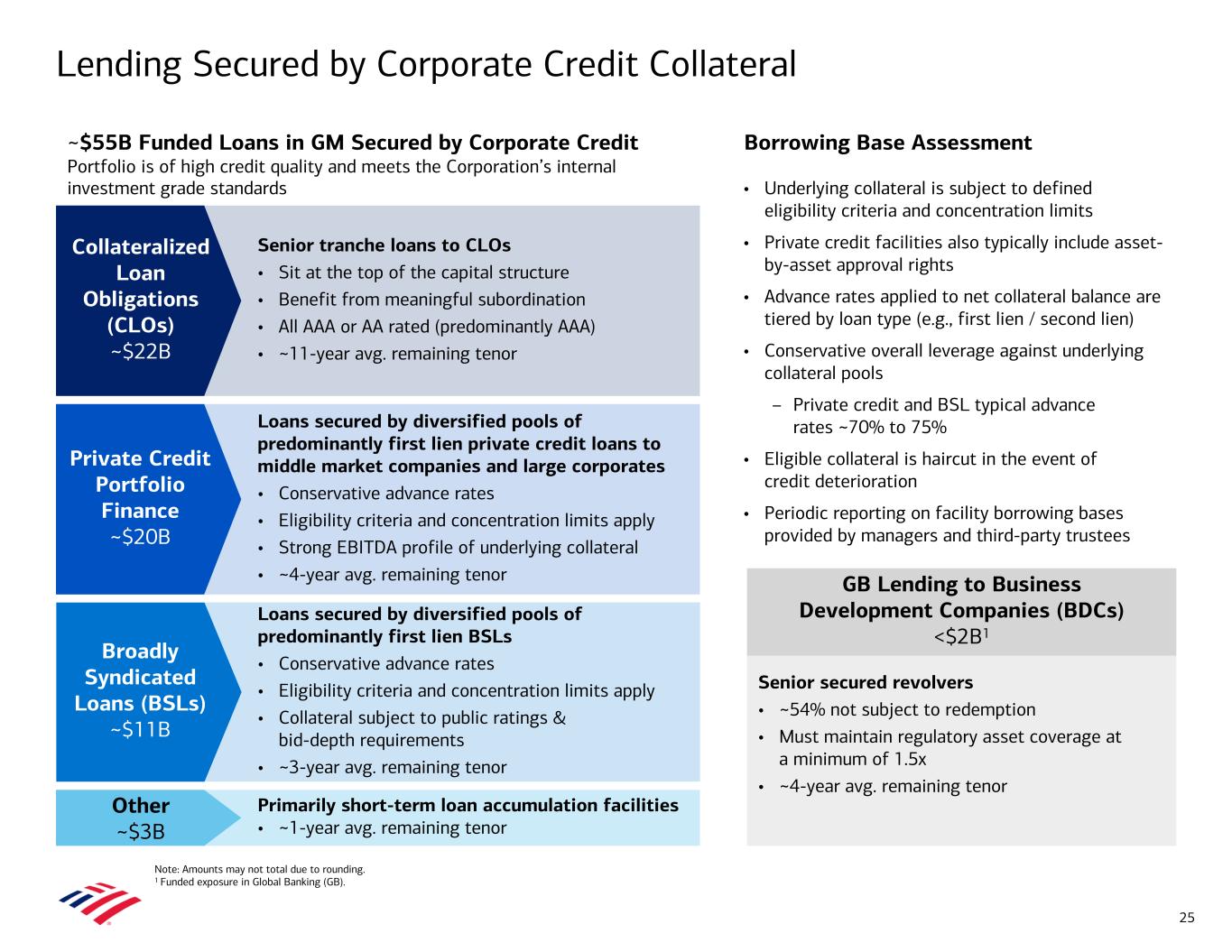
• Underlying collateral is subject to defined eligibility criteria and concentration limits • Private credit facilities also typically include asset- by-asset approval rights • Advance rates applied to net collateral balance are tiered by loan type (e.g., first lien / second lien) • Conservative overall leverage against underlying collateral pools – Private credit and BSL typical advance rates ~70% to 75% • Eligible collateral is haircut in the event of credit deterioration • Periodic reporting on facility borrowing bases provided by managers and third-party trustees Senior secured revolvers • ~54% not subject to redemption • Must maintain regulatory asset coverage at a minimum of 1.5x • ~4-year avg. remaining tenor Lending Secured by Corporate Credit Collateral 25 ~$55B Funded Loans in GM Secured by Corporate Credit Portfolio is of high credit quality and meets the Corporation’s internal investment grade standards Primarily short-term loan accumulation facilities • ~1-year avg. remaining tenor Senior tranche loans to CLOs • Sit at the top of the capital structure • Benefit from meaningful subordination • All AAA or AA rated (predominantly AAA) • ~11-year avg. remaining tenor Loans secured by diversified pools of predominantly first lien private credit loans to middle market companies and large corporates • Conservative advance rates • Eligibility criteria and concentration limits apply • Strong EBITDA profile of underlying collateral • ~4-year avg. remaining tenor Loans secured by diversified pools of predominantly first lien BSLs • Conservative advance rates • Eligibility criteria and concentration limits apply • Collateral subject to public ratings & bid-depth requirements • ~3-year avg. remaining tenor Borrowing Base Assessment Note: Amounts may not total due to rounding. 1 Funded exposure in Global Banking (GB). Collateralized Loan Obligations (CLOs) ~$22B Private Credit Portfolio Finance ~$20B Broadly Syndicated Loans (BSLs) ~$11B GB Lending to Business Development Companies (BDCs) <$2B1 Other ~$3B

Supplemental Business Segment Trends
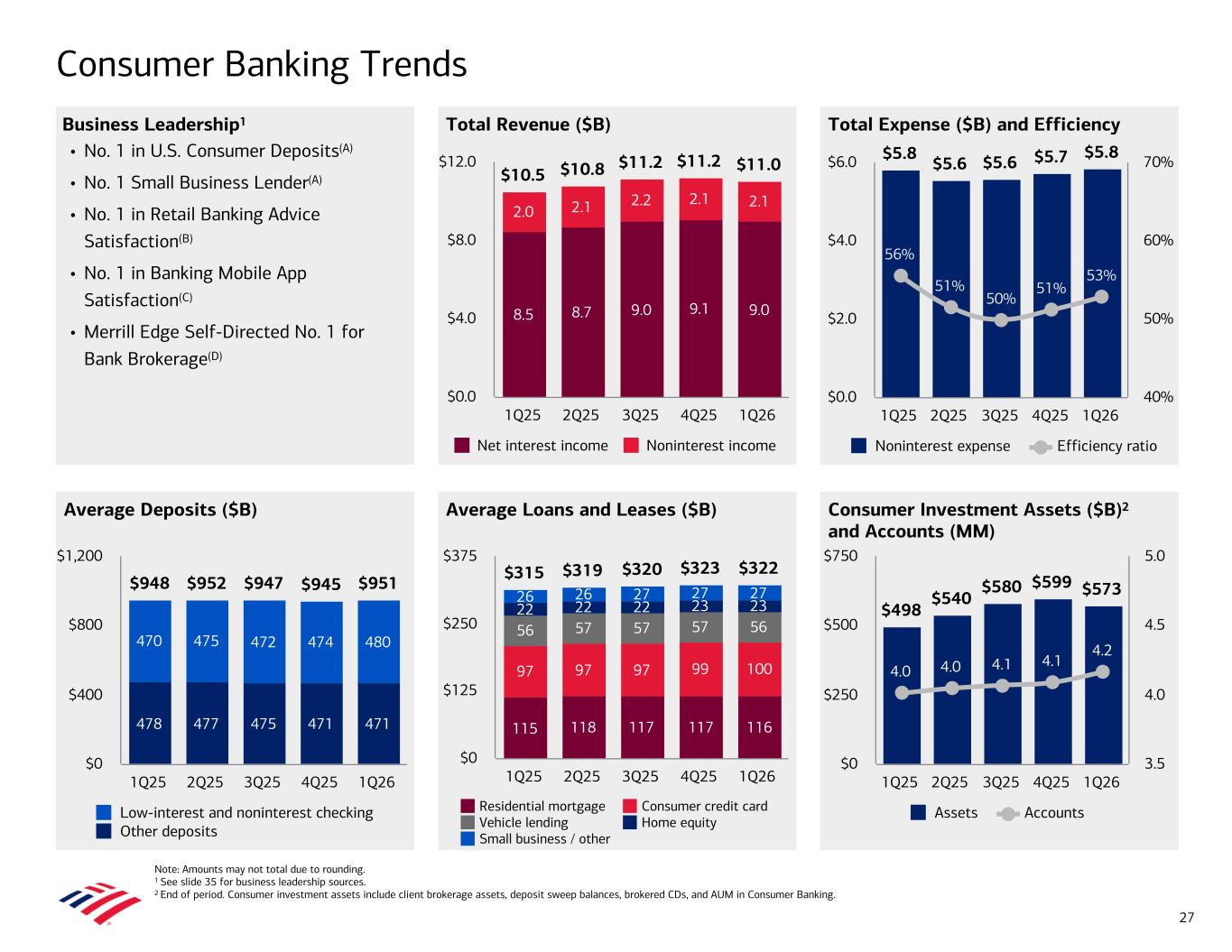
Total Expense ($B) and Efficiency Total Revenue ($B) Average Deposits ($B) Consumer Investment Assets ($B)2 and Accounts (MM) Average Loans and Leases ($B) Consumer Banking Trends Note: Amounts may not total due to rounding. 1 See slide 35 for business leadership sources. 2 End of period. Consumer investment assets include client brokerage assets, deposit sweep balances, brokered CDs, and AUM in Consumer Banking. $10.5 $10.8 $11.2 $11.2 $11.0 8.5 8.7 9.0 9.1 9.0 2.0 2.1 2.2 2.1 2.1 Net interest income Noninterest income 1Q25 2Q25 3Q25 4Q25 1Q26 $0.0 $4.0 $8.0 $12.0 $5.8 $5.6 $5.6 $5.7 $5.8 56% 51% 50% 51% 53% Noninterest expense Efficiency ratio 1Q25 2Q25 3Q25 4Q25 1Q26 $0.0 $2.0 $4.0 $6.0 40% 50% 60% 70% $948 $952 $947 $945 $951 478 477 475 471 471 470 475 472 474 480 Low-interest and noninterest checking Other deposits 1Q25 2Q25 3Q25 4Q25 1Q26 $0 $400 $800 $1,200 $315 $319 $320 $323 $322 115 118 117 117 116 97 97 97 99 100 56 57 57 57 56 22 22 22 23 23 26 26 27 27 27 Residential mortgage Consumer credit card Vehicle lending Home equity Small business / other 1Q25 2Q25 3Q25 4Q25 1Q26 $0 $125 $250 $375 27 $498 $540 $580 $599 $573 4.0 4.0 4.1 4.1 4.2 Assets Accounts 1Q25 2Q25 3Q25 4Q25 1Q26 $0 $250 $500 $750 3.5 4.0 4.5 5.0 Business Leadership1 • No. 1 in U.S. Consumer Deposits(A) • No. 1 Small Business Lender(A) • No. 1 in Retail Banking Advice Satisfaction(B) • No. 1 in Banking Mobile App Satisfaction(C) • Merrill Edge Self-Directed No. 1 for Bank Brokerage(D)
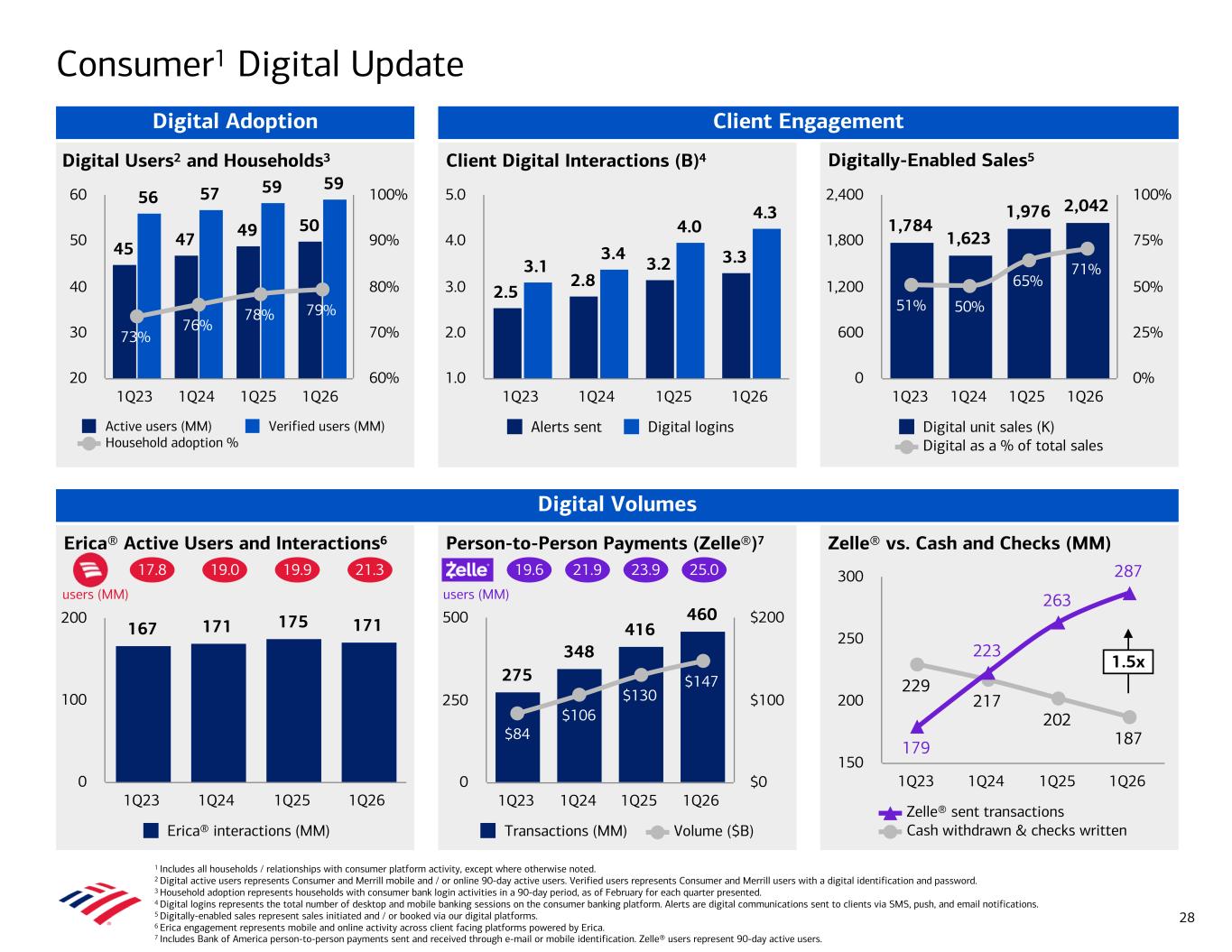
Erica® Active Users and Interactions6 Zelle® vs. Cash and Checks (MM) Digitally-Enabled Sales5Digital Users2 and Households3 Client Digital Interactions (B)4 1,784 1,623 1,976 2,042 51% 50% 65% 71% Digital unit sales (K) Digital as a % of total sales 1Q23 1Q24 1Q25 1Q26 0 600 1,200 1,800 2,400 0% 25% 50% 75% 100% 2.5 2.8 3.2 3.33.1 3.4 4.0 4.3 Alerts sent Digital logins 1Q23 1Q24 1Q25 1Q26 1.0 2.0 3.0 4.0 5.0 45 47 49 50 56 57 59 59 73% 76% 78% 79% Active users (MM) Verified users (MM) Household adoption % 1Q23 1Q24 1Q25 1Q26 20 30 40 50 60 60% 70% 80% 90% 100% Client Engagement Person-to-Person Payments (Zelle®)7 Digital Volumes 275 348 416 460 $84 $106 $130 $147 Transactions (MM) Volume ($B) 1Q23 1Q24 1Q25 1Q26 0 250 500 $0 $100 $200 Consumer1 Digital Update 1 Includes all households / relationships with consumer platform activity, except where otherwise noted. 2 Digital active users represents Consumer and Merrill mobile and / or online 90-day active users. Verified users represents Consumer and Merrill users with a digital identification and password. 3 Household adoption represents households with consumer bank login activities in a 90-day period, as of February for each quarter presented. 4 Digital logins represents the total number of desktop and mobile banking sessions on the consumer banking platform. Alerts are digital communications sent to clients via SMS, push, and email notifications. 5 Digitally-enabled sales represent sales initiated and / or booked via our digital platforms. 6 Erica engagement represents mobile and online activity across client facing platforms powered by Erica. 7 Includes Bank of America person-to-person payments sent and received through e-mail or mobile identification. Zelle® users represent 90-day active users. 19.6 21.9 23.9 25.0 users (MM) 28 Digital Adoption 167 171 175 171 Erica® interactions (MM) 1Q23 1Q24 1Q25 1Q26 0 100 200 229 217 202 187179 223 263 287 Zelle® sent transactions Cash withdrawn & checks written 1Q23 1Q24 1Q25 1Q26 150 200 250 300 1.5x 17.8 19.0 19.9 21.3 users (MM)
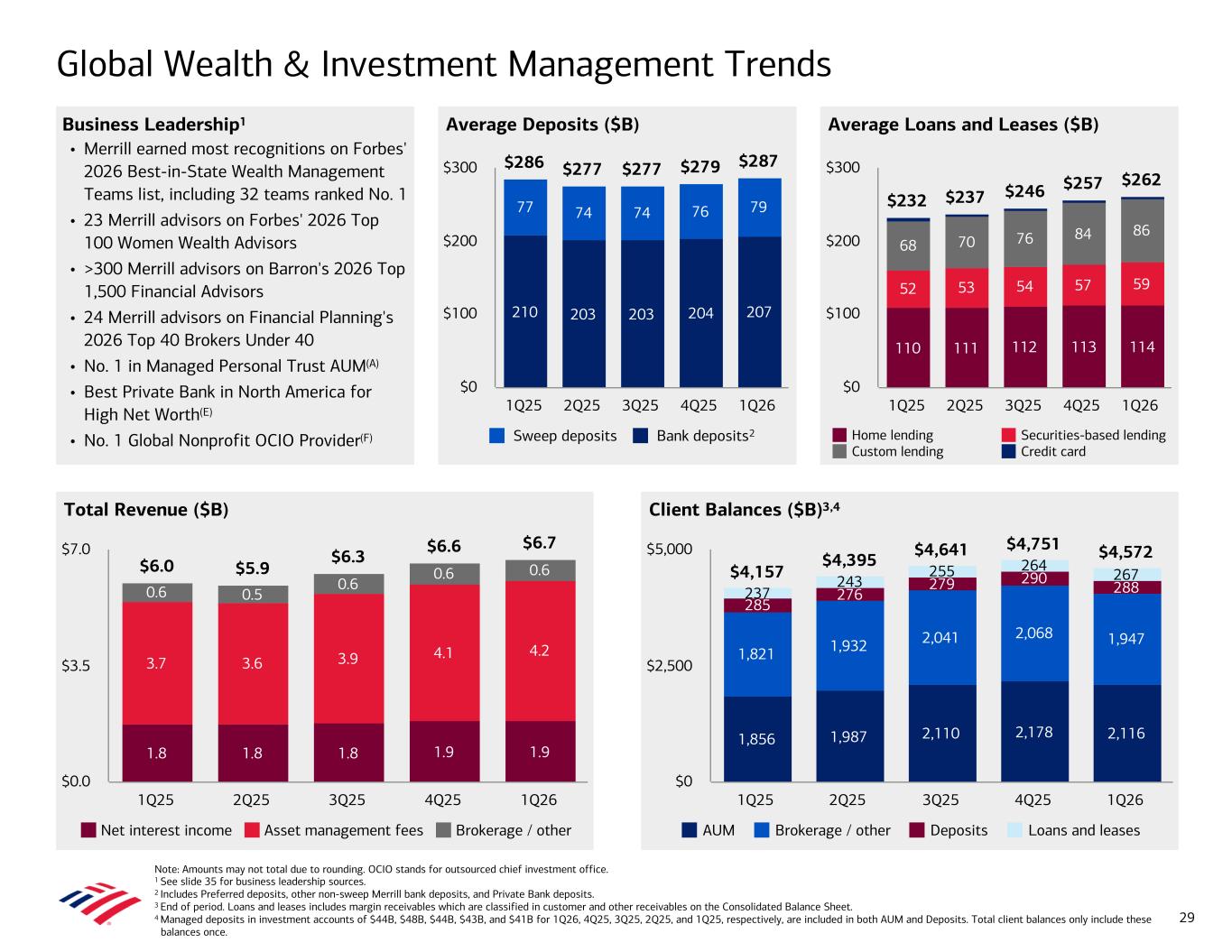
Note: Amounts may not total due to rounding. OCIO stands for outsourced chief investment office. 1 See slide 35 for business leadership sources. 2 Includes Preferred deposits, other non-sweep Merrill bank deposits, and Private Bank deposits. 3 End of period. Loans and leases includes margin receivables which are classified in customer and other receivables on the Consolidated Balance Sheet. 4 Managed deposits in investment accounts of $44B, $48B, $44B, $43B, and $41B for 1Q26, 4Q25, 3Q25, 2Q25, and 1Q25, respectively, are included in both AUM and Deposits. Total client balances only include these balances once. Average Deposits ($B) Global Wealth & Investment Management Trends Business Leadership1 • Merrill earned most recognitions on Forbes' 2026 Best-in-State Wealth Management Teams list, including 32 teams ranked No. 1 • 23 Merrill advisors on Forbes' 2026 Top 100 Women Wealth Advisors • >300 Merrill advisors on Barron's 2026 Top 1,500 Financial Advisors • 24 Merrill advisors on Financial Planning's 2026 Top 40 Brokers Under 40 • No. 1 in Managed Personal Trust AUM(A) • Best Private Bank in North America for High Net Worth(E) • No. 1 Global Nonprofit OCIO Provider(F) Average Loans and Leases ($B) Total Revenue ($B) Client Balances ($B)3,4 $6.0 $5.9 $6.3 $6.6 $6.7 1.8 1.8 1.8 1.9 1.9 3.7 3.6 3.9 4.1 4.2 0.6 0.5 0.6 0.6 0.6 Net interest income Asset management fees Brokerage / other 1Q25 2Q25 3Q25 4Q25 1Q26 $0.0 $3.5 $7.0 1,856 1,987 2,110 2,178 2,116 1,821 1,932 2,041 2,068 1,947 285 276 279 290 288237 243 255 264 267$4,157 $4,395 $4,641 $4,751 $4,572 AUM Brokerage / other Deposits Loans and leases 1Q25 2Q25 3Q25 4Q25 1Q26 $0 $2,500 $5,000 $232 $237 $246 $257 $262 110 111 112 113 114 52 53 54 57 59 68 70 76 84 86 Home lending Securities-based lending Custom lending Credit card 1Q25 2Q25 3Q25 4Q25 1Q26 $0 $100 $200 $300$286 $277 $277 $279 $287 210 203 203 204 207 77 74 74 76 79 Sweep deposits Bank deposits 1Q25 2Q25 3Q25 4Q25 1Q26 $0 $100 $200 $300 29 2
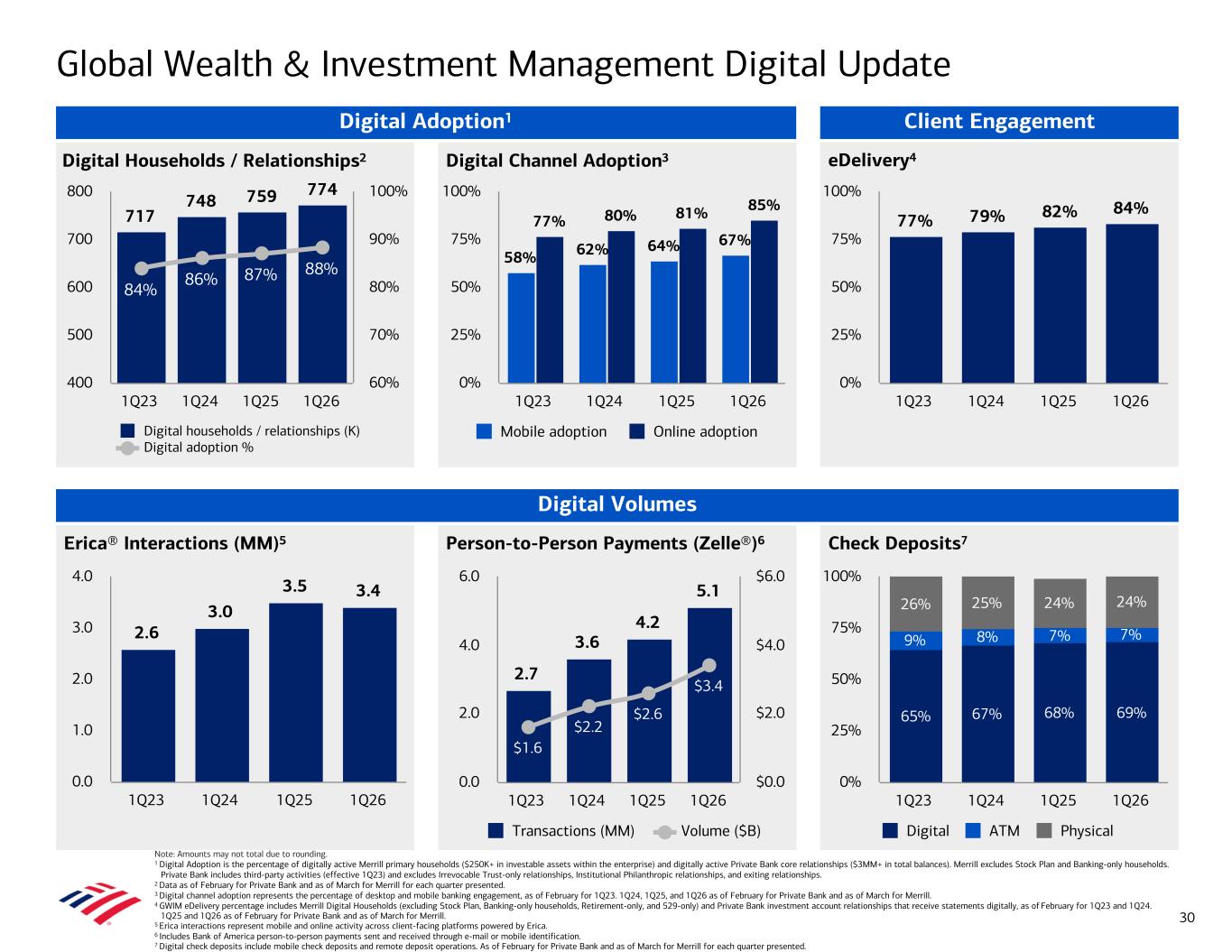
Erica® Interactions (MM)5 2.6 3.0 3.5 3.4 1Q23 1Q24 1Q25 1Q26 0.0 1.0 2.0 3.0 4.0 Person-to-Person Payments (Zelle®)6 Check Deposits7 eDelivery4Digital Households / Relationships2 Digital Channel Adoption3 77% 79% 82% 84% 1Q23 1Q24 1Q25 1Q26 0% 25% 50% 75% 100% 58% 62% 64% 67% 77% 80% 81% 85% Mobile adoption Online adoption 1Q23 1Q24 1Q25 1Q26 0% 25% 50% 75% 100% 717 748 759 774 84% 86% 87% 88% Digital households / relationships (K) Digital adoption % 1Q23 1Q24 1Q25 1Q26 400 500 600 700 800 60% 70% 80% 90% 100% Client Engagement Digital Volumes Global Wealth & Investment Management Digital Update 30 Digital Adoption1 2.7 3.6 4.2 5.1 $1.6 $2.2 $2.6 $3.4 Transactions (MM) Volume ($B) 1Q23 1Q24 1Q25 1Q26 0.0 2.0 4.0 6.0 $0.0 $2.0 $4.0 $6.0 65% 67% 68% 69% 9% 8% 7% 7% 26% 25% 24% 24% Digital ATM Physical 1Q23 1Q24 1Q25 1Q26 0% 25% 50% 75% 100% Note: Amounts may not total due to rounding. 1 Digital Adoption is the percentage of digitally active Merrill primary households ($250K+ in investable assets within the enterprise) and digitally active Private Bank core relationships ($3MM+ in total balances). Merrill excludes Stock Plan and Banking-only households. Private Bank includes third-party activities (effective 1Q23) and excludes Irrevocable Trust-only relationships, Institutional Philanthropic relationships, and exiting relationships. 2 Data as of February for Private Bank and as of March for Merrill for each quarter presented. 3 Digital channel adoption represents the percentage of desktop and mobile banking engagement, as of February for 1Q23. 1Q24, 1Q25, and 1Q26 as of February for Private Bank and as of March for Merrill. 4 GWIM eDelivery percentage includes Merrill Digital Households (excluding Stock Plan, Banking-only households, Retirement-only, and 529-only) and Private Bank investment account relationships that receive statements digitally, as of February for 1Q23 and 1Q24. 1Q25 and 1Q26 as of February for Private Bank and as of March for Merrill. 5 Erica interactions represent mobile and online activity across client-facing platforms powered by Erica. 6 Includes Bank of America person-to-person payments sent and received through e-mail or mobile identification. 7 Digital check deposits include mobile check deposits and remote deposit operations. As of February for Private Bank and as of March for Merrill for each quarter presented.
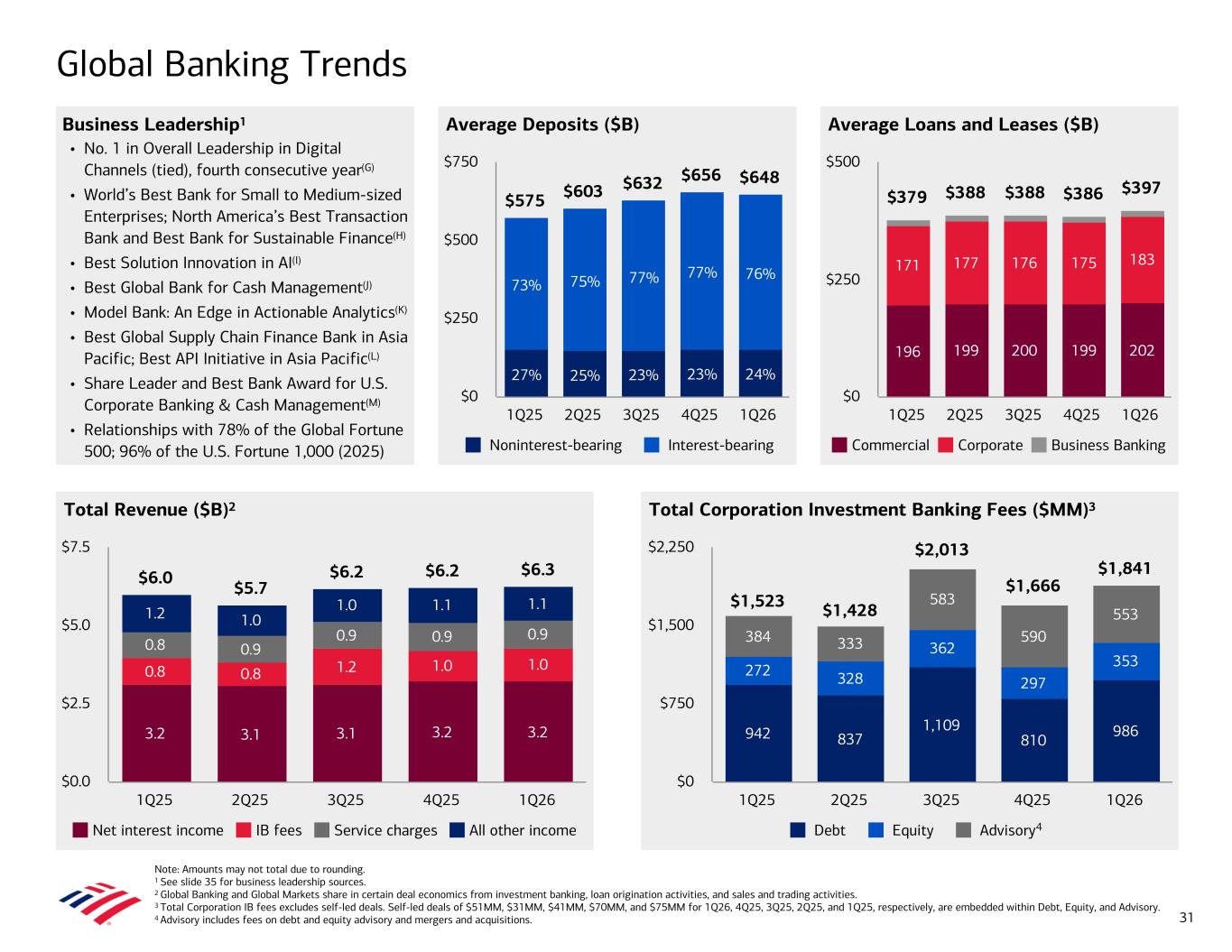
Global Banking Trends Note: Amounts may not total due to rounding. 1 See slide 35 for business leadership sources. 2 Global Banking and Global Markets share in certain deal economics from investment banking, loan origination activities, and sales and trading activities. 3 Total Corporation IB fees excludes self-led deals. Self-led deals of $51MM, $31MM, $41MM, $70MM, and $75MM for 1Q26, 4Q25, 3Q25, 2Q25, and 1Q25, respectively, are embedded within Debt, Equity, and Advisory. 4 Advisory includes fees on debt and equity advisory and mergers and acquisitions. Average Deposits ($B)Business Leadership1 • No. 1 in Overall Leadership in Digital Channels (tied), fourth consecutive year(G) • World’s Best Bank for Small to Medium-sized Enterprises; North America’s Best Transaction Bank and Best Bank for Sustainable Finance(H) • Best Solution Innovation in AI(I) • Best Global Bank for Cash Management(J) • Model Bank: An Edge in Actionable Analytics(K) • Best Global Supply Chain Finance Bank in Asia Pacific; Best API Initiative in Asia Pacific(L) • Share Leader and Best Bank Award for U.S. Corporate Banking & Cash Management(M) • Relationships with 78% of the Global Fortune 500; 96% of the U.S. Fortune 1,000 (2025) Average Loans and Leases ($B) Total Revenue ($B)2 Total Corporation Investment Banking Fees ($MM)3 $6.0 $5.7 $6.2 $6.2 $6.3 3.2 3.1 3.1 3.2 3.2 0.8 0.8 1.2 1.0 1.0 0.8 0.9 0.9 0.9 0.9 1.2 1.0 1.0 1.1 1.1 Net interest income IB fees Service charges All other income 1Q25 2Q25 3Q25 4Q25 1Q26 $0.0 $2.5 $5.0 $7.5 942 837 1,109 810 986 272 328 362 297 353 384 333 583 590 553 $1,523 $1,428 $2,013 $1,666 $1,841 Debt Equity Advisory 1Q25 2Q25 3Q25 4Q25 1Q26 $0 $750 $1,500 $2,250 196 199 200 199 202 171 177 176 175 183 $379 $388 $388 $386 $397 Commercial Corporate Business Banking 1Q25 2Q25 3Q25 4Q25 1Q26 $0 $250 $500 4 $575 $603 $632 $656 $648 Noninterest-bearing Interest-bearing 1Q25 2Q25 3Q25 4Q25 1Q26 $0 $250 $500 $750 31 27% 25% 23% 23% 24% 73% 75% 77% 77% 76%
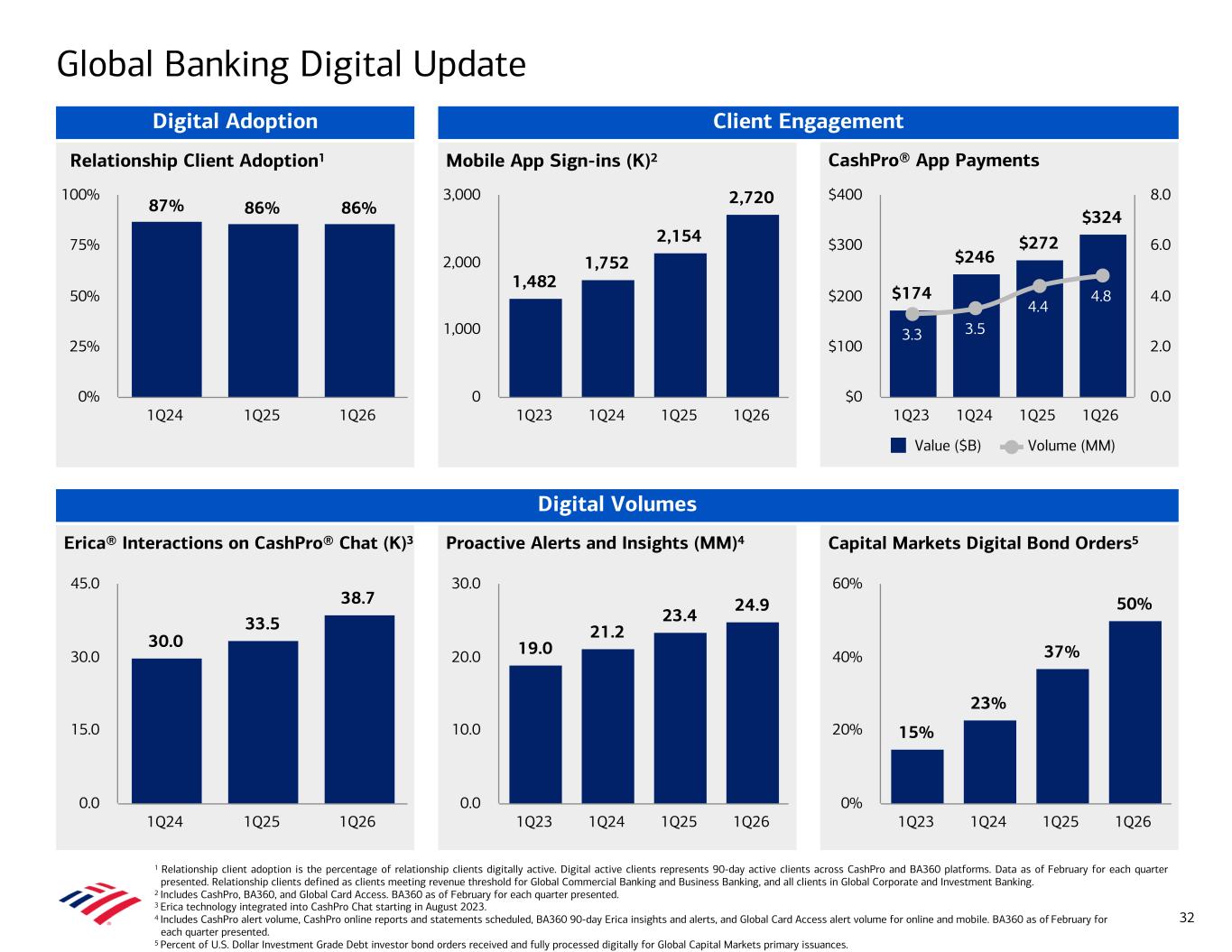
1 Relationship client adoption is the percentage of relationship clients digitally active. Digital active clients represents 90-day active clients across CashPro and BA360 platforms. Data as of February for each quarter presented. Relationship clients defined as clients meeting revenue threshold for Global Commercial Banking and Business Banking, and all clients in Global Corporate and Investment Banking. 2 Includes CashPro, BA360, and Global Card Access. BA360 as of February for each quarter presented. 3 Erica technology integrated into CashPro Chat starting in August 2023. 4 Includes CashPro alert volume, CashPro online reports and statements scheduled, BA360 90-day Erica insights and alerts, and Global Card Access alert volume for online and mobile. BA360 as of February for each quarter presented. 5 Percent of U.S. Dollar Investment Grade Debt investor bond orders received and fully processed digitally for Global Capital Markets primary issuances. Capital Markets Digital Bond Orders5 Erica® Interactions on CashPro® Chat (K)3 Proactive Alerts and Insights (MM)4 15% 23% 37% 50% 1Q23 1Q24 1Q25 1Q26 0% 20% 40% 60% 19.0 21.2 23.4 24.9 1Q23 1Q24 1Q25 1Q26 0.0 10.0 20.0 30.0 30.0 33.5 38.7 1Q24 1Q25 1Q26 0.0 15.0 30.0 45.0 CashPro® App PaymentsRelationship Client Adoption1 Mobile App Sign-ins (K)2 $174 $246 $272 $324 3.3 3.5 4.4 4.8 Value ($B) Volume (MM) 1Q23 1Q24 1Q25 1Q26 $0 $100 $200 $300 $400 0.0 2.0 4.0 6.0 8.0 1,482 1,752 2,154 2,720 1Q23 1Q24 1Q25 1Q26 0 1,000 2,000 3,000 87% 86% 86% 1Q24 1Q25 1Q26 0% 25% 50% 75% 100% Client Engagement Digital Volumes Global Banking Digital Update 32 Digital Adoption
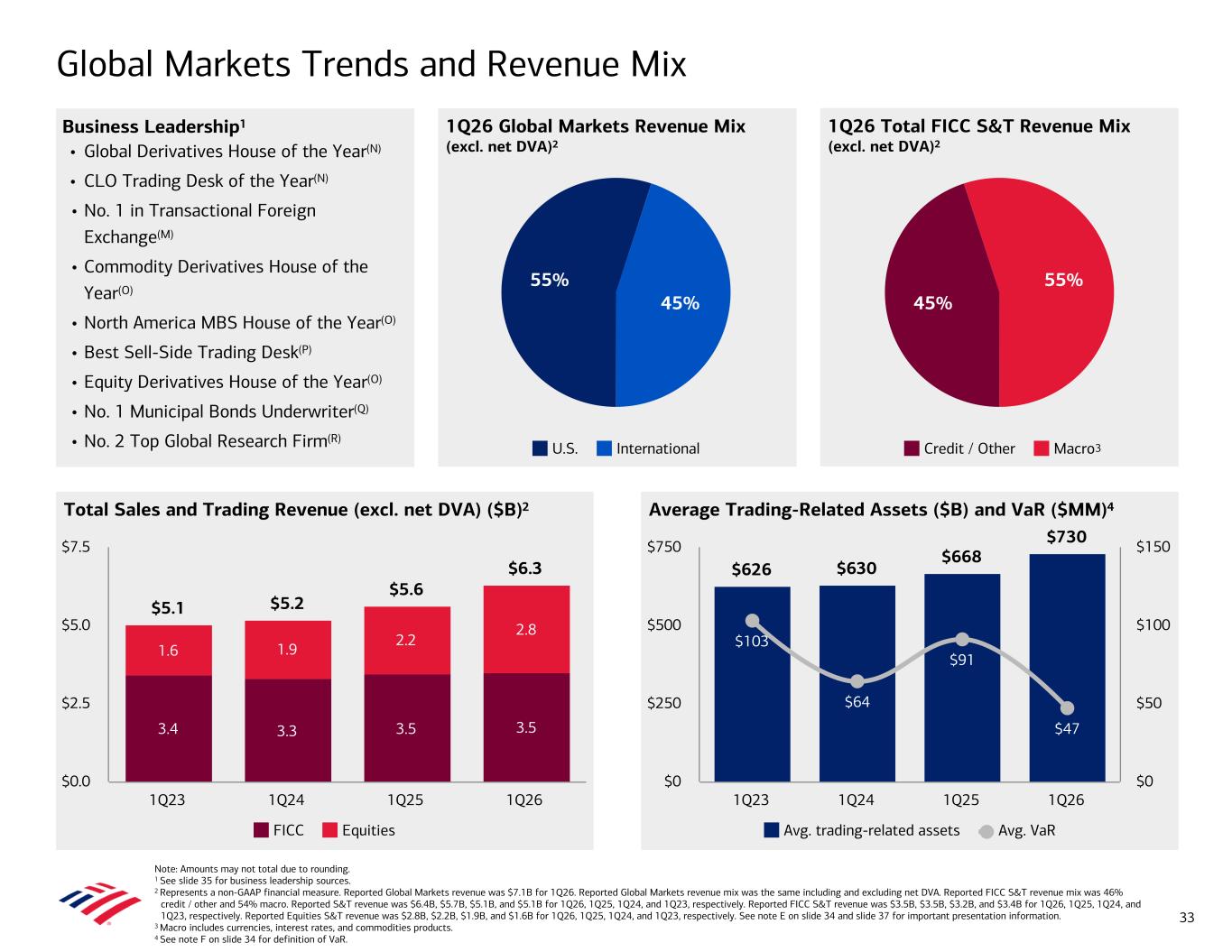
Global Markets Trends and Revenue Mix Note: Amounts may not total due to rounding. 1 See slide 35 for business leadership sources. 2 Represents a non-GAAP financial measure. Reported Global Markets revenue was $7.1B for 1Q26. Reported Global Markets revenue mix was the same including and excluding net DVA. Reported FICC S&T revenue mix was 46% credit / other and 54% macro. Reported S&T revenue was $6.4B, $5.7B, $5.1B, and $5.1B for 1Q26, 1Q25, 1Q24, and 1Q23, respectively. Reported FICC S&T revenue was $3.5B, $3.5B, $3.2B, and $3.4B for 1Q26, 1Q25, 1Q24, and 1Q23, respectively. Reported Equities S&T revenue was $2.8B, $2.2B, $1.9B, and $1.6B for 1Q26, 1Q25, 1Q24, and 1Q23, respectively. See note E on slide 34 and slide 37 for important presentation information. 3 Macro includes currencies, interest rates, and commodities products. 4 See note F on slide 34 for definition of VaR. 1Q26 Global Markets Revenue Mix (excl. net DVA)2 Business Leadership1 • Global Derivatives House of the Year(N) • CLO Trading Desk of the Year(N) • No. 1 in Transactional Foreign Exchange(M) • Commodity Derivatives House of the Year(O) • North America MBS House of the Year(O) • Best Sell-Side Trading Desk(P) • Equity Derivatives House of the Year(O) • No. 1 Municipal Bonds Underwriter(Q) • No. 2 Top Global Research Firm(R) 1Q26 Total FICC S&T Revenue Mix (excl. net DVA)2 Total Sales and Trading Revenue (excl. net DVA) ($B)2 Average Trading-Related Assets ($B) and VaR ($MM)4 $5.1 $5.2 $5.6 $6.3 3.4 3.3 3.5 3.5 1.6 1.9 2.2 2.8 FICC Equities 1Q23 1Q24 1Q25 1Q26 $0.0 $2.5 $5.0 $7.5 $626 $630 $668 $730 $103 $64 $91 $47 Avg. trading-related assets Avg. VaR 1Q23 1Q24 1Q25 1Q26 $0 $250 $500 $750 $0 $50 $100 $150 55% 45% U.S. International 45% 55% Credit / Other Macro3 33
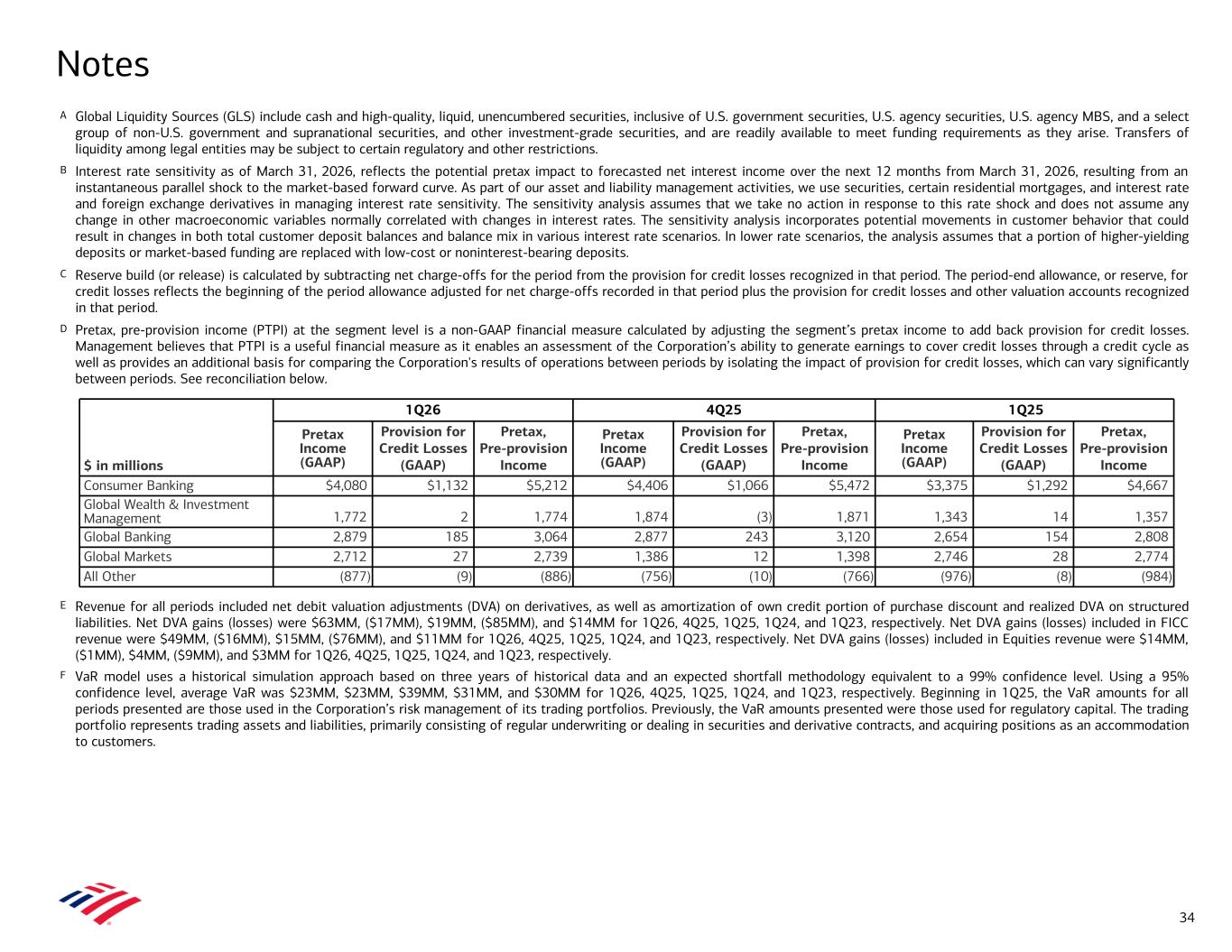
A Global Liquidity Sources (GLS) include cash and high-quality, liquid, unencumbered securities, inclusive of U.S. government securities, U.S. agency securities, U.S. agency MBS, and a select group of non-U.S. government and supranational securities, and other investment-grade securities, and are readily available to meet funding requirements as they arise. Transfers of liquidity among legal entities may be subject to certain regulatory and other restrictions. B Interest rate sensitivity as of March 31, 2026, reflects the potential pretax impact to forecasted net interest income over the next 12 months from March 31, 2026, resulting from an instantaneous parallel shock to the market-based forward curve. As part of our asset and liability management activities, we use securities, certain residential mortgages, and interest rate and foreign exchange derivatives in managing interest rate sensitivity. The sensitivity analysis assumes that we take no action in response to this rate shock and does not assume any change in other macroeconomic variables normally correlated with changes in interest rates. The sensitivity analysis incorporates potential movements in customer behavior that could result in changes in both total customer deposit balances and balance mix in various interest rate scenarios. In lower rate scenarios, the analysis assumes that a portion of higher-yielding deposits or market-based funding are replaced with low-cost or noninterest-bearing deposits. C Reserve build (or release) is calculated by subtracting net charge-offs for the period from the provision for credit losses recognized in that period. The period-end allowance, or reserve, for credit losses reflects the beginning of the period allowance adjusted for net charge-offs recorded in that period plus the provision for credit losses and other valuation accounts recognized in that period. D Pretax, pre-provision income (PTPI) at the segment level is a non-GAAP financial measure calculated by adjusting the segment’s pretax income to add back provision for credit losses. Management believes that PTPI is a useful financial measure as it enables an assessment of the Corporation’s ability to generate earnings to cover credit losses through a credit cycle as well as provides an additional basis for comparing the Corporation's results of operations between periods by isolating the impact of provision for credit losses, which can vary significantly between periods. See reconciliation below. E Revenue for all periods included net debit valuation adjustments (DVA) on derivatives, as well as amortization of own credit portion of purchase discount and realized DVA on structured liabilities. Net DVA gains (losses) were $63MM, ($17MM), $19MM, ($85MM), and $14MM for 1Q26, 4Q25, 1Q25, 1Q24, and 1Q23, respectively. Net DVA gains (losses) included in FICC revenue were $49MM, ($16MM), $15MM, ($76MM), and $11MM for 1Q26, 4Q25, 1Q25, 1Q24, and 1Q23, respectively. Net DVA gains (losses) included in Equities revenue were $14MM, ($1MM), $4MM, ($9MM), and $3MM for 1Q26, 4Q25, 1Q25, 1Q24, and 1Q23, respectively. F VaR model uses a historical simulation approach based on three years of historical data and an expected shortfall methodology equivalent to a 99% confidence level. Using a 95% confidence level, average VaR was $23MM, $23MM, $39MM, $31MM, and $30MM for 1Q26, 4Q25, 1Q25, 1Q24, and 1Q23, respectively. Beginning in 1Q25, the VaR amounts for all periods presented are those used in the Corporation’s risk management of its trading portfolios. Previously, the VaR amounts presented were those used for regulatory capital. The trading portfolio represents trading assets and liabilities, primarily consisting of regular underwriting or dealing in securities and derivative contracts, and acquiring positions as an accommodation to customers. Notes $ in millions 1Q26 4Q25 1Q25 Pretax Income (GAAP) Provision for Credit Losses (GAAP) Pretax, Pre-provision Income Pretax Income (GAAP) Provision for Credit Losses (GAAP) Pretax, Pre-provision Income Pretax Income (GAAP) Provision for Credit Losses (GAAP) Pretax, Pre-provision Income Consumer Banking $4,080 $1,132 $5,212 $4,406 $1,066 $5,472 $3,375 $1,292 $4,667 Global Wealth & Investment Management 1,772 2 1,774 1,874 (3) 1,871 1,343 14 1,357 Global Banking 2,879 185 3,064 2,877 243 3,120 2,654 154 2,808 Global Markets 2,712 27 2,739 1,386 12 1,398 2,746 28 2,774 All Other (877) (9) (886) (756) (10) (766) (976) (8) (984) 34

Business Leadership Sources (A) FFIEC Call Reports, 4Q25. (B) J.D. Power 2025 U.S. Retail Banking Advice Satisfaction Study measures customer satisfaction with retail bank advice / guidance in the past 12 months. For more information, visit jdpower.com/awards.* (C) J.D. Power 2025 U.S. Mobile App Satisfaction Study measures overall satisfaction with banking app channel in the first quarter of 2025. For more information, visit jdpower.com/ awards.* (D) StockBrokers.com* 2026 Annual Awards. (E) Euromoney, 2026. (F) Chestnut Solutions Institute, 2025. (G) Coalition Greenwich Digital Transformation Benchmarking Program, 2025. (H) Euromoney, 2025. (I) Treasury Management International, 2026. (J) Global Finance, 2025. (K) Celent, 2025. (L) Asian Banker, 2025. (M) Coalition Greenwich, 2026. (N) GlobalCapital, 2025. (O) IFR, 2025. (P) Global Markets Choice Awards, 2025. (Q) LSEG-Refinitiv, 1Q26. (R) Extel, 2025. 35 * Website content is not incorporated by reference into this presentation.
Forward-Looking Statements Bank of America Corporation (the Corporation) and its management may make certain statements that constitute “forward-looking statements” within the meaning of the Private Securities Litigation Reform Act of 1995. These statements can be identified by the fact that they do not relate strictly to historical or current facts. Forward-looking statements often use words such as “anticipates,” “targets,” “expects,” “hopes,” “estimates,” “intends,” “plans,” “goals,” “outlook,” “believes,” “continue” and other similar expressions or future or conditional verbs such as “will,” “may,” “might,” “should,” “would” and “could.” Forward-looking statements represent the Corporation’s current expectations, plans or forecasts of its or its business segments' future results, which may include, among other measures, revenue, liquidity, net interest income, other income, provision for credit losses, expenses, operating leverage, effective tax rate, efficiency ratio, capital measures, deposits and assets, as well as strategy, future business and economic conditions more generally, and other future matters. These statements are not guarantees of future results or performance and involve certain known and unknown risks, uncertainties and assumptions that are difficult to predict and are often beyond the Corporation’s control. Actual outcomes and results may differ materially from those expressed in, or implied by, any of these forward-looking statements. You should not place undue reliance on any forward-looking statement and should consider the following uncertainties and risks, as well as the risks and uncertainties more fully discussed under Item 1A. Risk Factors of the Corporation’s 2025 Annual Report on Form 10-K and in any of the Corporation’s subsequent U.S. Securities and Exchange Commission (SEC) filings: the Corporation’s potential judgments, orders, settlements, penalties, fines and reputational damage, which are inherently difficult to predict, resulting from pending, threatened or future litigation and regulatory inquiries, demands, requests, investigations, proceedings and enforcement actions, which the Corporation is subject to in the ordinary course of business, including matters related to our processing of unemployment benefits for California and certain other states, the features of our automatic credit card payment service, the adequacy of the Corporation’s anti- money laundering and economic sanctions programs and the processing of electronic payments, including through the Zelle network, and related fraud, which are in various stages; in connection with ongoing litigation, the impact of certain changes to Visa’s and Mastercard’s respective card payment network rules and reductions in interchange fees for U.S.-based merchants; the possibility that the Corporation's future liabilities may be in excess of its recorded liability and estimated range of possible loss for litigation, and regulatory and government actions; the impact of U.S. and global interest rates (including the potential for ongoing fluctuations in interest rates), inflation, currency exchange rates, economic conditions, trade policies and tensions, including changes in, or the imposition of, tariffs and / or trade barriers and the economic impacts, volatility and uncertainty resulting therefrom, which may have varying effects across industries and geographies, and geopolitical instability; uncertainties about the financial stability and growth rates of non-U.S. jurisdictions, the risk that those jurisdictions may face difficulties servicing their sovereign debt, and related stresses on financial markets, currencies and trade, and the Corporation’s exposures to such risks, including direct, indirect and operational; the impact of the interest rate, inflationary, macroeconomic, banking and regulatory environment on the Corporation’s assets, business, financial condition and results of operations; the impact of adverse developments affecting the U.S. or global banking industry, including a deterioration in private credit markets, bank failures and liquidity concerns, resulting in worsening economic and market volatility, and regulatory responses thereto; the possibility that future credit losses may be higher than currently expected, including due to changes in economic assumptions, which may include unemployment rates, real estate prices, gross domestic product levels and corporate bond spreads, customer behavior, adverse developments with respect to U.S. or global economic conditions and other uncertainties, such as the impact of trade policies, supply chain disruptions, inflationary pressures and labor shortages on economic conditions and our business; potential losses related to the Corporation’s concentration of credit risk; the Corporation's ability to achieve its expense targets (including noninterest expense) and expectations regarding revenue, net interest income, operating leverage, other income, provision for credit losses, net charge-offs, effective tax rate, loan or deposit growth or other projections and targets; variances to the underlying assumptions and judgments used in estimating banking book net interest income sensitivity; adverse changes to the Corporation’s credit ratings from the major credit rating agencies; an inability to access capital markets or maintain deposits or borrowing costs; estimates of the fair value and other accounting values, subject to impairment assessments, of certain of the Corporation’s assets and liabilities; the estimated or actual impact of changes in accounting standards or assumptions in applying those standards; uncertainty regarding the content, timing and impact of regulatory capital and liquidity requirements; the impact of adverse changes to total loss-absorbing capacity requirements, stress capital buffer requirements and / or global systemically important bank surcharges; the potential impact of actions of the Board of Governors of the Federal Reserve System on the Corporation’s capital plans; the effect of changes in or interpretations of income tax laws and regulations, including impacts from the 2025 Budget Reconciliation Act; the impact of implementation and compliance with U.S. and international laws, regulations and regulatory interpretations, including recovery and resolution planning requirements, Federal Deposit Insurance Corporation assessments, the Volcker Rule, fiduciary standards, derivatives regulations and potential changes to loss allocations between financial institutions and customers, including for losses incurred from the use of our products and services, including electronic payments and payment of checks, that were authorized by the customer but induced by fraud; the impact of failures or disruptions in or breaches of the Corporation’s operations or information systems, or those of various third parties, including regulators and federal and state governments, such as from cybersecurity incidents; the risks related to the development, implementation, use and management of emerging technologies, including artificial intelligence and the ability to achieve its potential benefits, such as increased productivity and cost savings; the risks related to the transition and physical impacts of climate change; our ability to achieve environmental goals or the impact of any changes in the Corporation's sustainability or human capital management strategy or goals; the impact of uncertain or changing political conditions, federal government shutdowns, including partial shutdowns, and uncertainty regarding the federal government’s debt limit or changes in fiscal, monetary, trade or regulatory policy; the emergence of widespread health emergencies or pandemics; the impact of natural disasters, extreme weather events, military conflicts (including the Russia / Ukraine conflict, the conflicts in the Middle East, the possible expansion of such conflicts and potential geopolitical and economic consequences), civil unrest, terrorism or other geopolitical events; and other matters. Forward-looking statements speak only as of the date they are made, and the Corporation undertakes no obligation to update any forward-looking statement to reflect the impact of circumstances or events that arise after the date the forward-looking statement was made. 36
Important Presentation Information 37 • The information contained herein is preliminary and based on Corporation data available at the time of the earnings presentation. It speaks only as of the particular date or dates included in the accompanying slides. Bank of America does not undertake an obligation to, and disclaims any duty to, update any of the information provided. • The Corporation may present certain metrics and ratios, including year-over-year comparisons of revenue, noninterest expense, and pretax income, excluding certain items (e.g., DVA), and ratios utilizing tangible equity and tangible assets, that are non-GAAP financial measures. The Corporation believes the use of these non-GAAP financial measures provides additional clarity in understanding its results of operations and trends. For more information about the non-GAAP financial measures contained herein, please see the presentation of the most directly comparable financial measures calculated in accordance with GAAP and accompanying reconciliations in the earnings press release for the quarter ended March 31, 2026, and other earnings-related information available through the Bank of America Investor Relations website at: https://investor.bankofamerica.com/quarterly- earnings, the content of which is not incorporated by reference into this presentation. • The Corporation presents certain key financial and nonfinancial performance indicators (KPIs) that management uses when assessing consolidated and / or segment results. The Corporation believes this information is useful because it provides management with information about underlying operational performance and trends. KPIs are presented herein, including in the 1Q26 Highlights on slides 2 and 4 and on Summary Income Statement for each segment. • The Corporation also views net interest income and related ratios and analyses on a fully taxable-equivalent (FTE) basis, which when presented on a consolidated basis are non-GAAP financial measures. The Corporation believes managing the business with net interest income on an FTE basis provides investors with meaningful information on the interest margin for comparative purposes. The Corporation believes that the presentation allows for comparison of amounts from both taxable and tax-exempt sources and is consistent with industry practices. The FTE adjustments were $162MM, $165MM, $154MM, $145MM, and $145MM for 1Q26, 4Q25, 3Q25, 2Q25, and 1Q25, respectively. • The Corporation allocates capital to its business segments using a methodology that considers the effect of regulatory capital requirements in addition to internal risk-based capital models. Allocated capital is reviewed periodically and refinements are made based on multiple considerations that include, but are not limited to, risk-weighted assets measured under Basel 3 Standardized and Advanced approaches, business segment exposures and risk profile, and strategic plans. As a result of this process, in 1Q26, the Corporation adjusted the amount of capital being allocated to its business segments.